
What Is Strategy Consulting? Work, Firms, Pay and How to Get In (2026)
Strategy consulting advises senior leaders on where to compete and how to win. See what strategy consultants do, the firms, 2026 pay, and how to get in.
On this page
Strategy consulting is advice to a company's senior leadership on its biggest choices: where to compete, how to win, what to buy or sell, and where growth will come from. It is the most senior slice of management consulting, and it is the work people usually mean when they name McKinsey, BCG, and Bain.
The US Bureau of Labor Statistics counts 1,077,100 management analyst jobs (2025), "often called management consultants", and projects 10% growth from 2025 to 2035 (BLS). Strategy roles are a small, selective part of that total. If you want the job rather than the definition, every firm below hires through case interviews, so the skills that matter are the ones a case tests.
What is strategy consulting, exactly?
A strategy project answers a question the CEO or board owns. The useful test comes from Michael Porter's argument that strategy means choosing a distinct position and accepting trade-offs, not simply running the same activities better (Porter, HBR 1996). A strategy recommendation therefore has to answer four questions in one coherent system:
That is the difference between a strategy deck and a to-do list. A goal ("grow revenue 20%") or a plan ("hire 20 salespeople") is not a strategy until it names the arena, the advantage, and the trade-off.
What does a strategy consultant do?
A strategy consultant turns a vague executive question into a decision the client can defend. Most projects follow the same arc, whatever the industry:
- Frame the question. Agree on the exact decision, the success metric, and the constraints with the client sponsor.
- Build a hypothesis and an issue tree. Break the question into mutually exclusive, collectively exhaustive branches (issue trees and hypothesis-driven problem solving) and decide which branches to test first.
- Gather evidence. Pull market data, run customer surveys and expert interviews, and analyze the client's own financials.
- Analyze. Size markets, model profit and investment cases, benchmark competitors, and stress-test the answer.
- Synthesize and recommend. Write the answer first and support it with the evidence, in the pyramid principle style executives expect.
Junior consultants usually own one workstream: one analysis, one set of interviews, or one model, plus the slides that present it. The day in the life of a management consultant walks through what that looks like hour by hour.
Step 2 is the core skill, and it is also exactly what a case interview asks you to do in the first two minutes. Try it on a real prompt:
Structure a strategy question like a consultant from the Road to Offer drill engine. Answer a real prompt and get AI-scored feedback. Free accounts include 5 drills per day for the first 3 days after signup.
What kinds of projects do strategy consultants work on?
Firms describe their strategy practices in similar terms. Bain, for example, lists corporate strategy, business strategy, M&A strategy, corporate finance, innovation and business building, and full potential transformation among its strategy services (Bain). In practice, most projects fall into six families, and each one maps to a case type you will meet in interviews:
Profit improvement projects sit on the border between strategy and operations. They are also the largest group in the Road to Offer case library (23 of 71 public cases), which is why the profitability framework is worth learning early.
The fastest way to feel what a growth project asks of you is to run one:

Growth · easy
Practice a real case, step by step
Matched to this article: a food & beverage growth case, guided step by step. Free.
Strategy consulting vs management consulting
Management consulting is the whole industry. Strategy consulting is the part focused on direction rather than execution. The short version:
Many firms do both. McKinsey, BCG, and Bain run large implementation and technology practices, and Big 4 firms have separate strategy arms inside much larger consulting businesses. The full comparison, including pay and lifestyle, is in strategy consulting vs management consulting.
Which firms do strategy consulting?
Strategy work is concentrated in a few groups of firms. The types of consulting firms guide covers the whole market; these are the ones strategy candidates target:
Who are the Big 4 strategy consultants? Monitor Deloitte, which Deloitte describes as helping clients "craft bold, transformational strategies" (Deloitte), plus Strategy&, EY-Parthenon, and KPMG's strategy group. For a ranked list across all firms, see the top consulting firms.
How much do strategy consultants make?
Entry pay at the top strategy firms is among the highest for new graduates. These are 2026 US figures from Management Consulted's salary report, as published by GMAC (September 10, 2026):
Bonuses add a lot on top. The same report lists a $30,000 MBA signing bonus at McKinsey, BCG, Bain, and EY-Parthenon, and MBA performance bonuses of up to $40,000 at McKinsey, $47,500 at BCG, $63,000 at Bain, and $52,500 at EY-Parthenon.
For context, the BLS median for all management analysts was $101,860 in May 2025 (BLS). That figure covers every kind of consultant and internal analyst, so it sits well below the strategy firms. City, level, and bonus detail are in the consulting salary guide.
What skills do strategy consultants need?
Every skill below is tested in the case interview, which is why case prep doubles as job prep:
- Structured thinking. Turning an open question into a complete, non-overlapping set of drivers. Trained with structure drills (above).
- Case math. Percentages, growth rates, break-even, and quick multiplication without a calculator.
- Market sizing. Estimating a market from a few assumptions, often the first analysis in a market entry or growth project. The market sizing questions guide has worked examples.
- Data and chart reading. Pulling the one insight that matters from an exhibit.
- Synthesis and communication. Leading with the answer, then the three reasons, in the language of an executive.
- Business judgment. Knowing which branch of the tree matters most before the data proves it.
Market sizing opens many market entry and growth cases. Try one estimate now:
Size a market the way a strategy team would from the Road to Offer drill engine. Answer a real prompt and get AI-scored feedback. Free accounts include 5 drills per day for the first 3 days after signup.
How to get into strategy consulting
Most people join straight from an undergraduate or master's program, after an MBA, or as an experienced hire with industry expertise. Whatever the route, the process is the same: an application, often an online assessment, then several rounds of case and behavioral interviews. This plan works backward from those interviews:
Phase 1: Understand the work and pick your firms
Decide whether you want pure strategy (MBB and the strategy firms) or a strategy arm inside a larger firm, then check each firm's application window. Recruiting calendars differ by firm and by school, so start from the consulting application deadlines and the broader how to get into consulting roadmap.
Phase 2: Learn the case method
Before drilling, learn what the interviewer is scoring: how you clarify the question, structure it, work the numbers, and recommend. The free lesson covers the method step by step and links each step to the drill that trains it.
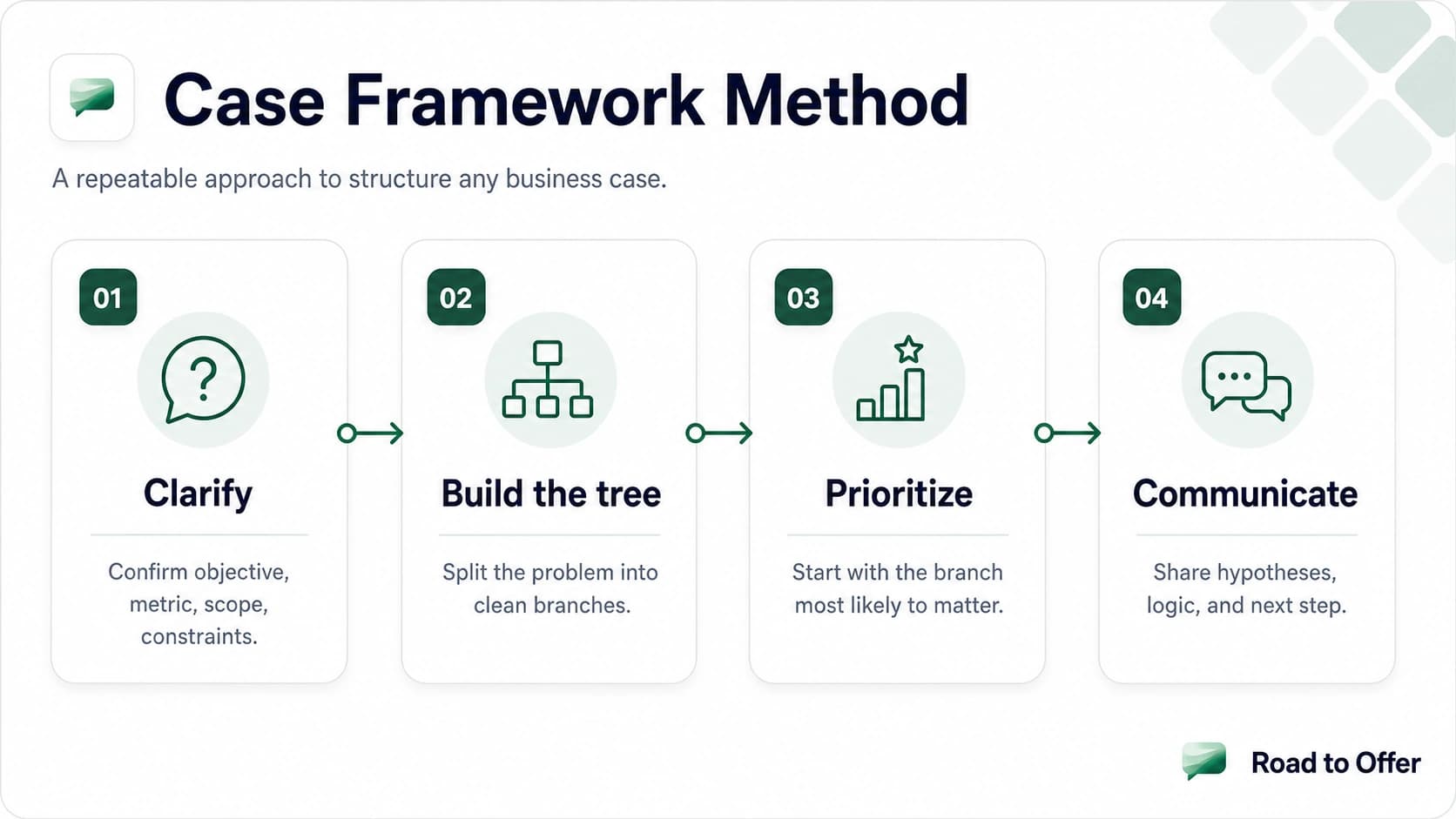
Learn the case method
One dense lesson, each step linked to the drill that trains it.
Phase 3: Drill the core skills
Short, repeated reps beat reading about frameworks. Rotate structure, case math, market sizing, chart reading, and synthesis drills so no single skill becomes the one that breaks in a live case. The complete case frameworks guide shows how to adapt a structure instead of memorizing one.
Case math is the skill that most often stalls an otherwise good structure, so give it its own reps:
Run the numbers a strategy case asks for from the Road to Offer drill engine. Answer a real prompt and get AI-scored feedback. Free accounts include 5 drills per day for the first 3 days after signup.
Phase 4: Run full cases
Strategy firms lean on growth, market entry, and M&A cases, so practice those end to end with a recommendation at the finish. A market entry case is a good first full rep because it combines sizing, economics, and a go or no-go call:

Market entry · medium
Practice a real energy market entry case
Matched to this article: a live energy market entry case with an AI interviewer. Free, scored on every step.
Phase 5: Prepare your fit answers
Every strategy firm pairs cases with behavioral questions about leadership, teamwork, and why you want the job. Prepare four to six stories and rehearse them out loud with free behavioral practice. The behavioral lesson shows how to build answers that hold up when the interviewer probes:
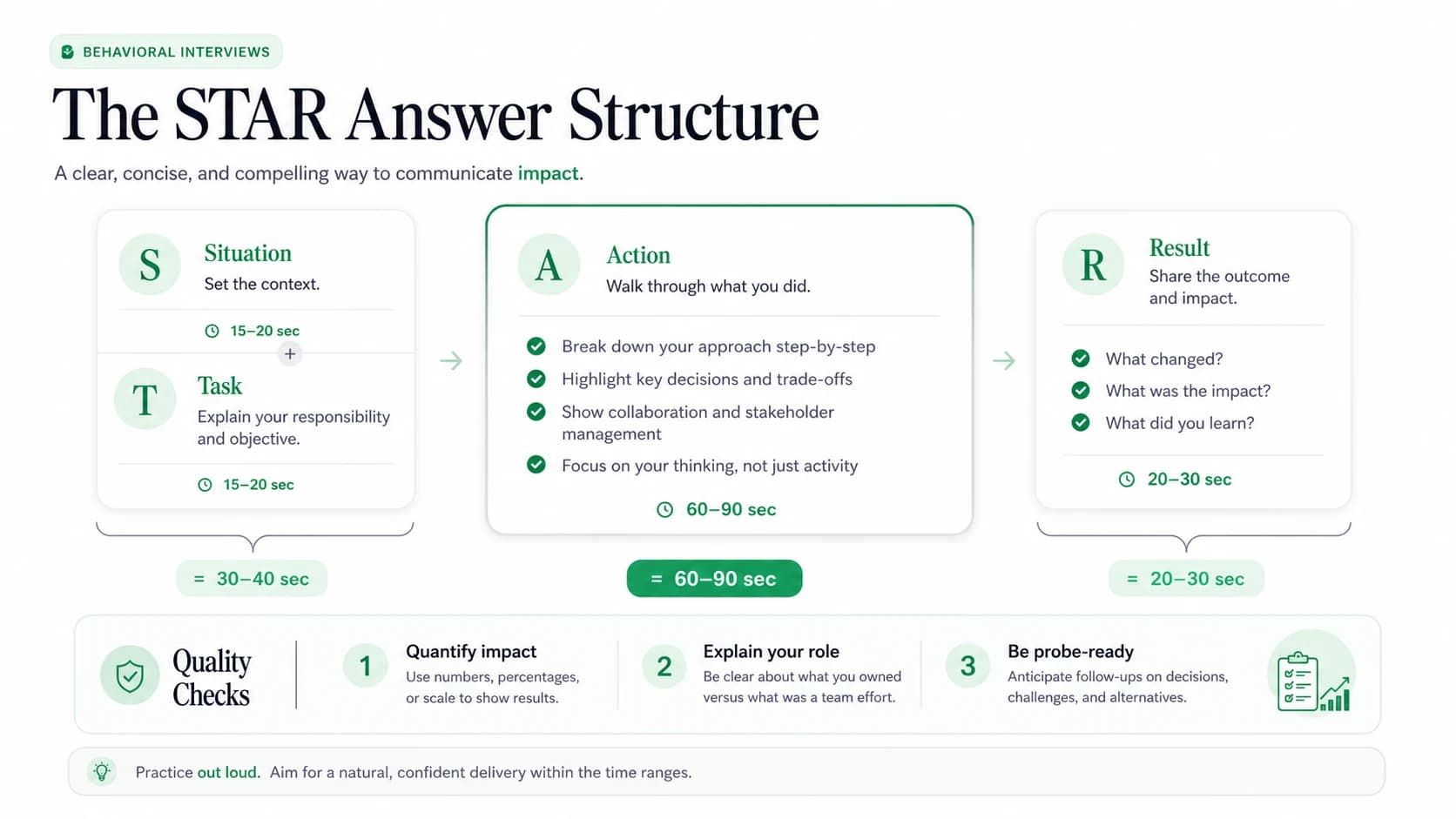
Learn the behavioral method
STAR that survives probing, linked to the live AI interviewer.
Is strategy consulting a good career?
It is a fast way to see many industries and senior decisions early, and it opens doors afterward: many consultants move into corporate strategy, private equity, startups, or general management. The trade-off is travel and long hours during intense project phases. The consulting career path covers promotion levels and timelines, and consulting exit opportunities covers where people go next.
If you are still deciding, the quickest honest test is to try the work: structure one executive question and run one full case. If you enjoy that, strategy consulting is worth the recruiting effort.
Sources and further reading (checked September 25, 2026)
- US Bureau of Labor Statistics, Occupational Outlook Handbook: Management Analysts (last modified August 27, 2026): bls.gov
- GMAC, Consulting Salaries, citing Management Consulted's 2026 Consultant Salary Report (September 10, 2026): gmac.com
- Porter, M., What Is Strategy?, Harvard Business Review (November-December 1996): hbr.org
- Bain & Company, Strategy consulting services: bain.com
- Deloitte, Monitor Deloitte: deloitte.com
Frequently asked questions
Resources and related guides
- Practice growth strategy in a real case interviewPractice
- Browse all free resourcesResource hub
- Strategy Consulting vs Management Consulting: DifferencesGetting Started · Apr 13, 2026
- Big 4 vs MBB Consulting: Key Differences in Pay, Work, and Career Trajectory (2026)Getting Started · Apr 1, 2026
- Top AI Consulting Firms in 2026: 10 Career Picks ComparedGetting Started · Sep 21, 2026