
Porter's Five Forces for Case Interviews: How to Analyze Industry Attractiveness
Use Porter's Five Forces in case interviews with detailed sub-factors, a scored airline industry example, and drills to build pattern recognition.
On this page
Porter's Five Forces is an industry analysis framework that evaluates five structural factors (rivalry, new entrants, substitutes, buyer power, and supplier power) to determine whether an industry can sustain attractive returns. It appears in roughly 15-20% of MBB strategy cases, typically as one branch within a custom structure rather than a standalone checklist.
The real skill is knowing which forces actually constrain profitability in a specific industry, and building your case answer around those 1-2 binding forces rather than treating all five equally. This article covers sub-factors that drive each force, a fully scored airline industry analysis, and guidance on when Five Forces helps versus when it hurts your interview performance.
Want to practice industry analysis cases with AI feedback?
Road to Offer gives you timed strategy cases with structured feedback on your framework logic, force prioritization, and recommendation quality.
What Is Porter's Five Forces?
Porter's Five Forces is an industry analysis framework developed by Michael Porter in 1979 that evaluates five structural factors determining long-term profitability: rivalry among existing competitors, threat of new entrants, threat of substitutes, buyer power, and supplier power. In case interviews, it helps you assess whether an industry is worth entering or why an industry's profit pool is shrinking. It pairs well with the 3Cs framework for company-level positioning and market entry analysis.
The Five Forces: Visual Orientation
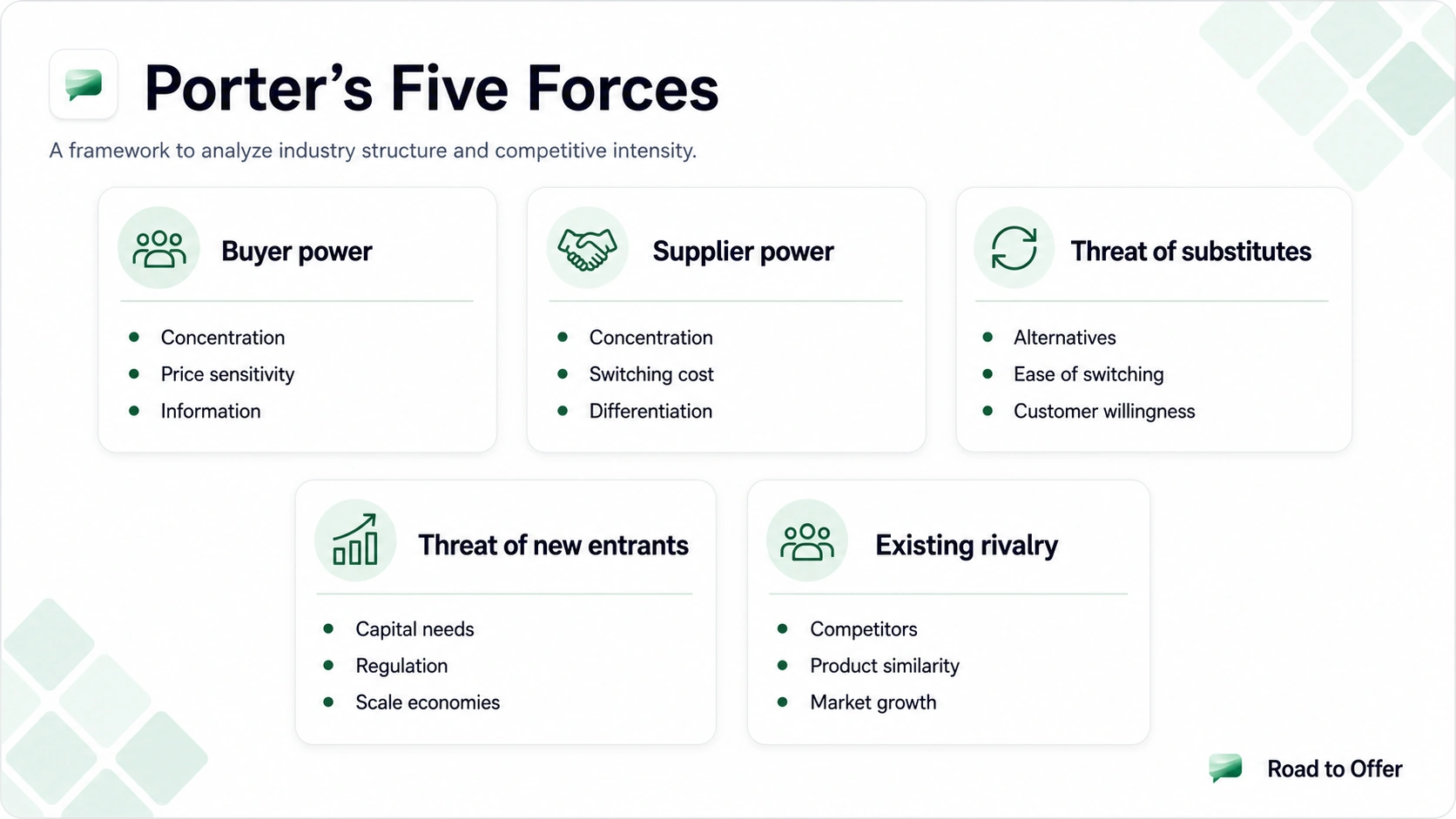
Why Five Forces Still Appears in Interviews
Porter introduced the Five Forces model in "How Competitive Forces Shape Strategy" (Harvard Business Review, 1979) and expanded it in Competitive Strategy (Free Press, 1980). Nearly five decades later, it remains one of the most referenced strategy frameworks in business education and consulting interviews alike. Management Consulted lists it among the core frameworks every candidate should understand.
The reason is simple: Five Forces answers a question that other frameworks do not. While the 3Cs framework evaluates a specific company's competitive position and the profitability framework diagnoses why profits changed, Five Forces asks a more fundamental question: is this industry structurally capable of supporting attractive returns for anyone?
That question matters most in three interview scenarios:
- Market entry cases where the client is evaluating a new industry (see market entry framework)
- Strategy cases asking whether a client should stay in, exit, or double down on an industry
- Growth cases where expansion into an adjacent industry is on the table (see growth strategy cases)
Force 1: Competitive Rivalry (Center of the Model)
Rivalry determines how aggressively existing players compete for the same customers. High rivalry compresses margins directly through price wars, increased marketing spend, and feature escalation.
Sub-factors that drive rivalry intensity
- Number and balance of competitors. An industry with four equal-sized players will see more aggressive competition than one with a clear leader holding 50%+ share. Fragmented industries (many small players, no dominant firm) often have the most intense rivalry.
- Industry growth rate. In fast-growing industries, firms can grow without stealing share. In flat or declining industries, every gain comes at a competitor's expense, which intensifies rivalry dramatically.
- Product differentiation. Commodity industries (steel, basic chemicals, bulk shipping) experience fierce price competition because buyers see no difference between sellers. Differentiated industries (luxury goods, specialized software) compete more on value.
- Fixed cost structure. High fixed costs create pressure to fill capacity, which leads to discounting. Airlines, hotels, and manufacturing all exhibit this pattern: when planes fly half-empty, marginal pricing takes over.
- Exit barriers. When it is expensive to leave an industry (specialized assets, labor obligations, emotional attachment), weak players stay and fight rather than exit, keeping rivalry elevated.
- Switching costs between rivals. If customers can move from Firm A to Firm B at zero cost, rivalry intensifies. If switching costs are high (data migration, retraining, contractual lock-in), incumbents are more protected.
What to say in an interview
Do not simply state "rivalry is high." Instead: "Rivalry is intense in this industry primarily because growth has slowed to 2% annually and the top four players each hold 20-28% share, meaning no firm has pricing power. Combined with low switching costs, this creates sustained margin pressure."
Force 2: Threat of New Entrants
New entrants bring fresh capacity and a desire to gain share, often through aggressive pricing. The strength of this threat depends on barriers to entry and the likely reaction of incumbents.
Sub-factors that determine entry barriers
- Capital requirements. Building a semiconductor fab costs $10B+. Opening a coffee shop costs $200K. Capital intensity is the most straightforward barrier.
- Economies of scale. If incumbents have cost advantages at their current volume that a new entrant cannot match at small scale, entry is harder. This applies to manufacturing, distribution, and even marketing.
- Network effects. Platforms like payment networks or social media become more valuable as users increase. A new entrant starts with zero users and must overcome the "cold start" problem.
- Regulatory and licensing barriers. Pharmaceutical companies need FDA approval. Banks need charters. Telecom companies need spectrum licenses. Regulation can be the single highest barrier in some industries.
- Brand loyalty and switching costs. If customers have deep brand attachment (Apple in consumer tech) or face real costs to switch (enterprise software migrations), new entrants face an uphill battle.
- Access to distribution channels. In consumer goods, shelf space is limited and incumbents have established relationships with retailers. A new entrant may need to build an entirely new distribution path.
- Incumbent retaliation expectations. If incumbents are known to respond aggressively to entry (predatory pricing, rapid capacity expansion), the expected profitability of entry drops.
According to CaseInterview.com, assessing barriers to entry is relevant in nearly every market entry case. The key skill is not listing barriers generically but identifying which specific barrier is the binding constraint in the industry you are analyzing.
Force 3: Threat of Substitutes
Substitutes are different products or services that fulfill the same customer need. This is not about rival firms offering the same product. It is about entirely different solutions. Video conferencing is a substitute for business air travel. Streaming is a substitute for movie theaters.
Sub-factors that determine substitute threat
- Price-performance ratio of substitutes. If a substitute offers 80% of the value at 40% of the price, it is a serious threat. The relevant comparison is value-adjusted, not just raw price.
- Switching costs to substitutes. Moving from a traditional CRM to a new AI-native platform has high switching costs (data migration, retraining). Moving from a taxi to Uber had near-zero switching costs.
- Buyer propensity to switch. Some buyers are habitual; others actively seek alternatives. B2B enterprise buyers tend to be stickier than consumers.
- Rate of improvement of substitutes. A substitute that is inferior today may be superior in two years. Electric vehicles were inferior substitutes for gas cars in 2015; by 2025, they were direct competitors in many segments.
- Functional similarity. The closer a substitute maps to the original need, the greater the threat. Generic drugs are near-perfect substitutes for branded pharmaceuticals once patents expire.
What to say in an interview
"The main substitute threat here is not from direct competitors but from [specific alternative]. It currently serves [X%] of comparable use cases at [Y%] of the cost, and its adoption rate is growing at [Z%] annually. This caps pricing power for the entire industry."
Force 4: Buyer Power
Buyer power measures how much leverage customers have to push down prices, demand higher quality, or extract better terms. When buyer power is high, the industry's value flows to customers rather than to producers.
Sub-factors that drive buyer power
- Buyer concentration. If a few large buyers account for most of your revenue, they have significant negotiating leverage. Walmart's purchasing power over consumer goods suppliers is a textbook example.
- Volume of purchase. Large-volume buyers can demand discounts that small buyers cannot. This is related to concentration but also applies within fragmented buyer markets where individual large accounts matter.
- Switching costs for the buyer. If buyers can easily switch between suppliers, their power is high. If switching is costly or disruptive, supplier power increases.
- Price sensitivity. Buyers spending a large share of their own cost base on your product will negotiate harder. If your product is a trivial portion of their costs, they care less.
- Information availability. Informed buyers negotiate better. The internet has dramatically increased buyer power in many industries by making pricing and alternatives transparent. Investopedia's Five Forces summary emphasizes information access as a key buyer power driver.
- Threat of backward integration. If buyers can credibly threaten to produce the product themselves, their bargaining power increases. Large retailers creating private-label products is a form of backward integration.
- Product importance to quality. If the supplier's product is critical to the buyer's own product quality (e.g., Intel chips inside laptops), the buyer has less power because switching to a cheaper, lower-quality supplier creates risk.
Force 5: Supplier Power
Supplier power is the mirror image of buyer power. When suppliers can raise prices or reduce quality without losing business, they capture value that would otherwise flow to the industry's firms.
Sub-factors that drive supplier power
- Supplier concentration. A few dominant suppliers have strong pricing power. TSMC's dominance in advanced semiconductor manufacturing gives it extraordinary supplier power over the entire electronics industry.
- Uniqueness of input. If the supplier provides a differentiated or proprietary input that cannot be easily substituted, their power is high. Specialized enzymes in biotech, rare earth minerals in electronics, and patented compounds in pharmaceuticals all create supplier power.
- Switching costs for the firm. Changing suppliers may require retooling, requalification, or regulatory re-approval. In aerospace, qualifying a new parts supplier can take 18+ months.
- Threat of forward integration. If suppliers could credibly enter your industry and compete with you directly, their bargaining position is stronger.
- Importance of the industry to the supplier. If your industry is a major customer for the supplier, they have less power (they need you). If your industry is a small portion of their revenue, they have more power (they can afford to lose you).
- Labor as a supplier. In knowledge-intensive industries, skilled labor is the most powerful supplier. Consulting firms, tech companies, and investment banks all face supplier power from talent markets, driving up compensation and reducing margins.
Scoring Method: How to Rate Each Force
Use a 1-5 scale for each force:
- 1 = Very favorable (strongly supports industry profitability)
- 2 = Favorable
- 3 = Neutral
- 4 = Unfavorable
- 5 = Very unfavorable (severely compresses profitability)
Two critical rules for scoring:
First, do not average. An industry with four forces at 1 and one force at 5 is not "average attractiveness." That one force at 5 could be the binding constraint that makes the industry unattractive. Explain which force dominates and why.
Second, show your reasoning. A score without reasoning is worthless. "Buyer power is a 4 because the top three customers account for 65% of industry revenue and have credible backward integration capability" is far stronger than "buyer power is high."
Worked Example: Full Airline Industry Analysis
This is the type of analysis you should be able to produce in 3-4 minutes during a case interview. The prompt: "Your client, a private equity fund, is evaluating whether to invest in a mid-size US domestic airline. Assess the industry's structural attractiveness."
Force 1: Competitive Rivalry. Score: 5 (Very unfavorable)
US domestic airlines compete in one of the most intensely rivalrous industries in the world. Here is why:
- Four major carriers (American, Delta, United, Southwest) control roughly 80% of domestic capacity, but they compete aggressively on overlapping routes. This is not oligopolistic coordination. It is concentrated but fierce.
- Growth is modest at 3-4% annually (pre-pandemic trend). Airlines cannot grow meaningfully without taking share.
- The product is largely undifferentiated for economy travelers. Seat 14C on Delta and seat 14C on United serve the same function. Price comparison sites make differences even harder to sustain.
- Extremely high fixed costs (aircraft leases, labor contracts, gate leases) create relentless pressure to fill seats, leading to aggressive discounting on marginal capacity.
- Exit barriers are high. Liquidating an airline means selling specialized assets (planes with specific configurations, route slots) in a market where the only buyers are your competitors.
Force 2: Threat of New Entrants. Score: 2 (Favorable)
Despite intense rivalry, the airline industry has strong entry barriers:
- Capital requirements are enormous. Launching a viable domestic airline requires $500M+ for aircraft, certification, gates, and working capital.
- Regulatory barriers include FAA certification, DOT operating authority, and slot constraints at congested airports (LaGuardia, Reagan National, JFK).
- Incumbent retaliation is well-documented. When JetBlue entered routes in the early 2000s, incumbents frequently matched fares within days.
- Route network economies give established carriers advantages in connecting traffic that a new entrant starting with 10 routes cannot replicate.
This force is one of the few working in the industry's favor.
Force 3: Threat of Substitutes. Score: 3 (Neutral)
- For short-haul routes (under 300 miles), driving is a real substitute. High-speed rail, if expanded, would be a stronger substitute on corridors like NYC-DC or LA-SF.
- For medium and long-haul domestic routes, there is no practical substitute. A business traveler flying Chicago to LA cannot realistically drive or take a train.
- Video conferencing (Zoom, Teams) is a substitute for business travel specifically, not for leisure or personal travel. Post-pandemic, business travel recovered to roughly 75-80% of 2019 levels according to Airlines for America (2025), suggesting this substitute has permanently captured some demand.
The net effect is moderate. Substitutes constrain some segments but not the core product.
Force 4: Buyer Power. Score: 4 (Unfavorable)
- Individual consumers have low switching costs (booking a different airline on Google Flights takes 30 seconds) and high price transparency. Metasearch engines like Google Flights and Kayak have made price the dominant decision factor for leisure travelers.
- Corporate travel buyers have more power through negotiated volume contracts. Large corporate accounts can extract significant discounts.
- Loyalty programs partially offset buyer power by creating switching costs, but this mainly works for frequent flyers, not the majority of travelers.
Overall, buyers have strong power, particularly in the leisure segment where price sensitivity is high and differentiation is low.
Force 5: Supplier Power. Score: 4 (Unfavorable)
- Aircraft manufacturers form a duopoly (Boeing and Airbus for large aircraft). Airlines cannot play many suppliers against each other, and order backlogs often stretch 5+ years.
- Airport authorities control a limited number of gates and slots. At capacity-constrained airports, gate access is a binding constraint.
- Labor is a powerful supplier. Pilots, in particular, are unionized, scarce, and essential. The pilot shortage post-pandemic drove significant wage inflation across the industry. According to the Corporate Finance Institute's Five Forces overview, labor as a supplier force is often underestimated.
- Fuel suppliers are price-takers on global commodity markets, but jet fuel represents 20-30% of operating costs, making the industry highly exposed to oil price volatility.
Overall Assessment
Synthesis for the PE client: "The US domestic airline industry is structurally unattractive. Four of five forces work against sustained profitability. The only favorable force, high barriers to entry, protects incumbents from new competition but does nothing to improve the margin environment among existing players. Average ROIC for US airlines has historically trailed the cost of capital over full economic cycles. For a PE investor, this means returns will depend almost entirely on operational turnaround or financial engineering at the specific target, not on favorable industry economics. I would recommend proceeding only if the target has a defensible cost advantage or route network position that insulates it from the structural headwinds."
This synthesis is what separates a strong answer from a mechanical one. You are not just listing scores. You are connecting the analysis to the client's decision.
Practice scoring industries under time pressure
Guided Mode walks you through industry analysis cases step by step, with AI feedback on your force prioritization and synthesis quality.
When to Use Five Forces vs. Alternatives
Choosing the right framework matters more than executing any single framework perfectly. Here is when Five Forces is the right tool and when it is not.
Combining Five Forces with other frameworks
In practice, Five Forces rarely stands alone in a case interview. It most commonly appears as one branch within a larger custom structure. For a market entry case, your structure might be:
- Market attractiveness (where Five Forces logic lives)
- Client's right-to-win (capability fit, cost position)
- Entry mode and economics (organic vs. acquisition, breakeven math)
- Risks and recommendation
This integration shows the interviewer you can think flexibly rather than recite memorized frameworks. For a deeper treatment of structuring market entry decisions, see the market entry framework guide.
When NOT to Use Five Forces
Five Forces is a powerful lens, but it has clear limitations. Using it in the wrong context will cost you points.
Do not use it for company-specific performance questions. If the interviewer asks "Why did our client's revenue drop 15% last year?", Five Forces is the wrong starting point. That is a profitability or diagnostic problem, not an industry structure problem.
Do not use it when the industry is already defined as attractive. Sometimes the case setup tells you: "The client operates in a fast-growing, high-margin industry." Spending three minutes analyzing industry attractiveness when it is already given as favorable wastes time and signals you are not listening.
Do not use it for highly regulated or government-dominated industries where market forces do not drive outcomes. Defense contracting, public utilities, and healthcare (in single-payer systems) are shaped more by regulation and government purchasing than by competitive forces. Five Forces can still offer some insight, but it will not be the primary analytical tool.
Do not use it as a standalone answer. Five Forces tells you whether an industry is attractive. It does not tell you whether a specific client should enter, what their strategy should be, or how to execute. It is an input to a decision, not the decision itself. Porter himself wrote in his 2008 HBR update: "Understanding the forces that shape industry competition is the starting point for developing strategy" (HBR, 2008). Starting point, not ending point.
Interview Delivery Tips
Based on patterns from successful candidates at McKinsey, BCG, and Bain, here is how to deliver Five Forces analysis effectively. PrepLounge's framework guidance reinforces these principles.
- Do not announce the framework by name unless asked. Instead of "I'll use Porter's Five Forces," say "I'd like to assess the structural attractiveness of this industry by looking at competitive dynamics, barriers to entry, and buyer/supplier economics."
- Sketch the hub-and-spoke diagram. It takes 10 seconds and immediately communicates your structure. Place rivalry in the center.
- Lead with the dominant force. "The most critical force here is [X] because [specific reason]. Let me explain why, then briefly cover the other factors."
- Quantify where possible. "The top 3 buyers control 70% of demand" is better than "buyer power is high."
- End with a so-what. Always connect your analysis back to the case question: "Given this industry structure, I would/would not recommend [decision] because [specific reasoning from forces analysis]."
Interactive Practice: Five Forces Drills
Interactive drill set. Write an answer before revealing the worked solution, then continue into Road to Offer for scored practice and AI feedback.
Common Mistakes and How to Fix Them
Sources and Further Reading (checked June 17, 2026)
- Porter, M.E. (1979). "How Competitive Forces Shape Strategy." Harvard Business Review: hbr.org/1979/03/how-competitive-forces-shape-strategy
- Porter, M.E. (1980). Competitive Strategy: Techniques for Analyzing Industries and Competitors. Free Press.
- Porter, M.E. (2008). "The Five Competitive Forces That Shape Strategy." Harvard Business Review: hbr.org/2008/01/the-five-competitive-forces-that-shape-strategy
- Investopedia, Porter's Five Forces summary: investopedia.com/terms/p/porter.asp
- Corporate Finance Institute, Five Forces overview: corporatefinanceinstitute.com/resources/management/porters-five-forces/
- Management Consulted, case interview frameworks: managementconsulted.com/case-interview-frameworks
- CaseInterview.com, frameworks overview: caseinterview.com/case-interview-frameworks
- PrepLounge, Five Forces framework guide: preplounge.com/en/case-interview-basics/case-cracking-toolbox/structure-your-thoughts/porters-five-forces
- Airlines for America, industry data (2025)
- Brewers Association, craft brewery statistics (2025)
Related Guides
- Case Interview Frameworks Complete Guide, the master selector covering when Five Forces fits versus 3Cs, SWOT, PESTLE, or VRIO
- 3Cs Framework for Case Interviews
- Market Entry Framework
- PESTLE Framework Analysis, the macro-environment complement to Five Forces for expansion and regulation cases
- VRIO Framework, the internal capability test that answers what Five Forces cannot: why one firm wins while others in the same industry do not
- Value Chain Framework
- SWOT Analysis, pairs with Five Forces when the case requires both external and internal diagnosis
- Growth Strategy Cases
- Case Interview Examples
Ready to practice Five Forces analysis in real case simulations?
Road to Offer runs full strategy and market entry cases with dynamic follow-up questions. Get scored on structure, force prioritization, and recommendation quality.
Frequently asked questions
Resources and related guides
- Practice Porter's Five Forces in a real case interviewPractice
- Browse all free resourcesResource hub
- 3Cs Framework: Company, Customer, Competitor (Worked Example)Frameworks · Feb 6, 2026
- 4Ps Framework Case Interview: Product, Price, Place, PromotionFrameworks · Feb 6, 2026
- Ansoff Matrix vs BCG Matrix for Case InterviewsFrameworks · Jun 2, 2026
- VRIO Framework: How to Analyze Competitive Advantage in a CaseFrameworks · Jun 2, 2026