
Capital One Case Interview Guide (2026): Format, Examples & Prep Strategy
Capital One case interviews are quantitative-first and interviewer-led, run as a Power Day. Format breakdown, 2 worked examples, and a 4-week prep plan.
On this page
Capital One's interview feels different from a consulting firm case because the interviewer controls the sequence and keeps handing you numbers to analyze. Expect break-even analysis, unit economics and margin decomposition, and credit product sizing with a basic four-function calculator explicitly permitted. The full process culminates in Power Day, a single final-round day of 3–5 back-to-back virtual interviews (4–6 hours total) covering 2–3 quantitative cases, a product interview for BA and PM roles, and a behavioral fit interview. The average total timeline from application to offer is approximately 26 days across all roles.
What Capital One Is (And Why It Interviews Differently)
Capital One Financial Corporation is a Fortune 100 bank headquartered in McLean, Virginia. It operates across three business segments: Credit Card, Consumer Banking, and Commercial Banking, with over $480 billion in assets and roughly 50,000 associates globally. Capital One positions itself as one of the most data-driven companies in financial services; its competitive differentiation since the 1990s has been using advanced analytics to price credit risk more accurately than traditional banks.
That analytical identity shows up directly in how Capital One interviews candidates. According to Capital One's official careers page, the interview is designed to evaluate "structured thinking, quantitative analysis, communication, and business judgment." The first two dimensions get the most screen time. Every element of the case format (the calculator allowance, the messy numbers, the data-heavy exhibits) is intentional and calibrated to surface candidates who can think clearly with real numbers, not cleaned-up textbook examples.
Hear a quantitative-first case out loud
Run one Capital One-style voice case and get instant feedback on math speed, narration, and business judgment before you map the full process.
The Full Capital One Interview Process
Capital One's Business Analyst and Associate recruiting process runs through five stages. Understanding the full timeline helps you budget prep time at each stage rather than front-loading everything into case practice.
Stage 1: Online Application and Automated Assessment
After submitting your application, Capital One sends an automated skills assessment covering communication, logical reasoning, and problem-solving. This is a screening gate; pass rates are not published, but the assessment is time-limited and tests candidates under mild pressure. Most candidates report it takes 45–60 minutes.
Preparation implication: Don't skip the automated assessment or treat it as a formality. A clean score here sets the tone for recruiter perception.
Stage 2: Recruiter Screen (Week 1–2)
A 30-minute call covering your resume, background, interest in Capital One, and fit for the specific role or team. The recruiter is assessing basic communication quality, enthusiasm, and whether your experience aligns with the Business Analyst profile. The recruiter reads straight off your application, so tighten it first with the consulting resume guide and the cover letter guide, then run the document through the resume grader for an independent read before the call.
Common recruiter screen questions:
- "Walk me through your resume."
- "Why Capital One versus other financial services companies?"
- "What do you know about the role you're applying for?"
- "What experience do you have with data analysis or quantitative problem-solving?"
Stage 3: Virtual Technical or Aptitude Assessment (Week 2–3)
For analyst roles, Capital One often administers a virtual technical assessment before the hiring manager call. Data and analytics track candidates may receive a take-home challenge involving data interpretation, SQL, or Excel modeling. Strategy and operations track candidates typically receive a numerical reasoning assessment.
This stage is another gate. Candidates who encounter technical take-homes generally report 3–5 days to complete and submit. Allocate real time to it; rushed submissions show.
Stage 4: Hiring Manager Pre-Screen (Week 3–4)
A 30-minute call with the hiring manager or team lead. This is your first substantive conversation about the role, the team's current work, and how your background connects to their specific analytical needs. Prepare 2–3 informed questions about the team's data environment, current projects, and what the ramp-up period looks like for new analysts. This is also where fit signals start to count, so learn the structure of a strong behavioral answer before you walk in.
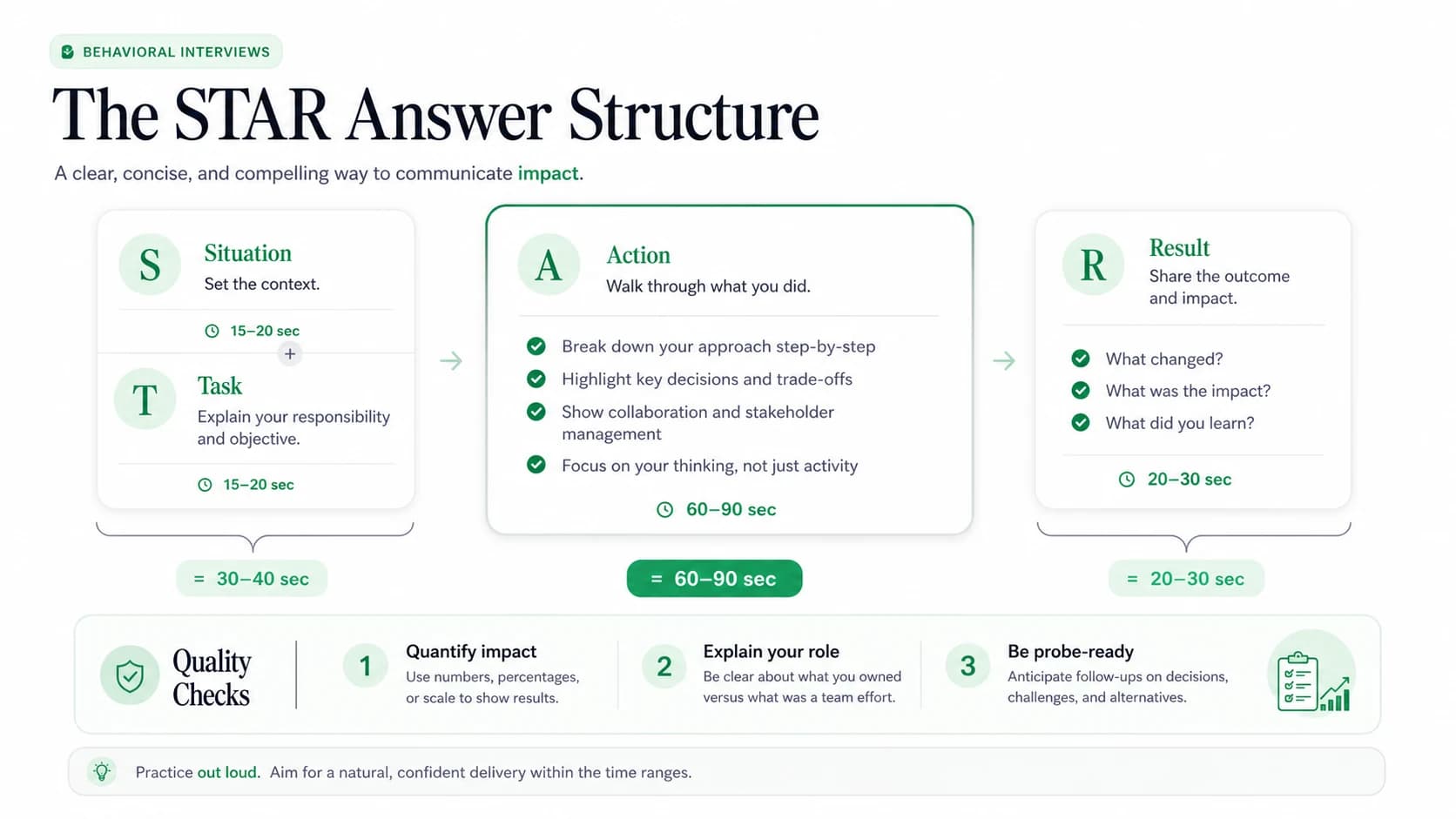
Learn the behavioral method
STAR that survives probing, linked to the live AI interviewer.
Stage 5: Power Day (Week 4–6)
Power Day is Capital One's final round: a single day of 3–5 back-to-back virtual interviews, typically lasting 4–6 hours total. The composition for Business Analyst roles:
After Power Day, interviewers submit independent hire/no-hire recommendations. If you match multiple teams, a brief team-selection call follows before the formal offer. According to data aggregated from Indeed and Glassdoor, the average time from application to offer at Capital One is approximately 26 days across all roles.
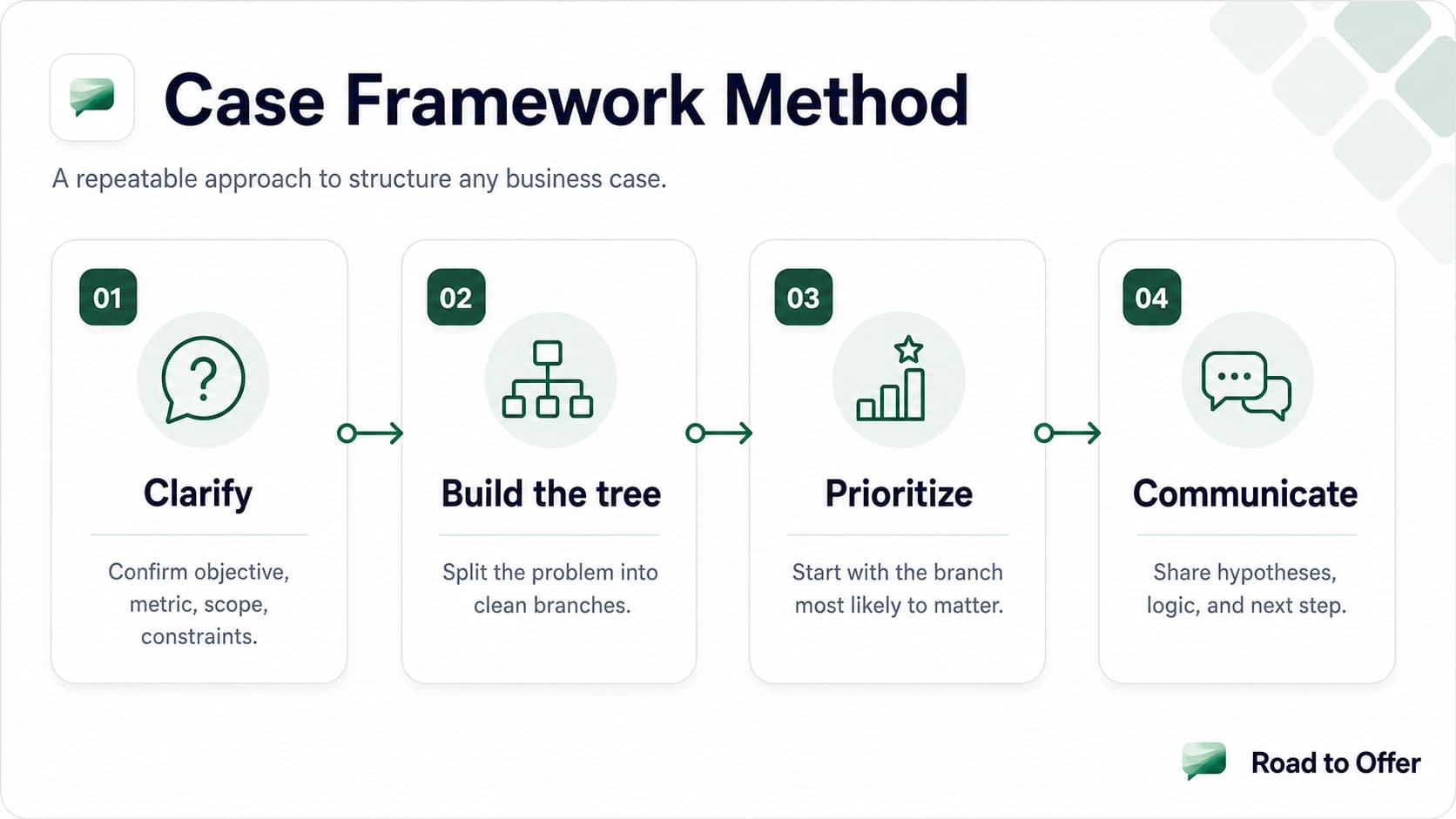
Learn the case method
One dense lesson, each step linked to the drill that trains it.
For a detailed walkthrough of how to prepare for and pace the full day, see the dedicated Capital One Power Day guide. The single biggest lever before Power Day is reps under time pressure on the exact case rhythm the interviewer drives.

Profitability · medium
Run a quantitative case before Power Day
Margin math, exhibit reads, and a closing recommendation, the exact rhythm Power Day tests.
Case Interview Format: Quantitative First
Capital One's case format differs from consulting firm cases in two structural ways that change how you should prepare.
Interviewer-led, not candidate-led. The interviewer controls the flow. You receive specific data and respond to directed prompts: "given this table, what is the break-even volume?" rather than "structure the problem and tell me what information you need." Strong frameworks and issue trees have limited value here. Precise execution of the calculation the interviewer is pointing at is what gets evaluated.
Calculator allowed; numbers intentionally messy. Capital One explicitly permits a basic four-function calculator (+, –, ×, ÷) during case interviews. The numbers in exhibits are large and irregular by design: $14,237,000 revenue, 73,400 unit volumes, 31.6% cost rates. Being fast and accurate with a calculator while maintaining a clear reasoning narrative is the core skill being tested.
What Capital One Case Interviews Evaluate
According to Capital One's own case interview tips, the four dimensions assessed are:
- Structured thinking: Can you decompose the problem before calculating?
- Quantitative analysis: Are your calculations accurate, fast, and well-organized?
- Communication: Do you explain your reasoning at each step?
- Business judgment: Does your recommendation make sense in context?
The weighting leans heavily toward dimensions 2 and 3 in practice. A structurally elegant framework that produces slow or incorrect calculations will not clear Power Day.
Most Common Case Types
Based on aggregated candidate reports across recent Capital One recruiting cycles:
Run three of the case types from the table as one timed set, graded question by question.
Quick Math
- Capital One is sizing a cash-back card for 4 million eligible households. Marketing expects a 5% take rate at launch and $260 of annual revenue per activated card. What is estimated Year 1 revenue, in dollars? Answer in $M.
Revenue = Eligible households x Take rate x Revenue per activated card.
- A servicing-platform upgrade costs $2.7M upfront and saves $600K a year in operating cost. Ignoring the time value of money, what is the payback period in years? Round to the nearest 0.1 year.
Payback period = Upfront cost / Annual saving, ignoring the time value of money.
- An auto-loan portfolio books $800M of revenue against $260M of interest expense, $220M of credit losses and $120M of servicing cost. What is the portfolio's profit margin, in percent? Round to the nearest whole percent.
Margin = (Revenue - Interest expense - Credit losses - Servicing cost) / Revenue.
For the underlying profit decomposition logic that runs through all of these, see our profitability framework guide. Candidates also targeting strategy consulting roles may find useful contrast in the McKinsey case interview guide (for interviewer-led format) and the Deloitte case interview guide (for financial services-adjacent case types).
How to Structure Your Response in an Interviewer-Led Case
Since you're responding to prompts rather than driving freely, the rhythm looks like:
- Restate the prompt: confirm you understood the question and the data you're working with
- State your approach: "I'll start by calculating the break-even volume, then compare it to the current volume to assess viability"
- Execute the calculation: show your work clearly, label intermediate steps
- Interpret the number: don't just give a result; explain what it means for the decision
- Anticipate the follow-on: cap with "the next question I'd want to answer is..." to signal forward thinking
For broader case interview communication principles, see our case interview communication tips guide.
How should you align your Capital One resume and cover letter before this interview?
Anchor the documents to the exact business, product, or analytical role named in the posting. Show structured decisions and quantitative judgment without claiming a Capital One-specific resume rubric.
- Before: Worked on a product analysis.
- After: Compared customer behavior across two segments and recommended the launch group with the more resilient unit economics.
Check that you can explain the assumptions and that the role language matches the current invitation. Recruiters read the resume and cover letter together: the resume proves relevant decisions, while the cover letter explains why the applicant wants this role. Rehearse the revised line as a short recommendation before the next mini-case or business-case rep.
Find the claims that need clearer assumptions
Drop the resume here for an independent graded report on how the quantitative work reads. Road to Offer's score, not an employer one.
By uploading, you agree to resume analysis and report storage until you delete it. See the privacy policy.
Revise one decision line, rehearse the recommendation, and carry it into the next practice rep.
Product Sense Interview (BA and PM Tracks)
Business Analyst candidates at Capital One face a dedicated 60-minute product interview during Power Day. This session is structurally different from the quantitative cases; analytical rigor still matters, but the emphasis shifts toward customer insight and strategic thinking.
Based on candidate reports, the product interview is divided into three sub-categories:
1. Product Discovery
Questions in this category ask you to identify customer needs, pain points, or unmet opportunities. Example:
"Capital One's mobile app has a feature that allows customers to lock their credit card instantly. What other features would you add to improve security-conscious customers' experience?"
Strong answers:
- Define the user segment precisely (security-conscious customer ≠ all customers)
- Identify 2–3 specific pain points with evidence or reasoning
- Prioritize one feature with a clear hypothesis for impact
- Connect back to a measurable outcome (reduced fraud calls, increased app engagement)
2. Product Skills
These questions assess PM fundamentals: prioritization, roadmapping, trade-off decision-making.
"You have engineering bandwidth for exactly two of these three features. How do you decide which two to build?"
Strong answers use an explicit prioritization framework (reach × impact × confidence ÷ effort is common) rather than vague "it depends" reasoning. Showing that you have a repeatable decision process matters more than landing on the "right" answer.
3. Product Strategy
Macro-level questions about competitive position, go-to-market thinking, or product direction.
"A new fintech startup just launched a credit card that auto-negotiates APR based on your credit score every month. How should Capital One respond?"
Strong answers situate Capital One's response within its actual competitive strengths (scale, data, brand) rather than generic strategic options. Show that you've thought about Capital One's position specifically, not just generic strategy playbooks.
The three product sub-categories each reward a different move: naming a specific segment, applying a repeatable prioritization framework, and grounding strategy in Capital One's actual strengths. Practice all three before Power Day.
Interactive drill set. Write an answer before revealing the worked solution, then continue into Road to Offer for scored practice and AI feedback.
Behavioral Interview: Capital One's Values Framework
Capital One's behavioral interview evaluates experience against four core values, sometimes referred to internally as the ARES framework:
- Excellence: delivering high-quality work under constraint
- Do the Right Thing: ethical decision-making, integrity under pressure
- Respect for Individuals: inclusive collaboration, listening before acting
- Succeed Together: cross-functional teamwork, shared accountability
Each behavioral question is followed by structured probing: "What specifically did you do?" / "What would you have done differently?" / "How did you measure success?"
Prepare 4–5 stories from your experience that can flex across multiple values. Each story should follow a tight structure: situation (one sentence), what you did (three specific actions), outcome (measurable), and reflection (what you learned or would change). For full story preparation methodology, see our behavioral interview guide for consulting.
Common Capital One behavioral questions:
- "Tell me about a time you used data to change a stakeholder's mind."
- "Describe a situation where you had to make a decision with incomplete information."
- "Give me an example of when you improved a process. What did you measure?"
- "Tell me about a conflict with a teammate and how you resolved it."
Worked Example 1: Break-Even Analysis
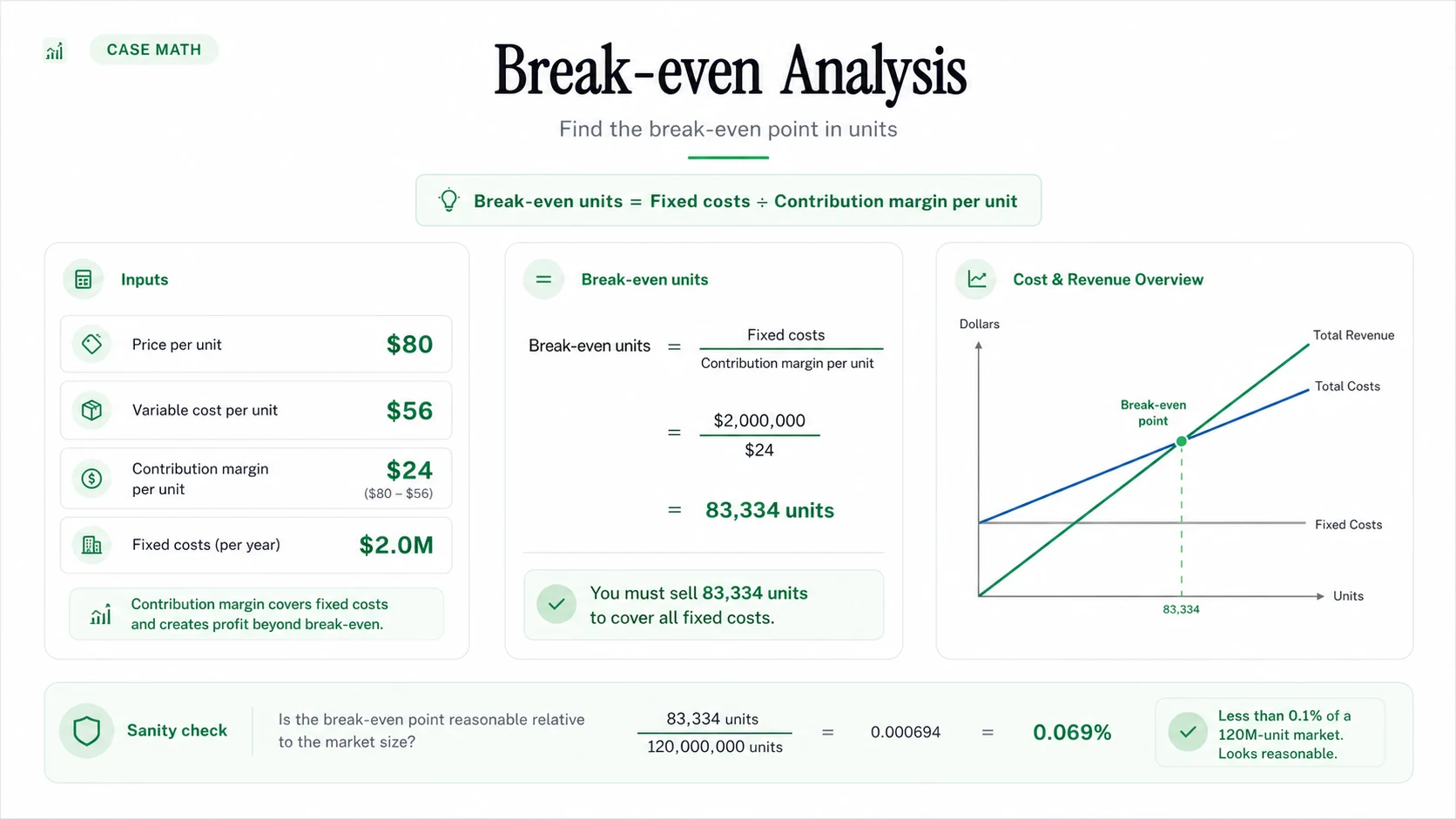
Prompt: "A Capital One branch manager is evaluating whether to keep the branch open on Sundays. Fixed costs for Sunday operations (staffing, utilities, security) total $4,200. Each customer served generates an average of $18 in fee and service revenue. Variable costs per customer (materials, transaction processing) are $3. Last Sunday, 240 customers visited. Should the branch stay open Sundays?"
Step 1: Identify the break-even volume:
Contribution margin per customer = Revenue per customer − Variable cost per customer = $18 − $3 = $15 per customer
Break-even volume = Fixed costs ÷ Contribution margin per customer = $4,200 ÷ $15 = 280 customers
Step 2: Compare to actual volume:
Last Sunday's volume: 240 customers Break-even volume: 280 customers Gap: 40 customers (240 is 86% of the 280 needed)
At current volume, Sunday operations lose money: 240 × $15 = $3,600 in contribution margin against $4,200 in fixed costs, a $600 weekly loss.
Step 3: Stress-test the recommendation:
Before recommending closure, raise two questions:
- Is Sunday volume growing? If the branch opened 3 months ago and Sunday traffic trends +15 customers/month, break-even is ~2.7 months away.
- Are there indirect value drivers? Customers who visit Sunday may have higher lifetime value (more products, lower churn). A single cross-sell on a checking account could shift the math.
Recommendation: "Based on current volume, Sunday operations are unprofitable by $600 per week, a $31,200 annual loss. I'd recommend a 60-day review: if Sunday traffic doesn't reach 280 customers by then, close Sunday hours. In parallel, I'd check whether Sunday visitors have higher average product counts than weekday visitors; if so, the revenue-per-visit figure of $18 may be understating true value."
This case type mirrors Capital One's actual published case scenarios, which include profitability decisions for retail and branch-level operations.
Run the same break-even mechanics on fresh numbers before moving to the next case type.
Break-even and contribution margin drill from the Road to Offer drill engine. Answer a real prompt and get AI-scored feedback. Free accounts include 3 drills per day for the first 3 days after signup.
For the underlying framework behind contribution margin and break-even logic, see our case interview math practice guide.

Profitability · medium
Practice a full profitability case with the same math
Consumer Electronics / Appliances
Worked Example 2: Credit Card Unit Economics
Prompt: "Capital One is evaluating a new credit card product targeted at college students. The marketing team estimates they can acquire 50,000 cardholders at a cost of $85 each. Average annual balance per cardholder: $1,200. APR: 19.99%. Charge-off rate: 4.5% of outstanding balances. Annual cost to service each account: $22. Should Capital One launch this card?"
Step 1: Calculate annual revenue per cardholder:
Interest income = Average balance × APR = $1,200 × 19.99% ≈ $240 per cardholder
(Note: Use 20% for mental math check, then refine: $1,200 × 0.1999 = $239.88 ≈ $240)
Step 2: Calculate annual cost per cardholder:
Charge-off cost = Average balance × Charge-off rate = $1,200 × 4.5% = $54 per cardholder Servicing cost = $22 per cardholder Total annual cost = $54 + $22 = $76 per cardholder
Step 3: Calculate annual profit per cardholder:
Annual profit = Revenue − Annual cost = $240 − $76 = $164 per cardholder
Step 4: Calculate payback period on acquisition cost:
Acquisition cost per cardholder: $85 Annual profit per cardholder: $164 Payback period: $85 ÷ $164 ≈ 0.52 years (approximately 6 months)
Step 5: Portfolio-level math:
Total acquisition cost: 50,000 × $85 = $4.25M Year 1 portfolio profit (assuming acquisition happens at start of year): 50,000 × $164 = $8.2M gross Year 1 net after acquisition cost: $8.2M − $4.25M = $3.95M
Step 6: Sensitivity check:
The key risk variable is charge-off rate. At 4.5% this looks attractive. If charge-off increases to 8% (a reasonable stress scenario for subprime college cardholders):
- Charge-off cost = $1,200 × 8% = $96 per cardholder
- Annual profit = $240 − $96 − $22 = $122 per cardholder
- Payback extends to $85 ÷ $122 = 0.70 years (~8.4 months), still viable but tighter
Recommendation: "The economics look favorable at baseline: a 6-month payback and $8.2M gross annual profit from 50,000 cardholders. I'd recommend proceeding with a controlled pilot of 10,000 accounts before full rollout. The critical variable to monitor is charge-off rate: at the baseline 4.5% the card is profitable; above 7.5%, annual profit per cardholder drops below $80 and the product's risk-adjusted return becomes marginal. I'd build a 90-day charge-off trigger into the launch plan."
For broader market sizing methodology applicable to financial product launches, see our market sizing step-by-step guide.
Unit economics cases stack several small calculations into one recommendation. Run the same sequence on a fresh card, against the clock.
Quick Math
- A secured card carries a $1,500 average annual balance per cardholder at an 18% APR. What is annual interest income per cardholder, in dollars?
Interest income = Average balance x APR.
- With $270 of interest income per cardholder, a 6% charge-off rate on the $1,500 average balance and $30 of annual servicing cost, what is annual profit per cardholder, in dollars?
Profit per card = Interest income - Charge-off cost - Servicing cost, where charge-off cost = Balance x Charge-off rate.
- Acquisition cost is $125 per cardholder and annual profit is $150 per cardholder. What is the acquisition payback period in months? Round to the nearest 0.1 month.
Payback in months = Acquisition cost / (Annual profit / 12).
Common Mistakes in Capital One Interviews
1. Preparing with candidate-led case frameworks Capital One's interviewer-led format rewards precision execution, not creative structure-setting. Spending your entire prep time building issue trees and hypothesis-driven frameworks leaves you under-prepared for the data-response pattern Capital One actually uses. Practice responding to specific quantitative prompts, not opening a blank slate.
2. Slow calculator use Candidates who hesitate before picking up the calculator, or who re-enter numbers multiple times, signal insecurity with the numbers. Practice building speed with your calculator until the mechanics are automatic; your cognitive bandwidth should be on interpretation, not button-pressing.
3. Calculating without narrating The most common failure mode reported by Capital One interviewers is candidates who "go silent and calculate." Talking through your arithmetic ("I'm dividing $4,200 by $15 to find break-even volume") demonstrates structured thinking and catches errors before they compound. Practice narrating every step.
4. Missing the recommendation Capital One cases end with a business decision, not a math answer. Candidates who stop at "the break-even volume is 280 customers" without stating "therefore the branch should close" or "therefore proceed with conditions" leave the most important part of the evaluation blank. Always close with a directional recommendation and one condition or risk.
5. Treating the product interview like a consulting case The product round rewards user empathy and strategic instinct, not profit trees. Candidates who try to quantify everything or rely on structured frameworks miss the creative, user-centric dimension Capital One is looking for. Ground your product answers in specific user pain points before moving to metrics.
6. Under-preparing the behavioral round Power Day is long and the behavioral interview often comes at the end when energy is low. Candidates who haven't prepared structured stories default to rambling narratives under fatigue. Prepare your 4–5 stories in writing before Power Day and know exactly which values each one demonstrates.
4-Week Capital One Prep Plan
Execution checklist
Week 1: Master break-even and contribution margin math cold. Break-even is the most-tested case type at Capital One. Drill it with AI-graded case math practice until you can set up and solve break-even problems in under 90 seconds before your first practice case.
Week 1: Read Capital One's official case interview guidance, then map it to the day. Capital One publishes first-party guidance at capitalonecareers.com and jobs.capitalone.co.uk, the closest signal to what interviewers actually value. Turn it into a schedule with the Power Day guide so you know which round each piece of advice applies to.
Week 2: Run interviewer-led case reps (respond to prompts, don't set direction). Capital One's format is interviewer-led, so practice with a live voice case that hands you data and scores your response. If you practice driving cases, you're preparing for the wrong interview.
Week 2: Build financial product vocabulary (credit cards, APR, charge-off, CLV, LTV, CAC). Encountering 'APR' or 'charge-off rate' for the first time mid-case slows your thinking. Ground the terms in unit economics practice so the vocabulary is automatic.
Week 3: Practice narrating calculations out loud for every rep. Silent calculation is the top failure mode Capital One interviewers flag. The case communication guide shows how to narrate arithmetic; build the habit before Power Day.
Week 3: Prepare 4–5 behavioral stories mapped to Capital One's four values (Excellence, Do the Right Thing, Respect, Succeed Together). Power Day ends with a behavioral interview after 4+ hours of cases. Rehearse each story in a live AI behavioral interview so they stay specific under fatigue.
Week 3: Find a case partner for live interviewer-led reps. Interviewer-led cases are easier to rehearse with someone handing you the data. Post in the Road to Offer case partner group to line up mock rounds between AI reps.
Week 4: Run 2 full mock Power Day simulations (cases back-to-back, then product interview, then behavioral). Endurance matters. Chain voice cases back to back; candidates who haven't simulated the full-day format underperform in later rounds relative to early rounds.
Week 4: Practice 3 product interview responses (discovery, skills, strategy), tying each to a business metric. Capital One's product interviewers consistently reward answers that connect features to measurable outcomes. Generate options fast with free brainstorming drills, then force each idea onto a metric before you say it out loud.
For a broader recruiting timeline covering all consulting and strategy firm applications simultaneously, see our consulting interview prep timeline guide.
How Capital One Compares to Other Firms
If you're evaluating Capital One alongside other financial services firms or strategy consulting roles, the format differences matter for how you split your preparation time.
Capital One cases are closer in style to internal corporate strategy interviews at financial firms than to MBB consulting cases. If you're cross-preparing for both Capital One and consulting, build your quantitative speed first; that investment transfers to every format. Our complete case interview frameworks guide covers the structural fundamentals that apply across all formats. To see where a corporate analytics employer like Capital One fits relative to strategy houses and economic consultancies, review how Capital One stacks up against the main types of consulting firms.
Sources (checked June 17, 2026)
- Capital One official case interview tips: capitalonecareers.com/4-tips-to-ace-your-capital-one-case-interview
- Capital One interview process overview: capitalonecareers.com/what-to-expect-during-your-capital-one-interview
- Capital One UK case study guide: jobs.capitalone.co.uk/business-analyst-case-study-guide
Frequently asked questions
Resources and related guides
- Run a real case interviewPractice
- Browse all free resourcesResource hub
- McKinsey Application Deadlines 2026: Every Date and ProgramFirm Specific · May 1, 2026
- McKinsey vs BCG: 10 Real Differences (2026 Guide)Firm Specific · May 1, 2026
- Accenture Case Interview: Strategy vs Consulting, Group Format, and Prep Plan (2026)Firm Specific · Mar 15, 2026
- Willis Towers Watson Interview: Process, Cases & Prep Strategy (2026)Firm Specific · Apr 8, 2026