
McKinsey Solve Game 2026: Format, Modules, and Scoring
The 2026 McKinsey Solve assessment guide: which modules you can be given, what is publicly known about scoring, a 10-day prep plan, and a test-day checklist.
On this page
McKinsey Solve is a game-based digital assessment whose results are considered alongside the rest of your application, not a standalone published pass/fail threshold. Candidates report three lengths in 2026: about 65 minutes (Redrock Study and Sea Wolf), about 85 minutes (those two plus the 20-minute Sustainable Futures Lab) and, since late August 2026, about 95 minutes (those two plus a newer 30-minute SFL that looks like a pilot). McKinsey's official FAQ says the invitation provides the assessment length and each task starts with an untimed tutorial. McKinsey does not publish which games each length contains, so treat the map as candidate-reported and let your tutorial overrule any guide.
This guide covers reported formats, what is and is not publicly known about scoring, and a day-by-day prep plan built around the specific skills each module tests.
What is the McKinsey Solve game in 2026?
Solve is McKinsey's game-based online screen, sent after resume review and before first-round interviews. The table below is the quick answer; every row is expanded, with sources, further down the page.
The single most important instruction: your invitation and the in-test screen override every guide, including this one. McKinsey varies the games, timing, and checks by role, level, and region.
The three Solve games at a glance
Times are candidate and prep-provider reports, not McKinsey's published allocation. Each Road to Offer simulation is original practice content, one complete run free per game, with more in paid packs; compare what each one includes.
The fastest way to understand Solve is to play it. Road to Offer has recorded 925 Solve practice attempts between 31 July and 22 September 2026 across its Red Rock, Sea Wolf and Sustainable Futures Lab simulations (attempts, not unique people).
Sea Wolf rewards disciplined constraint-matching: filter the microbes that break a hard rule first, then optimize the remaining set. The second module most candidates report is Redrock Study, which flips the challenge from optimization to data interpretation, so practice the switch between the two rather than either one in isolation.
What your invitation length tells you
The 95-minute evidence is thin but specific: on a PrepLounge thread, a candidate asked about a 95-minute invite on August 24, 2026, coaches first guessed the extra 10 minutes were buffer, and on September 11 a candidate who had sat it reported a new 30-minute SFL with a more complex interface. The Sustainable Futures Lab guide compares both versions side by side.

Got your invitation? Plan the days until your test
Pick 65, 85 or 95 minutes, add your test date, and get a plan for each day that includes the games your length contains. Free to build.
Once Solve prep is stable, move the same structured reasoning into live McKinsey practice cases so assessment practice does not crowd out the interview itself.
Where Solve came from, and how McKinsey uses it
McKinsey Solve is an online, game-based assessment sent to candidates after resume screening and before live interviews, according to McKinsey's Solve page. It replaced the old Problem Solving Test (PST) starting around 2020, built on technology from Imbellus, a game-based assessment company McKinsey acquired, as described in McKinsey's game-based innovation lab announcement. If you are weighing whether to prepare for the old test, the McKinsey Problem Solving Test explains what carries over to Solve.
Here's what you need to know upfront:
- Duration: about 65, 85 or 95 minutes, as stated in your invitation; tutorials are untimed
- Format: game-based simulations, not traditional multiple-choice. Two games (Redrock Study and Sea Wolf) or three, with the Sustainable Futures Lab as the third
- When: after resume screening, before first-round case interviews
- Retake policy: one attempt per application cycle, with a 12-24 month waiting period before you can retake. For what McKinsey itself publishes, see can you retake McKinsey Solve.
- Pass-through rate: no verified global figure in McKinsey's public guidance. Forum anecdotes and prep-provider estimates should not be treated as a representative pass rate or a personal probability of advancing. What Reddit says about McKinsey Solve sorts the common claims into confirmed, unverified and contradicted.
- Result usage: McKinsey evaluates Solve results alongside your resume to decide who gets interviews, not a standalone pass/fail gate. To weigh it against your resume and interviews, read how much McKinsey Solve matters.
Is Solve the same as the PSG, the Imbellus test, and the digital assessment?
Yes. Every one of those names points at the same assessment, and knowing that saves you from preparing for a test that no longer exists under its old name.
- Problem Solving Game (PSG) was the working name when the game replaced the old written Problem Solving Test around 2020.
- Imbellus test refers to the company that built the underlying technology before McKinsey acquired it.
- Digital assessment is the label McKinsey's own careers page uses.
- Solve is the current official name and the one your invitation will use.
Older forum posts and guides use these names interchangeably, and some describe game line-ups from the era their name comes from. When a source says "the Imbellus test has Ecosystem Building and Plant Defense," it is describing the 2020-2022 version, not the assessment you will sit in 2026.
Who receives Solve, and when do results come back?
Assessment requirements vary by role and recruiting process. Your invitation confirms whether you need to take Solve and which instructions apply. If you are wondering whether every applicant is invited, does everyone get McKinsey Solve walks through it.
After you submit, candidates on Wall Street Oasis and PrepLounge commonly report hearing back within one to two weeks, though timelines vary by office and recruiting season. You will not receive your score: McKinsey does not share Solve results with candidates, and it says results are reviewed together with the rest of your application rather than as a standalone cut.
Run a full Solve simulation free
One complete free simulation each of Red Rock, Sea Wolf and Sustainable Futures Lab, with the worked answer for every decision. Original practice, not official McKinsey questions.
McKinsey Redrock and Sea Wolf: The Two Modules
If you are deciding which game to practise first, Red Rock vs Sea Wolf compares them side by side.
Module 1: McKinsey Redrock Study (~35 minutes)
Redrock Study is the data-interpretation module. Candidate and prep-provider reports describe one Study that runs in order, followed by six standalone Cases, on a shared clock of roughly 35 minutes. The full breakdown, with worked examples, is in the McKinsey Redrock Study guide.
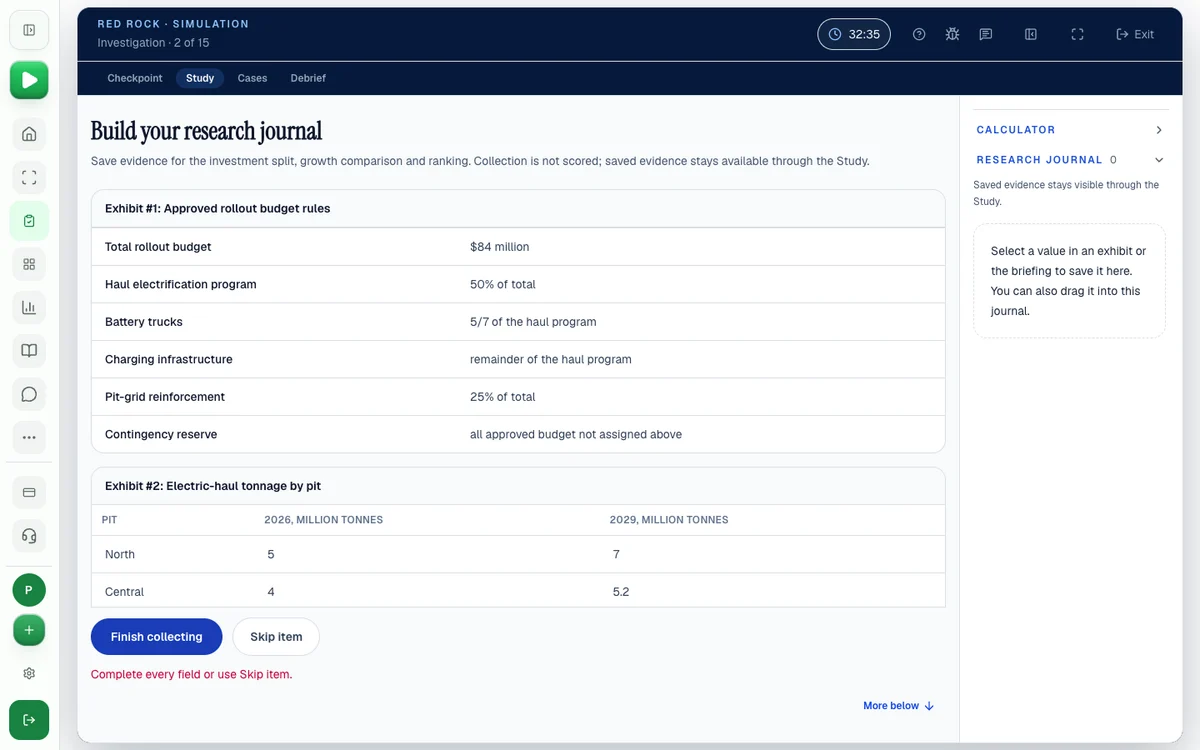
The math is not advanced, but it has to be right under time pressure: most lost points come from a wrong denominator, a unit missed in a footnote, or percentage points reported as a percent change. The six Case types each have an original worked example.
Redrock-style exhibit drill from the Road to Offer drill engine. Answer a real prompt and get AI-scored feedback. Free accounts include 5 drills per day for the first 3 days after signup.
Run a free Redrock-style study below before you read about Sea Wolf:
Free Solve practice from Road to Offer: pick a game and play it in the browser. Original practice, not official McKinsey material.
Module 2: McKinsey Sea Wolf Game (~30 minutes)
Sea Wolf is the constraint-matching module. Candidate reports from mid-2026 describe an ocean-cleanup scenario: for each contaminated site you build a treatment from a small set of microbes whose combined attributes must land inside the site's target ranges, include a required trait, and exclude a forbidden one. Some older write-ups instead describe matching marine species to water temperature, depth, and nutrient conditions; recent coach and candidate write-ups and McKinsey's own account of its game lab point to the microbe version, so trust the tutorial in your own assessment over any guide.
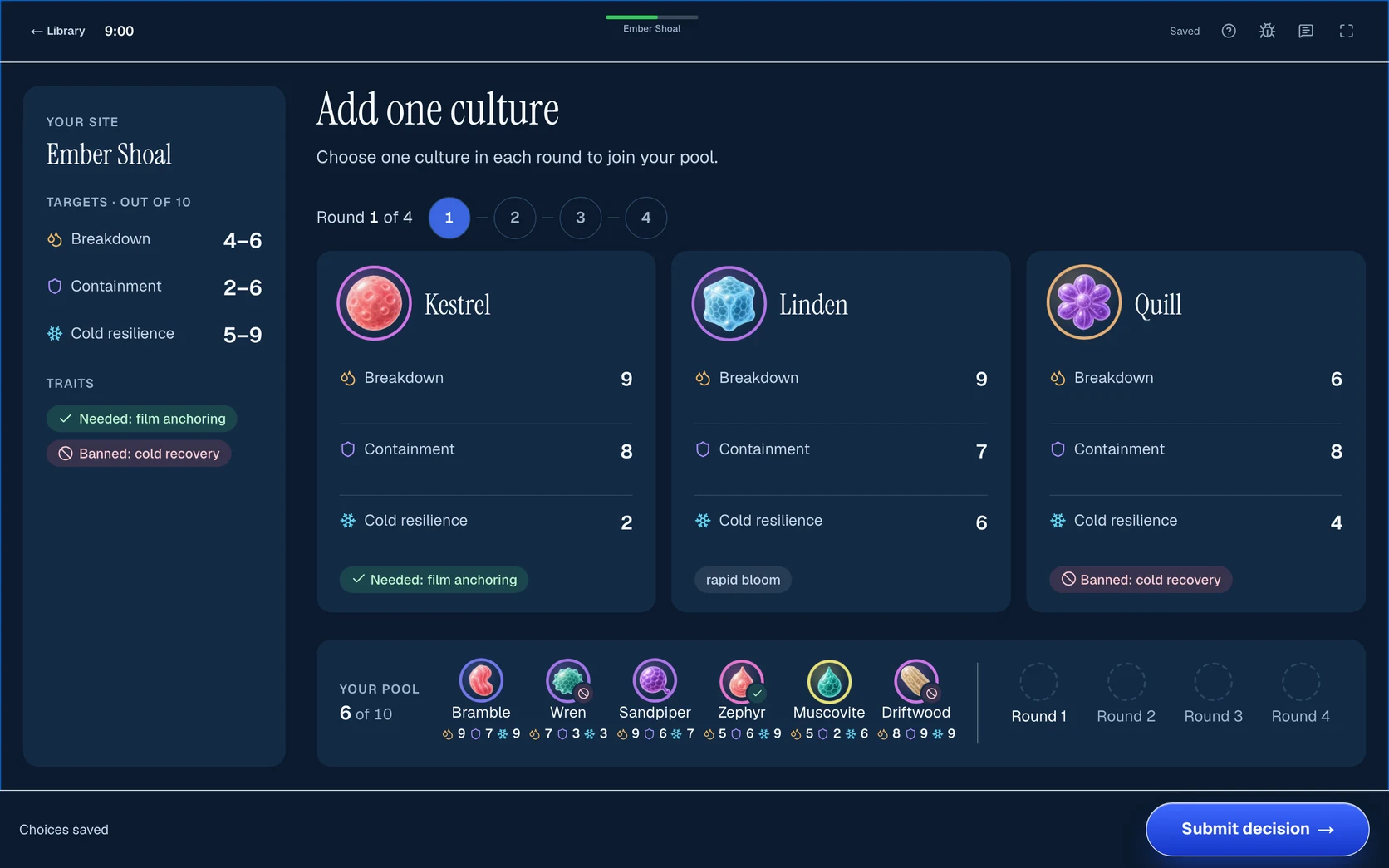
Reports of the current version describe the same loop at every site:
- Read the site's target ranges and its required and forbidden traits.
- Rule out microbes that break a trait rule or a hard limit.
- Choose three microbes and check that each attribute's average lands inside its range (a 4.0 to 6.0 range with three microbes means a total between 12 and 18).
- Confirm the required trait is covered, then move to the next site.
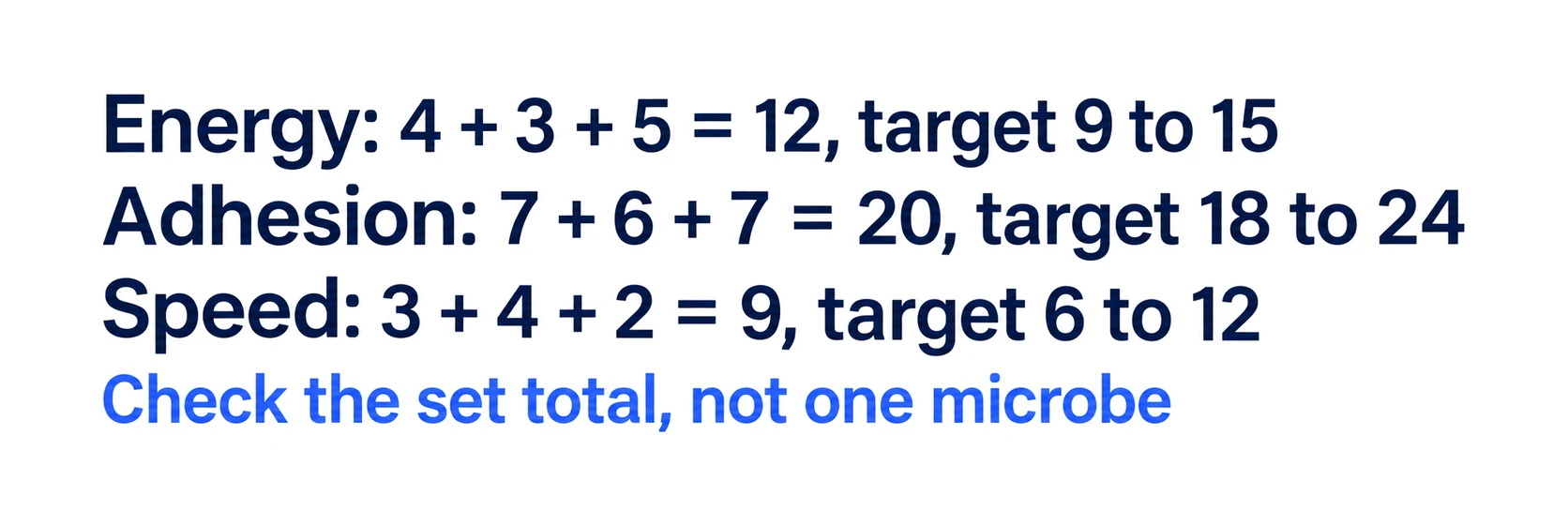
The skill being tested is the same either way: multi-variable constraint matching under a clock. Filter out options that break a hard rule first, convert each attribute range into a target sum so you can validate a candidate set with quick arithmetic, and confirm the set works as a group before committing. The dedicated guide linked above covers the full rules, a worked example, and per-site strategy.
Try the Sea Wolf constraint game yourself: pick it in the practice block in the Red Rock section above, which runs all three games.
Does McKinsey Solve always use the same two games?
No. Redrock Study and Sea Wolf are in every reported 2026 sitting, and longer invitations add the Sustainable Futures Lab as a third game: about 20 minutes in an 85-minute invitation, about 30 minutes in a 95-minute one. Which candidates get which length varies by role, office and region, and nobody has published a pattern for the 95-minute version. Read your invitation email for the length, then let the in-test instructions confirm the games before you start.
Older games you may still read about
Guides and forum posts from earlier versions describe games that are no longer reported in 2026 invitations. They help you recognise outdated advice; they are not what the 85- or 95-minute invitations contain.
- Ecosystem Building. You place a set of species into a location so the food chain stays stable. Each species has rules about what it eats, where it lives, and which conditions (depth, temperature, terrain) it tolerates. The core skill is building a self-sustaining chain where every species has a viable food source and no condition is violated. McKinsey itself has described this "build a reef, save a species" design. Treat it as a constraint-satisfaction problem: satisfy every species' requirements at once rather than optimizing any single trait.
- Redrock or Plant Defense. Redrock is the data-interpretation flow covered above. Older reports describe Plant Defense, where you defend a plant against waves of invaders by placing defenses with limited resources and reacting as conditions change. If you get Redrock, lean on clean exhibit math and evidence checks. If you get Plant Defense, think in terms of resource allocation under pressure and adapting your placements each round.
- The Sustainable Futures Lab. Not an older game: it is the current third game, covered below.
The Sustainable Futures Lab (20 or about 30 minutes)
The Sustainable Futures Lab is the module candidates know least about, which makes it the easiest one to lose easy points on. It now comes in two reported versions.
- Standard SFL, 85-minute invitations. Prep-provider write-ups (MyConsultingCoach and CaseBasix, checked August 31, 2026) describe a roughly 20-minute, text-based module: one prioritization question where you rank options, followed by about a dozen scenario questions that walk through a single sustainability project from kickoff to final synthesis.
- New SFL, 95-minute invitations. Since late August 2026, candidates and prep providers describe a roughly 30-minute version in which you lead four researchers across four workstations over three simulated days, each day spent requesting information, assigning people, resolving a researcher's dilemma and rating the team. McKinsey has not announced it; treat it as a pilot.
There is no heavy calculation. What it rewards is judgment under messy conditions: how you prioritize when everything looks urgent, how you react when new data contradicts earlier work, when you share partial findings with stakeholders, and how you handle trade-offs with no clean winner. The recurring trap is treating it as a sustainability knowledge quiz or always picking the safest, most collaborative-sounding option; the answers that score are the ones that keep the project moving without sacrificing analytical quality or stakeholder trust.
You can run a complete free SFL simulation of the standard version on the SFL practice page: 13 linked decisions on one project, starting with a ranking task, as original practice rather than a copy of the live module. For the 30-minute version, the SFL island is a free three-day run on a 30-minute clock with a worked debrief, and the island guide explains each stage.
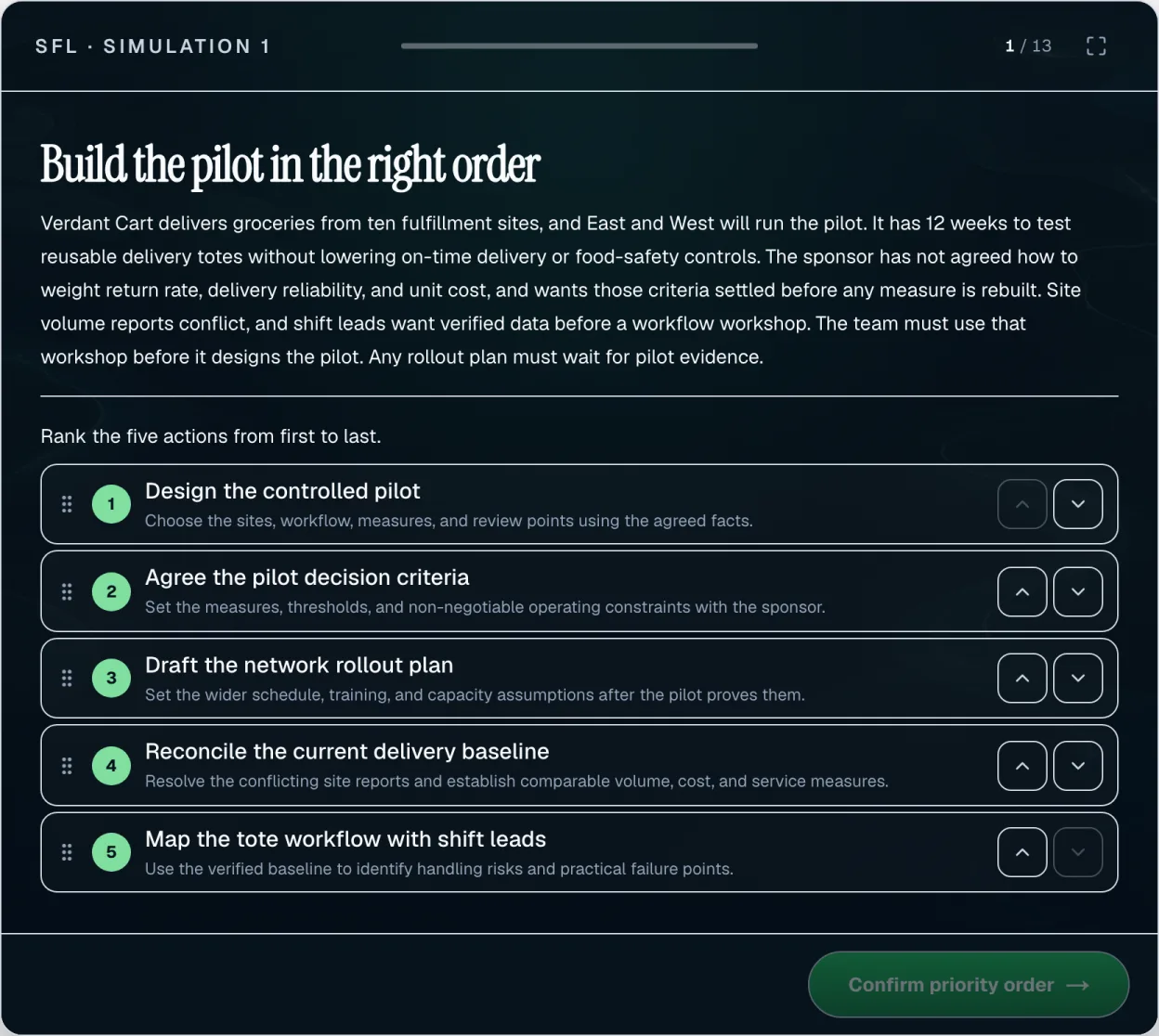
Run the new 30-minute SFL island free from the same practice block in the Red Rock section above.
Per-game benchmarks and pacing
McKinsey does not publish scoring thresholds for any game, so treat the figures below as time-budgeting guidance drawn from candidate reports, not official cutoffs. As a practice habit, reserve time for the final questions rather than spending the entire clock on the opening stage.
- Redrock Study (~35 min, reported): a practice budget of 23 minutes for the main Study plus 12 minutes for six mini-cases totals 35 minutes. Adjust to the actual timer and instructions; 5-7 minutes for every mini-case would leave insufficient time for the Study.
- Sea Wolf (~30 min): the difficulty climbs from site to site, so spend a little less time on the early, clear-cut sites and bank that time for the later ones where tighter ranges and trait conflicts decide your score.
- Ecosystem Building: there is no fixed species count to memorize, so check every species' food source and condition rules before placing anything. An unsustainable chain (a species with no viable food, or one placed in a condition it cannot tolerate) is the common failure, not slow play.
- Plant Defense: treat your resources as a budget. Place defenses where the pattern of incoming waves is densest, and adjust each round rather than committing everything early.
- Sustainable Futures Lab: the scenario questions rarely have a flashy right answer. Favor the option that keeps the project moving without sacrificing analytical quality or stakeholder trust, and do not stall re-reading. In the 30-minute version, spend each day's few information requests on the questions that day's goal needs.
What are the official test-day rules?
McKinsey publishes its own constraints in the Solve FAQ, on the digital assessment page, and in its assessment integrity expectations. The ones that decide outcomes:
- Work alone, with no unauthorized help. McKinsey's integrity rules ban other applications, websites, AI tools, prepared notes, screenshots, and outside assistance; is McKinsey Solve proctored covers what McKinsey says about monitoring. Pen and paper for your own notes and calculations are permitted unless your instructions say otherwise.
- Plan one uninterrupted sitting on a computer. The games are built for a full screen; the tutorial screens before each game are untimed, the games are not.
- Run the technical check first. The invitation includes a system check (device and browser setup for Solve); if something goes wrong mid-game, contact McKinsey's assessment support rather than restarting on your own.
- Expect your own variant. McKinsey varies the underlying parameters per sitting, which is why memorizing another candidate's answers is worthless and why the transferable skills below are the real preparation.
The pre-assessment checklist near the end of this guide turns these rules into a setup routine you can run right before you press Start.
What skills does Solve measure?
Across its materials and the write-ups of firms that study it, five competencies come up consistently: critical thinking, decision making under uncertainty, metacognition (knowing what you do and do not know), situational awareness, and systems thinking (per Management Consulted's analysis of the Imbellus design). You do not prepare these as abstractions. Each module operationalizes them: Redrock turns critical thinking into evidence checks, Sea Wolf turns systems thinking into constraint matching, and the Sustainable Futures Lab turns situational awareness into stakeholder judgment. That is why the prep plan below trains per-module skills instead of generic brain training.
The Dual Scoring System
This is the piece most candidates miss, and it changes how you should approach every minute of the assessment.
Product score measures whether you selected correct answers. Did you identify the right patterns? Did you build valid sets? This is straightforward accuracy.
Process score is the term used in third-party discussions of approach and behavior. The questions below are useful self-review prompts, not a verified list of scoring inputs or penalties:
- Reading time: Do you spend time reading scenarios before answering, or do you jump straight to questions?
- Navigation patterns: Do you review all available information, or do you skip panels?
- Revision behavior: Do you change answers after reviewing additional data, or do you commit without checking?
- Decision consistency: Does your clicking pattern suggest systematic analysis or random guessing?
- Pacing: Do you spend proportional time across questions, or do you rush through some and stall on others?
No public scoring weights justify claiming that 80% accuracy with one working style beats 85% with another. Improve the quality of your reasoning and answers instead of trying to optimize an undocumented behavioral score.
What Happened to the Old Games?
If you've been researching Solve, you may have encountered advice about "building an ecosystem with 8 species" or "protecting a plant from predators." That information is outdated. Here's the timeline:
- 2020: McKinsey replaces the Problem Solving Test (PST) with Solve, initially featuring Ecosystem Building and Plant Defense modules (per McKinsey's recruiting blog)
- 2021-2023: Format evolves, with Redrock Study and Sea Wolf gradually replacing older modules
- 2023-2024: Ecosystem Building (the food chain game) and Plant Defense dropped out of the standard two-module rotation across most offices
- 2025-2026: Redrock Study and Sea Wolf are the most common modules globally; longer 85-minute invitations add the Sustainable Futures Lab as a third game
- Late August 2026: candidates report 95-minute invitations with a new, roughly 30-minute SFL, alongside continuing 85-minute invitations
If a guide describes Ecosystem Building or Plant Defense as games you will see, it is outdated: 2026 candidate reports do not include them, although sources disagree on exactly when each was dropped and McKinsey has announced no date. The practical takeaway is to confirm your length from the invitation, then study the games you will actually face. The underlying cognitive skills overlap across all of them (pattern recognition, systems thinking, tradeoff analysis), but the specific strategies, interfaces, and time-management approaches differ game to game.
10-Day Preparation Plan
Generic advice like "practice logic puzzles" wastes your limited prep time. Each phase below targets the specific skills the games test, with one free rep and a concrete finish line.
Turn these ten days into your own calendar
Enter your test date and the plan places each game, guide and Quick Math set on a day, then tracks what you finish.
Days 1-2: Understand the Format
- Read this guide thoroughly and take notes on the question types in each module
- Watch 2-3 YouTube walkthroughs of the current Solve format (search "McKinsey Solve 2025 2026 walkthrough", filter for videos showing Redrock Study and Sea Wolf, not the old Ecosystem Building)
- Read 5-10 candidate experience posts on Wall Street Oasis and PrepLounge to understand what the real test interface looks like
- Write down the specific skills each module targets: data interpretation for Redrock, pattern-matching and optimization for Sea Wolf
Days 3-5: Build Data Interpretation Skills (for Redrock Study)
Redrock Study is mostly exhibit math. Build these until they are automatic:
- Percentage change against percentage points: a rate moving from 20% to 30% is a 10-point rise and a 50% relative increase. Write "points" or "relative" beside every growth figure.
- Weighted versus simple averages: combine totals, then divide, whenever the question asks for an overall rate.
- Budget splits from written rules: take each share of the right base, then check the parts add up to the total.
- Chart choice: say the message in one sentence, then pick the chart that shows it.
- Evidence selection: for each exhibit, name the one or two values the objective needs and note their units and periods.
Khan Academy's statistics and probability unit covers the mean, median and probability questions that also appear in the Cases.
Days 6-8: Build Systems Thinking Skills (for Sea Wolf)
Sea Wolf tests whether you can match multiple variables simultaneously under constraints. Train this:
- Practice constraint satisfaction problems: "If the site's Energy range converts to a total of 9 to 15 and my first two picks sum to 10, which third options keep the set valid?"
- Play optimization games that involve multi-variable matching. Sudoku variants, logic grid puzzles, and resource allocation exercises build the right mental patterns
- Practice if-then reasoning chains: "If I keep this option, the set's Speed average breaks the range. If I swap it for the low-Speed option, I lose the required trait. So the third slot must carry the trait."
- Focus on systematic approaches: practice completing one site fully before moving to the next, checking your work, then proceeding
Days 9-10: Simulate Test Conditions
- Find a quiet space with no distractions. Close all other browser tabs and applications. Set a timer matching your invite (about 65, 85 or 95 minutes)
- Run through a practice session focusing on process: read before answering, work systematically, don't rush
- After your simulation, review: Where did you spend too much time? Where did you rush? Did you read all available information before answering?
- Adjust your pacing strategy based on what you learned. A second timed simulation on Day 10 should feel noticeably smoother
Turn Days 9-10 into full Solve simulations
One complete free simulation of each game, timed, with the worked answer for every decision. Practice results are not an official Solve score.
Pre-Assessment Checklist
Complete this checklist before starting your Solve session. Once you begin, you cannot pause or restart.
Execution checklist
Stable internet connection and quiet environment. Technical issues or interruptions can invalidate your attempt
Laptop or desktop computer (not phone or tablet). The interface is designed for a full screen with mouse navigation
All other browser tabs and applications closed. Behavioral tracking can detect multitasking and tab-switching
90+ uninterrupted minutes blocked off. About 65, 85 or 95 minutes depending on your invitation, plus untimed tutorials and buffer for loading and transitions
No unauthorized tools: apps, websites, AI, or prepared notes closed and put away. McKinsey's integrity rules ban them; pen and paper for your own notes are permitted unless your instructions say otherwise
Completed at least one full practice run under timed conditions. Familiarity with format and pacing reduces test-day anxiety
Webcam and microphone permissions ready if prompted. Some sessions require identity verification or proctoring
Read the full instructions page before clicking 'Start'. The instructions screen contains module-specific guidance you won't see again
Five Mistakes That Tank Solve Scores
These aren't hypothetical. They come from candidate reports on Wall Street Oasis and PrepLounge forums, patterns from candidates who felt confident during the assessment but received rejections afterward.
1. Clicking answers before checking the evidence. An option can look plausible until you inspect its unit, denominator, or time period. Read the objective and relevant exhibits, then test the answer against them. This prevents reasoning errors; it is not a claim that a specific reading duration earns scoring points.
2. Filtering on a single attribute in Sea Wolf. A microbe that looks perfect on one attribute can still push the set's average on another attribute out of range, and a set that fits every range can still fail on a required or forbidden trait. Always check the full set against every range and both trait rules. One-variable matching can produce an invalid combination even when a single attribute looks strong.
3. Using external tools. McKinsey's published rules prohibit outside applications, websites, AI tools, prepared notes, recording, screenshots, and assistance unless an approved accommodation applies. Comply with the rules regardless of whether a particular detection method is publicly documented.
4. Trying to game an undocumented process score. Do not add unnecessary clicks, reread every panel, or deliberately slow down because a prep site suggests a secret scoring advantage. Use a consistent method because it helps you produce supported answers, not because its exact scoring weight is known.
5. Running out of time on the final mini-cases. Reserve a separate budget for the mini-case section and compare the time remaining with the work remaining. Decide when to move on using the actual navigation and scoring instructions, not an assumed no-negative-marking rule.
Bridge from Solve to Case Interviews
Passing Solve gets you to the interview round. It doesn't get you the offer. Once you clear the digital assessment, you'll face McKinsey's interviewer-led case interviews and Personal Experience Interview (PEI).
The good news: the analytical skills you build for Solve, data interpretation, structured reasoning, pattern recognition, transfer directly to case performance. The transition is about applying those skills in a live conversation rather than a digital interface.
Start your case prep in parallel with Solve prep, not after it:
- How to practice case interviews, build the live format skill set
- Free McKinsey interview prep tools, collect Solve, PEI, case, and math resources in one path
- McKinsey PEI guide, prepare the behavioral interview that accompanies every McKinsey case round
- Mental math for case interviews, the quantitative fluency Solve doesn't directly test, but McKinsey cases demand
- Consulting interview prep timeline, map out your full preparation schedule across Solve, case, and fit prep
Run a full McKinsey-style case with AI coaching
Solve gets you to the interview; the case gets you the offer. Practice a scored, end-to-end case and get feedback on structure, math, and recommendation.
Interactive Solve Prep Drills
Interactive drill set. Write an answer before revealing the worked solution, then continue into Road to Offer for scored practice and AI feedback.
Sources and Further Reading (checked June 17, 2026, unless dated otherwise)
- McKinsey interviewing resources: https://www.mckinsey.com/careers/interviewing
- McKinsey Imbellus acquisition announcement: https://www.mckinsey.com/about-us/new-at-mckinsey-blog/from-apprenticeship-in-space-to-selecting-microbes-meet-mckinseys-game-based-innovation-lab
- Wall Street Oasis McKinsey Solve discussion threads: https://www.wallstreetoasis.com/forum/consulting/mckinsey-solve-game-2024
- PrepLounge McKinsey Solve forum: https://www.preplounge.com/en/consulting-forum/mckinsey-problem-solving-game-15229
- PrepLounge Sea Wolf thread (checked August 31, 2026): https://www.preplounge.com/consulting-forum/mckinsey-sea-wolf-game-25150
- Management Consulted McKinsey digital assessment guide: https://managementconsulted.com/mckinsey-digital-assessment/
- McKinsey Problem Solving Game FAQ PDF: https://www.mckinsey.com/~/media/McKinsey/Careers%20REDESIGN/Interviewing/Main/McKinsey-Problem-Solving-Game-FAQ-v2.pdf
- MyConsultingCoach Solve guide (checked August 31, 2026): https://www.myconsultingcoach.com/mckinsey-problem-solving-game
- CaseBasix Solve guide (checked August 31, 2026): https://www.casebasix.com/pages/mckinsey-problem-solving-game-solve-full-guide
- Khan Academy statistics and probability: https://www.khanacademy.org/math/statistics-probability
- CaseInterview.com McKinsey prep resources: https://www.caseinterview.com/
- McKinsey assessment integrity expectations (checked August 31, 2026): https://www.mckinsey.com/careers/assessment-integrity-expectations
- McKinsey careers students page: https://www.mckinsey.com/careers/students
Related Guides
- McKinsey Redrock Study Guide
- McKinsey Sea Wolf Guide
- McKinsey case interview guide
- McKinsey Sustainable Futures Lab guide
- BCG Online Case (Casey) Guide: BCG's equivalent online assessment screen
- Consulting aptitude test overview: how Solve compares to BCG, Bain, and Big 4 assessments
Frequently asked questions
Resources and related guides
- Run a real case interviewPractice
- Browse all free resourcesResource hub
- Does McKinsey Solve Matter? How to Split Your Prep TimeFirm Specific · Oct 11, 2026
- McKinsey Solve on Reddit: Which Claims Can You Trust?Firm Specific · Oct 11, 2026
- Is McKinsey Solve Proctored? Rules, Camera and SetupFirm Specific · Oct 11, 2026
- McKinsey Case Interview 2026: Format, Process, and ScoringFirm Specific · Feb 19, 2026