
Market Entry Framework (2026): 5 Steps + Full Worked Case
A practical 5-step market entry framework for case interviews: size demand, assess competition, choose entry mode, and deliver a quantified recommendation.
On this page
A market entry framework is a 5-step structure for deciding whether and how to enter a new market: define scope, assess attractiveness, evaluate right to win, choose entry mode, and recommend with quantified economics. Market entry cases account for roughly 25-30% of first-round MBB interviews (Management Consulted, 2025), making this the second most-tested framework after profitability. Candidates who quantify the breakeven before recommending entry tend to score significantly higher on overall structure because it forces a concrete decision anchor before the recommendation. The pattern below handles new-geography and new-product entries, from a SaaS firm expanding abroad to an airline market entry case weighing a new route, and pairs naturally with growth strategy cases and the broader issue tree approach.
What is a market entry framework?
A market entry framework asks whether and how a client should enter a new market: a new geography, product category, or distribution channel. You structure your answer by defining scope, assessing attractiveness, evaluating right to win, choosing an entry mode, and quantifying the financial case. It pairs with pricing strategy cases and profitability frameworks. BCG's case interview preparation page and Bain's hiring process guide both list market entry as a core case type. It is also the dominant lens in many industry cases: an automotive case interview often turns on entering a new EV segment or region, and a life sciences consulting case interview frequently centers on launching a drug into a new market.
The fastest way to differentiate yourself is to quantify the financial case early, not just market size. Most candidates stop at TAM and recommend entry. Strong candidates calculate breakeven market share and ask whether that share is realistic given competitive intensity.
Run case math under time pressure from the Road to Offer drill engine. Answer a real prompt and get AI-scored feedback. Free accounts include 5 drills per day for the first 3 days after signup.
What are the 5 steps of the market entry framework?
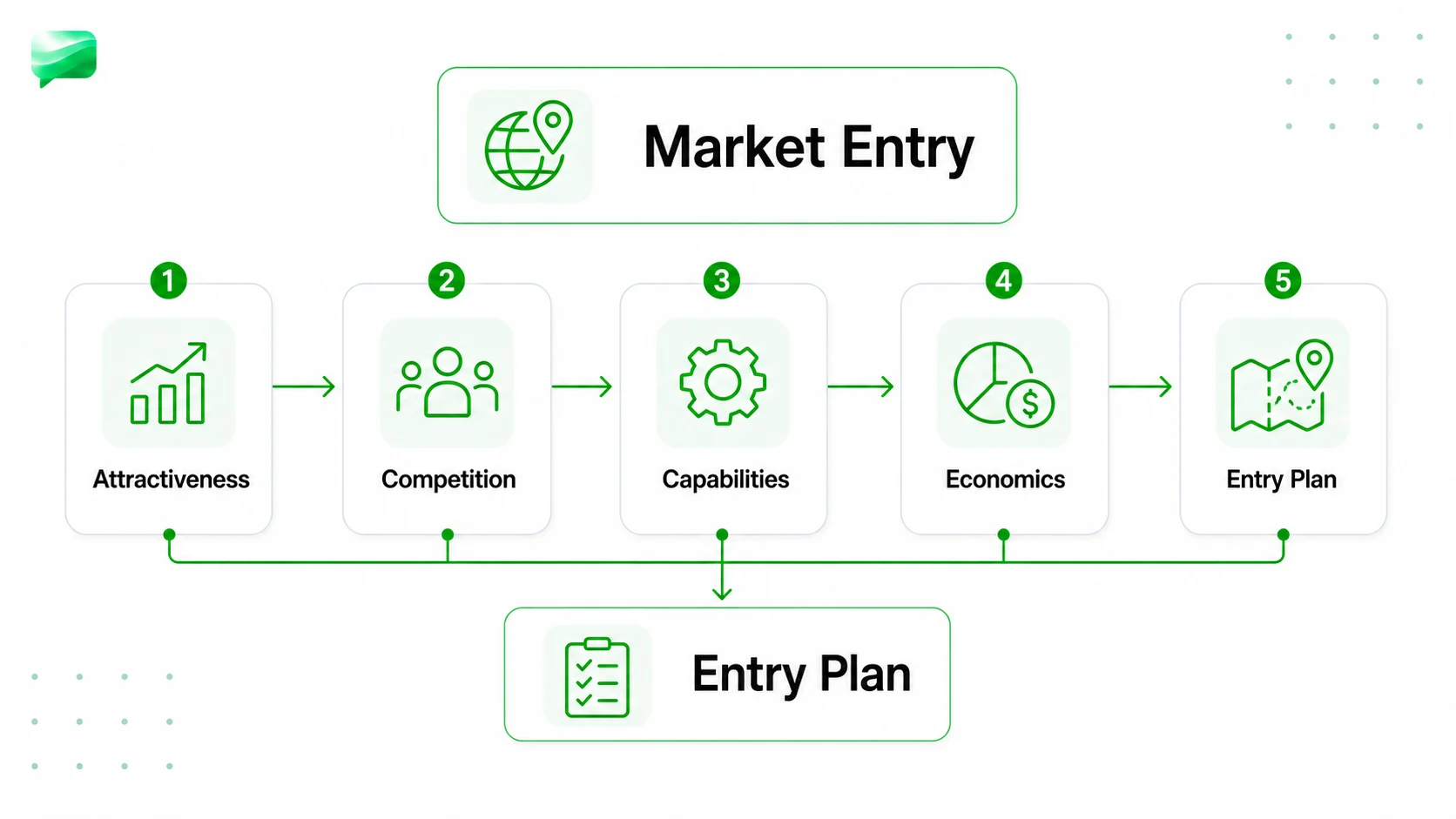
Step 1: Define scope precisely
Before any analysis, align on what "entering" means. Ask about geography (country, region, or global), product scope (existing or new), customer segment (B2B enterprise, SMB, consumer), and time horizon (12-month pilot vs 3-year rollout). If scope is fuzzy, your recommendation will be fuzzy.
Three scope questions to ask early:
- What is the client's objective: growth, diversification, margin, or strategic position?
- What constraints matter most: budget, timeline, risk tolerance, regulatory exposure?
- What does success look like: revenue target, payback, or market share?
For sizing the addressable market, see the market sizing step-by-step guide.

Market entry · medium
Practice market entry in a real case interview
Matched to this market entry guide: a live healthcare market entry case with an AI interviewer. Free, scored on every step.
Step 2: Assess market attractiveness
Use a short, decision-oriented lens covering demand potential (size and growth), profit pool quality (margins, pricing power), competitive structure (concentration, incumbent strength), and barriers (licensing, distribution, compliance). The market attractiveness framework gives a more structured scoring approach when you need to compare multiple candidate markets side by side.
Work your own numbers through the free market size calculator before you quote a TAM in a case. Seeing how much the SOM moves on a single penetration assumption is what stops you defending a figure you cannot justify.
Strong candidates do not stop at TAM. They move to SAM and a realistic SOM tied to distribution, brand strength, and execution capacity.
Run a market-sizing rep from the Road to Offer drill engine. Answer a real prompt and get AI-scored feedback. Free accounts include 5 drills per day for the first 3 days after signup.
Before moving to right to win, make the TAM to SAM to SOM chain a reflex rather than a lookup.
Quick Math
- A market has a TAM of $8,000M. SAM is 35% of TAM. What is SAM, in dollars?
SAM = TAM x SAM share.
- Using the same $8,000M TAM, you can serve 35% of it and expect to capture 6% of that segment in three years. What is SOM, in dollars?
SOM = TAM x SAM share x Capture rate, applying the capture rate to SAM, not TAM.
- A three-year revenue target of $126M sits against the $2,800M SAM. What share of SAM does that require, in percent? Round to the nearest 0.1 percentage point.
Required share of SAM = Revenue target / SAM.
Step 3: Evaluate right to win
Attractive markets still fail for entrants with weak fit. Score four dimensions:
Unit economics is where your profitability instincts overlap with market entry: gross margin, CAC payback, and operating leverage.
Score the four dimensions on a real prompt before moving to entry mode, since mode should follow from where you are weak.
Interactive drill set. Write an answer before revealing the worked solution, then continue into Road to Offer for scored practice and AI feedback.
Step 4: Choose entry mode deliberately
Mode choice should follow from constraints, not preference.
Market entry sits in the "new market" column of Ansoff's growth matrix (H.I. Ansoff, Strategies for Diversification, HBR 1957). See the Ansoff matrix case interview guide for a worked breakdown of all four quadrants. If the product is also new, you are in "diversification" territory, the highest-risk quadrant. Flag this explicitly.
Structure a case prompt against the clock from the Road to Offer drill engine. Answer a real prompt and get AI-scored feedback. Free accounts include 5 drills per day for the first 3 days after signup.
Step 5: Recommend with economics and risk plan
Close with: recommendation (go/no-go and mode), why now (2-3 evidence points), economics (upside and payback), risks (top 1-2 plus mitigation), and execution plan (pilot vs full rollout).
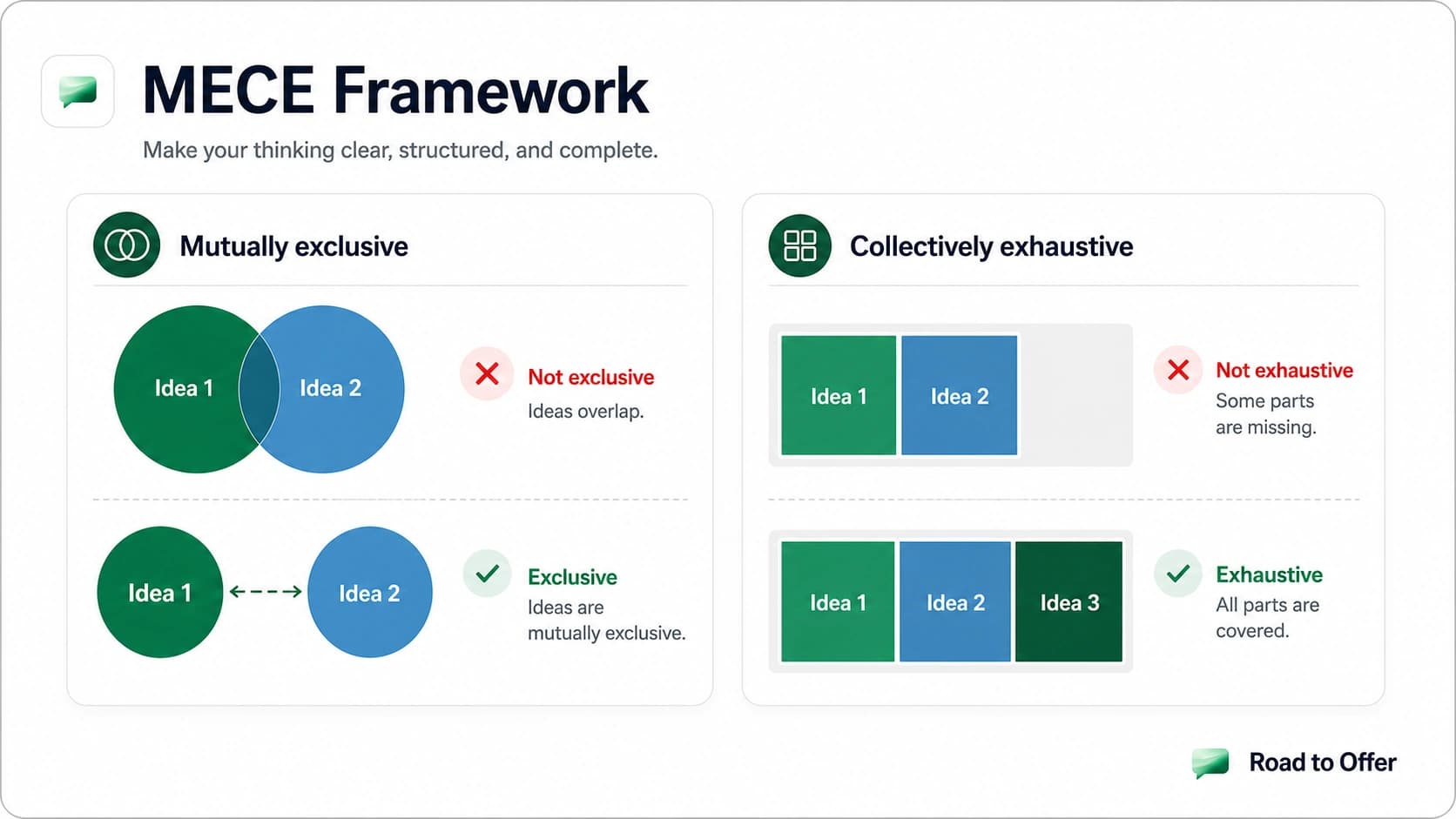
Learn frameworks properly
Pick and adapt structures instead of memorizing buckets.
What is a real-world example of market entry analysis?
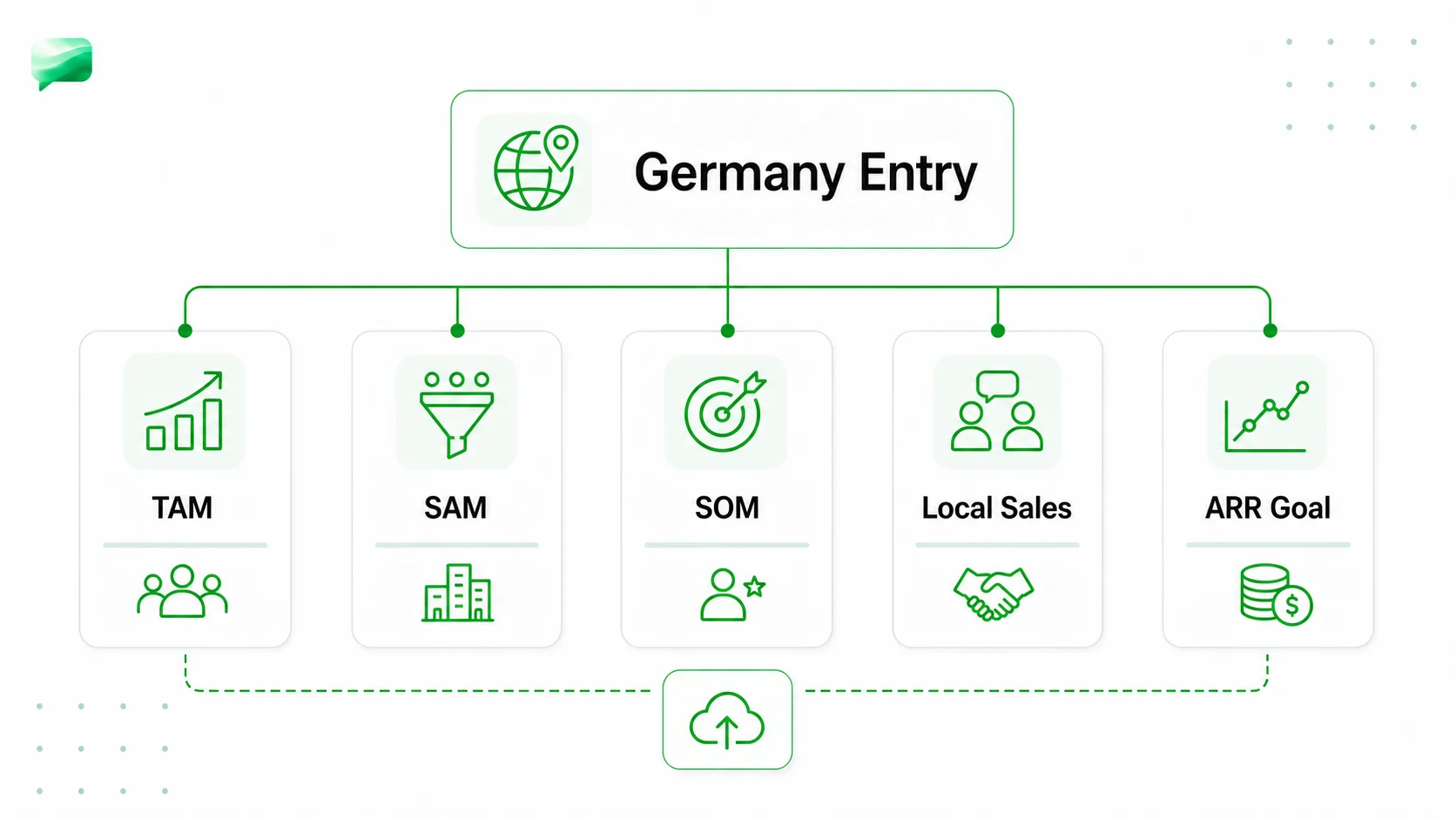
Case prompt: A US B2B SaaS company is considering entering Germany. Walk through the 5-step framework end-to-end.
How does the framework apply to SaaS expanding into Germany?
Scope. Germany, B2B mid-market segment. Objective: add $30M ARR in 3 years. Constraint: limited local sales team in year 1.
Attractiveness. TAM is roughly $1.2B in the relevant software category. SAM (mid-market plus target industries) is roughly $450M. Realistic 3-year SOM at 4-6% share equals $18M-$27M ARR. If this sizing step feels slow, use the market sizing framework before full case practice.
Right to win. Product fit is high (existing product localized in 6 months). Distribution is medium (no direct team initially). Economics are solid on gross margin, but customer acquisition efficiency is uncertain. That economics check should feel like a lightweight profitability framework: revenue ramp, gross margin, fixed investment, and payback. A 3Cs framework pass at this stage also surfaces whether the client's capabilities genuinely differentiate it from local competitors or whether the gap is too wide to close through a partnership.
Entry mode. Partner-led entry in year 1, then direct sales expansion in year 2. Rationale: fastest path to distribution with manageable execution risk. If the prompt instead asks whether to buy a German target, switch to an M&A case framework.
Quick Math
- Total three-year investment for an entry is $21M and gross margin is 70%. What cumulative revenue is needed to recover the investment, in dollars?
Break-even revenue = Total investment / Gross margin.
- Revenue ramps $8M in year 1 and $17M in year 2. How many dollars short of the $30M break-even bar is cumulative revenue at the end of year 2?
Gap = Break-even revenue - Cumulative revenue to date.
- Using the $30M break-even revenue and a $600M SAM, what share of SAM must the entry capture to break even, in percent? Round to the nearest 0.1 percentage point.
Required share of SAM = Break-even revenue / SAM.
What does the breakeven math look like?
Walk through the investment case step by step.
Assumptions:
- Year 1 investment (localization, partner setup, marketing, small team): $5M
- Year 2 investment (direct sales hiring, expanded marketing): $7M
- Year 3 investment: $3M
- Total 3-year investment: $15M
- Gross margin on SaaS revenue: 78%
- Target: $27M ARR by end of year 3
Breakeven revenue = $15M / 0.78 = $19.2M cumulative.
With a ramp of $5M ARR in year 1, $15M in year 2, and $27M in year 3, cumulative revenue across 3 years is roughly $47M.
Cumulative gross profit, Years 1-2 = ($5M + $15M) x 0.78 = $15.6M. Against a $15M total investment, you break even during year 2, around month 22-24. That is a reasonable payback for a SaaS market entry.
Sanity check. Required SOM for breakeven = $19.2M / $450M = 4.3%. Successful SaaS entrants into European markets typically capture 2-5% of addressable market within 3 years (SaaStr benchmarking, 2025). The financial case supports entry.
Run the same break-even test on a different entry, graded question by question.
Run the same math out loud under a clock before your next live case.
How do you deliver the recommendation?
"I recommend entering Germany through a partner-led launch in year 1, followed by selective direct sales expansion in year 2. Market is attractive, product fit is strong, and the phased approach improves speed while limiting early fixed-cost risk. Breakeven lands around month 22 at 4.3% SAM share, which is achievable. Top risk is partner underperformance; mitigation is performance-based contracts plus a direct-channel contingency by month 9."
Apply the market entry framework to a Bain case. Solara must clear $2M of year-1 EBITDA to justify entering the Texas home battery market. Answer this Bain market entry case step in the article, then continue the full case. Continue the full case on Road to Offer
What are common mistakes in market entry cases?
Choosing entry mode before sizing the market
The most common mistake is candidates leading with "I would acquire a local player" before establishing whether the market is attractive. Mode follows from scope and attractiveness, not the other way around.
Stopping at TAM instead of SOM
A $5B TAM means nothing if your realistic SOM is $30M and you need $200M to break even. Always pressure-test the market share required for breakeven against incumbent positions.
Ignoring right to win
Big markets attract every competitor. If your client lacks a clear right to win on product, distribution, or cost position, recommend no-go or a narrowly scoped niche entry, not full-scale launch.
Skipping the risk and mitigation pair
Naming risks without mitigations is a red flag. Every named risk should have one concrete mitigation step and a timing trigger. Running a quick SWOT analysis of the client's position in the new market is an efficient way to surface both the internal weaknesses and external threats that most candidates miss when they focus exclusively on market size. For markets with significant macro or regulatory exposure, a PESTLE analysis helps catch political and legal barriers before they appear as surprises in the recommendation stage.
Market entry · medium
Practice a real healthcare market entry case
Matched to this market entry guide: a live healthcare market entry case with an AI interviewer. Free, scored on every step.
When does market entry differ from M&A or growth cases?
Market entry overlaps with M&A and growth cases but the structure differs in emphasis.
If the prompt names a target company and price tag, treat it as M&A. If it asks about expanding share within an existing market, lean on growth strategy cases. For a complete prep stack, see the consulting toolkit bundle.
Related Frameworks
Market entry rarely sits alone in an interview. The most common combinations:
- Case Interview Frameworks Complete Guide, the full framework selector covering when to use market entry versus profitability, M&A, or pricing
- Market Sizing Framework, for quantifying the TAM and SAM before committing to entry
- Market Attractiveness Framework, a scoring lens that evaluates size, growth, profitability, and competitive intensity across candidate markets
- Ansoff Matrix, maps the strategic growth options (market penetration, development, product development, diversification) to anchor the entry rationale
- PESTLE Framework, pressure-tests macro and regulatory risk around expansion decisions
- Porter's Five Forces, assesses whether the target industry can sustain attractive profit margins
Sources and Further Reading (checked June 17, 2026)
- IGotAnOffer, market entry consulting cases: igotanoffer.com/blogs/mckinsey-case-interview-blog/market-entry-case
- Management Consulted, case interview frameworks: managementconsulted.com/case-interview-frameworks
- BCG, case interview preparation: careers.bcg.com/global/en/case-interview-preparation
- Bain, case interview preparation and hiring process: bain.com/careers/hiring-process/case-interview
- McKinsey, interviewing resources: mckinsey.com/careers/interviewing
- Ansoff, H.I. (1957). "Strategies for Diversification." Harvard Business Review: hbr.org/1957/09/strategies-for-diversification
- HBR, "Gateways to Entry" market entry strategy: hbr.org/1982/09/gateways-to-entry
- SaaStr, European SaaS expansion benchmarks (2025)
Practice a full market entry case end to end
Road to Offer simulates real market entry cases with dynamic data, follow-up questions, and detailed scoring on structure, breakeven math, and recommendation quality.
Frequently asked questions
Resources and related guides
- Practice market entry in a real case interviewPractice
- Browse all free resourcesResource hub
- Product Launch Case Interview: Framework and Example (2026)Frameworks · Mar 31, 2026
- 3Cs Framework: Company, Customer, Competitor (Worked Example)Frameworks · Feb 6, 2026
- 4Ps Framework Case Interview: Product, Price, Place, PromotionFrameworks · Feb 6, 2026