
Monitor Deloitte Case Study and Case Interview: The Written Case, Group Case, and Prep (2026)
The Monitor Deloitte written case study explained: independent prep time, the slide packet, the presentation to a Director, plus the group case, the individual case, and a prep plan.
On this page
This Monitor Deloitte case interview guide for 2026 is for candidates targeting Deloitte's strategy consulting practice, not a generic Deloitte implementation role. Candidates search for Monitor Deloitte for two related reasons: to understand what the practice does and to prepare for its case interview process. The answer is connected: Monitor Deloitte was formed through Deloitte's 2013 acquisition of Monitor Group, the strategy consultancy co-founded in 1983 by Harvard Business School professor Michael Porter, and it still focuses exclusively on corporate strategy, market entry, M&A strategy, and competitive positioning, the same work McKinsey, BCG, and Bain do. That history is why Monitor Deloitte sits closer to MBB-style strategy work than to Deloitte's broader implementation and digital practice (Deloitte S&O), so the interview prep needs to match that positioning: candidate-led cases, strategy framing, and sometimes a group case component in the assessment center, rather than the more interviewer-led format typical of broad Deloitte consulting rounds.
What format should you prepare for at Monitor Deloitte?
Monitor Deloitte preparation depends on the role, region, and hiring stage. Individual cases are commonly framed as candidate-led strategy work, while some UK and EMEA assessment centers add a group case and behavioral interview. Treat the invitation as the source of truth.
Figures above are Road to Offer's article-reported synthesis of candidate processes, checked June 17, 2026, not a published Deloitte format.
Use the candidate-led strategy method in order: clarify the decision and constraint, build a custom issue tree, test the highest-value branch, then synthesize a CEO recommendation with a risk and next step. In an energy market-entry case, for example, the recommendation is stronger when it states the chosen path and the reason than when it lists both sides without a call.
The most common mistake applicants make: treating the Monitor Deloitte case interview like a standard Deloitte S&O interview and under-preparing for case rigor. Don't.
What Is Monitor Deloitte?
Monitor Deloitte is the strategy arm within Deloitte Consulting. It serves clients on questions like where to grow, which markets to enter, how to reposition against competitors, and whether an acquisition has strategic logic. That makes it different from broader Deloitte Consulting roles that may blend strategy, implementation, technology, and transformation delivery.
For candidates, the practical implication is simple: a Monitor Deloitte application should be treated as a strategy-consulting application first. Your interview preparation should emphasize candidate-led cases, market-entry logic, M&A rationale, growth strategy, and concise executive recommendations.
How Is Monitor Deloitte Different from Deloitte Consulting?
Candidates often conflate these two entities. They are distinct practices with different cultures, different hiring standards, and different work types.
As an approximate US anchor (early 2026, figures change yearly and vary by office and program), core Deloitte Consulting pays roughly $95,000-$105,000 total at the undergraduate analyst level, around $200,000-$240,000 total for post-MBA consultants, and roughly $240,000-$290,000 total at the manager level. Monitor Deloitte typically sits about 10-20% above these at each level given its strategy-practice positioning. Treat these as ballpark figures and confirm current numbers against our consulting salary guide and your own offer.
When you see a Deloitte job posting, check whether it's specifically Monitor Deloitte or Deloitte Consulting broadly. The recruiting process, required prep, and career trajectory are meaningfully different.
For the broader Deloitte assessment center, group case, and service-line process, use the Deloitte case interview guide as the companion page.
The Interview Process
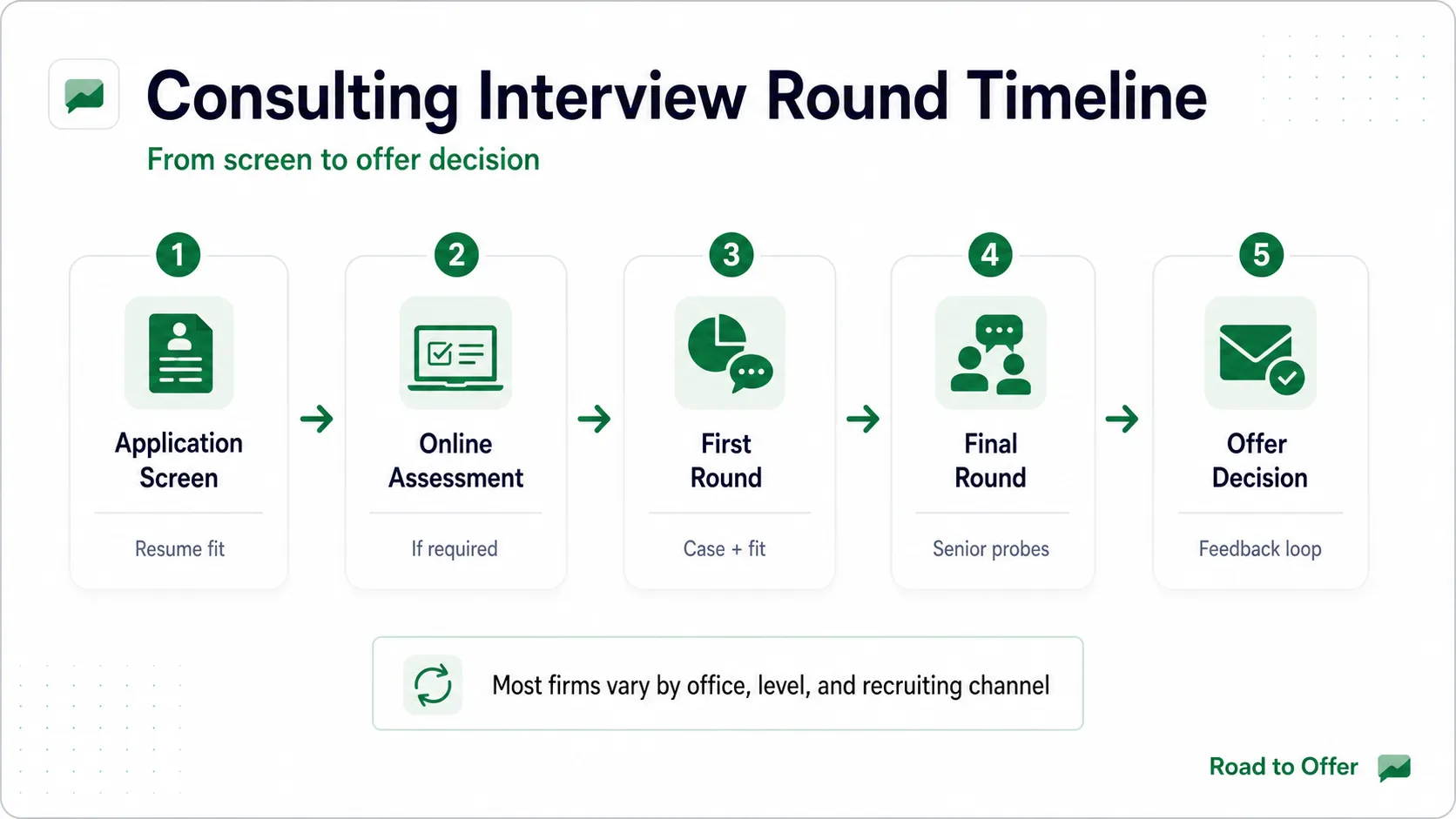
Monitor Deloitte's process varies by region and career level. The most common formats:
U.S. Graduate/Post-MBA Recruiting:
- Round 1: 2 × 30–40 minute candidate-led case interviews (typically virtual, with Managers or Senior Managers)
- Round 2 (Final): 2 × 30–40 minute case interviews with Partners or Managing Directors, plus a fit/behavioral interview
UK/EMEA Assessment Center (most common for undergrad and grad):
- Group case exercise (30–45 min): 4–6 candidates work together on a business problem; assessors observe dynamics
- Individual case interview (30–40 min): Candidate-led, 1-on-1 with a Partner or Manager
- Behavioral interview (20–30 min): Competency-based questions
The assessment center format is more common in Europe and Asia-Pacific. U.S. recruiting typically follows the standard 2-round individual case process.
For the strategy-practice fit portion, use the Monitor Deloitte behavioral interview questions guide alongside this case prep.
Practice candidate-led strategy cases with real AI feedback
Road to Offer's AI coach scores your case structuring and recommendation quality before your Monitor Deloitte interview.
How should you align your Monitor Deloitte resume and cover letter before this interview?
Keep the documents under the Monitor Deloitte role while using parent-brand guidance only when the posting makes it relevant. Show strategic diagnosis, communication, and implementation you can defend.
- Before: Supported a strategy engagement.
- After: Structured the operating question, compared two options, and prepared the recommendation used in the sponsor decision.
Check the current role, office, and round format before naming a written, group, or case variant. Recruiters read the resume and letter together: the resume proves strategy work, while the letter explains why Monitor or the selected Deloitte practice. Rehearse the revised line against the current case flow.
Keep the arm-specific evidence clear
Upload the resume for a Road to Offer graded report, not a Monitor Deloitte score.
Revise one strategy line, rehearse the matching decision, and use it in the next case rep.
Case Interview Format: What to Expect
Monitor Deloitte cases skew heavily toward corporate strategy. Expect:
Which case topics come up most at Monitor Deloitte?
Reported by candidates, the most common Monitor Deloitte topics are strategy-weighted cases about market entry, growth, profitability, pricing, and M&A. This is a candidate-reported pattern, not an official Monitor Deloitte topic-frequency statistic. Because Monitor is Deloitte's strategy practice, pure operations and technology implementation cases are less common than they are in broader Deloitte consulting interviews.
Common case types:
- Market entry: "Should our client enter the European renewable energy market?"
- Competitive positioning: "A consumer goods company is losing market share to a private-label competitor. What should they do?"
- M&A strategy: "Should our client acquire this target? What is the strategic rationale?"
- Growth strategy: "A professional services firm wants to grow revenue by 20% in 3 years. How?"
What Monitor Deloitte cases rarely involve:
- Pure profitability improvement (too operational)
- Operations or cost-cutting focus
- Market sizing as a standalone exercise (though it appears as a sub-component)

Market entry · medium
Practice for Monitor Deloitte in a real case interview
Matched to this Monitor Deloitte guide: a live energy market entry case with an AI interviewer. Free, scored on every step.
The structure of a typical 35-minute Monitor Deloitte case:
Monitor Deloitte Case Flow
- 01
Clarification (2–3 min). Ask 2–3 targeted clarifying questions to sharpen the problem scope. Focus on defining success metrics and any constraints. Don't ask for data you should be able to estimate.
- 02
Framework (3-4 min). Structure the problem with a custom MECE framework. For a market entry case, this might be: Market Attractiveness (size, growth, competition) -> Company Fit (capabilities, resources) -> Entry Mode (build, buy, partner) -> Risks. Avoid presenting a memorized template; Monitor Deloitte interviewers flag canned frameworks.
- 03
Analysis (15–18 min). Work through the top 2 branches of your framework with data the interviewer provides. Show hypothesis-driven thinking: state what you expect to find, analyze, and confirm or adjust. One numerical calculation is typical.
- 04
Synthesis (4–5 min). Lead with a clear, direct recommendation. State it in the first sentence. Follow with 3 supporting reasons and the key risk or caveat. Monitor interviewers expect CEO-ready communication, not a list of pros and cons.
The synthesis step is where many candidates underperform. After thorough analysis, they say "there are arguments on both sides" instead of committing. Monitor Deloitte expects a view. See our case interview synthesis guide for how to structure this.
The analysis step almost always hides one numerical calculation (market sizing, a payback, a margin bridge).
Practice this next: Use structure drills for the opening issue tree, then run a synthesis drill to practice committing to a CEO-level recommendation.
Run the numbers in a case from the Road to Offer drill engine. Answer a real prompt and get AI-scored feedback. Free accounts include 5 drills per day for the first 3 days after signup.
What is the Monitor Deloitte written case study?
The written case study is the format that separates Monitor Deloitte from a standard candidate-led interview, and it is the one most candidates end up facing. Instead of a conversation where the interviewer feeds you data, you are handed a packet and left alone with it.
The shape reported consistently across candidate accounts and prep guides is:
Confirm the exact timings in your invitation rather than trusting any guide, this one included. Reported figures vary by office and by year, and the invitation is the only source that is true for your process.
The three things that decide the outcome:
- Triage before you analyse. Read the questions first, then the packet. Mark which exhibits can answer which question and accept that some slides exist to be skipped. Candidates who read linearly run out of time in the packet and present an unfinished answer.
- Lead with the recommendation. Your first slide states the answer. Everything after it is support. A deck that walks the reader through your journey and reveals the conclusion at the end reads as a student presentation, not a consultant's.
- Defend without collapsing. The challenge after the presentation is the test. A partner pushing back is checking whether you know which parts of your answer are load-bearing and which are assumptions you would happily revise.
Deloitte's own published Footloose written case is the closest thing to a rehearsal you can get for free. It is worked end to end, question by question, in the Deloitte practice cases page, alongside the rest of Deloitte's official case library.
What is the group case, and how is it actually scored?
If you're in an assessment center, the group case is your chance to demonstrate the collaborative leadership that consulting firms value.
Interviewers are NOT primarily evaluating whose analysis is best. They're watching for:
- Does this person help the group make progress? Proposing structure, suggesting next steps, keeping the group on track.
- Do they listen and build on others' ideas? Adding "and another factor to consider..." builds the conversation. Ignoring what was just said doesn't.
- Can they synthesize? When 10 minutes remain, the person who says "OK, let me pull together what we've covered" and draws the threads together stands out.
- Do they know when to lead vs. follow? Dominating a 45-minute group case signals low EQ. Never talking signals low confidence. The win is contribution calibrated to the room.
Behavioral Interview Preparation
Monitor Deloitte's behavioral questions focus on strategic impact and leadership. Specific themes:
The "Why Monitor Deloitte" question requires a real answer. You need to be able to articulate why the Deloitte ecosystem (scale, global platform, access to implementation capabilities) is a feature, not a fallback. "It was my second choice after McKinsey" is the one answer guaranteed to sink you.
For behavioral prep structure, see our STAR method for consulting interviews guide.
Connecting to Broader Prep
Monitor Deloitte's interview difficulty sits squarely in the range that MBB case prep covers. If you're targeting both MBB and Monitor Deloitte:
- Use McKinsey case interview guide for structuring discipline
- Use BCG case interview guide for quantitative case rigor
- Use Bain case interview guide for the conversational candidate-led style closest to Monitor Deloitte
- Use Strategy& case interview guide for the peer strategy arm of Big 4 and its integrated case format
- Use EY-Parthenon case interview guide for a comparable PE diligence and strategy focus
- Use Oliver Wyman case interview guide as a candidate-led Tier-2 peer
- Run 30+ practice cases before your first Monitor Deloitte interview
Practice Monitor Deloitte-style synthesis
Run a focused Road to Offer synthesis drill after your next strategy case so your final recommendation is direct, supported, and partner-ready.
Sources and Further Reading (checked June 17, 2026)
- CaseInterview.com Monitor Deloitte profile: caseinterview.com/monitor-deloitte
- Hacking the Case Interview, Deloitte guide: hackingthecaseinterview.com/pages/deloitte-case-interview-prep
- IGotAnOffer, Deloitte case interview: igotanoffer.com/blogs/mckinsey-case-interview-blog/deloitte-case-interview
- Road to Offer, Deloitte case interview guide: roadtooffer.com/blog/deloitte-case-interview-guide
- PrepLounge, Deloitte interview guide: preplounge.com/en/blog/consulting/firms/deloitte
Frequently asked questions
Resources and related guides
- Practice for Monitor Deloitte in a real case interviewPractice
- Browse all free resourcesResource hub
- Arthur D. Little Case Interview: Format, Sample Cases, and a 2026 Prep PlanFirm Specific · Mar 31, 2026
- AlixPartners Careers 2026: Turnaround Salary and Interview GuideFirm Specific · Sep 11, 2026
- Alvarez and Marsal Careers 2026: Restructuring Salary and Interview GuideFirm Specific · Sep 11, 2026
- Monitor Deloitte Behavioral Interview Questions: Strategy Fit (2026)Firm Specific · Jul 7, 2026