
Bain Case Interview Guide (2026): Format, Examples + Prep
The 2026 Bain case interview: standardized first-round cases, candidate-led partner rounds, the SOVA online assessment, written cases, PE due diligence, and a fully worked acquisition example.
On this page
The Bain case interview has changed. Bain has moved many first-round interviews to standardized, interviewer-led cases built by a central team, while partners in the final round still run candidate-led cases drawn from their own projects. Most regions also screen you with an online assessment (SOVA, TestGorilla, or HireVue) before any live case. Expect two first-round interviews and two to three final-round interviews, each mixing case work with an experience interview, and a written case in some second rounds. Prep for Bain by practicing both case formats, drilling PE-style due diligence, clean math, recommendation-first synthesis, and stories that show collaboration (Bain Careers; Glassdoor interview data). If you are comparing Bain against McKinsey and BCG, use the MBB case interview prep guide to sequence firm-specific reps.
Bain Case Interview Format and Rounds
Bain's recruiting pipeline usually centers on five stages, including an online assessment that most regions now run before any live case. Treat your invitation as the source of truth rather than assuming every process is identical.
The Bain Interview Process
- 01
Application. Resume + cover letter screening
- 02
Online Assessment. SOVA, TestGorilla, or HireVue (most regions)
- 03
First Round. 2 back-to-back interviews (~40-45 min each)
- 04
Final Round. 2-3 interviews with senior leaders
- 05
Offer Decision. Usually within 1-2 weeks
Application and Online Assessment
Your resume is screened by the recruiting team, not an algorithm. Strong GPAs and leadership experience get prioritized. After the resume screen, most regions ask you to complete an online assessment before interviews: the SOVA test (common in Europe, the Middle East, and Asia), or TestGorilla and HireVue in other markets. These mix numerical reasoning, logical reasoning, and situational-judgment or "Bainie" values modules. Bain's official interview preparation page covers the live case, while a separate assessment step gates many processes. Verify your specific office invite so you do not get blindsided by a screen you did not prepare for.
If SOVA is the screen you are facing, try the format before test day with the free SOVA practice: seven original SOVA-style questions (data interpretation, percentage change, exchange rates, a funnel, two sequences and a matrix), each explained after you answer. The interviews that follow are cases, so start one now:
 Bain
BainGrowth · easy
Practice real Bain cases
Matched to this Bain guide: a food & beverage growth case, guided step by step. Free.
First Round
Two back-to-back interviews, each roughly 40-45 minutes. Every interview pairs a case (about 30-35 minutes) with a shorter experience interview (about 10-15 minutes). The important update for 2026: Bain has moved many first-round cases to a standardized, interviewer-led format built by a central team, so the interviewer may share a main question and sub-questions, then direct you to specific areas. That is closer to McKinsey than to Bain's historical style. You still bring structure and clear reasoning, but you may not be setting the agenda the way the old candidate-led format assumed. Practice answering the exact question asked rather than running ahead.
Final Round
Two to three interviews with Senior Managers, Associate Partners, or Partners. This is where the candidate-led format survives: partners often run cases drawn from their own client engagements rather than the centrally scripted first-round cases, so they are more conversational and open-ended. Interviewers have latitude to go off-script, probe your reasoning, and test your composure under ambiguity. The experience-interview component gets deeper here, because partners are evaluating whether you would represent Bain well in front of a client CEO.
Written Case (Office-Specific)
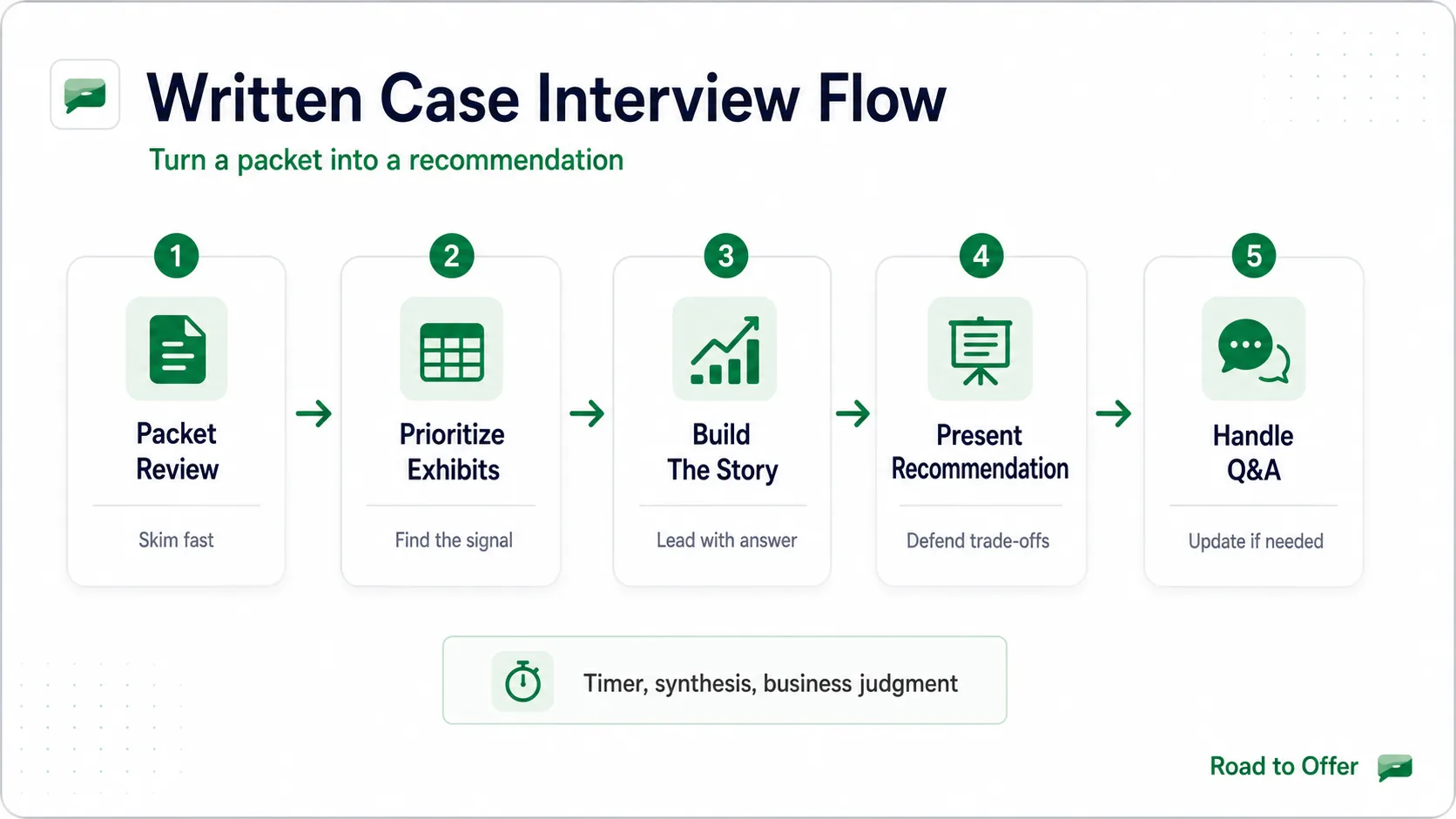
Some Bain offices add a written case, most commonly in the second round in the US, UK, European, and Asian offices. You receive a data packet, commonly 20-30 slides or pages of charts, tables, and qualitative text, and you build a recommendation independently before presenting it. Reported timing varies: many candidates describe roughly 55 minutes to analyze and handwrite their recommendation followed by about 40 minutes to present and defend it, while other formats use a longer prep window and a shorter presentation. You typically cannot use a calculator, so clean mental math matters. According to PrepLounge's Bain interview guide, the written case is used in select offices rather than universally, so confirm whether yours uses it. For a deeper walkthrough, see our written case interview guide.
See where you stand on Bain's evaluation criteria
Practice a real case with AI coaching on structure, math, and business judgment, the skills Bain interviewers score you on.
What Makes Bain Different from McKinsey and BCG
Candidates who prepare with generic "MBB" materials miss firm-specific differences that interviewers notice immediately. Here's the actual comparison:
The Format Shift: Standardized vs Candidate-Led
This is the most misunderstood part of preparing for Bain in 2026. For years Bain was the clearest example of a candidate-led firm: you proposed the structure, chose which branch to explore, requested data, and drove toward a recommendation. That is still true with many partners in the final round, who run cases from their own engagements. But Bain has moved much of the first round to standardized, interviewer-led cases built centrally, where the interviewer shares the question and sub-questions and directs you to specific areas. The practical takeaway: do not prepare for only one format. Management Consulted's Bain prep resource and IGotAnOffer's Bain guide both note this shift, and the difference between first-round and partner-round style is real.
Opening sequence that works in either format: (1) restate the client question, (2) clarify the success metric, (3) ask one or two questions that would change the analysis, (4) take 60 seconds to build a short structure, (5) state which branch you are prioritizing and why. In a standardized first-round case, then answer the exact question the interviewer asks rather than running ahead; with a partner, drive the next step yourself. Starting with the business objective, not a memorized framework, is what separates Bain-ready candidates from candidates who practiced on generic cases.
Collaboration Emphasis
Bain's culture is built on teamwork. Their internal motto, "results, not reports," signals a bias toward practical delivery over intellectual showmanship. Interviewers notice whether you ask clarifying questions, acknowledge their hints, and communicate as a thought partner rather than performing a solo analysis. The difference between a "strong hire" and "no hire" at Bain often comes down to how the interviewer felt working through the problem with you.
The Bain Capital Connection
Bain & Company partners founded Bain Capital in 1984, now one of the world's largest alternative-asset firms, with roughly $185-225 billion in assets under management depending on the reporting source and date (Bain Capital). This heritage means PE-style cases, such as evaluating an acquisition target, assessing a portfolio company, or calculating investment returns, appear more frequently at Bain than at BCG or McKinsey. If you have only prepared profitability and market entry cases, you have a gap. For the corporate-history and career distinction, see Bain Capital vs Bain & Company, and for the underlying analytical toolkit, the private equity case interview guide and the PE due diligence framework.
What Bain Evaluates
Bain doesn't publish a formal scoring rubric, but interview patterns from Glassdoor's Bain interview review database, Bain's own interview preparation page, and coaching communities reveal four consistent dimensions:
1. Structured Problem Decomposition
Can you break a complex problem into manageable, mutually exclusive parts? Bain cases are candidate-led, so interviewers expect you to bring the structure and show clear, organized thinking as you work through it. A messy structure is worse than a slightly incomplete but well-organized one.
What good looks like: "There are two possible drivers here: demand-side and supply-side. On the demand side, I'd look at volume and pricing. Let me start with volume since the client mentioned declining foot traffic."
2. Quantitative Precision
Bain cases involve real math, especially PE/financial cases where you'll calculate valuations, margins, EBITDA multiples, and growth rates. Accuracy matters more than speed. An interviewer will forgive a 10-second pause to set up the calculation correctly. They won't forgive a 30% math error that you don't catch.
What good looks like: Sanity-checking every number. "That gives us $120M in revenue, which at a 15% margin is $18M EBITDA. For a 10x multiple, the enterprise value would be $180M. That's in the right ballpark for a mid-market healthcare acquisition."
Math narration protocol: Bain's public prep guidance calls out "quick math and sensible assumptions." In practice, say (1) what you are calculating, (2) the formula, (3) the units, (4) the approximate result, and (5) the implication for the case. Silent math is the failure mode. Interviewers cannot follow reasoning they cannot hear.
Bain-style case math, calculator-free from the Road to Offer drill engine. Answer a real prompt and get AI-scored feedback. Free accounts include 5 drills per day for the first 3 days after signup.
3. Business Judgment
Beyond the math, can you make a recommendation that makes commercial sense? Bain values practical, implementable advice. Your recommendation should sound like something a partner could walk into a boardroom and deliver, not an academic exercise.
What good looks like: "I'd recommend proceeding with the acquisition, but only if we can negotiate the price below 9x EBITDA. At 10x, the returns are marginal given the integration risk."
Recommendation template: Lead with the answer, then show you understand the tradeoff. "I recommend [option] because it [primary reason tied to client objective]. The main risk is [specific risk], so I would [concrete mitigation]." Avoid ending with "I would need more data" unless the case truly cannot be decided. Bain interviewers expect a recommendation from imperfect information, followed by naming what you would validate next.
4. Communication and Collaboration
Can you explain your thinking clearly while engaging with the interviewer? This is where the "Bainie" culture shows up most. Top-down communication (answer first, then supporting logic), concise delivery, and genuine back-and-forth with the interviewer all matter.
What good looks like: Responding to interviewer pushback with curiosity rather than defensiveness. "That's a fair challenge, let me reconsider the assumption about customer switching costs."
Common Bain Case Types
Five case archetypes dominate at Bain. Prepare at least two practice cases for each, and use the Bain practice cases page when you want full worked examples for these archetypes rather than the summaries below:
Profitability analysis: the most common type across all MBB firms. Revenue and cost decomposition, margin diagnosis, and a turnaround recommendation. See our profitability framework guide for structure.
Private equity due diligence: evaluate a target acquisition. Market attractiveness, competitive position, financial performance, and value creation levers. This is where Bain diverges most from other firms.
Growth strategy: how should a portfolio company or client expand? New products, new geographies, new customer segments. Requires market sizing and competitive analysis.
Market entry: should the client enter a new market or geography? Structure with our market entry framework.
Pricing: set or change price for a product or service. Structure around willingness to pay, competitor pricing, and cost floor. Often appears in growth and market entry cases as a sub-question.
Operations and cost optimization: reduce costs across a value chain. Often involves supply chain, procurement, or labor efficiency analysis.
Practice a Bain-style acquisition diligence case where you build the thesis and make a go/no-go call:
Run a Bain M&A case the way the archetype works. Craft beer growth has slowed, so the US segment leader is weighing a hard seltzer acquisition. Answer this Bain M&A case step in the article, then continue the full case. Continue the full case on Road to Offer
A Bain-Style PE Case: Acquisition Analysis
This walkthrough demonstrates how a Bain PE due diligence case unfolds. Whether the interviewer hands you the sub-questions (standardized format) or you propose the structure yourself (a partner round), the work is the same: analyze each piece, build a running thesis, and deliver a quantified recommendation.
Setup
"Our client is a mid-market PE fund considering acquiring CloudStack, a B2B SaaS company that provides infrastructure monitoring tools to mid-size enterprises. The asking price is 12x trailing EBITDA. The fund's partners want to know: should they proceed, and at what price?"
CloudStack's financials: $40M ARR, $8M EBITDA (20% margin), 85% gross margins, 110% net revenue retention, ~400 enterprise customers.
The Analysis Framework
You structure the diligence around three areas and work through them in turn:
1. Market Attractiveness
The interviewer asks: "Is this a good market to invest in?"
The infrastructure monitoring market is $12B globally, growing at 14% annually. CloudStack has ~0.3% market share. The market is consolidating: the top 3 players hold 45% share, but the mid-market segment (companies with 100-5,000 employees) is fragmented, with no dominant player. CloudStack is the #2 player in this segment.
Strong answer: "The market is attractive: 14% growth, large TAM, and the mid-market segment is fragmented with no clear winner. CloudStack's position as #2 in that segment gives us a consolidation opportunity. The risk is that a top-3 player moves downmarket and competes directly."
2. Business Quality
The interviewer asks: "Is CloudStack a quality business?"
Data provided: 110% net revenue retention means existing customers spend 10% more each year. Gross margins of 85% are strong for B2B SaaS. Customer acquisition cost (CAC) payback is 18 months. Annual churn is 8% by logo count but only 3% by revenue (small customers churn, large ones stay and expand).
Strong answer: "The unit economics are strong. 110% NRR means we grow revenue even without new customers. The 85% gross margins give us operating leverage as we scale. The CAC payback of 18 months is healthy for enterprise SaaS. The churn pattern is actually positive: losing small customers while retaining and expanding large ones suggests the product has strong stickiness in the core segment."
3. Financial Returns
The interviewer asks: "Can we hit our 20% IRR target?"
This is the key Bain PE calculation. Here's how to think through it:
- Entry: 12x EBITDA = 12 x $8M = $96M enterprise value
- Assumed exit: 10x EBITDA in 5 years (conservative, assumes some multiple compression)
- Target: 20% IRR, which means roughly 2.5x money-on-money over 5 years (since 1.2^5 = 2.49)
- Required exit value: 2.5 x $96M = $240M
- Required exit EBITDA: $240M / 10x = $24M
- Required EBITDA growth: From $8M to $24M in 5 years = 3x, or ~25% annual EBITDA growth
"To hit 20% IRR at a 12x entry and 10x exit, we need EBITDA to grow from $8M to $24M over five years. That's roughly 25% annual growth. Given the market is growing at 14% and CloudStack has 110% NRR, we'd need to add approximately 11-15% growth from new customer acquisition on top of organic expansion. That's ambitious but achievable if we invest in the sales team. The return is sensitive to the exit multiple: at a 12x exit instead of 10x, the required exit EBITDA drops to $240M / 12x = $20M, so we'd only need EBITDA to grow from $8M to $20M (2.5x, or about 20% annual growth), which is more comfortable."
The Recommendation
"I'd recommend proceeding, but negotiating the entry price down to 10-11x EBITDA. At 12x, the returns work only if we execute aggressively on new customer acquisition and maintain margins during growth, which leaves little room for error. At 10x entry with a 10x exit, we need roughly 20% annual EBITDA growth, which is well within reach given the 14% market growth plus NRR-driven organic expansion. The key value creation levers are: expanding the sales team to capture mid-market share, pursuing 2-3 tuck-in acquisitions to accelerate geographic coverage, and improving operating leverage as ARR scales. The primary risk is competitive pressure from larger players moving downmarket; I'd mitigate this by investing in product differentiation for the mid-market segment within the first 12 months post-acquisition."
Run a full Bain-style PE due diligence case, scored end to end
Build the investment thesis, work the IRR math, and deliver a go/no-go recommendation, then get scored on the exact dimensions Bain interviewers weigh.
Bain Experience Interview (Behavioral)
Bain runs the behavioral portion as a dedicated experience interview, typically 10-15 minutes paired with the case in each round, not just 5 minutes of "fit" tacked on at the start. This is a meaningful difference from McKinsey's PEI, which is structured around four specific dimensions, and from BCG, where fit questions are woven into the case interview itself. For a deeper breakdown of Bain's fit interview, and for the broader playbook, see our consulting behavioral interview guide.
What Bain Probes For
- Leadership: Tell me about a time you led a team through a difficult situation. (They want to hear how you handled disagreement, not just that you delegated tasks.)
- Teamwork: Describe a situation where you had to work with someone difficult. (Bain cares deeply about this, more than McKinsey does.)
- Overcoming challenges: What's the hardest problem you've solved? (They're evaluating resilience and creativity, not just outcomes.)
- Motivation for consulting: Why consulting? Why Bain? (Generic answers are transparent. Reference specific Bain practices, industries, or cultural elements.)
- Intellectual curiosity: What's something you've learned recently that changed how you think? (This question catches candidates off guard. Have an answer ready.)
How to Prepare
Build a bank of 4-6 stories covering different themes. Use the STAR method (Situation, Task, Action, Result), but emphasize the collaborative and team dimensions of each story. Bain interviewers will probe deeper than surface-level responses, so expect 2-3 follow-up questions per story.
For your answer to the Why Bain question, reference specific aspects: the results delivery model, the mentorship culture, the Bain Capital ecosystem, a specific practice area or industry group that aligns with your interests, or a conversation you had with a current Bainie that resonated.
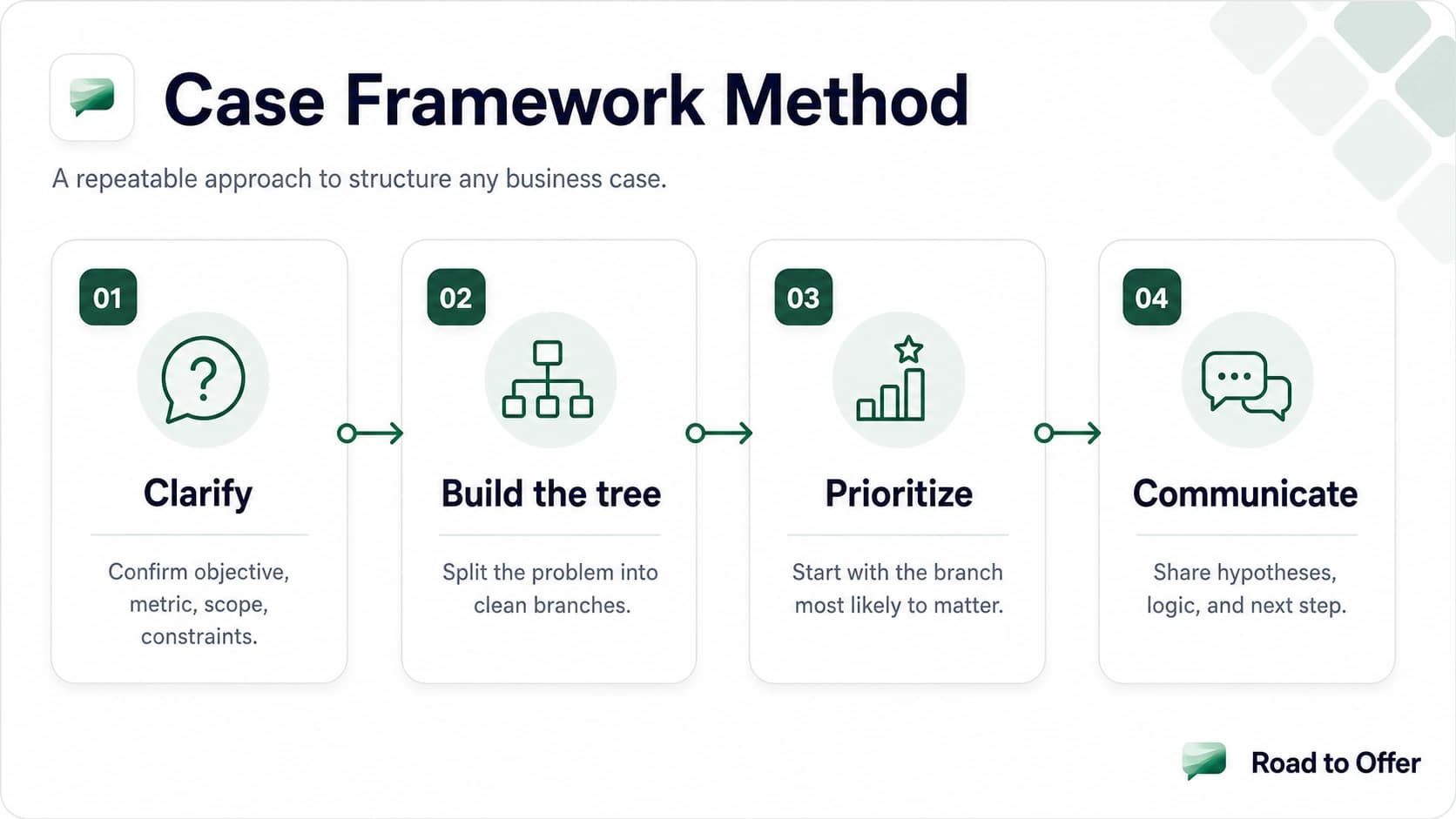
Learn the case method
One dense lesson, each step linked to the drill that trains it.
Official Practice Resources
Bain provides free practice cases on their careers page. Use them. Skipping them signals you didn't do basic homework.
- Bain's FashionCo Interactive Case: A full interactive case simulation, available directly at bain.com/careers/hiring-process/interviewing/fashion-case-study. FashionCo is a women's fashion retailer that has seen revenue decline each year for five years, and the CEO wants a recommendation before a management meeting. The case walks you through identifying revenue drivers, customer purchase criteria, and quantified options (for example, comparing an intermittent-sales strategy against a loyalty program). Complete it at least twice, once to learn the flow and once to practice delivering polished answers under self-imposed time pressure.
- Bain's Mock Interview Video: Bain also provides a recorded Associate Consultant mock interview video that demonstrates what a strong performance looks like in their format.
- Bain's Interviewing Overview: The Bain interviewing page outlines what to expect at each stage of the process.
These are the only officially sanctioned practice materials from Bain. Everything else is third-party interpretation. Start here, then supplement with broader case practice.
Prep Plans
If You Have 2 Weeks
Run your daily case with Bain-style feedback
Every day in this plan calls for a full case with feedback. Run a free Bain-style case on Road to Offer and get scored on structure, math narration, and synthesis.
Don't cram new frameworks the last two nights. Drill the behaviors Bain actually scores: structured opening, clear math narration, tight synthesis, calm pushback. The free Bain interview prep tools page groups the official Bain materials, drills, and practice cases to use alongside this plan.
Weeks 1-2: Foundation
Learn core frameworks: profitability, market entry, and growth strategy. Start mental math drills, 15 minutes per day of percentage calculations, multiplication, and division. Read 5-10 case interview examples to understand the format before jumping into practice.
Weeks 3-4: Case Practice
Do 1-2 full cases per day with feedback from an AI practice tool or human partner. Focus on the candidate-led format, practice driving the case end-to-end: propose the structure, request data, and lead to a recommendation. This is the phase where most Bain candidates undertrain. Begin PE case practice: acquisition evaluation, portfolio company analysis, and investment return calculations.
Week 5: Behavioral and Specialized
Prepare 4-6 behavioral stories with STAR structure. Practice your "Why Bain?" answer out loud, it should sound natural, not rehearsed. Do 2-3 written case exercises if your target office uses that format. Complete Bain's FashionCo interactive case from bain.com/careers/hiring-process/interviewing/fashion-case-study and watch the Associate Consultant mock interview video.
Week 6: Final Calibration
Full mock interviews under realistic conditions: timed, back-to-back, with a debrief after each. Focus your remaining practice on the weakest area identified from feedback, don't spread your time evenly across all skills. Review your behavioral stories one final time. Get 8 hours of sleep the night before your interview. Exhaustion is the most common unforced error in final rounds.
Common Mistakes That Kill Bain Candidacies
Interactive Drills: Bain-Style Case Questions
Practice these candidate-led prompts. Each mirrors the structure-and-drive rhythm of an actual Bain case.
Interactive drill set. Write an answer before revealing the worked solution, then continue into Road to Offer for scored practice and AI feedback.
Related Guides
Prepare for all MBB firms, not just Bain (see how consulting firms rank and compare). Each firm has distinct interview formats and scoring criteria:
- Bain practice cases: worked Bain-style cases to rehearse after this guide
- BCG case interview guide: candidate-led format with Casey chatbot assessment
- McKinsey case interview guide: the interviewer-led MBB peer with a distinct format
- What is Bain & Company: firm overview, history, and practice areas
- EY-Parthenon case interview guide: the closest peer for PE-focused strategy work
- McKinsey PEI guide: the behavioral interview component that accounts for 50% of your McKinsey evaluation
- McKinsey Solve guide: the digital assessment you'll face before live McKinsey interviews
- Consulting interview prep timeline: 2-week to 12-week study plans with daily hour commitments
- Profitability framework: the most common case type across all MBB firms, including Bain
Sources and Further Reading (checked June 18, 2026)
- Bain case interview preparation page: bain.com/careers/hiring-process/case-interview
- Bain interviewing overview: bain.com/careers/hiring-process/interviewing
- Bain FashionCo interactive case: bain.com/careers/hiring-process/interviewing/fashion-case-study
- Bain Associate Consultant mock interview video: bain.com/careers/hiring-process/interviewing/associate-consultant-practice-case-interview
- Bain Capital about us (AUM and overview): baincapital.com/about-us
- IGotAnOffer, Bain case interview (rounds, format, written case): igotanoffer.com/blogs/mckinsey-case-interview-blog/bain-case-interview
- PrepLounge Bain & Company case interview guide: preplounge.com/en/blog/consulting/firms/bain
- StrategyCase, Bain new case interview format: strategycase.com/bain-new-case-interview-format
- Management Consulted Bain case interview: managementconsulted.com/bain-case-interview
- Glassdoor Bain interview reviews: glassdoor.com/Interview/Bain-and-Company-Interview-Questions-E3752.htm
Frequently asked questions
Resources and related guides
- Practice real Bain casesPractice
- Browse all free resourcesResource hub
- BCG Case Interview Guide 2026: Format, Rounds + Worked ExamplesFirm Specific · Feb 2, 2026
- Bain Practice Cases: 10 Worked Examples With Solutions (2026)Firm Specific · Jul 18, 2026
- Bain SOVA Assessment GuideFirm Specific · Mar 20, 2026
- Accenture Behavioral Interview Questions & STAR Answers (2026)Firm Specific · Jun 3, 2026
- What Should You Expect in a Deloitte Case Interview in 2026?Firm Specific · Feb 19, 2026