
Pyramid Principle (Minto) for Consulting: How to Deliver a Case Synthesis (2026)
The Pyramid Principle (Minto) for consulting, applied to the case interview: answer-first structure, SCQA setup, MECE grouping, plus copy-paste 30 and 60 second recommendation scripts and a full worked example.
On this page
The Pyramid Principle (Minto) for consulting is the communication structure that top candidates use in 2026 to deliver a recommendation the way a partner wants to hear it: the answer first, then the reasons, then the evidence. Developed by Barbara Minto, a former McKinsey consultant, the method leads with the answer (the governing thought), groups two to three supporting arguments beneath it, and rests on data at the base, according to My Consulting Offer. It matters most at the single highest-stakes moment of a case. My Consulting Offer notes that a case interview typically runs about 20 to 25 minutes before you must deliver a synthesized recommendation, and that closing synthesis is often what the interviewer remembers and scores. This guide does what most do not: it scripts exactly what to say out loud, contrasts a rambling answer with a top-down one, and ties the principle to the synthesis moment your interviewer actually grades.
What the Pyramid Principle Actually Is
The Pyramid Principle is a top-down structure with three levels. At the apex sits one governing thought: your single answer to the question. Directly below it sit two to three arguments that, taken together, justify that answer. At the base sits the evidence: the data, calculations, and facts that prove each argument.
The reason it is shaped like a pyramid is that each level summarizes the level below it. Your governing thought summarizes your arguments. Each argument summarizes its supporting data. A listener can stop at any level and still have a coherent, true statement. That property is what lets a busy interviewer absorb your conclusion in ten seconds and then choose how far down to drill.
Practice delivering a synthesis out loud
The Pyramid Principle only counts when you say it under pressure. Run a free AI-guided case and get scored on how cleanly you deliver the recommendation.
Where It Came From and Why It Became the Standard
Barbara Minto built the Pyramid Principle while at McKinsey, where she was tasked with improving how consultants wrote. Her book on the method is over 200 pages long, per My Consulting Coach, but its influence comes from a single insight: readers and listeners reconstruct meaning fastest when they are given the conclusion first.
From McKinsey the method spread across MBB and into corporate strategy, where it is now the implicit standard for memos, slides, and board updates. That is why interviewers expect it without naming it. When a partner says your synthesis was "structured" or "clear," they usually mean it followed a pyramid: one answer, a small set of grouped reasons, evidence underneath. Candidates who default to chronological storytelling read as junior even when their analysis is correct.
Why Top-Down Beats Bottom-Up
Most people communicate bottom-up by default. They walk the listener through everything they looked at, in the order they looked at it, and arrive at a conclusion only at the end. That works for a diary. It fails for a decision-maker.
Busy executives, and interviewers role-playing them, think outcome-first. They want to know the recommendation immediately so they can decide whether to act, push back, or ask for the one piece of evidence that would change their mind. When you bury the answer at the end, you force them to hold every fact in working memory without knowing which facts matter. By the time you reach your conclusion, they have stopped tracking and started worrying that you do not have one.
Top-down delivery flips this. The answer comes first, so every subsequent sentence has a job: it supports a conclusion the listener already holds. This is the same logic behind a clean case interview synthesis, and it is the single most common communication upgrade strong candidates make.
Setting Up the Pyramid With SCQA
A governing thought lands harder when the listener already feels the problem. That is what SCQA does. Per StrategyCase, the Pyramid Principle pairs with SCQA, which stands for Situation, Complication, Question, Answer, to set up the governing thought before you state it.
- Situation: the stable context everyone agrees on. "The client is a regional coffee chain with healthy margins in its home market."
- Complication: what changed or went wrong. "Growth has stalled because the home market is saturated."
- Question: the decision that follows. "Should the client enter the German market?"
- Answer: your governing thought. "Yes, with a phased two-city launch."
In a live case you compress SCQA into two or three sentences before the recommendation. It signals that you understood the prompt and earns you the right to make a strong claim, because the listener now sees why the claim matters.
Interactive drill set. Write an answer before revealing the worked solution, then continue into Road to Offer for scored practice and AI feedback.
Grouping the Arguments: MECE and Inductive Reasoning
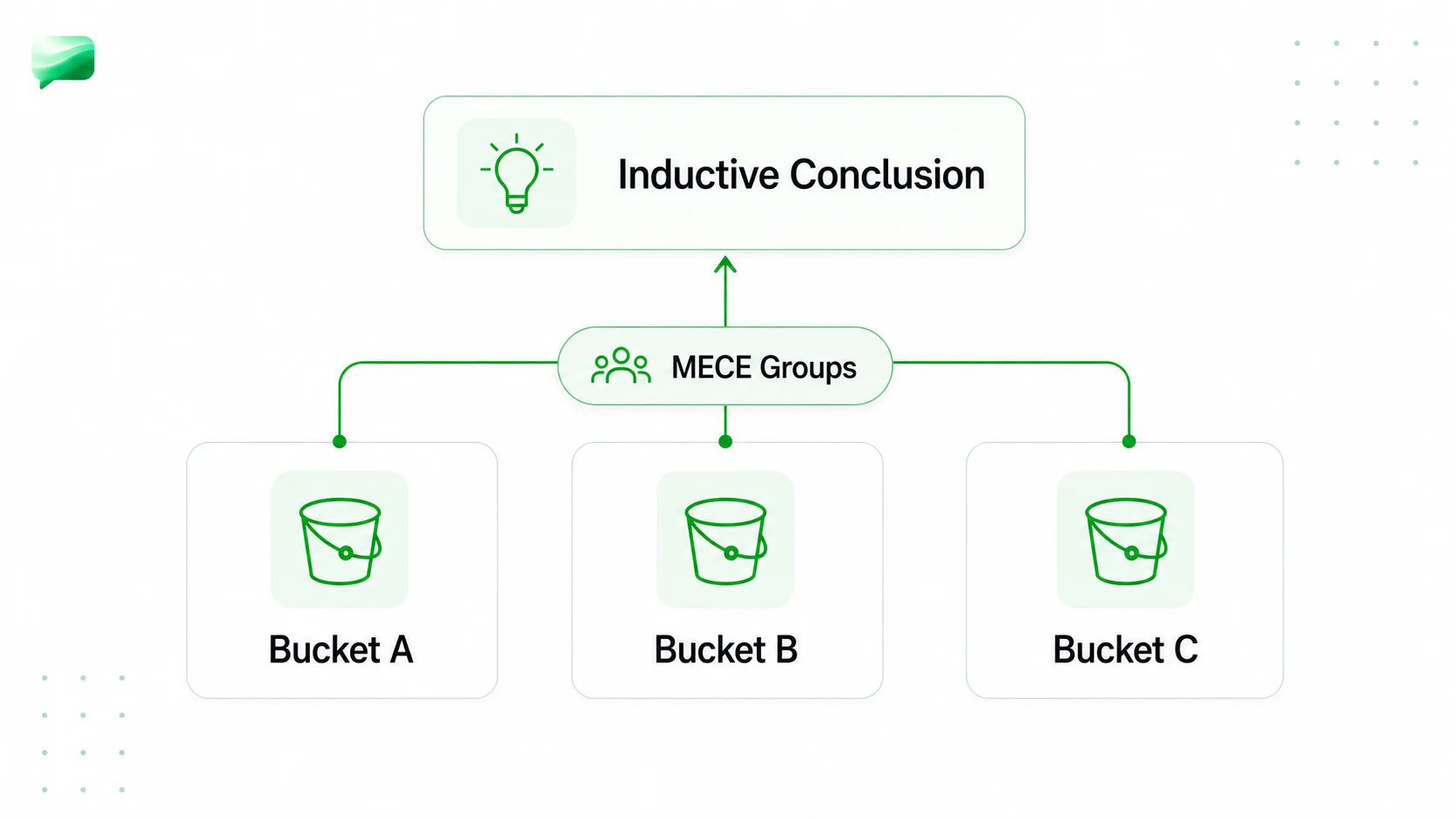
The middle layer of the pyramid is where candidates either look senior or fall apart. My Consulting Coach recommends grouping your supporting arguments into a small set, preferably three, that are MECE: mutually exclusive (no overlap) and collectively exhaustive (no gaps). Three buckets is the sweet spot. Two can feel thin, four starts to leak overlap.
You then have two ways to connect those arguments to the conclusion:
- Inductive grouping: the arguments are siblings of the same type that together support the answer. "We should enter because (1) the market is large, (2) we can win share, and (3) the economics work." Each is independent; together they make the case.
- Deductive grouping: the arguments form a logical chain. "The market is attractive. We have a right to win in attractive markets. Therefore we should enter." One link breaks the whole chain.
Under interview pressure, prefer inductive grouping. It is more robust, because if the interviewer attacks one argument the other two still stand. A deductive chain collapses entirely the moment one premise is questioned, which is exactly what a sharp interviewer will try to do.
Interactive drill set. Write an answer before revealing the worked solution, then continue into Road to Offer for scored practice and AI feedback.
Delivering the Synthesis Live: Answer, Reasons, Risk
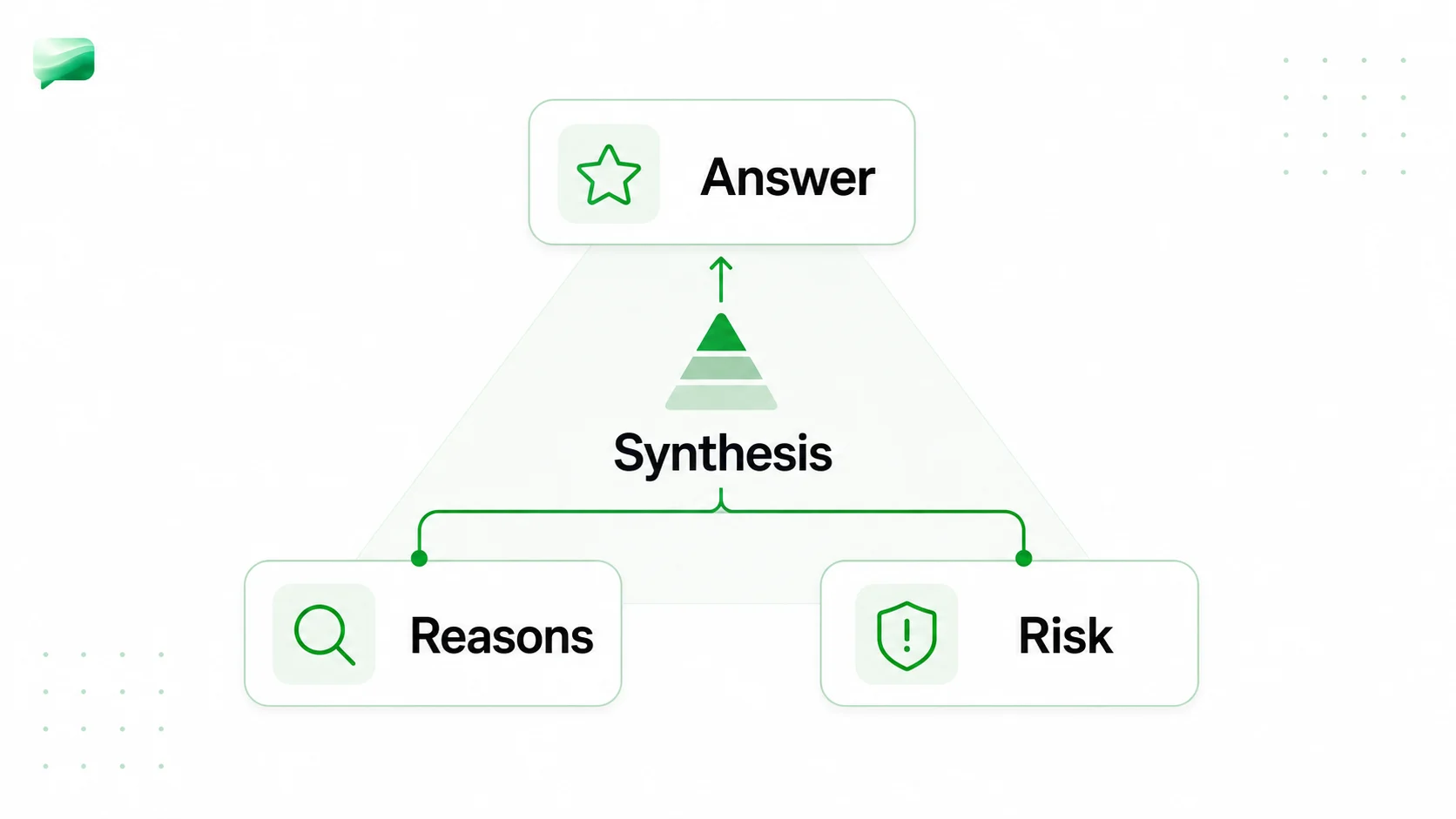
This is the part competitors gloss over and the part interviewers grade hardest. Here is the fixed pattern, and a verbatim script you can adapt to any case.
The Pyramid Synthesis Delivery Pattern
- 01
1. Lead with the answer. One sentence. The recommendation, stated as a decision, not a maybe. 'My recommendation is to enter the German market.'
- 02
2. Group the reasons. Two to three MECE buckets, signposted. 'Three reasons: demand, our right to win, and the unit economics.'
- 03
3. Support each with one number. One headline figure per argument. Do not dump every calculation; give the proof point that carries the bucket.
- 04
4. Name the main risk. State the single biggest threat to your recommendation. Showing you see it makes you more credible, not less.
- 05
5. De-risk and give the next step. Say how you would manage the risk and what you would do first. This turns analysis into an executable plan.
Before and After: The Same Content, Two Ways
The content below is identical. Only the order changes. Watch how much more decisive the second version sounds.
Bottom-up (rambling): "So I looked at the market, and it is around 8 million customers, growing maybe 6 percent. I also checked the competitors, there are two big ones but their pricing is high. Our margin would be about 35 percent I think, and the fixed cost to enter is around 12 million. There is some risk with retaliation. So, putting that together, I guess we should probably consider entering?"
Top-down (pyramid): "My recommendation is to enter the German market with a phased two-city launch. Three reasons: the market is large and growing, we have a clear price-based right to win, and the unit economics break even within 18 months. The main risk is price retaliation, which I would manage with a staged rollout."
Same facts, same analysis. The first sounds like a student thinking out loud. The second sounds like a consultant briefing a client. The only variable is the Pyramid Principle.
A Full Worked Example: One Recommendation Through Three Levels
Here is the German market-entry recommendation laid out as a complete pyramid so you can see every level connect.
Notice the structure. The three arguments are MECE: demand, competition, and economics do not overlap and together they cover the entry decision. Each argument is carried by one headline number, not a wall of math. And the governing thought is reversible: read only the top row and you still know what to do. (The figures here are illustrative numbers built for this example, not a claim about any real company.)
Pyramid Principle vs MECE vs SCQA vs Hypothesis-Driven
Candidates routinely confuse this cluster of terms because they show up together. They do different jobs.
The clean mental model: hypothesis-driven thinking shapes how you solve the case, MECE and SCQA are tools you use while building the pyramid, and the Pyramid Principle shapes how you communicate the result. See the complete frameworks guide for how these fit alongside the rest of your toolkit.
Spoken vs Written: Interview vs Memo and Slide
The same principle applies differently depending on the medium, and most guides blur the two.
Spoken (the case interview): You have one shot and no scrollback. Signpost aggressively ("Three reasons. First... Second... Third..."), keep each argument to one sentence and one number, and finish with risk and next step. The listener cannot re-read you, so the verbal cues do the work a slide layout would do on paper.
Written (memo or slide): The pyramid becomes visual. On a slide, the governing thought is the action-title at the top, the arguments are the column or section headers, and the evidence is the body. In a memo, the first paragraph is the answer, and each following section opens with one argument. The reader can skim the top line of every section and reconstruct your whole logic without reading a single data point. That skimmability is the entire point.
Common Mistakes
1. Burying the answer. The most common failure is saving the recommendation for the end. If your synthesis opens with "So, looking at everything we covered," you have already lost. Open with the decision.
2. Listing facts instead of grouping them. Reciting findings in the order you discovered them is not a pyramid. Every fact has to sit under an argument, and every argument has to sit under the answer. If a fact does not support an argument, cut it from the synthesis.
3. Drifting off the core question. Your governing thought must answer the exact question that was asked. If the prompt asked "should we enter," do not deliver a synthesis about "how to enter." Re-read the question in your head before you speak.
4. Too many arguments. Five reasons signal that you have not prioritized. Force yourself to the two or three that actually drive the decision.
When NOT to Use the Pyramid Principle
The Pyramid Principle is for analytical recommendations. It is the wrong tool for fit and behavioral questions. StrategyCase is explicit that the Pyramid Principle should not be used for fit or behavioral interviews, which instead call for a story structure like SCORE or STAR.
The reason is narrative tension. A behavioral story persuades through arc: a challenge, a struggle, a turning point, a result. If you open a "tell me about a time you led a team" answer with the outcome, you delete the suspense that makes the listener care. Save answer-first delivery for the case. Tell your stories like stories.
How to Practice the Pyramid Principle Daily
You do not need a case partner to build this habit. The skill is reflexive answer-first thinking, and you can drill it in the gaps of your day.
- Subject-line-first email habit. Before writing any email, write the subject line as the conclusion ("Approve the Q3 budget by Friday"), then make the body the support. If you cannot state the ask in the subject, you do not yet know your governing thought.
- 30-second verbal summaries. After every article, meeting, or video, force yourself to summarize it out loud in one answer plus three reasons. Speed matters because the case clock is real.
- Build the pyramid before you speak. In a practice case, take five seconds before your synthesis to fix the top line and the three buckets in your head. Speaking before the pyramid exists is what produces rambling.
Interactive drill set. Write an answer before revealing the worked solution, then continue into Road to Offer for scored practice and AI feedback.
The fastest way to internalize this is reps with feedback. Road to Offer's drills and AI coach let you deliver a pyramid synthesis out loud and get scored on whether you led with the answer, grouped your reasons, and closed with risk and next step, which is exactly what an interviewer weighs.
Get your synthesis scored before the real interview
Run a free AI-guided case, deliver the recommendation top-down, and see whether your structure, grouping, and risk framing land the way an interviewer expects.
Sources (checked June 26, 2026)
- My Consulting Offer, Pyramid Principle for case interviews: https://www.myconsultingoffer.org/case-study-interview-prep/pyramid-principle/
- My Consulting Coach, Pyramid Principle in case interviews: https://www.myconsultingcoach.com/case-interview-pyramid-principle
- StrategyCase, The Pyramid Principle for case interviews: https://strategycase.com/the-pyramid-principle-case-interview/
Frequently asked questions
Resources and related guides
- Practice the Pyramid Principle in a real case interviewPractice
- Browse all free resourcesResource hub
- SCQA Framework: Structure Your Case Recommendation (2026)Frameworks · Jun 28, 2026
- 3Cs Framework: Company, Customer, Competitor (Worked Example)Frameworks · Feb 6, 2026
- 4C Framework Case Interview: The 4 Cs, a Worked Example & How to Use It (2026)Frameworks · Jun 28, 2026