
Hypothesis-Driven Case Interview: How to Lead with a Hypothesis
A practical, example-led guide to the hypothesis-driven case interview: how to form an answer-first hypothesis, test it with real numbers, pivot when the data disagrees, and avoid the answer-first trap that sinks candidates.
On this page
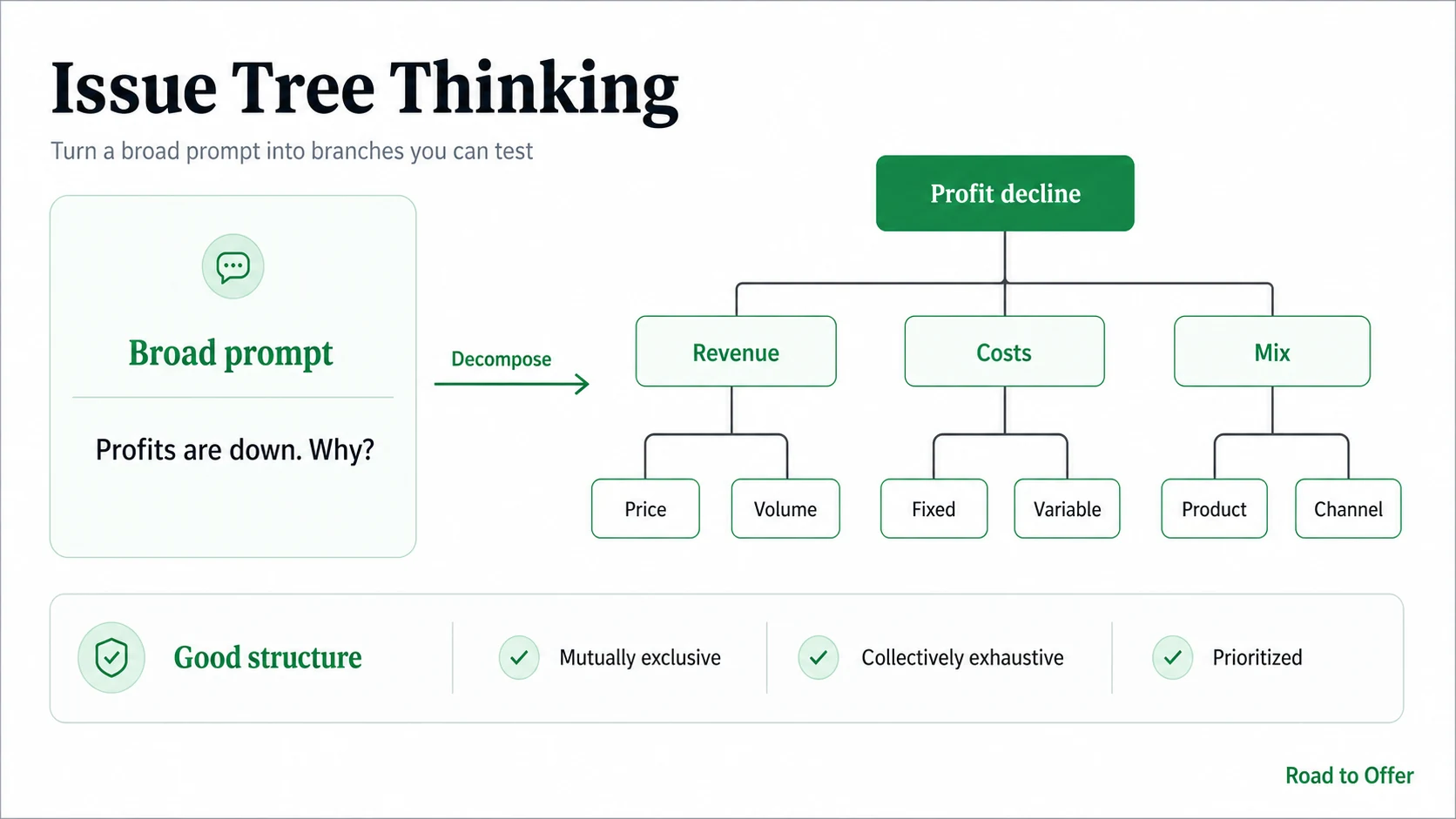
A hypothesis-driven case interview in 2026 means you do not wander through the case hoping the answer appears. Instead, you state a directional, testable guess about what is probably driving the client's problem, then use your structure to confirm or disprove it with real numbers and exhibits, updating the hypothesis as new evidence arrives. This is the approach top consulting interviewers reward, because it mirrors how real consultants think: a McKinsey partner can hear "profits are down 20 percent" and form a sharp first hypothesis within seconds, drawing on 20-plus years of pattern recognition from similar engagements. Candidates do not have that experience, so the safer version is to map the plausible routes on an issue tree and explain why you would test one branch before another. Practiced this way, hypothesis-driven thinking turns a rambling case into a focused, evidence-led conversation instead of a random walk through every possible driver.
What Does a Good Hypothesis Sound Like?
A good hypothesis is specific, directional, grounded in the prompt, and easy to test. It should guide the next analysis without locking you into a conclusion, so update it when the evidence changes.
A good hypothesis is:
- specific enough to test
- directional, not absolute
- grounded in the prompt
- easy to update
Here is the difference:
The point is not to sound certain. The point is to sound organized. A testable hypothesis names a direction, a driver, and a way to check it. A vague one names a topic and leaves the interviewer to do your steering.
Is the Answer-First Approach a Trap for Candidates?
This is the nuance most guides skip, and it is worth understanding before you over-commit to bold predictions.
Real consultants genuinely do work answer-first. A McKinsey partner can hear "profits are down 20 percent" and form a sharp first hypothesis in seconds, because they have run dozens of similar engagements over 20-plus years. Their gut is trained on real pattern data.
You are not that partner. If you treat the case like a guessing game and your single bold guess is wrong, two bad things happen. If you happen to be right, you look lucky rather than skilled. If you are wrong, the case becomes disorganized because you never built the full map of alternatives.
A safer mental model is navigation. Picture getting from point A (the problem) to point B (the recommendation). Instead of claiming you already know the one correct route, you map all the plausible routes in an issue tree, then at each intersection you explain why you would turn one way: "my hypothesis is that the bigger driver is on the cost side, so I want to test that branch first." The hypothesis is not a wild bet on the destination. It is your reasoning about which road to drive down next.
That reframe keeps the upside of answer-first thinking, which is focus and speed, without the downside, which is being stranded when your one guess collapses.
When Should You Form a Hypothesis in a Case?
Use a hypothesis whenever the case asks a decision or diagnosis question:
- why profits fell
- whether a market entry is attractive
- which customer segment to target
- whether an acquisition makes sense
There are two specific moments to state one out loud.
Moment 1, right after your structure. Once you have laid out your branches, do not ask a flat "where should I start?" Instead, name the branch you will test first and say why: "Given that the prompt mentions a new low-cost competitor, I will start on the revenue side, specifically volume." This is also the backbone of a strong case interview opening statement.
Moment 2, after every analysis resolves. Each time a number or exhibit comes back, restate where you now stand and what you want to test next. This is the part candidates forget. A hypothesis is not a one-time speech at minute two; it is a running thread that updates after every data point.
You usually should not force a detailed hypothesis in the first 20 seconds before you understand the goal. First, clarify the objective. Second, lay out your structure. Third, state the most likely answer and how you will test it.
That sequencing is especially useful in unstructured case interviews, where the interviewer gives you less guidance and expects you to drive the discussion yourself.
How Do You Form a Hypothesis Quickly?
There are two reliable ways to generate the first hypothesis, and good candidates use both.
Quantitative: follow the biggest number
When you have data, anchor on magnitude. If a cost breakdown shows materials at 30 percent, manufacturing at 60 percent, and SG&A at 10 percent, your hypothesis writes itself: the problem most likely sits in manufacturing because that is where the money is. You are applying the 80/20 rule, testing the branch with the most leverage first.
Qualitative: use business pattern recognition
When you have context but no numbers yet, lean on how the business works. Case prompts usually plant clues:
- "a competitor just entered" often points toward revenue or share pressure
- "demand is up but margins are down" often points toward cost, mix, or capacity
- "a commodity product where buyers shop on price" points toward pricing and competitor moves
- "a new geography" usually points toward market attractiveness plus capability fit
This is one reason issue trees matter. They turn the hypothesis from a loose guess into a test plan. For the underlying logic of clean branches, see the MECE principle.
Phrase it so it can survive being wrong
Good phrasing:
- "My initial hypothesis is..."
- "Based on the prompt, I suspect..."
- "I would start by testing whether..."
Bad phrasing:
- "The answer is definitely..."
- "I know the problem is..."
- "This company should obviously..."
Hypothesis vs. Framework vs. Issue Tree
Candidates often mix these up.
In practice, the workflow looks like this:
- clarify the objective
- choose a structure
- state a hypothesis
- test the most important branch first
- update the hypothesis as you learn
If you skip step 3, your framework often turns into a checklist. If you skip step 2, your hypothesis sounds like a random guess. A simple practice loop is to run one structure drill, state the hypothesis out loud before checking the answer, then do a 60-second synthesis drill on what you would recommend after the first data point.
For a broader view of common structures, see case interview frameworks, and for diagnosing profit cases specifically, the profitability framework. For how interviewers evaluate your reasoning quality, see the case interview scoring rubric.
Worked Example: A Profit-Decline Case With Real Numbers
Suppose the interviewer says:
"Our client is a national gym chain. Profits are down 20 percent year over year. What is going on?"
A weak answer:
"I would like to look at revenues and costs."
That is not wrong, but it is not guiding the case. Here is a hypothesis-driven answer that follows the biggest-clue logic:
"My initial hypothesis is that the decline is revenue-driven, likely from lower retention or weaker new-member growth rather than pricing, because the gym market has been crowding with low-cost entrants. I would like to test that by splitting profit into revenue and cost, then breaking revenue into members times average price."
Now the interviewer hands you the numbers. Let us actually do the arithmetic, because the discipline of hypothesis-driven thinking is converting each fact into an implication.
Last year: 50,000 members at an average annual fee of $600.
Revenue = 50,000 x $600 = $30,000,000.
This year: member count is down 12 percent and the average fee is unchanged.
Members = 50,000 x (1 - 0.12) = 44,000.
Revenue = 44,000 x $600 = $26,400,000.
Revenue fell by $30.0M - $26.4M = $3.6M, a drop of 3,600,000 / 30,000,000 = 12 percent.
If total costs had stayed flat at, say, $24,000,000, then profit moved like this:
- Last year profit = $30.0M - $24.0M = $6.0M
- This year profit = $26.4M - $24.0M = $2.4M
- Profit decline = (6.0 - 2.4) / 6.0 = 60 percent
That single calculation is the moment the case turns. A 12 percent revenue drop with flat costs produced a 60 percent profit collapse. That is operating leverage: when fixed costs do not fall with volume, a modest revenue dip hits profit much harder. Your hypothesis is now confirmed and sharper:
"The profit problem is volume-driven. A 12-percent fall in members, magnified by fixed costs, more than explains it. I now want to test where the churn is concentrated, because the prompt hinted at a new competitor."
The interviewer then confirms:
- average fee is flat
- member count is down 12 percent
- churn rose sharply after a low-cost competitor opened nearby
"This confirms the volume hypothesis. My updated view is that rising churn after the competitor launch is the core driver. I want to test whether the loss is broad-based or concentrated in price-sensitive members and specific locations."
That is the real skill. The first hypothesis gave direction, the arithmetic gave proof, and the second hypothesis got more precise after the evidence arrived.
When the data kills your hypothesis
Now imagine the numbers had come back differently: member count flat, average fee flat, but labor and occupancy costs up 25 percent. The right move is to pivot cleanly and say so:
"This disproves my initial revenue hypothesis. Revenue held, so the profit issue is cost-driven, most likely labor or occupancy. My updated hypothesis is that a step-up in fixed costs compressed margins, and I would like to test which bucket moved and whether it is temporary or structural."
Interviewers usually like that. It shows you are listening to the data instead of defending your first guess out of ego.
This is also where exhibit reading matters. If a chart disproves your hypothesis, use the data interpretation method to state the implication first, then update the case direction. And when you build to your final answer, fold the confirmed hypothesis into a tight case interview synthesis.
What Are the Most Common Hypothesis Mistakes?
Stating a hypothesis before understanding the question
If you guess too early, you often solve the wrong problem. Clarify the objective first.
Using a hypothesis that is too broad
"The company should grow" is not a hypothesis. It cannot be tested. A useful hypothesis points to a driver, tradeoff, or decision.
Refusing to update when the data changes
The biggest failure mode is attachment. If the exhibit disproves your idea, say so and pivot. According to one consulting-prep guide, failing to re-hypothesize after each analysis is among the top reasons candidates get rejected, second only to weak MECE structure.
Confusing confidence with rigidity
Strong candidates sound calm and directional. Weak candidates sound defensive. There is a difference between holding a view and clinging to it.
Asking questions without explaining their purpose
"What is the market size?" with no link to the problem reads as fishing. "I want the market size to test whether the decline is the whole market shrinking or just our share" reads as hypothesis-driven. Always attach the "so what."
Forcing a hypothesis when the case is still too open
Sometimes the right move is to say:
"Before I state a hypothesis, I want to clarify whether success means growth, profitability, or share."
That still sounds structured because you are narrowing the problem before committing.
When Should You Not Force a Hypothesis?
Hypothesis-driven thinking is useful, but not every moment in a case needs a bold prediction.
Do not force a heavy hypothesis when:
- you still do not understand the objective
- the interviewer is asking for a brainstorm, not a diagnosis
- you need one quick fact before any directional statement makes sense
The better default is "directional, testable, and revisable," not "certain." If you are a career changer without a consulting background, this restraint actually helps: you are not expected to have a partner's instant read, so showing disciplined, evidence-led reasoning is exactly what scores.
How Do You Build an Issue Tree for a Two-Sided Marketplace or Recurring-Revenue Business?
Tailor the tree to the decision rather than copying revenue and cost.
Two-sided marketplace issue tree
- Demand on each side: buyer acquisition, seller acquisition, activation, and retention.
- Match quality: liquidity by segment, search success, fill rate, and time to match.
- Economics: transaction value, take rate, incentives, service cost, and contribution.
- Constraints: trust, geographic density, supply quality, regulation, and multi-homing.
A testable opening hypothesis is: “Growth is constrained by seller density rather than buyer acquisition because buyers arrive but cannot find available supply. I would test match success and time to match by city first.”
Recurring-revenue issue tree
- Acquisition: qualified leads, conversion, CAC, and channel mix.
- Activation: onboarding completion and time to first value.
- Retention: logo churn, revenue churn, cohort behavior, and expansion.
- Economics: contribution, payback, support cost, and capacity.
A testable hypothesis is: “The growth slowdown is retention-led because acquisition volume remains stable while mature cohorts shrink. I would compare cohort retention at equal tenure before changing acquisition spend.”
The issue-tree guide owns the deeper structure method. These examples show how the tree supports hypothesis choice.
How Should You Prioritize Hypotheses When Data Is Sparse?
Rank each hypothesis by potential decision impact, prior evidence from the prompt, and cost of testing. Test a high-impact hypothesis early when one accessible exhibit can confirm or reverse it. Do not invent a probability merely to make the ranking look quantitative.
Marketplace growth stalls. Sample synthesis: “Demand exists, but low supply density limits completed matches.” Next action: compare matched and unmatched buyer cohorts.
Subscription revenue slows. Sample synthesis: “New sales are stable, but mature-cohort contraction reduces net growth.” Next action: split retention by segment.
Product launch appears attractive. Sample synthesis: “Gross launch demand overstates incremental volume.” Next action: pilot and track the source of volume.
What Belongs in a Live Hypothesis Log?
A hypothesis log is a small working table, not a transcript of the case. Record the current hypothesis, evidence for and against it, confidence in plain language, what would reverse it, and the next test.
Prompt: Status is open. Next test: request retention by cohort.
Exhibit 1: Status is supported and narrowed. Next test: check small-customer onboarding.
Exhibit 2: Status is conditional. Next test: compare matched users or intervention evidence.
This prevents a hypothesis from becoming a position you defend after the evidence changes.
How Do You Handle Missing or Contradictory Data Without Inventing Precision?
- If the data is clean, quantify the implication and update the hypothesis.
- If a required value is missing, state the relationship and the threshold that would change the decision.
- If sources conflict, compare definition, period, population, unit, and method.
- If the conflict remains, show a range and test whether the decision changes at either bound.
For example, one exhibit reports 50,000 registered users and another reports 18,000 monthly active users. Do not average them. They answer different questions. Use active users for current engagement and registered users only for a reactivation or historical reach question.
How Do You Synthesize Three Exhibits Into One Insight?
Illustrative case. A meal subscription company is considering a lower-priced plan.
Exhibit 1: Survey intent suggests 8,000 customers may choose the plan.
Exhibit 2: Sixty percent of interested respondents are existing customers. Among those existing customers, half say they would switch from the current plan.
Exhibit 3: The new plan contributes €12 per month, while the current plan contributes €20. New customers stay an estimated ten months in the scenario.
Cannibalization calculation. Existing interested customers are 8,000 × 60% = 4,800. Expected switchers are 4,800 × 50% = 2,400. The remaining 5,600 customers are treated as incremental in this simplified scenario.
Incremental contribution from new customers is 5,600 × €12 × 10 = €672,000. Contribution lost from switchers is 2,400 × (€20 − €12) × 10 = €192,000. Net modeled contribution before launch cost is €480,000.
Three-exhibit insight: “Survey demand overstates incremental growth because 2,400 expected customers would switch from the current plan. After accounting for the €8 monthly contribution loss on switchers, the plan adds an estimated €480,000 over ten months before launch cost.”
Uncertainty. Survey intent and switching are assumptions, not observed behavior. The decision depends on launch cost and actual conversion.
Next question. What is the launch cost, and what pilot result would validate incremental conversion and switching?
How Do You Make an Answer-First Recommendation With Risks and Mitigations?
Recommendation: Pilot the lower-priced plan rather than launch broadly because the adjusted scenario estimates €480,000 contribution before launch cost and reveals material cannibalization.
Evidence: 5,600 modeled customers are incremental, while 2,400 are expected switchers whose contribution falls by €8 per month.
Risk: Survey intent may overstate conversion or understate switching.
Mitigation: Limit the pilot to a defined segment, tag the source of every subscriber, and set thresholds for incremental conversion, switching, and contribution before scaling.
This format keeps the decision first while preserving uncertainty.
Carry the evidence into the final decision
Practice one concise synthesis with a recommendation, risk, and next step.
When Should You Stop Drilling Into an Issue?
Stop when the branch cannot change the decision, the next fact costs more time than its decision value, or the remaining uncertainty can be managed through a pilot or condition. Continue when a plausible value could reverse the answer.
In the subscription example, the launch-cost threshold matters directly. A minor demographic split may not matter unless it changes conversion or cannibalization. Say: “The current evidence supports a pilot. I would stop segmenting survey respondents and test launch cost and observed switching because those inputs can reverse the economics.”
How Do You Quantify Cannibalization Without Double Counting?
Define the total interested population once, separate incremental customers from switchers, and apply only the contribution difference to switchers. Do not count switcher revenue as both new revenue and lost old revenue without reconciling the net change.
The worked calculation above uses 5,600 incremental customers at €12 contribution and 2,400 switchers at an €8 contribution loss. The groups sum to the original 8,000 interested customers, so no customer is counted twice.
Choose the next branch to test
Build a tailored structure and explain which evidence should come first.
Related Guides
- Issue Tree Case Interview: How to Build a MECE Structure
- Case Interview Opening Statement
- Case Interview Synthesis
- Reading Charts and Exhibits in Case Interviews
- Case Interview Scoring Rubric
- Case Interview Frameworks: 7 Essential Models with Examples
- Profitability Framework for Case Interviews
- Case Interview Prep Guide
- Consulting Interview Prep Timeline: 4 Plans from 2 Weeks to 12 Weeks
Sources
- Hypothesis-Driven Approach in Case Interviews, My Consulting Offer, checked June 18, 2026
- How to be hypothesis driven in your case interview, MyConsultingCoach, checked June 18, 2026
- Hypothesis-driven approach: the definitive guide, Career in Consulting, checked June 18, 2026
- Hypothesis-Driven Case Interview, Caseinterview (Victor Cheng), checked June 18, 2026
Test whether the opening can change
State a directional hypothesis, name the reversing evidence, and update it after one rep.
Frequently asked questions
Resources and related guides
- Practice hypothesis-driven solving in a real case interviewPractice
- Browse all free resourcesResource hub
- How to Structure Your Case Interview Opening StatementFrameworks · Mar 1, 2026
- 3Cs Framework: Company, Customer, Competitor (Worked Example)Frameworks · Feb 6, 2026
- 4Ps Framework Case Interview: Product, Price, Place, PromotionFrameworks · Feb 6, 2026
- Fintech Case Interview: Payments, Neobanks, Lending & Crypto (2026)Frameworks · Apr 8, 2026