
McKinsey Case Interview 2026: Format, Process, and Scoring
Prepare for the McKinsey case interview with the format, scoring criteria, common case types, and a practical prep plan.

McKinseyEV Charging Hub ProfitabilityProfitability · Medium
Start a free McKinsey case interview
Hear the case, say or type your answer, get your score.

Don't know how to case yet? Learn how to case
On this page
The McKinsey case interview tests whether you can structure an ambiguous business problem, drive the analysis, and synthesize a clear recommendation under pressure. According to McKinsey's official interviewing guide, every interview includes a personal experience component and a problem-solving case. The main preparation challenge is not memorizing frameworks; it is learning to build a custom structure, request useful data, and self-correct when the case changes direction.
This guide covers the process end to end: the four hiring stages, the interviewer-led case format, the Solve digital assessment, the four PEI dimensions, how interviewers score you, and a six-week prep plan. It carries one compact worked case so you can see the format in motion, and it stops there on purpose. When you want practice volume rather than process, the fully worked McKinsey cases with solutions live on a separate page: McKinsey practice cases. Read the process here first, then go run the reps there.
McKinsey Interview Process
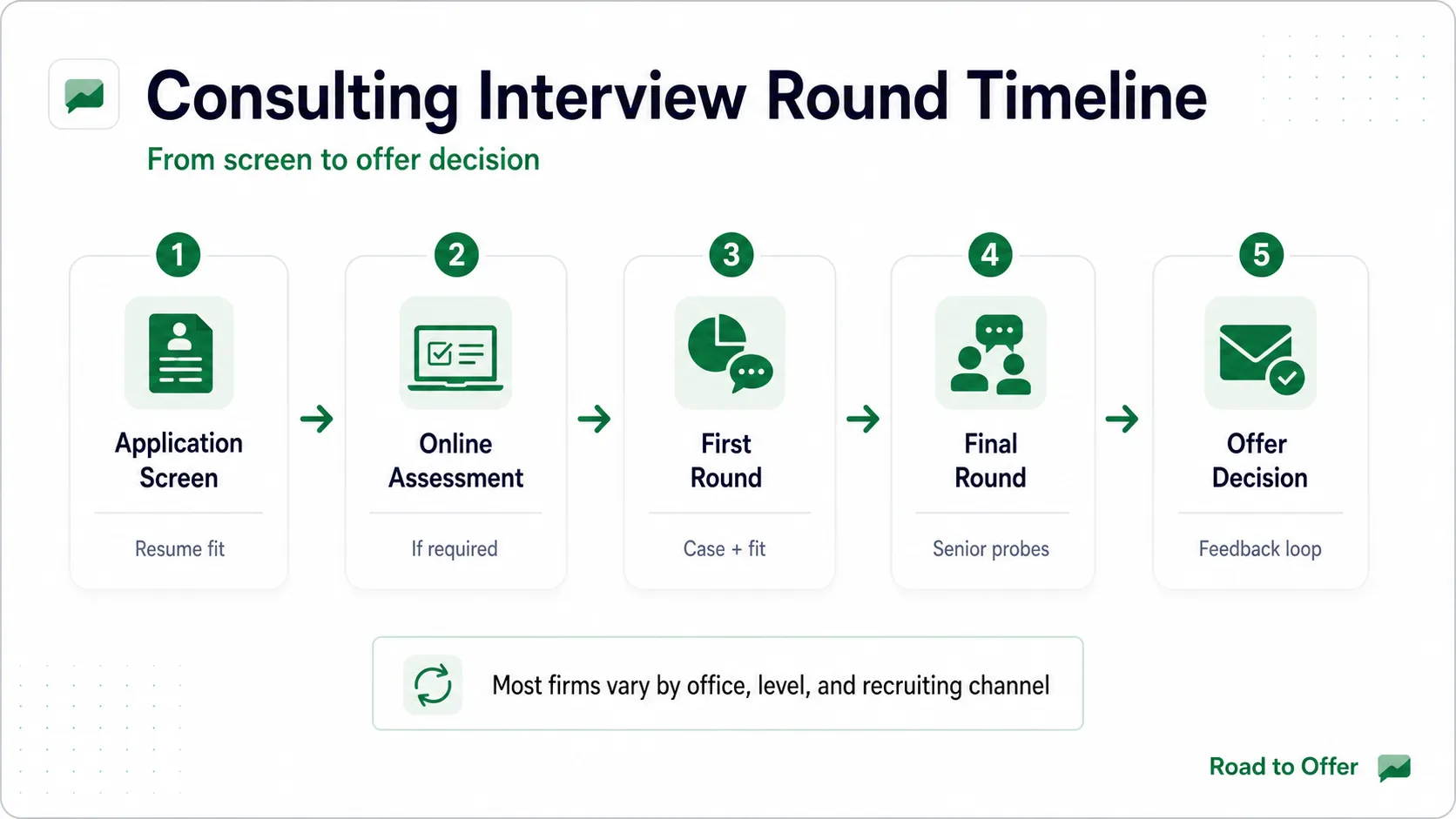
McKinsey's hiring pipeline has four stages. The process varies slightly by office, but the core structure is consistent globally.
McKinsey Interview Pipeline
- 01
Application. Resume screen + referral track
- 02
Solve Assessment. Digital game-based assessment (60-70 min)
- 03
First Round. 2 interviews: case (interviewer-led) + PEI
- 04
Final Round. 2-3 interviews with senior partners
Stage 1: Application
McKinsey screens resumes for academic achievement, leadership experience, and impact evidence. GPA thresholds vary by office, but top-tier schools and strong extracurriculars increase your chances. Employee referrals carry significant weight, not because of favoritism, but because referred candidates tend to be pre-vetted for cultural fit. For context on where McKinsey sits alongside BCG and Bain, see what is MBB consulting, MBB case interview prep, and the management consulting firms ranking. Candidates targeting analytics or QuantumBlack-style work should also prepare for data science case interviews.
Stage 2: Solve Assessment
The McKinsey Solve (formerly the Problem Solving Test) is a digital, game-based assessment taken before interviews. According to McKinsey's Solve page, it is given to around 300,000 early-career consultant candidates per year (including those applying for the Business Analyst role or McKinsey's Sophomore Summer Business Analyst (SSBA) program) and uses advanced AI methods to ensure variation across scenarios. Not every applicant is necessarily invited; does everyone get McKinsey Solve covers that. It has two modules:
- Redrock Study: A research simulation where you analyze wildlife population data, perform calculations, and build a research report.
- Sea Wolf: A microbe-selection optimization module where you match marine microbes to ocean cleanup sites based on attribute averages and trait constraints (the Ocean Treatment game explains this task).
The Solve is scored on both accuracy and underlying behavioral patterns. According to MConsultingPrep's Solve pass-rate analysis, roughly 20-30% of candidates who take the Solve advance to first-round interviews. To see how Solve is weighed against the rest of your application, read does McKinsey Solve matter.
For a deep dive: the full McKinsey Solve assessment guide. If a result went badly, can you retake McKinsey Solve covers what McKinsey publishes.
You can try each module's format free before test day, in the block below.
Start with the free Red Rock study below. Playing one module shows you what Solve actually asks of you faster than reading about it:
Free Solve practice from Road to Offer: pick a game and play it in the browser. Original practice, not official McKinsey material.
Then the second module. Sea Wolf swaps data reading for rule checking, so run it before you decide which of the two feels weaker. If your invitation is the longer 85 or 95-minute version, the third game is a judgment task; the newer 30-minute island format is in the cards above, each with its own free run.
Prepping for McKinsey means you will meet these games, and the invitation can leave only days. Build a free Solve plan with your test date, or with no invitation yet, and it schedules the games, guides and Quick Math.
Stage 3: First Round
Two back-to-back interviews, each 50-60 minutes. Every interview includes:
- Case interview (30-40 min): Interviewer-led format. The interviewer presents a business problem and walks you through specific questions in sequence, directing which area you analyze next.
- PEI (10-15 min): The Personal Experience Interview. Each interviewer tests one of four behavioral dimensions.
The two interviewers debrief after the round and make a joint recommendation: advance, hold, or reject. Both interviewers must support advancing you.
Stage 4: Final Round
Two to three interviews with Partners or Senior Partners. The format is identical (case + PEI), but cases become more open-ended, interviewers probe deeper on business judgment, and the PEI questions target different dimensions than first round. Partners are evaluating not just your analytical ability but whether you can hold your own in front of a CEO. (If you want to understand the career path above the Analyst and Associate levels, see what an Engagement Manager at McKinsey does; for the full picture of what reaching the top looks like, see the advantages of being a McKinsey partner.)
McKinsey's Interviewer-Led Case Format
This is the core differentiator. At McKinsey, after hearing the prompt and asking clarifying questions, you:
- Take 60-90 seconds to build your structure (in silence, with notes)
- Present your framework to the interviewer, explaining what you'll investigate and why
- Answer the interviewer's questions in sequence, since the interviewer chooses which area to explore next and hands you specific prompts and data
- Work the question in front of you with a clear hypothesis before the interviewer steers you to the next one
- Synthesize into a clear recommendation when the interviewer asks you to close
What McKinsey Interviewers Want to See
Want to see how your structure scores against these criteria? Try an interviewer-led case and get scored on the seven dimensions above.
Interviewer-Led vs Candidate-Led: Why It Matters
At BCG or Bain, the case is often candidate-led, though interviewers vary the amount of guidance: a weak opening structure can mean you'll spend the next 30 minutes lost, because you're driving and the interviewer may not rescue you. At McKinsey, the interviewer steers you question by question, so if your structure is weak the interviewer redirects you to the next area. The same redirecting rhythm applies at Deloitte, which also uses interviewer-led cases.
This means McKinsey prep must disproportionately emphasize:
- Building custom frameworks in 60-90 seconds
- Practicing hypothesis-driven investigation
- Learning to self-correct when a branch is unproductive
- Delivering a clean synthesis under time pressure
Structure a McKinsey profitability case in 90 seconds. Voltigo's 60 fast charging sites in France swung to an operating loss after years of profit. Answer this McKinsey profitability case step in the article, then continue the full case. Continue the full case on Road to Offer
The PEI: McKinsey's Behavioral Interview
The Personal Experience Interview (PEI) is McKinsey's behavioral format. It's not a warm-up. It accounts for a significant portion of your interview score, and candidates fail on PEI more often than they realize.
The Four PEI Dimensions
According to McKinsey's careers page, the PEI tests four dimensions. Each interview covers one dimension for the full 10-15 minutes:
- Leadership: Setting direction and mobilizing a team toward a goal, especially under pressure or without full authority.
- Connection: Persuading or influencing someone who initially disagreed with you, without formal authority.
- Drive: Achieving a significant result through personal initiative and resourcefulness, often without being asked.
- Growth: Driving change despite resistance, or learning meaningfully from a significant failure or setback.
How PEI Actually Works
The interviewer asks one question ("Tell me about a time you led a team through a challenge") and then probes for 10-15 minutes. They go deep, far deeper than a typical behavioral interview. Expect follow-ups like:
- "What specifically did you say to them?"
- "How did they react?"
- "What would you do differently in hindsight?"
- "Why did you choose that approach over X?"
Surface-level stories get exposed immediately. You need stories with real depth: genuine conflict, specific actions you took, measurable outcomes, and honest self-reflection.
Stress-Test Each PEI Story Before You Call It Ready
Shallow stories sound fine on the first answer and collapse under follow-up. Run each story through four questions before interview day:
- Can I explain the tension without blaming other people?
- Can I name my exact action, not the team's action?
- Can I show a result without inflating it?
- Can I answer "what would you do differently" honestly?
If any answer is shaky, the story is not ready. Prepare fewer stories with more depth rather than many thin ones.
For a complete PEI preparation guide with full sample answers, use the McKinsey PEI Guide. Then pressure-test your stories live. Many candidates also field a fit question on motivation, so prepare a specific answer to the "Why McKinsey?" question before interview day.
Case Types McKinsey Favors
McKinsey cases cluster around these patterns, based on candidate reports compiled by IGotAnOffer and Management Consulted:
Profitability (Most Common)
Classic "profits are down, diagnose and fix" cases. McKinsey's version tends to be more open-ended than BCG or Bain, you might receive a broad prompt with less guidance on where to start.
Prep resource: Profitability Framework
Practice this next: Run one free interviewer-led case after reading the framework, then compare your opening structure against the seven scoring dimensions above.
Market Entry / Growth Strategy
"Should the client enter market X?" or "How should the client grow from $Y to $Z?" These test your ability to size markets, assess competitive dynamics, and build a strategic recommendation.
Prep resources: Market Entry Framework | Growth Strategy Cases
Practice this next: Use a structure drill to build the issue tree in 90 seconds before you read another example.
Pricing
McKinsey frequently uses pricing cases, especially in second rounds. You might need to determine optimal pricing for a new product, restructure a pricing model, or analyze price elasticity effects.
Prep resource: Pricing Strategy Cases
Market Sizing (Often Standalone)
McKinsey uses standalone market sizing questions more than BCG or Bain. "Estimate the number of gas stations in the US." "How many tennis balls fit in this room?" These test your ability to build logical estimation trees and calculate under pressure.
Prep resources: Market Sizing Step-by-Step | Market Sizing Questions
Practice this next: If the math is slow, run market sizing drills before doing a full mock.
Operations / Cost Optimization
Less common at McKinsey than at Bain or BCG, but still appears. Supply chain optimization, cost reduction across a portfolio, or process improvement in manufacturing. For the operations flavor specifically, work the supply chain case interview and its resilience example before test day.
Practice the case types McKinsey actually favors
Our AI plays a McKinsey interviewer: it steers you question by question, hands you data, and scores hypothesis quality, MECE structure, and synthesis, the exact skills that separate hires from no-hires.
A McKinsey Case: From Prompt to Synthesis
This walkthrough shows how a strong candidate moves through a McKinsey-style case from the first sentence to the final recommendation. Follow the reasoning at each step. This is what "interviewer-led" looks like in practice. It is the only full walkthrough in this guide on purpose: the rest of the worked McKinsey cases with solutions sit on the practice page linked in the intro.
The Prompt
"Our client is a mid-size European consumer goods company that makes premium skincare products. Revenue has been flat for three years despite a growing market. The CEO wants to know why and what to do about it."
Clarifying Questions
A strong candidate asks 2-3 targeted questions before structuring. Here are three good ones and one bad one:
Good: "When you say 'flat revenue,' are we talking about organic revenue or does that include acquisitions?" This scopes the problem. If revenue includes a recent acquisition, organic revenue is actually declining, which changes everything.
Good: "Is this flat performance consistent across all product lines and geographies, or concentrated somewhere?" This narrows where to look before building a framework.
Good: "What does the competitive landscape look like? Is market share shifting to specific competitors or new entrants?" This tests whether the issue is internal (execution) or external (competitive dynamics).
Bad: "What's their EBITDA margin?" This is a data request, not a clarifying question. You haven't structured the problem yet, so you don't know what data you need or why. Interviewers notice when candidates fish for data before having a plan.
Framework Sketch
The candidate takes 75 seconds, then presents:
"I'd like to investigate three areas. First, revenue decomposition: I want to understand whether the flat revenue is driven by volume, price, or mix effects, and whether it's concentrated in specific product lines or geographies. Second, competitive dynamics: I want to see if the client is losing share and to whom, which tells us whether this is a market problem or a client-specific problem. Third, go-to-market effectiveness: the client is in premium skincare, so I want to check whether their channel strategy and brand positioning still match where consumers are buying. I'd like to start with revenue decomposition because it will tell us where to focus the rest of the analysis."
Quantitative Analysis
The interviewer provides data: the client's two largest product lines account for 80% of revenue. Line A (anti-aging) grew 12% but Line B (daily moisturizers) declined 18%. The overall market for daily moisturizers grew 6%. Reading an exhibit fast is its own skill, so practice with an exhibit drill before your mocks.
"So Line B lost significant share in a growing market, roughly 24 percentage points of underperformance versus the market. That's not a market problem. I'd hypothesize this is either a pricing issue (perhaps competitors undercut them in the daily segment) or a channel issue, since premium daily moisturizers are increasingly sold through e-commerce and DTC channels. Can I see Line B's pricing relative to competitors and their channel mix over the past three years?"
The data shows Line B's prices are comparable to competitors, but 85% of Line B's sales still go through department stores while competitors shifted to 50%+ DTC/e-commerce. Department store foot traffic declined 20% in the same period.
"That confirms it. Line B's channel mix is misaligned with where consumers now buy daily skincare. The product and pricing are competitive, but the client is selling through a channel that's shrinking 20% annually."
Synthesis (60 Seconds)
"My recommendation is that the client should aggressively shift Line B's distribution toward DTC and e-commerce channels. Three reasons support this. First, Line B's 18% revenue decline is almost entirely explained by channel dynamics, not product or pricing weakness. Competitors with comparable products are growing because they're selling where consumers shop. Second, the client has proven brand strength in Line A, which means they have the brand equity to succeed in direct channels. Third, the premium skincare DTC market is growing at 15-20% annually, so the tailwind is strong.
The primary risk is channel conflict with existing department store partners, who generate 85% of Line B's current revenue. I'd mitigate this by launching DTC with exclusive product variants rather than pulling existing SKUs from retail partners. The immediate next step would be sizing the DTC investment required and modeling the revenue ramp over 18-24 months."
McKinsey Scoring Criteria
McKinsey doesn't publish an official scoring rubric, but interview debriefs and coaching data from sources including PrepLounge's McKinsey interview forum and Management Consulted's McKinsey case guide reveal a consistent pattern. Each interviewer scores along these dimensions:
Problem Structuring
- Is the framework custom-built for this specific problem?
- Is it MECE (mutually exclusive, collectively exhaustive)?
- Are the branches prioritized based on likely impact?
- Does the candidate clearly communicate the logic behind the structure?
Analytical Problem Solving
- Does the candidate form and test hypotheses?
- Are data requests specific and justified?
- Is the math accurate and efficiently performed?
- Does the candidate integrate quantitative and qualitative evidence?
Business Judgment
- Does the recommendation make commercial sense?
- Does the candidate consider implementation feasibility?
- Are risks identified and addressed?
- Does the candidate understand the client's context beyond the math?
Communication
- Is the candidate using top-down communication (answer first)?
- Are transitions between analysis sections clear?
- Does the candidate engage the interviewer as a thought partner?
- Is the final synthesis crisp and compelling?
PEI
- Does the story demonstrate the dimension being tested?
- Is there specific, concrete detail (not generalizations)?
- Does the candidate show self-awareness and learning?
- Is the story told in a structured, concise way?
6-Week McKinsey Prep Plan
Execution checklist
Learn core frameworks (profitability, market entry, growth, pricing, market sizing). Custom frameworks come from internalizing the building blocks, not memorizing complete templates
Practice the MECE principle until structuring is automatic. McKinsey specifically penalizes non-MECE frameworks and overlapping branches
Start mental math drills (15 min/day). Clean, fast math is scored directly in interviewer-led cases and a single error can derail the question the interviewer hands you
Read 8-10 case examples end-to-end. Pattern recognition accelerates before deliberate practice does
Practice 2 full interviewer-led cases per day. Volume with feedback is the fastest path to case intuition
Build 4 PEI stories covering all dimensions. PEI accounts for ~30% of the interview score; underpreparing here is a common mistake
Complete the McKinsey Solve practice environment. The Solve is a screening gate; candidates who skip practice are gambling unnecessarily
Practice building frameworks in 60-90 seconds under pressure. At McKinsey, your opening structure sets the trajectory for the entire case
Run 4+ full mock interviews under realistic conditions. Back-to-back timed mocks simulate interview-day pressure and reveal stamina issues
Record yourself and review for communication habits. Filler words, non-MECE language, and rambling syntheses are invisible until you see them
Weeks 1-2: Foundation
Master the building blocks: MECE principle, profitability framework, market entry and ecosystem-building cases, growth strategy. Start mental math drills at 15 minutes per day. Read 8-10 case examples to internalize the format. Use the free McKinsey interview prep tools to assemble the official pages, drills, and cases in one path. Complete the Solve practice environment.
Sharpen your case math from the Road to Offer drill engine. Answer a real prompt and get AI-scored feedback. Free accounts include 5 drills per day for the first 3 days after signup.
Weeks 3-4: Case Reps
Do 2 full interviewer-led McKinsey practice cases per day with feedback. Focus on building custom frameworks in 60-90 seconds and answering the interviewer's questions sharply as they steer the case.
Begin market sizing drills, which McKinsey uses more than other firms. Start drafting PEI stories.
Week 5: PEI and Integration
Finalize 4 PEI stories (one per dimension). Practice delivering them with 2-3 levels of follow-up probing. Run integrated mock interviews (case + PEI in one session). Work on synthesis delivery to sharpen your closing recommendations.
Week 6: Final Calibration
Full mock interviews under realistic conditions: timed, back-to-back, with debrief. Focus remaining practice on your weakest area. Review PEI stories one final time. Rest the day before your interview. If compensation matters to your decision, review the McKinsey salary guide before your offer conversations.
How to Run a Single Practice Rep
Volume only helps if each rep is structured. Run every case in three passes:
- Run: solve the prompt straight through without stopping for notes.
- Replay: identify the one spot where structure, math, or synthesis broke down.
- Repair: redo only that weak segment until it sounds natural, then move on.
After each rep, write down one behavior to keep, one to cut, and one to test next time. Behavioral feedback beats vague feedback: "you named revenue and cost but skipped customer segments" gives you a repair target; "your structure was weak" does not. If the same issue shows up twice, pause full cases and drill that one behavior before adding more volume.
Common Mistakes That Kill McKinsey Candidacies
What to Do When the Case Goes Off Track
Getting stuck is recoverable; staying silent or defending a structure the data has killed is not. The worst moves are calculating randomly and clinging to a hypothesis the evidence already disproved. Instead, pause, restate the objective, and name the gap out loud.
A clean recovery line sounds like: "I want to step back to the client question. We know demand is stable but margins are down, so I'd shift from market analysis to unit economics." That shows control without pretending the first path worked. A candidate who can summarize what changed and pick the next step looks stronger than one who tries to hide the stumble.
Practice a McKinsey-Style Case
 McKinsey
Profitability · medium
Practice real McKinsey cases
Matched to this McKinsey guide: a live automotive profitability case with an AI interviewer. Free, scored on every step.
Run a full interviewer-led McKinsey case, scored
The AI steers you question by question like a McKinsey interviewer, hands you exhibits, and scores your structure, quant, exhibits, synthesis and the rest of its seven dimensions. Know exactly where you stand before interview day.
Related Guides
Build a complete McKinsey prep toolkit:
- BCG Case Interview Guide, the peer MBB firm using a candidate-led format
- Bain Case Interview Guide, the third MBB firm with a strong PE diligence focus
- Case Interview Examples, 12 fully worked cases across all types
- How to Practice Case Interviews, session structure for maximum improvement
- Consulting Interview Prep Timeline, 4 plans from 2 weeks to 12 weeks
Sources and Further Reading (checked June 17, 2026)
- McKinsey interview preparation: mckinsey.com/careers/interviewing
- McKinsey Solve assessment overview: mckinsey.com/careers/interviewing/mckinsey-solve
- Glassdoor McKinsey interview reviews: glassdoor.com/Interview/McKinsey-and-Company-Interview-Questions-E2893.htm
- IGotAnOffer McKinsey case guide: igotanoffer.com/blogs/mckinsey-case-interview-blog
- PrepLounge McKinsey interview guide: preplounge.com/en/articles/mckinsey-interview
- Management Consulted McKinsey overview: managementconsulted.com/mckinsey-case-interview
Frequently asked questions
Resources and related guides
- Practice real McKinsey casesPractice
- Browse all free resourcesResource hub
- McKinsey Solve Game 2026: Format, Modules, and ScoringFirm Specific · Feb 6, 2026
- Bain Case Interview Guide (2026): Format, Examples + PrepFirm Specific · Feb 6, 2026
- BCG Case Interview Guide 2026: Format, Rounds + Worked ExamplesFirm Specific · Feb 2, 2026
- What Should You Expect in a Deloitte Case Interview in 2026?Firm Specific · Feb 19, 2026