
Consulting Frameworks: The Complete Case Interview Guide (2026)
The complete guide to consulting frameworks: profitability, 3Cs, 4Ps, Porter's Five Forces, market entry, and M&A, with worked examples for case interviews.
On this page
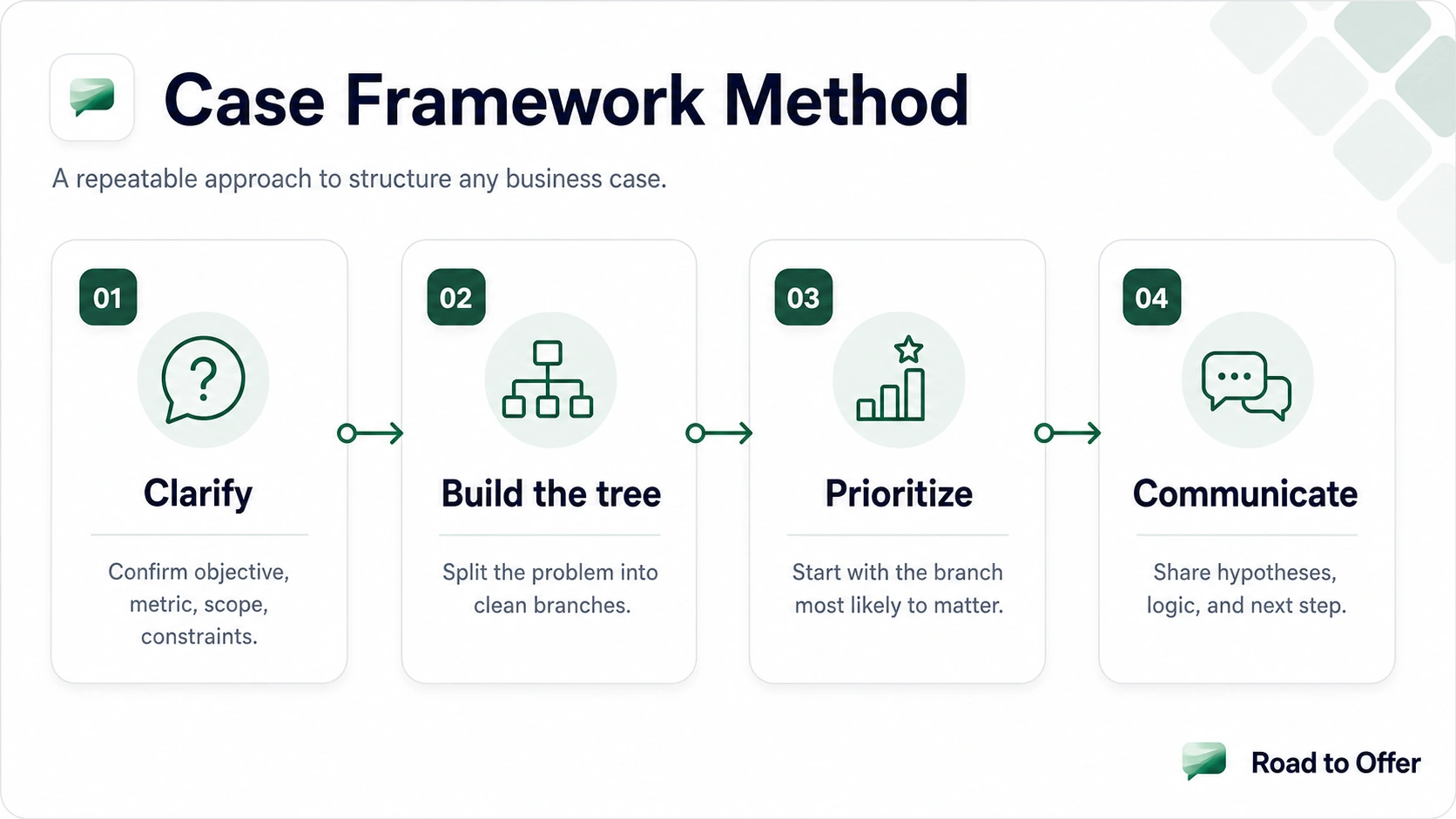
A consulting framework is a reusable way of breaking a business problem into the parts that decide the answer, and the seven that cover almost every case interview are profitability, market entry, M&A, pricing, growth strategy, operations, and market sizing. Knowing them is the entry ticket, not the score. Interviewers mark the structure you build for the case in front of you, which means the framework is the input and your tailored tree is the output. Everything below is organised so you can find your case type, take its framework as a starting lens, and adapt every branch to the client's actual objective before you say a word out loud.
The fastest way to use case interview frameworks is not to memorize seven templates. It is to identify the client's core question, choose the closest starting logic, and turn it into a case-specific issue tree in the first 90 seconds.
Before reaching case interviews, most MBB candidates are screened by a digital assessment (McKinsey Solve and the Bain Sova test are the two most common), so framework prep typically runs in parallel with assessment prep rather than before it.
The seven core frameworks (Profitability, Market Entry, 3Cs, 4Ps, Porter's Five Forces, M&A, and Pricing) cover the vast majority of cases you will encounter at McKinsey, BCG, Bain, and similar firms, according to IGotAnOffer's framework guide and Management Consulted's ultimate frameworks guide. But they only help if you adapt them.
Use this guide as a decision tool. Start with the selector below, pick the framework that answers the actual prompt, replace generic branches with client-specific drivers, then practice the opening structure out loud. Once you have a structure, prioritizing which branches to explore first is its own skill. The impact-effort matrix is a useful tool for ranking workstreams by value and feasibility. For cost-heavy cases, the cost reduction case interview guide provides a dedicated breakdown of cost-side levers. When the problem involves evaluating internal capabilities against competitors, a SWOT analysis or a McKinsey 7S assessment gives you a structured audit of both dimensions. If you freeze at the first structure or keep producing branches like "market, competition, operations," use the guided structure drill below before reading another framework.
case framework structure from the Road to Offer drill engine. Start with guided choices and explanations, then answer the same skill in your own words for AI-scored feedback. Free accounts include 5 drills per day for the first 3 days after signup.
Jump to the framework you need
Use this section like a cheat sheet. Pick the client decision first, then open the deeper guide and practice one prompt with that structure. If you want the one-page version before drilling, use the case interview cheat sheet.
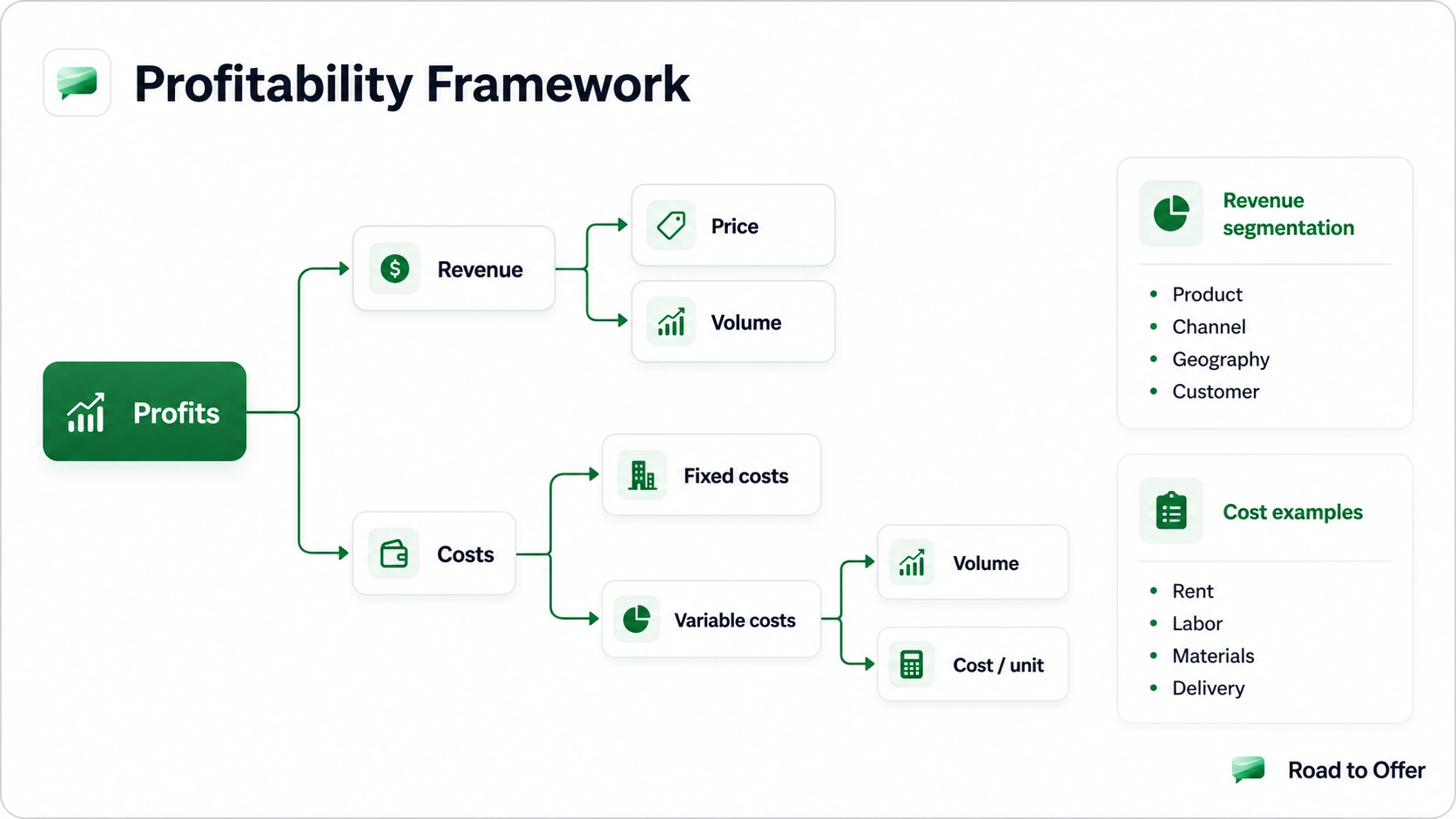
Profitability
Use when the client asks why profit or margin changed.
Prompt: A restaurant chain has flat revenue and falling EBITDA. Where do you start?
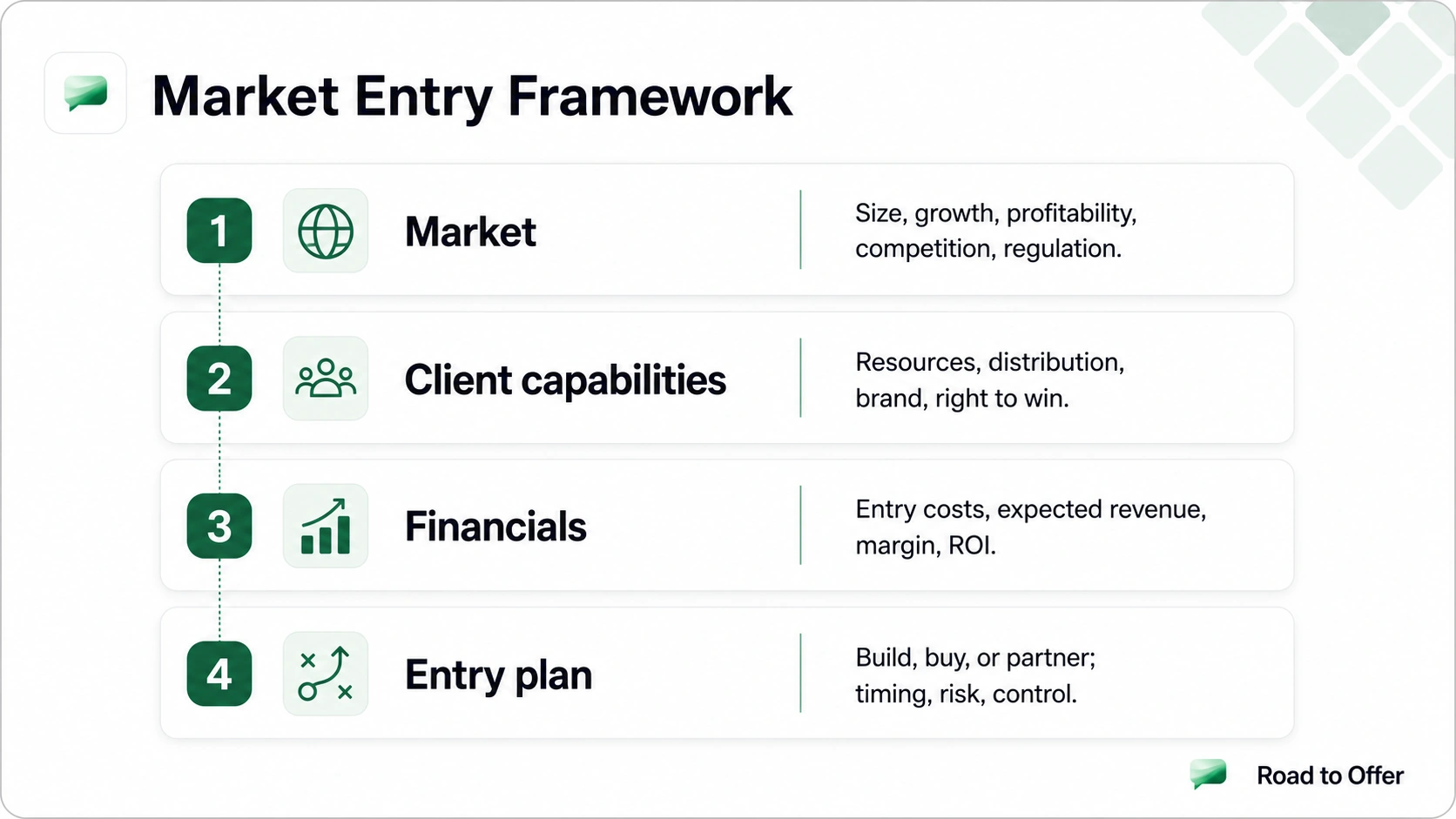
Market Entry
Use when the client asks whether to enter a geography, segment, product, or channel.
Prompt: A premium coffee chain wants to open stores in Austin. Should it enter?
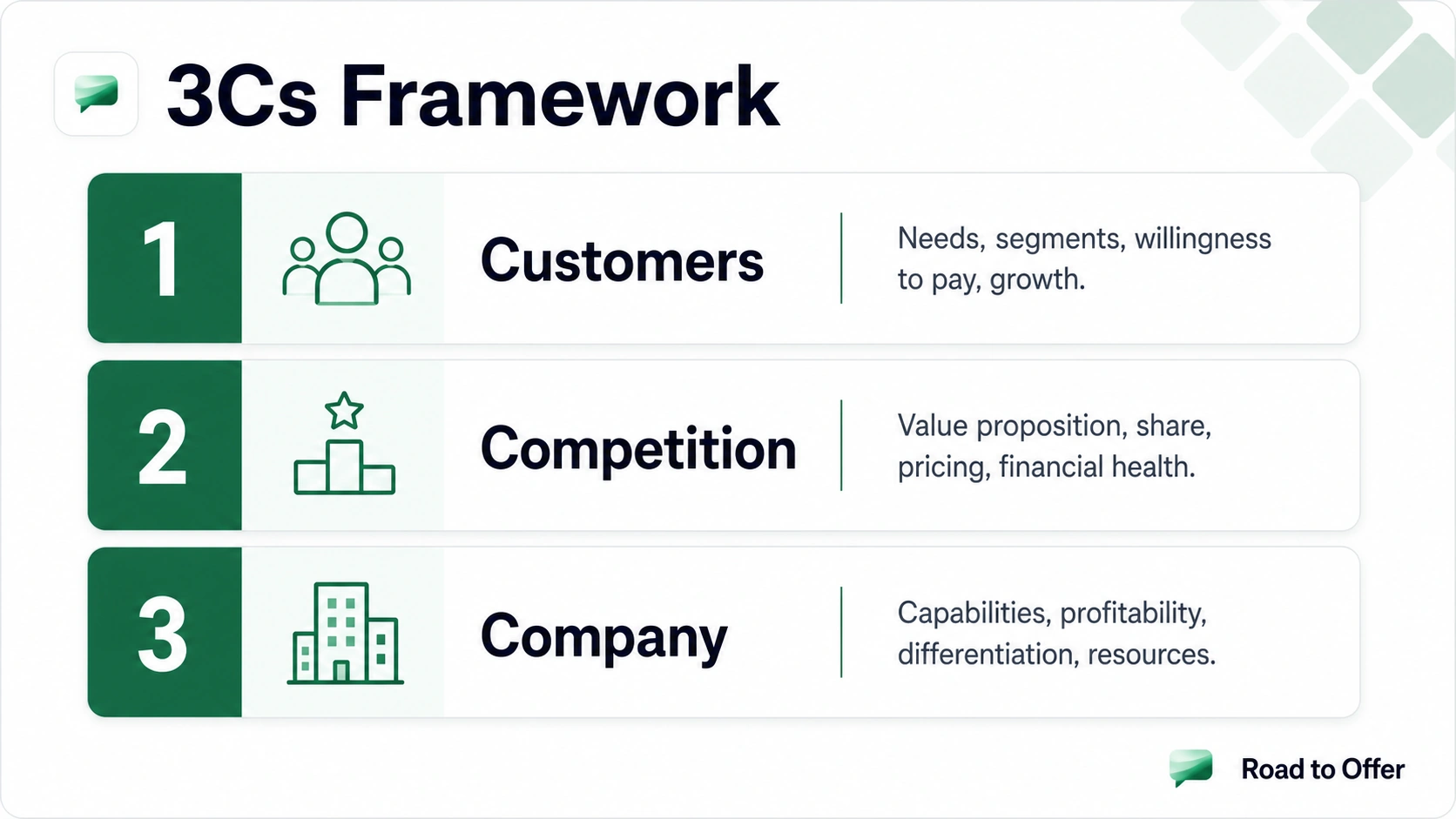
3Cs
Use when market share, customer behavior, or competitive position is the core question.
Prompt: A strong brand is losing share despite stable pricing. What changed?
4Ps
Use for product launch, marketing mix, channel, and positioning decisions.
Prompt: A beverage company is launching a new drink. What go-to-market questions matter?
Porter's Five Forces
Use when the client asks whether an industry can sustain attractive profits.
Prompt: A client wants to enter an industry with fast growth but heavy supplier concentration.
M&A
Use when the client asks whether to acquire, merge, divest, or integrate.
Prompt: A buyer wants to acquire a competitor for synergies. Is the deal worth it?
Pricing
Use when the client asks how much to charge, whether to raise price, or how to defend pricing power.
Prompt: A pharma company is launching a new drug against a cheaper incumbent. How should it price?
Build a framework on a real case
Pick a live voice case, structure it out loud, and get instant AI feedback on whether your tree fits the prompt.
Related framework tools
These are not always full opening frameworks. Use them when the case needs a more specific lens after you understand the client decision.
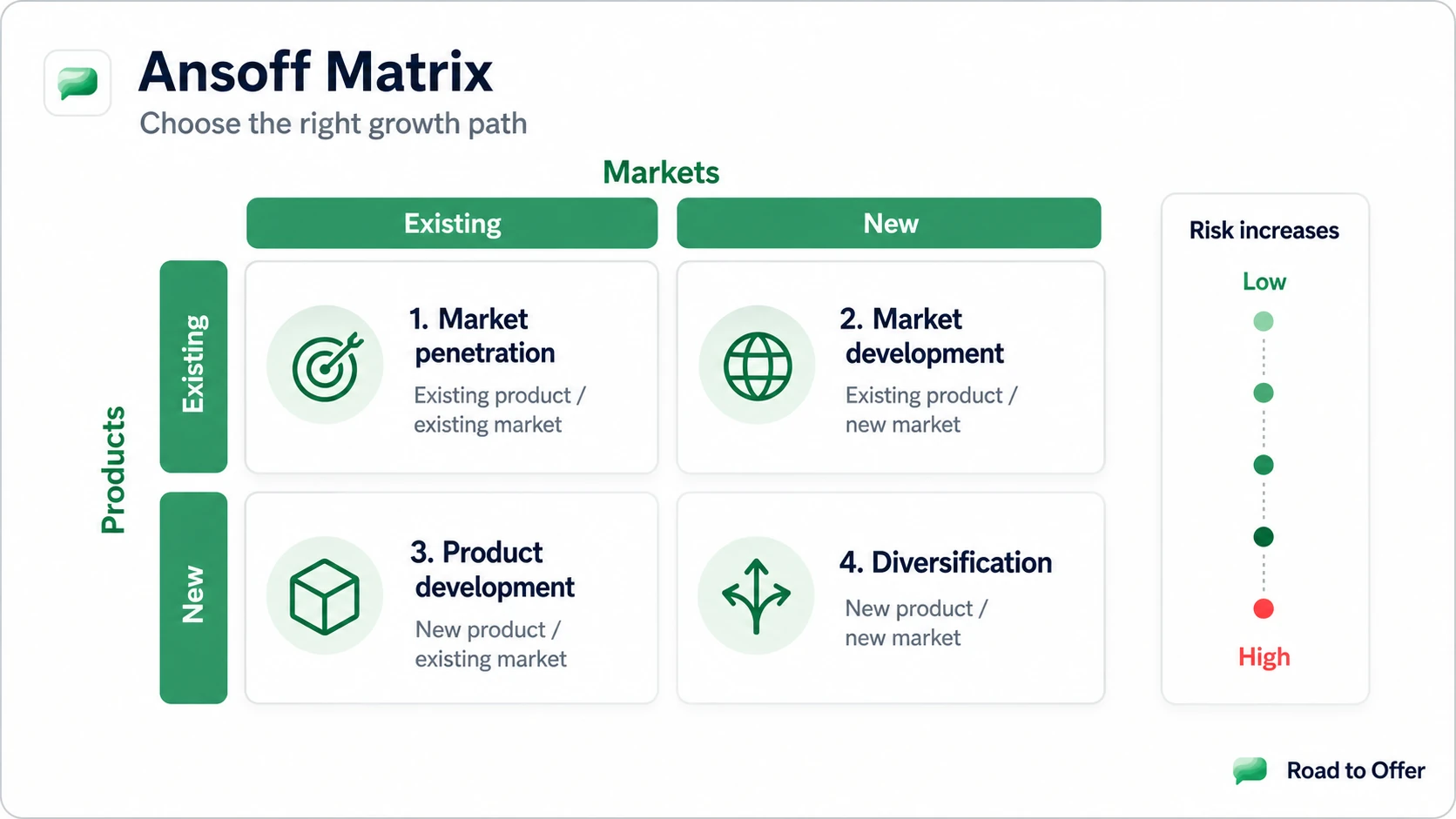
Ansoff Matrix
Choose a growth path across products and markets.
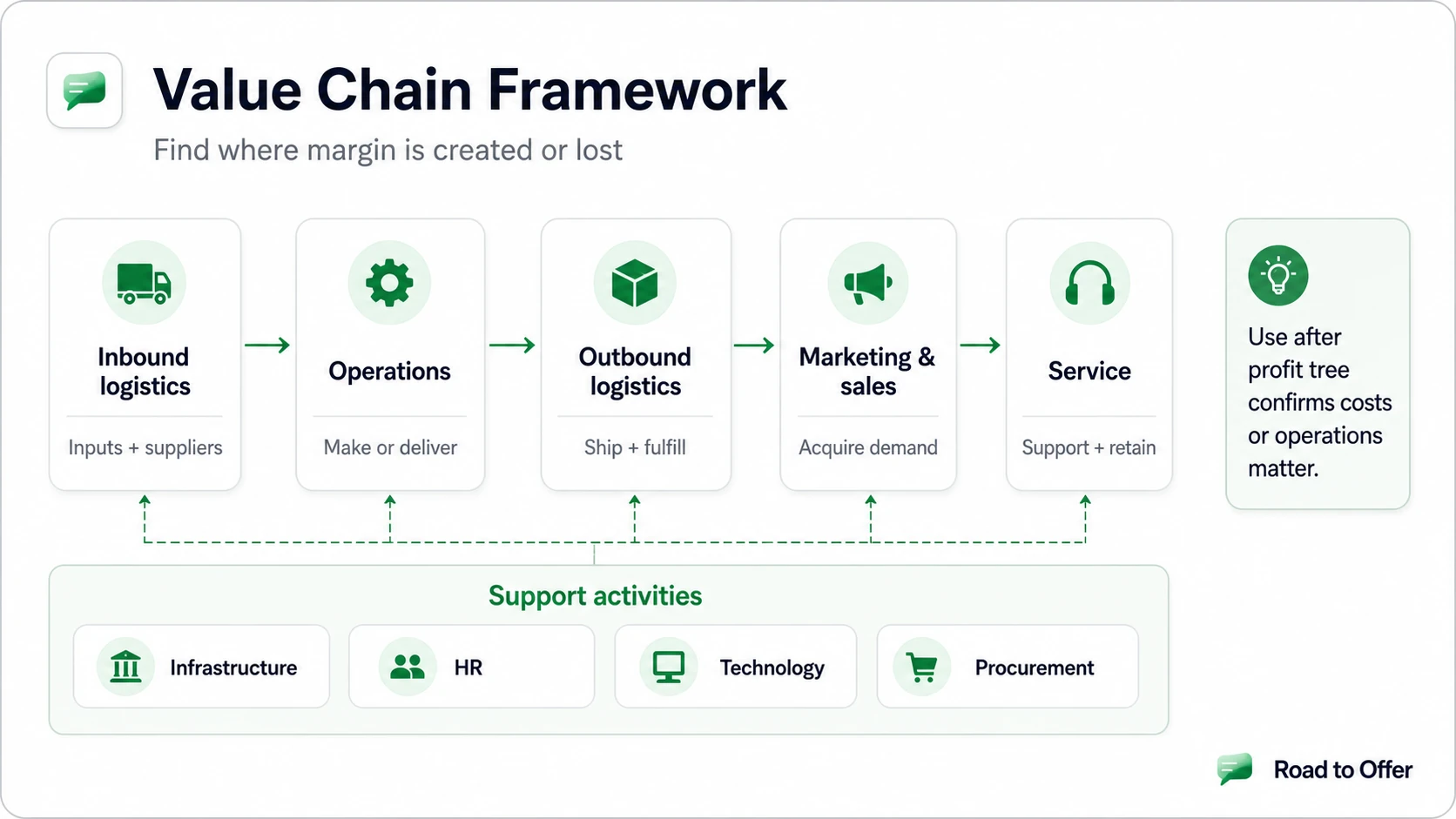
Value Chain
Find where cost leaks or value creation happen operationally.
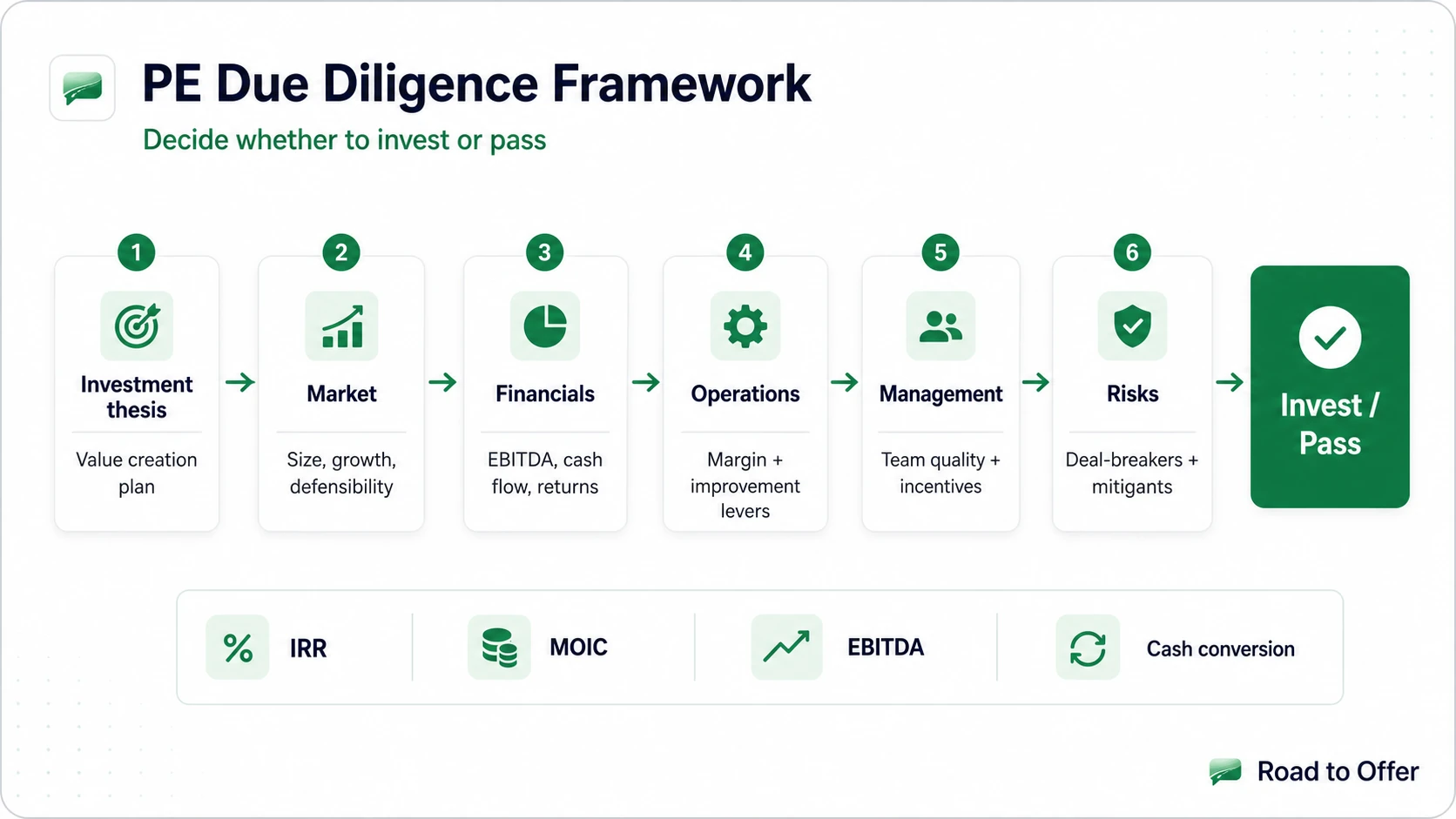
PE Due Diligence
Decide whether an investment target is worth buying.
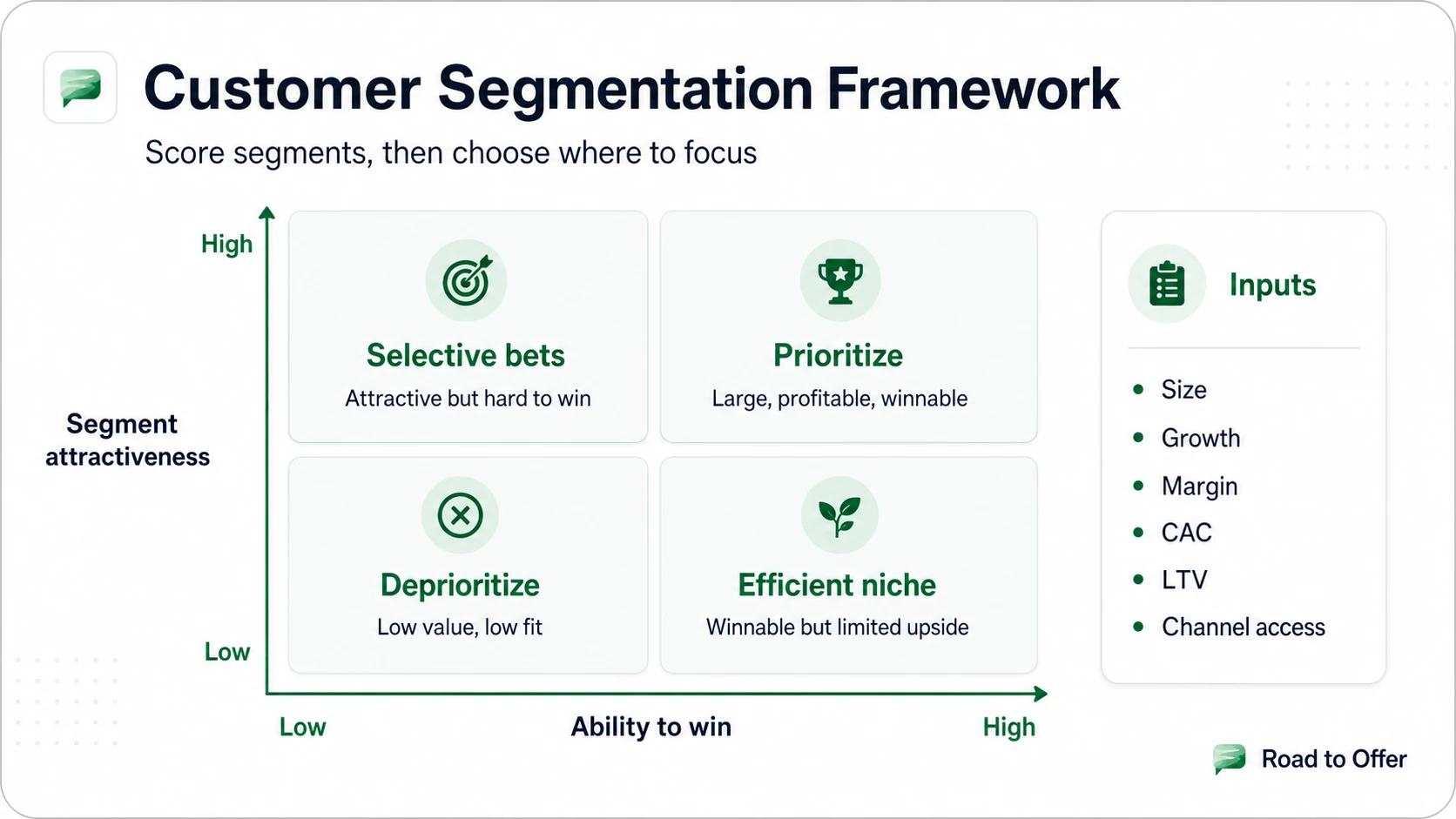
Customer Segmentation
Prioritize segments by attractiveness and ability to win.
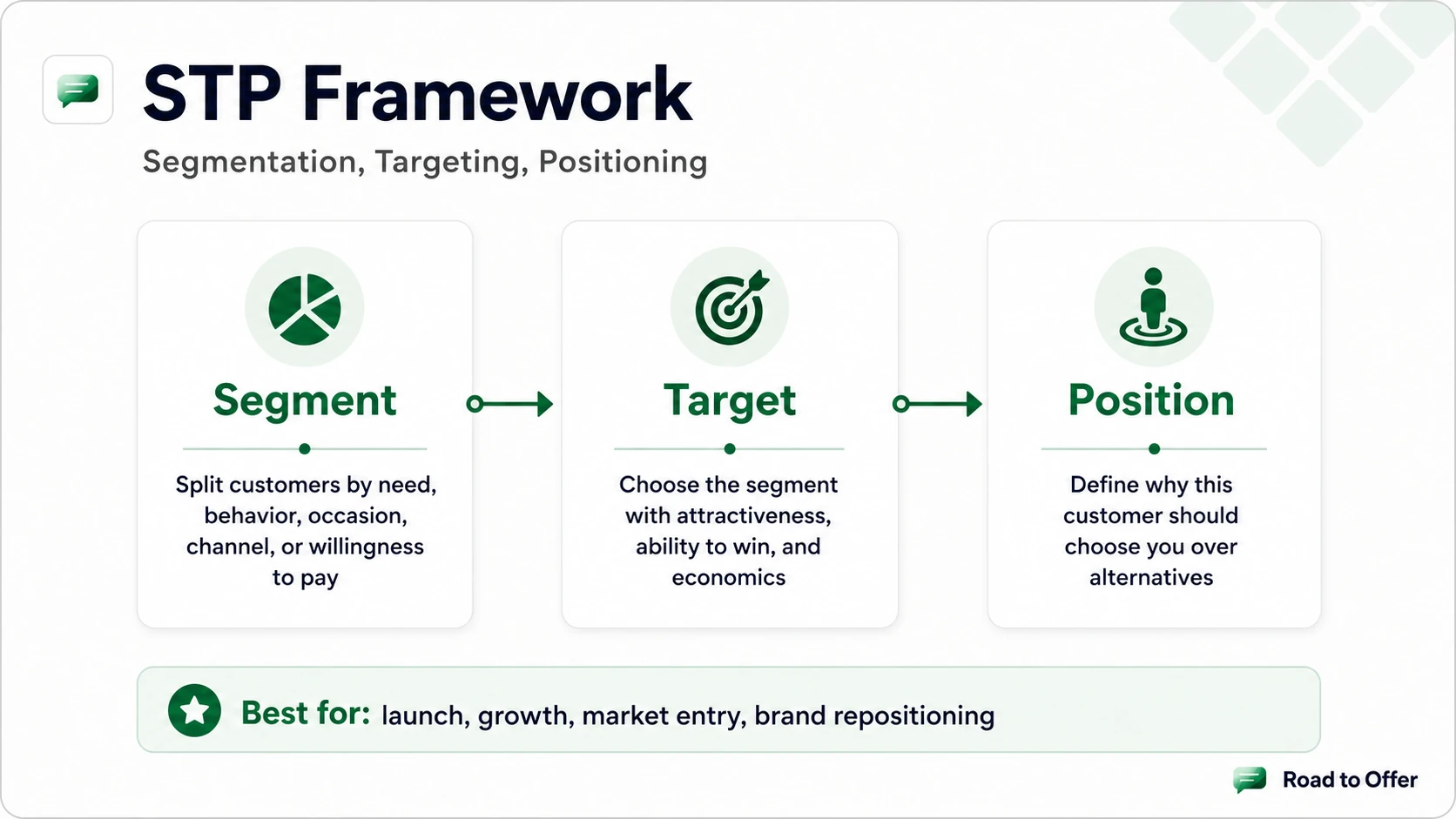
STP
Move from segment logic to target choice and positioning.
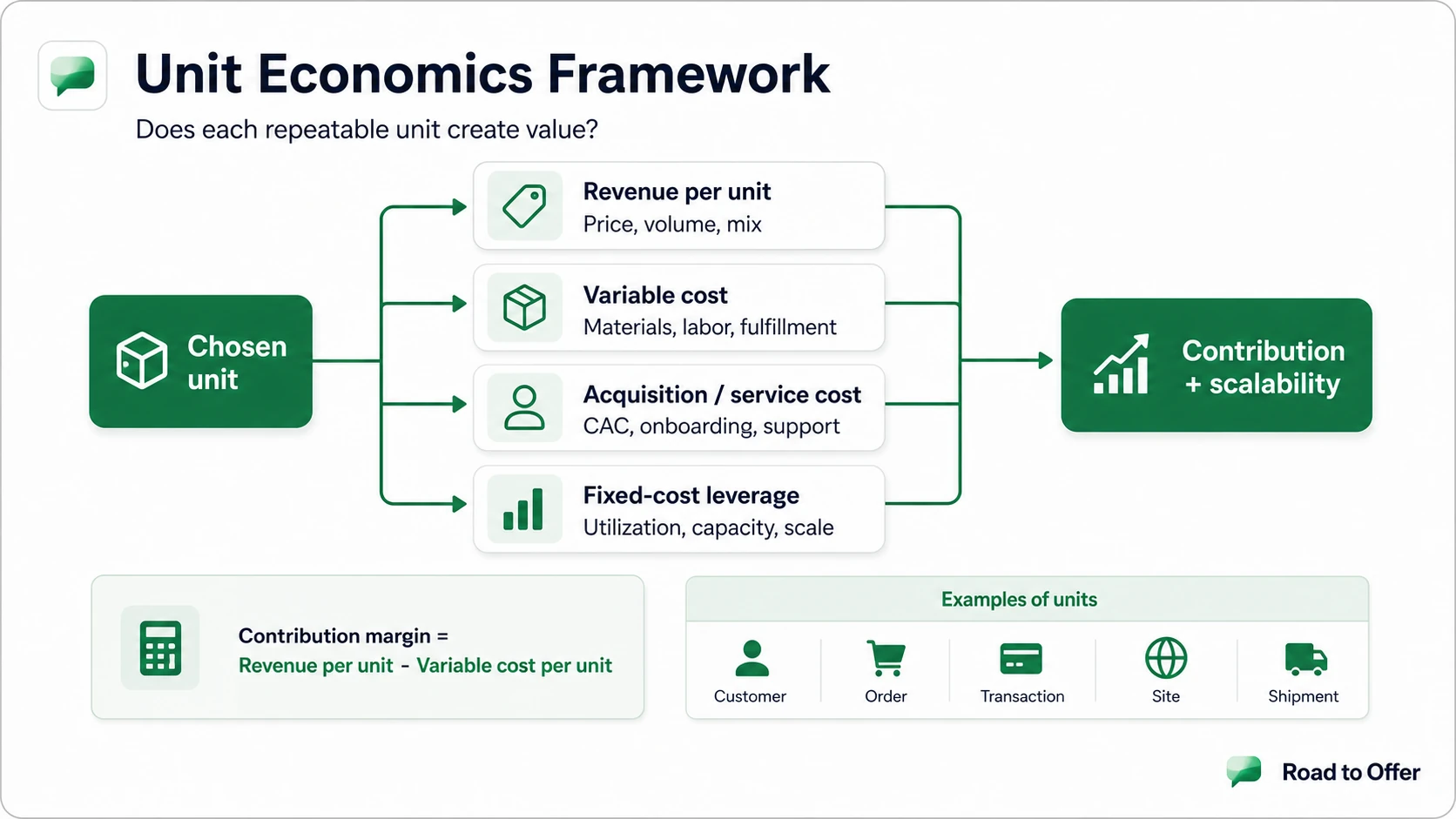
Unit Economics
Test whether each repeatable unit creates enough value.
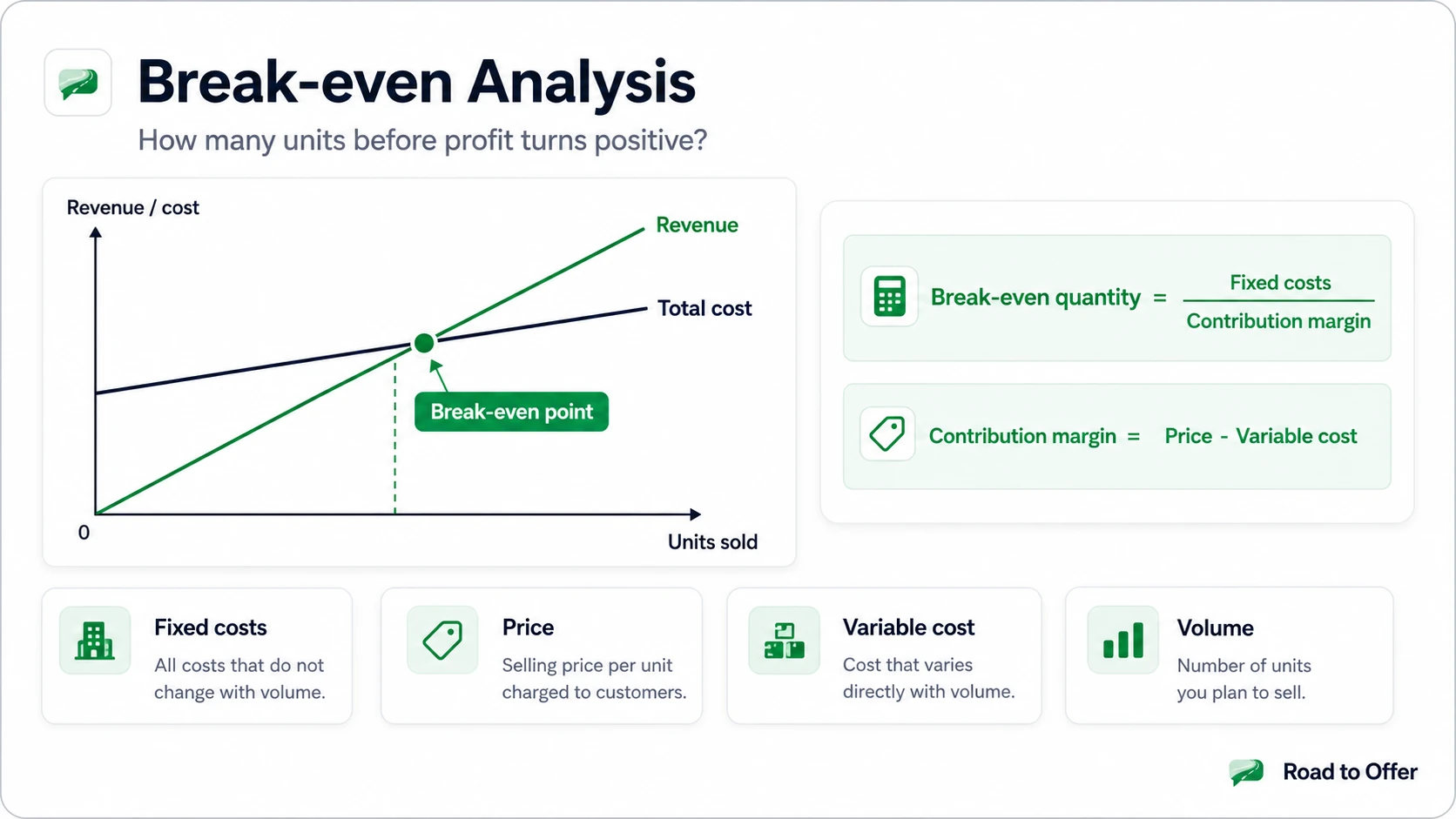
Break-even
Calculate the volume needed before profit turns positive.
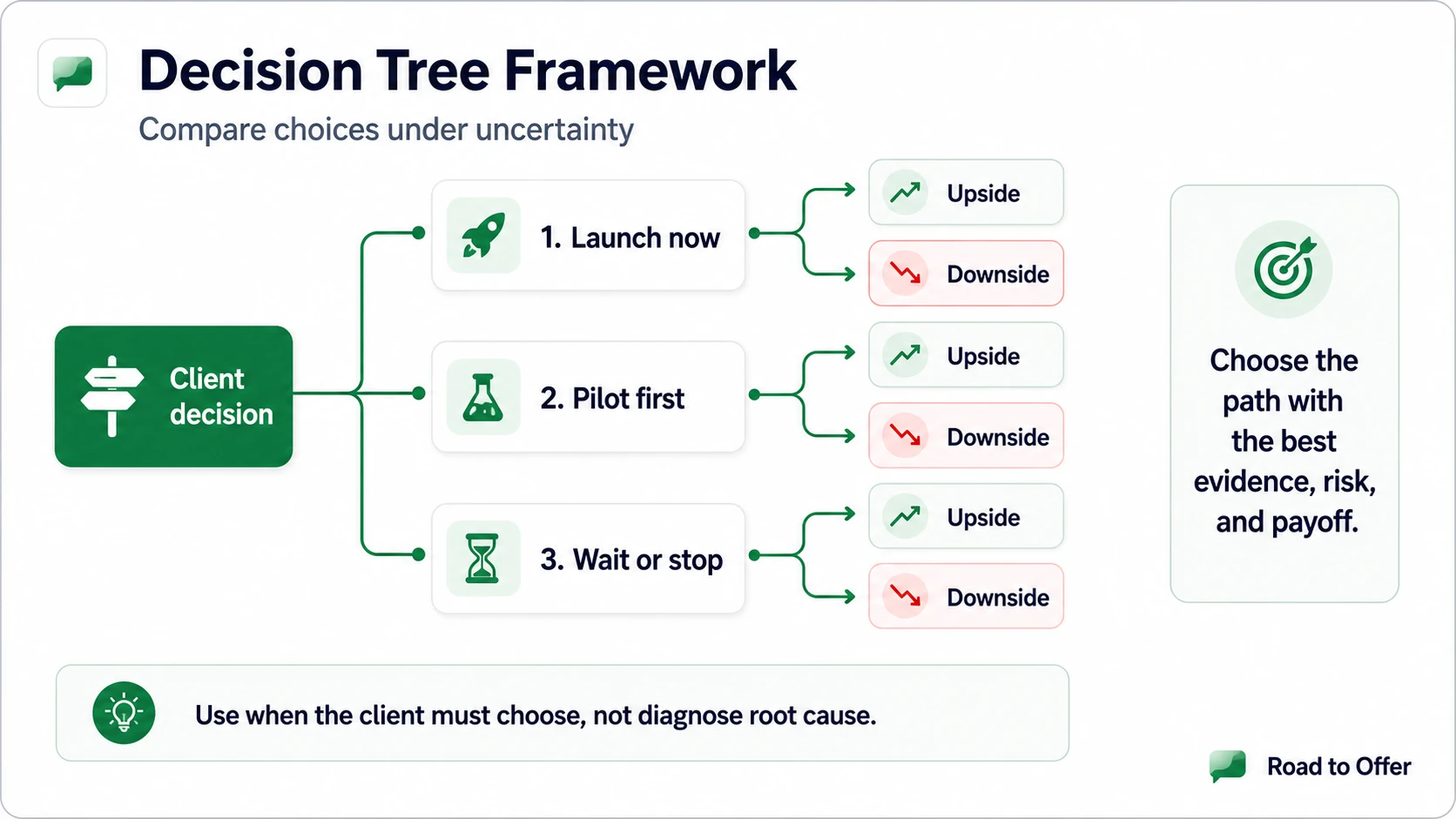
Decision Tree
Compare controllable choices under uncertainty.
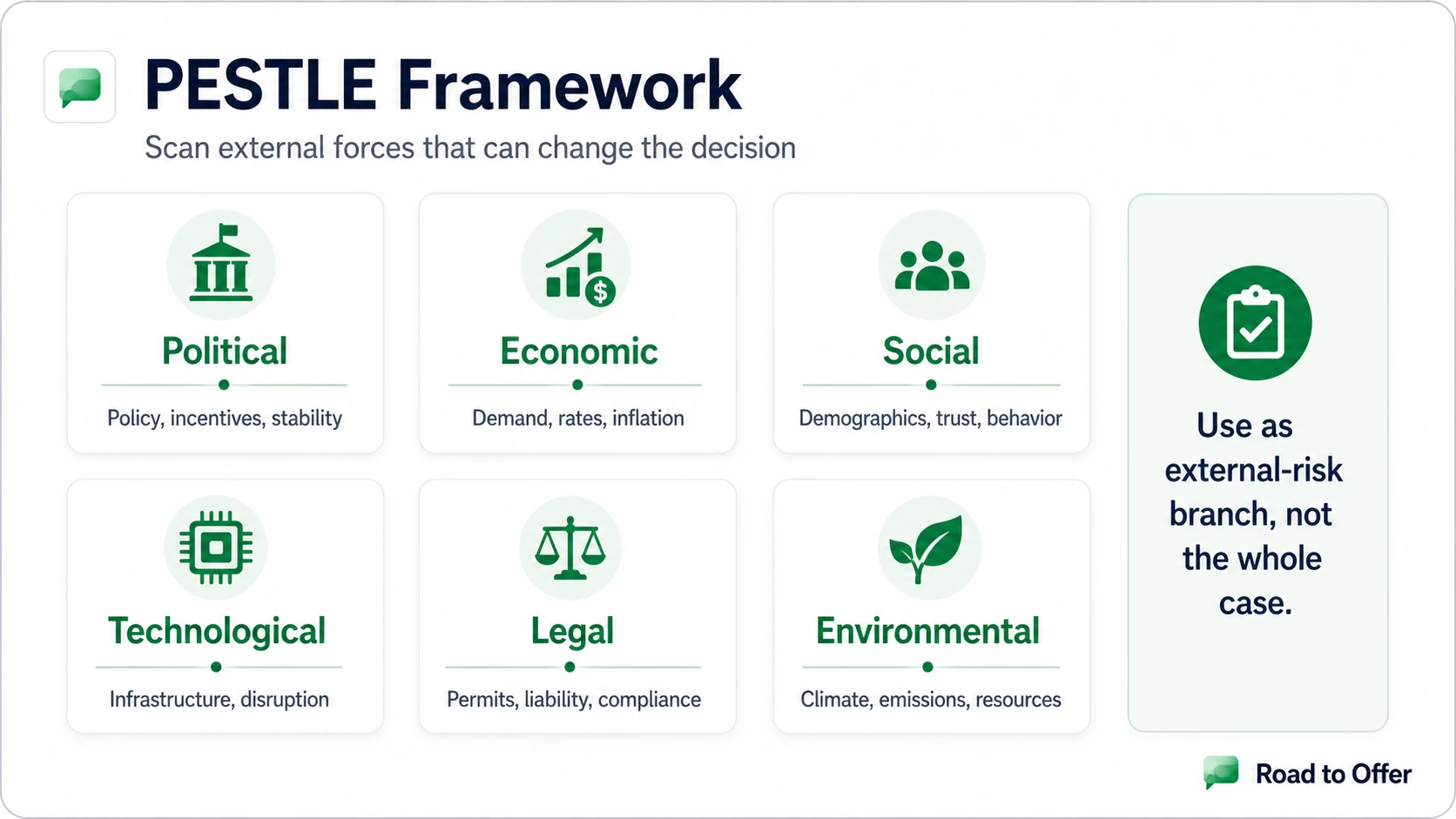
PESTLE
Pressure-test external forces around market or expansion decisions.
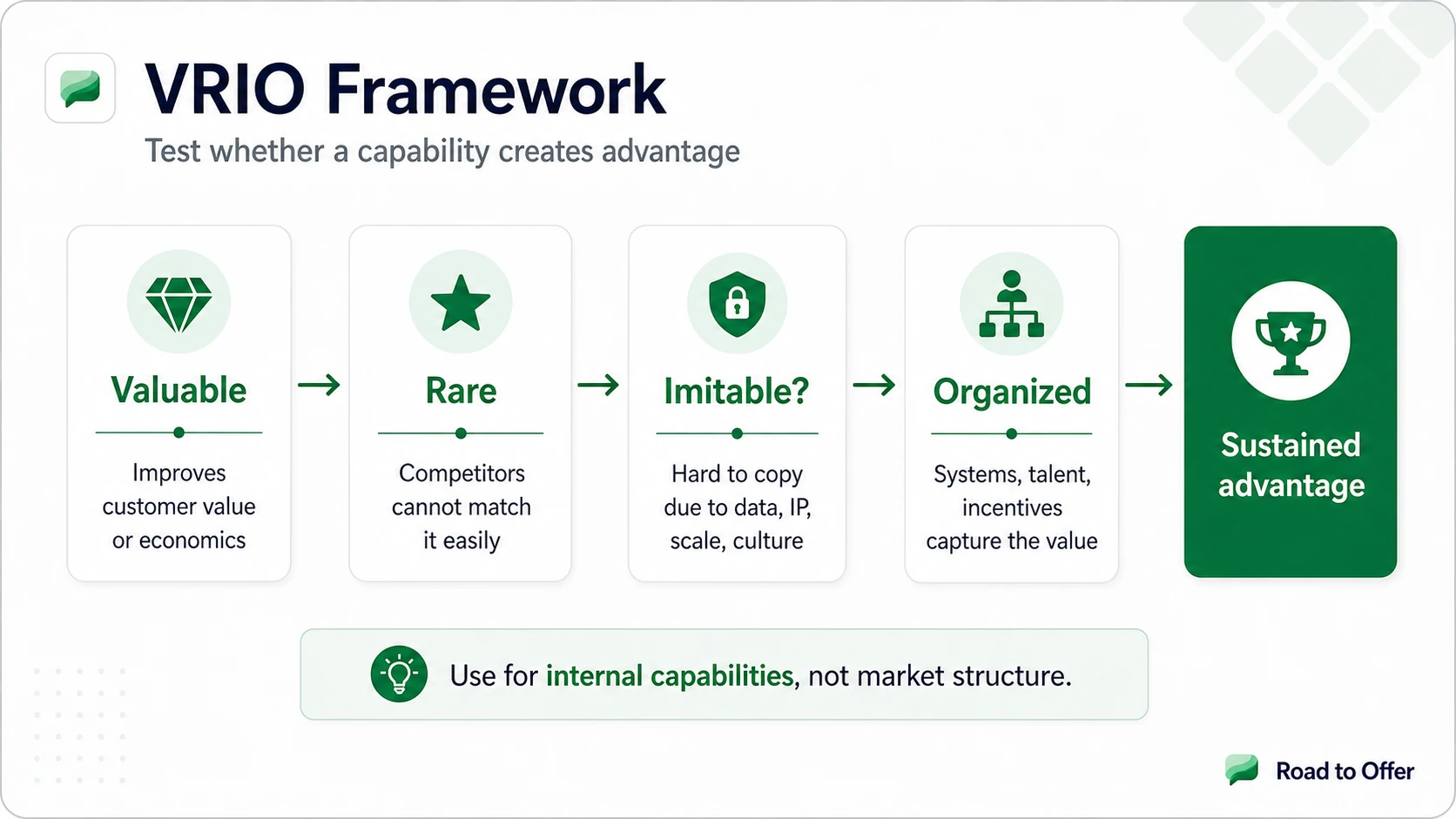
VRIO
Test whether internal resources create sustained advantage.
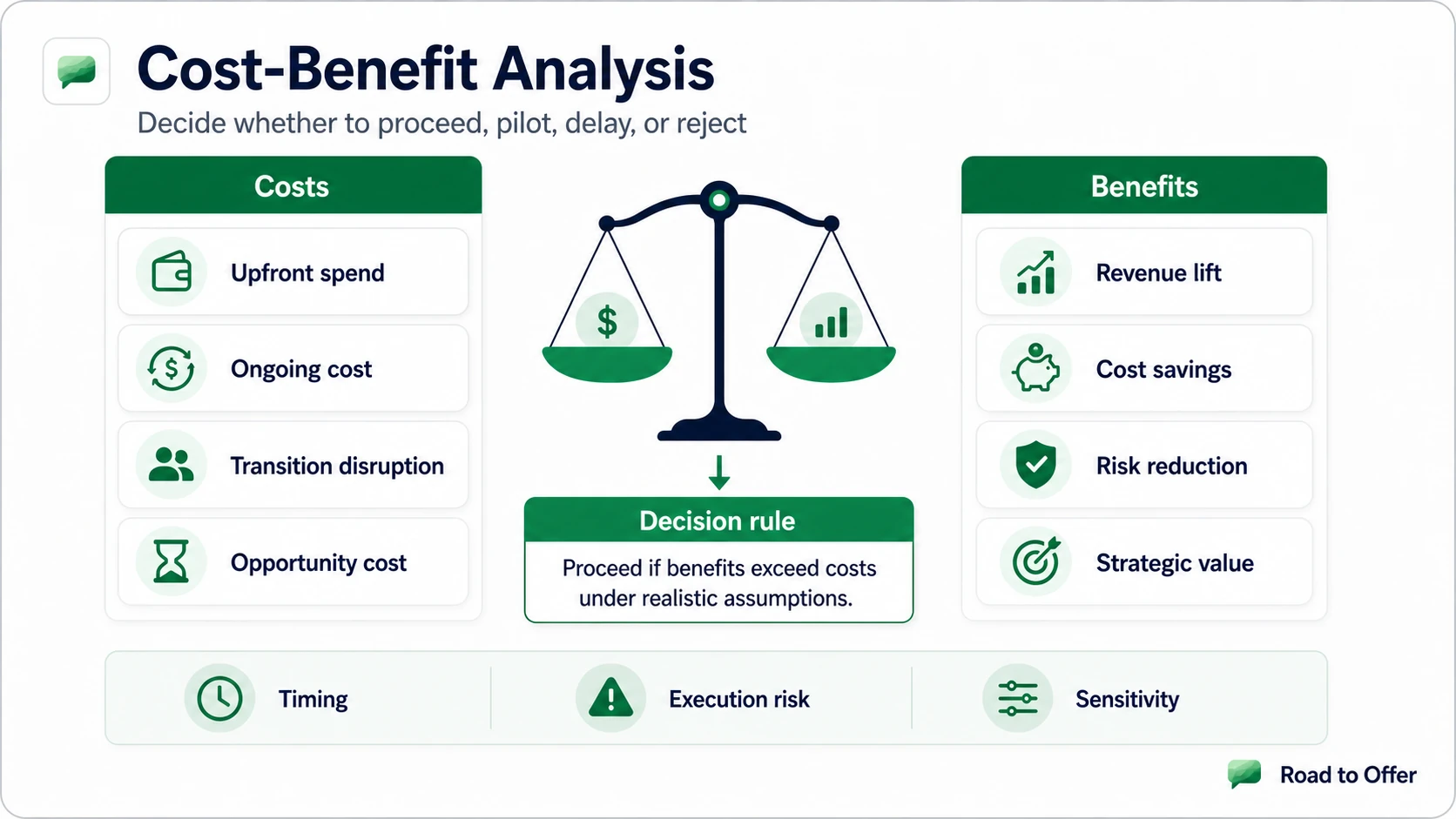
Cost-Benefit Analysis
Evaluate whether an action is worth the cost, risk, and timing.
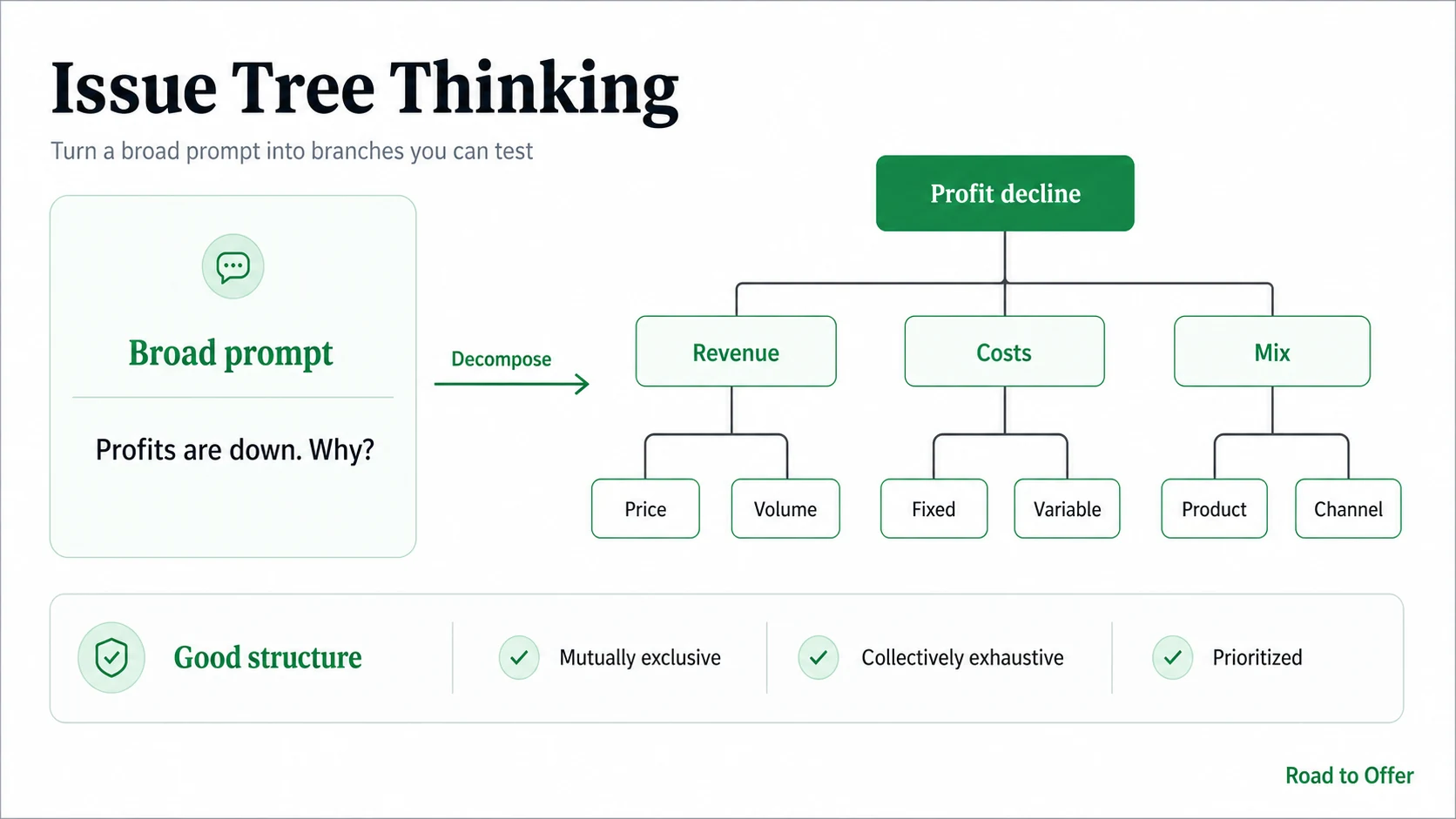
Issue Tree
Turn one root question into MECE, testable branches.
Why Frameworks Matter (and Why They're Not Enough)
A framework does one specific thing: it breaks a complex, ambiguous business problem into smaller pieces that you can analyze systematically. Without a framework, most candidates default to asking random questions, missing entire categories of analysis, and losing track of where they are in their reasoning.
But here is what most prep resources won't tell you: interviewers penalize candidates who apply frameworks mechanically. McKinsey, BCG, and Bain interviewers all report that one of the most common reasons they give low scores is "applied a generic framework without adapting it to the case," a pattern both IGotAnOffer and Management Consulted identify as the single most penalized mistake (and a key reason the rigid scripted approach in Case in Point draws criticism from interviewers). If your structure for a healthcare company's profitability case looks identical to your structure for a retail market entry case, that is a red flag.
The goal is to internalize the logic of each framework so deeply that you can reconstruct and modify it on the fly. Think of frameworks as vocabulary, not scripts. You need to know the words to speak fluently, but you never recite from a script.
Interactive drill set. Write an answer before revealing the worked solution, then continue into Road to Offer for scored practice and AI feedback.
The Framework Selection Decision Tree
Before diving into each framework, choose the starting point from the prompt. The framework is not the answer; it is the first draft you customize.
Step 1: What is the core question?
- "Why are profits declining?" or "How can we improve margins?" --> start with the Profitability Framework, then split revenue and cost drivers in the client's business model.
- "Should we enter this market?" or "Should we launch this product?" --> start with the Market Entry Framework, then add economics, competitive advantage, and execution risk.
- "Should we acquire this company?" or "Is this deal worth the price?" --> start with the M&A Framework, then test strategic fit, synergies, valuation, and integration risk.
- "How should we price this product?" --> start with the pricing strategy case framework, then pressure-test willingness to pay, alternatives, margin, competitor response, and channel constraints.
- "Why are we losing market share?" --> start with the 3Cs Framework, then isolate whether the issue sits with the company, competitors, or customers.
- "Is this industry attractive?" --> start with Porter's Five Forces, then focus only on the forces that determine long-term profit pools.
- "How should we position or market this product?" --> start with the 4Ps Framework, then make the branches specific to the target segment and go-to-market motion.
Step 2: Does the case involve multiple dimensions?
Most real interview cases involve more than one question. A market entry case almost always requires a profitability analysis of the new market. A profitability case might require a competitive analysis to understand why costs are rising. In these situations, use a primary framework for the core question and layer in elements from secondary frameworks as needed.
Step 3: Customize.
After selecting your primary framework, tailor it to the specific case. Replace generic labels with case-specific language. Add branches that are relevant to the industry. Cut branches that are irrelevant. This customization is what separates a 3-score from a 4-score on problem structuring.
Practice checkpoint: Take any prompt from case interview examples, choose the matching branch in this decision tree, and build the first structure before reading the worked approach. The goal is not to name the framework. The goal is to make the first 3-4 branches specific enough that they could only fit that client. For a timed version, run a free structure drill and force yourself to state why you picked that framework.
Choose and build a case structure from the Road to Offer drill engine. Answer a real prompt and get AI-scored feedback. Free accounts include 5 drills per day for the first 3 days after signup.
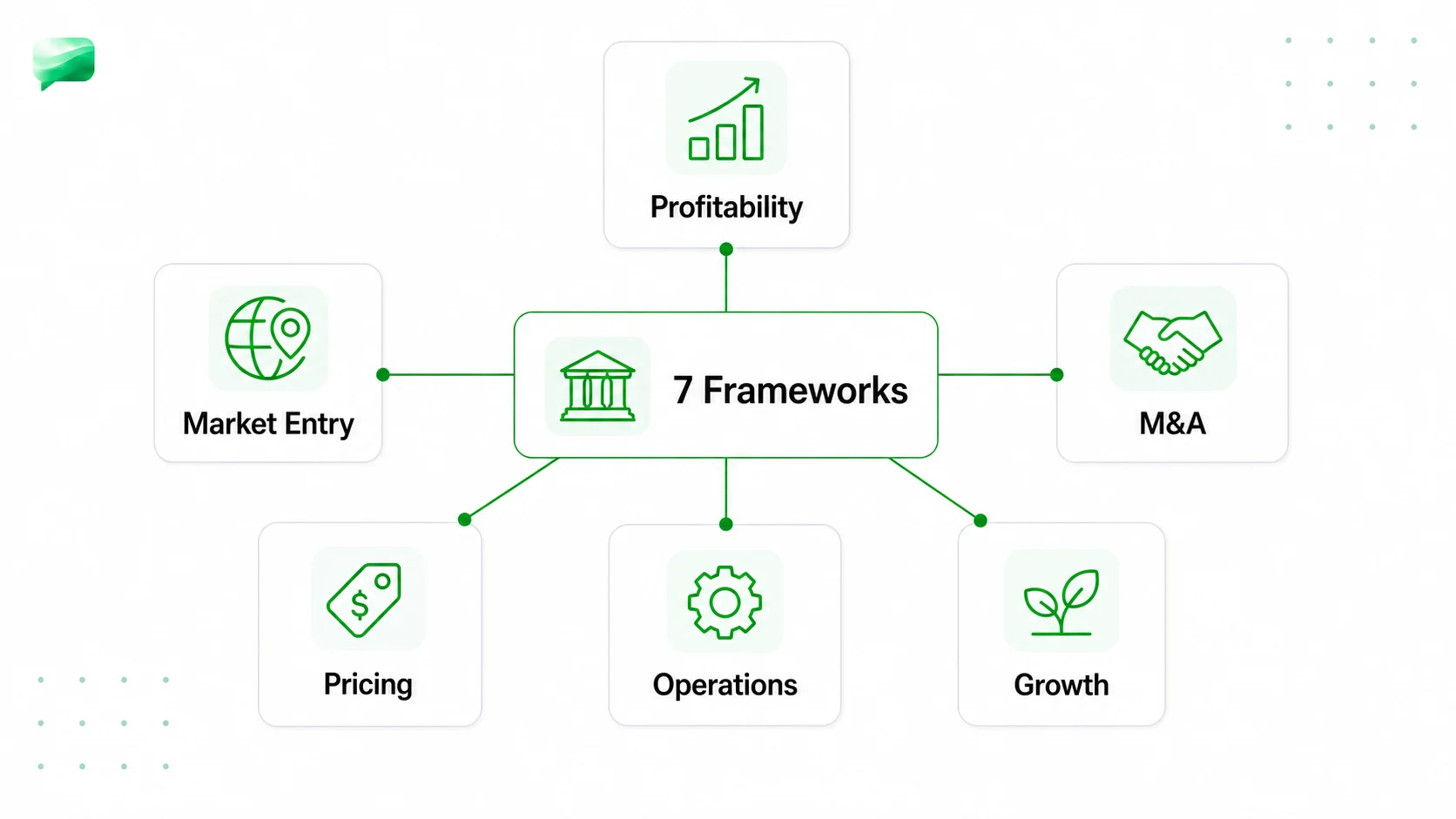
The 7 Core Case Interview Frameworks
1. The Profitability Framework
The profitability framework is the most versatile and most commonly tested framework. It decomposes any profitability problem into its mathematical components.
Profit = Revenue - Costs
Revenue = Volume x Price
Costs = Fixed Costs + Variable Costs
When to use it: Any case that mentions declining profits, margin pressure, cost reduction, or "why is our business underperforming?" This is your default starting framework for roughly 40% of all case interviews, making it the most common framework type according to both IGotAnOffer's case type frequency data and PrepLounge's case interview basics.
When NOT to use it: When the core question is about strategic direction (market entry, acquisition) rather than diagnosing a current problem. A profitability framework is backward-looking. If the case asks "should we do X," you need a forward-looking framework.
How to apply it well:
Break revenue into case-specific components. For a retail chain: Revenue = Number of stores x Average customers per store x Average transaction value. For a SaaS company: Revenue = Number of subscribers x Average revenue per user x Retention rate. The decomposition should reflect how the specific business actually generates revenue.
On the cost side, separate fixed from variable, then drill into the cost categories most relevant to the industry. A manufacturing company's cost structure looks very different from a professional services firm. For cases where the cost side is the entire focus, use the cost reduction case interview framework to structure discrete levers before recommending. Breaking down specific cost and revenue drivers into their operational inputs is also where a driver tree adds precision: it maps each top-level metric to the underlying variables that actually move it.
Worked example: Your client is a regional pizza chain with declining profits over the past two years.
Instead of starting with "revenues and costs," customize:
- Revenue = Number of locations x Average daily orders per location x Average order value
- Costs = Store-level costs (rent, staff, ingredients) + Corporate overhead + Delivery infrastructure
You ask about each driver. Customer traffic is down 15% due to a competitor opening nearby. Ingredient costs are up 12% due to supply chain issues. Average order value is flat. This immediately tells you: the problem is split between a revenue driver (volume) and a cost driver (ingredients), not a pricing issue.
Apply the profitability framework to a McKinsey case. A Spanish EV charging network saw profits fall sharply in a single year. Answer this McKinsey profitability case step in the article and get AI-scored feedback on your structure. Continue the full case on Road to Offer
2. The Market Entry Framework
The market entry framework evaluates whether a company should enter a new market, geography, or product category.
Core components:
- Market attractiveness: Size, growth rate, profitability, competitive intensity.
- Competitive position: Can we win? What advantages do we bring? What are barriers to entry?
- Entry strategy: How would we enter? Build, buy, or partner?
- Economics: What investment is required? What is the expected return and timeline?
When to use it: Cases about geographic expansion, adjacent markets, diversification decisions, or high-level product-market choices. If the case has already committed to launch and asks for pricing, channels, and metrics, switch to the dedicated new product launch case framework. When comparing multiple potential markets, the market attractiveness framework provides a scoring lens across size, growth, profitability, and competitive intensity.
For asset-heavy expansion cases, layer in real estate-specific metrics from the real estate case interview guide: cap rate, NOI, lease-up risk, capex, and exit assumptions.
When NOT to use it: When the client is already in the market and the problem is operational (declining profits, cost optimization). Use profitability for those.
Key difference from profitability: The market entry framework is forward-looking. You are evaluating a decision that hasn't been made yet. This means you need to estimate future market conditions, not just diagnose current problems.
How to avoid the common mistake: Many candidates assess market attractiveness thoroughly but forget to evaluate whether the client can actually compete. A $50 billion market with 20% growth is irrelevant if the client has no competitive advantage and would face entrenched incumbents.
Interactive drill set. Write an answer before revealing the worked solution, then continue into Road to Offer for scored practice and AI feedback.
Try the same logic on a live profitability prompt, then build the opening structure under a timer:
3. The 3Cs Framework
The 3Cs framework (Company, Competitors, Customers) is essential for understanding market dynamics and competitive positioning. A close variant, the 4C framework, adds Cost as a fourth lens (Customer, Company, Competition, and Cost) for cases where the cost position is as decisive as the competitive one.
Components:
- Company: Internal capabilities, resources, market share, strengths, weaknesses.
- Competitors: Who are they? What are their strategies, market shares, cost positions?
- Customers: Who are they? What do they value? How price-sensitive are they? What are their switching costs? When the case requires cutting customers into distinct groups before answering those questions, a segmentation framework for business analysis gives you a structured lens for dividing the market.
When to use it: Market share decline, competitive strategy, customer retention, brand positioning.
When NOT to use it as primary: Pure cost optimization or operational efficiency cases where the competition is less relevant than internal operations.
The power of 3Cs: It forces you to triangulate. If a company is losing market share, is it because:
- The company has internal problems (quality decline, operational issues)?
- Competitors got stronger (new product, better pricing, more marketing)?
- Customers' needs changed (new preferences, demographic shift, switching to substitutes)?
Each answer leads to a fundamentally different recommendation. That is why 3Cs is more diagnostic than profitability for market share questions.
Interactive drill set. Write an answer before revealing the worked solution, then continue into Road to Offer for scored practice and AI feedback.
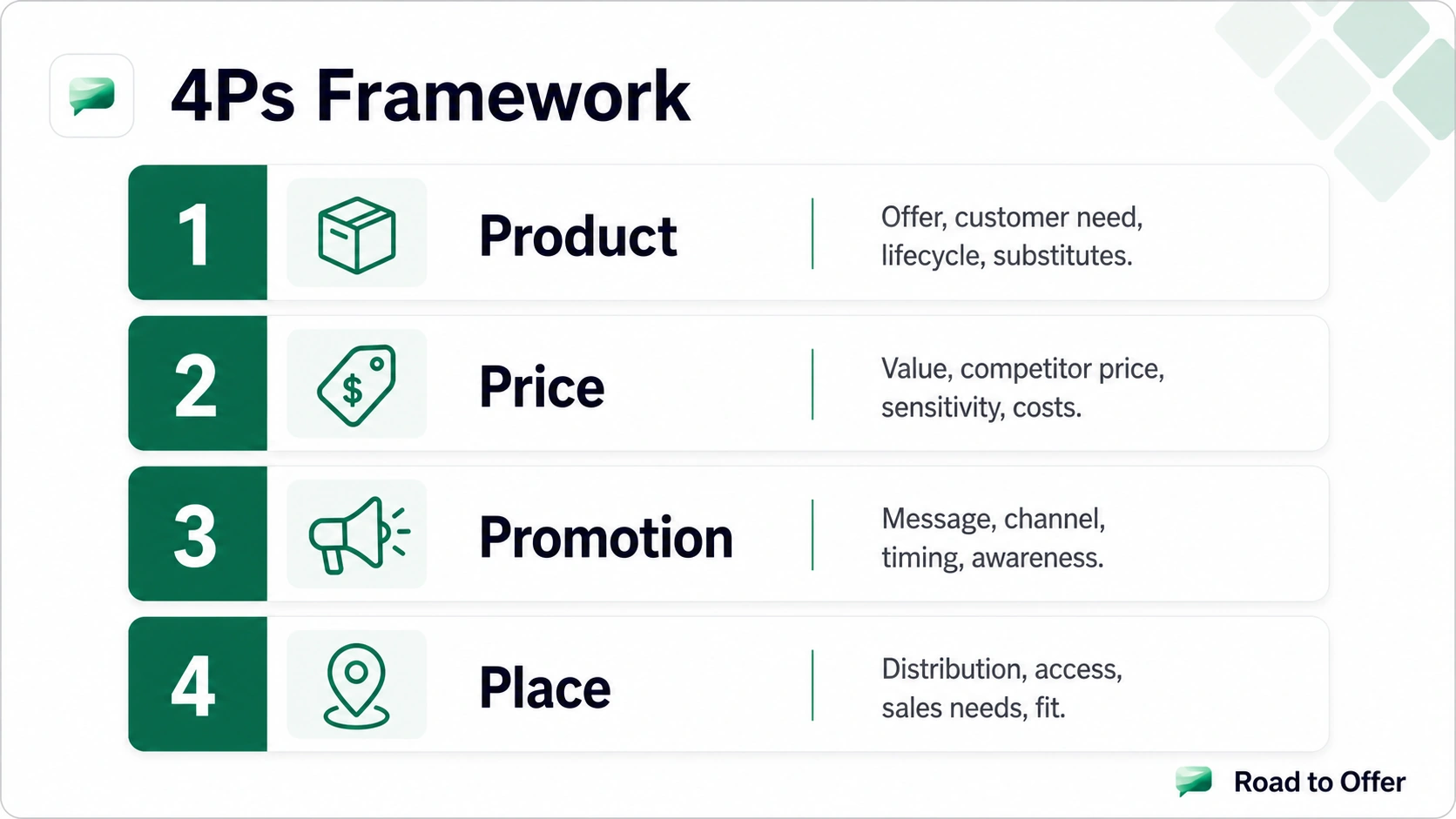
4. The 4Ps Framework
The 4Ps framework (Product, Price, Place, Promotion) structures marketing and go-to-market strategy cases.
Components:
- Product: Features, quality, differentiation, brand positioning, product lifecycle stage.
- Price: Pricing strategy, price point relative to competitors, customer willingness to pay.
- Place: Distribution channels, retail presence, online vs. offline, geographic coverage.
- Promotion: Advertising, branding, digital marketing, customer acquisition cost, promotional mix.
When to use it: New product launches, marketing strategy, sales channel optimization, brand repositioning, and pricing decisions with a marketing dimension. For a full go-to-market walkthrough, use the new product launch case interview guide covered above.
When NOT to use it: Cases about internal operations, cost reduction, or acquisition decisions. 4Ps is an externally-focused, go-to-market framework.
Quick example: A premium coffee brand's sales are declining in urban markets. Using 4Ps:
- Product: Has product quality changed? Has the brand been diluted by line extensions?
- Price: Are prices above what the target customer will pay? Did competitors undercut?
- Place: Are they losing shelf space in key retailers? Are online channels underperforming?
- Promotion: Is competitor advertising drowning them out? Has their marketing spend declined?
Interactive drill set. Write an answer before revealing the worked solution, then continue into Road to Offer for scored practice and AI feedback.
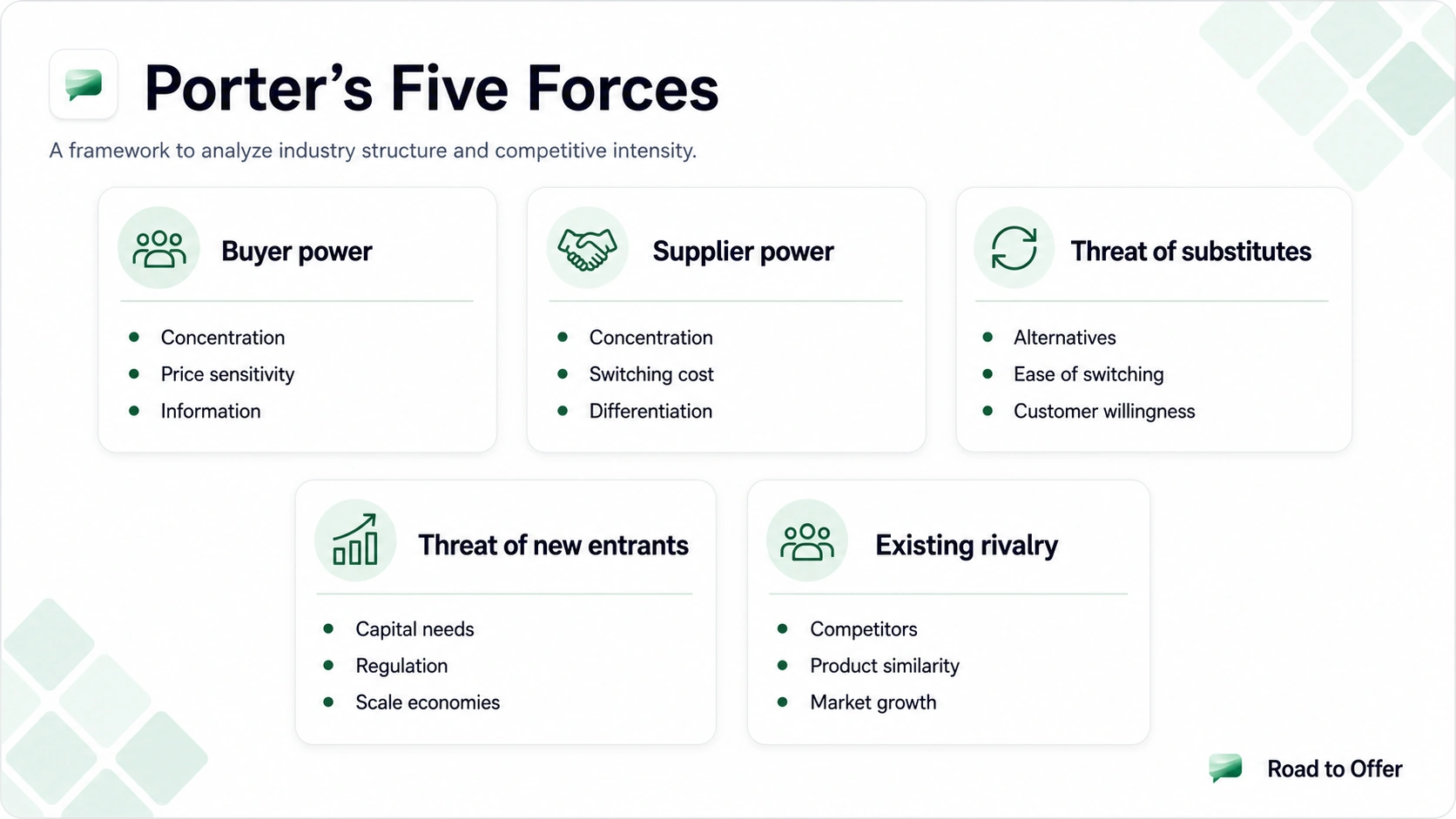
5. Porter's Five Forces
Porter's Five Forces analyzes industry attractiveness and the structural factors that drive profitability in a market. The framework was introduced by Michael E. Porter in his landmark 1979 Harvard Business Review article "How Competitive Forces Shape Strategy" and updated in his 2008 HBR piece "The Five Competitive Forces That Shape Strategy". It remains one of the most widely taught strategy frameworks globally.
The five forces:
- Rivalry among existing competitors: How intense is direct competition?
- Threat of new entrants: How easy is it for new companies to enter?
- Threat of substitutes: Do alternative products or services exist?
- Bargaining power of suppliers: How much leverage do suppliers have?
- Bargaining power of buyers: How much leverage do customers have?
When to use it: Industry analysis, market entry decisions (as a supplement to the market entry framework), understanding pricing power, evaluating long-term industry profitability.
When NOT to use it as primary: Firm-specific operational problems. Five Forces is about industry structure, not company performance. If the case asks why one specific company is underperforming in an otherwise healthy industry, Five Forces won't get you there.
Critical application tip: Don't try to analyze all five forces equally in every case. Focus on the 2-3 forces most relevant to the case question. For a pricing case, supplier and buyer power matter most. For a market entry case, barriers to entry and rivalry matter most. Selectivity shows judgment.
Interactive drill set. Write an answer before revealing the worked solution, then continue into Road to Offer for scored practice and AI feedback.
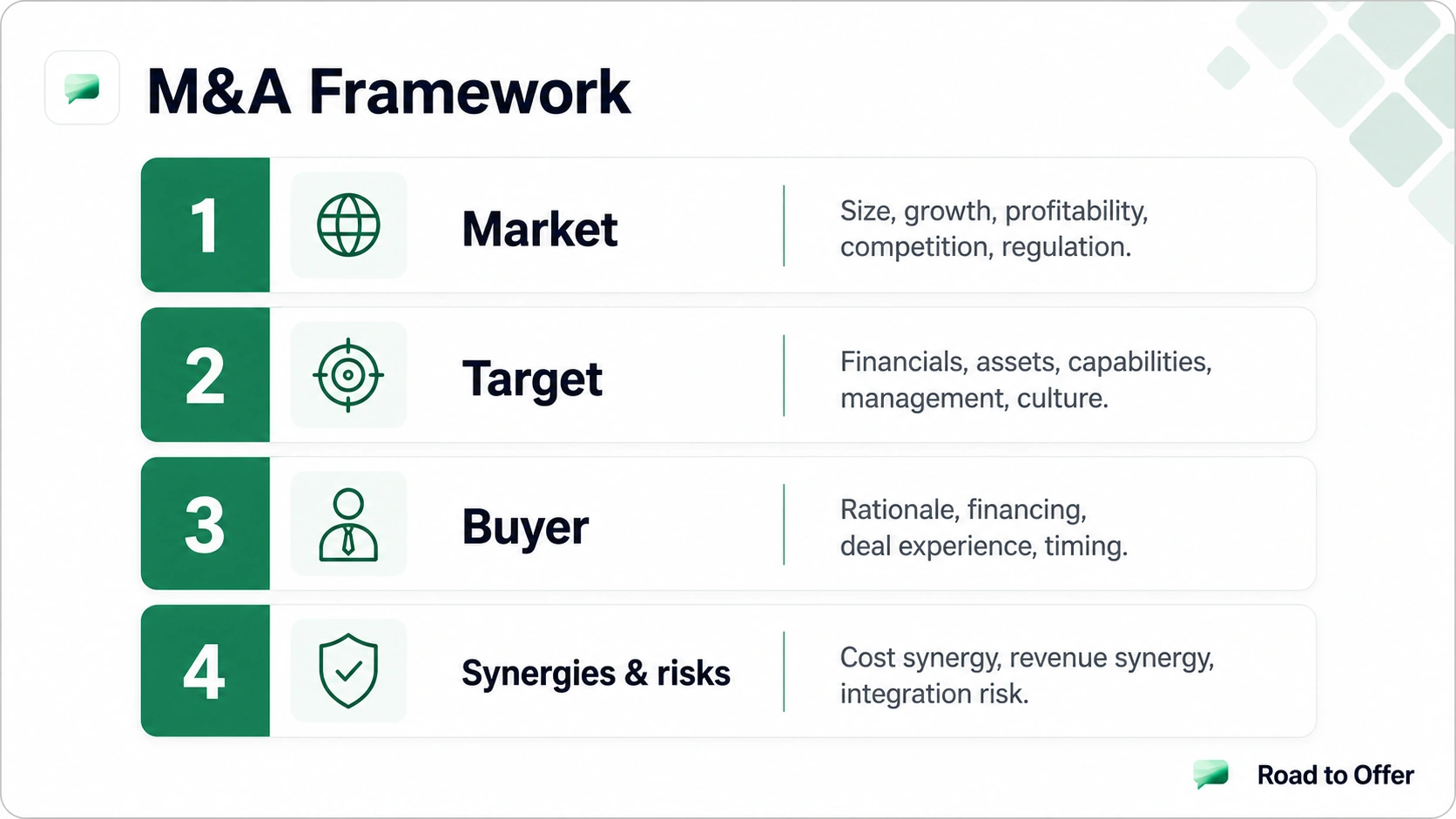
6. The M&A Framework
The M&A framework evaluates whether acquiring another company is a good strategic and financial decision.
Core components:
- Strategic rationale: Why acquire? Does it align with strategy and fill a genuine capability gap?
- Target evaluation: Is the target company attractive? Financial health, market position, growth trajectory.
- Synergies: Cost synergies (eliminate duplicates, consolidate operations) and revenue synergies (cross-sell, enter new markets, share distribution).
- Integration risks: Cultural fit, technology compatibility, customer retention risk, management retention.
- Valuation: Is the price justified by the synergies? What is the payback period?
When to use it: Any case about acquiring a company, evaluating a deal, or deciding between build-vs-buy options.
The common trap: Candidates analyze synergies enthusiastically but forget integration risks. In practice, McKinsey's research on merger failures finds that roughly 70% of mergers fail to deliver projected value, with revenue synergy overestimation as the primary culprit: nearly 70% of deals in their database failed to achieve expected revenue synergies. Integration difficulty is the most common reason. Always discuss what could go wrong.
Interactive drill set. Write an answer before revealing the worked solution, then continue into Road to Offer for scored practice and AI feedback.
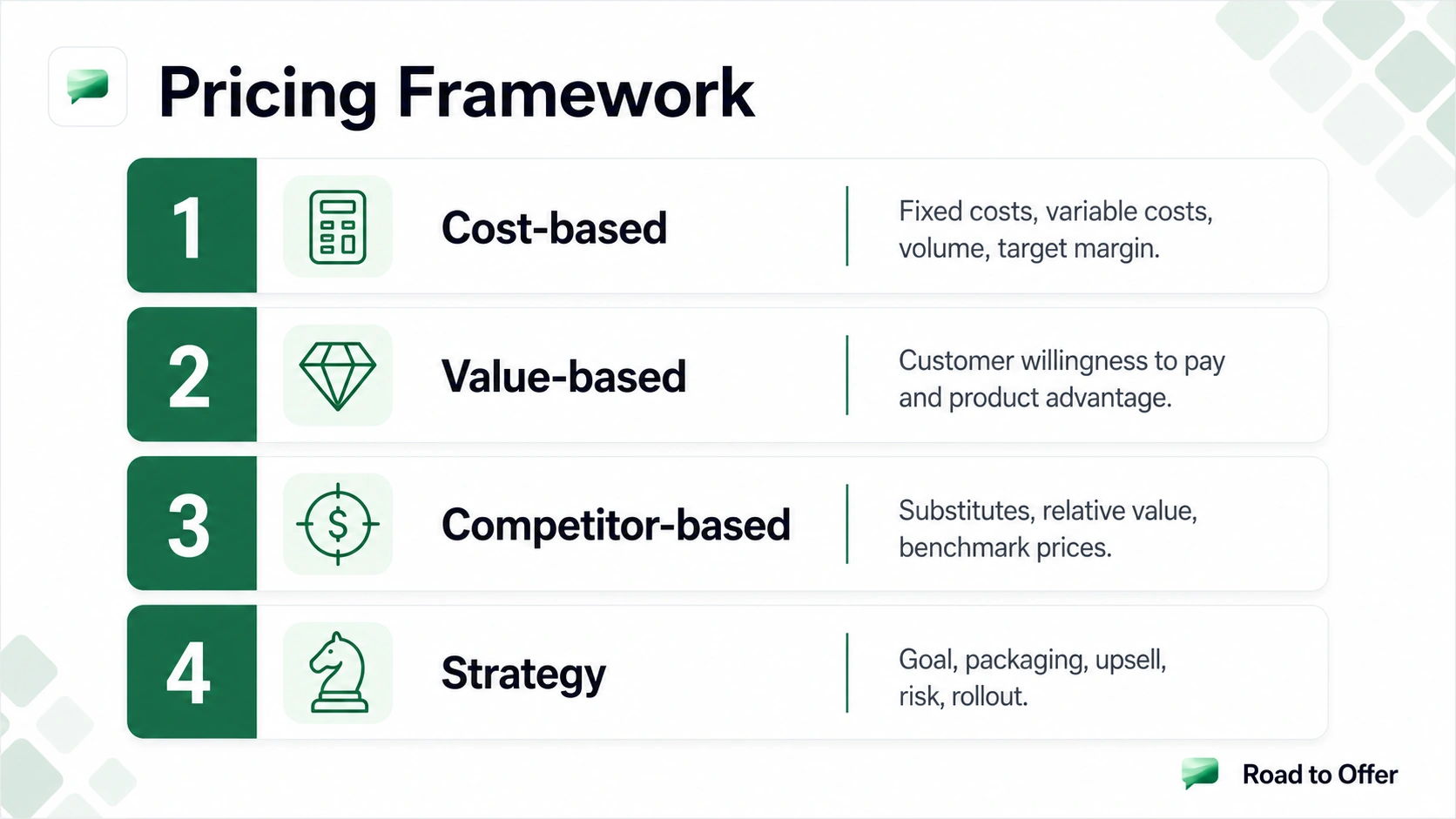
7. The Pricing Framework
The pricing strategy case framework helps you decide how much a client should charge, whether to raise or lower price, or how to defend pricing power.
Core components:
- Cost-based price floor: What price covers fixed costs, variable costs, and target margin?
- Value-based ceiling: What is the product worth to the customer versus the next best alternative?
- Competitor benchmark: What do substitutes and direct competitors charge?
- Strategy and constraints: Is the goal profit, share, adoption, retention, or signaling?
When to use it: Pricing a new product, evaluating a price increase, estimating willingness to pay, defending premium pricing, or analyzing price-volume trade-offs.
When NOT to use it as primary: Pure cost reduction, market entry, or M&A cases where pricing is only one sub-branch.
Example: A pharmaceutical company wants to price a new drug that prevents complications after surgery. A strong structure starts with clinical value versus the incumbent, patient and payer willingness to pay, production cost and margin floor, competitor response, and access/reimbursement constraints. Supply-demand logic can support the analysis, but it is not enough on its own.
Practice prompt: Your client sells a premium B2B software product and is considering a 12% price increase. What evidence would you need before recommending yes or no?
This prevents the naive answer of "raise price because demand is inelastic" by forcing you to test customer value, alternatives, margin impact, and retention risk.
Interactive drill set. Write an answer before revealing the worked solution, then continue into Road to Offer for scored practice and AI feedback.
When to Combine Frameworks
Real interview cases rarely fit a single framework perfectly. The skill is knowing when and how to combine them.
Profitability + 3Cs: When a company's profits are declining and you suspect competitive pressure. Use profitability to diagnose the financial mechanics, then 3Cs to understand the competitive dynamics driving the revenue or cost changes.
Market Entry + Porter's Five Forces: When evaluating whether to enter a market. Use Five Forces to assess industry attractiveness, then the market entry framework to evaluate the client's ability to compete and the entry strategy.
Market Entry + Profitability: Almost every market entry case requires a profitability analysis of the proposed venture. Can the client actually make money in this market given the required investment and expected market share?
3Cs + 4Ps: When a company is losing market share due to go-to-market issues. Use 3Cs to diagnose whether the problem is company, competitor, or customer driven, then 4Ps to analyze the marketing mix if the issue is go-to-market execution.
Pricing + Profitability: When a price change could improve profit but reduce volume. Use pricing logic to estimate willingness to pay and competitor response, then profitability math to quantify the margin-volume trade-off.
The key principle: Start with the framework that directly answers the core case question. Add supporting frameworks only when they fill genuine analytical gaps. Don't layer on frameworks to appear thorough. Interviewers recognize unnecessary complexity.
Structure versus framework: what each one is for
The two words are used interchangeably and they are not the same thing. A framework is a reusable lens you bring with you: profitability, market entry, M&A. A structure is the specific tree you build for the case in front of you, in the room, against that client's objective. The framework is an input; the structure is the output.
This matters in the interview because the score lands on the structure, not on which framework you recognised. A candidate who names the profitability framework and then lists its generic buckets is producing a memorised lens. A candidate who takes the same lens and makes every branch specific to this client's decision is producing a structure. Interviewers can tell instantly, and the second one is what gets marked.
How is a case structure scored?
A strong structure is relevant, sufficiently independent and complete, prioritized, and easy to communicate. The rubric below is a practice tool, not a claim that every firm uses identical labels.
Use the case interview scoring rubric for the broader interview dimensions, then test the structure itself in the typed drill above.
The 5 Biggest Framework Mistakes
Mistake 1: Using the Same Framework for Every Case
The most common and most penalized mistake. A candidate who applies the profitability tree to a market entry case, a pricing case, and a competitive strategy case is telling the interviewer "I memorized one framework and I'm going to use it regardless of relevance." Match the framework to the question. That is the decision tree in action.
Mistake 2: Memorizing Labels Without Understanding Logic
You can recite "revenue equals price times volume" perfectly. But when the interviewer says "what if variable costs are declining but profits are still down?", you freeze because you don't understand the underlying logic well enough to reason through the unexpected. Learn why each framework works, not just what it contains.
Mistake 3: Building a Framework Then Abandoning It
You spend 90 seconds building a structured framework, present it to the interviewer, and then start asking questions that have no connection to any branch of your framework. This is worse than having no framework at all because it signals that you don't actually use structure to guide your thinking. Follow your structure. Signpost which branch you're exploring and why. Come back to the framework throughout the case.
Mistake 4: Never Adapting the Template
Using "Revenue, Costs, Market, Competition" as your four branches for every single case. Interviewers see through generic frameworks immediately. The difference between a 2-score and a 4-score on structuring is whether your branches are case-specific. "Revenue per product line segmented by channel" tells the interviewer you've thought about the business. "Revenue" tells them you memorized a template.
Mistake 5: Skipping the "Why" When Presenting
Many candidates lay out their framework branches but don't explain why those branches matter for this specific case. "I'd like to analyze three areas: customer retention dynamics, pricing relative to new entrants, and operational cost structure. I'm starting with customer retention because the brief mentioned a 15% decline in repeat orders, which suggests that's where the primary issue may lie." That last sentence makes the difference.
For more on common case interview pitfalls, see case interview tips and common mistakes.
How to Build Custom Frameworks
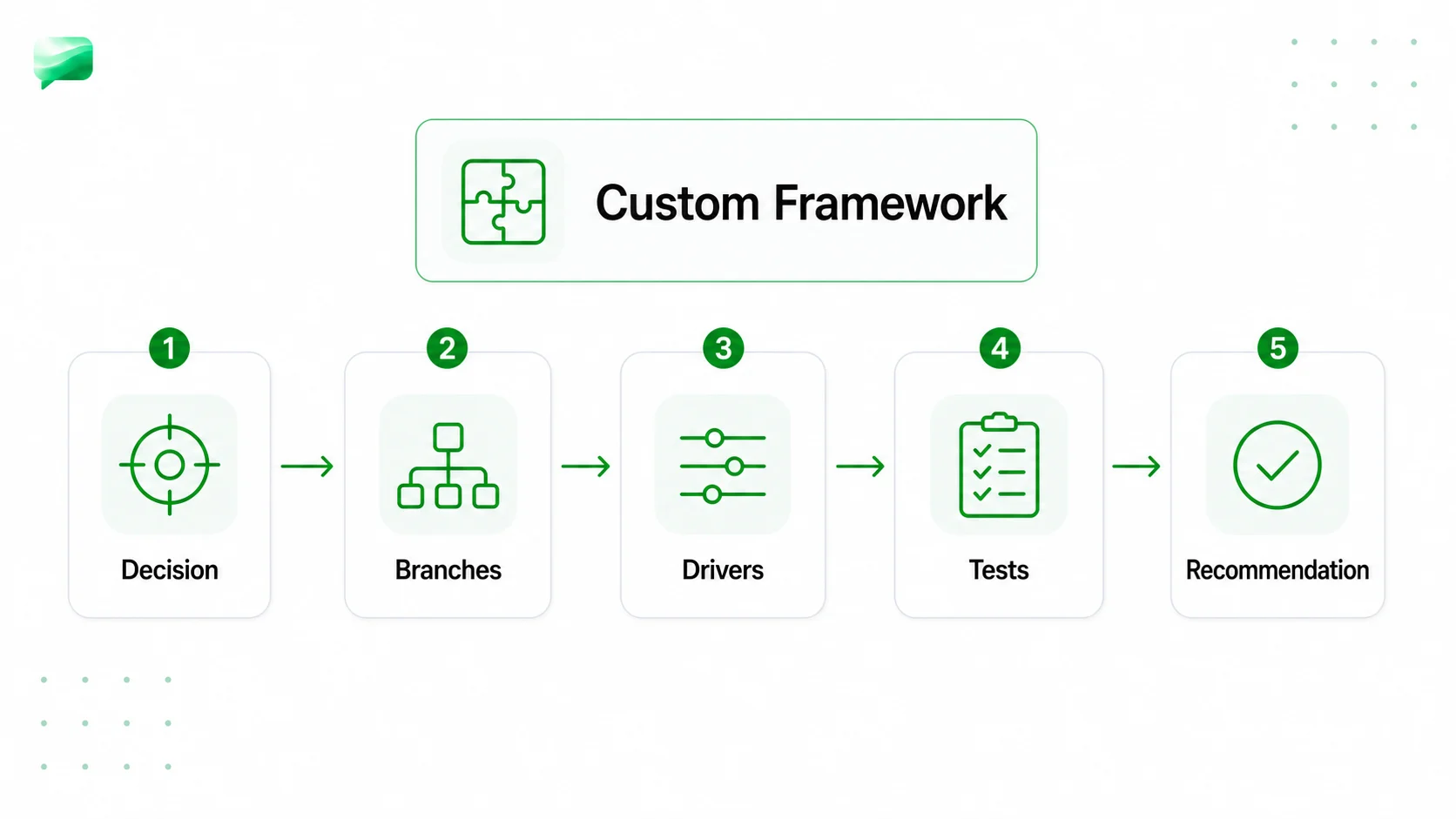
Standard frameworks cover roughly 80% of case interviews. The other 20% require customization. Here is the process for building a case-specific framework when no standard template fits.
Step 1: Identify the core decision. What does the client need to decide? "Should we expand into India?" or "How do we reduce customer churn by 20%?"
Step 2: List the 3-4 things that would need to be true for your recommendation. These become your framework branches. For expanding into India: "The market is large enough," "We can compete against local players," "The economics work," and "We can execute operationally."
You can assemble these three steps in the free case structure builder, which starts from an MBB template and tells you where your branches overlap.
Step 3: Make it MECE. Check that your branches don't overlap and that they collectively cover the problem. If a relevant consideration doesn't fit any branch, add one. If two branches cover the same ground, consolidate them. First principles thinking is useful here when the standard frameworks don't fit: decompose the problem to its irreducible axioms and rebuild the structure from the ground up rather than forcing it into an existing template.
Step 4: Prioritize. Not all branches are equally important. State which one you want to start with and why. This shows the interviewer you have an initial hypothesis, not just a list.
Example: A restaurant chain is considering launching a delivery service.
Custom framework:
- Market opportunity: Is there enough delivery demand in their geographic footprint? How large is the addressable market?
- Competitive dynamics: Who else delivers in their area? What advantages or disadvantages does the restaurant have?
- Unit economics: Is delivery profitable per order after accounting for packaging, drivers, platform fees?
- Operational feasibility: Can their kitchen handle delivery volume alongside dine-in without quality degradation?
This custom framework is specific to the case, covers the problem completely, and has a natural starting point (market opportunity, because if demand doesn't exist, nothing else matters).
Interactive drill set. Write an answer before revealing the worked solution, then continue into Road to Offer for scored practice and AI feedback.
Now run the same 4-step process yourself on a full case, end to end, instead of just the opening structure:
Run the 4-step process on a live case
Pick a case, build your structure out loud, and get AI feedback on whether your branches are MECE, prioritized, and adapted to the prompt instead of a memorized template.
Drill It: Pick the Right Structure in 30 Seconds
The skill is not knowing frameworks, it is choosing and adapting one fast. Time yourself: 30 seconds per prompt to name your structure, then compare.
Interactive drill set. Write an answer before revealing the worked solution, then continue into Road to Offer for scored practice and AI feedback.
Connecting Frameworks to Practice
The gap between knowing frameworks intellectually and applying them under interview pressure is real. Framework knowledge without practice produces candidates who can describe frameworks but freeze when they have to deploy one in 90 seconds with an interviewer watching. For a guide focused specifically on how to actually apply consulting frameworks in a live case rather than just memorizing them, that piece covers the transition from knowing a framework to deploying it under pressure.
The most effective practice method: take a case prompt, set a 90-second timer, and build your framework from scratch. Then evaluate: Is it case-specific? Does it cover the problem? Is it MECE? Could you explain why you chose this structure over alternatives? For a deep well of prompts to drill against, the major MBA club casebooks in our free consulting case book vault give you dozens of real cases to structure.
Road to Offer's free structure drills are designed for exactly this. You get a case prompt, build your framework under time pressure, and receive AI feedback on whether your structure is logical, complete, MECE, and adapted to the specific case. Each drill includes a worked solution showing how experienced consultants would structure the same problem.
If you are not ready for a timed rep, study worked structures side-by-side first. Start with issue tree case interview, then compare how the logic changes in profitability, market entry, M&A, and pricing strategy cases. The point is to see how each template turns into a different issue tree once the objective changes.
Once the issue tree clicks, deepen specific case types with the relevant supplements:
- Subscription or consumer businesses: the customer lifetime value framework surfaces unit-level diagnostics that top-line trees often miss.
- Portfolio or multi-unit decisions: the BCG growth-share matrix helps decide where to invest versus where to harvest. If the case also asks how a company should grow into new products or markets, the Ansoff matrix vs BCG growth-share matrix comparison clarifies which tool fits the strategic question.
- Sizing the opportunity first: the market sizing framework provides the estimation structure before you commit to entry or growth.
- MECE as the core evaluation criterion: the MECE framework guide covers both the definition and applied examples.
Run a full scored case from prompt to recommendation
Pick a case, build your framework under a 90-second timer, and get AI feedback on structure, math, and synthesis the way an interviewer would score it.
Sources and Further Reading (checked June 17, 2026)
- IGotAnOffer, case interview frameworks, comprehensive guide: igotanoffer.com/blogs/mckinsey-case-interview-blog/118288068-case-interviews-frameworks-comprehensive-guide
- IGotAnOffer, case interview types and frequency data: igotanoffer.com/en/advice/types-of-case-interview
- Management Consulted, case interview frameworks ultimate guide: managementconsulted.com/case-interview-frameworks
- Management Consulted, Porter's Five Forces framework guide: managementconsulted.com/porters-five-forces
- PrepLounge, profitability case type overview: preplounge.com/en/case-interview-basics/case-cracking-toolbox/identify-your-case-type/profitability-case
- Porter, M.E. (1979). "How Competitive Forces Shape Strategy." Harvard Business Review, March–April 1979: hbr.org/1979/03/how-competitive-forces-shape-strategy
- Porter, M.E. (2008). "The Five Competitive Forces That Shape Strategy." Harvard Business Review, January 2008: hbr.org/2008/01/the-five-competitive-forces-that-shape-strategy
- McKinsey, "Where mergers go wrong," M&A synergy failure research: mckinsey.com/capabilities/strategy-and-corporate-finance/our-insights/where-mergers-go-wrong
- McKinsey, interviewing resources and case interview preparation: mckinsey.com/careers/interviewing
- BCG, case interview preparation: careers.bcg.com/global/en/case-interview-preparation
- Bain, case interview preparation: bain.com/careers/hiring-process/case-interview
Frequently asked questions
Resources and related guides
- Learn frameworks step by stepPractice
- Browse all free resourcesResource hub
- Cost-Benefit Analysis Framework for Case InterviewsFrameworks · Jun 1, 2026
- 3Cs Framework: Company, Customer, Competitor (Worked Example)Frameworks · Feb 6, 2026
- 4C Framework Case Interview: The 4 Cs, a Worked Example & How to Use It (2026)Frameworks · Jun 28, 2026
- Consulting Framework Mistakes: 9 That Get You Rejected (2026)Frameworks · Jun 2, 2026