
Pricing Case Interview: Strategies, 7-Step Approach, Worked Example
Master the pricing case interview with the three pricing strategies, a 7-step approach, the three question formats, a full worked example, mistakes, and FAQs.

McKinseyMedSuite Technologies Hospital Software PricingMarket entry · Medium
Start a free case interview
Hear the case, say or type your answer, get your score.

Don't know how to case yet? Learn how to case
On this page
A pricing case interview asks you to set or change the price of a product or service by combining three pricing strategies: cost-plus, competitive, and value-based pricing. According to McKinsey Quarterly's "The Power of Pricing" (2003), a 1% improvement in average price drives roughly an 8% improvement in operating profit for the typical S&P 1500 company, more than any other lever. That is why pricing cases come up across McKinsey, BCG, and Bain interviews, often nested inside profitability, market entry, or growth strategy cases. Anchoring on customer value before checking competitor benchmarks is the move that separates strong pricing recommendations from weak ones.
If you are preparing for a pricing-specialist firm, read this framework first and then move to the Simon-Kucher case interview guide. Simon-Kucher cases use the same pricing logic but expect deeper fluency in willingness-to-pay, elasticity, and tiered packaging.
Practice a pricing math drill
Pricing cases turn on contribution margin, break-even churn, and clean value-capture math. Run one real case math drill below: finish the rep, get AI feedback, and then continue with a case interview math drill after completion.
pricing math from the Road to Offer drill engine. Answer a real prompt and get AI-scored feedback. Free accounts include 5 drills per day for the first 3 days after signup.
What is a pricing case interview, and why do firms use it?
A pricing case interview asks you to determine the right price for a product or service. The interviewer wants to see whether you can combine quantitative analysis (cost economics, margin math) with business judgment (customer value, competitive position, strategic objectives). This case format tests whether you can turn that choice into a decision. These cases use the same skills as a profitability framework case but zoom in on one specific lever: price.
Firms lean on pricing cases because price is the most concentrated test of commercial judgment they can give you in 30 minutes. The McKinsey 1% finding is the reason: price is the highest-leverage profit lever a client controls, and it is also the easiest to get wrong. A candidate who reaches for a formula instead of reasoning about willingness to pay reveals exactly the gap that loses clients money. So the interviewer is not grading recall of "cost-plus." They are watching whether you separate what the product costs, what rivals charge, and what it is worth to the buyer, and then choose a number that survives all three.
What are the three pricing strategies?
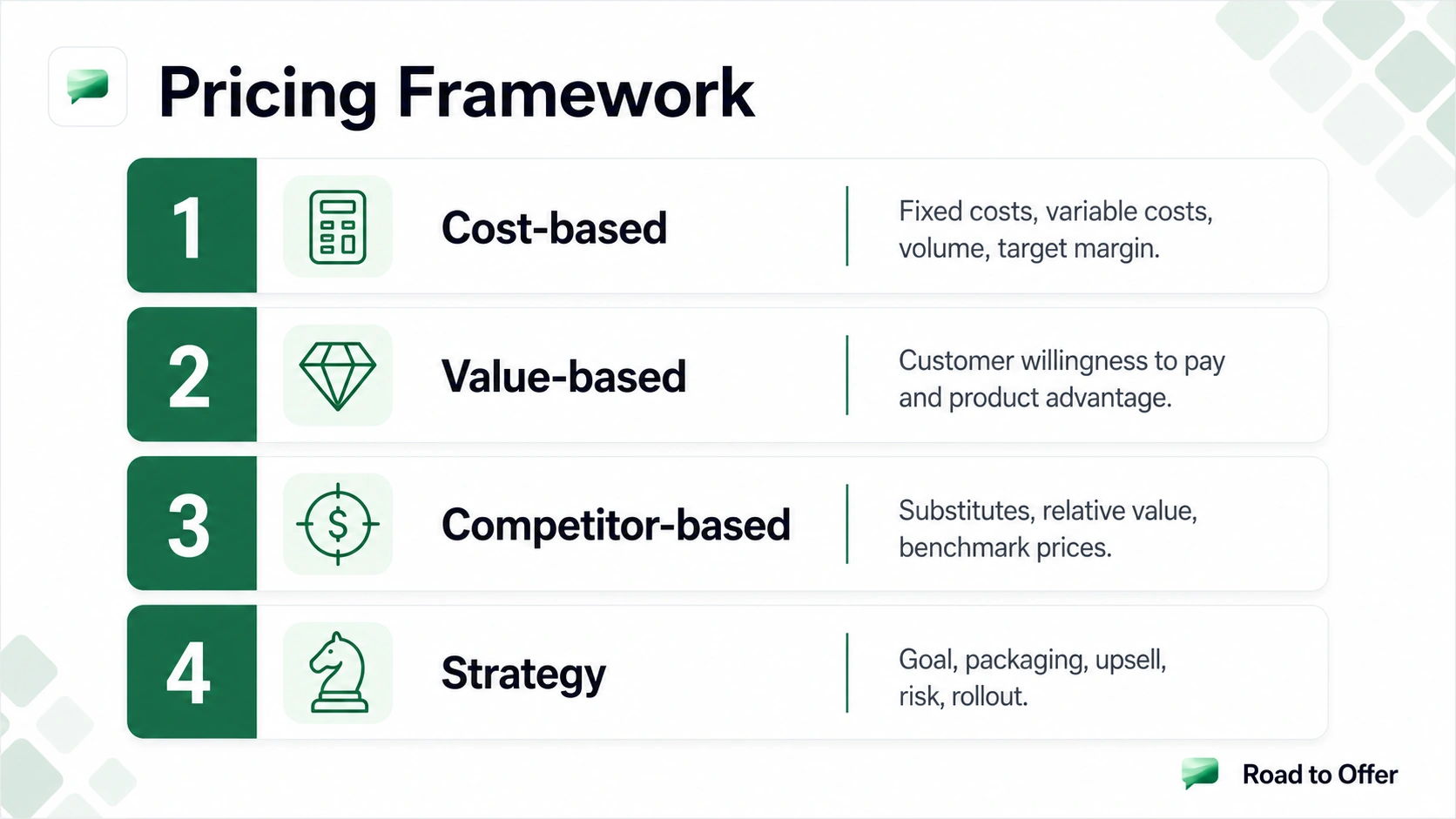
Every pricing case answer should reference all three strategies, even if you only do the math on one or two. Together they form a price range, and your recommendation lives somewhere inside it.
Cost-plus pricing (the floor) and when to use it
Cost-plus calculates the minimum price needed to cover costs and hit a target return. There are two forms, and they are not the same number, so state which one you are using. Markup on cost: Price = Unit Cost × (1 + Markup %), which is how much you add on top of cost. Target gross margin: Price = Unit Cost / (1 - Target Margin %), which is the share of the final price that is profit. A 60% markup on a $200 cost gives $320; a 60% gross margin on the same cost gives $500. Break unit costs into variable (materials, direct labor, shipping) and allocated fixed costs (overhead, R&D, marketing spread across expected volume). Cost-plus tells you the minimum viable price, not the optimal one. If you stop here, you leave money on the table.
When to lead with it: commodities and undifferentiated products with transparent prices, regulated or cost-pass-through contracts, or any case where the question is "are we even covering our costs?" In those settings the floor is the binding constraint.
Value-based pricing (the ceiling) and when to use it
Value-based pricing, described in HBR's "A Quick Guide to Value-Based Pricing" (Dholakia, 2016), asks: what is our product worth to the customer? Three steps: (1) identify the next-best alternative, (2) quantify the incremental value your product delivers over that alternative, (3) share the value by pricing below full value so the customer has a reason to switch. This is what separates good answers from great ones.
When to lead with it: differentiated B2B products with measurable ROI, anything where you can quantify customer savings or revenue uplift, and premium or first-mover launches. HBS Online's willingness-to-pay guide frames the ceiling around customer value and perceived alternatives rather than the seller's margin wish, which is the right mental anchor.
Competitive pricing (the reference) and when to use it
Competitive pricing maps the competitive set to understand where your product sits. Position relative to competitors based on feature parity, brand strength, and target segment.
Competitive pricing is a reference range, not the answer. Use it to sanity-check whether your value-based price is realistic. Lead with it when the market is mature and price-transparent, when you are a fast follower with near-parity features, or when a competitor's move forces a response. One guardrail: analyze competitor behavior, never coordinate with it. The FTC's price-fixing guidance is a reminder that pricing recommendations should reason about independent market reactions, not aligned prices.
Interactive drill set. Write an answer before revealing the worked solution, then continue into Road to Offer for scored practice and AI feedback.
How long is a pricing case, and how should you spend the time?
A full pricing case runs about 25 to 35 minutes. A clean split is roughly 2 minutes on clarifying questions, 3 minutes structuring the framework out loud, 15 to 20 minutes on analysis and math, and 3 to 5 minutes on the recommendation and risks. The biggest time sink for weak candidates is skipping the clarifying step and then re-deriving the objective halfway through the math.
Before you structure anything, ask three clarifying questions. What is the objective (profit, revenue, market share, or long-term customer value)? Is this a new product, an existing product, or an existing product entering a new market? And what do we already know about cost, competitors, and customer willingness to pay? The answers tell you which of the three strategies to weight before you draw a single branch.
The 7-step approach to any pricing case
Use this sequence for any pricing prompt. The first six steps build the recommendation; the seventh is what separates a passing answer from a strong one. Practice the opening tree with a case interview structure drill until the order is automatic.
- Clarify the objective. Profit, share, or long-term customer value? Penetration goals point to a low entry price; premium goals point to value capture. This decides how you weight the three strategies later.
- Set the cost-plus floor. Get unit cost (variable plus allocated fixed) and apply either a markup on cost or a target gross margin, stating which. Most B2B software targets 60 to 80% gross margin; most consumer goods target 30 to 50%.
- Map the competitive reference range. List 3 to 5 competitors with prices and differentiators. Identify where your product sits on features and brand. New entrants typically price slightly below the competitive midpoint to drive trial.
- Quantify the value-based ceiling. Identify the customer's next-best alternative and quantify the incremental value (savings, revenue uplift, time saved). The ceiling is the full value; a typical recommendation captures 30 to 50% of it, leaving the customer clear ROI.
- Weight the strategy against the objective. A share-grab in a network-effects market leans on penetration even when the value ceiling is high. A premium signal leans on value capture. The objective from step 1 decides the tilt.
- Recommend one number. Pick a single price, justify it against all three strategies, then layer strategic factors: penetration for share, premium for signaling, bundling for total-spend lift, freemium for adoption. If tiering is in play, mention anchoring (a high top tier makes the mid tier feel reasonable).
- Pressure-test downside and execution. Name the break-even churn or volume risk, the likely competitor reaction, and the execution path (list price vs. packaging vs. renewal vs. a targeted test). State what signal would make you stop or stage the rollout.
The hardest part is step 1 to step 3: turning a vague pricing prompt into a clean issue tree before the math starts. Drill that opening until it is automatic.
Once the opening tree is fast, check that you can also reason about how the 7 steps connect to each other, not just recite them in order.
Interactive drill set. Write an answer before revealing the worked solution, then continue into Road to Offer for scored practice and AI feedback.
The three pricing question formats
Pricing cases come in three recognizable formats. They share the three strategies but weight them differently, and spotting the format early tells you where to spend your time.
For the "respond to a move" format, do not assume a price war is inevitable. Diagnose first: is the rival clearing inventory, buying share, or signaling a structural cost advantage? A targeted defense (bundle, loyalty lock-in, segment-specific match) usually beats an across-the-board cut.
What is price elasticity, and how do you use it in a case?
Price elasticity of demand measures how much quantity responds to a price change. The formula is the percentage change in quantity demanded divided by the percentage change in price.
Elasticity = (% change in quantity) / (% change in price)
Read the absolute value against 1. Above 1 means elastic (customers are price-sensitive, so a price cut can lift revenue and a price hike can sink it). Below 1 means inelastic (demand barely moves, so you usually have room to raise price). At exactly 1 the two effects cancel and revenue is flat.
Work a quick example. A meal kit raises price from $5 to $6, a 20% increase, and weekly orders fall from 2,000 to 1,400, a 30% decline. Elasticity is 0.30 / 0.20 = 1.5, so demand is elastic and the price hike backfires. Check the revenue directly: $5 × 2,000 = $10,000 before, $6 × 1,400 = $8,400 after, a 16% revenue drop. When elasticity is above 1, a price increase shrinks revenue, and that single ratio tells you so before you run the full table.
When the case gives you a before-and-after price and volume, compute elasticity and let it drive the recommendation. The harder and more common situation is having no quantity-response data at all, covered next.
How to handle a pricing case with no elasticity data
Many pricing cases, especially the "evaluate a price change" format, give you no clean quantity-response data. You cannot calculate true elasticity from nothing, and faking a demand curve is the fastest way to lose the interviewer. The move is to turn elasticity into a hypothesis: rank demand risk with proxy signals, then ask for the evidence that would confirm or disprove it.
A proxy table earns its place only if it changes your next move. If urgency and switching costs are high, ask for margin and churn data so you can size the upside. If substitutes are strong and price is visible, shift toward segmentation, bundles, or cost actions instead of a blunt increase. When service burden differs by segment, use a customer profitability case to calculate whether the right move is an operating fix, a targeted reprice, or an exit. This proxy logic is the heart of the pricing-power version of the question: can the client raise or defend price under pressure, given what you can infer about demand?
Test pricing power with case math from the Road to Offer drill engine. Answer a real prompt and get AI-scored feedback. Free accounts include 5 drills per day for the first 3 days after signup.
A full worked pricing case, end to end
A B2B software company is launching a new analytics product. The market has 3 competitors priced at $500-800/user/year. The client's fully loaded cost is $200/user/year. The product saves customers an estimated $2,000/year in analyst time per user. The objective is profitable growth, not a land-grab. What price should the client charge?
Step 1 and 2: Objective and the cost floor
The objective is profit with healthy adoption, so value capture matters but the price still has to feel like an easy yes. Floor Price = $200 × (1 + 0.60) = $320/user/year at a 60% markup on cost (markup, not the gross-margin benchmark from Step 2: a 60% gross margin would instead give $200 / (1 - 0.60) = $500). That is the minimum, not the answer.
Step 3 and 4: Competitive reference and value ceiling
The competitive reference sits at $500-800/user/year. As a new entrant with comparable features, target the low end ($500-650). Customer savings are $2,000/user/year, so the value ceiling is $2,000. At 30 to 40% value capture, the value-based price lands at $600-800/user/year, leaving the customer $1,200-1,400 in savings, a clear ROI.
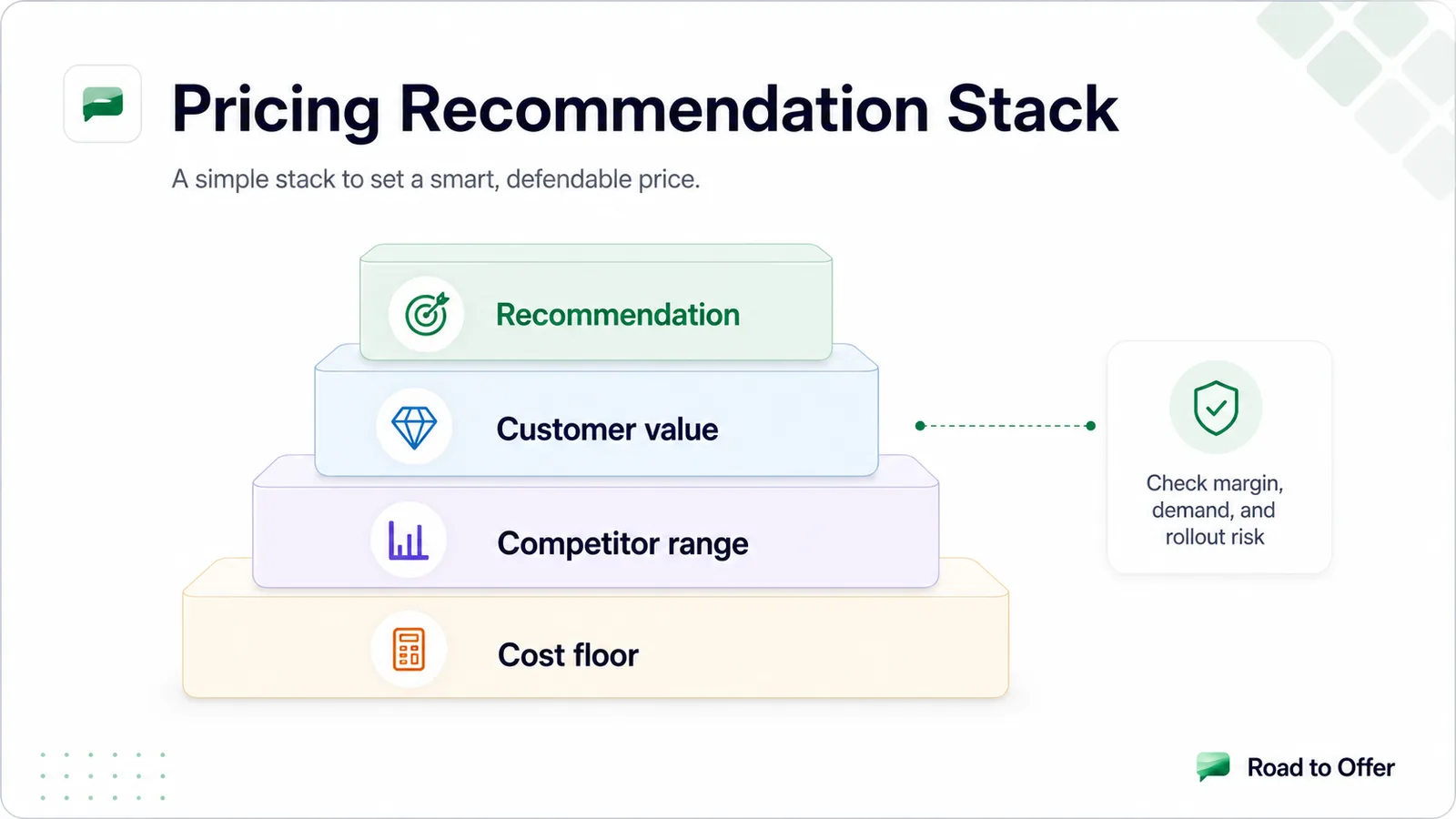
Step 5 and 6: Weight the strategy and build the number
Rationale: $599/user/year sits at the bottom of the value-based range, in the middle of the competitive range, and well above the cost floor. Pricing at the low end of value capture gives buyers a strong ROI story ($2,000 savings vs. $599 cost = 3.3x return), undercuts the top competitors, and still delivers 67% gross margins.
Set the launch price in a McKinsey pricing case. An Italian luxury scooter brand must set a launch price for Vietnam. Answer this McKinsey pricing case step in the article, then continue the full case. Continue the full case on Road to Offer
Step 7: Pressure-test downside and execution
Before committing, run the break-even math on the downside. If the client later raised price 10% to $659 and lost 5% of customers, revenue would still rise (1.10 × 0.95 = 1.045, a 4.5% gain), so there is headroom. The execution path is a list price for new logos plus a renewal escalator, not a blunt change to the installed base. After 12-18 months, once the product has traction and references, the client can move price toward $700-750 as brand risk decreases. The stop signal: if early win-loss data shows price (not features) is the top loss reason, hold and revisit packaging.
Rebuild the recommendation stack yourself before moving to the reverse case below.
A second worked example: evaluate a price change
The launch case above is the "set a new price" format. The other common format hands you an existing price and asks whether to move it, and the math runs in reverse. A SaaS product charges $50/month to 20,000 customers, so monthly revenue is $50 × 20,000 = $1,000,000. The team proposes a 12% increase to $56. The objective is profit, and gross margin is high enough that the volume question dominates. How many customers can the client afford to lose?
Solve for break-even churn, the point where new revenue equals old revenue. New price is $56, so $56 × X customers = $1,000,000, which gives X = 17,857. Starting from 20,000, that is a loss of 2,143, or about 10.7%. So any churn below 10.7% leaves the client ahead on revenue, and anything above it loses money. Reframed as elasticity, break-even sits where elasticity equals 1: the 10.7% volume drop against the 12% price rise is 0.107 / 0.12 = 0.89, just inside inelastic territory.
That single number reframes the whole case. The recommendation is not "raise price" or "do not"; it is "raise price 12% only if expected churn stays under roughly 10%, and here is how to find out." Pull the proxy signals from the table above (switching costs, substitutes, contract timing), then propose a staged test on new cohorts or one segment before touching the full base. Sharpen this reverse-math with mental math drills.
Run both elasticity directions, forward from volume data and backward from a target price, before your next live case.
Interactive drill set. Write an answer before revealing the worked solution, then continue into Road to Offer for scored practice and AI feedback.
Practice pricing cases with AI feedback
Get instant feedback on your pricing frameworks and math, no scheduling required.
You can run this exact archetype as a live case. Lux Rides is an Italian brand launching a luxury scooter in Vietnam with no direct benchmark, the cleanest possible "set a new price" prompt because cost-plus, competition, and value all pull in different directions.
What are common mistakes in pricing cases?
The most common pricing case mistake we see is candidates defaulting to cost-plus when the case calls for value-based pricing. Avoid these traps.
Anchoring on cost first
If the customer saves $10,000/year and your cost is $50, cost-plus gives you $80 while value-based gives you $3,000-5,000. Starting from cost trains your brain to think small. Always identify the value pool first, then check whether costs allow it.
Ignoring strategic context
A 60% margin product priced at $599 is mathematically defensible but strategically wrong if the goal is to take share fast in a network-effects market. Read the prompt for cues on objective: "build market position" means penetration, "premium launch" means value capture.
Confusing a premium brand with pricing power
A strong brand is not automatic permission to raise price. Test differentiation, substitutes, switching costs, and trust before assuming the client can move. Pricing power is the room to move; a price increase is the action; they are not the same thing.
Forgetting elasticity in price-change cases
Never recommend a price move without testing the volume math. Compute elasticity when you have before-and-after data, or solve for break-even churn when you have a target price, as in the SaaS example above. A recommendation to "raise price 12%" with no stated churn ceiling is an opinion, not an answer.
Skipping execution and the stop signal
A recommendation that names no rollout path, no competitor reaction, and no signal to stop sounds abstract. Name whether the move is list price, packaging, tiering, renewal pricing, or a targeted test, and say what would make you pause it.
When does pricing differ from market entry or growth cases?
Pricing cases share DNA with market entry and growth strategy cases but ask a narrower question. Use this comparison to tell which case you are in.
If the prompt gives you a product and asks "what price?", it is a pricing case. If it gives you a market and asks "should we?", it is market entry with a likely pricing sub-question. The issue tree you draw should reflect which question dominates. When the math is done, use a case interview synthesis drill to practice turning the price range into a single recommendation with risk and next steps.
For adjacent archetype cases: the revenue growth case interview sits one level up when pricing is the growth lever. The new product launch case interview is where pricing strategy becomes a launch decision. Pricing also dominates two industry archetypes: a consumer goods case interview often hinges on trade spend, promotional pricing, and price-pack architecture, while an airline case interview is essentially a revenue-management and dynamic-pricing problem. The market entry case interview guide covers the entry version of the pricing decision: what price gets you to critical mass in a new market without destroying margin. When the question is specifically whether a client can defend price under competitive or cost pressure, that is the pricing-power variant, and the same proxy logic above applies.
Sources and Further Reading (checked June 18, 2026)
- Marn, M.V. & Rosiello, R.L. (1992). "Managing Price, Gaining Profit." Harvard Business Review. The foundational article introducing the pocket price waterfall and the 1% pricing insight.
- McKinsey Quarterly. "The Power of Pricing" (2003). Analysis of S&P 1500 income statements showing a 1% price improvement generates ~8% operating profit uplift.
- Dholakia, U.M. (2016). "A Quick Guide to Value-Based Pricing." Harvard Business Review. Practical framework for estimating willingness to pay.
- Harvard Business School Online. "Willingness to Pay: What It Is and How to Calculate." Frames the price ceiling around customer value and alternatives.
- OpenStax / Principles of Microeconomics. "Price Elasticity of Demand and Price Elasticity of Supply." The percentage-change elasticity formula and the elastic vs. inelastic thresholds used in the price-change math above.
- Federal Trade Commission. "Price Fixing." Reminder to analyze independent competitor behavior, not coordinate prices.
To round out pricing prep, connect this with the profitability framework, issue tree fundamentals, and the case interview frameworks complete guide for the full context of when pricing is the primary framework versus a branch inside a profitability or growth case. When pricing decisions depend on segmenting customers by willingness to pay, the customer segmentation framework provides the structure for that split, and the unit economics framework grounds the recommendation in margin and breakeven logic.
Stop memorizing frameworks. Start applying them.
Road to Offer gives you unlimited pricing cases with real-time feedback on structure, math, and recommendation quality.
Frequently asked questions
Resources and related guides
- Practice pricing in a real case interviewPractice
- Browse all free resourcesResource hub
- 3Cs Framework: Company, Customer, Competitor (Worked Example)Frameworks · Feb 6, 2026
- 4Ps Framework Case Interview: Product, Price, Place, PromotionFrameworks · Feb 6, 2026
- Ansoff Matrix vs BCG Matrix for Case InterviewsFrameworks · Jun 2, 2026
- Revenue Growth Case Interview: Framework, Levers, and Worked Examples (2026)Frameworks · Mar 20, 2026