
BCG Case Interview Guide 2026: Format, Rounds + Worked Examples
A complete BCG case interview guide: candidate-led live cases, the online screening assessments, scoring criteria, the written case, worked sample cases, and exhibit drills.

BCGUrbanBrew Coffee Margin CaseProfitability · Easy
Start a free BCG case interview
Hear the case, say or type your answer, get your score.

Don't know how to case yet? Learn how to case
On this page
BCG case interviews are candidate-led live cases: you drive the structure and direction while the interviewer gives exhibits and probes your reasoning, scoring how you structure, calculate, interpret data, and synthesize. Before the live rounds, candidates may also complete online assessments, and two names people routinely mix up are the Consulting Career Assessment (CCA) and the Casey-style chatbot case. Use this guide to prep the live case and distinguish the online experiences without assuming every office uses the same sequence (BCG interview process; BCG case prep).
This guide covers the live BCG case interview, the CCA and Casey online screens, what interviewers score, and sample cases for BCG's data-driven, exhibit-heavy style. If you're also preparing for other MBB firms (see how consulting firms rank against each other), pair this with our MBB case interview prep and Bain case interview guide. For the full Casey chatbot deep dive, see the BCG online case Casey guide.
See where you stand on BCG's evaluation criteria
Practice a real case with AI coaching on structure, data interpretation, math accuracy, and business judgment, the skills BCG interviewers score you on.
Skip to case interview prep
BCG Case Interview Format and Process
BCG's interview process centers on fit or skill interviews and case interviews. If your office assigns Casey, it usually acts as an online screening step before live interviews.
BCG Interview Process
- 01
Application and screening. Resume screen; CCA and/or Casey may be assigned online
- 02
First Round. 2-3 interviews: case + fit (video or in-person)
- 03
Final Round. 2-3 interviews with senior partners (in-person)
Prep each stage with the matching resource: tighten the resume screen with the consulting resume guide and an independent resume grader read, rehearse the CCA and Casey online screens if your invitation assigns them, work through BCG's practice cases for the live case, and prepare the fit portion with the BCG fit interview guide.
Each live interview lasts about 45 minutes: roughly 30 minutes for the case and 10-15 minutes for fit and behavioral questions. Where used, online assessments can gate access to live interviews, so treat them as a real stage, not a warm-up. Candidates often confuse the CCA with Casey-style case assessments. Know which one you have been assigned, because they reward different preparation.
How should you align your BCG resume and cover letter before this interview?
Keep this section as the bridge to the BCG resume guide. Make the problem, original thinking, collaboration, and outcome visible without presenting them as an official BCG resume rubric.
- Before: Performed market research for a launch.
- After: Compared customer interviews and competitor pricing to recommend the first entry segment to the project sponsor.
Check that the line makes your thinking visible and that you can explain the weakest assumption. Recruiters read the resume and cover letter together: the resume proves the achievement, while the letter explains why it fits BCG and the role. Rehearse the evidence once as a fit story and once as a concise case recommendation.
Find the bullets that hide your thinking
Drop the resume here for an independent graded report on whether the reasoning behind each result is visible. Road to Offer's score, not a BCG hiring one.
By uploading, you agree to resume analysis and report storage until you delete it. See the privacy policy.
Revise one line, rehearse the evidence, and bring the same reasoning into the next BCG-style case rep.
The Consulting Career Assessment (CCA): BCG's First Online Screen
Some candidates receive the Consulting Career Assessment (CCA), a separate early online assessment. BCG publicly describes a short, multidimensional experience that is normally completed soon after invitation. Office and cohort details can vary, so the invitation, not a third-party sequence, is authoritative.
The CCA is not a case. Public candidate reports describe experiences such as:
- Work-style choices. Some candidates report ranking plausible workplace statements. BCG does not publish a universal response mechanic or ideal profile, so practice should focus on interface familiarity and a stable reference frame, not desired answers.
- Numerical or logic questions. Some candidates report timed quantitative reasoning. Practice percentages, rates, scheduling constraints, and exhibit reading, while following the calculator and navigation rules in your own invitation.
Try a CCA-style numerical rep right here:
 Free simulator
8-question CCA diagnostic
- 4 Numerical tasks plus 4 work-style questions
- One shared 12-minute clock
- Numerical score plus an unscored work-style reflection
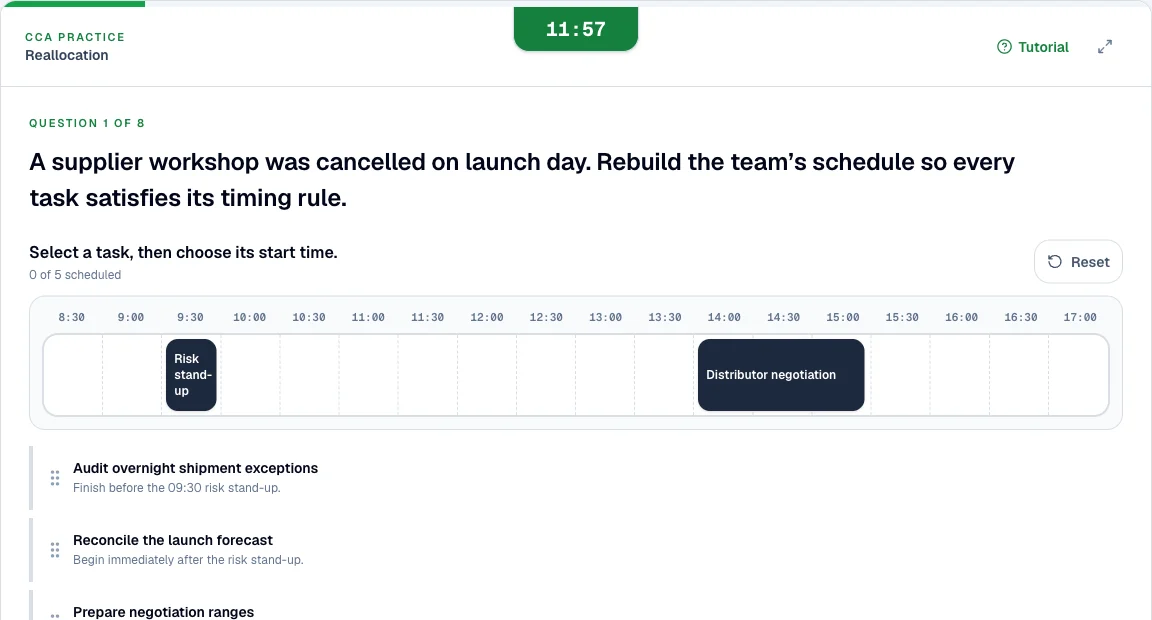
How to treat it: use your typical recent work behavior as a stable reference rather than trying to game an imagined profile. For numerical preparation, learn clean setups before adding a clock and warm up with mental math for case interviews. If you want timed reps in the CCA format, compare the CCA practice tools. Do not confuse the CCA with Casey: they are distinct experiences, and neither Road to Offer nor public candidate reports can predict BCG's scoring or hiring outcome.
The Casey Chatbot Assessment
Casey is BCG's online, chatbot-based case assessment, and for candidates who receive it, it is the first case-format gate. By 2026 it is used by the large majority of BCG offices worldwide, having replaced the older BCG Potential Test (Management Consulted BCG Online Case). BCG describes its practice experience as an interactive business case guided by a chatbot that evaluates problem-solving and analytical skills (BCG Case Interview Preparation). Some offices use Casey in place of a phone screen entirely, meaning your performance on this chatbot determines whether you ever speak to a human interviewer. Reported timing clusters around 25-35 minutes for the case portion, with roughly 8-10 questions, plus a separate 1-minute video recommendation at the end (CaseBasix Casey guide). It evaluates four named traits: brainstorming, structuring, problem solving, and data analysis. Pass rates are not published by BCG, but prep sources commonly estimate that roughly 30% of candidates clear it, which is why it should not be treated as a formality.
Format and Structure
Casey presents a business case through a chat interface. You interact with a virtual interviewer who walks you through the case step by step. The assessment typically includes 8-10 questions across three formats:
Multiple-choice questions ask you to identify the correct interpretation of data, select the right next step in an analysis, or choose the best recommendation from several options. These test your ability to read exhibits quickly and apply structured thinking under time pressure.
Short-answer (text) questions require you to explain your reasoning in writing. You might be asked to interpret a chart, calculate a key metric, or explain why one business approach is better than another. The quality of your written reasoning matters here, not just the final answer. Show your work: state your approach, walk through the logic, and arrive at a clear conclusion.
Video recording questions (included in some versions of Casey) ask you to record yourself delivering a structured response on camera. This tests communication skills that text answers cannot capture: clarity, confidence, structure, and presence. You typically get one attempt with a short preparation window.
What Casey Evaluates
Casey tests the same core skills as a live BCG interview, just through a digital interface:
- Data interpretation: Can you read charts, tables, and exhibits accurately and extract the key insight?
- Quantitative reasoning: Can you perform calculations correctly and apply the result to the business question?
- Structured thinking: Do your answers follow a logical sequence, or do you jump to conclusions?
- Communication (video): Can you deliver a clear, structured answer when speaking to a camera?
- Synthesis: Can you pull together multiple data points into a coherent recommendation?
Casey Timing and Stakes
The case portion takes roughly 25-35 minutes depending on the version, and you cannot pause it once it starts. The chatbot typically reminds you of the time remaining at intervals (often around every 5 minutes), so you feel the clock without a hard per-question timer. The video pitch is separate: you usually get about 60 seconds to prepare and 60 seconds to deliver. The practical implication is pacing. You cannot spend 10 minutes on a single question, so budget your time across the 8-10 questions and leave a buffer for the final recommendation.
How to Prepare for Casey
Treat each question as a mini-case. Even multiple-choice questions have an underlying logic. Don't just pick the answer that "feels right." Identify the relevant data, apply a framework or calculation, and select the answer that the evidence supports.
Practice written case explanations. Casey's short-answer questions reward candidates who write structured, clear responses. Practice writing out your reasoning for case questions in 3-5 sentences: state the approach, show the key calculation or logic, and state the conclusion. Bullet points are fine, but each bullet should advance the argument.
Record yourself answering mini-case questions. For the video component, practice delivering 60-90 second structured answers to a camera. Use a top-down approach: state your answer first, then give 2-3 supporting reasons. Watch your recordings and check for filler words, wandering structure, and eye contact with the camera lens.
Do BCG's official practice cases first. BCG provides practice cases, including a climate strategy case, a digital bank scenario, and a cloud migration case, on their case interview preparation page. Complete these before attempting Casey. They give you a feel for BCG's exhibit style and question phrasing. A BCG consultant shares additional prep advice on the BCG Careers blog.
BCG Interview Day: What to Expect Hour by Hour
Most candidates know BCG has "2-3 interviews per round," but few know what the day actually looks like. Here is a typical first-round and final-round interview day timeline:
First Round (In-Person or Virtual)
Final Round (In-Person)
Want to see a BCG-style case end to end before your first round? Practice one with scored feedback:
 BCG
BCGGrowth · hard
Cloud Computing Capacity Expansion
Technology / Cloud Infrastructure
The Partner Round (Sometimes Called the "Chairman's Case")
The final-round case run by a partner is the most candidate-led case you will face at BCG. Some candidates and prep communities call it the "chairman's case" because of how open-ended it is: instead of a tidy prompt with neatly staged exhibits, the partner often opens with an ambiguous, loosely defined business situation drawn from a real engagement, then says very little. You are expected to drive the entire conversation, define what the problem actually is, decide what data you would want, and reason toward a recommendation with minimal hand-offs along the way.
Naming and emphasis vary by office and region, and the format is not a separate official interview type that BCG publishes. Treat "chairman's case" as shorthand for the open-ended partner-round case, not a fixed BCG-branded stage.
How it differs from a first-round case
How to prepare
- Practice scoping out loud. Restate the problem in your own words, name the decision the client actually faces, and confirm the objective before you build structure.
- Get comfortable reasoning without exhibits. Estimate ranges, state the assumptions you would test, and explain how you would get the data rather than waiting for a chart.
- Commit to a recommendation under uncertainty. Partners want a clear stance with caveats, not "it depends." End with a view, the two or three reasons behind it, and the main risk.
- Rehearse executive presence. The partner is judging whether you could sit across from a client CEO, so keep answers top-down, concise, and calm when pushed.
How BCG Cases Differ from McKinsey and Bain
Candidates who prepare with generic "MBB" materials miss firm-specific differences that interviewers notice. Here is how BCG compares:
For a deeper comparison on the Bain side, see our Bain case interview guide (linked in the table above). For McKinsey's digital assessment, see our McKinsey Solve guide.
What Candidate-Led Means in Practice
In a BCG case, you control the flow:
- You restate the situation and clarify the objective.
- You lay out a structure and tell the interviewer which area you want to explore first and why.
- You request the data you need and drive the analysis forward.
- You proactively pull the threads together into a recommendation.
The interviewer feeds you exhibits and probes your reasoning, but the direction is yours. You own the framework, the prioritization, and the pace. The skill being tested is whether you can lead a structured analysis independently, not whether you can answer a string of prompts.
Drive a candidate-led BCG profitability case. A 2,000-seat Nashville theater must decide whether to renew a resident show whose profit has flatlined. Answer this BCG profitability case step in the article, then continue the full case. Continue the full case on Road to Offer
What BCG Evaluates
BCG interviewers assess four main dimensions. These align closely with the evaluation criteria published on BCG's case interview preparation page, supplemented by patterns from over 3,000 candidate reviews in Glassdoor's BCG interview database and IGotAnOffer's BCG prep guide.
1. Problem Solving
Can you break down a complex problem into logical parts? Do you approach each question with structure rather than guessing?
- Structure your answer before speaking. Even a 5-second pause to organize your thoughts signals discipline.
- State your approach: "I'd look at this in two parts: the market side and the company side."
- Prioritize: tell the interviewer which part matters most and why.
2. Analytical Rigor
Can you work with data accurately and draw the right conclusions? This is where BCG's exhibit-heavy style raises the bar.
- Read charts carefully. State what the chart shows before interpreting it.
- Do math cleanly. BCG cases are data-heavy, so practice mental math for case interviews until calculations feel automatic.
- Sanity-check your numbers: "That implies $50 per customer, which seems reasonable for this industry."
Read a BCG exhibit under time pressure from the Road to Offer drill engine. Answer a real prompt and get AI-scored feedback. Free accounts include 5 drills per day for the first 3 days after signup.
3. Business Judgment
Do your answers make business sense? Can you connect analysis to real-world implications?
- After analyzing data, explain what it means: "This 20% margin decline suggests we're losing pricing power."
- Consider second-order effects: "If we raise prices, some customers may switch to competitors."
- Show you understand the client's industry context. Generic answers that could apply to any company are a red flag.
4. Communication
Can you explain your thinking clearly and concisely? BCG's candidate-led format makes communication visible at every step, not just the final recommendation, because you are narrating the structure and direction yourself.
- Lead with the answer, then support it: "Revenue decline is driven by volume loss in the enterprise segment. Here's why..."
- Be concise. Don't narrate every calculation step.
- Engage with the interviewer: make eye contact, ask clarifying questions, and acknowledge their hints. The interview should feel like a collaborative working session, not a presentation.
Sample BCG Case Flow
Here is what a typical BCG case looks like in practice. Notice the candidate-led rhythm: you propose where to look, interpret the data, draw an implication, and ask for the next exhibit that tests your hypothesis.
Interviewer: "Our client is a European airline seeing profit margins decline. They want to understand why and what to do. Let's start: what are the main drivers of airline profitability?"
You: "Airline profitability is driven by revenue per passenger (yield times load factor) minus operating costs per seat (fuel, labor, aircraft, airport fees). I'd want to know whether the decline is on the revenue side or the cost side."
Interviewer: "Good. Here's a chart showing revenue per available seat kilometer over the past 3 years." (shows chart)
You: "The chart shows RASK declining 12% from 2023 to 2025, from 0.08 euros to 0.07 euros. The decline accelerated in 2025. This suggests either yield compression (lower fares) or load factor decline (emptier planes), or both. Do we have data on load factor separately?"
Interviewer: "Load factor has been flat at 82%. So what does that tell you?"
You: "If load factor is flat but RASK is declining, the issue is yield, meaning average fares are dropping. I'd want to understand whether this is market-wide fare compression from low-cost carrier competition, or specific to our client, for example, a route mix shift toward lower-yield routes."
Interviewer: "Here's a table showing our client's route-level revenue versus two competitors." (shows table)
You: "Looking at this table, our client's fares are 8-15% lower than Competitor A on the same routes, but roughly in line with Competitor B, which is the low-cost carrier. This suggests the client is being forced to match low-cost pricing on overlapping routes. The key question is whether they can differentiate on service to justify a price premium, or whether they need to accept lower yields and cut costs to protect margins."
This is the BCG rhythm: answer the question, interpret the data, draw a business implication, and ask a logical follow-up. Each exchange moves the case forward.
BCG Exhibit Workflow (30-Second Read)
When you get a chart or table, use this sequence:
- Frame: "This chart compares X across Y from year A to B."
- Extract: Identify 1-2 non-obvious signals (not every data point).
- Implication: Connect insight directly to the case question.
- Ask: Request the next data needed to test your hypothesis.
Practice this workflow until it becomes automatic. Our case interview examples include exhibit-heavy cases you can use for reps.
BCG-Style Case Example: Retail Bank Digital Transformation
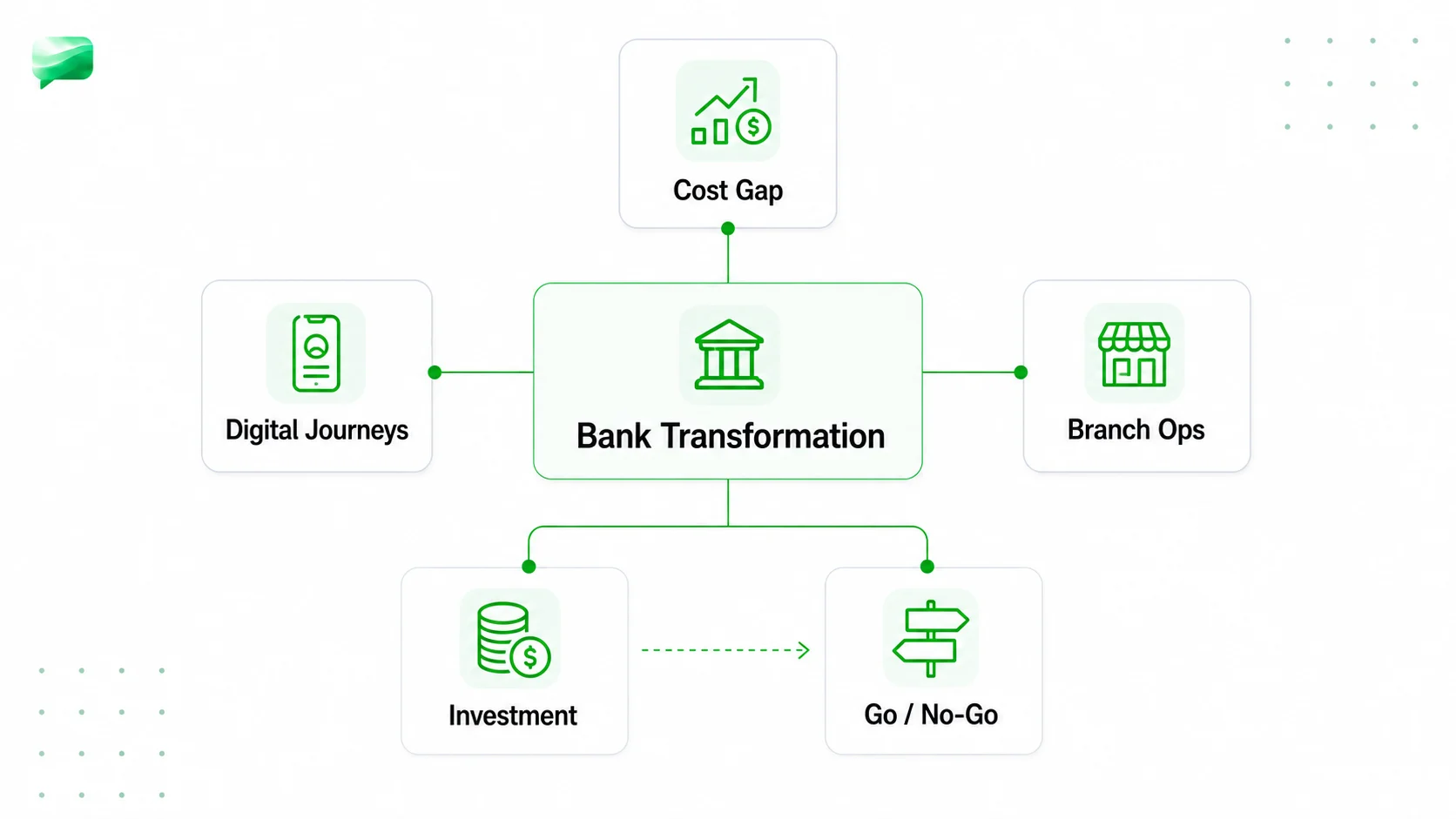
Here is a BCG-flavored case prompt that reflects their data-heavy, exhibit-driven style. This is the kind of case BCG interviewers build: multiple exhibits, specific questions at each stage, and a synthesis ask at the end.
Setup: "Our client is a mid-size European retail bank with 4 million customers. Over the past 3 years, their cost-to-income ratio has risen from 58% to 67%, while digital-native competitors are operating at 35-40%. The CEO wants to know: should the bank invest 200 million euros in a digital transformation over 3 years, and if so, where should the investment be focused?"
Exhibit 1 (table): Cost breakdown by category: branch operations (40% of total costs), IT infrastructure (25%), customer service call center (18%), compliance and risk (12%), other (5%).
Question 1: "Looking at this cost breakdown, where do you see the biggest opportunity for the digital investment to reduce costs?"
A strong answer: "Branch operations at 40% of costs is the largest category and the one most directly impacted by digital migration. If the bank can shift a meaningful share of transactions from branches to digital channels, that's where the highest-magnitude cost reduction sits. The call center at 18% is the second target, since digital self-service tools (chatbots, app-based issue resolution) can reduce call volume. I'd want to see data on what percentage of transactions currently happen in-branch versus digitally."
Exhibit 2 (bar chart): Transaction channel mix: 65% in-branch, 20% online banking, 15% mobile app. Competitor benchmark: 25% in-branch, 35% online, 40% mobile.
Question 2: "The bank is at 65% in-branch versus the competitor benchmark of 25%. If the bank could shift to 35% in-branch over 3 years, what's the annual cost saving, assuming branch costs are 320 million euros today and scale roughly linearly with transaction volume?"
A strong answer: "Going from 65% to 35% in-branch is a reduction of roughly 46% of in-branch transactions (30 percentage points out of 65). If branch costs scale linearly, that's 46% of 320 million euros, which equals approximately 147 million euros in annual savings. However, not all branch costs are variable. Fixed costs like leases and core staff would remain unless branches are actually closed. So the realistic savings are probably 60-70% of that figure, roughly 90-100 million euros annually, if the bank also consolidates its branch network."
Question 3 (synthesis): "Given what we've analyzed, what's your recommendation to the CEO?"
This kind of multi-exhibit, question-by-question case is quintessentially BCG. Practice building your answer incrementally as new data arrives, rather than trying to solve everything at once.
BCG-Style Case Example: Specialty Chemicals Pricing
Here is a second BCG-flavored prompt focused on pricing, a case type BCG asks frequently.
Setup: "Our client manufactures specialty chemicals sold to industrial customers. Margins have declined from 22% to 14% over two years despite stable volumes. The CEO wants to understand the margin decline and identify pricing actions."
Exhibit 1 (waterfall chart): Margin bridge showing: base margin 22%, raw material cost increase (-4%), customer discount creep (-3%), product mix shift toward lower-margin products (-2%), operational inefficiency (-1%), new margin 12%. (Note: the CEO quoted 14%, so there is a 2pp gap to reconcile.)
Key question: "This waterfall shows margin declining to 12%, but the CEO said margins are 14%. What might explain the discrepancy, and which driver would you address first?"
A strong answer addresses the 2pp gap (possibly timing differences, one-time items, or different margin definitions) and then prioritizes the largest controllable driver: customer discount creep at 3pp, since raw material costs are harder to influence and discount discipline is an internal lever the client can act on immediately.
This type of case, starting with a data discrepancy and requiring you to question the numbers, is a classic BCG move. They want to see whether you trust exhibits blindly or interrogate them.
The BCG Written Case Interview
Some BCG offices and certain roles add a written case interview. Instead of solving live with an interviewer, you receive a data pack (a brief plus several exhibits, tables, and charts), work through it on your own under a time limit, and produce a structured recommendation. In some formats you summarize your answer in writing; in others you build a short set of slides and then present and defend them in a follow-up discussion. BCG publishes a representative example you can work through (BCG Written Case Example PDF).
Format and what it tests
The written case rewards the same thinking as a live case, but the bottleneck shifts to prioritization and packaging. You have to read a stack of material quickly, decide which two or three facts actually drive the answer, ignore the deliberate distractor data, and assemble a recommendation a partner could act on. It tests structure, data interpretation, synthesis, and the ability to communicate a defensible conclusion without a person prompting you step by step.
Timing varies, so confirm it
Format and timing differ by office, region, role, and year, and BCG does not run an identical written case everywhere. Reported versions range from roughly 30 minutes to around an hour or more, sometimes split between analysis time and a presentation, sometimes folded into the interview day. Prep sources such as IGotAnOffer's BCG case interview guide and PrepLounge's BCG guide note that written and presentation cases appear in some processes but not others. Do not assume you will get one, and if you do, ask your recruiter for the exact format and time limit rather than guessing.
How to prepare
- Time-box your reading. Practice scanning a multi-exhibit pack in the first few minutes, flagging the headline of each chart, and deciding what matters before you analyze anything in depth.
- Lead with the answer. Whether you write a memo or build slides, put the recommendation first, then support it with two or three evidence-backed reasons and the main risk.
- Practice on real material. Work through BCG's official written case example end to end under a clock, then have someone pressure-test your conclusion the way a partner would in the follow-up discussion.
- Keep slides clean. One message per slide, a clear chart that proves it, and no decorative filler. The exercise is testing judgment, not design.
How to Prepare for BCG Cases
1. Practice Candidate-Led Format
Many candidates only practice interviewer-led cases (the McKinsey style). BCG's format is fundamentally different:
- Practice driving the structure yourself: open with a framework, name the branch you want to test first, and lead the analysis.
- When given a chart, practice the "describe, interpret, implication" flow until it's automatic, then proactively ask for the data that tests your next hypothesis.
- Practice owning the pace. You set the direction, but stay flexible enough to fold in new data without abandoning your thread.
For a broader preparation approach across all case formats, including BCG-specific practice cases, see our guide on how to practice case interviews.
2. Build Data Interpretation Skills
BCG cases are chart-heavy. Practice reading:
- Bar charts and trends over time.
- Scatter plots comparing metrics across segments.
- Tables with multiple variables.
- Waterfall charts showing drivers of change.
For each chart, practice: "What does this show? What's the key insight? What does it mean for the case?" Our case interview math guide includes exhibit-based math drills.
Read a BCG-style exhibit from the Road to Offer drill engine. Answer a real prompt and get AI-scored feedback. Free accounts include 5 drills per day for the first 3 days after signup.
3. Sharpen Your Math
BCG integrates math into case questions rather than isolating it. Practice:
- Percentages and growth rates in context.
- Market sizing within a case flow.
- Break-even and payback calculations.
- Margin calculations across segments.
BCG-style quant reps are strongest when you rotate case types: profitability framework, market entry framework, and pricing strategy cases.
Use mental math for case interviews to speed up exhibit math and case interview synthesis to tighten your recommendation close.
4. Prepare Fit Stories
BCG's fit portion covers leadership, impact, and teamwork. Prepare 3-4 stories using the STAR format (Situation, Task, Action, Result):
- Leadership: A time you led a team through a challenge.
- Impact: A time you created measurable impact.
- Overcoming obstacles: A time you faced resistance and persisted.
Keep each story under 2 minutes. Focus on your specific actions and quantifiable results. For a full breakdown of BCG's fit interview, including a strong answer to the Why BCG question, prepare that portion as deliberately as the case itself. For McKinsey candidates preparing similar behavioral stories, see the McKinsey PEI guide. Bain uses a distinct behavioral format worth preparing for separately. If you are switching into consulting from another field, translate your non-consulting wins into BCG's leadership-impact-teamwork language using case interview prep for career changers.
5. Use BCG's Official Practice Resources
BCG provides free practice cases and Casey preparation materials on their case interview preparation page, including interactive case scenarios and a downloadable written case PDF (BCG Written Case Example). Complete these before your interview, then use the free BCG interview prep tools to add timed drills, cases, and fit practice. Not using the official resources signals that you didn't do basic homework, and BCG interviewers can tell.
6. Drill the Weak Behavior, Not Just More Full Cases
Most candidates do too many full cases and too few targeted reps. Full cases build stamina and integration, but they are inefficient for fixing one specific weakness, because the same mistake hides inside a new prompt every time. Use a tighter loop:
- Run one full case and score the weakest dimension: structure, math, exhibit reading, synthesis, communication, or business judgment.
- Isolate the weak behavior. If your structure was generic, practice only openings. If math was slow, practice only setup and units.
- Repeat the drill 5-10 times until the behavior is automatic enough to survive live pressure. Isolated reps exist by type: structure, math, exhibits, and synthesis.
- Return to a full case to confirm the fix holds when prompt, data, and timing are all present.
- Debrief with evidence: write the one thing that improved, the one thing still weak, and the next drill to run before your next mock.
If every mock surfaces the same issue, stop adding volume and drill that behavior in isolation.
7. Prepare for Digital and AI Prompts
BCG increasingly runs digital, AI, analytics, cloud, and transformation cases, but the interview behavior is still consulting-first. In an AI prompt, do not open by naming model types. Lead with the client objective and decision, the value pool (revenue, cost, productivity, quality, or risk), data and workflow feasibility, adoption and change management, then a pilot with success metrics and a scale path. Candidates targeting BCG X or analytics roles should also prepare for data science case interviews and the dedicated BCG X case interview guide. For a full breakdown, see the BCG digital strategy and AI challenge guide.
Run a full BCG-style case with scored feedback
Put this prep plan into reps: drive a candidate-led case, work real exhibits, and get scored on structure, data interpretation, math, and synthesis, the four dimensions BCG evaluates.
6-Week BCG Prep Plan
Execution checklist
Complete BCG's official practice cases from their careers page. Using official resources shows genuine interest and calibrates you to BCG's exhibit style
Learn core frameworks (profitability, market entry, growth strategy, pricing). Frameworks give you structure under pressure, but BCG rewards flexible application, not rigid templates
Start mental math drills (15 min/day). BCG's exhibit-heavy cases require fast, accurate calculations on margins, growth rates, and percentages. Drill it directly with a timed math rep
Confirm which online screen you have (CCA vs Casey) and prep accordingly. The experiences are distinct and can vary by cohort. Preparing for the wrong one wastes your completion window
Practice Casey-format questions if assigned (text and video). Casey may be your first case-format gate. Practice writing structured 3-5 sentence explanations and recording 60-90 second video answers with the free Casey simulator
Practice 1-2 candidate-led cases per day with feedback. Volume with feedback is the only way to build case intuition in BCG's specific format. Run one with a free case
Build data interpretation speed with 2-3 exhibit drills per day. BCG cases include more charts per case than McKinsey or Bain. Speed and accuracy on exhibits is a differentiator. Practice with a free exhibit drill
Prepare 3-4 behavioral stories in STAR format. BCG fit questions probe leadership, impact, and teamwork. Surface-level stories get exposed by follow-up questions. Rehearse them in a live BCG-style behavioral rep
Run full mock interviews under realistic conditions. Back-to-back timed mocks are the closest simulation to BCG interview day pressure
Practice the exhibit workflow (frame, extract, implication, ask) until automatic. This 4-step sequence is the foundation of strong BCG exhibit performance
Review and refine your synthesis delivery. BCG asks for synthesis explicitly at the end. Practice delivering a clear recommendation with 2-3 evidence-backed reasons and one key risk using a synthesis drill
Interactive BCG Prompt Drills
Interactive drill set. Write an answer before revealing the worked solution, then continue into Road to Offer for scored practice and AI feedback.
Common Mistakes That Kill BCG Candidacies
Sources and Further Reading (checked June 18, 2026)
- BCG case interview preparation and practice cases: careers.bcg.com/global/en/case-interview-preparation
- BCG interview process overview: careers.bcg.com/global/en/interview-process
- BCG Careers blog, how to prepare for a case interview (BCGer advice): careers.bcg.com/global/en/blogarticle/how-to-prepare-for-a-case-interview-a-bcger-s-advice
- BCG written case interview example (PDF): media-publications.bcg.com/BCG-Written-Case-Example.pdf
- Glassdoor BCG interview reviews and experiences: glassdoor.com/Interview/Boston-Consulting-Group-Interview-Questions-E3879.htm
- IGotAnOffer BCG case interview guide: igotanoffer.com/blogs/mckinsey-case-interview-blog/bcg-case-interview
- IGotAnOffer BCG Casey chatbot guide: igotanoffer.com/en/advice/bcg-online-case-assessment
- Management Consulted BCG Online Case (Casey) guide: managementconsulted.com/bcg-online-case
- Management Consulted BCG Consulting Career Assessment (CCA) guide: managementconsulted.com/bcg-consulting-career-assessment
- CaseBasix BCG Online Case (Casey chatbot) guide: casebasix.com/pages/bcg-online-case-casey-chatbot-guide
- MConsultingPrep BCG case interview guide: mconsultingprep.com/bcg-case-interview
- PrepLounge BCG case interview guide: preplounge.com/en/blog/consulting/firms/bcg
- PrepLounge BCG Consulting Career Assessment (CCA) explainer: preplounge.com/en/blog/consulting/interview/bcg-consulting-career-assessment
- Wall Street Oasis BCG interview discussion threads: wallstreetoasis.com/forum/consulting
Related Guides
- McKinsey Case Interview Guide, the interviewer-led MBB peer
- Oliver Wyman Case Interview Guide, the closest peer for candidate-led format outside MBB
- BCG Salary Guide, compensation ranges across levels
- McKinsey PEI Guide
- McKinsey Solve Guide (the digital assessment, linked above)
- Consulting Interview Prep Timeline
- Profitability Framework
Frequently asked questions
Resources and related guides
- Run a real case interviewPractice
- Browse all free resourcesResource hub
- Bain Case Interview Guide (2026): Format, Examples + PrepFirm Specific · Feb 6, 2026
- Caso online de BCG (Casey): formato, tipos de preguntas y preparación (2026)Firm Specific · Mar 20, 2026
- Cas en ligne BCG (Casey) : format, types de questions et préparation (2026)Firm Specific · Mar 20, 2026
- Accenture Behavioral Interview Questions & STAR Answers (2026)Firm Specific · Jun 3, 2026
- Bridge to BCG: 2026 Status, Eligibility, and PrepFirm Specific · May 1, 2026