
OC&C Case Interview: Process, Online Assessment & Prep
OC&C case interview guide: recruiting funnel, 45-minute online assessment, candidate-led cases, PEI weighting, and a worked consumer case.

Pet Care Services Market EntryMarket entry · Hard
Start a free case interview for OC&C
Hear the case, say or type your answer, get your score.

Don't know how to case yet? Learn how to case
On this page
The OC&C Strategy Consultants case interview rewards commercial instinct more than memorised frameworks, and in 2026 it remains one of the least-mapped processes among the strong Tier-2 strategy firms. OC&C is a strategy boutique with deep roots in consumer goods, retail, leisure, and private equity, so its cases lean heavily commercial rather than generic. The funnel is demanding. Career in Consulting reports that fewer than 30% of applicants clear the CV and cover letter screen, and that the Personal Experience Interview accounts for roughly 50% of the overall assessment. You will face an online application, a 45-minute GMAT-style online assessment with no calculator, an HR phone screen, and two interview rounds that each pair a fit conversation with a candidate-led case. This guide maps every stage, resolves the contradictions other sources leave open, and walks one realistic consumer case start to finish.
Which OC&C interview format should you prepare for?
OC&C preparation depends on role and office. The useful distinction is between the online screen, candidate-led or interviewer-led case, and final-round recommendation. Verify timing and calculator rules from the invitation instead of treating one reported format as universal.
Use the OC&C decision method: 1. confirm the stage, 2. clarify the decision, 3. prioritize the branch with the largest consequence, 4. commit to a recommendation and risk. The existing worked case is the micro-example: the business implication is a direct decision, not a list of observations.
What OC&C Strategy Consultants Is and Why Its Cases Are Different
OC&C is not MBB, and that shapes everything about its cases. According to OC&C's own about page, the firm has been operating for more than 35 years (founded in 1987) and is B Corp certified, with seven core industry specialisms: Advanced Analytics and AI, B2B Services, Consumer Goods, Digital, Leisure and Hospitality, Retail, and TMT. That specialism list is the single most useful fact for prep. OC&C earns its living on commercial strategy for consumer-facing businesses and on private equity due diligence, so its cases are built on real client situations in those sectors rather than the abstract, operations-led prompts you might see at a firm like Kearney.
There is a genuine contradiction in the sources here, and it is worth resolving honestly rather than copy-pasting one number. OC&C's about page frames the firm around roughly 10 countries, naming the UK, Australia, Brazil, Germany, France, Italy, Netherlands, Poland, USA, and China. PrepLounge instead reports about 700 employees across 15 offices in 11 countries. Both can be true at once. The official page counts countries while PrepLounge counts physical offices (a single country can hold several), and the 700-employee figure is a third-party estimate, not an OC&C disclosure. The practical takeaway: this is a focused, mid-sized boutique, not a 30,000-person global network. You will likely interview with people who know each other and who set a high, consistent bar.
Practice a commercial case with instant AI feedback
OC&C cases are candidate-led, commercial, and run without a calculator. Drill that exact shape and get scored the moment you finish.
The OC&C Recruitment Funnel, End to End
OC&C runs a longer, more deliberate funnel than its size might suggest. Per Career in Consulting, the full process takes about two to three months, with roughly 14 days between steps on average. Mapping the whole sequence keeps you from being surprised by a stage that competitors gloss over.
Two details matter early. First, OC&C's application page states that applications are online only, that you receive a confirmation email within 48 hours, and that feedback comes within three weeks of the closing date rather than on a rolling basis. So do not read silence in the first fortnight as rejection. Second, the CV should be one to two pages, and because fewer than 30% pass this screen, the cover letter is not a formality. Make it specific to OC&C's consumer and PE work, not a generic strategy-firm letter.
Inside the OC&C Online Assessment: The 45-Minute GMAT-Style Test
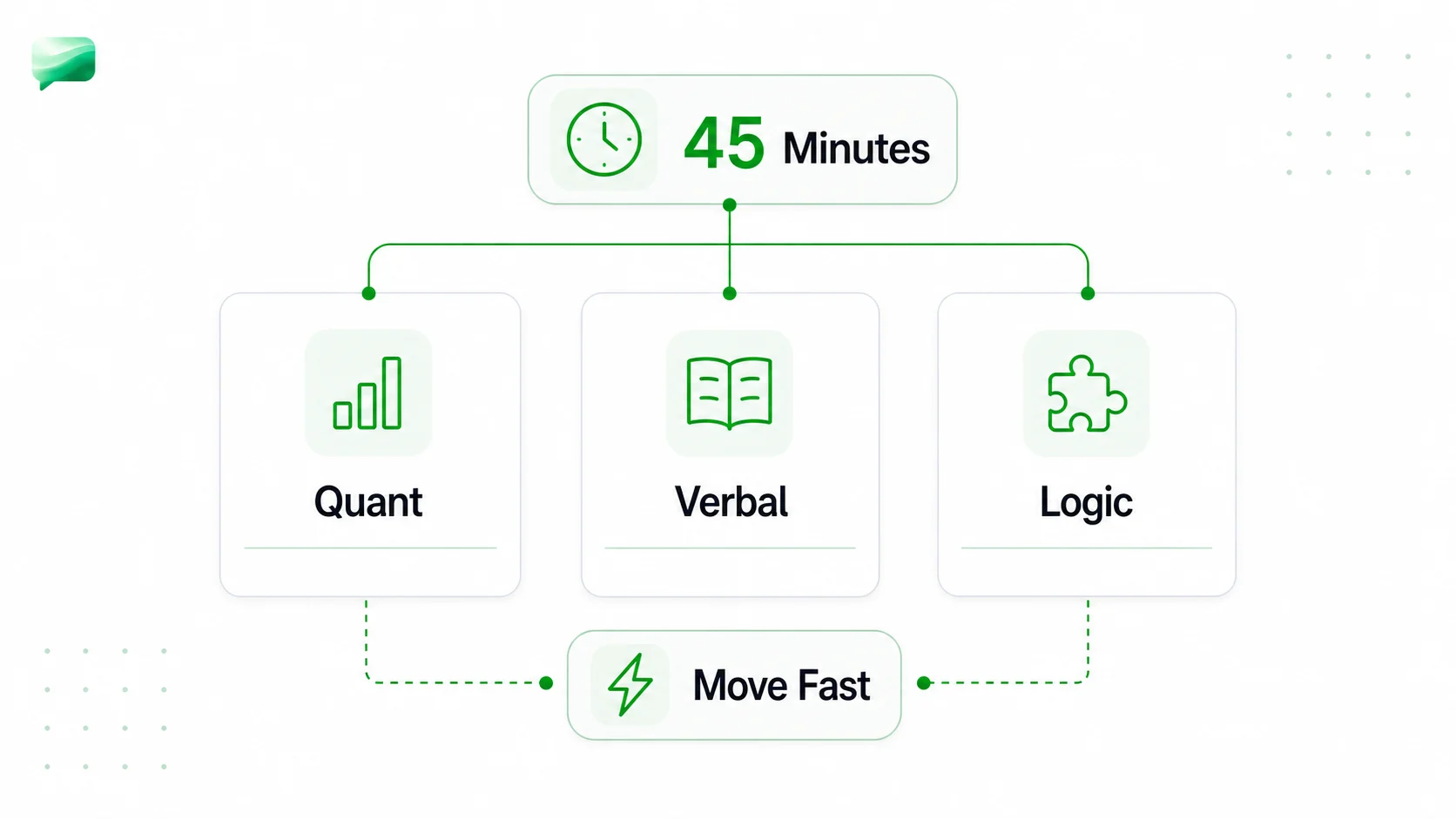
This is the stage almost every competitor waves past with one line, so it is where focused prep pays off most. Per Career in Consulting, the online assessment is a 45-minute, GMAT-style test delivered in three parts covering quantitative and verbal reasoning, with adaptive difficulty and crucially no calculator allowed. The format is SHL-style, which gives you a concrete way to drill it rather than treating it as a black box.
Here is how to prepare for each component concretely:
- Quantitative reasoning. Expect data interpretation from tables, charts, and short word problems: percentages, ratios, growth rates, and simple breakeven. Because there is no calculator, the bottleneck is mental arithmetic, not concepts. Drill timed sets where you must compute 12% of 850 or a 3-year CAGR in your head. The goal is to make the arithmetic automatic so your reasoning time is spent on the question, not the calculation.
- Verbal reasoning. SHL verbal usually uses a True, False, Cannot Say format against short business passages. The classic trap is answering from outside knowledge. If the passage does not support the statement, the answer is Cannot Say even when the claim is plausible in the real world. Practise reading only what the text licenses.
- Adaptive difficulty. Because the test adapts, early questions calibrate the rest. Do not rush the opening items into careless errors, and because SHL tests generally do not penalise wrong answers, never leave a question blank when the clock runs out. A considered guess has positive expected value.
Drill percentages and ratios without a calculator from the Road to Offer drill engine. Answer a real prompt and get AI-scored feedback. Free accounts include 5 drills per day for the first 3 days after signup.
First Round vs Final Round: Structure and Who You Meet
OC&C uses two rounds, and the difference between them is more about ambiguity and seniority than about format. Case-prep reports that both the first and final rounds are typically two interviews of about 45 minutes each, with consultants conducting round one and partners conducting the final. CaseBasix breaks a single session down further: a 2 to 3 minute intro, roughly 30 to 35 minutes of main case, 5 to 10 minutes of behavioral questions, and 2 to 5 minutes for your own questions. PrepLounge adds that the first-round fit segment runs about 15 minutes with junior consultants before the case, and that the second round follows the same shape with senior consultants, partners, or directors.
What actually changes between rounds:
- Round one cases are more contained. A junior consultant runs a tighter prompt and is often checking whether you can structure cleanly and do the math under light pressure.
- Final round cases get more ambiguous and the probing intensifies. Partners and directors are testing judgement: can you take a vague consumer or PE prompt, impose a sensible structure, and defend a recommendation when they push back? They are also weighing fit harder, because at a boutique a partner is deciding whether they personally want you on their cases.
For a sense of how a peer candidate-led boutique sequences its rounds and weights math, the L.E.K. case interview guide is a useful comparison point, since L.E.K. shares OC&C's commercial, quant-forward, candidate-led DNA.
How an OC&C Case Actually Runs: Candidate-Led vs Interviewer-Led, Resolved
Sources contradict each other on whether OC&C cases are candidate-led or interviewer-led, and the honest answer is that both descriptions are pointing at the same reality from different angles. OC&C cases are candidate-led and hypothesis-driven. You ask clarifying questions, lay out a structure, state a hypothesis, and drive which analyses to run. That is the candidate-led mechanic.
What makes people call it interviewer-led is the intensity of the probing. OC&C interviewers are known to interrupt with repeated why questions, challenge your assumptions, and pressure-test your logic in the moment. CaseBasix notes the cases are built on real client examples, which means the interviewer often knows exactly where the weak points in your reasoning are. So you still own the direction, but you should expect to defend every step rather than narrate uninterrupted.
The right mental model: lead like it is a BCG or Bain case, but rehearse for an interviewer who pushes back harder than usual. State your hypothesis early so the probing has something concrete to attack, and treat each why as an invitation to show your reasoning rather than a signal that you are wrong.
The Most Common OC&C Case Types
Because OC&C lives in consumer, retail, leisure, TMT, and private equity, its case types cluster around commercial decisions rather than cost-cutting or operations. CaseBasix lists market sizing, strategic analysis, and operational improvement across consumer goods, retail, private equity, and TMT as the common archetypes. In practice the prompts you should rehearse are:
- Market sizing. Often a warm-up or embedded step: size a consumer category, a retail segment, or a subscription base. No calculator, so clean mental math wins.
- Market entry and growth strategy. Should a consumer brand enter a new country or category? Where should a retailer grow next? These reward a structured view of market attractiveness plus the client's right to win.
- Pricing. Premium consumer pricing, promotional mechanics, subscription tiers.
- Profitability. Margin decline at a retailer or hospitality operator, decomposed into revenue and cost drivers.
- M&A and PE due diligence. Given OC&C's heavy PE practice, expect acquisition screens: is this target attractive, and should our PE client buy it?
For the market entry and growth flavor specifically, build a clean way to judge whether a market is worth entering before you ever get the prompt. The growth strategy framework covers the full sequencing, organic-first ordering, phasing, and recommendation write-up these prompts reward. The market attractiveness framework gives you a reusable lens on market size, growth, competition, and profitability that maps directly onto OC&C's consumer prompts.
A Step-by-Step Framework for Cracking an OC&C Case
OC&C's candidate-led, hypothesis-driven style means a generic memorised framework will get punished. What works is a disciplined, adaptable sequence you can apply to any commercial prompt and then tailor on the spot.
OC&C Commercial Case Sequence
- 01
1. Clarify the objective. Pin down the exact decision and the metric of success. Is the client deciding whether to enter, acquire, reprice, or grow, and what does winning look like in numbers?
- 02
2. Structure the problem. Build a tailored, MECE structure for this prompt. For a consumer entry, that is usually market attractiveness, ability to win, and economics. Avoid bolting on a textbook framework.
- 03
3. State a hypothesis. Commit to a directional view up front, for example 'this is attractive only if we can reach 10% share at premium pricing.' It gives the interviewer something concrete to probe.
- 04
4. Drive the analysis. Prioritise the branch most likely to make or break the decision. Request data, and when it is not given, size it yourself with stated assumptions.
- 05
5. Handle the quant. Do market sizing and economics in clean steps with no calculator. Narrate the math, round sensibly, and sanity-check magnitudes out loud.
- 06
6. Sense-check and synthesise. Step back, test whether the numbers and the qualitative story agree, and surface the biggest risk before you conclude.
- 07
7. Recommend. Lead with the answer, give two or three reasons, name the key risk, and state the next step. Top-down, not a recap of everything you did.
The structure step is where most candidates either win or lose an OC&C case, so it is worth running inside full cases until building a tailored, MECE tree feels automatic under pressure.

Growth · easy
Practice for OC&C in a real case interview
Matched to this OC&C guide: a live consumer goods growth case with an AI interviewer. Free, scored on every step.
How should you align your OC&C Strategy resume and cover letter before this interview?
Use strategy, consumer, retail, or another practice context only when the current role and office support it. The resume should show commercial reasoning and the candidate's contribution, not a list of team tasks.
- Before: Worked on a consumer strategy project.
- After: Compared customer needs and competitor pricing to recommend the priority segment for the sponsor review.
Check that the role and case format are current and that the result separates your action from the team's outcome. Recruiters read the documents together: the resume proves commercial evidence, while the letter explains why OC&C and the practice. Rehearse the revised line against the guide's commercial-case sequence.
Make the commercial judgment visible
Drop the resume here for an independent graded report on whether the commercial reasoning reads clearly. Road to Offer's score, not an OC&C hiring one.
By uploading, you agree to resume analysis and report storage until you delete it. See the privacy policy.
Revise one commercial line, rehearse the recommendation, and bring it into the next case rep.
A Fully Worked OC&C-Style Case: Premium Pet Food
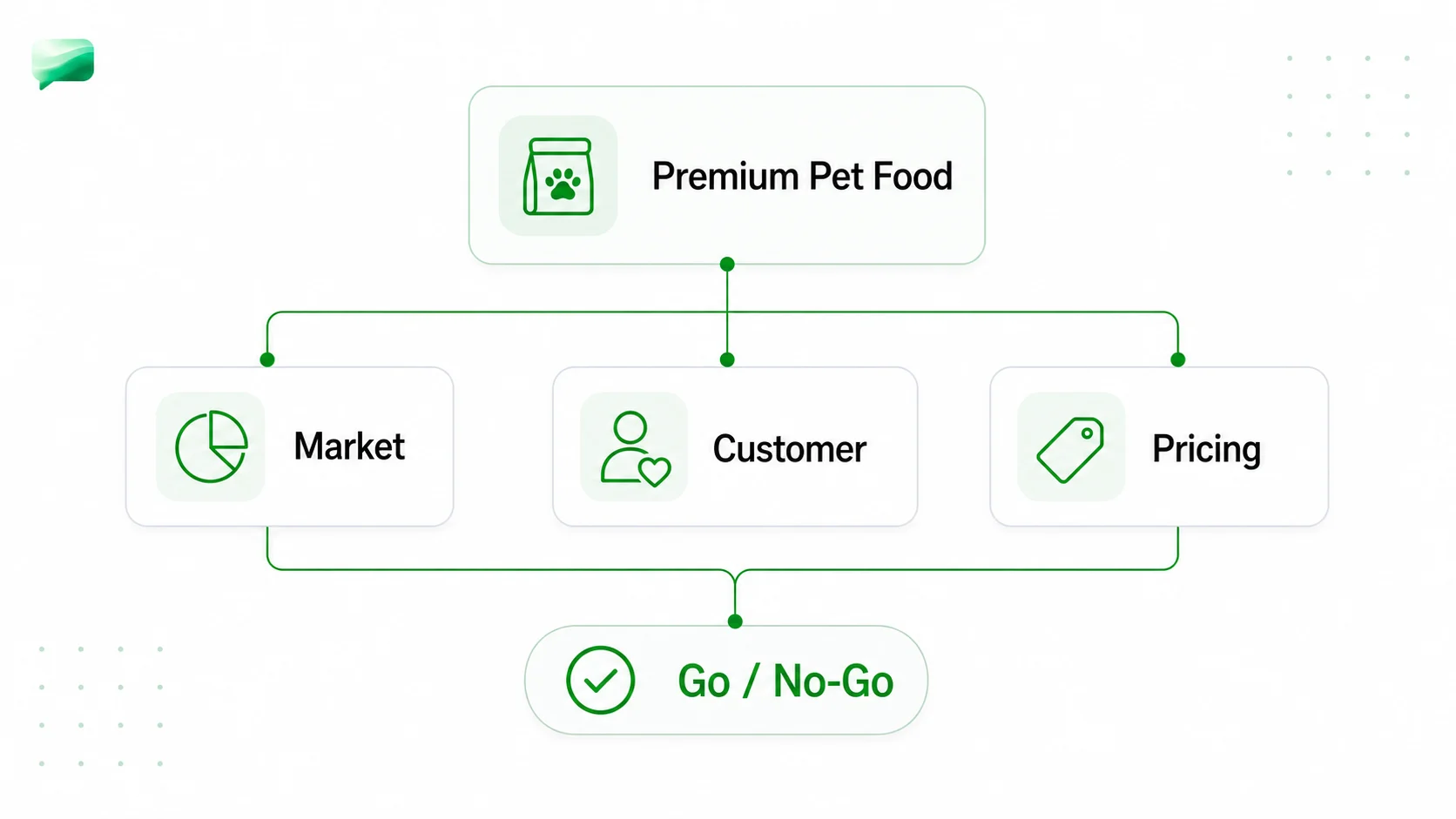
No competitor takes an OC&C-style prompt start to finish with the actual math, so here is one. It deliberately sits in OC&C's wheelhouse: a consumer brand with a private equity angle.
Prompt. A private equity client is considering acquiring a premium dog food brand in the UK. Should they buy it? The brand currently does about 60 million pounds in annual revenue.
Step 1: Clarify and structure
Clarifying questions worth asking: what return horizon and hold period does the PE client expect, what is the asking price and implied multiple, and is the thesis growth (expand the brand) or efficiency (fix margins)? Assume a growth thesis over a five-year hold.
A tailored structure has three branches:
- Market attractiveness. How big is the UK premium dog food market, and is it growing?
- Ability to win. Can this brand take or hold share against incumbents and private label?
- Deal economics. At the likely price, can the PE client earn its target return?
Hypothesis. This is attractive only if the premium segment is both sizeable and growing faster than the overall pet food market, and the brand has a defensible position that supports continued double-digit growth.
Step 2: Size the market (no calculator)
Walk the math in clean, stated steps:
So the brand's 60 million pounds in revenue implies roughly a 5% share of a 1.2 billion pound premium segment (60m divided by 1.2bn). That is a meaningful but not dominant position, which leaves clear room to grow.
Step 3: Test the hypothesis
Market attractiveness looks supportive: premiumisation in pet food is a structural trend, so if the premium segment grows at, say, 8% a year against a low-single-digit overall pet food market, the segment roughly doubles over a decade. Ability to win is the swing factor. At 5% share, the brand must show why it can keep growing: brand loyalty, a differentiated formulation, or distribution wins in grocery and e-commerce. The biggest risk is private label and large incumbents compressing margins as the premium niche goes mainstream.
Step 4: Deal economics, simply
Suppose the brand earns a 15% EBITDA margin: 60 million pounds revenue gives 9 million pounds EBITDA. At a 10x entry multiple, the purchase price is about 90 million pounds. If the PE client can grow revenue to roughly 100 million pounds over five years at a held 15% margin, EBITDA reaches 15 million pounds, and a flat 10x exit implies a 150 million pound exit value. Before leverage, that is roughly a 1.7x money multiple over five years, which is at the lower end of what most PE funds target, so the deal only clears the bar if growth runs ahead of this base case or some margin expansion is credible.
Step 5: Recommend
"Proceed to detailed due diligence, but do not overpay. The premium segment is attractive and growing, and at 5% share the brand has clear runway. However, the base-case return is only adequate, and it hinges on holding margins against private label. I would only recommend buying at or below a 10x multiple, and I would prioritise diligence on brand loyalty and the realistic ceiling on share, since those determine whether growth beats the base case. The single biggest risk is margin compression as premium pet food goes mainstream."
The Personal Experience Interview: Half Your Score
Most guides bury the fit interview, which is a mistake at OC&C. Per Career in Consulting, the Personal Experience Interview accounts for roughly 50% of the overall assessment and runs 20 to 40 minutes. If you spend 90% of your prep on cases, you are under-preparing for half of how you will be judged.
The PEI clusters around three things:
- Why consulting. A clear, non-generic reason you want strategy work, ideally tied to how you already think.
- Why OC&C. This is where boutique candidates separate themselves. Reference OC&C's consumer, retail, or PE focus, or its B Corp status, not interchangeable lines about culture and training that would survive a firm-name swap.
- Behavioral stories. Two to four sharp examples of leadership, analytical problem-solving, handling conflict, and overcoming setbacks, each told in under two minutes with a clear result.
Candidate Experience and Insider Edges
A few process details give prepared candidates an edge. Case-prep notes that OC&C offers an interview buddy between rounds, a current consultant you can speak with to understand the firm and the format better. Use it. Ask concrete questions about how cases are run and what the partners value, and let what you learn sharpen your why OC&C answer.
On timing and feedback, the picture across sources is consistent. OC&C confirms a confirmation email within 48 hours and feedback within three weeks of the closing date, while CaseBasix reports candidates typically hear back within one to three days between rounds. If the process does not work out, Career in Consulting reports a 12 to 18 month waiting period before reapplying, so it is worth preparing thoroughly the first time rather than treating an early attempt as a free practice run.
How to Prepare for OC&C Specifically
A generic case prep plan under-serves OC&C because of three firm-specific quirks: the no-calculator assessment, the candidate-led-but-heavily-probed case style, and the 50% PEI weighting. CaseBasix recommends four to six weeks minimum with 10 to 15 live mock cases. Here is how to spend that time.
Execution checklist
Weeks 1 to 2: No-calculator math and market sizing. OC&C bans calculators on the assessment and in cases. Drill mental percentages, growth rates, and consumer market sizing daily until the arithmetic is automatic, not the bottleneck.
Weeks 1 to 2: SHL-style assessment practice. Run timed SHL numerical data-interpretation sets and verbal True, False, Cannot Say passages so the 45-minute, three-part, adaptive test holds no surprises.
Week 1: Build your PEI story bank. Because fit is ~50% of the assessment, prepare why consulting, a firm-specific why OC&C, and three to four behavioral stories early, each under two minutes.
Weeks 2 to 4: Candidate-led commercial cases. Run 10 to 15 live mocks focused on market entry, growth, pricing, and PE screens in consumer and retail. Have your mock partner probe every assumption aggressively.
Week 3: Sector vocabulary. Learn the basics of consumer goods, retail, leisure, and private equity diligence so prompts feel native and your hypotheses sound informed.
Weeks 4 to 6: Full-round simulations. Simulate two back-to-back 45-minute interviews per round, each pairing fit and a candidate-led case, to build stamina and tighten synthesis under partner-level pressure.
If you are recruiting at OC&C alongside other strong non-MBB strategy firms, read the Oliver Wyman case interview guide too. Oliver Wyman shares OC&C's quant-forward, commercial orientation, and seeing how two peer firms differ in emphasis will sharpen your why OC&C answer and your sense of what each firm probes hardest.
Practice this next. Run a free candidate-led case to find your real bottleneck, then hammer market-sizing and mental-math drills until no-calculator arithmetic stops slowing you down.
Rehearse OC&C-style cases out loud
OC&C interviewers probe hard and ban calculators. Practice candidate-led commercial cases with voice-based AI that pushes back on your logic and scores your structure, math, and recommendation.
Sources and Further Reading (checked June 26, 2026)
- OC&C, About OC&C: https://www.occstrategy.com/en/about-occ
- OC&C, Your application: https://www.occstrategy.com/usa/careers/your-application/
- PrepLounge, OC&C firm profile
- CaseBasix, OC&C case interview
- Career in Consulting, OC&C recruitment process
- Case-prep, OC&C Strategy Consultants
Frequently asked questions
Resources and related guides
- Practice for OC&C in a real case interviewPractice
- Browse all free resourcesResource hub
- Arthur D. Little Case Interview: Format, Sample Cases, and a 2026 Prep PlanFirm Specific · Mar 31, 2026
- L.E.K. Consulting: Firm, Careers, and Interview GuideFirm Specific · May 22, 2026
- Monitor Deloitte Case Study and Case Interview: The Written Case, Group Case, and Prep (2026)Firm Specific · Apr 1, 2026