
Growth Strategy Framework: How to Structure Growth Cases
Learn how to structure growth strategy cases in consulting interviews. Split organic and inorganic levers, decompose revenue into price and volume, prioritize by size and feasibility, and quantify with two worked examples.
On this page
A growth strategy case asks how a company should grow revenue, profit, or market share, and it is one of the most common archetypes you will see at McKinsey, BCG, and Bain. The reliable way to structure it: clarify what growth means, split growth into organic (existing products, new customers, new geographies, new products) and inorganic (M&A, JV, partnerships), then evaluate each lever on opportunity size, feasibility, and risk. Separating volume levers from price levers inside the organic side is one of the clearest synthesis signals interviewers reward. The case interview frameworks complete guide shows how growth connects to market entry and pricing as part of the broader toolkit. For sister frameworks, the market entry framework handles geographic expansion in depth, and the Ansoff matrix maps the four strategic growth paths when the client needs to choose a direction rather than execute one.
Practice a growth lever drill
Growth cases usually break when the answer turns into a loose list of ideas. Run one real brainstorming drill below: bucket the growth levers, prioritize the first test, and then continue with a case interview brainstorming drill if you want more reps.
growth strategy from the Road to Offer drill engine. Answer a real prompt and get AI-scored feedback. Free accounts include 5 drills per day for the first 3 days after signup.
What is a growth strategy case?
A growth strategy case asks how a company should grow revenue, profit, or market share, usually over a 3-5 year horizon. The interviewer tests whether you can pin down the goal, generate a complete set of options, prioritize them, and recommend a phased plan with quantified upside.
The prompt usually arrives in one of three flavors:
- Growth target: "The CEO wants to double revenue in 5 years. How?"
- Plateau: "Growth has stalled at 2%. What now?"
- Strategic move: "Should we acquire competitor X?" or "Should we enter market Y?"
There is also a cross-cutting split worth recognizing out loud. A find-and-fix growth case has a problem to diagnose first ("growth slowed, why, and how do we restart it"). A forward-looking growth case has a healthy business that simply wants more ("we are doing well, how do we accelerate"). The find-and-fix version needs a diagnosis step before ideation; the forward-looking version goes straight to lever generation. Naming which one you are in tells the interviewer you are not running a memorized template. For the diagnostic logic underneath a find-and-fix case, see the issue tree case interview guide.
How do you clarify the objective before structuring?
This is the step weak candidates skip and strong candidates spend 30 seconds on. "Growth" is ambiguous until you define it. Before you draw a single lever, pin down four things.
- What metric? Revenue, profit, units, customers, or market share. A plan that doubles revenue while halving margin is not the same plan that doubles profit.
- How much, by when? "Double in 5 years" is a 15% compound annual growth rate. "Grow 10% next year" is a different problem. Convert the goal into a number you can size against.
- What constraints? Capital available, appetite for risk, time horizon, regulatory limits, and what the client has already tried.
- Why now? A board mandate, a new competitor, a funding round, or a stalled core all push the answer in different directions.
What are the main growth levers?
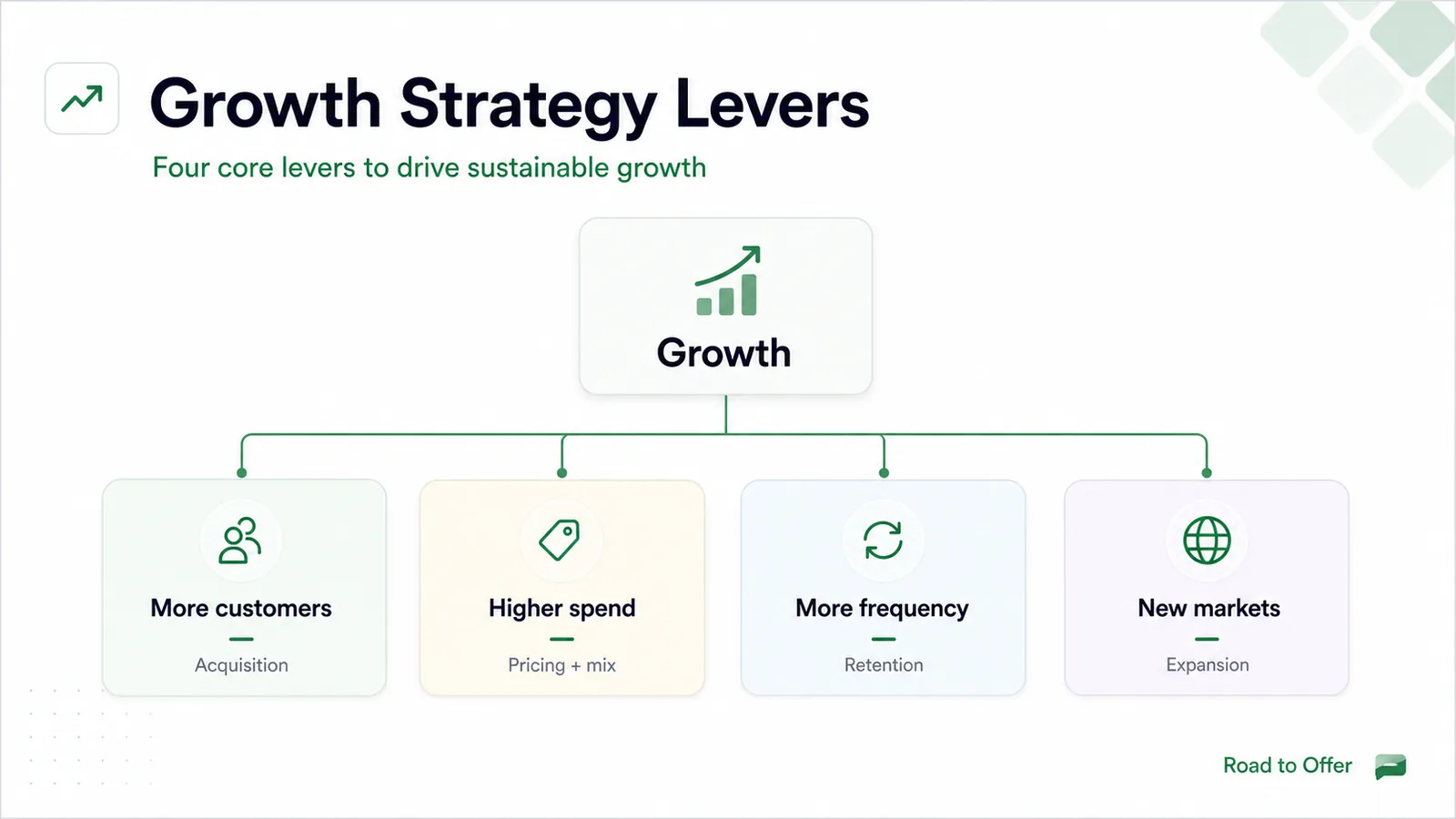
Split into organic (build) and inorganic (buy or partner). Within organic, separate volume levers from price levers. This split is the single thing interviewers reward most because it is genuinely MECE: every way a company can grow fits in one bucket, and the buckets do not overlap.
Organic growth levers
- Sell more to existing customers (cross-sell, upsell, frequency). A bank offers investment products to checking holders.
- Acquire new customers (new segments, channels, marketing). A B2B SaaS company expands from enterprise to mid-market.
- New products or services. A coffee chain adds prepared food.
- New geographies. A US retailer expands to Canada.
- New channels. A wholesale brand launches direct-to-consumer.
Inorganic growth levers
- Acquisition: buy a competitor or complementary business when speed, scale, or capabilities cannot be built in time.
- Joint venture: partner for local knowledge or shared risk.
- Partnership or licensing: non-equity collaboration for market access without commitment.
For the deal-evaluation logic on the inorganic side (strategic fit, synergies, deal risk), see the M&A case framework.
Revenue vs volume vs price
A clean decomposition: Revenue = Volume x Price. Volume = Customers x Frequency x Units per purchase. Use this when the case asks for revenue growth without specifying levers. It forces you to separate "sell to more people" from "charge them more" from "sell them more often." For deeper price logic, see pricing strategy cases.
Tailor the levers to the industry
Generic levers earn a passing structure. Industry-specific levers earn a strong one. Same skeleton, renamed branches:
- SaaS or subscription: new logos, expansion revenue (more seats, higher tiers, add-on modules), and reduced churn. Decompose as ARR = customers x average revenue per account, then attack each. Streaming reframes this as price x subscribers x retention.
- Retail or consumer goods: same-store sales (traffic x conversion x basket size), new store openings, e-commerce, and category extensions.
- B2B services: more clients, larger engagements, higher utilization, and new service lines.
Saying "in SaaS, expansion revenue from existing accounts is usually the cheapest growth, so I would size net revenue retention first" signals you know the business model, not just the framework.
How does the Ansoff Matrix apply to growth cases?
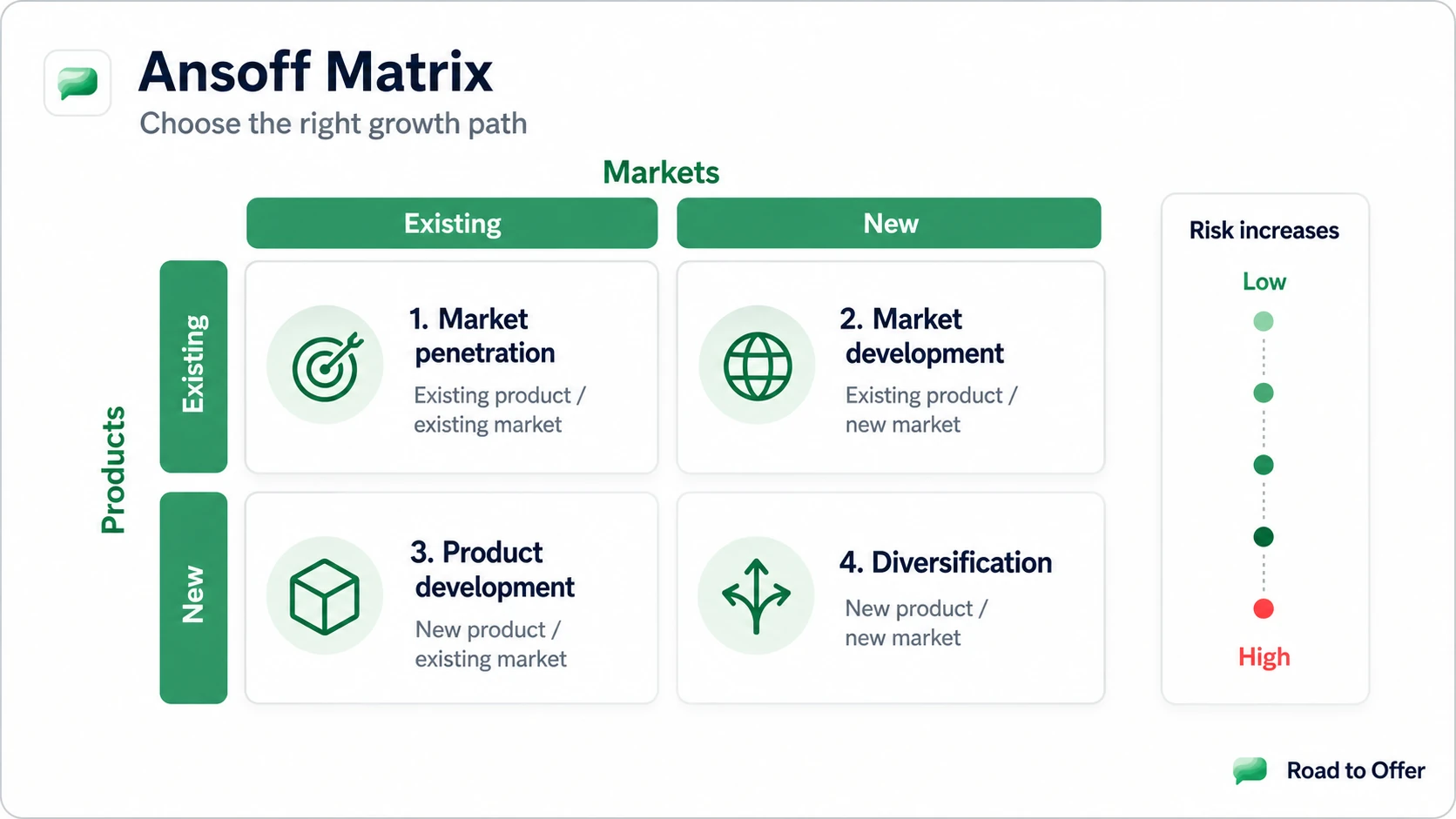
The Ansoff Matrix (Igor Ansoff, Harvard Business Review, 1957) maps growth by product and market dimensions. It is the cleanest way to communicate risk trade-offs to your interviewer, and the best fit when the case is a product-market choice (new menu items vs new stores) rather than a build-vs-buy choice (where organic vs inorganic fits better).
Market penetration
Same product, same customer. Cross-sell, upsell, share gains. Always evaluate first because the customer and product already exist.
Product or market development
Either the product is new (development) or the market is new (entry). Change one variable at a time. Phase development before diversification.
Diversification
New product AND new market. Justified only when core markets are saturated and the company has excess capital. Flag the risk out loud. "This is diversification, the riskiest quadrant" earns a structure point on its own.
How do you structure a growth strategy case step by step?
Four steps. Do them in order. Skipping step 1 is the most common reason candidates fail growth cases.
Step 1: Clarify objective and current state
Run the objective check above, then pin down core product, target customer, revenue and growth rate, market position, and constraints (capital, talent, regulatory). Ask what the client has already tried.
Step 2: Identify levers
Run the organic and inorganic checklists, tailored to the industry. Aim for 5-7 distinct options. Three well-quantified levers beat seven hand-waves. If your opening tree overlaps or misses one side of the build/buy split, isolate that skill with a case interview structure drill.
Step 3: Evaluate and prioritize
Score each on opportunity size, feasibility, and risk. The scoring is what produces the recommendation.
Step 4: Recommend with implementation plan
Lead with the recommendation, then the rationale: which lever, why it wins, sequence, milestones, resources. For synthesis under time pressure, see case interview synthesis, then practice the close with a case interview synthesis drill.
Run the four steps on a Bain growth strategy case. A $1.5 billion US coffee shop chain wants a plan to grow revenue. Answer this Bain growth strategy case step in the article, then continue the full case. Continue the full case on Road to Offer
What is a worked example of a growth case?
Prompt: A regional grocery chain with $500M annual revenue wants to double to $1B in 5 years. The market grows 2% annually. How should they grow?
Step 1: Size the gap
Target = $1B. Passive market growth carries the base along with the market: $500M x (1.02)^5. Computing the multiplier, 1.02^5 is about 1.104, so the base reaches roughly $552M on its own. That leaves a gap of about $448M to fill with active initiatives. Right away you know organic same-store tweaks cannot close this alone; the answer needs new stores or M&A.
Step 2: Quantify levers
Sanity-check one line so the numbers are not magic. Geographic expansion: 18 new stores at an average $8.5M revenue each is about $153M, which rounds to the +$150M in the table. Combined with passive growth (about $52M), active growth of $420M brings the total to roughly $972M, close to the $1B target. State that you land slightly short rather than forcing the numbers.
Size a gap yourself on a different chain, since the phasing only makes sense once you know how much each lever has to carry.
Quick Math
- A $400M chain sits in a market growing 3% a year. Using 1.03^5 = 1.159, where does revenue land in 5 years on market growth alone? Answer to the nearest $1M.
Passive revenue = Base x (1 + market growth rate)^years. Size the passive base before planning any lever.
- The target is $900M in 5 years and passive market growth carries the base to $464M. How large is the gap the active levers must close?
Gap = Target - Passive base. A gap this size rules out same-store tweaks on their own.
- Same-store growth adds $60M, geographic expansion $130M and an acquisition $180M, on top of the $464M passive base. Where does total revenue land?
Total = Passive base + every active lever. Say out loud where you land against the target instead of forcing the numbers.
Step 3: Phased recommendation
Notice the sequencing. Lower-risk organic first, geographic second, acquisition last. The client earns the right to make bigger bets by proving operational capability with the easier wins.
What is a worked example for a SaaS growth case?
Retail is not the only flavor. Here is the same structure on a subscription model, where the levers are net new logos, expansion, and churn.
Prompt: A B2B SaaS company has 2,000 customers paying an average of $20,000 per year, so $40M in annual recurring revenue. Leadership wants to reach $60M ARR in 2 years. How?
Step 1: Frame the math
ARR = customers x average revenue per account. The $20M gap can come from more customers, more revenue per account, or less churn (which protects the base you already have). Start by protecting the base: if annual logo churn is 10%, the company loses about 200 customers, or roughly $4M, every year before any growth counts. Cutting churn to 5% saves about $2M per year, so reducing churn is worth quantifying first because it is the cheapest dollar.
Step 2: Size the levers
Expansion math: a $4K lift across 2,000 existing accounts is $8M, and expansion revenue is usually the cheapest growth because the customer relationship already exists. New logos plus expansion give +$18M, churn protection adds the cushion, and the company clears $60M with margin to spare.
Step 3: Recommend
Lead with expansion (cheapest, fastest), pair it with a churn-reduction investment in customer success (protects the base), and use new-logo acquisition as the third lever because it carries the highest cost per dollar. Same organic-first logic as the grocery case, expressed in subscription language.
What are common mistakes in growth strategy cases?
The most common growth case mistake is starting to brainstorm before clarifying what growth means and what is causing the gap. Top mistakes, in order of frequency.
Skipping objective and current-state assessment
Candidates list options before defining the metric, the target number, or the constraints. Anchor in the objective and the facts first.
Listing levers without scoring
A bullet list of seven options is not a recommendation. Score each on size, feasibility, and risk. The scoring produces the recommendation.
Unrealistic numbers
Share gains of 5+ points per year are aggressive almost everywhere. Cross-sell attach above 40% needs justification. New-geography Year-1 revenue rarely exceeds 20-40% of mature-market run-rate. M&A synergy capture typically lands around 70% of projections, per Bain M&A insights.
Recommending acquisition first
Acquisitions are capital-intensive, slow, and high-risk. Default to organic. If the prompt is "should we acquire competitor X," still walk through organic alternatives before saying yes.
Treating all growth as good growth
Not every growth dollar is worth chasing. Growth that dilutes margin, strains the supply chain, or attracts low-retention customers can destroy value even as the top line rises. When a lever grows revenue but hurts profit, say so and weigh it against the objective. If growth requires sacrificing margin, the scale vs profitability case interview frames that exact trade-off.
How do you quantify a growth opportunity?
Multiply the addressable customer base by a capture rate by price per unit. Anchor each input on a benchmark.
- Cross-sell attach: 15-30%. Above 40% needs justification.
- New-geography Year 1: 20-40% of mature-market run-rate. Full run-rate takes 3-5 years.
- M&A synergies: roughly 70% of projected synergies materialize. Revenue synergies are slower than cost synergies.
- Share gains: 1-3 points per year is aggressive. 5+ rarely holds without a structural advantage.
If a growth case turns into a profit case, pair this with the profitability framework to decompose margin levers alongside revenue. The revenue growth case interview goes deeper on the organic lever decomposition, and the restructuring case interview is the recovery path when growth has stalled and the business needs to stabilize before reaccelerating. Switching industries mid-career? The patterns transfer cleanly; see case interview prep for career changers.
If the arithmetic is the bottleneck, drill capture-rate, price, and revenue-impact reps with case interview math practice before your next full case.
Practice growth cases with AI feedback
Run full growth strategy cases against an AI interviewer that scores your structure, math, and synthesis.
Sources and Further Reading (checked June 18, 2026)
- Ansoff, H.I. (1957). "Strategies for Diversification." Harvard Business Review, 35(5), 113-124.
- Favaro, K., Meer, D., & Sharma, S. (May 2012). "Creating an Organic Growth Machine." Harvard Business Review.
- McKinsey & Company. "The ten rules of growth" (August 2022).
- McKinsey & Company. "A proven recipe for organic growth".
- Bain M&A Report and synergy capture benchmarks: bain.com/insights/topics/mergers-and-acquisitions.
- Management Consulted growth case examples: managementconsulted.com/case-interview-examples.
- IGotAnOffer case interview examples and frameworks: igotanoffer.com/blogs/mckinsey-case-interview-blog/case-interview-examples.
You know the framework. Now apply it under pressure.
Run full growth strategy cases against an AI interviewer that adapts to your level. Scored on structure, quantification, and synthesis.
Frequently asked questions
Resources and related guides
- Practice growth strategy in a real case interviewPractice
- Browse all free resourcesResource hub
- M&A Case Interview Framework: 5 Steps + Synergy Math (2026)Frameworks · Feb 6, 2026
- PE Due Diligence Framework for Case Interviews (2026)Frameworks · Feb 19, 2026
- Revenue Growth Case Interview: Framework, Levers, and Worked Examples (2026)Frameworks · Mar 20, 2026
- Pyramid Principle (Minto) for Consulting: How to Deliver a Case Synthesis (2026)Frameworks · Jun 27, 2026