
Issue Tree: How to Build One for Case Interviews (2026)
How to build a MECE issue tree in a case interview: the diagnostic vs solution split, a 4-step method, two worked numeric examples, and the mistakes that get structures rejected.
On this page
An issue tree is a hierarchical, MECE diagram that turns a case interview prompt into one root question split into 3 to 4 non-overlapping branches that together cover every plausible answer, built in roughly 60 to 90 seconds of silent structuring before you speak. That timing and branch count are what McKinsey, BCG, and Bain interviewers expect, and you can see the shape across ten worked structures in our issue tree examples library. There are two kinds. A diagnostic (why) tree breaks a problem into possible causes so you can isolate the root cause. A solution (how) tree maps the levers available to fix that cause once you know it. To build either one, define the root question, choose an algebraic, process, or segmentation split, add testable sub-branches, then prioritize the branch to analyze first. This guide gives the 4-step method, two fully worked numeric examples, and the mistakes that get structures rejected. For the full toolkit of frameworks that use issue tree logic as their backbone, the case interview frameworks complete guide shows how profitability, market entry, and pricing each produce a differently shaped tree from the same root technique. For the MECE quality standard behind every layer, the MECE principle explained article covers the overlap and gap tests in depth.
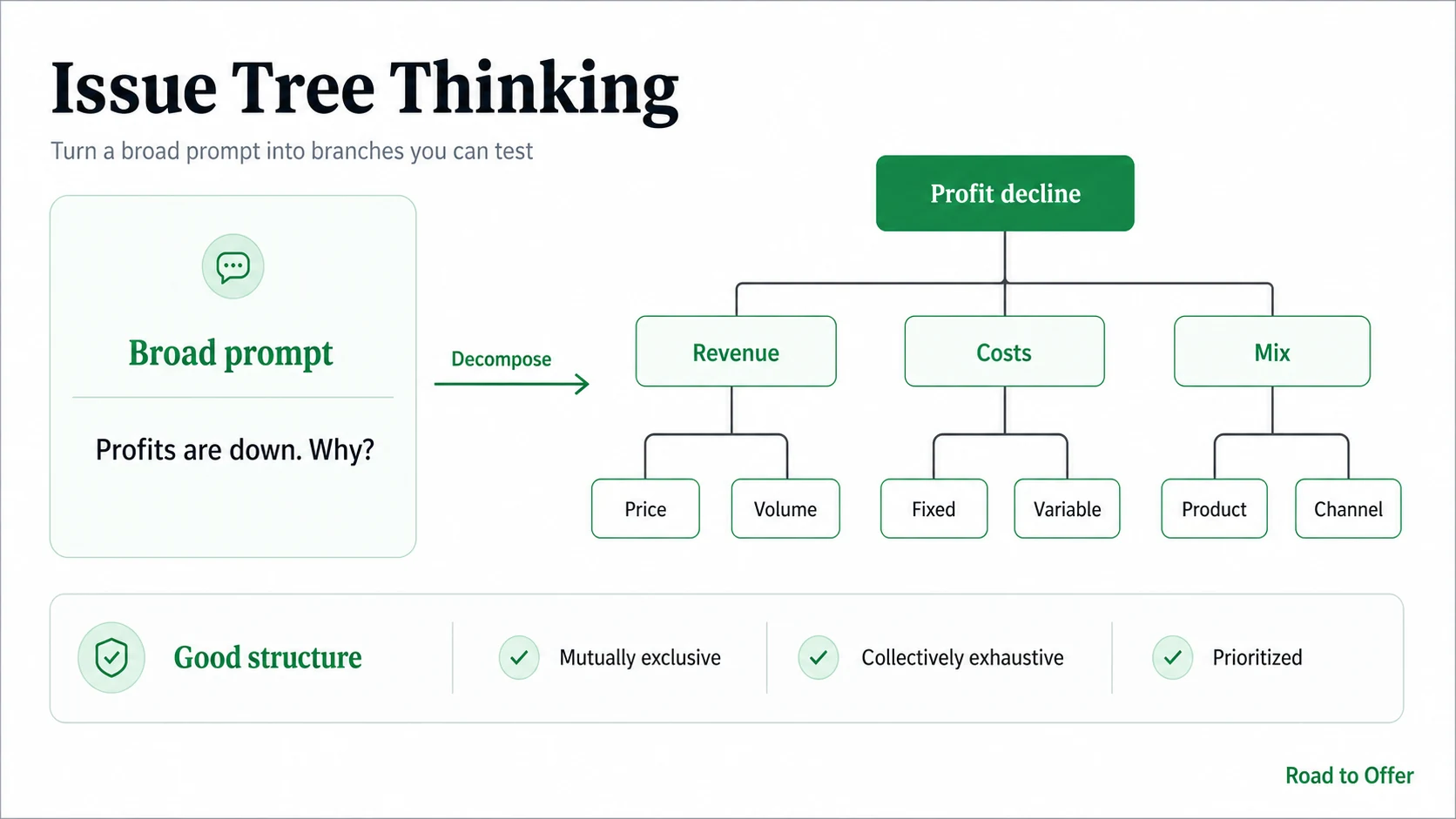
What is an issue tree in a case interview?
An issue tree is a top-down diagram that starts with a single root question and splits into branches representing possible answers. Each branch is a testable hypothesis. McKinsey, BCG, and Bain use issue trees in real client work, then test the same skill in interviews because it predicts how a consultant decomposes an ambiguous problem on day one.
The tree serves three purposes. It forces a complete view of the problem so you do not miss a cause. It shows the interviewer how you think under uncertainty. And it gives you a navigation map once data starts arriving, so you always know which branch a new number belongs to.
Issue trees are also the foundation for hypothesis-driven thinking, which interviewers expect by the second round. The tree maps what could be true; the hypothesis names what you bet is true and tells you which number to ask for first.
The fastest way to internalize the tree is to build one against a live prompt where the interviewer reacts to your structure. A profitability case is the cleanest place to start, since the algebraic split gives you an unambiguous MECE tree to walk top-down.

Profitability · easy
Practice a live profitability case
CPG / Packaged Snacks
What is the difference between a diagnostic and a solution tree?
This is the distinction most candidates miss, and it is the single biggest lever for sounding like a consultant rather than a student reciting a framework.
A diagnostic tree (also called a why tree or problem tree) answers "why is this happening?" You use it when the cause is unknown. A retailer's profit fell and you do not yet know whether it is a revenue or a cost problem, so you decompose the possible causes and test them.
A solution tree (a how tree) answers "how do we fix this?" You use it once the cause is known. The retailer's profit fell because of a volume drop in one region, so now you map the levers (price, promotion, distribution, product mix) that could lift volume back.
Most full-length cases run both in sequence: a diagnostic tree to find the driver, then a solution tree on the branch that turned out to matter. Naming which mode you are in out loud ("I will first diagnose the cause, then structure the fix") signals senior thinking. For revenue-growth prompts specifically, the growth strategy cases guide shows how the solution tree splits into organic and inorganic levers.
Learn frameworks properly
Pick and adapt structures instead of memorizing buckets.
How does MECE apply to issue trees?
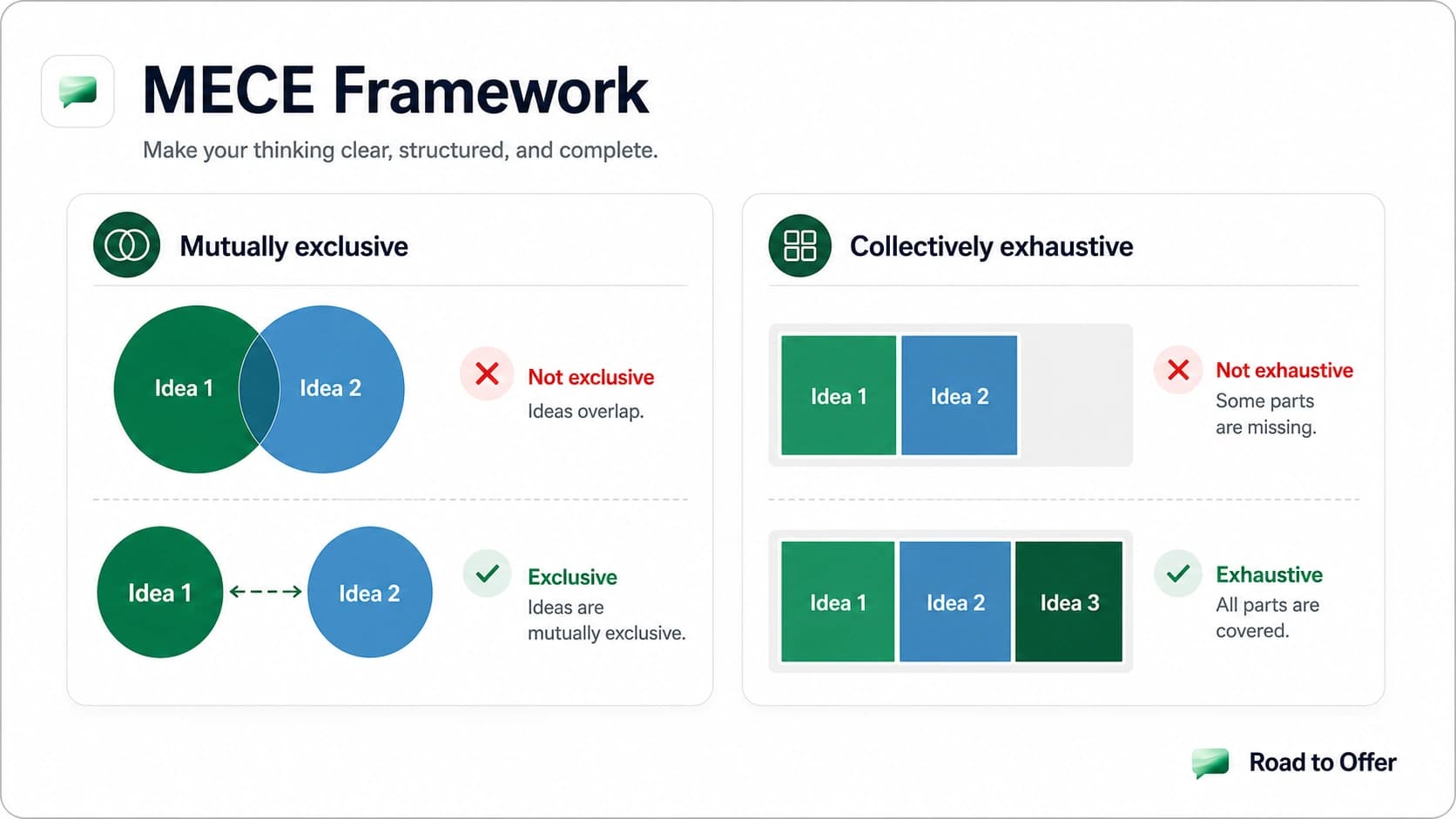
MECE stands for mutually exclusive, collectively exhaustive. The principle, popularized by Barbara Minto at McKinsey as part of the pyramid principle, governs every level of the tree. A non-MECE split signals weak structuring and almost always leads to either double-counting or a missed root cause. For a deeper treatment of the principle on its own, see the MECE explainer.
What do mutually exclusive and collectively exhaustive mean?
Mutually exclusive: no two branches at the same level overlap. Splitting a revenue decline into "price drop" and "customer attrition" overlaps, because attrition changes both volume and the prices that remaining customers pay. A clean split is "volume change" versus "price change," where every revenue dollar maps to exactly one branch.
Collectively exhaustive: the branches together cover every possible answer. If a profit-decline tree includes revenue and costs but omits one-time write-offs, it is not exhaustive. The test: could a true cause exist that fits no branch? If yes, add one or add a catch-all "other" leaf and revisit it.
Spotting a broken split is a distinct skill from building a clean one in the first place, worth drilling on its own.
Interactive drill set. Write an answer before revealing the worked solution, then continue into Road to Offer for scored practice and AI feedback.
What are the three reliable MECE techniques?
Algebraic decomposition is the strongest because a formula is MECE by construction: every dollar must land in exactly one term. Process-based decomposition follows the value chain, where each step is physically distinct. Segmentation splits by non-overlapping categories, which is reliable only if the categories are genuinely exclusive (geography and product line, for instance, can cross-cut, so pick one axis per layer).
Picking the right technique for the prompt in front of you, before you start drawing branches, is what separates a clean tree from a brainstorm. Run one timed rep against a fresh prompt and get scored on the split you choose.
Choose a decomposition and structure it live from the Road to Offer drill engine. Answer a real prompt and get AI-scored feedback. Free accounts include 5 drills per day for the first 3 days after signup.
How do you build an issue tree step by step?
The full build takes 60 to 90 seconds after hearing the prompt. Skipping any step weakens the structure.
Execution checklist
Define the root question as one measurable question. Use 'Why did operating profit drop 20% over 18 months?' not 'What about profitability?'; pinning the magnitude and timeframe keeps the whole tree anchored to the real gap
Pick a decomposition technique and split into 3-4 MECE branches. Profitability defaults to algebraic (Revenue versus Costs), operations to process, market sizing to segmentation; cap the top layer at four branches
Add 2-3 testable sub-branches under each branch. Each sub-branch must be settled by one data pull. 'Is the price decline from competitive pressure or discounting?' is testable; 'what about price?' is not. Usually three layers at most
Prioritize the first branch and present top-down. Name the branch you would test first and why ('start with costs because revenue is stable'), then walk root, branches, prioritization, and data request out loud in under 90 seconds. A silent tree earns zero structuring points
The split itself varies by prompt: a market-entry question uses Market Attractiveness, Right-to-Win, and Financial Viability, while a growth strategy case splits Organic versus Inorganic. To frame the delivery, the SCQA framework (Situation, Complication, Question, Answer) gives you a clean way to set up the problem before you walk through the tree.
What is a worked profitability issue tree example?
Three worked examples cover the most common prompts, starting with the one where arithmetic matters most.
Example 1: Profitability (retail bank profit decline)
A retail bank's profit dropped $40M year over year despite stable total assets. Diagnose the cause.
Four MECE branches, all under an algebraic profit decomposition:
- Net interest income (loan volume x spread)
- Non-interest income (fees, trading)
- Operating expenses (compensation, technology)
- Provisions for loan losses (non-performing loans, reserve methodology)
Prioritization: "I would start with net interest income, because it is 60 to 70% of a retail bank's revenue, so a small spread compression on a large loan book could explain the entire gap on its own."
Now the arithmetic. The bank carries a $10B loan book. You learn the net interest margin fell from 3.2% to 2.8%, a 40 basis point (0.40 percentage point) compression. The lost income is:
$10B x 0.004 = $40M
That single calculation accounts for the full $40M profit drop, so the root cause sits entirely in branch one and you can deprioritize the other three. Notice why this branch was well built: it was falsifiable. A single margin number either explained the gap or it did not, and it did. For the underlying logic, see the profitability framework.
Running that arithmetic quickly, and checking whether it fully explains the gap, is the case math skill this example is actually testing.
Interactive drill set. Write an answer before revealing the worked solution, then continue into Road to Offer for scored practice and AI feedback.
Example 2: Market entry (coffee chain into India)
A US coffee chain is considering entry into India. Should it enter?
Three MECE branches: Market attractiveness (size, growth, competitive intensity), Right-to-win (brand fit, supply chain, partnerships), and Financial viability (capex, payback, returns). Prioritization: "I would start with market attractiveness, because if the market is unattractive the other two branches do not matter."
Data: the Indian specialty-coffee market is roughly $400M and growing about 15% a year, dominated by two local chains. Brand fit is strong with urban professionals, but the supply chain requires a local partner. Financials show a 7-year payback. Conclusion: enter via a joint venture in tier-1 cities. The market entry framework guide covers the full template.
Example 3: Growth (SaaS revenue plateau)
A B2B SaaS firm has hit a $100M ARR plateau. How should it grow? This is where the diagnostic tree hands off to a solution tree.
Two MECE branches: Organic (new logos, expansion, new products) and Inorganic (acquisitions, partnerships). The organic branch splits further into pricing, packaging, segment, and geography. Prioritization: "I would start with expansion revenue, because the customer base already exists, so expanding it is the cheapest lever."
Data: net revenue retention is 95%, below the 110% benchmark strong SaaS firms hit, which points straight at weak upsell. Recommendation: invest in customer success and usage-based pricing. For the pricing-driven growth angle, the analysis goes one layer deeper.
Turning that retention gap into a dollar figure is what makes the recommendation land with a CFO instead of staying qualitative.
Interactive drill set. Write an answer before revealing the worked solution, then continue into Road to Offer for scored practice and AI feedback.
What are common mistakes when building issue trees?
Four mistakes account for most rejected structures in MBB interviews.
Mistake 1: Too many branches or non-MECE overlap
More than four top-level branches signals weak prioritization. The canonical overlap error is listing "Revenue" and "Pricing" as siblings, since pricing is a component of revenue. Run the overlap test on every pair: can a single cause map to two branches? If yes, the split is broken. Six loosely related causes read as a brainstorm, not a structure.
Mistake 2: Branches you cannot test
A branch like "external versus internal factors" sounds tidy but is not falsifiable, because you cannot name the single number that would confirm or rule it out. Before you commit to a branch, ask: what data point would kill this? If you cannot answer, rebuild the branch around something measurable.
Mistake 3: Misreading the prompt
If the prompt says "theft in our warehouses," do not structure the broader "inventory loss" (which folds in spoilage, miscounts, and damage). Reread the question and structure exactly what was asked. Scope creep at the root layer guarantees a non-exhaustive or off-target tree no matter how clean the branches look.
Mistake 4: Building without presenting, or refusing to pivot
A tree built silently earns nothing; always walk it top-down out loud. And once data disproves your prioritized branch, pivot explicitly: "costs are flat, so I am revising my hypothesis to a revenue-driven decline." Clinging to a disproved branch is penalized harder than picking the wrong branch first.
When should you use an issue tree vs other frameworks?
Issue trees are not always the right tool. Use the comparison below to choose.
Rule of thumb: build an issue tree when the question is "what could explain or fix X," and switch to a hypothesis-driven structure when the question is "is this specific thing true." Career changers moving into consulting from another field often over-rely on memorized frameworks here; the case interview prep for career changers guide covers how to build the from-first-principles instinct instead.
Choosing the right tool before you start structuring saves the minute you'd otherwise waste building the wrong kind of tree.
Interactive drill set. Write an answer before revealing the worked solution, then continue into Road to Offer for scored practice and AI feedback.
Build an issue tree with live AI feedback
Reading the mechanics only gets you so far. The skill that interviewers actually score is delivering a clean MECE tree out loud under time pressure, then walking it top-down. Run one timed rep against a fresh prompt and get scored on structure, MECE logic, and prioritization.
Build an issue tree, graded live from the Road to Offer drill engine. Answer a real prompt and get AI-scored feedback. Free accounts include 5 drills per day for the first 3 days after signup.
Sources
- CaseInterview.com: Issue Tree (checked June 18, 2026)
- Crafting Cases: Issue Trees: The Definitive Guide (checked June 18, 2026)
- Crafting Cases: How To Create Issue Trees, The 5 Ways To Be MECE (checked June 18, 2026)
- IGotAnOffer: Issue Trees in Case Interviews (checked June 18, 2026)
- PrepLounge: How to Use the Issue Tree in Case Interviews (checked June 18, 2026)
- My Consulting Offer: Issue Tree, The Complete Guide (checked June 18, 2026)
- Hacking the Case Interview: Issue Trees (checked June 18, 2026)
- Minto, B. (1987). The Pyramid Principle. Pearson.
Frequently asked questions
Resources and related guides
- Practice a full casePractice
- Browse all free resourcesResource hub
- Case Interview Cheat Sheet: Frameworks, Formulas & PDF (2026)Fundamentals · Mar 20, 2026
- MECE Framework in Case Interviews: Structures, Tests & MistakesFundamentals · Feb 2, 2026
- Revenue Decline Case Interview: Diagnose and Fix IssuesFundamentals · Jun 1, 2026