
What Is a Case Interview? Beginner Guide + Example
A case interview is a live business problem you solve out loud with an interviewer. Learn the format, the firms that use it, how you are scored, and a fully worked example.
On this page
A case interview is a business problem you solve while making your reasoning visible. You may work live with an interviewer, respond to an online case, analyze a written packet, present a recommendation, or collaborate in a group exercise. The exact format, duration, and role in the hiring decision vary by firm and position.
“Case study interview” is commonly another name for the same search job. The important boundary is format: one employer may mean a live interviewer-led case, while another may mean a written case study, take-home analysis, presentation, or group exercise. Confirm the format in the invitation before choosing how to practice.
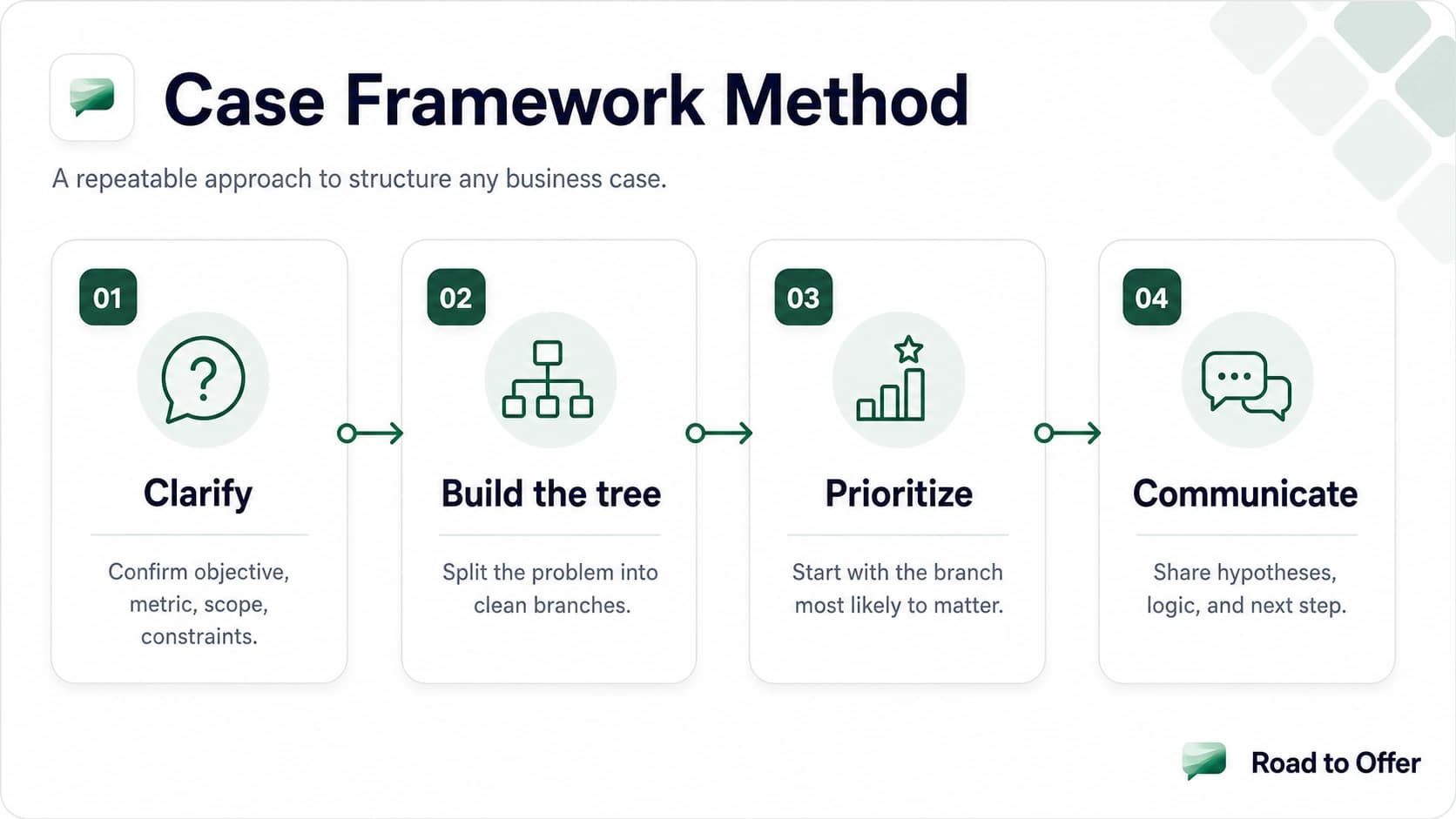
In a live case, you usually clarify the objective, organize the problem, analyze evidence, and recommend an action. There may be several defensible answers; the interviewer is evaluating whether your conclusion follows from clear reasoning.
Split the gym problem into a clear case structure from the Road to Offer drill engine. Answer a real prompt and get AI-scored feedback. Free accounts include 5 drills per day for the first 3 days after signup.
What Happens During a Case Interview?
A live case often follows this sequence:
- The prompt. The interviewer gives you a business scenario and objective.
- Clarifying questions. You confirm the objective, scope, and key definitions without asking for information merely to delay.
- Structure. You take a brief pause to organize an approach, then present it clearly. You can drill it in isolation before doing full cases.
- Analysis. You work through the problem: requesting data, interpreting charts, doing math, and forming hypotheses.
- Recommendation. You synthesize your findings into a clear, concise recommendation with supporting evidence.
The length and sequence vary. Use the current invitation and official preparation material to understand your process.
What Does a Case Actually Look Like? A Worked Example
Reading about cases is abstract. Here is a profitability case worked end to end, with the worked arithmetic, so you can see how structure, math, and judgment fit together. RetailCo and every figure below are fictional teaching inputs.
Prompt. "RetailCo is a national clothing retailer. Operating profit fell from $80M to $60M last year while revenue stayed flat at $1B. The CEO wants to know why, and what to do."
Step 1, clarify. A strong candidate confirms scope before structuring. Are we talking operating profit, not net? Yes. Is revenue truly flat across all channels, or flat in total with mix shifts underneath? Total is flat. Is this company-specific or industry-wide? Company-specific. Those answers already hint that the problem is on the cost side, since revenue did not move.
Step 2, structure. Profit equals revenue minus costs, so a profit drop with flat revenue means costs rose. Break costs into the standard split:
- Revenue = price x volume (flat, so park it for now)
- Costs = fixed costs (rent, salaried staff, systems) + variable costs (cost of goods sold, shipping, payment fees)
This is a MECE structure: the buckets do not overlap and they cover the whole problem. You would tell the interviewer you want to isolate which cost bucket grew.
Step 3, the math. The interviewer gives you data. Last year revenue was $1B with a 30 percent gross margin, so cost of goods sold (COGS) was $700M. This year revenue is still $1B but gross margin fell to 28 percent, so COGS is now $720M.
- Margin drop: 30% minus 28% = 2 percentage points
- Extra COGS: 2% x $1B = $20M
That $20M increase in cost of goods sold exactly accounts for the $80M to $60M profit decline. Fixed costs did not move. So the entire problem lives in the variable cost line, not in pricing, volume, or overhead.
Step 4, dig one level deeper. Why did COGS rise on flat revenue? You hypothesize and test: input cost inflation, a shift toward lower-margin products, or higher markdowns. The interviewer reveals that markdowns rose because the company over-ordered and discounted heavily to clear inventory. Root cause found: an inventory planning failure, not a pricing or demand problem.
Step 5, recommendation. "RetailCo's $20M profit decline is driven entirely by a 2-point gross margin drop from excess markdowns, caused by over-ordering. I would tighten demand forecasting and inventory buys to cut markdown losses, targeting recovery of the $20M over the next two seasons. The main risk is stockouts if we cut orders too aggressively, so I would pilot the tighter buying on two product categories first."

Profitability · easy
Practice a real case interview
Matched to this article: a live CPG profitability case with an AI interviewer. Free, scored on every step.
Interviewer-Led vs Candidate-Led: What's the Difference?
Live case interviews vary in how much the interviewer guides the analysis. Treat “interviewer-led” and “candidate-led” as ends of a spectrum, not permanent firm rules.
Interviewer-Led
The interviewer guides the discussion with specific questions. You still need to structure each question, interpret the evidence, and connect the answer to the business objective.
Candidate-Led
The interviewer gives you more responsibility for deciding what to investigate, in what order, and when to request data. The interviewer can still redirect or probe.
Blended formats
Many interviews blend direct questions with open-ended investigation. The degree of guidance can vary within one case and between interviewers at the same firm.
What other case-interview formats exist?
“Case interview” is a family of formats, not only a live one-to-one conversation.
Only prepare a special format when the posting or invitation supports it. Written, group, presentation, and online exercises are not universal across firms or roles.
Which Firms Use Case Interviews?
Case interviews are common in management consulting and also appear in some adjacent roles. The role posting and invitation decide whether your process includes one.
MBB (McKinsey, BCG, Bain)
McKinsey, BCG, and Bain commonly use case interviews for consulting roles, but the number, sequence, and accompanying assessments vary by role, office, and recruiting program.
- McKinsey: Official guidance describes case interviews and the Personal Experience Interview; some processes also name an assessment such as Solve.
- BCG: Official guidance describes case interviews; some invitations may include an online case or another assessment such as Casey or the CCA.
- Bain: Official guidance describes case and experience questions; assessment use varies by process.
Big 4 Consulting (Deloitte, PwC, EY, KPMG)
Big Four strategy and consulting practices may use case, presentation, group, or competency exercises depending on the role and region.
- Deloitte: Check the specific role for case, group, or presentation exercises.
- PwC and Strategy&: Check the specific practice and region.
- EY and EY-Parthenon: Check the specific role and invitation.
- KPMG: Check the specific consulting role and region.
Boutique Strategy Firms
Oliver Wyman, L.E.K., Roland Berger, Simon-Kucher, and other specialist firms may use case interviews. Format and rigor vary by role and process.
Beyond Consulting
Some technology, private equity, corporate strategy, operations, and finance roles use case-style questions. The business context and expected analysis can differ substantially from a consulting case.
Which six case patterns should beginners practice?
Cases cluster into recurring patterns. For a full breakdown with frequency data, see the case interview types guide. You do not need to memorize solutions, but recognizing the type helps you structure faster.
Common Case Types
- 01
Profitability. Why are profits declining? Diagnose and fix.
- 02
Market Entry. Should the client enter a new market or geography?
- 03
Growth Strategy. How should the client grow revenue or market share?
- 04
M&A / Due Diligence. Should the client acquire a target company?
- 05
Pricing. How should the client set or change prices?
- 06
Market Sizing. Estimate the size of a market or demand.
1. Profitability Cases
A common practice pattern. You diagnose why profits changed by decomposing revenue and costs, then recommend fixes supported by evidence. The worked example above is a profitability case. Learn the full structure in the profitability framework.
2. Market Entry Cases
Should the client enter a new market, geography, or product category? You assess market attractiveness, competitive dynamics, the client's capabilities, entry mode options, and financial viability. Learn the full structure in the market entry framework.
3. Growth Strategy Cases
How should the client grow? This spans organic levers (new products, new segments, pricing optimization) and inorganic levers (M&A, partnerships, joint ventures). You prioritize options by impact and feasibility. Learn the full structure in growth strategy cases.
4. M&A and Due Diligence Cases
Should the client acquire a target company? You evaluate strategic fit, revenue and cost synergies, valuation, integration risk, and whether the deal creates value. Learn the full structure in the M&A case framework.
5. Pricing Cases
How should the client set, change, or structure pricing? You analyze cost-plus economics, willingness to pay, competitive pricing, and the revenue versus volume trade-off. Learn the full structure in pricing strategy cases.
6. Market Sizing Cases
Estimate the size of a market, a customer base, or a quantity. These are often standalone questions (especially at McKinsey) or embedded inside larger cases. You build a logical estimation tree and calculate step by step. Learn the full method in market sizing step-by-step.
What Do Interviewers Actually Evaluate?
Interviewers commonly look for the following evidence, with emphasis varying by firm, role, and format.
1. Structured Thinking
Can you break a messy problem into organized, useful parts? A clear, MECE structure that covers the key issues makes the rest of the analysis easier to test.
What good looks like: "I would break this into three areas: demand-side drivers, supply-side drivers, and competitive dynamics. Let me start with demand, since the client mentioned declining volumes."
What bad looks like: "Well, there are a lot of things that could be going on. Maybe it is pricing, or competition, or maybe their product is not good, or costs are too high..."
2. Quantitative Skill
Can you work with numbers quickly and accurately, then translate the result into business meaning? This includes mental math, interpreting charts, and estimating. As the worked example showed, the arithmetic is usually simple. What matters is doing it cleanly out loud and saying what the number means. Build speed with mental math drills and case interview math practice.
What good looks like: "Revenue is $1B and gross margin fell 2 points, so cost of goods sold rose by $20M. That fully explains the $20M profit drop, so the problem is on the variable cost line."
3. Business Judgment
Do your recommendations make practical sense? Can you tell a textbook answer from what would actually work in this industry, for this client, given these constraints?
What good looks like: "I would recommend option A over option B. Option B has higher NPV, but it requires capabilities the client does not have and would take 18 months to build. Option A can ship in Q1 with existing resources."
4. Communication
Can you explain your thinking clearly, concisely, and top-down (answer first, then the supporting logic)? This includes signposting where you are in the analysis and treating the interviewer as a thought partner.
What good looks like: Starting each answer with the conclusion, then the reasoning. "I think the root cause is excess markdowns in the apparel line. Here is why..."
How Do You Start Preparing?
If you are starting from zero, here is the sequence that matters. For a complete structured study plan, see the case interview prep guide.
Phase 1: Learn the fundamentals
- Understand the MECE principle, the foundation of structured thinking.
- Learn the core frameworks: profitability, market entry, growth strategy.
- Read a few case interview examples to understand the format, then switch to active work.
- Use mental math drills when calculation is a diagnosed weakness.
Phase 2: Build case reps
- Practice complete cases at a pace that leaves time for review. You can run a guided diagnostic case now.
- Learn how to practice case interviews for maximum improvement per rep.
- Study your target firm's specific format and expectations.
Phase 3: Prepare the specific firm process
- Deep-dive your target firm's format and assessment: McKinsey PEI, BCG, or Bain.
- Prepare behavioral stories using the STAR method.
- Run full mock interviews under realistic conditions, then review your prep timeline and adjust.
If you are switching into consulting from another field, the structure is the same but your story and timeline differ. See the guide for case interview prep for career changers.
Common Mistakes Beginners Make
These three errors can make otherwise useful analysis hard to evaluate. For detailed examples and fixes, see 10 common case interview mistakes.
- Deploying a template instead of thinking. Reciting "revenue equals price times volume, costs equal fixed plus variable" tells the interviewer you memorized a framework. Customizing it to the specific industry and situation tells them you understand the logic. In the worked example, the split was the same, but the candidate immediately reasoned that flat revenue pointed to costs.
- Diagnosing and recommending at the same time. Gather enough evidence to support the recommendation before committing to it. An early hypothesis is useful when you treat it as testable, not as the answer.
- Ending without a recommendation. Strong analysis followed by "so yeah, those are my thoughts" wastes everything you built. Practice a concise synthesis with one recommendation, supporting evidence, one material risk, and one next step. Match the duration to your confirmed format.
Interactive Drills: Case Interview Basics
Interactive drill set. Write an answer before revealing the worked solution, then continue into Road to Offer for scored practice and AI feedback.
Next Steps
You now understand what a case interview is, how it is scored, and what a worked case looks like. Where to go next:
- Learn frameworks first: start with the profitability framework and market entry framework.
- See more cases: read through case interview examples.
- Build a study plan: use the consulting interview prep timeline.
- Start practicing: learn how to practice case interviews effectively, or run a guided diagnostic case.
- Target a specific firm: read the guides for McKinsey, BCG, or Bain.
Learn the case method
One dense lesson, each step linked to the drill that trains it.
Sources (checked June 18, 2026)
- McKinsey, interviewing and Solve assessment: mckinsey.com/careers/interviewing
- BCG, case interview preparation and Casey online case: careers.bcg.com/global/en/case-interview-preparation
- Bain, hiring process and case interview: bain.com/careers/hiring-process/case-interview
- PrepLounge, case interview 2026 guide: preplounge.com/en/blog/consulting/interview/case-interview
- Wikipedia, case interview overview: en.wikipedia.org/wiki/Case_interview
Frequently asked questions
Resources and related guides
- Practice a real case interviewPractice
- Browse all free resourcesResource hub
- Best Case Interview Books 2026: Ranked, Scored, and What to SkipGetting Started · Mar 20, 2026
- Case Interview Questions by Stage (With Worked Solutions)Getting Started · Feb 6, 2026
- Case Interview Tips: 10 Common Mistakes and How to Avoid Them (2026)Getting Started · Feb 19, 2026
- Consulting Interview Process: Stages, Timeline, and FormatGetting Started · Mar 20, 2026