
L.E.K. (LEK) Case Interview Guide: Format, Written Case & Prep Strategy (2026)
L.E.K. / LEK Consulting case interview guide: role-specific process checks, quantitative practice, sector cases, worked examples, and a 30-day prep plan.
On this page
This L.E.K. case interview guide, also useful if you search for the LEK Consulting case interview, focuses on three useful practice areas: fast quant, sector fluency, and concise synthesis. The actual process varies by office and role, so map your preparation to the current invitation rather than treating candidate reports as a fixed sequence.
What L.E.K. Is (and Why It Interviews Differently)
L.E.K. Consulting was founded in 1983 in London (the initials stand for co-founders James Lawrence, Iain Evans, and Richard Koch). Today it operates about 26 offices globally with roughly 1,600 consultants. It sits comfortably in the Tier 2 strategy consulting tier alongside Oliver Wyman, Roland Berger, and Kearney, consistently placed above Big 4 consulting in prestige rankings, below MBB.
What sets L.E.K. apart operationally is where its revenue comes from. Unlike McKinsey or BCG, which spread work broadly across industries, L.E.K. has built genuine depth in life sciences (biopharma, MedTech, CRO), private equity commercial due diligence, consumer, and industrials. According to L.E.K.'s official interview preparation page, candidates should "hone your skills in the areas most relevant to L.E.K.'s core sectors." That is as close to a direct signal as a firm will give you.
For the biopharma and MedTech side of that prep, use the life sciences consulting case interview guide before your L.E.K.-specific mocks. It covers the FDA, payer, HEOR, and rNPV concepts that make L.E.K. cases feel different from generic MBB practice.
That industry mix shows up directly in the cases you'll receive. A candidate preparing only on general business cases is under-prepared for L.E.K. by default.
For fit questions on motivation, mistakes, and teamwork, use the L.E.K. behavioral interview questions guide with this case plan.
Find your current case interview baseline
Before you build a 30-day L.E.K. prep plan, know where you actually stand. Road to Offer's AI gives you structured feedback on your case performance in one 30-minute session.
What is confirmed about the L.E.K. interview process?
Application and any invitation-specific screen
Some candidates report a numerical reasoning test before interviews. If your invitation includes one, use its stated platform, duration, and question format to guide practice.
Candidate reports mention fast-paced numerical screens in some processes, but they do not establish a global product, cutoff, or sequence. If your invitation names one, use the official sample and the stated timing. If it does not, do not spend weeks preparing an assessment that may not be part of your process.
Early live interviews
Early-round interview count, length, and fit/case split vary by office and role. Confirm each from your invitation.
The two case types candidates report encountering:
For practice, train yourself to set direction, request data, and propose the next analytical step. In the real interview, adapt that initiative to the guidance the interviewer provides.
According to multiple candidate reports on PrepLounge, the quantitative case often involves "pushing real numbers at you mid-case" rather than abstracting to percentages. Clean, fast arithmetic matters more than it does at firms where cases stay at the conceptual level.
Later interviews and any written exercise
Later-round formats vary. If your invitation includes a written case, use its stated packet, output, and time limit; the sequence below is a practice template, not a universal L.E.K. process.
The written case structure:
- Review the supplied packet for data exhibits, financial summaries, market context, and client background
- Within the invitation's time limit, identify the key question and build the requested concise output
- You present your findings to the interviewer, who probes your reasoning and challenges your conclusions
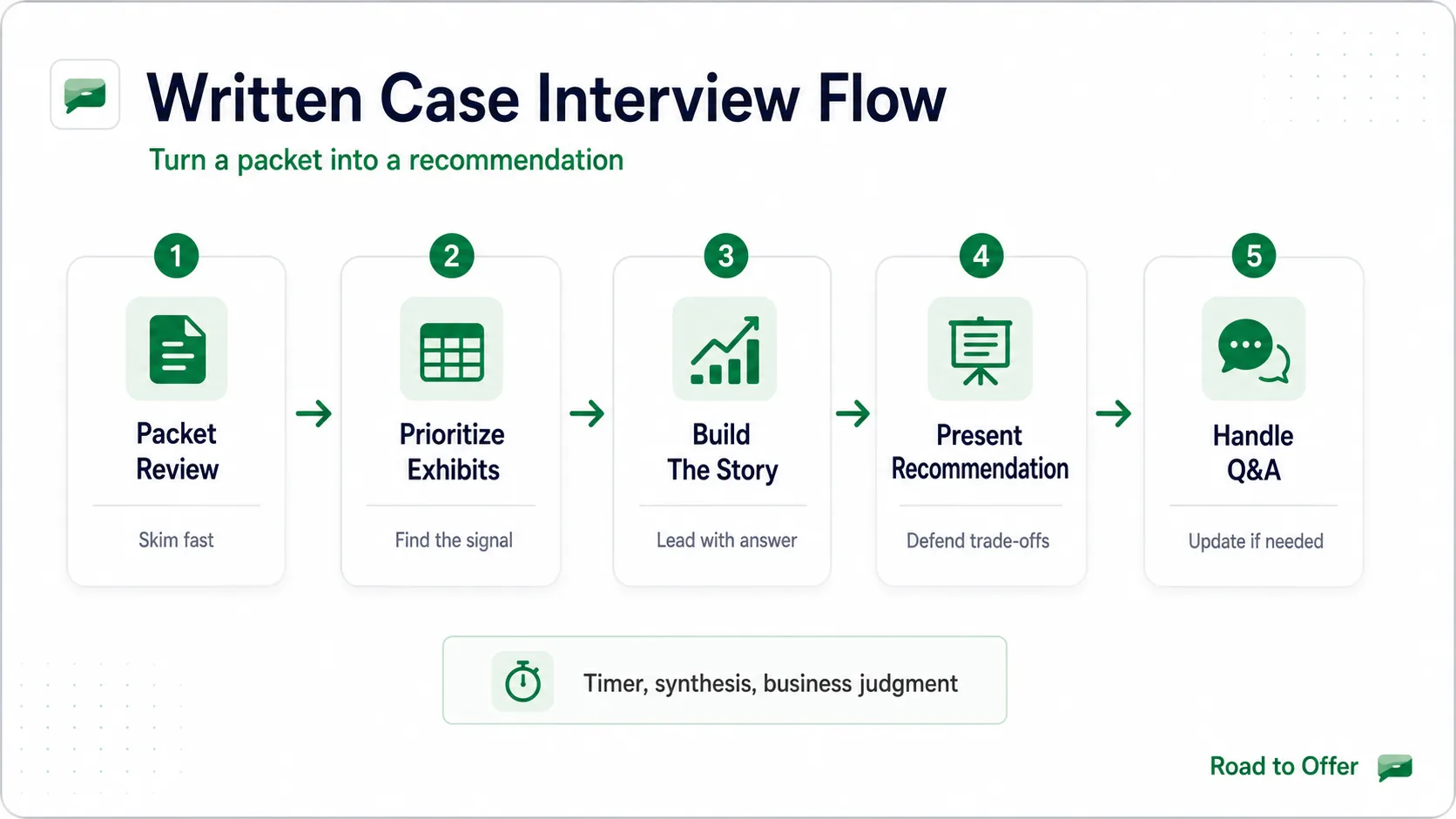
If you've never practiced building structured slide recommendations under a strict time limit, the written case is where strong verbal case performers often stumble. For a complete breakdown of the written case format and slide structure, see our written case interview guide.
How L.E.K. Cases Differ From MBB
This is the comparison that matters most for candidates who've spent weeks preparing for McKinsey, BCG, or Bain.
The practical implication is to build clean structures, transparent quantitative work, and concise synthesis without pretending one office's process applies everywhere.
For general framework fundamentals, start with our complete case interview frameworks guide.
Build L.E.K.-level quantitative speed with Quick Math
Road to Offer's AI tracks your math accuracy and pacing in real time, flagging exactly where you slow down under pressure, so you fix it before the interview.
L.E.K.'s Sector Focus: What It Means for Case Prep
L.E.K. publishes its sector focus openly: life sciences, healthcare services, private equity, consumer, and industrials. "If you have a background in this area," the careers page reads, "it is ideal if you prepare for cases focusing on biopharma, healthcare and related services, and MedTech."
For candidates without those backgrounds, there's a vocabulary gap to close before any case technique matters.
Life Sciences and Healthcare Cases
Life sciences cases at L.E.K. typically involve one of these scenarios:
- Drug market sizing: Estimate revenue potential for a new therapeutic entering a defined indication
- CRO (contract research organization) strategy: A CRO considering service expansion or geographic entry
- MedTech entry: A medical device company evaluating a new market or evaluating an acquisition
- Biopharma profitability: Declining margins at a specialty pharma company despite revenue growth
- AI in drug discovery: A technology company assessing commercialization options for a compound-identification platform
According to Wall Street Oasis interview reports, candidates have encountered prompts including "strategy for biopharma," "business opportunity for diagnostic company," and "open-ended evaluation of a biopharma company." The framework mechanics are identical to standard case frameworks. The challenge is the vocabulary.
Terms to know before your interview: payer mix (how a drug's revenue splits between insurance types), formulary inclusion (whether a drug is covered under an insurer's approved drug list), reimbursement rates (what payers actually pay per prescription), patent cliff (revenue loss when a drug's patent expires and generics enter), Phase II/III/IV (clinical trial stages and their cost/risk profiles), and CRO (a company that runs clinical trials on behalf of pharma clients).
Private Equity Due Diligence Cases
L.E.K. is one of the top global firms for PE commercial due diligence. Cases in this space look like:
- "A PE fund is considering acquiring Company X at a 9x EBITDA multiple. Should they proceed?"
- "Assess the market size and growth trajectory for this B2B healthcare software sector"
- "What is the competitive position of this target versus its three nearest rivals, and is it defensible?"
The framework for PE due diligence cases sits between market entry and profitability: you're assessing market attractiveness, then evaluating whether this specific company can win and sustain its position. Our market entry framework guide covers the attractiveness assessment piece in depth.
Worked Example 1: L.E.K. Life Sciences Profitability Case
Prompt: "A specialty pharma company has seen EBITDA margin decline from 28% to 13% over three years, despite revenue growing from $400M to $560M. What's driving this, and what should they do?"
Step 1, Quantify the problem before diagnosing it:
- Year 1: Revenue $400M × 28% margin = $112M EBITDA; Cost base = $288M
- Year 3: Revenue $560M × 13% margin = $72.8M EBITDA; Cost base = $487.2M
Cost growth: $487.2M – $288M = $199.2M increase to generate only $160M in additional revenue. The company spent $1.25 for every $1.00 of revenue growth. That's the core problem.
Step 2, Structure the cost analysis:
Break the cost base into: COGS (variable, tied to volume), SG&A (selling, general, admin, often semi-fixed), and R&D (investment in future pipeline).
Hypothesis: Excessive SG&A expansion. A scaled-up commercial organization that hasn't returned proportional revenue.
Step 3, Interpret the data: (In a real L.E.K. case, you'd explicitly request this breakdown.)
Assume the interviewer provides: COGS held stable at 40% of revenue. SG&A grew from 20% to 31% of revenue. R&D from 12% to 16%.
- SG&A Year 1: $400M × 20% = $80M
- SG&A Year 3: $560M × 31% = $173.6M → growth of $93.6M
SG&A increased by $93.6M, approximately 47% of the $199.2M cost-base increase.
Recommendation: "The core issue is SG&A over-expansion. The company added $93.6M in selling costs while generating $160M in revenue growth. I'd recommend a SG&A efficiency audit focused on sales force productivity by territory, benchmarked against the pharma peer median of approximately 20-22% of revenue. The immediate lever is identifying which markets have the lowest revenue-per-sales-rep and restructuring or exiting those territories."
For structured recommendation practice, see our case interview synthesis guide.
The cost-bridge arithmetic above, EBITDA from margin and revenue, then SG&A growth as a share of revenue, is useful preparation for quantitative cases. Drill it until the setup is clear and fast, then follow the timing in your actual invitation.
Worked Example 2: L.E.K. PE Due Diligence Case
Prompt: "A PE fund is evaluating acquiring a mid-size CRO with $200M revenue, 17% EBITDA margins, priced at 10x EBITDA. Should they proceed? What are your key diligence questions?"
Structure, two core questions:
1. Is the market attractive?
- Global CRO market is approximately $75-80B and growing at 7-8% annually, driven by pharma companies increasingly outsourcing clinical trial execution to reduce fixed costs
- Market is fragmented: the top 5 players (IQVIA, Covance, PPD, Syneos, PRA) hold roughly 50% share; the remaining 50% is split across hundreds of specialty firms
- Tailwinds: rising R&D spend, complexity of late-stage oncology/rare disease trials, and pressure on pharma margins driving outsourcing
2. Does this company win in that market?
Questions I'd ask:
- What is the CRO's therapeutic specialization? (Oncology CROs command premium margins vs. general Phase I-II shops)
- What is client concentration? If top 3 clients represent 50%+ of revenue, that's a major risk
- What is backlog? (A 12-18 month contracted backlog signals revenue visibility)
- Are contracts milestone-based or time-and-materials? (Milestone contracts create margin risk on overruns)
Quantify the deal:
- EBITDA = $200M × 17% = $34M
- Enterprise value at 10x = $340M
- At a conservative 7x exit multiple (down from 10x at entry, reflecting growth deceleration at maturity) after 5 years with 8% annual revenue growth: Revenue = $200M × (1.08)^5 ≈ $294M. EBITDA at 17% = ~$50M. Exit EV at 7x = $350M.
That's barely 3% total return over a 5-year hold (~0.6% annualized IRR), which is not attractive unless margin expansion or multiple expansion is achievable. The case depends heavily on whether the CRO can expand margins through scale.
Recommendation: "I'd proceed with diligence only if the CRO has oncology or rare disease specialization and client concentration below 30% for its top client. The current deal math is tight: the return only works if the firm can expand margins from 17% to 20%+ through operational leverage. The first diligence step would be a revenue quality analysis: how much of the $200M is contracted vs. at-risk, and what is the backlog-to-revenue ratio?"
For broader market sizing methodology used in PE cases, see our market sizing guide.
L.E.K.'s diligence cases live and die on the same questions, is the market attractive, can this target win, and does the entry multiple work, that drive a standard acquisition case. Run one end to end with that lens.

M&A · medium
Practice for L.E.K. in a real case interview
Matched to this L.E.K. guide: a live consumer goods M&A case with an AI interviewer. Free, scored on every step.
Common Mistakes in L.E.K. Interviews
1. Treating it like a McKinsey interview Practice taking initiative: ask for data, propose a structure, and decide when to pivot. In the actual interview, calibrate that initiative to the interviewer's instructions and guidance.
2. Preparing the wrong numerical screen Do not assume every L.E.K. candidate receives one test. If your invitation names a numerical screen, use that provider's instructions, official sample, and timing. Otherwise, build transferable case math without inventing a gate.
3. Ignoring sector vocabulary Walking into a biopharma case and asking "what is formulary inclusion?" signals poor preparation. Spend 5-8 hours on L.E.K.'s core industries before your interviews. You don't need deep expertise; you need enough fluency that sector-specific prompts don't slow your thinking.
4. Over-reading the written case packet For any written exercise, practice scanning: read the executive summary, identify the few financial exhibits that quantify the core problem, and skip supporting data unless your hypothesis requires it.
5. Hedging the synthesis Candidate reports on PrepLounge mention recommendation clarity as a recurring concern. Treat that as anecdotal preparation evidence, not a published scoring rule. Practice giving a direct answer with structured support even when the data is ambiguous.
6. Insufficient mental math speed L.E.K. cases run faster than MBB cases in candidate accounts. If your mental math slows the case at key moments (mid-analysis, building toward a recommendation) it signals a fundamental skill gap. Use our mental math guide to build daily drills into your prep routine.
30-Day L.E.K. Prep Plan
Execution checklist
Weeks 1-2: Daily 20-minute quant drills. Quantitative cases reward visible setup, correct units, and speed. Use Road to Offer's Quick Math, then add the official sample if your invitation names a numerical screen.
Weeks 1-2: Read L.E.K.'s sector primers on life sciences, PE, and consumer. Vocabulary fluency prevents freezing on sector-specific prompts in Round 1. Budget 5-8 hours for sector reading.
Week 1: Watch L.E.K.'s official market sizing video at lek.com/careers/lek-market-sizing-interview. L.E.K. provides first-party guidance. Use it before any third-party prep resource.
Weeks 2-3: Complete 8 cases out loud. Practice setting direction, requesting data, and synthesizing clearly, then adapt to the level of guidance the interviewer provides.
Week 2: Rehearse the confirmed exercise. If your invitation includes a written case, use its output and time limit. Otherwise, spend the session on the live case format you actually have.
Weeks 3-4: Complete 3 life sciences cases and 2 PE due diligence cases. Generic practice won't prepare you for L.E.K.'s sector-skewed interview pool. Pair the sector reading with Road to Offer cases or drills that force quant, market sizing, and recommendation pressure.
Week 4: Run 3 full mock interviews with timed synthesis under pressure. Unclear recommendations are the top failure mode reported by L.E.K. candidates. Use each mock debrief to choose the next Road to Offer drill: math, structure, market sizing, or synthesis.
For a full timeline that covers all consulting firms, see our consulting interview prep timeline. For candidates making a non-traditional transition into consulting, our career changer case interview guide covers how to position non-consulting experience effectively.
Bridge: Firm-Specific Guides
If you're evaluating multiple firms or want to understand how L.E.K.'s process compares to adjacent options:
- McKinsey: Interviewer-led format, no written case. See our McKinsey case interview guide for the PEI structure and problem-solving test prep.
- BCG: Candidate-led, with an online screen (the BCG Online Case "Casey" chatbot, which replaced the older BCG Potential Test; some offices also use a gamified behavioral assessment). See our BCG case interview guide.
- Oliver Wyman: Closest structural comparison to L.E.K., candidate-led, quant-intensive, sector-specialist. See our Oliver Wyman case interview guide.
- Kearney: Another Tier-2 candidate-led firm with quantitative depth, see our Kearney case interview guide
- EY-Parthenon: Shares L.E.K.'s PE due diligence focus, see our EY-Parthenon case interview guide
- OC&C: A consumer- and retail-focused strategy boutique that overlaps directly with L.E.K.'s consumer practice. See our OC&C Strategy case interview guide
- L.E.K. firm overview: See our L.E.K. Consulting overview for context on the firm's positioning and practice areas
- Written case format (firm-agnostic): Use the written case guide linked earlier; the L.E.K. format follows the same fundamentals
Practice Drills
Get scored on your L.E.K. case performance
Structure, math accuracy, hypothesis quality, and synthesis are the exact dimensions L.E.K. interviewers evaluate. Take a free assessment to see where you actually stand before Round 1.
Sources and Further Reading (checked June 17, 2026)
- L.E.K. official interview preparation resources: lek.com/join-lek/apply/interview-preparation
- L.E.K. market sizing interview guide (official video): lek.com/careers/lek-market-sizing-interview
- L.E.K. Consulting interview experiences (Glassdoor 2026): glassdoor.com/Interview/L-E-K-Consulting
- Management Consulted LEK case interview guide: managementconsulted.com/lek-case-interview
- Hacking the Case Interview, LEK case guide: hackingthecaseinterview.com/pages/lek-case-interview
- PrepLounge community, LEK Round 1 case format discussion: preplounge.com/consulting-forum/lek-first-round-cases
- Wall Street Oasis, LEK consulting interview questions (67 entries): wallstreetoasis.com/company/lek-consulting/interview
Frequently asked questions
Resources and related guides
- Practice real L.E.K. casesPractice
- Browse all free resourcesResource hub
- EY-Parthenon Case Interview 2026: Process, Rounds, Written CaseFirm Specific · Mar 7, 2026
- AlixPartners Careers 2026: Turnaround Salary and Interview GuideFirm Specific · Sep 11, 2026
- Alvarez and Marsal Careers 2026: Restructuring Salary and Interview GuideFirm Specific · Sep 11, 2026