
EY-Parthenon Case Interview 2026: Process, Rounds, Written Case
EY-Parthenon / EYP case interview guide: how to verify the local format, prepare for possible written work, and practise diligence math.
On this page
EY-Parthenon case prep is about choosing a clear growth or diligence hypothesis, sizing the economics, and defending the recommendation with the evidence in front of you. This guide also covers the EYP shorthand candidates use for the same practice. Process duration, case style, round count, and any written or group exercise vary by office and role. PE diligence is useful practice for relevant roles, but no official data supports a universal first-round frequency.
For the partner-fit and motivation side, use the EY-Parthenon behavioral interview questions guide with this case prep.
Treat the table as a verification checklist. The Craft Beverage case below is Road to Offer's EY-Parthenon-style adjacent diligence practice, not an official EY-Parthenon case.
EY-Parthenon vs EY Consulting vs MBB: What Actually Differs
EY-Parthenon is a separate entity operating inside EY's legal structure. This distinction is not cosmetic: it shapes the interview format, the work you'd do, and the caliber of competition you face.
The most important row is case format. Prepare to drive the analysis and to answer guided prompts, then confirm which format the invitation names. A flexible candidate can set a hypothesis, prioritize the work, and adapt when the interviewer changes the sequence.
Parthenon Group was founded in 1991 and built a reputation for education and private equity strategy before EY acquired it in 2014. That independence of culture persisted post-acquisition. EY-Parthenon partners do not see themselves as Big 4 consultants. They compete directly for McKinsey and BCG mandates on strategy work, and their interview bar reflects that ambition.
EY-Parthenon Interview Process: Rounds, Format, Timeline
The recruiting process at EY-Parthenon varies by office and role. The components below are possibilities, not a universal sequence.
EY-Parthenon Interview Process
- 01
Application & Resume Screening. Resume reviewed by recruiting team. Target schools get preference, but non-targets with strong experience advance.
- 02
Live Interviews. Case and fit content, interviewer seniority, and timing depend on the office and role.
- 03
Written Case Exercise. May apply. Use the data packet, time limit, and presentation instructions in your invitation.
- 04
Group Case Interview. May apply. See our group case interview guide if your invitation names this component.
- 05
Later Interviews. Additional case or fit interviews may apply; confirm the format with your recruiter.
- 06
Offer Decision. Decision timing varies by process; ask your recruiter when to expect an update.
Timeline: Application and decision timing varies by office, role, and recruiting cycle. Check EY-Parthenon's careers page and ask your recruiter for the current schedule. Whatever the sequence, drive it live in the free case library before your first round.
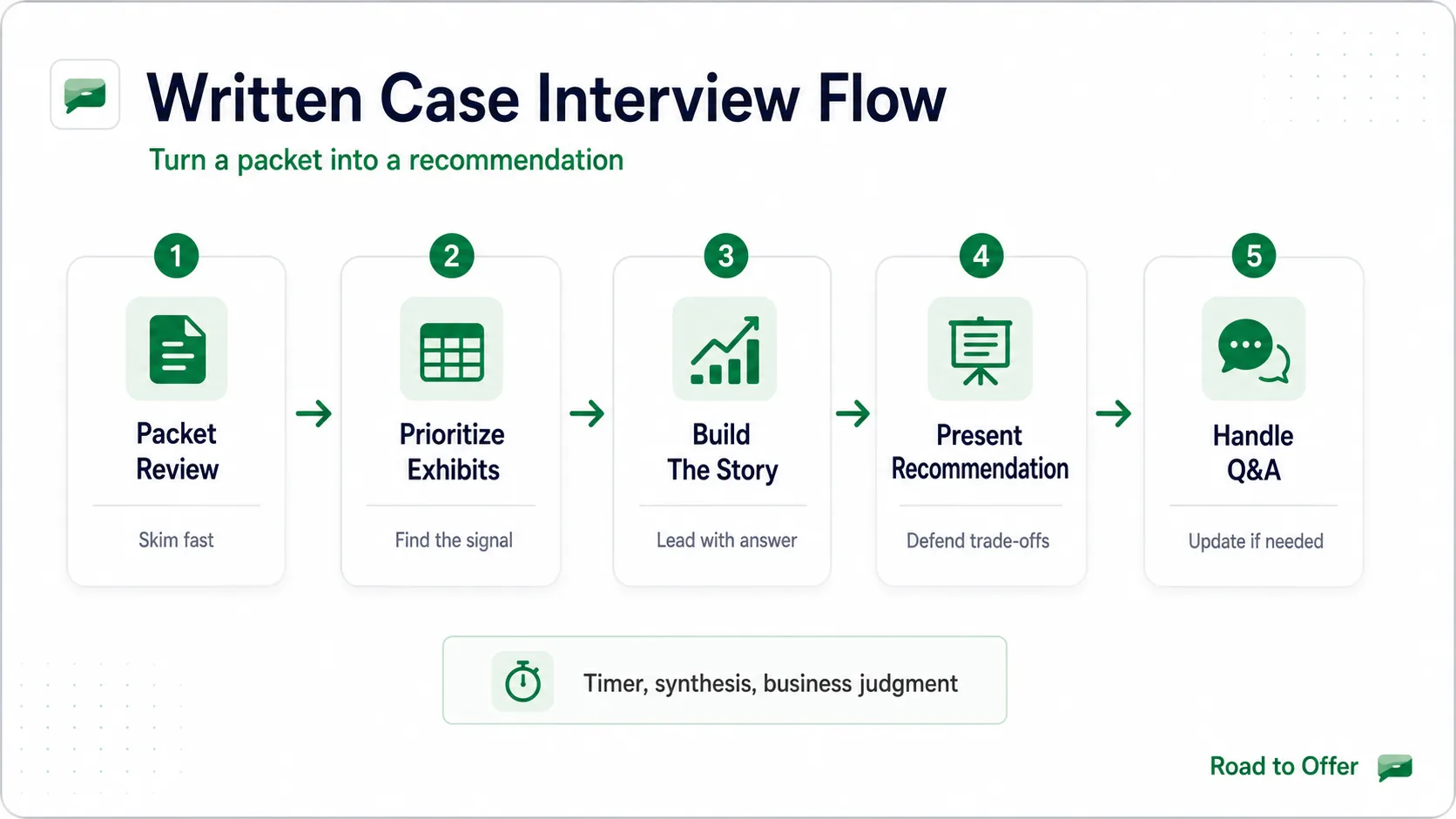
Written case exercise: The written case can appear before or during the process depending on office. You receive a data packet, analyze it under time pressure, then present and defend your findings. Road to Offer's structure drill is a fast way to rehearse turning a packet into a clean opening structure.
First round cases are often more structured, a real business problem with defined parameters. First-round interviewers tend to be Senior Consultants or Managers. The bar is: can you structure a problem cleanly and drive analysis?
Final round cases are open-ended and strategically ambiguous. Partners want to see whether you form a point of view, not just whether you follow a process. A case that starts as "our client is considering entering the Southeast Asian education market" may evolve based on your questions and analysis direction.

Market entry · medium
Practice a first-round-to-final-round market entry case
Energy / Residential Storage
Group case assessment: If your invitation includes one, structure the team's approach and synthesize others' points without dominating airtime. See our group case interview guide.
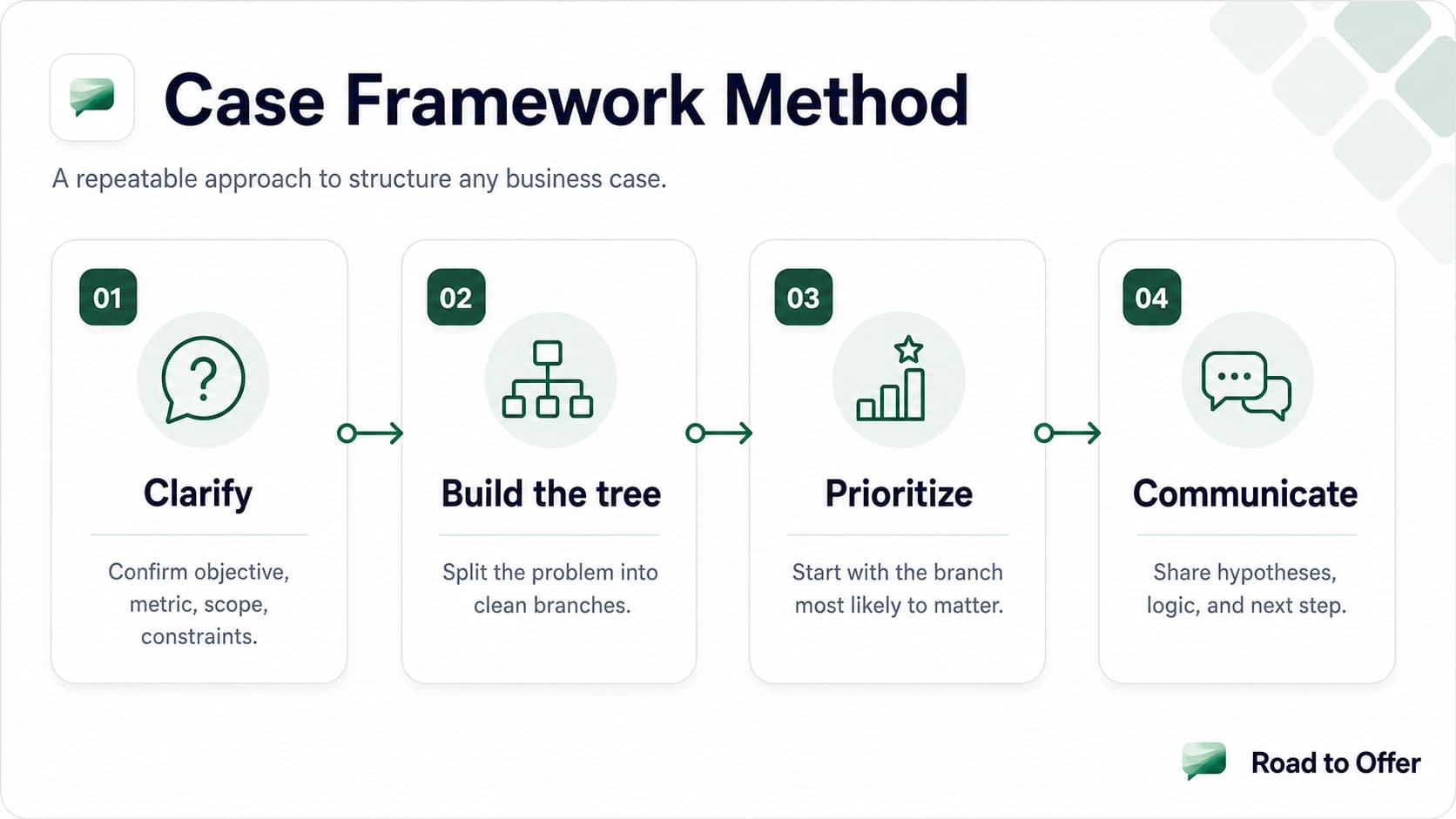
Learn the case method
One dense lesson, each step linked to the drill that trains it.
How should you align your EY-Parthenon resume and cover letter before this interview?
Keep the documents arm-specific and verify the current practice, role, office, and invitation. The resume should show relevant strategic reasoning, while the letter explains why this arm and timing make sense.
- Before: Worked on a market analysis.
- After: Compared two entry segments, tested the demand assumptions, and recommended the priority segment to the project sponsor.
Check that the evidence fits EY-Parthenon rather than a generic EY application and verify the current invitation. Recruiters read the resume and cover letter together: the resume proves the strategic work, while the letter explains why this arm, role, and timing. Rehearse the line as both a written conclusion and a live recommendation.
Make the strategic contribution visible
Drop the resume here for an independent graded report on whether the strategy work reads as strategy work. Road to Offer's score, not an EY-Parthenon one.
By uploading, you agree to resume analysis and report storage until you delete it. See the privacy policy.
Revise one strategic line, rehearse the recommendation, and bring it into the next written or live case rep.
The Candidate-Led Case Structure EY-P Uses
Candidate-led means you own the case from the first moment. When the interviewer finishes presenting the prompt, the floor is yours. No one will ask you "what framework would you use?" and wait for a response. You are expected to ask clarifying questions, structure the problem, and drive.
The four phases of a candidate-led EY-Parthenon case:
1. Clarifying questions (2-3 minutes) Ask 2-3 focused questions that sharpen the problem definition. Don't ask about data you could gather later. Ask about the client's objective (growth? profitability? exit in 3 years?), any known constraints (budget, geographic scope, timeline), and what success looks like.
2. Structure (3-5 minutes) Say "Give me a moment to structure my thinking" and build your framework on paper. Then present it verbally in one clear statement: "I want to look at this across three areas: market attractiveness, competitive position, and financial feasibility. I'll start with market attractiveness because if the market isn't large enough, the other questions don't matter."
3. Analysis (15-20 minutes) Work through your structure with the data the interviewer provides. Do the math out loud, verbalize your reasoning, and call out assumptions explicitly. When you find a key insight, stop and say what it means before moving on.
4. Recommendation (3-5 minutes) Lead with your answer. "I recommend the client [action] for three reasons: [1], [2], [3]. The main risk is [X], which I'd mitigate by [Y]." Don't summarize the analysis. Give the conclusion.
Written Case Component: What to Expect and How to Score High
The EY-Parthenon written case is an independent exercise, typically 60-90 minutes, where you receive a data packet of 15-25 pages: charts, tables, interview excerpts, market data, and a brief client problem statement. You analyze the packet alone and then present your findings and recommendation to a panel of 2-3 interviewers.
This is not the same skill as performing well in a live case. The written case tests:
- Data triage: With 25 pages and 75 minutes, you cannot analyze everything. The skill is deciding what matters.
- Quantitative synthesis: Combining numbers from multiple exhibits to reach a single insight. For example, converting a market size chart + a market share table + a growth rate exhibit into a single revenue opportunity estimate.
- Structured communication: Your presentation needs to follow a logical flow: situation, complication, key findings, recommendation, risks.
- Slide-level thinking: Some candidates are asked to prepare 3-5 slides summarizing their analysis. Each slide should carry one clear message.
How to score high on the written case:
First, skim the full packet before analyzing anything. Spend 5-7 minutes reading every page at a surface level. This gives you a mental map of what data exists before you commit to an analytical direction.
Second, identify the 3-4 most important exhibits. These are usually the ones that directly address the client's core question: profitability drivers, market size, competitive landscape. Circle them and go deep on these first.
Third, build your recommendation before you finalize your supporting analysis. Working backwards from a hypothesis helps you identify which data you actually need vs. which data is noise.
Fourth, practice with real data packets under timed conditions. The written case interview guide and case data packets that bundle several exhibits provide good practice material with the same cognitive demand and similar data structures.
For more on the written case format specifically, use the written case guide linked above.
EY-Parthenon's Industry Focus: PE, Corporate Strategy, and Education
Understanding EY-Parthenon's actual client base matters for case preparation. Cases in your interviews will reflect the firm's practice areas, and preparing case types you'll actually face is more efficient than practicing the full universe of consulting case types.
Private equity: This is EY-Parthenon's core. They advise PE funds on commercial due diligence (CDD), evaluating acquisition targets before purchase, and support portfolio companies on value creation. Expect cases involving: should our client acquire this business? What is the market growth rate? Is the target's competitive position sustainable? What operational improvements could drive EBITDA expansion?
PE-related cases are useful practice for candidates applying to PE-focused roles, but the firm does not publish a universal first-round frequency.
Corporate strategy: Classic strategic questions including market entry, competitive response, growth strategy, and portfolio optimization. These cases are less financially oriented than PE diligence but require the same structured hypothesis-driven approach.
Education: EY-Parthenon has one of the few dedicated education practices among elite strategy firms. If you're targeting the Boston or New York offices, education cases are plausible. These might cover: should a for-profit university enter online degree programs? How should a school district allocate budget across interventions? What is the ROI of tutoring programs?
Retail and consumer: Growth strategy and omnichannel transformation for consumer brands. Cases often involve pricing strategy, channel economics, and customer segmentation.
For a broader breakdown of case types across firms, see case interview examples.
3 Worked EY-Parthenon Case Examples
Three condensed examples follow, one per core archetype. When you are ready to rehearse full cases end to end, the EY-Parthenon practice cases page carries 8 worked due-diligence cases with the complete math.
Example 1: PE Commercial Due Diligence
Prompt: "Our client is a PE fund considering acquiring a regional chain of 45 urgent care clinics for $180M. They've asked us to assess whether this is an attractive investment. How would you approach this?"
Strong opening structure: "I'd look at this across three dimensions: market attractiveness, competitive position of the target, and financial returns. Given the PE context, I'll be working toward a view on whether the deal makes sense at $180M. Let me start with market attractiveness. Can I ask whether the clinics are concentrated in one region or spread across several states?"
Key analysis (with numbers): Assume the interviewer shares: the urgent care market is growing at 7% annually, the 45 clinics generate $4M in average annual revenue each ($180M total), and EBITDA margins are 18%.
- Revenue: 45 × $4M = $180M
- EBITDA: $180M × 18% = $32.4M
- Purchase multiple: $180M ÷ $32.4M = 5.6x EBITDA
"At 5.6x EBITDA in a growing market, the entry multiple looks attractive, and comparable urgent care transactions have traded at 7-10x. The key question becomes: can the PE fund expand margins or accelerate unit growth to drive returns above the fund's 20% IRR hurdle?"
Run the multiple calculation as a live drill from the Road to Offer drill engine. Answer a real prompt and get AI-scored feedback. Free accounts include 3 drills per day for the first 3 days after signup.
Recommendation: "I'd recommend proceeding with further diligence, focused on two questions: what is driving the 18% EBITDA margin (is it sustainable?) and what is the whitespace for new unit growth in the current geographies? If those diligence workstreams confirm the thesis, this looks like a strong platform investment at 5.6x."

M&A · medium
Practice an EY-Parthenon-style commercial due diligence case
Consumer Goods / Beverages
Example 2: Market Entry Strategy
Prompt: "A US-based for-profit education company wants to enter the European K-12 tutoring market. Should they?"
Structure: "I'd evaluate this using a market entry framework across three questions: Is the market attractive? Can our client compete effectively? And does entry make financial sense? The key complication is that European K-12 markets vary enormously by country: regulatory regimes, public vs. private school dynamics, and cultural attitudes toward tutoring differ significantly. I'd want to pick 1-2 priority markets before analyzing the full European opportunity."
Key insight: After reviewing market data, if Germany's tutoring market is €2.3B and growing at 5% annually, but the top 3 players hold 60% market share and local regulations require country-specific teacher certifications, the entry barriers are significant. The recommendation would be to enter via acquisition of a local player rather than organic greenfield.
Example 3: Profitability Case
Prompt: "A national retail chain's operating margins have dropped from 12% to 7% over 3 years. Why, and what should they do?"
Analysis path: Decompose: Revenue flat or declining? Or costs rising faster? If revenue grew 5% but operating income fell, costs are the driver. Decompose costs: COGS, SG&A, occupancy, other. If occupancy costs rose from 8% to 11% of revenue due to lease renewals at higher market rents, that's a 3-point drag. The remaining 2-point gap is likely SG&A.
Recommendation with numbers: "The margin compression is 60% driven by occupancy cost increases and 40% by SG&A growth. On occupancy, the client should renegotiate leases on renewal cycles and consider closing the 15% of locations with below-average unit economics. On SG&A, there's likely corporate overhead that grew without corresponding revenue growth; a benchmarking exercise against comparable retailers would identify the gap. I'd target recovering 3 margin points within 18 months."
Scoring: What EY-P Partners Look For vs MBB Partners
Management Consulted's EY-Parthenon guide identifies a consistent pattern in what distinguishes strong from weak performers in EY-P interviews. Here's how it compares to MBB:
EY-Parthenon partners are often ex-Parthenon Group veterans who built the firm's reputation on analytical independence. They reward candidates who take a genuine position on the case (even if imperfect) over candidates who present a balanced "it depends" conclusion. IGotAnOffer's EY-Parthenon guide notes that candidates who fail to commit to a recommendation by the end of the case fail most often.
For a deeper look at how scoring criteria work across firms, see the case interview scoring rubric guide.
 EY-Parthenon
M&A · medium
Practice a diligence case scored on judgment, not just structure
Healthcare / Digital Health
30-Day EY-Parthenon Prep Plan
Execution checklist
Learn candidate-led case format (not just frameworks). EY-P expects you to drive the case; run one in the free case library before assuming interviewer-led habits will transfer
Practice 4-5 PE due diligence cases. PE cases dominate EY-Parthenon's practice; Road to Offer's guided cases cover commercial diligence, acquisition evaluation, and portfolio strategy
Complete 3 timed written case exercises. The written case tests data triage and synthesis under time pressure; drill it with the structure drill
Read Glassdoor interview reviews for EY-Parthenon. Candidate reports reveal specific case types, question patterns, and interviewer styles by office
Prepare your 'Why EY-Parthenon?' answer with specific references. Interviewers can tell instantly if you haven't researched the firm; reference the strategy focus, PE practice, or a specific industry group
Practice committing to a recommendation under pressure. EY-P partners penalize 'it depends' endings; run a free case and force a recommendation before time runs out
Common EY-Parthenon Interview Mistakes
Misreading the candidate-led format. Many candidates structure a framework, present it, and then wait for the interviewer to ask questions. That's interviewer-led behavior in a candidate-led context. You must drive: say "I want to start by exploring market attractiveness. Can you share any data on market size or growth rates?" and keep moving.
Ignoring PE fundamentals. Candidates who haven't practiced acquisition evaluation cases don't know how to discuss EBITDA multiples, entry vs. exit valuations, or value creation levers. For PE-office roles, this is disqualifying. Review basic PE concepts before your first interview regardless of the role you're applying for, because EY-Parthenon's culture is PE-inflected even in non-PE practices.
Written case data overload. Candidates who try to present every finding from the data packet run out of time and bury the recommendation. Structure your presentation around the 3 most important insights before you walk in.
Weak synthesis. Glassdoor interview data consistently shows candidates get dinged for not connecting their analysis to a clear business recommendation. Knowing facts isn't the goal; knowing what those facts mean for the client is. For more on synthesis technique, use the synthesis guide linked in the prep plan.
Generic behavioral answers. EY-Parthenon is a smaller firm than the Big 4, and cultural fit matters. They want to know you specifically want to work there, not at a generic strategy firm. Reference the firm's PE practice, education vertical, or a specific engagement type you know they do. "I want to do strategy consulting" is not a differentiated answer.
Practice Drills: EY-Parthenon Style
Open a candidate-led case as a live drill from the Road to Offer drill engine. Answer a real prompt and get AI-scored feedback. Free accounts include 3 drills per day for the first 3 days after signup.
Interactive drill set. Write an answer before revealing the worked solution, then continue into Road to Offer for scored practice and AI feedback.
Static EY-Parthenon-style diligence drill guide
These are Road to Offer EY-Parthenon-style adjacent prompts. The answer shape is thesis, economics, evidence, risk, and next diligence question. Use the target office's official materials and invitation for the actual process.
Related Guides
- EY-Parthenon practice cases: 8 worked due-diligence cases to rehearse after this guide
- EY case interview guide: the parent firm's broader consulting process
- EY Launch internship program: EY's early-career pipeline for students targeting a path into Parthenon and consulting
- Written case interview guide: specific tactics for data packet analysis and presentation
- L.E.K. case interview guide: PE diligence peer with similar quantitative demands
- Case interview frameworks complete guide: how to build a structure for any case type
- Case interview synthesis: how to connect analysis to a recommendation
- Behavioral interview consulting: fit question preparation for consulting firm interviews
Sources and Further Reading (checked June 17, 2026)
- EY-Parthenon careers and overview: https://www.ey.com/en_us/services/strategy/parthenon
- IGotAnOffer EY-Parthenon case interview guide: https://igotanoffer.com/blogs/mckinsey-case-interview-blog/ey-parthenon-case-interview
- Hacking the Case Interview, EY-Parthenon guide: https://www.hackingthecaseinterview.com/pages/ey-parthenon-case-interview
- Management Consulted EY-Parthenon case interview: https://managementconsulted.com/ey-parthenon-case-interview/
- Glassdoor EY-Parthenon interview questions: https://www.glassdoor.com/Interview/EY-Parthenon-Interview-Questions-E5248.htm
Frequently asked questions
Resources and related guides
- Run a real case interviewPractice
- Browse all free resourcesResource hub
- EY-Parthenon Consulting: Deal Strategy Careers, Salary, and Interview Guide (2026)Firm Specific · Sep 11, 2026
- L.E.K. (LEK) Case Interview Guide: Format, Written Case & Prep Strategy (2026)Firm Specific · Mar 14, 2026
- AlixPartners Careers 2026: Turnaround Salary and Interview GuideFirm Specific · Sep 11, 2026
- Guidehouse Case Interview 2026: Process, Cases, and ClearanceFirm Specific · Apr 1, 2026