
Mock Consulting Case Interview Prep: Frameworks and Feedback
Use mock consulting case interviews to practice structure, math, exhibits, and recommendations under realistic pressure before MBB rounds.
On this page
Mock consulting case interview preparation works when the session feels like the real interview and produces a clear next drill. This page covers the live mock itself; for the broader practice loop, tools and method, use the case interview practice with AI guide. If you are new to the format, start with what is a case interview and the case interview types guide before running your first mock. McKinsey says problem-solving interviews test how candidates structure ambiguous business problems, work with facts and data, form recommendations, and explain thinking in a fast discussion (McKinsey Careers). BCG emphasizes active listening, structured thinking, clear communication, and showing your thinking (BCG Careers). Your mock should train those behaviors, not just add another case to a tracker.
What to know before you run a mock
- Mirror the real case flow: prompt, questions, structure, analysis, recommendation, and feedback.
- Use firm-specific habits after the basics: McKinsey, BCG, and Bain do not feel identical.
- Score one weakness per mock, then drill it before the next full case.
- Mix peer practice, expert feedback, and AI cases so repetition does not become blind volume.
Run a realistic practice case
Use Road to Offer to practice a full case with AI feedback on structure, math, communication, and synthesis.
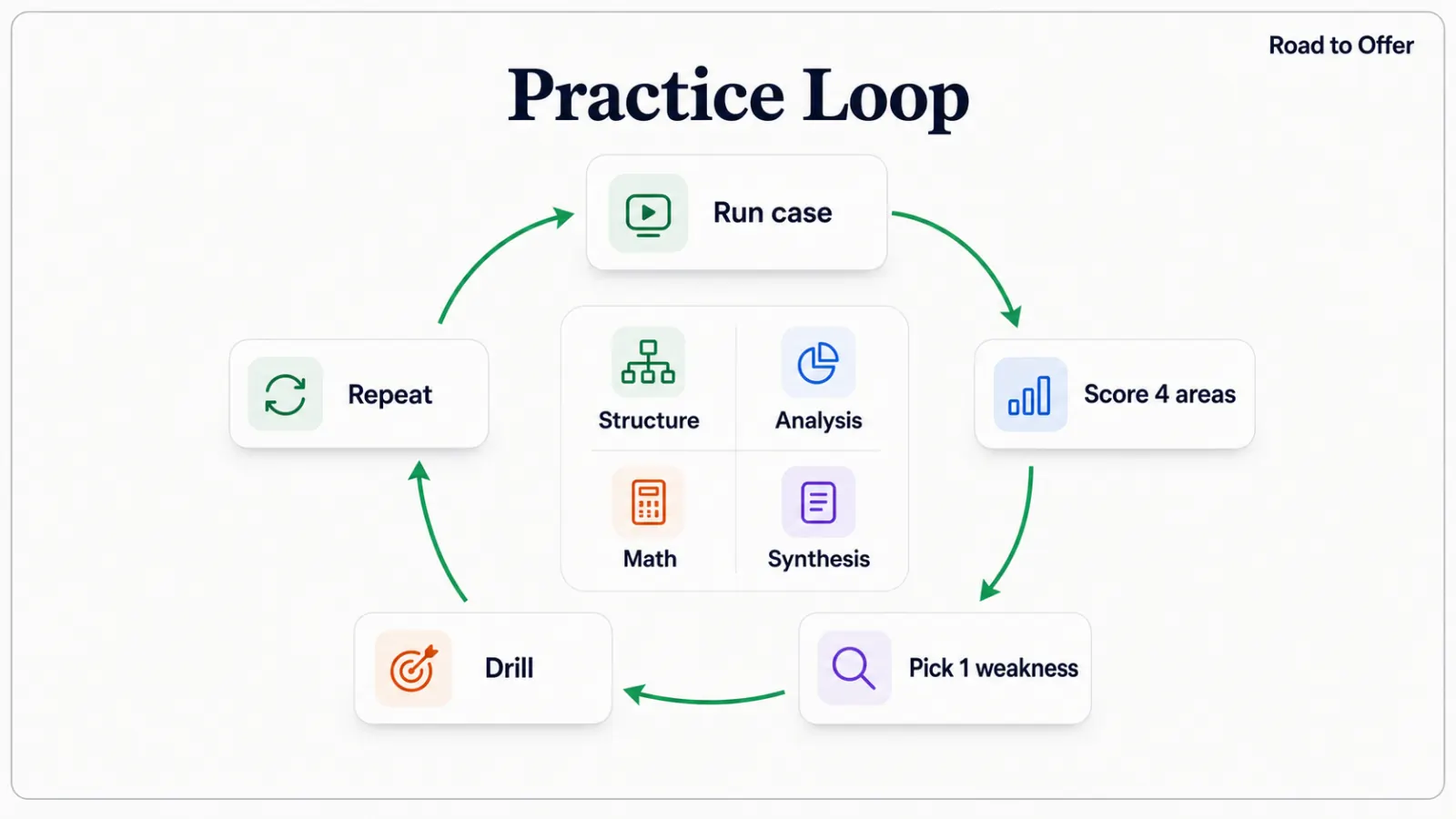
A useful mock creates a specific next drill, not just another completed case.
What should a mock consulting case interview simulate?
A useful mock simulates the pressure and sequence of the real case, not just the topic. A useful mock should be a structured rehearsal with introduction, fit question, case prompt, structuring, analysis, recommendation, and review. That sequence is a solid default because it forces you to manage both the case and the conversation.
The interview flow
Start with a brief fit question, then move into a business prompt. Give yourself quiet time to structure, present the structure, work through exhibits or math, and close with a direct recommendation. If you need a broader prep map, pair this with the case interview prep guide.
The scoring focus
Score the mock on a few concrete dimensions: did the structure answer the question, did the math connect to the decision, did the recommendation include risks, and did the interviewer understand your logic? BCG's public prep page stresses communication and showing your thinking, which means silent analysis does not count as a strong case.
The interviewer role
The mock interviewer should not only read prompts. They should hand over data, push on assumptions, interrupt unclear answers, and ask for a final recommendation before you feel fully ready. That pressure is the point.
The best interviewers also separate coaching from interviewing. During the case, they stay in role and only give prompts or data. After the case, they switch into feedback mode and explain what would have scored well, what was unclear, and which drill should come next.
How should you structure the case during a mock?
Structure should be custom to the prompt. Use frameworks as source material, not as memorized scripts. If the client has declining profit, start with the profitability framework. If the client is entering a new geography, start with the market entry framework. Then edit the buckets so they match the client decision.
Opening structure
Give the interviewer a clean map before you analyze. A good opening tests demand, economics, and execution risk, then starts with the bucket tied most closely to the client decision. That is stronger than listing revenue, cost, market, competition, and risks without a hypothesis.
Analysis rhythm
Keep each step visible. State the calculation, do the math, sanity-check the result, and explain what it means for the decision. If the math is the weak spot, use the mental math case interview guide between mocks instead of hoping full cases fix arithmetic by accident.
Recommendation
End with the answer first. Then give two or three reasons, the biggest risk, and the next test. McKinsey's official interview guidance calls out conclusions and recommendations as part of the problem-solving discussion, so this is not optional polish. It is part of the score.
How do you use feedback after each mock?
Feedback only works if it becomes a drill. Do not leave a mock with a vague note about needing more structure. Translate it into an action: write five opening structures for new prompts, redo the missed calculation, or record three final recommendations until the answer is crisp.
One theme per session
Pick one scoring theme before the mock. Structure day means the interviewer should push on buckets and overlap. Math day means they should force clean arithmetic and exhibit interpretation. Communication day means they should interrupt, clarify, and test whether you stay top-down.
This also keeps feedback usable. If every mock produces 12 comments, you will not know what to fix first. If the session has one theme, the next drill is obvious and progress is easier to measure.
Feedback log
After every mock, write four lines: case type, biggest miss, exact drill, and next session focus. For solo practice, the practice case interviews alone guide explains how to create a feedback loop without waiting for a partner.
If structure was the biggest miss, the drill below is the exact rep: a fresh prompt, a clean opening map, and no memorized script to lean on.
Turn mock feedback into a structure rep from the Road to Offer drill engine. Answer a real prompt and get AI-scored feedback. Free accounts include 5 drills per day for the first 3 days after signup.
What mistakes make mock cases less useful?
The biggest mistake is treating mocks as volume. A candidate who runs many cases with no feedback loop often reinforces the same habit: generic structures, loose math, and long recommendations. Better practice is narrower and more honest. For a structured approach to building a practice routine, see how to practice case interviews, which covers cadence, feedback cycles, and worked case interview examples to anchor your sessions.
Practicing only with friends
Peers are useful, but peer feedback can be too soft. Add at least some sharper review from a coach, former consultant, AI scorer, or experienced candidate. You need someone who will call out vague bucket labels, unsupported assumptions, and weak synthesis.
Memorizing framework scripts
Framework fluency matters, but script memorization creates bad interviews. Use MECE thinking to make buckets clean, then customize. Interviewers notice when the structure could apply to any company in any industry.
Skipping the close
Many candidates stop when the math is done. The case is not done until you give a recommendation. Practice closing even when the answer is imperfect, because real interviews rarely end with perfect data.
How should your final week of mock prep look?
The final week should reduce noise. Do fewer random cases and more realistic simulations. Run full cases in the same format as your target firms, review official firm materials, and keep drilling the one weakness that still appears under pressure.
Firm-specific reps
Use Bain's official interview resources if Bain is your target, McKinsey sample cases for McKinsey, and BCG's case prep quizzes for BCG. The Bain case interview guide and case interview examples can help you choose practice cases that match the office and role.
Final calibration
In the last few sessions, ask your interviewer for harsher feedback on decision quality. Finishing the case is not enough. The better test is whether a client would trust the recommendation after hearing your logic, risks, and next steps.
Sources and Further Reading (checked 2026-05-01)
- McKinsey Careers, interviewing and problem-solving interview guidance: https://www.mckinsey.com/careers/interviewing
- BCG Careers, case interview preparation: https://careers.bcg.com/global/en/case-interview-preparation
- Bain Careers, interviewing process and case resources: https://www.bain.com/careers/hiring-process/interviewing/
Frequently asked questions
Resources and related guides
- Start structure drillsPractice
- Browse all free resourcesResource hub
- 3Cs Framework: Company, Customer, Competitor (Worked Example)Frameworks · Feb 6, 2026
- 4Ps Framework Case Interview: Product, Price, Place, PromotionFrameworks · Feb 6, 2026
- Ansoff Matrix vs BCG Matrix for Case InterviewsFrameworks · Jun 2, 2026
- Hypothesis-Driven Case Interview: How to Lead with a HypothesisFrameworks · Mar 1, 2026