
d-fine Interview: 3 Rounds, Case Study and Quant Questions
The d-fine interview is three conversations on one day, about 2.5 to 3 hours in total, with no assessment center. The middle one is a case study or a technical discussion, depending on your degree. It is not a McKinsey-style strategy case.
For the German version, written for applicants who interview in German, see d-fine Bewerbung: 3 Gespräche, Case Study, Quant-Fragen. Facts come from d-fine's career pages and from candidate reports, checked on 24 November 2026; where d-fine publishes nothing, the page says so.
What is the d-fine interview process?
Five steps: application, document check, meeting, contract offer and start, with usually three interviews on one day, about 2.5 to 3 hours in total. d-fine's application page says there is no standardised assessment center. Consulting and Solutions candidates choose Microsoft Teams or the office, and an optional phone or remote interview can come first, depending on the role. Open a step to see what d-fine looks for and how to practise it.
From application to offer at d-fine
Send CV and documents
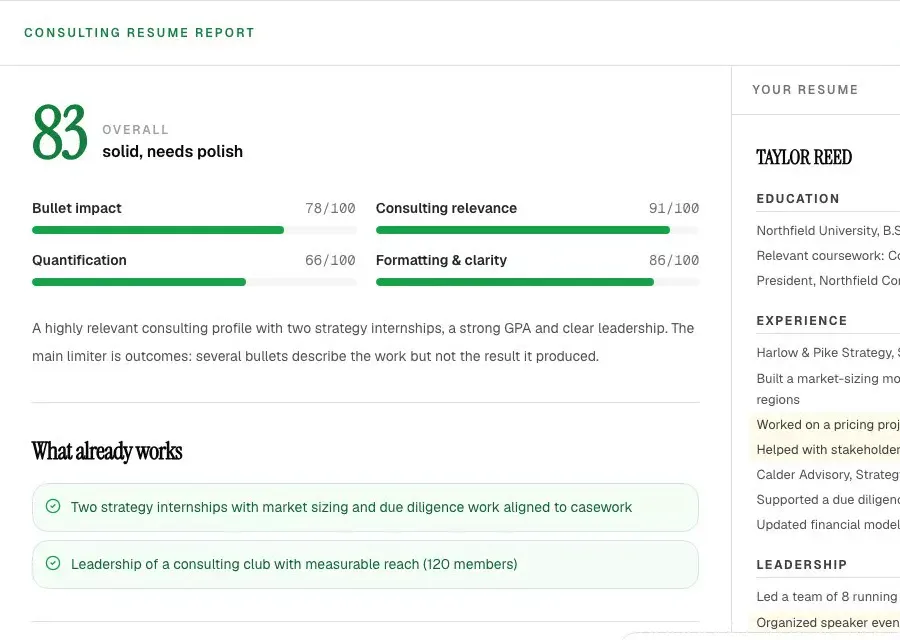
Apply on the job portal. The CV lists IT skills, programming in particular. Grade your CV before you upload it.
Opening resume uploader...
d-fine says it reimburses interview travel costs. For the wider German market, see consulting firms in Germany and the German Bewerbungsprozess in der Unternehmensberatung.
Is the d-fine interview a case interview?
Not in the McKinsey sense: d-fine says the middle interview is a case study or a discussion of technical questions, depending on your qualification. d-fine publishes no practice case, question list or test, so no page, ours included, can give you "the d-fine cases". The Swiss page adds that the technical talk stresses finance topics.
Welcome talk
first of three
- CV, motivation and your questions
- Same day as the others
Technical talk
case study or technical questions
- Depends on your qualification
- Depends on your degree and CV
Switzerland: finance topics in particular
Closing talk
contract and career
- Terms and development options
- Ask in the invitation who joins
Interns
one talk, about an hour
- Path, expectations, questions
- Possibly a case study or technical talk
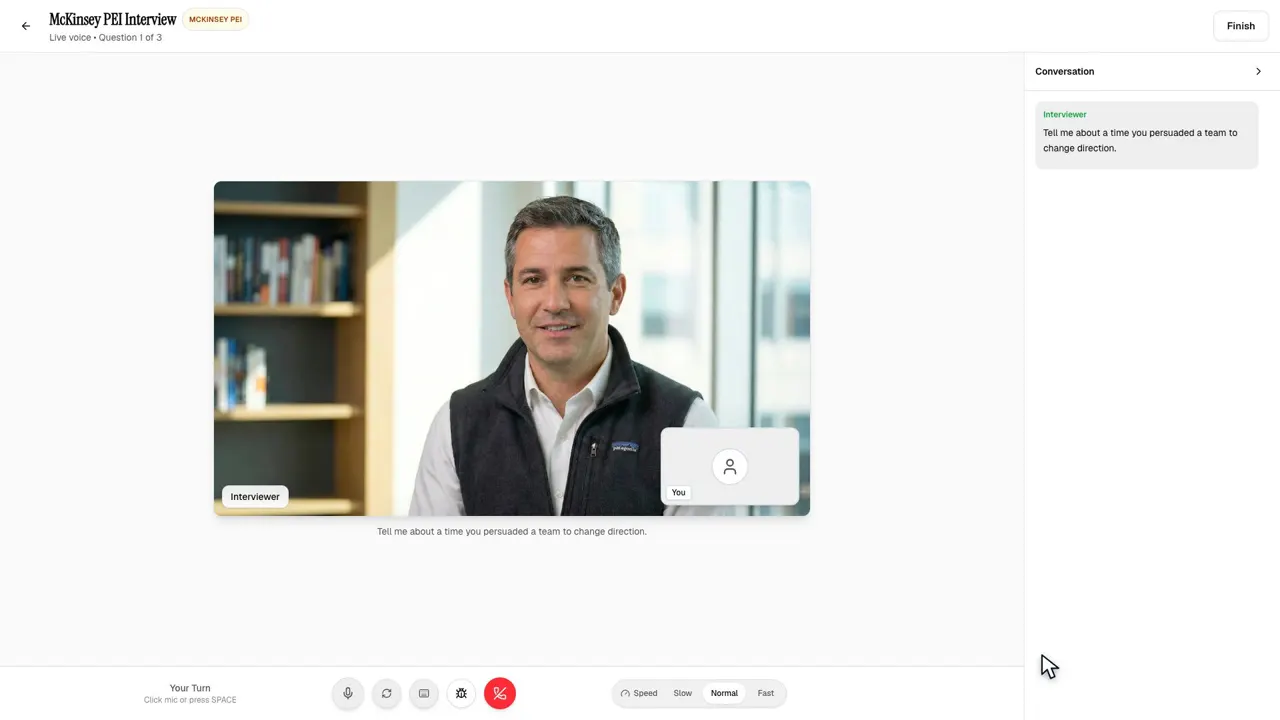
What does transfer is the way you speak: state assumptions, structure out loud and compute carefully. To train that, run a numeric energy case with an AI interviewer. It is our own case, not a d-fine case, and it runs in English:
Start a free case interview for d-fine
Don't know how to case yet? Learn how to case
New to case interviews? Start with the method.
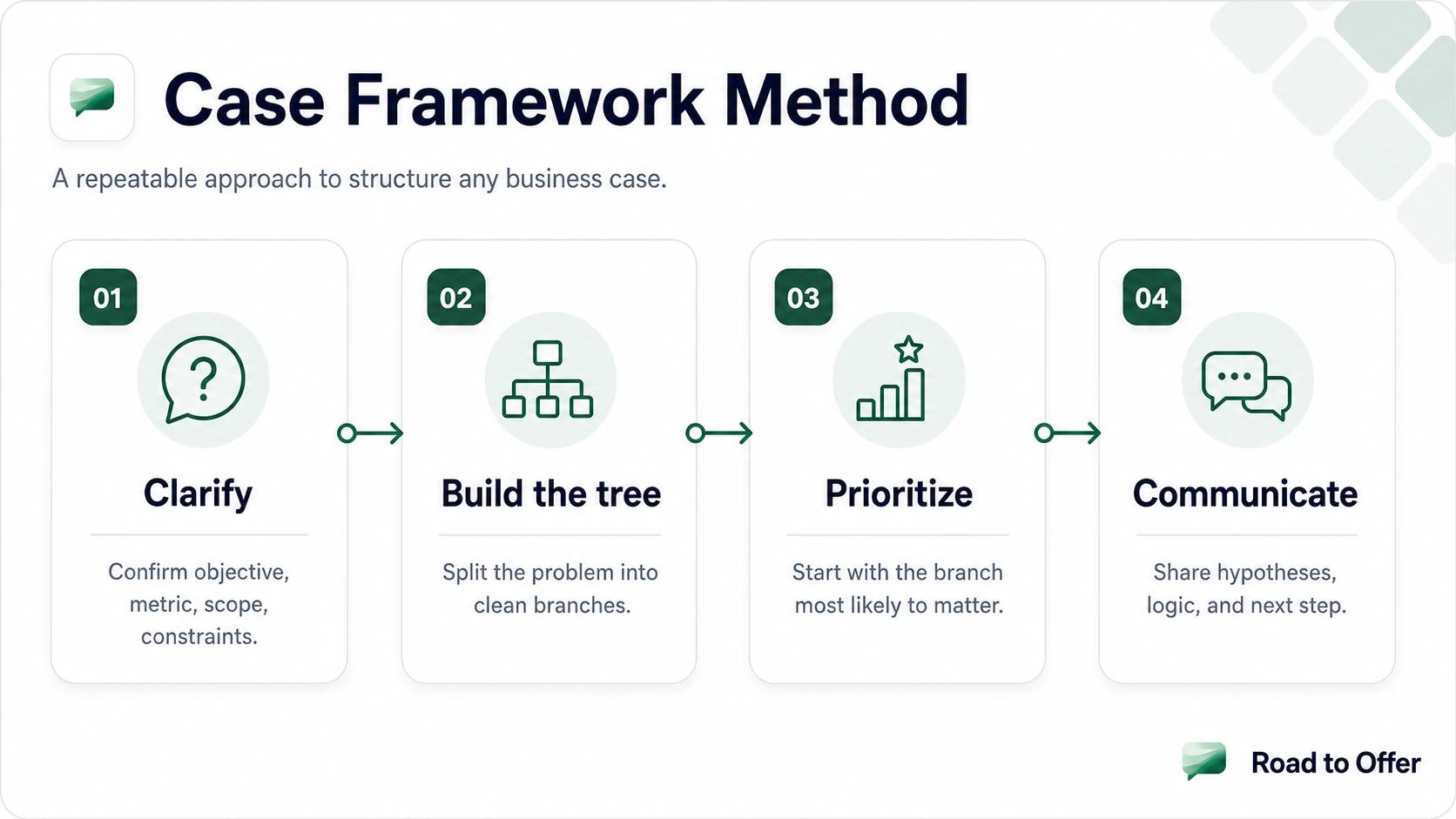
Learn the case method
One dense lesson, each step linked to the drill that trains it.
What do the three d-fine interviews cover?
A welcome talk on your path and motivation, a technical talk, and a closing talk on contract and career. The names come from d-fine's page; d-fine publishes no more detail than that.
- Welcome talk: your path, your motivation and your questions about d-fine.
- Technical talk: a case study or technical questions, depending on your qualification. d-fine publishes no examples, so we quote none.
- Closing talk: d-fine says it covers contract terms plus career and development options.
Applicants on kununu rate the process fast and fair, and one asks for more precise information about what to expect in the talks. That gap is why this page separates what d-fine publishes from what we cannot confirm. One employee post says no business knowledge is expected, that structure and quick adaptation are what is tested, and that you should never put anything on your CV you do not fully master.
Which d-fine interview questions can come up?
d-fine publishes no question list, so we cannot give you one: expect technical questions that follow your degree and the skills on your CV. The Swiss page says the technical talk stresses finance topics. We will not invent sample questions.
What the one employee post suggests is the approach. Say your assumptions, structure the problem, and show a logical, reproducible path. Do not put anything on your CV that you cannot defend. For the numeric side of a problem, practise the arithmetic aloud with the drill below.
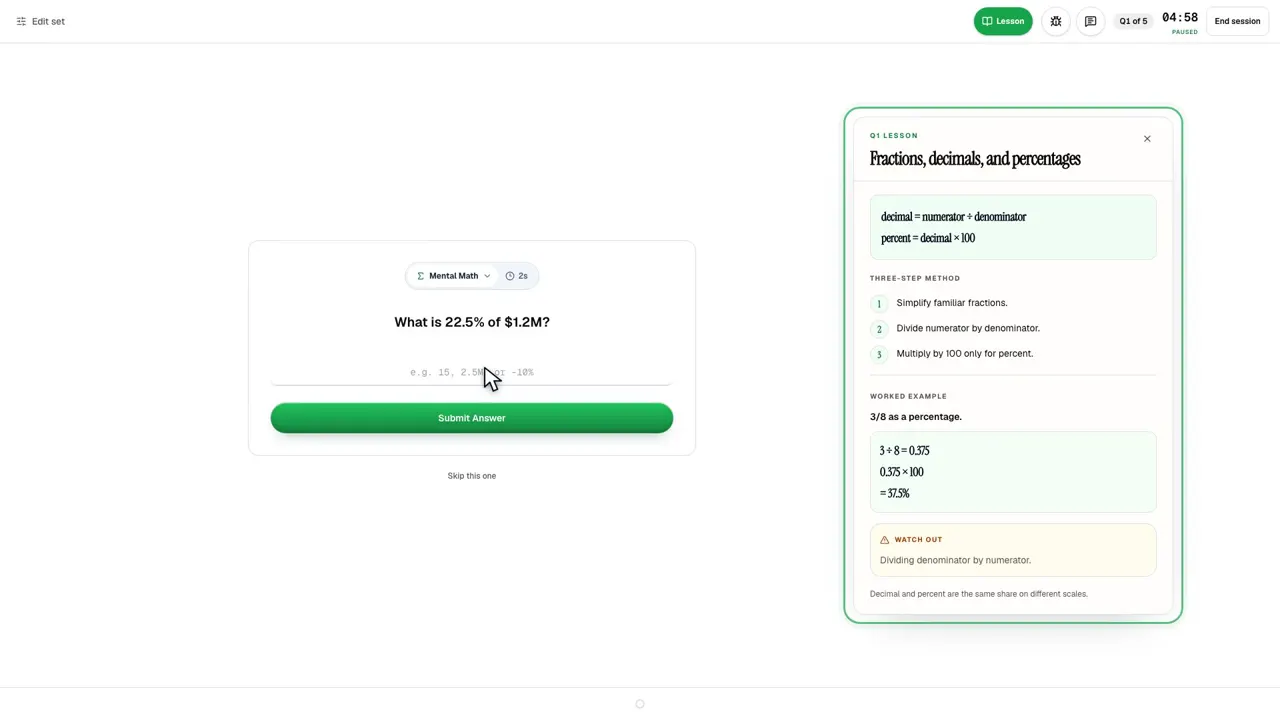
Mental math shortcut Quick Math
- Revenue is $90M and cost is 70% of revenue. What is profit, in dollars?
Build the percentage off the 10% anchor, then Profit = Revenue - Cost.
- A market grows 9% a year. Using the Rule of 72, how many years does it take to double?
Years to double = 72 / growth rate. It runs backwards too: divide 72 by the years a market took to double to recover its rate.
- Segment A is 75% of revenue at a 16% margin. Segment B is 25% of revenue at a 40% margin. What is the blended margin, in percent?
Blended margin = (Weight A x Margin A) + (Weight B x Margin B). Never average the two percentages: revenue mix moves this number.
For data questions, the data interpretation guide and the data science case guide are the closest we have.
How do you prepare for the d-fine interview?
Three steps: re-read your CV claims, practise structured numeracy out loud, and do two or three business cases for the case-study half. Be clear about what our library covers: it has no d-fine case, no risk or derivatives case and no stochastics drill. Use your own course material for pricing models and probability.
- CV first. Revise every course, thesis topic and programming language you list.
- Numeracy. Use the case math trainer and the mental math guide, then size a market with market sizing, step by step.
- Business cases. d-fine's sectors include energy and industrials, healthcare, technology and banking, so pick cases there. The energy case guide, the insurance case guide and the fintech case guide give the vocabulary.
| Case (style, industry) | Quant difficulty | Qualitative difficulty | The math you run | Median time |
|---|---|---|---|---|
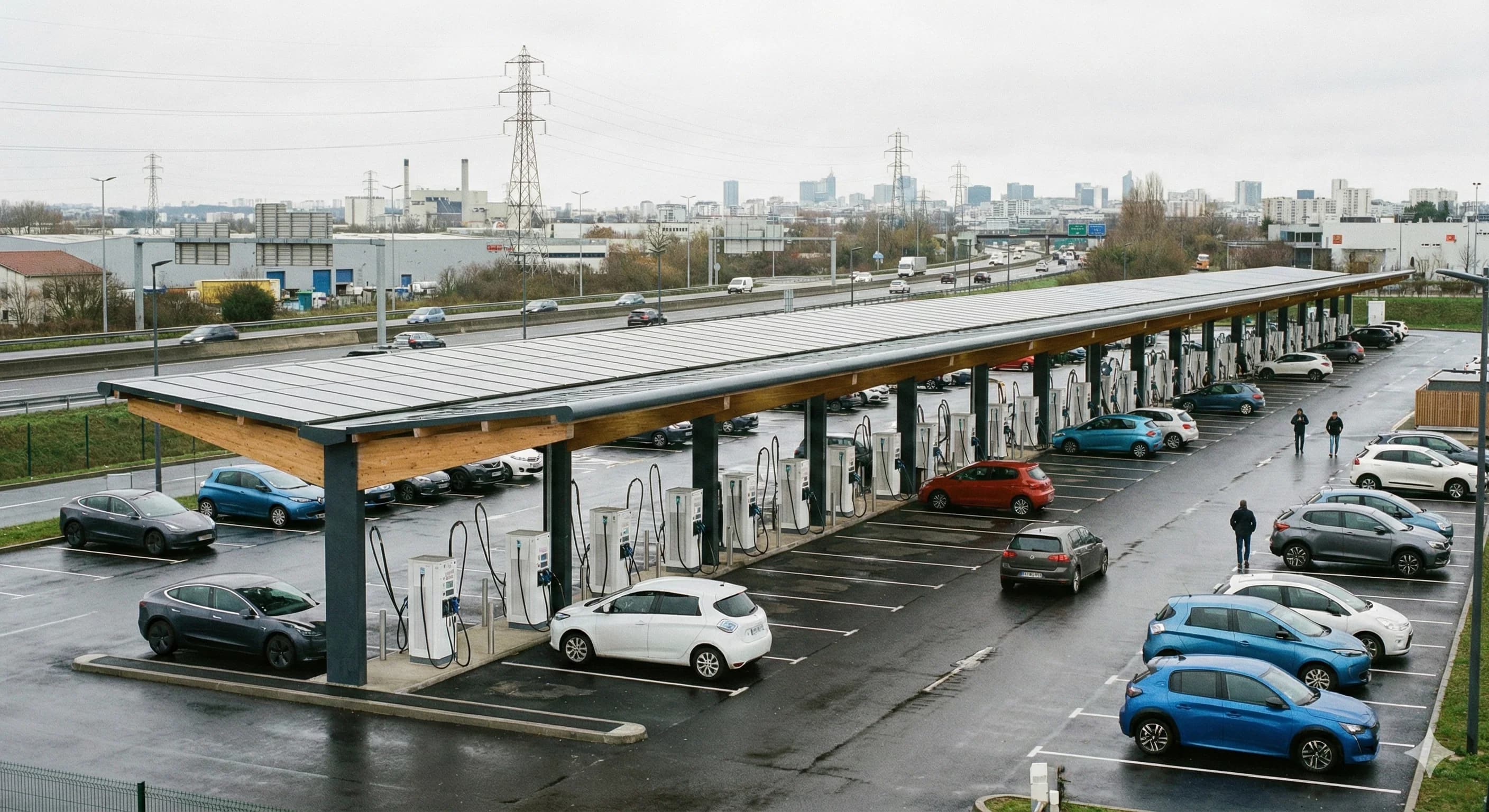
Voltigo FastCharge Turnaround (McKinsey, EV charging). 7 (3 with math), 3 exhibits. | medium | medium | Loss split, hub energy margin, profit | 23 min, 13 voice runs |
Solara Home Energy Texas Battery Market Entry (Bain, home energy storage). 8 (3 with math), 4 exhibits. | easy | medium | Install contribution, year-one profit | 32 min, 11 voice runs |
HarborHealth Acquisition of MedLink Virtual Care (BCG, digital health). 8 (2 with math), 4 exhibits. | medium | hard | EV/EBITDA multiple, maximum justified offer | 27 min, 28 voice runs |
Cloud Computing Capacity Expansion (BCG, cloud infrastructure). 9 (4 with math), 3 exhibits. | hard | hard | Price read, profit uplift, payback, payoffs | 30 min, 13 voice runs |
Bank Loan Operations (Independent, financial services). 7 (2 with math), 2 exhibits. | medium | medium | Issued loans, contribution, profit by system | Fewer than 10 runs |


Questions, exhibits and run counts come from the Road to Offer case library. Bank Loan Operations is adapted from a university casebook; none of these is d-fine material. All run in English. Between two full cases:
- Mental math: the case math trainer, because a quant interviewer checks every number.
- Structure: the structure drill, to set up an open problem in two minutes.
- Charts: the chart drill.
- Fit questions: the fit interview simulator, in English.
- CV: the resume grader, before you upload.
What does d-fine require to apply?
For Germany: a German cover letter, a CV that lists IT skills (programming in particular), your school certificate, degree transcripts with grades and any work or internship references. Foreign certificates need a German or English translation, which you can make yourself. The Italian and Nordic pages ask for cover letter and CV in English. Apply through the job portal of the country you want.
For the German CV format see the consulting Lebenslauf guide (in German) and the case interview language guide (in German).
d-fine internship and working student: what to know
d-fine's German internship lasts 8 to 12 weeks at 40 hours a week, and you need a finished bachelor and a planned master in a quantitative field. The listed fields are physics, maths, computer science, natural science, engineering and economics with a quantitative, analytical or technology focus, with very good grades. You must live in Germany during the internship.
- Interview: usually one talk of about an hour, possibly with a case study or a technical discussion.
- Working student: up to 20 hours a week, up to 40 in semester breaks, mostly remote, with enrolment required.
- Intake dates: not found. d-fine says you can apply spontaneously at any time.
- Alumni: the alumni programme usually shortens the application for a later direct entry.
d-fine publishes no starting salary and says only "attractive". For pay at other firms, see the consulting salary guide.
Which d-fine working model fits: Blue, Orange or Yellow?
Blue means travel across Germany and Europe, Orange means regional work with evenings at home, and Yellow means a fixed team, mostly remote. d-fine says you do not need to choose a model before you apply, and you can state a preference.
How does d-fine compare with MBB for your prep?
d-fine hires mostly quant degrees and interviews on technical depth, while MBB rounds are built around repeated cases. There is no up or out at d-fine, per its FAQ. An MBB-style case drill transfers the structure and the spoken arithmetic; it does not transfer stochastics, modelling or code questions. To see the contrast, read consulting vs finance careers and, for German firms generally, consulting firms in Germany.
Three ways to practice for d-fine
- Start a free case
Run a full case. 92 cases in voice or guided text, scored on seven dimensions.
- Try a free drill
Drill one skill. 550+ drills across 6 skill types.
- Find your test
Practice your firm's test. Solve, Casey, CCA, SOVA and TestGorilla, each free to try.



Frequently asked questions
Let your favorite AI make the case
Ask ChatGPT, Claude, or Perplexity whether Road to Offer is worth it. We're confident you'll like the answer.
No affiliation with ChatGPT, Claude, or Perplexity
Resources and related guides
- Practice for d-fine in a real case interviewPractice
- Browse all free resourcesResource hub
- d-fine Bewerbung: 3 Gespräche, Case Study, Quant-FragenFirm Specific · Nov 24, 2026
- BearingPoint Interview: Process, Online Test, CaseFirm Specific · Nov 24, 2026
- Accenture Internship 2027: Salary, Deadlines, Summer AnalystFirm Specific · May 22, 2026