
Mental Math for Case Interviews: Speed Drills, Tricks, and Mistakes
Get faster and more accurate at case interview math. Rounding, shortcuts, and drills for percentages, multiplication, and sanity checks, without a calculator.
On this page
Mental math for case interviews means getting to a clean answer in 5-10 seconds per step without a calculator, while keeping the interviewer inside your logic. Start with one timed rep, then use the shortcuts below to fix the exact move that slowed you down: percentages, break-even, CAGR, price-volume math, or units.
Start with one scored math rep
Static examples help with technique. The interview skill is entering an answer under a timer, showing the formula, carrying units, and getting feedback on whether the number changes the recommendation.
case math from the Road to Offer drill engine. Answer a real prompt and get AI-scored feedback. Free accounts include 5 drills per day for the first 3 days after signup.
Speed Targets by Calculation Type
Consulting cases are full of numbers: market sizes, margins, growth rates, break-even. Interviewers expect you to compute quickly and clearly without a calculator. McKinsey's career page confirms that calculators are not permitted and candidates should write out calculations on paper. BCG's interview preparation guide states that candidates should be able to "use numbers to swiftly form opinions and guide decisions." They care more about your logic and structure than the last digit, so round boldly and state your assumptions. According to RocketBlocks, candidates who structure their math out loud score significantly higher on quantitative assessments, even when they round aggressively, because the interviewer can follow (and correct) their reasoning. The same timed arithmetic carries directly to the numerical reasoning tests many firms use as an online screen before live cases.
If you consistently exceed these targets, focus your drill time on the specific category where you are slowest.
Learn the case math method
Setup, units, and shortcut math, linked to timed scored reps.
The Mental Math Loop
Use the same five moves on every quant prompt: round inputs to friendly numbers, write the formula and units, calculate one line at a time, sanity-check the order of magnitude, then state the business implication. If one move breaks, drill that move directly before doing more full cases.
Round First
- Use round numbers: 300M instead of 327M, 10% instead of 9.7%.
- Round inputs so the math is easy; you can refine once if the interviewer asks.
- Example: 18% of 250 → 20% of 250 = 50; say "about 45" if you want to be closer, or stick with 50 for speed.
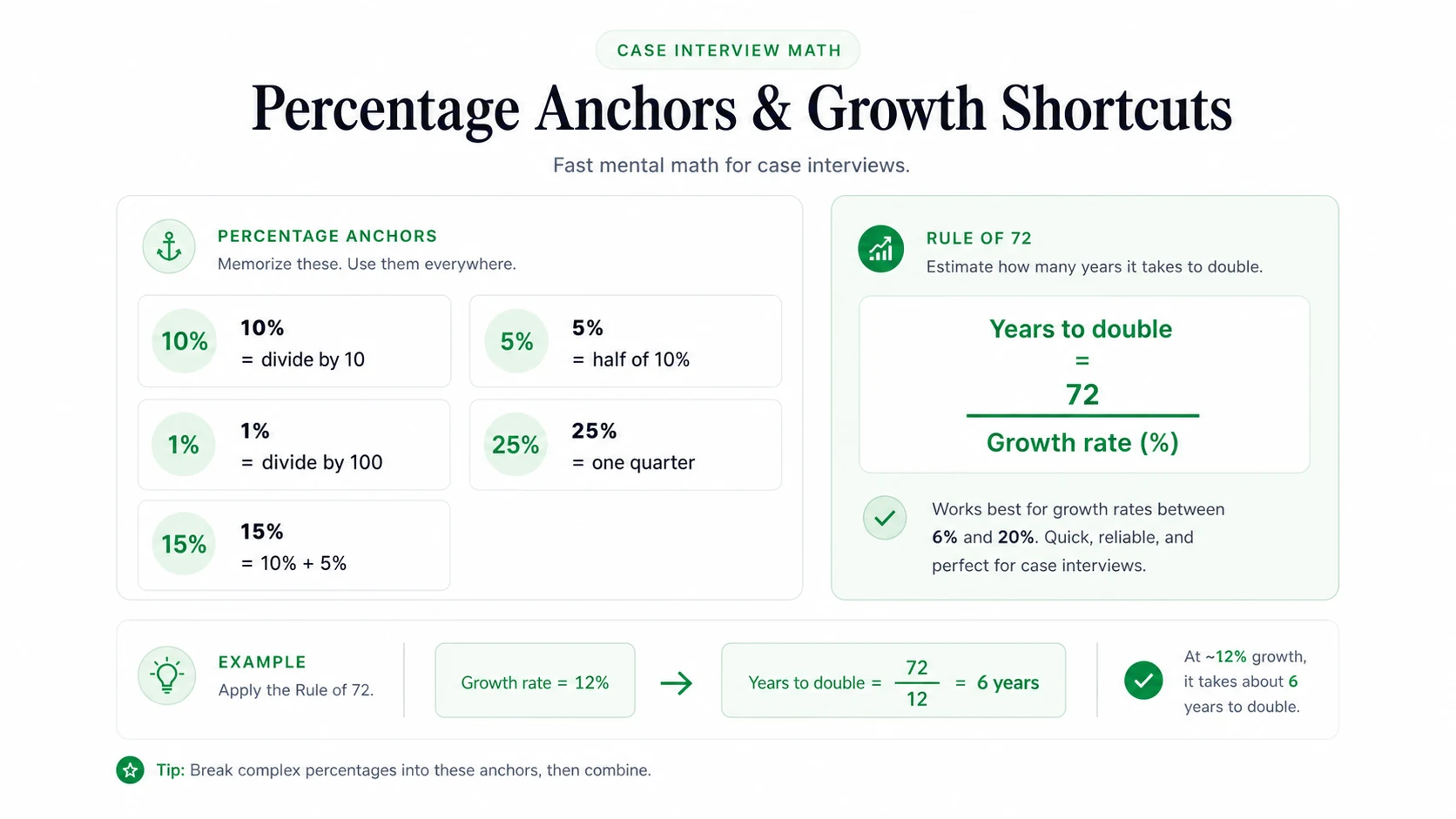
Use Percentage Anchors
- 10% = divide by 10. So 10% of 80M = 8M.
- 1% = divide by 100. So 1% of 80M = 0.8M = 800K.
- 5% = half of 10%. So 5% of 80M = 4M.
- 25% = quarter. So 25% of 80M = 20M.
From there you can build: 15% = 10% + 5%, 3% = 3 × 1%, etc.
Break Multiplication Into Steps
- 25 × 12 = 25 × 10 + 25 × 2 = 250 + 50 = 300.
- 17 × 6 = 17 × 5 + 17 = 85 + 17 = 102.
- 1.2 × 50 = 12 × 5 = 60.
Division Shortcuts
Division comes up constantly in per-unit and per-capita calculations. A few patterns save time:
- Dividing by 7: Know that 1/7 ≈ 0.143. So $700K / 7 departments = $100K each. For less clean numbers, round: $500K / 7 ≈ $71K (since 7 × 70 = 490).
- Dividing by 8: 1/8 = 0.125. So $800M / 8 business units = $100M each. For quick estimation, halve three times: $800M → $400M → $200M → $100M.
- Dividing by 9: Use this shortcut: divide by 10, then add roughly 11% back. Example: $450M / 9 → $450M / 10 = $45M, then $45M × 1.11 ≈ $50M. Check: 9 × 50 = 450. Exact.
CAGR / Compound Growth Approximation (Rule of 72)
When a case involves compound growth, you need a fast way to estimate doubling time. The Rule of 72: divide 72 by the annual growth rate to get the approximate number of years to double.
- At 8% growth, doubling takes ~72 / 8 = 9 years.
- At 12% growth, doubling takes ~72 / 12 = 6 years.
- At 6% growth, doubling takes ~72 / 6 = 12 years.
This works in reverse too. If a market doubled in 10 years, the implied CAGR is roughly 72 / 10 = ~7.2%. You will see this pattern in growth strategy cases where the interviewer asks whether a growth target is realistic.
Break-Even Math
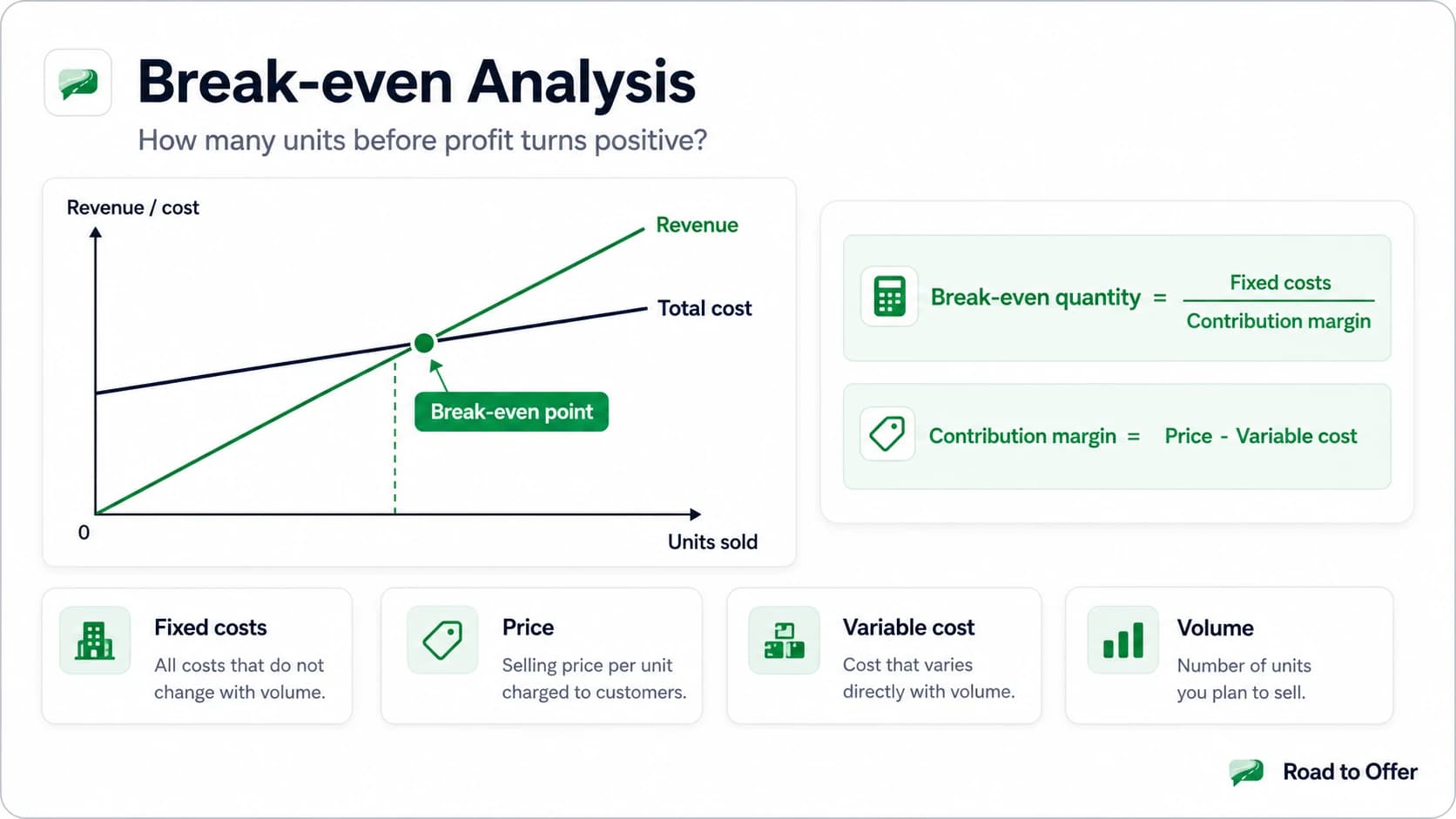
Break-even shows up in pricing, new product, and investment cases. The formula:
Price × Volume = Fixed Costs + Variable Cost × Volume
Rearranged: Volume = Fixed Costs / (Price − Variable Cost)
Example: A coffee shop has $200K/year in fixed costs (rent, salaries). Each cup sells for $5 with $2 in variable costs (beans, cup, milk). Break-even volume = $200K / ($5 − $2) = $200K / $3 ≈ 66,700 cups/year, or roughly 183 cups/day. That is achievable for a busy urban location. Sanity-check passes.
Weighted Averages
Segment mix calculations appear in nearly every profitability framework case. The pattern:
Blended metric = (Weight_A × Metric_A) + (Weight_B × Metric_B)
Example: Segment A represents 60% of revenue with 20% margins. Segment B represents 40% of revenue with 35% margins. Blended margin = (0.6 × 20%) + (0.4 × 35%) = 12% + 14% = 26%.
This matters because if the company shifts mix toward Segment B (the higher-margin segment), blended margins improve without any operational change. Interviewers test whether you spot that.
Back-of-Envelope Division
Large-number division is common in per-capita and market-share calculations. The technique: round both numerator and denominator to numbers that divide cleanly, then adjust.
Example: US GDP is roughly $28 trillion. Population is ~330M. What is GDP per capita?
- Round: $28T / 330M. Simplify: $28,000B / 330M = $28,000,000M / 330M.
- Think of it as $28,000 / 330 (thousands cancel). Round 330 to 333 (which is 1/3 of 1,000). So $28,000 / 333 ≈ $28,000 × 3 / 1,000 = $84,000 / 1,000 = ~$84K per person.
- Actual figure is roughly $85K. Close enough for a case.
Another example: $80B market / 330M people ≈ $80,000M / 330M ≈ $242/person. Round 330 to 300 for speed: $80,000 / 300 ≈ $267/person (actual ~$242, so you are within 10%, which is fine for a case).
Sanity-Check
- Zeros: Are you in millions (6 zeros) or billions (9 zeros)? Double-check.
- Magnitude: Does the result make sense for the market or segment?
- Units: Revenue in $, volume in units, don't add them.
Interpret: State the Business Implication
After sanity-checking, take one more step: translate the number into what it means for the business. This is where you separate yourself from candidates who are "human calculators" and show actual business judgment.
Shortcuts only count when they are automatic, so run three of them under a timer before the worked examples.
Quick Math
- Revenue is $90M and cost is 70% of revenue. What is profit, in dollars?
Build the percentage off the 10% anchor, then Profit = Revenue - Cost.
- A market grows 9% a year. Using the Rule of 72, how many years does it take to double?
Years to double = 72 / growth rate. It runs backwards too: divide 72 by the years a market took to double to recover its rate.
- Segment A is 75% of revenue at a 16% margin. Segment B is 25% of revenue at a 40% margin. What is the blended margin, in percent?
Blended margin = (Weight A x Margin A) + (Weight B x Margin B). Never average the two percentages: revenue mix moves this number.
Worked Example: Quick Percentage Chain
Question: "Revenue is $80M. Cost is 60% of revenue. What's profit in $M?"
- Revenue = $80M.
- Cost = 60% of 80M = 6 × 8M = $48M (using 10% = 8M, so 60% = 6 × 8M).
- Profit = 80 − 48 = $32M.
Sanity-check: Profit is 40% of revenue (32/80). That's plausible for a business with 60% cost share.
Want more reps like this? Use the case interview math practice guide for worked solutions, or jump into Quick Math when you want answer entry and feedback.
Multi-Step Worked Examples
Real cases rarely involve a single calculation. Here are three examples that chain multiple operations, exactly what you will face in a live case interview.
Example 1: Revenue Decline Decomposition
Question: "Revenue declined 15%. Price went up 5%. What happened to volume?"
- Revenue = Price × Volume. If revenue is now 0.85× the original and price is 1.05× the original, then:
- Volume = Revenue / Price = 0.85 / 1.05.
- Shortcut: 0.85 / 1.05, round 1.05 to 1, answer ≈ 0.85. But you need more precision. Use: 85 / 105. Simplify: divide both by 5 → 17 / 21 ≈ 0.81.
- Volume dropped roughly 19%.
- Interpret: A 5% price increase drove away nearly a fifth of the customer base. That is a strong signal that the product may be price-elastic, and you should investigate which customer segments churned.
This is the same revenue bridge you will use in profitability cases and pricing strategy cases. If the division slowed you down, run Quick Math before reading the next example.
Example 2: Operating Margin Calculation
Question: "A company has $500M revenue, 30% gross margin, $100M in SG&A. What's the operating margin?"
- Gross profit = 30% × $500M = $150M.
- Operating profit = Gross profit − SG&A = $150M − $100M = $50M.
- Operating margin = $50M / $500M = 10%.
- Sanity-check: 10% operating margin is typical for a mid-size industrial or consumer company. Plausible.
- Interpret: SG&A is eating two-thirds of gross profit ($100M of $150M). If the client wants to improve operating margin, SG&A efficiency is the first lever to test. Even a 10% SG&A reduction ($10M) would lift operating margin from 10% to 12%.
For the formulas behind this, use the case interview formulas and consulting math formulas references. Then practice the arithmetic in Quick Math.
Example 3: Price Cut Volume Offset
Question: "If you cut price by 3%, what volume increase do you need to maintain revenue?"
- New price = 0.97 × original price.
- You need: New Price × New Volume = Old Revenue. So New Volume = 1 / 0.97.
- 1 / 0.97 ≈ 1.031 (since 0.97 × 1.031 ≈ 1.0).
- You need roughly a 3.1% volume increase to offset a 3% price cut.
- Interpret: That 3.1% is the minimum, it just keeps revenue flat. If the client also wants to grow revenue, the required volume increase is even higher. And the key question is whether the market has that much latent demand at the lower price point.
This shortcut matters in pricing and growth cases. Pair it with the pricing strategy cases guide, then do one Quick Math rep so you can see whether your setup and units are clean enough under time pressure.
Common Mistakes
- Losing zeros: Writing 30 when you mean 30M. Always note "M" or "B" and say it out loud.
- Mixing units: Adding revenue ($) and volume (units). Keep units in every line.
- Rushing: Doing too much in your head and losing the thread. Use paper and one step at a time.
- No sanity-check: Finishing without asking "Does this number make sense?"
- Stopping at the number: Giving the interviewer "10%" without saying what 10% means for the business. Always add the interpret step.
For more on structuring numerical cases, see market sizing step-by-step and guesstimate and estimation questions. Management Consulted's case math guide recommends targeting 5-10 seconds per calculation step, and Hacking the Case Interview outlines 10 specific mental math strategies, including the compensation method and proportional scaling, that are worth drilling before your first mock interview. To apply math inside full business logic, pair this with profitability framework, pricing strategy cases, case interview examples, consulting brain teasers, and best case interview prep tools for 2026.
Percentage Shortcuts
The fastest way to handle percentages under pressure is to break them into round components: 15% = 10% + 5%, 20% = 10% + 10%, 25% = quarter, 33% = one third, 50% = half, 66% = two thirds.
Five Fast Warm-Up Prompts
Use these as 60-second checks, not as a substitute for scored practice. Say the formula, answer, units, and implication out loud.
Start a free Quick Math rep
Enter your answer, show the formula and units, and get feedback on whether your math would hold up in an interview.
Related Practice
Build speed with targeted drills, then apply it in full case simulations:
- Case interview math practice: 30 interactive drills with worked solutions across percentages, break-even, CAGR, and market sizing
- Quick Math: timed reps with answer entry and feedback on setup, units, and business implication
- Case interview math mental shortcuts: a deeper shortcut library for rounding, percentage anchors, and estimation
- Market sizing step-by-step: the case type where mental math speed matters most
- Profitability framework: margin bridges and cost decompositions that require fast, accurate arithmetic
- How to practice case interviews: structure your math drills into effective daily sessions
- Best case interview prep tools 2026: tools with built-in math drill features
Sources and Further Reading (checked June 17, 2026)
- McKinsey case interview preparation (calculator policy and paper math): https://www.mckinsey.com/careers/interviewing
- BCG case interview preparation (quantitative skills expectations): https://careers.bcg.com/global/en/case-interview-preparation
- Bain case interview prep: https://www.bain.com/careers/interview-prep/
- RocketBlocks consulting drills: https://www.rocketblocks.me/consulting.php
- CaseInterview.com math and quant resources: https://www.caseinterview.com/
- Management Consulted case math guide (10-second calculation standard): https://managementconsulted.com/case-interview-math/
- Management Consulted fast math drills: https://managementconsulted.com/fast-math/
- Hacking the Case Interview, mental math strategies: https://www.hackingthecaseinterview.com/pages/case-interview-mental-math
- US Census Bureau, 2024 population estimates (340.1 million): https://www.census.gov/library/stories/2024/12/population-estimates.html
- World Bank Open Data (mobile and demographic indicators): https://data.worldbank.org/
- GMAT Club mental math techniques: https://gmatclub.com/
Frequently asked questions
Resources and related guides
- Start free consulting drillsPractice
- Browse all free resourcesResource hub
- Best Free AI for Case Interview Math Practice (2026)Math And Quant · May 8, 2026
- Case Interview Math: Mental Shortcuts to Calculate FasterMath And Quant · Mar 1, 2026
- Case Interview Math Practice: 12 Graded Mental Math DrillsMath And Quant · Feb 6, 2026