
5 Consulting Cover Letter Examples + Format and Free Review (2026)
One worked letter per background, and the swap test that kills a generic paragraph two.
Free consulting resume review
Check the resume behind your MBB cover letter
Your letter frames the story; your resume has to prove it. Get the score, evidence-based strengths, and priority fixes.
Opening resume uploader...
On this page
A consulting cover letter in 2026 is a one-page argument for why consulting, why this firm, and why your evidence fits, and the data says the tailoring is what pays. In a ResumeGo field experiment across 7,287 real applications, letters tailored to the specific job earned a 16.4% callback rate versus 10.7% for applications with no cover letter, a 53% lift that comes from specificity, not from simply attaching a letter. That is the whole game for MBB: McKinsey, BCG, and Bain do not publish a universal cover-letter requirement, so whether you submit one depends on the live application portal, but when you do write one it has to survive the swap test. Swap the firm name for a competitor, and a strong consulting cover letter should fall apart. This guide gives you the format from real career-center sources, five worked examples across the main candidate backgrounds, the paragraph-by-paragraph logic, and a free AI review.
If a firm asks for a recorded screen or video pitch instead of a written letter, use the video cover letter guide. The core logic is the same, but the artifact is shorter and tests delivery as much as writing.
Consulting cover letter examples
The best letter depends on your background, because each one needs different proof. Five worked examples follow. Each shows the two paragraphs that decide the letter, the opening and the proof; the firm paragraph and the close follow the four-paragraph table further down, which is where the full format, the length, the swap test and the paragraph-by-paragraph logic live. Every letter below is complete, four paragraphs, and written to the 250-400 word range. The candidates are composites and the details are illustrative, because no firm or career center publishes a real applicant's letter. Read the one closest to you, copy the logic and not the words, and replace every detail with evidence you can defend in an interview.
Writing specifically for McKinsey? Road to Offer's McKinsey cover letter guide has that firm's format, office logic and its own worked example. Stay here for examples across candidate backgrounds and the format they all share.
Undergraduate cover letter example (non-MBA)
This one targets McKinsey. The firm reason is earned through research, and the proof reads like a case.
I am applying for the Business Analyst position at McKinsey's Chicago office. After speaking with two consultants in the Operations practice, I learned the firm's recent manufacturing cost work ties factory-level data to enterprise planning decisions, and that intersection is exactly where I want to start my career.
Last fall I led a six-person student consulting team for a regional grocery chain with unexplained margin decline. I pushed back on the team's pricing hypothesis, broke the problem into volume mix, shrink, and promotional timing, and found the real driver was a category shift toward lower-margin fresh goods worsened by the promotional calendar. I presented to the owner, defended our data methodology under tough questions, and watched them restructure the plan. Revenue per square foot rose 8% the next quarter. That taught me what consulting evidence has to do: survive a skeptical decision-maker.
The Chicago office is a deliberate choice rather than a convenient one. Both consultants I spoke with had spent time on manufacturing and industrial clients out of that office, and the operations work I keep being drawn to is the kind that only exists where those clients are. I would rather start where the problems I want are already on the staffing sheet.
I would welcome the chance to walk through the grocery diagnostic in an interview, including the part I got wrong first.
It works because the opening names a specific practice and a real conversation, the body shows problem structure and a quantified result, and the close hands the interviewer a phrase to probe.
Experienced hire cover letter example (Big 4 or Tier 2)
Four years in industry, no MBA. The firm reason cites specific published work, and the proof is quantified and multi-layered.
I am applying for the Senior Consultant role in Deloitte's Strategy and Analytics practice. I have followed the practice's work on supply chain resilience, particularly the nearshoring cost trade-off analysis, and I work these problems from the operator side today.
For four years I have led data and operations projects inside a mid-size consumer goods manufacturer. The most relevant: our demand forecast error was running at 31% MAPE and causing inventory and service problems. I structured it as three failure modes (input data quality, model calibration lag, sales consensus bias), redesigned the input pipeline, retrained the model on a rolling 18-month window, and facilitated a new S&OP process that let commercial teams override forecasts with documented rationale. Error dropped to 17%, service levels improved, and the CFO cited the project in the annual report. I also presented findings to a VP who preferred the original plan and held the recommendation under pressure. That, more than the technical work, is what I want to bring to client work.
I am applying to Deloitte rather than moving to another operator role because the diagnosis is the part I want to do repeatedly. Inside one manufacturer I get one supply chain and one forecast process every few years. The Strategy and Analytics practice sees the same failure modes across an industry, and the nearshoring work is the clearest published example of that pattern being used rather than just observed.
I would be glad to talk through the forecasting rebuild, the S&OP change, and what I would do differently now.
It works because the firm reason is sourced, the MAPE result is concrete, the three-failure-mode diagnosis shows method, and naming the VP tension makes the fit story credible.
Career changer cover letter example (engineering to consulting)
The bridge is made explicit, and naming a weakness signals maturity.
I am applying for the Consultant role at Bain's San Francisco office. My background is software engineering, but over five years I kept gravitating toward questions that do not have engineering answers: why teams ship the wrong product, how technical constraints shape business decisions, what makes some organizations adopt new tools while others stall. They have consulting answers, and Bain's work on organizational effectiveness and technology transformation is where I want to pursue them.
My most relevant experience is a 14-month integration after my company acquired a competitor, a project with no clear owner across product, engineering, and the acquired team. I treated it as a strategy problem first: I mapped the decision dependencies, identified that the core conflict was long-term architecture versus short-term shipping pressure, and facilitated three structured leadership sessions to separate what had to be decided now from what could wait. We shipped on schedule, and both teams trusted the process, which reduced attrition during the transition. I also completed a structured case curriculum. I can structure ambiguity, build models from first principles, and communicate to non-technical audiences.
I am applying to San Francisco because the technology clients I would be useful to are there, and because the two Bain consultants I spoke with both described organizational work sitting alongside the technical work rather than after it. That combination is what I have been doing informally and want to do properly. My weakest cases are market sizing under time pressure and I am still working on them; I mention it because fit and preparation matter more to me than a clean story.
I would welcome the chance to talk through the integration, and to be cased on something I would find hard.
It works because the engineering-to-consulting logic is stated plainly, the integration project is described in consulting language with a human result (attrition), and the honest weakness gives the recruiter something real to probe.
MBA cover letter example (summer consultant)
The pre-MBA record does the proving, and the firm reason is anchored in a named practice.
I am applying for the Summer Consultant role at BCG's Boston office. Before business school I spent four years in commercial banking, the last two underwriting mid-market healthcare deals, and the pattern I kept seeing was that the credit decision was easy once someone had done the operational diagnosis. Nobody on our side was doing it. BCG's healthcare payers and providers work is exactly that diagnosis, done properly, and a first-year course project confirmed it is the work I want: my team spent a semester with a regional health system on emergency department throughput, and I built the patient-flow model that identified discharge timing, not admissions volume, as the binding constraint. The COO piloted the recommendation on two wards.
My banking record shows the base skills at professional stakes: I ran diligence on 14 transactions totaling roughly $600M, presented directly to credit committee, and twice recommended against deals my own group had sourced, both of which were later withdrawn. I am comfortable being the person in the room whose model everyone is about to argue with. The summer consultant role asks for that under a faster clock, and I want the ten weeks to prove it.
I asked a consultant in the Boston healthcare group how the work ends, and she described staying with a payer client through implementation rather than handing over a recommendation. Implementation is exactly where the credit decisions I underwrote were won or lost, so that is the half of the work I most want to see from the inside.
I would be glad to discuss the throughput model or the two deals I argued against.
It works because the pre-MBA experience is quantified at professional scale, the school project connects to a named practice with a real outcome, and the "recommended against our own deals" line shows judgment rather than compliance.
Summer internship cover letter example (sophomore or junior)
With a thin resume, the letter wins on initiative and one result described honestly.
I am applying for the summer internship in Oliver Wyman's New York office. I found the firm through its transportation work: after a delayed commuter train made me miss a final exam review last spring, I read the firm's published work on rail operations and realized that the delays I complained about were an optimization problem someone actually solves for a living. That is the kind of problem I want to spend a summer on.
The best evidence I can offer is small but real. When our student cafe was losing money, I volunteered to find out why, tracked three weeks of sales against staffing by hand, and showed that we were fully staffed during the two dead hours after lunch and understaffed at the morning peak. The manager moved four shifts, and the cafe broke even the next month. I have also placed twice in campus case competitions, where the feedback both times was the same: strong with numbers, needs faster structure. I am working on exactly that, and an Oliver Wyman summer is where I would learn it fastest.
I asked in New York whether an intern gets near transportation work or lands wherever staffing needs a body, and the answer I got was honest: mostly the second, with room to ask. I would still rather spend the summer in the office where the work that interested me is being done than pick one for convenience.
I would welcome the chance to discuss the cafe analysis, including how little data I actually had.
It works because the interest story is genuinely personal rather than manufactured, the cafe result is small, verifiable, and quantified, and quoting critical feedback ("needs faster structure") reads as self-awareness instead of weakness.
Do McKinsey, BCG, and Bain even read cover letters?
There is no universal 2026 MBB cover-letter requirement. McKinsey describes cover letters as optional attachments in some application guidance, BCG says they are not required for some U.S. Associate paths, and Bain requirements differ by office and role. The live job page and portal control.
Optional does not mean unread. Keith Bevans, Bain's head of global consultant recruiting, has described the letter as "an important data point on how good they are at certain skills that might be relevant to the job they're applying for". That is the useful way to think about an optional letter: it is a writing sample that a reviewer reads as evidence of structure and judgment, so a weak one costs you something even when it was never required.
Some paths are not optional at all. Bain's experienced-professionals recruiting page describes candidates submitting "a cover letter and my academic transcripts as part of the application process", and the same page bands entry level by experience: "1-4 years' work experience" for Associate Consultant and "5+ years' work experience" for Consultant. Two consequences for the letter: check the office page and not just the global careers site, and write paragraph three at the level you are actually applying to. The evidence behind the letter is the resume, and that you can get read for free: the consulting resume grader is a public page, so you can see the score and the priority fixes on your current draft before a recruiter does.
Use this decision rule:
Do not claim that an optional letter will rescue a borderline application; firms do not publish that decision rule. The defensible standard is simpler: every submitted document should add accurate, specific evidence.
How long should a consulting cover letter be?
A one-page letter with three to five short paragraphs is a practical default. Drafting within roughly 250 to 400 words usually forces useful prioritization, but it is not a published universal MBB cutoff. Follow any role-specific limit in the application.
What formatting do consulting cover letters use?
Use a conservative professional format and follow the portal. The standards below come from university career-center guidance and common application-file practice; they are not a hidden MBB scoring rubric.
Match the resume on purpose. When the cover letter header, font, and spacing mirror the resume, the application reads as one considered package rather than two documents stapled together.
One thing not to do: write the letter for a keyword parser. At MBB and most strategy firms a person reads the letter, which is why keyword-stuffing a consulting application backfires. Some Big 4 and large corporate portals do parse your upload before a human opens it, but the format that survives a parse (a PDF, standard margins, real paragraphs, no text boxes or columns) is the same format a human reader prefers, so you never have to choose. The letter has no automated check here, so read it aloud once against the format table above.
Which real template should you start from?
The format layer should come from a trusted career center, not a generic internet template. Use these sources for layout, salutation, spacing, and correspondence norms, then write the substance yourself.
Two things to take from the published samples, and one to leave. Take the scaffold, because both open by naming the person who prompted the application (Columbia's opens after an information session; Princeton's opens "at the suggestion of" a named contact) and both close with a concrete next step rather than a hope. That referral opener is the single strongest first line available to you, and it is missing from most letters a firm receives. Leave the evidence style: neither published sample contains a single number. They were written for a hiring norm that consulting has moved past. MIT's own guidance is to keep the letter to "no longer than one page" with an introduction, two to three body paragraphs, and a closing, which is the same shape as the four-paragraph table below; what the samples do not show you is how to fill those body paragraphs with defensible results. That is what the examples at the top of this page are for.
Do not copy the sample body text into a consulting application. Generic source copy fails the swap test, and the strongest consulting letters are specific to one firm. If your own school has a career office, use that first, because campus recruiters often expect materials that match local norms.
Want the source pack beside your draft? Open the free cover-letter source pack for a printable index and direct links to the MIT, Yale, Penn, Harvard, McKinsey, BCG, and Bain resources. It is a source launcher, not an editable Road to Offer DOCX template.
What four paragraphs actually work?
Use the source template for layout, then structure the consulting argument this way.
Do not open with a generic statement of interest. Open with evidence: a strategy problem you owned, a messy stakeholder decision you clarified, or an analysis that changed a business decision. If your resume still reads like a task list, fix that first with the consulting resume guide. The letter should amplify your best evidence, not compensate for weak bullets.
The easiest way to draft is out of order:
This order prevents a common failure: writing a polished opening before you know what evidence the letter will actually carry.
How do you make paragraph two firm-specific?
Paragraph two is the highest-return paragraph and the one most candidates get wrong. The fix is the swap test: replace every mention of the firm with a competitor. If the paragraph still reads as true and complete, it is too generic and you should rewrite it.
The research that earns a swap-proof paragraph almost always comes from a person, not a page. If you have no conversation to draw on yet, that is the gap to close first: the consulting networking guide covers how to get those conversations, and the referral strategy guide covers what to do when one goes well.
The most persuasive evidence comes from real contact: a conversation with a current consultant, a published report you actually read, or an alum you have worked with. Naming a specific person, report, or office detail is what makes a reviewer think the homework was done. For prep after the application lands, use the McKinsey case interview guide, BCG case interview guide, and Bain case interview guide.
Are the proof points in paragraph three defensible?
Paragraph three is only as strong as the resume behind it. Get a free consulting-specific score on the resume, with the weak bullets named, then pick the two that earn a paragraph.
How do you write paragraph three proof points?
Paragraph three should not summarize every role. Pick proof points that match consulting work: structuring ambiguity, analyzing data, leading stakeholders, communicating a recommendation, or driving implementation.
Weak proof:
I have strong analytical skills and enjoy working on challenging business problems.
Stronger proof:
In my operations role, I rebuilt the weekly margin review so leaders could see product, channel, and region performance in one view, and the new format became the standard agenda for commercial planning.
Weak proof:
I am a strong leader and communicator.
Stronger proof:
As consulting club president, I split a stalled speaker series into alumni, recruiter, and peer-led tracks, then assigned owners for each track so the team could run events without waiting for me.
The stronger versions work because they show action and consequence. If you can add honest numbers, add them. If the result was qualitative, make the observed change specific.
Write paragraph three knowing it sets the interview agenda. A fit interviewer will almost always open on the proof point you chose to put in writing, and they have your own sentence in front of them, so the spoken version has to be longer and more specific than the letter, never shorter. If you can only repeat the sentence out loud, the proof point is decoration. The STAR method for consulting interviews is the structure that holds up under that follow-up, and leadership story examples show what a defensible one sounds like. Learn the method before you rehearse it, then build the story bank the behavioral interview guide lays out.
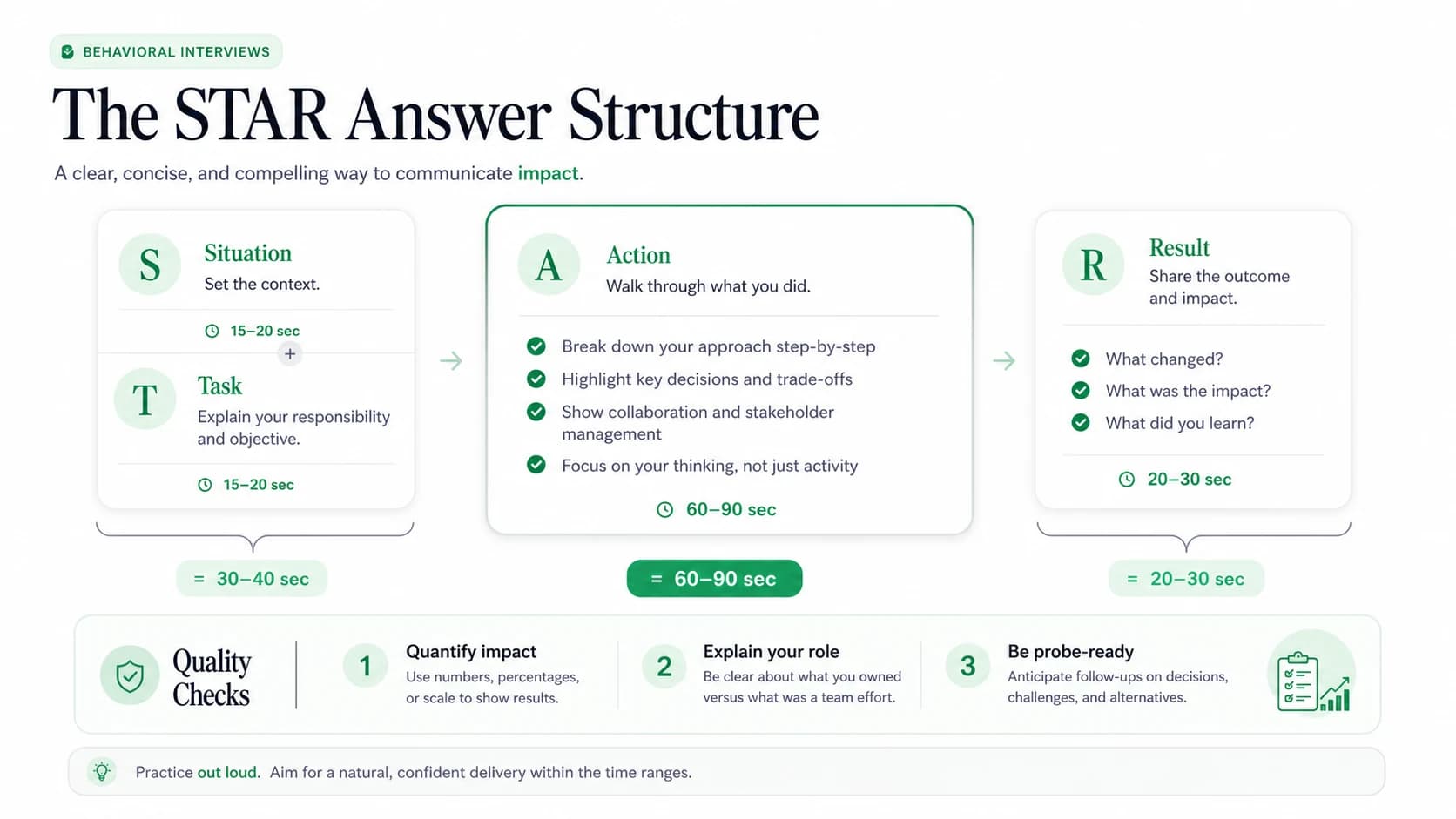
Learn the behavioral method
STAR that survives probing, linked to the live AI interviewer.
Paragraph three should usually contain only two proof moves. The first should prove analytical horsepower or structured problem solving. The second should prove leadership, communication, or stakeholder judgment. A third proof point earns its place only if it adds a new dimension. If it repeats a skill already shown, cut it and spend the space on a sharper firm paragraph.
Do not introduce a proof point that is absent from the resume. The letter can add context, but the resume should substantiate the claim. If the letter says you led a pricing analysis, the resume should carry the role and result. Keeping the two documents aligned is half the battle, which is why the consulting resume guide is the companion to this page.
Free live AI interview
Say the proof point without reading the letter
Practice the behavioral story behind paragraph three so the evidence still holds up when an interviewer asks what you personally did.
Practice the story live
What is the final pre-submit checklist?
Before submitting, compare your draft against the career-center source and this consulting checklist.
The highest-return edit is almost always paragraph two. If it survives a firm-name swap, rewrite it before you do anything else. When the format is clean, the last gate is judgment: ask why consulting now, why this firm, why you, and why anyone should believe it. If one answer is weak, add better evidence or cut the claim. Consulting letters improve when they become plainer and more specific, not when they become more enthusiastic.
A clean letter gets you into the room. The skills it advertises, structure, clarity, and judgment under pressure, are the same ones the case interview tests. If the case method itself is still new, learn it before you start drilling, because reps without the method mostly rehearse the same mistakes.
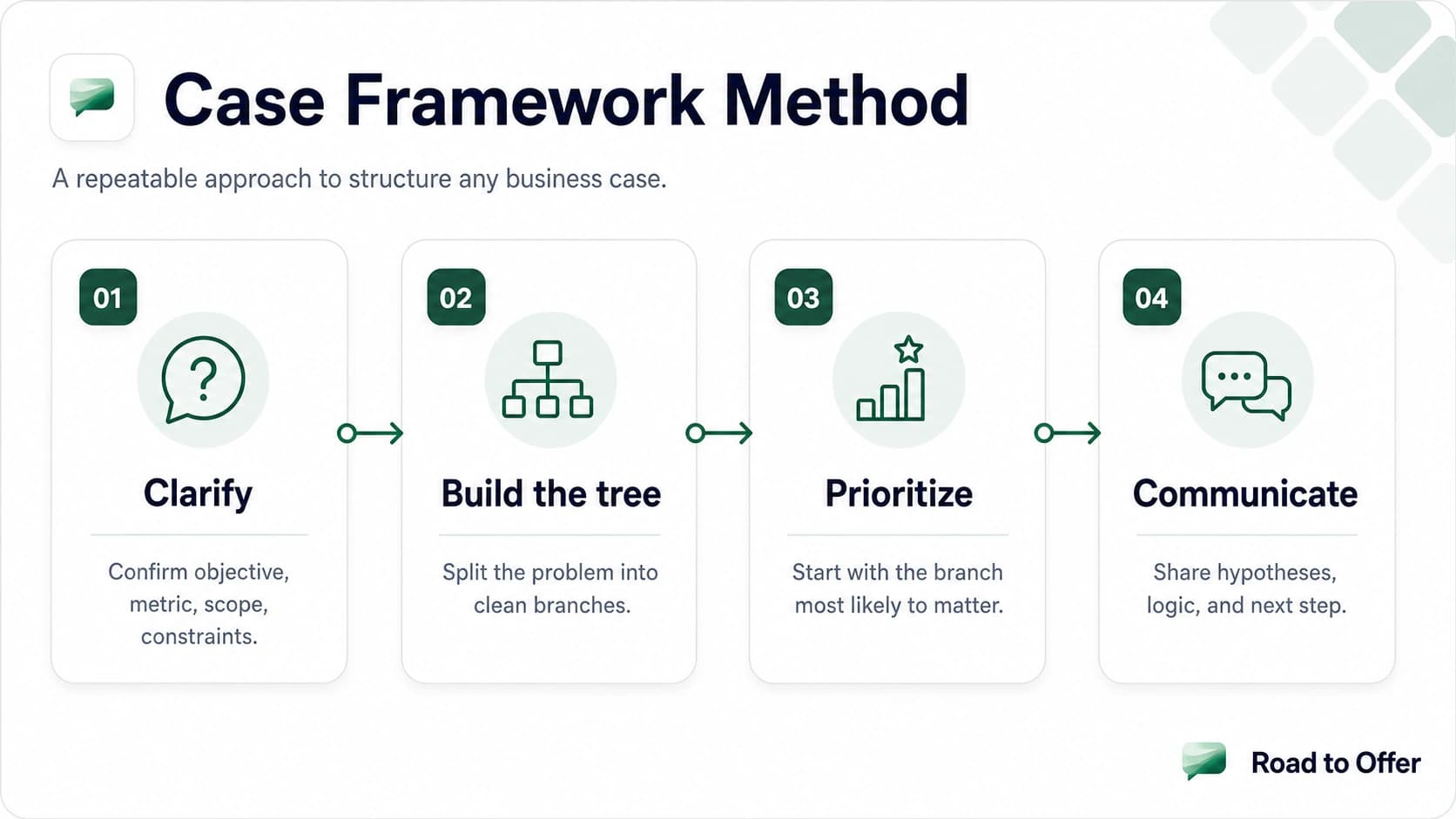
Learn the case method
One dense lesson, each step linked to the drill that trains it.
The piece of that method your letter already trained is the answer-first habit: the recommendation, then the reasons that support it. A case interview scores the spoken version of exactly that. Use the scored synthesis rep directly below so you answer before seeing feedback instead of clicking away to another drill surface.
Once the application is submitted, test the same answer-first communication in a complete case.
Related reading
- Consulting resume guide for the evidence layer your letter draws from
- Behavioral interview guide for consulting for the fit story behind your proof points
- Consulting networking guide for the conversations that make paragraph two specific
- Consulting application deadlines for 2026 so the letter is ready before the window closes
- Deloitte cover letter guide for the Big 4 version with Deloitte-specific firm reasons
- EY cover letter guide for tailoring the letter to EY's practices and values
- KPMG cover letter guide for a KPMG-specific take on paragraph two
Sources
- McKinsey Careers, application materials and cover-letter guidance: McKinsey careers (checked June 18, 2026)
- BCG Careers, how to submit a great application: BCG application guidance (checked June 18, 2026)
- Bain and Company, how to write a killer cover letter (Keith Bevans): Bain cover-letter guidance (checked June 18, 2026)
- Bain and Company, experienced-professionals recruiting page stating the cover letter and transcript requirement and the entry level by years of experience: Bain experienced professionals (checked July 24, 2026)
- Yale Office of Career Strategy, cover letters and correspondence: Yale cover-letter samples (checked June 18, 2026)
- Harvard Mignone Center for Career Success, resumes and cover letter guide: Harvard resume and cover-letter guide (checked June 18, 2026)
- MIT Career Advising and Professional Development, how to write an effective cover letter: MIT effective cover-letter guide (checked June 18, 2026)
- MIT Career Advising and Professional Development, sample resumes and cover letters: MIT resume and cover-letter samples (checked June 18, 2026)
- Princeton School of Public and International Affairs, consulting cover letter sample: Princeton SPIA consulting sample (checked September 2, 2026)
- Columbia SIPA, sample cover letter requesting a full-time consulting position: Columbia SIPA sample letter (checked September 2, 2026)
- ResumeGo, cover-letter field experiment reporting a 16.4% callback rate for tailored letters versus 10.7% with no letter: ResumeGo cover-letter research (checked July 23, 2026)
Frequently asked questions
Resources and related guides
- Free consulting resume graderPractice
- Browse all free resourcesResource hub
- Consulting Resume: The Guide + Free AI Review (2026)Getting Started · Jun 12, 2026
- MBB Resume Template: McKinsey, BCG and Bain Format (2026)Getting Started · Jun 4, 2026
- Case Interview Questions by Stage (With Worked Solutions)Getting Started · Feb 6, 2026
- Why Consulting? How to Answer (Examples That Land Offers) (2026)Getting Started · Mar 7, 2026