
Consulting vs Finance Careers: How to Choose (2026)
Consulting vs finance careers compared across salary, hours, exits, and lifestyle at years 0, 3, 5, 10. 2026 data with dated sources throughout.
On this page
Consulting vs finance careers differ most in pace, pay curve, and exits. Finance pays more by year 5; consulting offers broader exits. Here is the full 2026 comparison across salary, hours, culture, and career path, for undergrads and MBAs deciding between the two tracks.
"Finance" here means investment banking (IB), private equity (PE), and hedge funds (HF), not retail banking or corporate finance. "Consulting" means MBB and top strategy firms like Oliver Wyman and LEK. This scoping matters: finance is not a single career, and bundling IB with retail banking or corporate FP&A muddies the comparison.
Consulting vs Finance: The 60-Second Answer
- Year 1 total comp is similar. MBB MBA hires earn $267K–$285K; IB analysts earn $170K–$190K; PE associates earn $275K–$350K; HF analysts earn $200K–$300K at established funds (Sources: Mergers & Inquisitions 2026 IB; Glassdoor PE Associate Feb 2026; full sourcing in the comparison table below).
- By year 5, finance pulls ahead. PE associates at mega-funds cross $400K–$500K; MBB Managers cap at $280K–$350K.
- Consulting offers broader exits; finance offers deeper finance exits. For PE, go IB first. For everything else (corp strategy, tech, startups, operating roles), consulting wins.
- Hours are meaningfully different. IB = 80–100/week; PE = 60–80; HF = 50–70; MBB consulting = 55–75.
- Pick based on pace, not prestige. Both tracks carry elite prestige. The real question is whether you prefer client-facing problem-solving in 2–4 month cycles (consulting) or transaction-driven deal work in 6–12 week cycles (IB/PE).
2026 compensation report
Free account unlocks the report instantly. Unsubscribe anytime.
Consulting vs Finance Comparison Table (2026)
This is the spine of the article. Every figure below is sourced and dated.
Sources: Management Consulted 2026 Salary Report, Mergers & Inquisitions 2026 IB Salary, Glassdoor PE Associate Feb 2026, Wall Street Oasis Hedge Fund Pay Guide 2026, Poets & Quants 2025 MBB Exit Analysis.
Day-to-Day: Consultant vs Banker vs PE vs HF
Management consultant (MBB): Client-facing problem-solving on 2–4 month engagements. Typical day: morning team sync on hypothesis, client interviews, data analysis in Excel/Alteryx, slide-writing in the afternoon, client update call late afternoon. Rotating across industries (healthcare → banking → retail) is a feature, not a bug. See the consulting career path for how engagements evolve.
Investment banker (analyst/associate): Transaction execution on M&A, IPO, LBO, and debt deals. Typical day: pitch deck building, financial modeling, diligence coordination, late-night revisions. Deal cycles are 6–12 weeks with surges. Less industry rotation than consulting: analysts often stick within a sector group (TMT, Healthcare, Industrials).
Private equity associate: Deal sourcing and execution on company acquisitions. Typical day: screening investment opportunities, building LBO models, diligence on targets, portfolio company monitoring. 60–80 hour weeks, more predictable than IB but with closing-week surges. Teams are small (3–10 people on a deal).
Hedge fund analyst: Idea generation and position management on public markets. Typical day: reading sell-side research, building investment theses, tracking earnings, writing memos to the PM. 50–70 hour weeks on average, the most predictable of the four, though long-short and event-driven funds run hotter.
Salary Progression: Year 0 to Year 10 (2026 Data)
Year 0 (entry): IB analyst earns $170K–$190K total; MBB undergrad Associate earns $132K–$137K. Consulting underpays undergrads by ~$40K/year vs IB. See the consulting salary guide for firm-level detail.
Year 1–3: MBA consultants jump to $267K–$285K total (see McKinsey salary). PE associates at mega-funds hit $300K–$400K all-in. IB associates reach $225K–$275K. Hedge fund analysts at established funds land $250K–$400K. Consulting is mid-pack at this stage.
Year 5: Divergence begins. MBB Principals earn $350K–$500K (Partnership track). PE pre-MBA senior associates cross $400K–$500K. IB VPs earn $350K–$500K base+bonus. HF senior analysts at strong funds cross $500K–$1M. Finance pulls clearly ahead.
Year 10: MBB Partners earn $700K–$2M per RocketBlocks' 2026 MBB Partner analysis. IB MDs earn $800K–$2M. PE Partners and HF PMs cross $1M–$5M+ easily, with top performers at mega-funds exceeding $10M. Finance's ceiling is structurally higher. Equity and carry in PE/HF create step-change wealth events that consulting's partnership model does not.
Hours and Lifestyle Reality
Per Mergers & Inquisitions' 2026 IB analysis, first-year IB analysts at bulge brackets average 80–100 hour weeks with regular 3 AM finishes during live deals. PE associates average 60–80 hours with more predictable schedules between closings. HF analysts average 50–70 hours, the most lifestyle-friendly of the finance track.
MBB consultants average 55–75 hours per week per 2026 consultant reports on Fishbowl and Management Consulted. Travel is the historical consulting lifestyle tax. Monday-to-Thursday client travel was the norm pre-2020, but hybrid models post-2022 have cut onsite days to 1–2 per week for most engagements.
Predictability score (highest to lowest): HF > MBB consulting > PE > IB. If "I can plan a Thursday dinner 2 weeks out" matters to you, HF wins. If it doesn't, the IB pay premium may be worth the cost.
Exit Opportunities: Where Each Path Leads
Per Management Consulted's 2025 analysis of 1,644 MBB departures, the top consulting exits are corporate strategy (16.6%), financial services including PE/VC (14%), tech (13%), and startups (~10%). Average MBB tenure before exit is 2.7 years.
IB exits concentrate in PE (30–40% of 2nd-year analysts at bulge brackets), HF, corporate development, and business school. The IB → PE path is the single most direct route into private equity. For this reason, candidates targeting PE should strongly consider IB over consulting.
PE exits go to hedge funds, operating roles at portfolio companies, continuation vehicles, or business school. Exit timing tends to be post-Associate (year 3–4) or post-VP (year 6–8).
HF exits are narrower: mostly to other HFs, family offices, or starting your own fund. HF is more of a career terminus than a launching pad.
Of candidates on our platform who cross-prep for consulting and finance, most choose consulting when optionality and industry breadth matter more than top-quartile pay, and finance when they have a clear view on deals or markets. See consulting exit opportunities for the full consulting exit landscape.
Meet candidates already prepping the consulting path
- Post your firm, timezone, and interview date to find candidates interviewing the same month
- Free prep material in the group, no Road to Offer account or email needed (a Facebook login is)
- Run live mocks with a real person between your solo reps
The group opens MBB Case Interview Prep on Facebook
Decision Framework: Which Path Fits You
Use these four questions to decide between consulting and finance:
- Do you already know you want PE? Go IB. It is the most direct path, period.
- Do you want to understand how businesses work broadly before specializing? Go consulting. Industry rotation is the core feature.
- Do you want the highest possible year-10 ceiling? Finance (PE/HF) has a structurally higher top end due to carry and equity.
- Do you prioritize 55 hours over 80 hours at similar year-1 pay? Go consulting or HF.
For a narrower comparison focused only on IB (not PE/HF), see consulting vs investment banking. For technology-path comparison, see consulting vs tech.
If the real choice is between two entry paths rather than four, the consulting versus investment banking comparison sets them side by side.
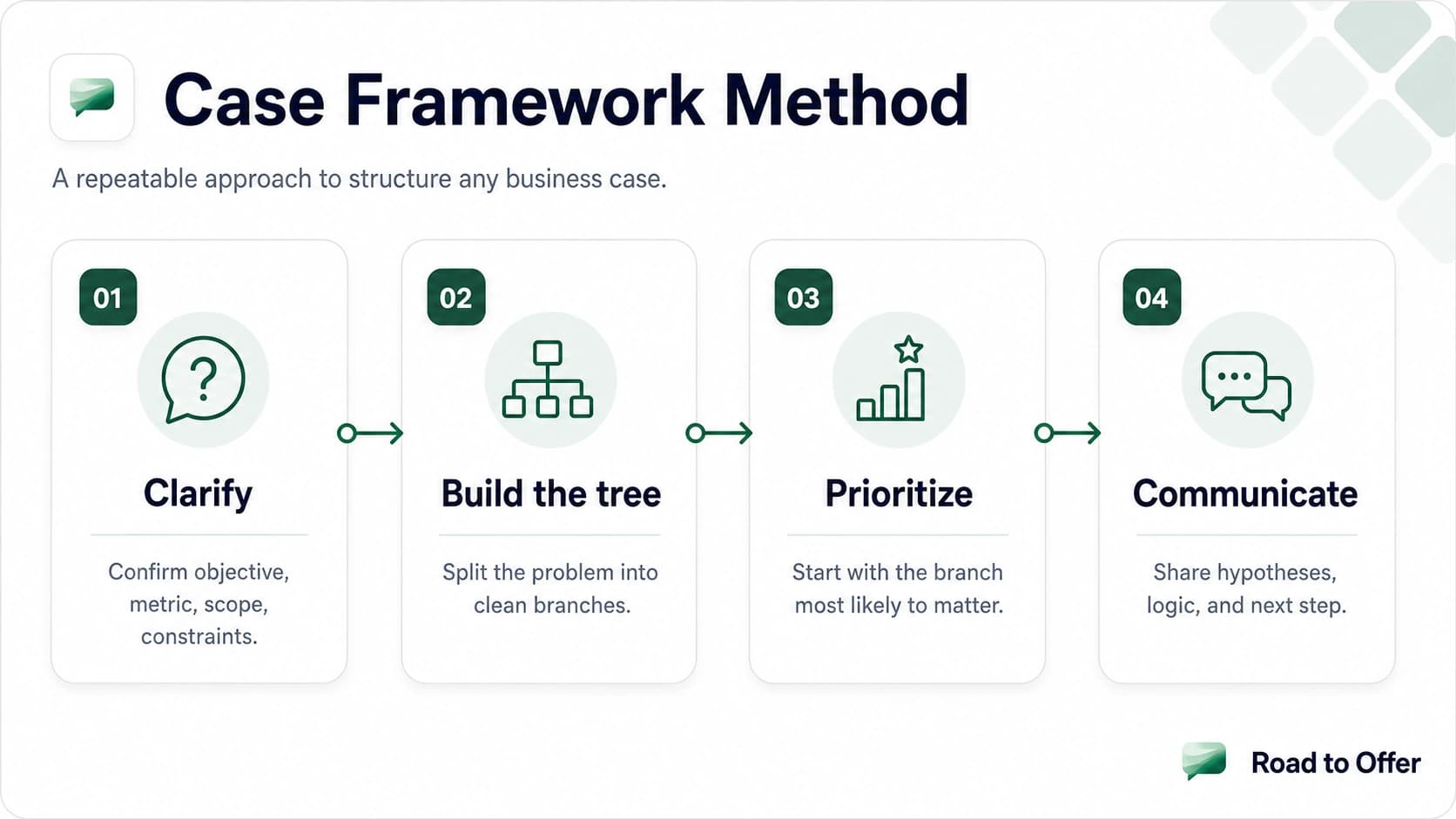
Learn the case method
One dense lesson, each step linked to the drill that trains it.
Sources
All figures in this article checked June 17, 2026.
- Management Consulted: 2026 Consultant Salary Report
- Management Consulted: Management Consulting Exit Opportunities
- Mergers & Inquisitions: Investment Banker Salary 2026
- Glassdoor: Private Equity Associate Salary (February 2026)
- Wall Street Oasis: Hedge Fund Pay Guide 2026
- Wall Street Careers: PE Associate Guide 2026
- Mergers & Inquisitions: Hedge Fund Analyst
- Poets & Quants: Consulting Pay 2024/2025
- RocketBlocks: MBB Partner Salaries
- BusinessBecause: Consulting Salaries 2025
Frequently asked questions
Resources and related guides
- Practice a real case interviewPractice
- Browse all free resourcesResource hub
- AlixPartners Careers 2026: Turnaround Salary and Interview GuideFirm Specific · Sep 11, 2026
- AlixPartners Internship Guide 2027: Tracks, Pay, and DeadlinesRecruiting · Sep 11, 2026
- Alvarez and Marsal Careers 2026: Restructuring Salary and Interview GuideFirm Specific · Sep 11, 2026