
Data Science Case Interview Guide: BCG X, QuantumBlack, Bain Vector
Master data science case interviews at BCG X, McKinsey QuantumBlack, and Bain Vector. Covers ML framing, A/B testing, product analytics, technical cases, and a 30-day prep plan.
On this page
A consulting data-science case usually tests three things: business diagnosis, experiment design, and model or data trade-offs before you recommend a data-backed action.
If your target is specifically BCG X, start with the dedicated BCG X case interview guide. This page covers the broader data science case format across consulting firms.
Worked experiment example. A checkout redesign is intended to raise completed purchases. Define the primary metric as completed purchases per randomized user, use user-level treatment and control groups, and monitor guardrails such as average order value, returns, and support contacts. Check weekly cycles, sample-size sufficiency, and sample-ratio mismatch before deciding. A positive conversion result changes the rollout decision only if the guardrails remain acceptable.
Read the experiment chart before choosing a model from the Road to Offer drill engine. Answer a real prompt and get AI-scored feedback. Free accounts include 5 drills per day for the first 3 days after signup.
Why Data Science Case Interviews Are Different
Standard consulting cases test your ability to structure an ambiguous business problem, perform mental math, and synthesize a recommendation. Data science cases test all of that, plus your ability to:
- Frame a business problem as an ML or analytics task
- Identify what data you need and where it comes from
- Select appropriate statistical or ML methods with justified trade-offs
- Design a valid experiment (A/B test or quasi-experiment)
- Interpret results and quantify uncertainty
The business framing is still table stakes. Interviewers at BCG X expect you to open a case the same way any consulting candidate would: clarify the objective, ask about the timeline, confirm metrics. The difference is what comes next: you need to propose a technical path forward, not just a strategic one.
Firms That Use Data Science Cases
BCG X differs from the traditional BCG practice because it builds data products, not just advisory decks. McKinsey QuantumBlack applies AI and analytics to enterprise transformations. Bain & Company's data scientist process includes case studies where candidates outline an end-to-end approach to a business problem using data.
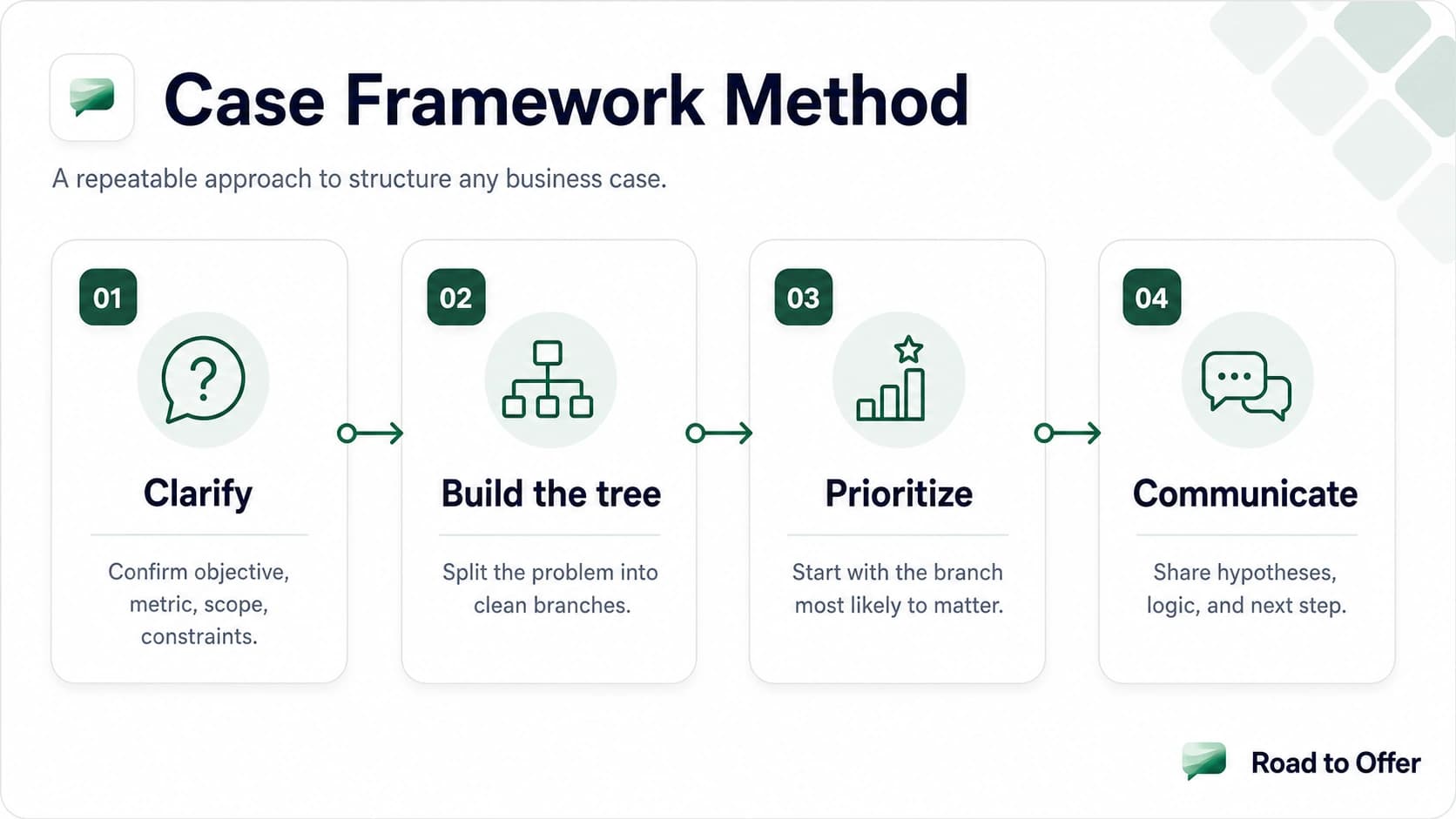
Learn the case method
One dense lesson, each step linked to the drill that trains it.
The Three Main Case Types
1. Product Analytics Cases
These cases present a metric that has moved, usually dropped, and ask you to diagnose why and propose a fix. The structure mirrors a standard profitability case but adds a data layer.
Example prompt: "Spotify's premium conversion rate dropped 15% over the past 30 days. Walk me through how you'd diagnose this."
A strong answer:
- Segment the drop: Is it across all user cohorts or specific ones (geography, device, acquisition channel, tenure)?
- Rule out external factors: Competitive pricing changes, a major event, a product bug
- Identify the funnel stage: Free trial sign-up? Payment completion? Upgrade prompt view?
- Propose data queries: What SQL query would you run first? What would you look for in event logs?
- Recommend next steps: If it's a payment completion drop among mobile Android users, what's your hypothesis and experiment design?
These cases appear frequently at QuantumBlack and Bain Vector, where candidates are expected to speak in event-level data terms, not just strategic buckets.
2. A/B Testing and Experimentation Cases
Interviewers present you with an experiment that was run, or ask you to design one, and assess whether you understand:
- Randomization and bias: Were treatment and control groups correctly assigned? Is there selection bias?
- Statistical power: How large does the sample need to be? What's the minimum detectable effect?
- Metric selection: Are you measuring the right primary and guardrail metrics?
- Novelty and network effects: Are results inflated by novelty? Does the treatment affect non-participants (network effects in social products)?
Typical question: "We ran a 2-week A/B test on a new checkout flow. Conversion improved 3% with a p-value of 0.04. Should we ship it?"
The "correct" answer is: not necessarily. Is 2 weeks long enough to capture weekly usage cycles? What are the guardrail metrics (AOV, return rate, support tickets)? Was the test correctly randomized at the user level, not session level? This nuanced questioning is exactly what data science interviewers evaluate.
3. ML Model Design Cases
These cases ask you to architect a data science solution for a business problem. You will not code live in most consulting firm rounds, but you must demonstrate that you can:
- Frame the ML task correctly (binary classification, multi-class, regression, ranking)
- Identify features from real-world data sources
- Choose a model family and justify interpretability vs. performance trade-offs
- Define evaluation metrics appropriate to the business context
Example prompt: "A major bank wants to predict which SMB customers will churn in the next 90 days. Design the ML solution."
Strong structure: Define churned (account closed, 6+ months dormant?). Features: transaction volume trend, product breadth, login frequency, support call frequency, competitor rate environment. Model: gradient boosting (XGBoost or LightGBM) for tabular data; logistic regression as interpretable baseline for regulatory compliance. Evaluation: AUC-ROC for ranking; precision/recall trade-off depends on cost of false positive (sending retention offer) vs. false negative (losing customer).
Worked Example: Uber Ride Acceptance Rate
Prompt: "Uber's driver ride acceptance rate dropped 8% over the past two weeks in three major cities. Build a diagnostic framework and propose an ML solution to address the underlying driver supply problem."
Step 1: Clarify the problem
- What is the acceptance rate denominator: all dispatched requests, or dispatched-to-online-driver requests?
- Is the 8% drop uniform across cities or concentrated (surge pricing zones, airport areas, time-of-day)?
- Has this drop translated into a rider experience metric change (wait time, cancellation rate)?
Step 2: Diagnose root causes (MECE buckets)
Step 3: Propose an ML solution
Problem framing: Binary classification: predict the probability that a given driver will reject the next ride request given contextual features. Use this score to dynamically adjust dispatch logic (prefer high-acceptance drivers when supply is tight) and trigger proactive incentives before rejection occurs.
Key features:
- Driver's rolling 7-day acceptance rate by zone
- Current hourly earnings vs. 30-day average
- Time to next surge window (model-predicted)
- Distance from rider to driver
- Ride estimated duration and distance
Model choice: Gradient boosting on tabular data. Low latency required (dispatch must happen in ~2 seconds), so avoid deep learning. Output a probability score at dispatch time.
Success metric: Reduction in unfulfilled ride requests within 5 minutes; driver acceptance rate increase measured via A/B test against current dispatch algorithm.
Step 4: Recommendation
The most likely driver is an earnings decline relative to expectations, compounded by a competitor incentive campaign. The short-term fix is targeted surge bonuses for high-acceptance drivers in the affected zones. The long-term fix is the predictive acceptance model integrated into dispatch, expected to reduce rider wait time by 15–20% in constrained supply conditions.

Growth · hard
Practice for data science interviews in a real case
Matched to this data science guide: a live technology growth case with an AI interviewer. Free, scored on every step.
What BCG X, QuantumBlack, and Bain Vector Actually Assess
BCG X
BCG X candidates should expect role-specific screening. Data science and analytics roles may include Python, SQL, or statistics; product and design roles may emphasize product thinking and implementation trade-offs; client-facing roles can include a technical case. What differentiates top BCG X candidates is the ability to think like a product builder, not just a strategy advisor: if you were building this model in production, what would you actually do?
McKinsey QuantumBlack
QuantumBlack roles can include technical and behavioral assessment, but the components vary. Use the current role description and invitation to decide whether to prepare coding, statistics, prior-project discussion, a case, or a presentation.
Bain Vector
Bain Vector interviews follow a similar arc to BCG X but tend to weight the business case component more heavily. Candidates report a technical screen (Python, ML theory), a business case study where you outline your analytical approach end-to-end, and a behavioral round focused on past analytical impact.
Technical Concepts to Review
Before your interview, you should be comfortable explaining these concepts clearly to a non-technical interviewer:
Review resources: Interview Query's data science guides, DataLemur for SQL practice, and Towards Data Science case study walkthroughs.
Drill the statistical-power math live from the Road to Offer drill engine. Answer a real prompt and get AI-scored feedback. Free accounts include 5 drills per day for the first 3 days after signup.
Interactive drill set. Write an answer before revealing the worked solution, then continue into Road to Offer for scored practice and AI feedback.
30-Day Prep Plan
Week 1: Consulting case fundamentals
- Practice 2 standard business cases per day using the profitability framework and market entry framework, then run a full case in Road to Offer's case library
- Review hypothesis-driven case approach
- Read your target firm's public case examples (McKinsey's GlobaPharm is excellent for data-heavy cases)
Week 2: Technical foundations
- Review statistical significance, power calculations, and A/B test design
- Complete 5 SQL problems on DataLemur (window functions, aggregations, subqueries)
- Study precision/recall, AUC-ROC, and confusion matrices, then drill the underlying math on Road to Offer's math drill
- Practice explaining gradient boosting in plain English
Week 3: Data science case practice
- Solve 2 product analytics cases (e.g., "DAU dropped 20%: diagnose") in Road to Offer's case library
- Practice 2 A/B testing interpretation questions with edge cases (novelty effects, network effects) using the chart drill
- Complete 2 ML model design cases end-to-end
- Time yourself: target 5 minutes for problem framing, 10 minutes for analysis, 3 minutes for synthesis
Week 4: Firm-specific prep and mock interviews
- BCG X: complete Python data manipulation exercises; practice technical case framing
- QuantumBlack: practice only the coding, statistics, case, or project-discussion components named in your invitation
- Bain Vector: practice business impact storytelling with quantified results
- Run 2 full mock interviews with a partner using the practice partner guide, or run a scored case solo if a partner isn't available
Technical Answer Checks
Execution checklist
Reviewed hypothesis-driven case structure. Data science cases still require strong business framing before technical proposals; drill it on Road to Offer's structure drill
Practiced 3+ A/B test design questions including edge cases. Experimentation design is the single most commonly tested concept across BCG X, QuantumBlack, and Bain Vector; practice reads on Road to Offer's chart drill
Can explain precision/recall trade-off with a business example. ML design cases require fluency in evaluation metrics in business terms; run the tradeoff math on Road to Offer's math drill
Completed SQL window function exercises. BCG X technical assessment specifically tests SQL on real-world data manipulation tasks
Prepared 2 TEI stories from own ML work with quantified business impact. QuantumBlack's Technical Experience Interview goes deep on your personal project history
Practiced synthesizing a 2-minute ML design recommendation. Consulting firms assess communication quality; get scored on it with a full case rep
Related Guides
For foundational case interview skills that underpin data science cases, review:
- Case Interview Frameworks: Complete Guide
- Hypothesis-Driven Case Approach
- BCG X Case Interview
- BCG Case Interview Guide
- McKinsey Case Interview Guide
- Case Interview Data Interpretation
- Mental Math for Case Interviews
Keep the technical edge sharp with an honest skill rep
Return to graph interpretation, then use a math rep for the experiment calculation.
Sources (checked June 29, 2026)
- BCG X official page
- BCG interview process
- BCG data scientist interview guide - InterviewQuery
- QuantumBlack by McKinsey
- How to Pass the McKinsey QuantHub Test for Data Scientists - MyConsultingOffer
- Bain & Company data scientist interview - DataInterview
- Top QuantumBlack data science interview questions - InterviewQuery
Frequently asked questions
Resources and related guides
- Practice for data science interviews in a real casePractice
- Browse all free resourcesResource hub
- Accenture Salary Guide 2026 - Pay by Level and Career PathFundamentals · May 20, 2026
- Campus Consulting Clubs: Benefits, Recruiting, and How to Get InFundamentals · Jun 3, 2026
- Case Interview Cheat Sheet: Frameworks, Formulas & PDF (2026)Fundamentals · Mar 20, 2026
- Strategy Consulting vs Operations Consulting - DifferencesFundamentals · Jun 2, 2026