
Consulting Recruiting Germany & Austria: Tests, Deadlines
Consulting recruiting in Germany and Austria runs all year in batches: firms take applications continuously, close them at fixed cut-offs and interview each batch together, often partly in German. McKinsey Germany's 2026 cut-off is 23 November 2026, checked 7 November 2026. This guide covers deadlines, tests, case interview language and Praktikum rules.
Every date links to the firm's own page, checked on 6 November 2026 and rechecked for McKinsey on 7 November 2026. Firms can change a cut-off, so confirm it on the firm's page before you plan around it.
How does consulting recruiting work in Germany and Austria?
You can apply at any time, but your application waits for the next cut-off and is reviewed with that batch. McKinsey Germany states it plainly: it collects every application until the next deadline, reviews them under the same conditions, and says you have the same chance of an invitation whichever deadline you choose. Its next cut-off is 23 November 2026.
Three features set the German-speaking market apart from the UK and US cycles:
- Batches instead of one season. McKinsey publishes dated cut-offs (24 August and 23 November in 2026). Roland Berger's German internship posting lists 15 January and 12 March 2027. BCG, Simon-Kucher, Strategy& and Kearney recruit on a rolling basis with no published deadline.
- The Praktikum is the main entry route. Students apply for 8 to 12 week internships from their 3rd to 5th Bachelor semester, and a strong internship can turn into a full-time offer. McKinsey, for example, says a convincing intern may receive an offer straight away or join its "McKinsey College" coaching programme for former interns.
- German is often part of the interview. Documents are accepted in German or English almost everywhere, but several firms state that at least one interview is in German.
If you are still choosing which firms to target, start with our map of consulting firms in Germany, which owns the shortlist question. This page owns the process: when, which test, which language. For other European countries, the Europe consulting recruiting timeline puts Germany next to the UK, France and the rest.
Which deadlines are open right now?
McKinsey Germany's cut-off on 23 November 2026 is the next one; Bain's Power of 4 closes on 6 December, BCG's Women's Intensiveship spring slots on 10 January and Roland Berger's internship batch on 15 January 2027. Oliver Wyman's STEM Goes Consulting programme follows on 12 February and Roland Berger's next internship cut-off on 12 March 2027.
Nov 23Cut-off
Open nowMcKinsey Germany: internship and full-time
Feedback mid to late Dec 2026 · first interview Jan 2027 · interview day Jan/Feb 2027
Dec 6Closes
Open nowBain Power of 4 (gap year 2027/28)
German-speaking students with a Bachelor by mid-2027 · interview days 18 and 19 Mar 2027
Jan 10Closes
Open nowBCG Women's Intensiveship, spring 2027
Four weeks from 22 Feb, 1 Mar or 8 Mar 2027 · summer slots close 28 Mar
Jan 15Cut-off
Open nowRoland Berger Consulting-Praktikum
Answer by 29 Jan 2027 · selection days from mid-Feb
Feb 12Closes
Deadline publishedOliver Wyman STEM Goes Consulting
STEM students · internship from June 2027 · online assessment
Mar 12Next cut-off
Next batchRoland Berger Consulting-Praktikum
Selection days from early April 2027
Checked on each firm's official careers page, November 6, 2026.
Two things the dates do not tell you. First, a McKinsey application counts only for the deadline it was submitted under: McKinsey says it cannot move it to a later deadline, so if you want a later batch you apply again in the next cycle. Second, McKinsey had not published the cut-off that follows 23 November when we checked. A date for February 2027 circulates on third-party sites, but until it appears on karriere.mckinsey.de treat it as unconfirmed.
Firms with no published deadline (BCG, Simon-Kucher, Strategy&, Kearney, Porsche Consulting, Horváth) still have a best time to apply, set by your start date. The table in the next section gives each firm's lead time. To keep every cut-off and lead time in one place, the consulting application tracker works for European firms too.
How does each firm recruit in Germany?
Each firm combines a screen, a test or none, and one to three interview rounds, and the official pages differ more than most guides admit. This table is the short version; the firm sections below give the source for each cell.
"Not published" means the firm's page does not say. It does not mean English only. When the page is silent, ask the recruiter when you are invited, and prepare a case in German anyway.
McKinsey Germany
McKinsey's deadline page lists what a complete application contains: CV, academic certificates (Abitur, Bachelor, Master) and references for internships and other activities. A cover letter is optional, and documents can be in German or English. After a first review you receive a link to Solve and have five days to complete it. You can apply up to a year before your start date, and an offer lets you join within 12 months. McKinsey recommends applying about six months before your preferred start.
The interview process has two steps: a virtual interview, then an interview day with further interviews. McKinsey notes the process can differ for Analytics, Risk & Resilience and Operations roles. On its interview page it describes the cases as client situations discussed in dialogue, plus a Personal Experience Interview about one experience of yours. Full-time and Associate Intern candidates have a final conversation with a partner; Fellow Interns get their decision straight after the morning interviews. The same deadlines apply to the Tech & AI, Growth, Marketing & Sales, Strategy & Corporate Finance and Private Capital practices. Experienced hires applying as (Senior) Associate or above are not bound by deadlines and hear back within 14 days.
The McKinsey deadline guide covers how the firm's cut-offs work worldwide, the McKinsey PEI guide covers the experience interview.
BCG Germany and Austria
BCG's process page says the interview process is the same for full-time and internship candidates. Round 1 is virtual: a 30-minute multiple-choice cognitive test with numerical, verbal and logical questions, solved without aids, plus one case interview in three parts (a CV conversation, the case and your questions). Round 2 has two case interviews, one in German and one in English, and "BCG Real Life": two 15-minute conversations with changing interviewers that BCG says need no preparation. Round 2 is on site for full-time candidates and virtual for Visiting Associates. Every candidate gets personal feedback from the interviewer, whether or not they reach round 2. A cover letter is optional.
The Visiting Associate page adds the timing rules: apply all year, but no earlier than six months before your preferred start, for one of eight offices in Germany and Austria. BCG uses fixed start dates and accepts documents in German or English. The BCG internship guide compares the programme with other offices.
Bain DACH
Bain's DACH interview page says consulting candidates should expect case interviews built on project situations, plus questions about academic and work experience. It adds that some positions include an online screening assessment before interviews. It does not publish round counts, test names or interview language for Germany, so your invitation is the source of truth. The Bain case interview guide covers the interview format.
Bain's two dated programmes for German-speaking students are better documented. Power of 4 is a gap year of four 11-week internships at Allianz, Bain, Deutsche Telekom and FC Bayern München, for German-speaking students who finish their Bachelor by mid-2027 and start a Master afterwards. Applications close Sunday 6 December 2026, feedback comes at the end of January 2027 and the interview days on 18 and 19 March 2027 have three individual interviews each, with case studies. Jumpstart, for women students from the 4th Bachelor semester and PhD students, has closed its 2026 round and had no 2027 date when we checked.
Roland Berger
Roland Berger's German internship posting gives fixed cut-offs: 15 January 2027 (answer by 29 January, selection days from mid-February, virtual participation possible) and 12 March 2027 (selection days from early April). The selection day has one personality interview and two technical interviews, followed by detailed feedback. The posting asks for CV, academic certificates and work certificates, accepts students of all subjects from the 4th semester, and offers 10 to 12 weeks with a start within up to 12 months; a start before April 2027 is not guaranteed.
Roland Berger's tips page explains the split between interns and permanent hires: permanent candidates whose profile matches take an online analytics test first, while internship candidates go straight to a recruiting day. Permanent candidates who pass the recruiting day then have a final interview with someone from management. The firm's FAQ puts the whole process at six to eight weeks, suggests applying four to six months before your start, and promises an answer within three weeks of an online application. It also asks for excellent English and a good command of the local language. For the case itself, read the Roland Berger case interview guide, then practise with Roland Berger-style practice cases.
If you have not run a full case before, learn the method once before you pick firm-specific material:
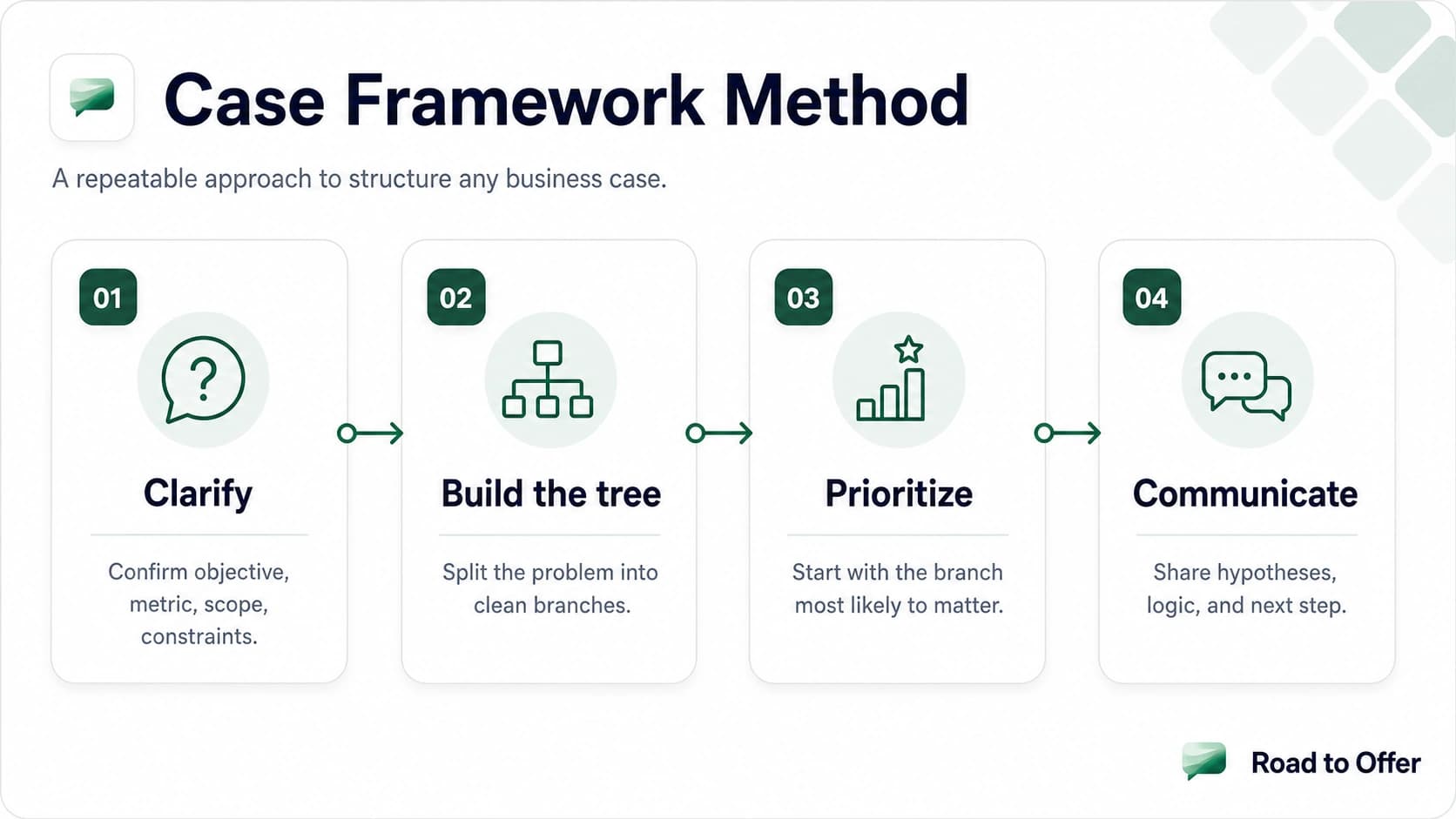
Learn the case method
One dense lesson, each step linked to the drill that trains it.
Simon-Kucher
Simon-Kucher's student FAQ describes three steps: an application through the portal (no cover letter needed, no e-mail applications), an online assessment of analytical skills, and interview rounds or days that vary by position and division. Each interviewer prepares an individual case, and feedback usually comes within three days. Apply about six months before your start, and earlier for summer internships. Internships start from the 4th Bachelor semester and last at least 10 weeks and at most six months.
The firm also publishes a two-page case study guide. It says many cases include charts, brainstorming questions and estimates, and that you should close with a recommendation, its reasons, the risks and next steps. Simon-Kucher is a pricing specialist, so the Simon-Kucher case interview guide is worth reading before the interview day. A pricing-flavoured rep in English:

Practice for Simon-Kucher in a real case interview
HealthcareMedium
Oliver Wyman
Oliver Wyman Germany's interview page asks for CV, cover letter and all relevant certificates including the Abitur, and promises feedback on your documents within one to two weeks. Selection days are always on Fridays and mostly virtual: two one-on-one interviews for an internship, four for a full-time role, each with a case and a personal part. You learn the same day whether you have an offer. The page also notes that Oliver Wyman is now part of the expanded Marsh brand, so expect that name on the portal.
STEM Goes Consulting is the dated route: for STEM students from the 5th Bachelor semester or in a Master's, with fluent German and English, applications close on 12 February 2027. It includes an online assessment, a virtual get-to-know conversation, a case workshop in Munich in mid-April and a virtual interview day with two one-hour interviews, leading to an 8 to 12 week internship from June 2027. The Oliver Wyman case interview guide and the Oliver Wyman assessment guide cover both stages.
Porsche Consulting
Porsche Consulting's application page lists the order: online application through the Job Locator, an HR call of about 30 minutes, an online test of about 45 minutes for Young Professionals that checks structured and analytical thinking, a specialist interview with a case, and a final interview with your future line manager. Its FAQ adds that internships need at least four semesters of study, ideally last four to six months, and are not possible after graduation, when you apply as a Young Professional instead. Expect operations and industrial cases; the Porsche Consulting case interview guide explains why.
Strategy&
Strategy& Germany recruits all year in Germany and Austria, only for specific postings on its portal. Its student page describes the internship process: a virtual selection day with three interviews, each a personal conversation plus a case, one of them in English, and the result straight after. Internships are 8 to 12 weeks from the 5th semester, and you hear back on your application within three weeks at the latest. The FAQ says direct entry in consulting usually requires a completed Master's and expects very good German and English. The Strategy& case interview guide covers the case format.
Kearney
Kearney Germany's student page promises an answer within a week of applying. Interview rounds are always on Fridays and consist of three one-hour interviews, each with a behavioural part and a case. Two interviews are in German and one in English, and external aids, including AI tools and calculators, are not allowed. Kearney's FAQ says it offers internships only to enrolled Bachelor, Master or doctoral students, with an exception for STEM students and doctoral candidates. Practise case maths by hand before a Kearney Friday: the Kearney case interview guide shows the operations cases the firm favours.
Horváth and Capgemini Invent
Horváth recommends applying about three months before your start, accepts applications in German or English, and usually runs two stages: a first interview on you and your background, then a second with more colleagues and a case study, with feedback by phone after each one. Capgemini Invent matches your profile against open roles, runs a virtual interview that may include a case, and finishes with an on-site round with a subject-specific case. The Horváth case interview guide and the Capgemini Invent case interview guide go deeper.
Which online test will you take?
McKinsey sends Solve, BCG a 30-minute cognitive test, and most German firms either a short analytical test or none at all. The test decides whether your batch application reaches an interview, so it is the first thing to prepare after you submit.
McKinsey Solve
after document review
- Link arrives after a first review
- Five days to complete it
McKinsey says no targeted preparation is needed
BCG cognitive test
round 1, DE and AT
- 30 minutes, multiple choice
- Numerical, verbal and logical, no aids
Short analytical tests
Simon-Kucher, Porsche, Roland Berger
- Simon-Kucher: online analytical assessment
- Porsche: about 45 minutes for Young Professionals
Roland Berger tests permanent candidates only
McKinsey Solve. The German deadline page says you get five days from the link, and that each part opens with a tutorial, so no gaming or business knowledge is required. McKinsey also says targeted preparation is not necessary. Many candidates still want to see the format before the clock starts. The McKinsey Solve guide (also in German) explains the games, and you can try the Red Rock and Sea Wolf simulators in English.
BCG's cognitive test, not Casey. BCG's own Germany and Austria page describes a 30-minute multiple-choice test with numerical, verbal and logical questions and no aids. That is different from the Casey chatbot case some other BCG offices use, so do not prepare only for Casey. Train timed numerical and verbal reasoning with the numerical reasoning test guide and the case maths drill. The BCG online assessment by country page maps which office uses which test; the Casey guide is the right page only if your invitation names Casey.
Short analytical tests and none at all. Simon-Kucher, Porsche Consulting (Young Professionals) and Roland Berger (permanent roles) use their own analytical tests and do not publish the question types. Oliver Wyman's interview page and Kearney's student page mention no test, so your effort goes into the interviews; Oliver Wyman's STEM programme does include an online assessment.
These are the online tests we simulate. The Bain test applies only if your invitation names it:
The online tests McKinsey, BCG and Bain give before the case interview











Is the case interview in Germany in German or English?
Expect at least one interview in German at most firms in Germany and Austria, and prepare to switch. Of the firms that publish it, McKinsey Germany runs its one-on-one interviews in German, BCG puts one German and one English case in round 2, Kearney runs two German and one English interview, and Strategy& one English interview out of three.
What the case itself looks like. BCG's process page says each interview has three parts, a talk about your CV, a case study and your questions, that the cases are based on real client projects, and that no prior knowledge is needed. Roland Berger publishes two worked cases on its case preparation page (transit-oriented development, marked as available in English, and 3D-printed hip implants, with no English flag), and tells you to practise with a friend on a current topic. Checked 7 November 2026.
Applying in English is accepted almost everywhere: McKinsey, BCG, Simon-Kucher, Horváth and Bain's programmes all say documents can be in German or English. That is a rule about your documents, not your interviews. Bain's Power of 4 and BCG's Women's Intensiveship are open to German-speaking students only, and Oliver Wyman's STEM programme and Roland Berger ask for fluent German or a good command of the local language.
Practise the method in English first, then rehearse your opening structure and your experience story in German out loud. The case interview language guide for Europe compares the rules across countries, and the consulting Lebenslauf guide covers how to state your language level on the CV. Our practice runs in English. For McKinsey's German PEI, draft the story with the behavioural lesson, then retell it in German:
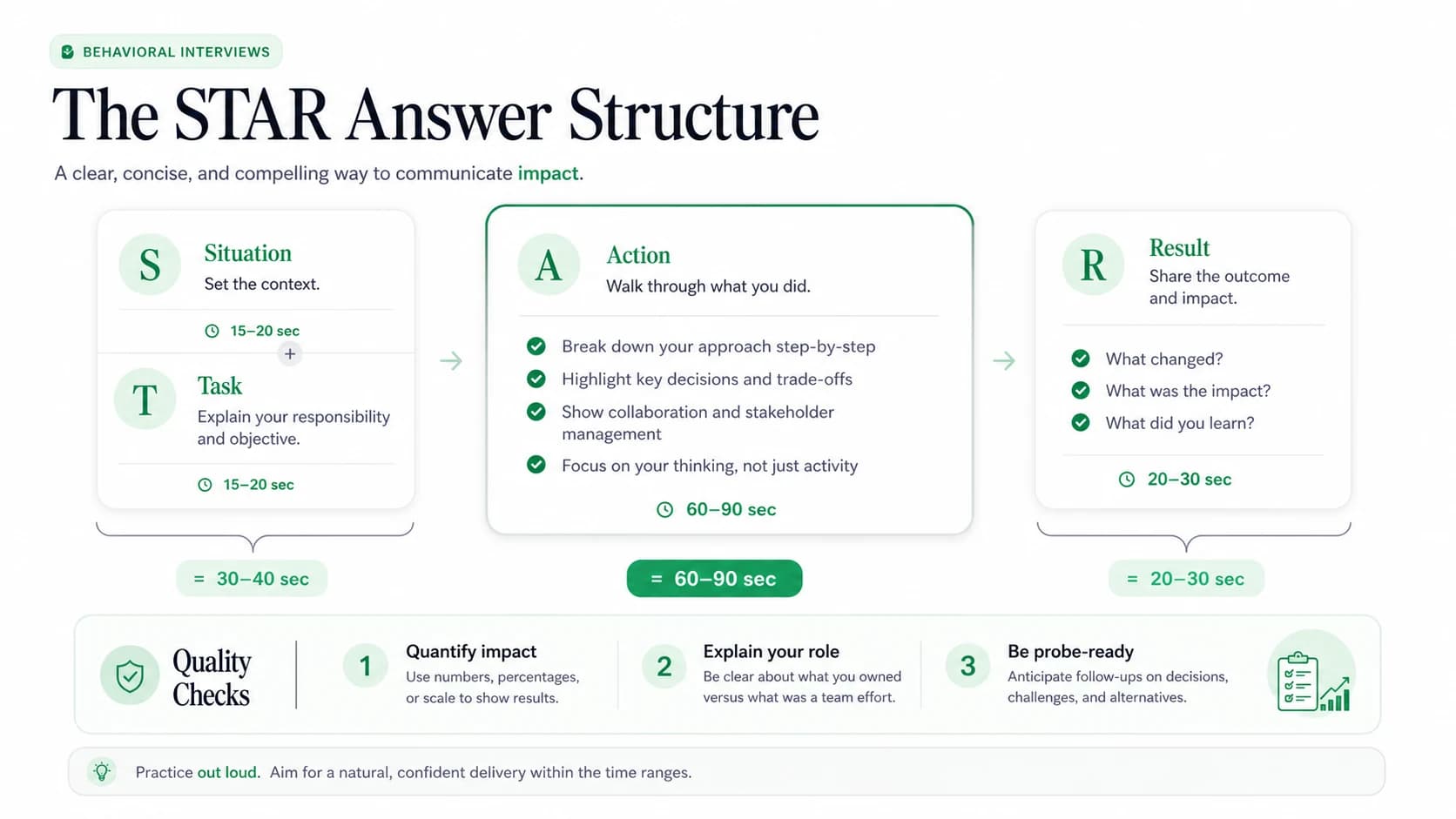
Learn the behavioral method
STAR that survives probing, linked to the live AI interviewer.
How does a Praktikum fit into the timeline?
Most German candidates do one or two consulting internships before applying full-time, starting between the 3rd and 5th Bachelor semester. The minimum semester is the first filter, so check it before you write a single line of your CV.
Sources: McKinsey, BCG, Roland Berger, Simon-Kucher, Porsche Consulting, Strategy&.
Two timing rules decide which batch to aim for. At McKinsey, you can apply up to a year ahead, so a summer 2027 internship fits the 23 November 2026 cut-off. At BCG, you may not apply more than six months before your start, so a July 2027 internship opens to applications in January 2027. If you are between Bachelor and Master, the gap year is the window most firms design for: BCG names gap-year students explicitly, Porsche Consulting allows an internship between the two degrees, and Bain's Power of 4 is built around it.
The internship interviews are not lighter versions of the full-time ones. At BCG the process is identical, and at Roland Berger interns skip the online test but still face two technical interviews. The McKinsey internship guide covers what changes and what does not at McKinsey.
What changes in Austria and Switzerland?
Austria runs on the German process: the same firms recruit for Vienna through their German-language portals. McKinsey lists Vienna (Wien) among its internship locations next to seven German offices, BCG's Visiting Associate covers eight offices in Germany and Austria, Bain's Power of 4 and Jumpstart include Vienna, and Strategy& recruits in Germany and Austria all year. Our checks found no separate Austrian deadline at any of these firms, so the dates above apply.
Switzerland is a separate process. BCG Switzerland's interview page asks you to apply at least six months ahead, sets the 30-minute cognitive test about one month before your first interview, and holds in-person interviews in Zurich: one virtual 45-minute case then three in-person cases for full-time candidates, three in-person cases for interns. Interviews are generally in German or French with at least one in English, and all in English if you are not fluent in German or French. Bain lists Zurich among its DACH offices.
Swiss campus recruiting has fixed dates: the University of St. Gallen's HSG Career Days run from 11 to 20 October 2027, with the consulting day on 19 October 2027. For pay, the consulting salary guide for Switzerland covers pay in CHF.
What should you do before the next cut-off?
Before McKinsey's 23 November 2026 cut-off, submit first and prepare second; for the January batches, you have about nine weeks. Batch firms review everything after the deadline, so an early submission does not help you at McKinsey, but a late one shuts you out of the batch. Use the weeks after you submit to prepare for the test and the interviews that follow.
Step 1: submit a complete application
Batch firms only review complete files. McKinsey wants CV, academic certificates from Abitur onwards and references; Oliver Wyman asks for the Abitur certificate too; Roland Berger wants work certificates. Several firms want certificates going back to school, so collect them now rather than the night before. A cover letter is optional at McKinsey, BCG and Simon-Kucher; Porsche Consulting, Horváth, Oliver Wyman and Roland Berger ask for one.
Step 2: prepare for the test you will actually get
Do not prepare for a test your firm does not use. McKinsey candidates should look at the Solve format; BCG candidates in Germany and Austria should drill timed numerical, verbal and logical questions; Roland Berger interns can skip the test and go straight to cases.
Step 3: build the case method, then the maths
Most German interviews are interviewer-guided cases with charts, estimates and a recommendation at the end, the shape Simon-Kucher's guide describes. Kearney does not allow calculators, so practise division and percentages by hand. The case interview prep guide is the full method. For a European profitability rep in the style Roland Berger uses, start here:

Practice for Roland Berger in a real case interview
Consumer GoodsHard
Steps 4 and 5: rehearse in both languages
Tell your experience story in English, then in German, and time both. Then run a full case out loud and open it in German: state the objective, your structure and your first hypothesis in German before you switch. That is the moment that trips up candidates who prepared only in English.











Prep plans for McKinsey, BCG, Bain, Deloitte, Accenture, EY-Parthenon, Kearney, Oliver Wyman, Roland Berger, L.E.K., OC&C, Strategy&, Simon-Kucher, Arthur D. Little, Capital One and your target firm. Choose your firm in the plan builder.
Get your prep plan
A week-by-week schedule built around your target firm and interview date.
What could not be confirmed?
Every firm fact above comes from an official page read on 6 November 2026; where a page was silent, this guide says so. The gaps: interview language at Bain, Roland Berger, Simon-Kucher, Oliver Wyman and Porsche Consulting; McKinsey's cut-off after 23 November 2026; Bain's Jumpstart 2027 date; the round 1 interview language at BCG. Kearney's student page states its process but not a deadline, and Horváth's English page gives lead time but no internship rules. BCG's Women's Intensiveship page still shows 2026 dates in its FAQ; the 2027 dates above come from the programme listing on the same page.
Three ways to start practicing
- Start a free case
Run a full case. 92 cases in voice or guided text, scored on seven dimensions.
- Try a free drill
Drill one skill. 550+ drills across 6 skill types.
- Find your test
Practice your firm's test. Solve, Casey, CCA, SOVA and TestGorilla, each free to try.



Frequently asked questions
Resources and related guides
- Consulting application trackerPractice
- Browse all free resourcesResource hub
- Bewerbungsfristen Unternehmensberatung 2026/27 (DACH)Recruiting · Nov 6, 2026
- Consulting Recruiting Timeline Europe 2026/27Recruiting · Nov 6, 2026
- McKinsey Bewerbung: Ablauf, Solve, Deadline und AuswahltagRecruiting · Nov 6, 2026
- Calendrier recrutement conseil en stratégie : stage 2026/27Recruiting · Nov 7, 2026
- UK Consulting Application Deadlines 2027: Tracker by FirmRecruiting · Nov 6, 2026