
Oliver Wyman Online Test and Assessment 2026: Format, Scoring & Prep
What the Oliver Wyman online test and assessment really is in 2026: the numerical reasoning test, the work-styles psychometric, negative marking, the pass bar, and how to prepare.
On this page
The Oliver Wyman online test and assessment in 2026 is best understood as two separate pieces, not one exam, and not every candidate or office is asked to take it. Most reports describe a numerical reasoning test plus a behavioral work-styles questionnaire that sit after the online application and before interviews, inside a full recruitment process that GraduatesFirst says runs roughly two to three months. The numerical section is the one candidates fear: PrepLounge describes a 20-minute test of up to 30 multiple-choice questions, leaving under a minute each, and it deducts points for wrong answers. The work-styles section is a psychometric questionnaire that, per My Consulting Offer, runs about 20 minutes across four short sections and scores you against seven traits. Treat your invitation email as the source of truth, because the exact format varies by region, role, and recruiting cycle, and confirm which pieces you actually face before you prepare.
What should you verify about the Oliver Wyman assessment?
Oliver Wyman assessment preparation should start with the current role and invitation because the format varies by route. PrepLounge reports a 20-minute numerical test with up to 30 multiple-choice questions, as checked June 26, 2026. My Consulting Offer reports a work-styles questionnaire lasting about 20 minutes across 4 sections, as checked June 26, 2026. Use timed graph and exhibit reasoning drills as adjacent skill practice, not as an Oliver Wyman simulator.
Use the assessment-check method: 1. read the invite, 2. log the block and constraint, 3. practice one matching rep, 4. review accuracy and consistency. An illustrative percentage calculation can train the skill, but it is not an Oliver Wyman answer key.
What the Oliver Wyman online assessment actually is
Oliver Wyman is a global management consulting firm founded in 1984, with over 5,000 professionals across more than 60 offices according to GraduatesFirst. If you want the bigger picture on the firm and why people target it, the why Oliver Wyman guide covers positioning and culture. This article is narrower: what the online screen is, how it scores, and how to beat it.
The online assessment sits early in the funnel. After you submit the online application, a subset of candidates is invited to the online test before any interview. The whole recruitment process, from application to offer, takes about two to three months per GraduatesFirst, and the online test is one filter inside that window, not the finish line.
The single most important thing to internalize is that the test is inconsistent. Prep sites contradict each other because Oliver Wyman does not use one fixed format worldwide. PrepLounge frames it as a single timed numerical test. My Consulting Offer describes a four-section work-styles psychometric. GraduatesFirst lists a broader battery: numerical reasoning, verbal reasoning, situational judgement, and a personality assessment. They are all describing real variants of the same screen. Your invitation email tells you which one you face.
Practice the reasoning the test actually measures
The Oliver Wyman numerical test rewards reading a chart and reaching a business conclusion fast. Run a free AI-scored case to drill that exact skill.
The two pieces: numerical reasoning and work-styles
Strip away the contradictions and two components appear most often. The first is an aptitude test built around numerical reasoning. The second is a behavioral work-styles questionnaire, sometimes labelled a personality or psychometric assessment. Some candidates get both, some get one, and a few are invited straight to interviews.
The practical takeaway: prepare hardest for the numerical test, because it is the piece with a hard pass bar and a wrong-answer penalty. Prepare for the work-styles section by getting honest and consistent, not by trying to game it.
The numerical reasoning test in depth
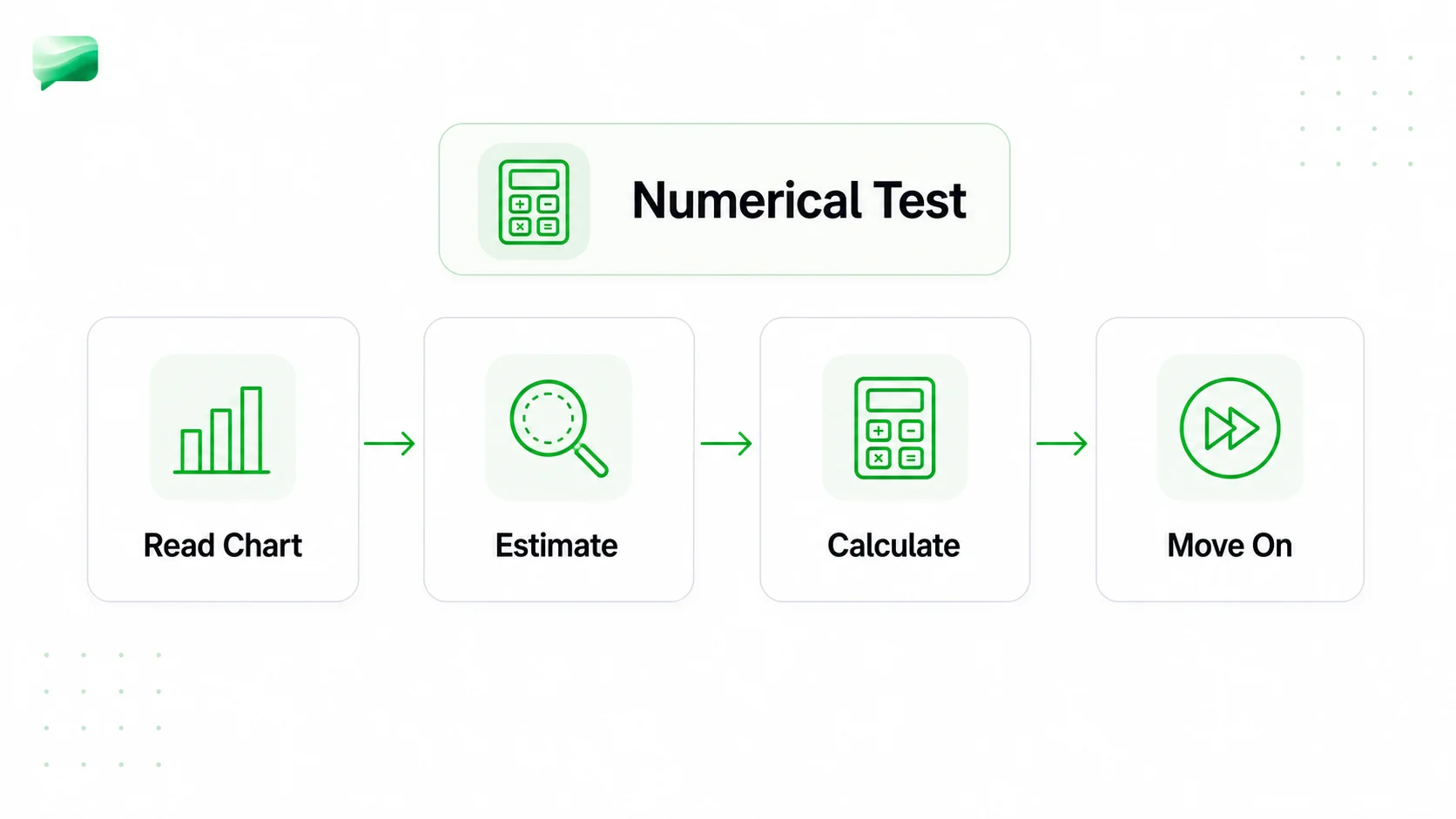
This is the section that decides most outcomes, and it is not a classic SHL arithmetic drill. Candidates describe it as dynamic and case-lite: interactive charts, data you have to filter, and trends you have to spot before you can answer. The style sits closer to the McKinsey RedRock-style problem solving or BCG's interactive assessments than to a static numerical battery. You read a scenario, pull the right figures off an exhibit, and convert them into a business conclusion, usually with a calculator allowed and the ability to move between questions.
Per PrepLounge, you get about 20 minutes for up to 30 questions, so under a minute each. That clock, not the math difficulty, is what catches people out. The skill being tested is speed plus accuracy in reading exhibits, which is the same muscle a case interview uses.
Here is a worked example in the spirit of the test. Suppose an exhibit shows a retailer's revenue rising from 40 million to 52 million over a year, while its store count grows from 100 to 130. A slow candidate computes total revenue growth, 30%, and stops. A strong candidate computes revenue per store: 40,000,000 / 100 = 400,000 last year versus 52,000,000 / 130 = 400,000 this year, flat. The implication is that all of the growth came from opening new stores, with zero gain in existing-store productivity. The question is rarely "what is the growth rate." It is "what does this pattern imply for the business," and that is the conclusion the test rewards.
The work-styles psychometric section
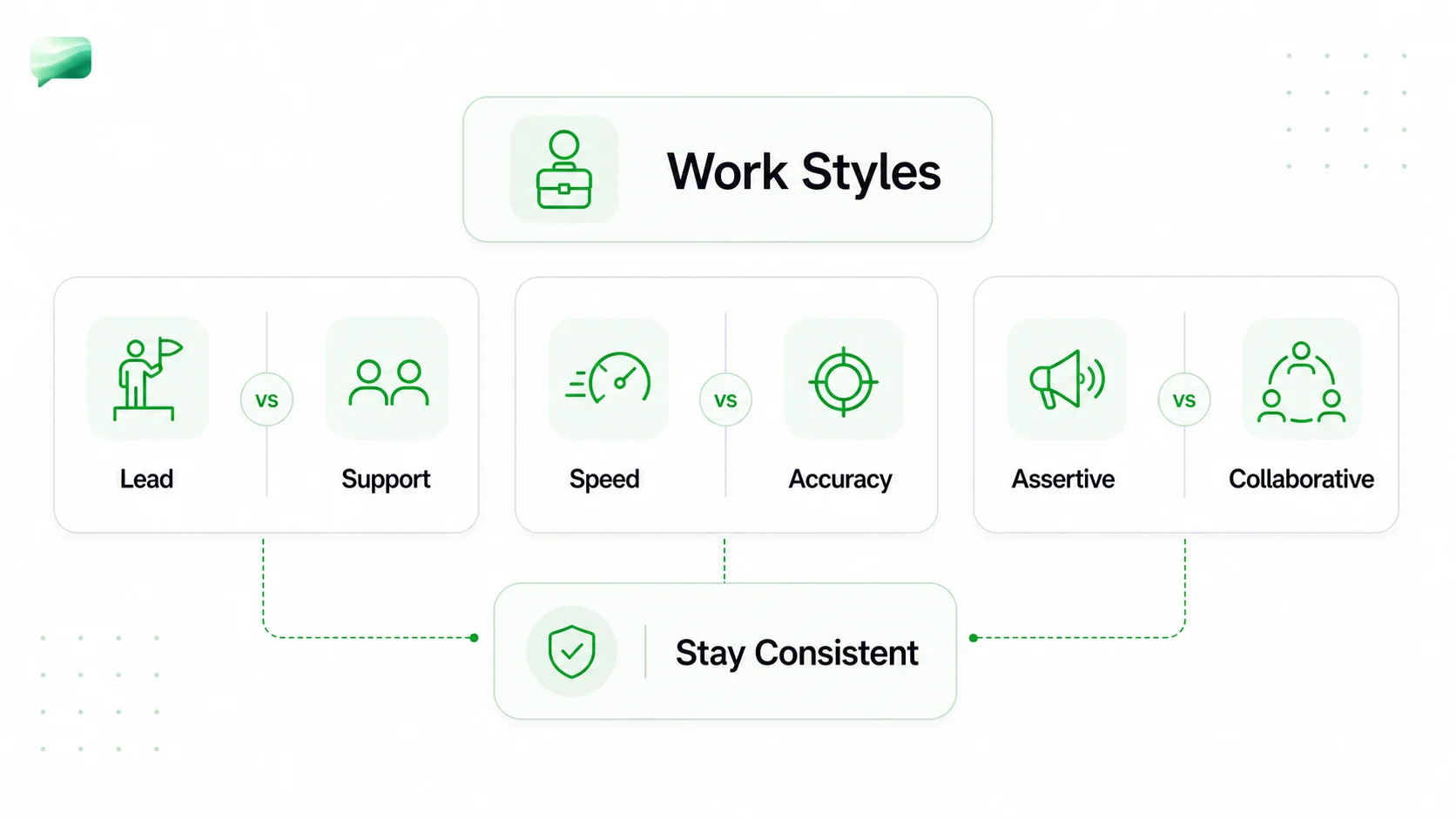
The behavioral component is a different animal. Per My Consulting Offer, the work-styles test gives you about 20 minutes across four sections: Section 1 is 14 workstyle questions, Section 2 asks you to select your top 5 strengths, Section 3 asks you to select 5 more strengths or characteristics, and Section 4 is another 14 workstyle questions.
The same source reports the assessment scores you against seven named traits: Teamwork, Impact, Grit, Curiosity, Rigor, Ownership, and Polish. Knowing the traits is useful, but trying to reverse-engineer the "consultant" answer backfires. Psychometric instruments look for consistency, and the repeated workstyle blocks plus the strength-selection rounds are designed to catch people who answer strategically rather than honestly.
The right approach is to answer authentically and let consistency carry you. If you are more rigorous than outgoing, do not pretend you win through constant social energy. Pick strengths you can defend with a real example, because the fit interview later will probe the same ground.
The seven traits the work-styles test scores are the same story your resume and fit interview need to tell. It is worth checking those materials line up before you sit the test.
See how your resume holds up
Upload the draft here for a consulting-specific score, evidence-based strengths, and priority fixes grounded in what is actually on the page.
By uploading, you agree to resume analysis and report storage until you delete it. See the privacy policy.
Scoring and the pass bar
Two scoring facts make the Oliver Wyman test distinctive. First, there is a target. PrepLounge suggests aiming for roughly 50% of total points, while PracticeAptitudeTests suggests targeting about 60% of questions correct. Treat 60% as the safer working target.
Second, and more important, the cut is relative, not a fixed line. PracticeAptitudeTests reports the pass rate is effectively determined by the top 10% of candidates, so your score is graded against the applicant pool, not an absolute threshold. That is why you aim as high as you can rather than for a number.
The detail that changes how you play: PrepLounge reports the numerical test uses negative marking and deducts points for wrong answers. Most aptitude tests do not penalize guessing, so the usual advice ("answer everything before time runs out") is wrong here. Under negative marking, a blind guess has negative expected value.
How hard it is and your real odds
The screen is a genuine filter. PracticeAptitudeTests reports that roughly 60% of candidates are rejected as a result of their aptitude test performance. That is not because the math is advanced. It is because the combination of a sub-one-minute pace, exhibit-reading under pressure, and negative marking punishes anyone who is even slightly slow or careless.
This reframes your prep. Raw math ability is not the bottleneck for most candidates. The bottleneck is reading an exhibit quickly, choosing the one calculation that answers the question, and deciding when an answer is worth committing to given the penalty. Speed plus accuracy plus disciplined guessing beats brute-force arithmetic.
Section-by-section prep strategy and the guess rule
Here is a tight prep checklist. The first tactic is the one most thin aptitude-mill pages gloss over, because it is the highest-leverage move on the test.
- Master the guess-versus-skip rule. Because of negative marking, do not blind guess. If you can eliminate two or more options, an educated guess turns positive: take it. If you cannot eliminate anything, leave it blank. A blank scores zero; a wrong answer scores below zero.
- Budget time per question. With about a minute each, set a hard ceiling near 50 seconds. If you blow past it, flag the question and move on. You can switch between questions, so bank the easy points first.
- Practice chart and table reading, not arithmetic. Drill timed data-interpretation sets until pulling the right figure off an exhibit is automatic. The calculator handles the math; your eyes are the slow part.
- Train the "so what." After each practice exhibit, force yourself to state the business implication in one sentence. That habit maps directly onto the case-lite questions.
- Answer the work-styles section honestly. Do not try to game the seven traits. Consistency across the repeated blocks reads better than a performance.
- Pick defensible strengths. In the strength-selection rounds, choose traits you can back with a real story, since the fit interview revisits them.
- Simulate the clock. Do at least three full timed numerical sets so the pace stops being a shock on test day.
- Set up your environment. Quiet room, stable connection, calculator, scratch paper, one uninterrupted sitting.
Oliver Wyman simulator: early access, and the estimation drills behind it
We are still building the Oliver Wyman simulator. A free account reserves early access and opens the market-sizing drills that train the structured estimation the test rewards.
Which firms and tests it resembles, so prep transfers
You do not need Oliver Wyman-branded practice. The numerical test's interactive, case-lite, chart-reading style means prep transfers from several places. Material built for the McKinsey RedRock-style problem-solving game, BCG's interactive assessment, and generic SHL numerical reasoning sets all build overlapping muscles: filtering data, spotting trends, and converting exhibits into conclusions under time pressure.
The deepest transfer, though, is from case practice itself, because exhibit-reading and the "so what" step are the same skill a live case tests. Drilling exhibit-to-conclusion reasoning is the most direct way to prepare for both the test and the interviews that follow.
Interactive drill set. Write an answer before revealing the worked solution, then continue into Road to Offer for scored practice and AI feedback.
If you are also recruiting at the Big Four in the same cycle, the PwC assessment test guide breaks down a different screening route (work-styles, SHL aptitude, and game-based formats), and the reasoning skills carry across both.
How the test connects to the rest of the process
The online test is a screen, not the whole evaluation. Candidates who clear it move into interviews, which typically include a case interview, sometimes a written case, and a conversational fit interview. PracticeAptitudeTests reports the fit interview runs about 30 minutes.
Oliver Wyman cases are known for being heavier on quantitative reasoning than average, which is the same signal the online test measures. The chart-reading and "so what" habit you build for the test is the habit you will use in the case rounds, so treat the test as the on-ramp to interview prep, not a separate chore. For the full interview format, worked examples, and a prep plan, read the Oliver Wyman case interview guide.

Growth · hard
Practice a financial services case end to end
Financial Services
Sources
- PrepLounge: Oliver Wyman test guide (checked June 26, 2026)
- My Consulting Offer: Oliver Wyman test (checked June 26, 2026)
- PracticeAptitudeTests: Oliver Wyman assessments profile (checked June 26, 2026)
- GraduatesFirst: Oliver Wyman assessment tests (checked June 26, 2026)
Frequently asked questions
Resources and related guides
- Run a real case interviewPractice
- Browse all free resourcesResource hub
- Accenture Assessment Test 2026: Identify Your Route & PrepareFirm Specific · Jun 27, 2026
- BCG Pymetrics Assessment: 12 Games, Scoring, and Prep (2026)Firm Specific · May 1, 2026
- Deloitte Assessment Test and Job Simulation 2026: Format, Sections & PrepFirm Specific · Jun 27, 2026
- KPMG Launch Pad: Conditional Preparation Guide and Worked TaskFirm Specific · Jul 18, 2026