
Capgemini Invent Case Interview: Group Case & Example
Capgemini Invent case interview guide: group case round, candidate-led cases, digital transformation prompts, worked example, and prep plan.
On this page
The Capgemini Invent case interview in 2026 is the part of the process candidates fear most, and for good reason: it ends with a group case interview that almost no other major firm runs. According to CaseBasix, the group round puts 4 to 6 candidates together, hands each one 10 to 15 pages of materials, gives roughly 10 minutes of individual reading time, then runs about 30 minutes of group discussion. Before that you face a 30-minute recruiter screen and one or more individual case interviews of 30 to 45 minutes. Invent is Capgemini's strategy, innovation and transformation arm, so the cases lean toward digital transformation, customer experience and sustainability rather than recycled profitability templates. Round 2 is candidate-led, meaning you drive the structure and decide what to explore. This guide gives you an Invent-tailored, fully worked playbook covering the candidate-led format and the group case that generic Capgemini pages skip.
What is Capgemini Invent, and why does it change your case types?
Capgemini Invent is the digital innovation, design and transformation brand inside the wider Capgemini group. That distinction matters for your prep. Core Capgemini is largely an engineering and IT services business, and the old Capgemini Consulting brand was folded into Invent. So when you interview for Invent specifically, you are interviewing for the strategy and transformation arm, not the systems-integration side of the house.
The parent group is large. Per MyConsultingOffer, Capgemini was founded in 1967, operates in more than 50 countries, has more than 325,000 team members, and reported 18 billion euros in revenue in 2021. PrepLounge puts the group at over 300,000 employees with offices in more than 40 countries. MyConsultingOffer also notes a goal of women making up 40 percent of the workforce and that the group has made over 40 acquisitions.
Why does the brand split change your cases? Because Invent's bread and butter is digital transformation, customer experience, innovation and sustainability work. Interviewers want to see you reason about technology-enabled change and operating-model redesign, not just walk a textbook profitability tree.
Practice an Invent-style transformation case
Invent cases sit in digital transformation, CX, and sustainability, not textbook profitability. Try one and see how you handle a messy, real-world problem with instant AI feedback.
What does the Capgemini Invent interview process look like?
The process is a funnel, and each stage filters differently. Per CaseBasix, the recruiter screen runs about 30 minutes, and the one-on-one case interview runs 30 to 45 minutes. MyConsultingOffer reports interviews are conducted as 30 to 45 minute video calls.
The first hurdle is the recruiter and behavioral screen. This is where your "Why Capgemini Invent" story and resume walk-through get tested before anyone hands you a case.
Next come one or more individual case interviews. These are candidate-led, so you set the structure and drive the analysis. Expect a real operational scenario, often digital or transformation flavored.
The final round adds the group case interview. This is the differentiator. Almost no other major firm puts candidates in a room together and grades how they collaborate to solve a shared problem. Most competitor pages give it two or three sentences. We are going to give it a full section, because it is the part you can least afford to walk into cold.
What exactly is the Capgemini Invent group case interview?
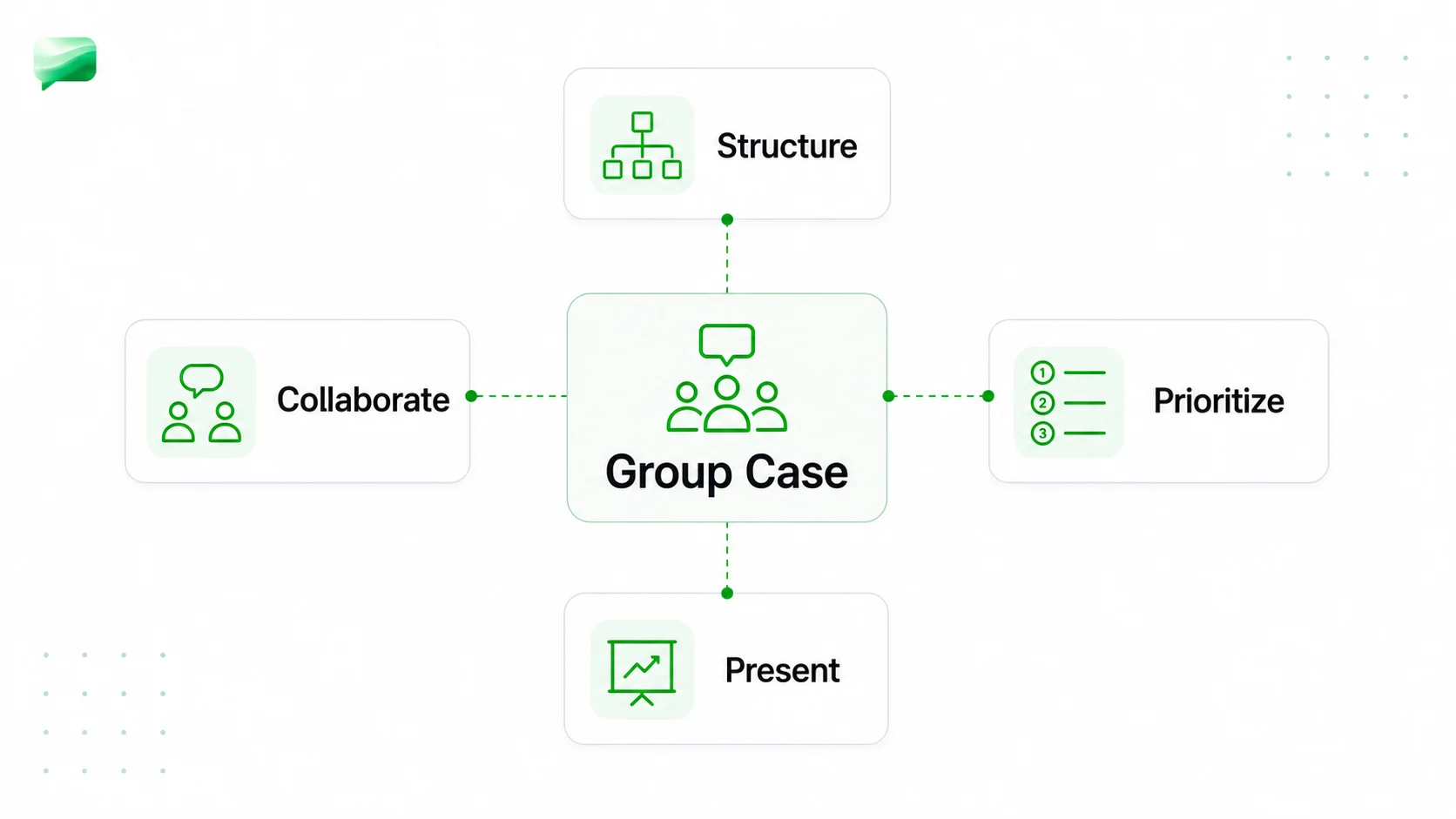
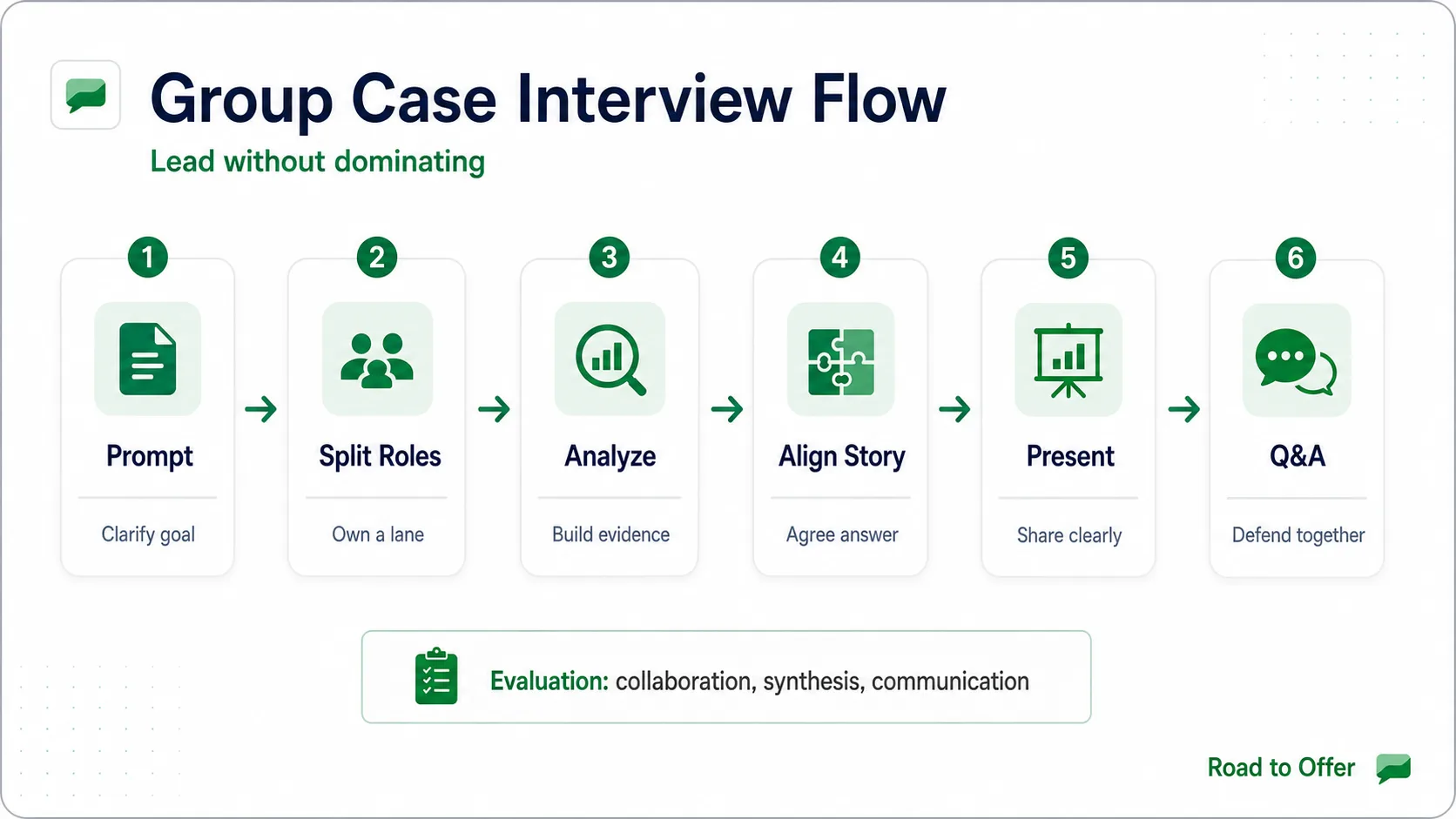
The group case is a collaborative exercise, not a debate to win. Per CaseBasix, it involves 4 to 6 candidates, provides 10 to 15 pages of supporting materials, gives roughly 10 minutes of individual reading time, then opens about 30 minutes of group discussion before a shared recommendation is presented.
Here is the trap. Candidates assume the way to win is to talk the most and dominate the room. That is exactly what loses. Interviewers are scoring how you behave in a real project team, where the best consultants make the group smarter, not louder.
How to stand out without dominating
Use your 10 minutes of reading deliberately. Skim all the materials once, then go deep on the two or three exhibits that actually drive the answer. Note the one structuring idea you will offer the group in the first two minutes.
In the discussion, score points by doing the things a good consultant does on a team:
- Open with structure, not opinions. Propose a simple way to split the problem so the group has a shared map. "Should we organize this into demand drivers, cost drivers, and implementation risks?" gives everyone a frame.
- Pull in quiet voices. "We have not heard from you yet, what does the data on page 7 suggest?" reads as leadership, not deference.
- Track time. Volunteer to keep the group on schedule so you land a recommendation. A team that runs out of time with no answer fails together.
- Build, do not bulldoze. Reference and extend others' points instead of restarting the analysis. "Building on that, the second lever would be..."
- Synthesize at the end. Offer to summarize the group's recommendation cleanly. The person who crystallizes the answer is remembered.
Practice the structure before the group round
The group case rewards candidates who can frame the problem fast. Drill issue trees and prioritization before you have to do it with five other candidates watching.
What case types does Capgemini Invent ask?
Invent cases span the classic toolkit plus a transformation overlay. You should be ready for the standard archetypes and for Invent-specific flavors layered on top.
Classic case types you will still see:
- Profitability and margin diagnosis
- Cost reduction and benchmarking
- Market entry
- Pricing
Invent-specific flavors layered on top:
- Digital transformation and technology-driven change
- Customer experience (CX) redesign
- Sustainability and decarbonization roadmaps
- Delivery and operating-model optimization
Even the classic prompts arrive grounded in operations. Per CaseBasix, example prompts include a US bank case flagging 500 million dollars in excess costs and a Tropicana case involving a 36-ounce product. Notice the pattern: real companies, real numbers, real operational decisions, not abstract puzzles.
Because digital transformation is the dominant theme, work through a dedicated digital transformation case interview before your Invent loop. It walks the specific structure (current state, target state, gap, roadmap, change risk) that an Invent interviewer expects you to reach for.
How do you structure a candidate-led Capgemini Invent case?
Round 2 is candidate-led, so the burden of structure is on you. Do not wait to be handed exhibits. Ask for a moment, build a tailored issue tree, present it, then drive. A memorized framework dropped on the table without adapting it to the prompt is the fastest way to look junior.

Growth · hard
Practice for Capgemini Invent in a real case interview
Matched to this Capgemini Invent guide: a live technology growth case with an AI interviewer. Free, scored on every step.
Here is a structure that flexes to most Invent transformation cases without becoming generic.
Capgemini Invent Candidate-Led Transformation Framework
- 01
1. Clarify the objective. Pin down the real decision and the success metric. Is the client chasing revenue growth, cost reduction, a better customer experience, or a sustainability target? Transformation cases drift without a defined goal.
- 02
2. Map current vs target state. Establish where the client is today (process, technology, customer journey, cost base) and where they want to be. The gap between the two is the actual problem to solve.
- 03
3. Diagnose the gap. Break the gap into drivers. For digital transformation: people, process, technology, data. For CX: each stage of the customer journey. Quantify where you can.
- 04
4. Identify and size levers. For each driver, name 2 to 3 specific interventions, then size the impact. Invent expects numbers, even rough ones, behind a transformation story.
- 05
5. Sequence the roadmap. Prioritize by impact and feasibility. Quick wins first, structural change later. A phased roadmap reads as implementable, which is what Invent rewards.
- 06
6. Recommend with risks. Lead with the answer, then give the change and delivery risks plus mitigations. Holistic risk-and-mitigation thinking is explicitly assessed.
The baseline frameworks still matter underneath this. Keep the profitability framework, the market entry framework, and the full case interview frameworks guide in your toolkit, then bend them to the transformation prompt rather than reciting them.
How should you align your Capgemini Invent resume and cover letter before this interview?
Write for Invent or the exact consulting role named in the posting, not for every Capgemini job. Show how you translated a problem into a client decision or implementation step, with market and role caveats.
- Before: Helped with a transformation project.
- After: Mapped the user handoff, compared failure points, and proposed the workflow adopted for the pilot review.
Check that the resume proof, letter motivation, and case example all fit the same role. Recruiters read the documents together: the resume proves the transformation work, while the letter explains why this practice and role. Verify the current invitation before naming an assessment, group exercise, or case format.
Make the delivery evidence easier to trace
Upload the resume for a Road to Offer graded report, not a Capgemini score.
Revise one line, rehearse the matching transformation story, and use it in the next case practice rep.
A fully worked Capgemini Invent case: digital transformation
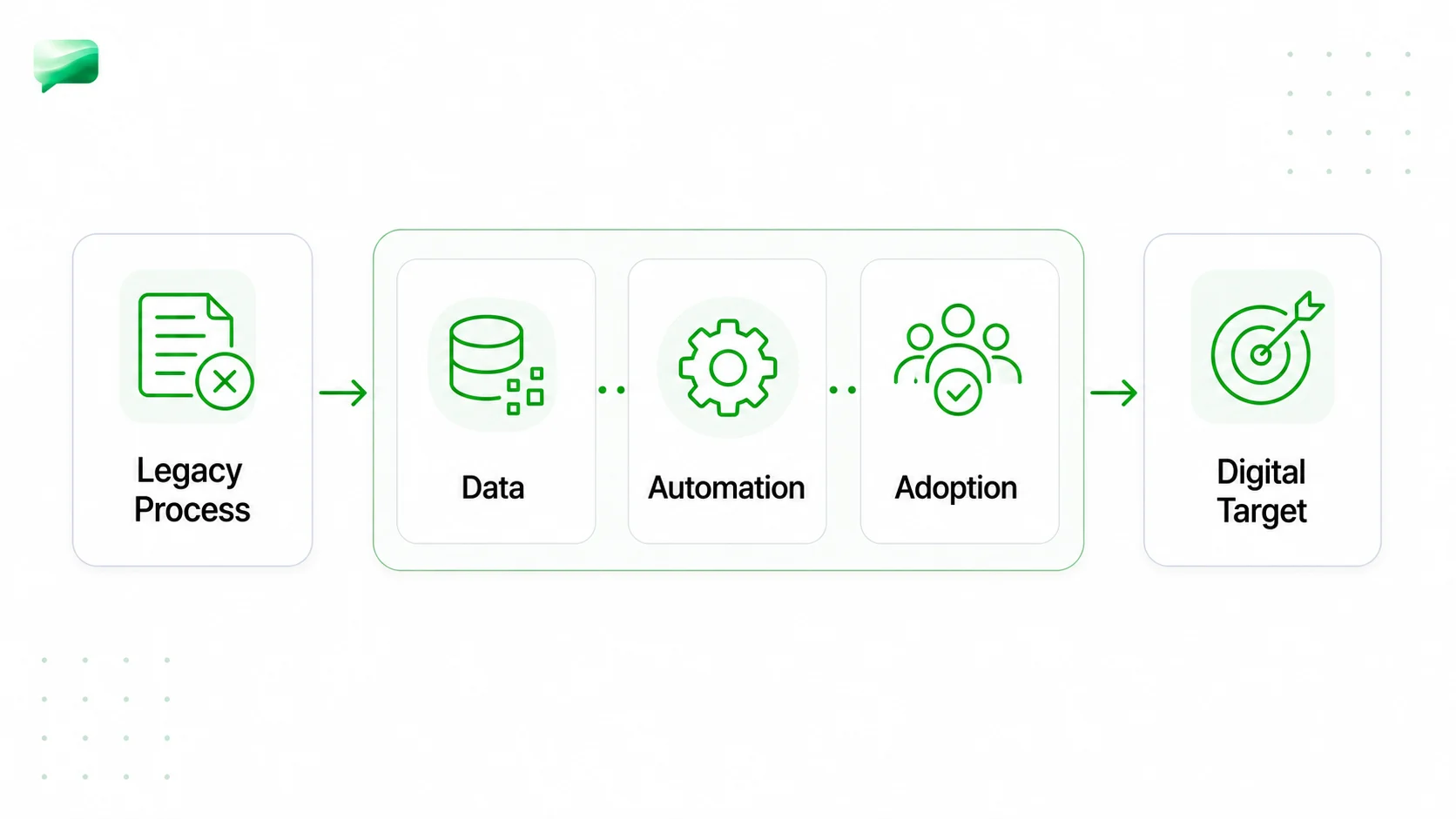
Competitor pages list prompts and stop. Here is one solved start to finish, in the candidate-led style you will actually use.
Prompt: A national retail bank wants to cut its cost-to-serve and improve customer satisfaction by moving routine transactions out of branches and into a new mobile app. Adoption has stalled at 30 percent of customers after a year. The COO asks: why is adoption stuck, and what should we do?
Step 1: Clarify the objective
Ask the gating questions before structuring:
- What does success look like in 18 months, a target adoption percentage, a cost-to-serve reduction, or both?
- What does a branch transaction cost versus an app transaction?
- Which customer segments have adopted, and which have not?
Assume the interviewer confirms: target is 70 percent adoption, a branch transaction costs 4 dollars to serve and an app transaction costs 0.50 dollars, and adoption skews young and urban.
Step 2: Map current vs target state
Today: 30 percent on app, 70 percent in branch, high cost-to-serve. Target: 70 percent on app, lower cost-to-serve, higher satisfaction. The gap is 40 percentage points of customers who could move but have not.
Step 3: Diagnose the gap
Structure the "why adoption is stuck" question into clean buckets:
- Awareness: Do customers know the app exists and what it does?
- Ability: Can they use it (onboarding friction, identity verification, device access)?
- Motivation: Is there a reason to switch (trust, incentives, feature completeness)?
- Experience: Once they try it, does the app actually work (bugs, missing transactions, slow support)?
This people-and-journey lens is more Invent-appropriate than a pure cost tree, because the problem is behavioral and technological at once.
Step 4: Size the levers
Run the math the interviewer wants to see. There are 10 million customers. Moving from 30 to 70 percent adoption shifts 4 million customers to the app.
A 40-point adoption gain is worth roughly 700 million dollars a year in cost-to-serve, before app investment. That number reframes the whole case: this is a large prize that justifies real spend on adoption.
Step 5: Sequence the roadmap
- Quick wins (0 to 3 months): In-branch nudges where staff onboard customers to the app before serving them, plus a simplified identity-verification flow to cut onboarding friction.
- Mid term (3 to 9 months): Close feature gaps for the transactions older and rural segments still visit branches for, and add multilingual and accessibility support.
- Structural (9 to 18 months): Re-skill branch staff toward advisory roles as transactions migrate, and introduce targeted incentives for the slowest-adopting segments.
Step 6: Recommend with risks
Recommendation: The adoption gap is worth about 700 million dollars a year, so the bank should invest aggressively in adoption, led by staff-assisted onboarding and friction removal, sequenced into quick wins then structural change. Risks and mitigations: alienating older customers (keep a branch safety net during transition), app reliability under load (stress-test before pushing volume), and staff resistance (involve branch managers early and tie the re-skilling to clear career paths).

Operations · medium
Practice a real retail supply chain operations case
Matched to this Capgemini Invent guide: a live retail supply chain operations case with an AI interviewer. Free, scored on every step.
What behavioral and fit questions does Capgemini Invent ask?
The recruiter screen and the fit portion of each case test motivation as hard as the case tests structure. Prepare a tight personal pitch and three to four stories.
Expect:
- Why Capgemini Invent? Be specific. Generic "great culture and training" answers fail. Connect to Invent's identity as the strategy, innovation and transformation arm, and name the kind of work that draws you (digital transformation, CX, sustainability).
- Why consulting? A crisp, honest reason that fits your resume narrative.
- Resume walk-through. A clean two-minute story of your path with quantified impact.
- Culture-fit and teamwork stories. Because the group case grades collaboration, have a real story about making a team better, not just leading it.
Build your stories with a clear structure and rehearse them under two minutes each. The behavioral interview for consulting guide covers story structure in depth. Tailor at least one teamwork story specifically to collaboration, since it doubles as evidence for the group round.
How are Capgemini Invent cases different from MBB?
Invent cases are more grounded in real-world operational scenarios than MBB cases. Where McKinsey or BCG might hand you an abstract strategy puzzle, Invent tends to give you a concrete transformation, a cost-benchmarking exercise, or a delivery-optimization problem rooted in how a real organization runs.
If you are also recruiting at technology-and-transformation-led firms, the IBM Consulting case interview guide and the Accenture case interview guide are the closest peers to read alongside this one. All three weight digital transformation and delivery more heavily than pure strategy, so the prep overlaps. To see where Invent sits in the broader landscape, the types of consulting firms overview maps the tiers from MBB down to the transformation specialists.
How should you prepare for Capgemini Invent?
Aim for 15 to 20 practice cases across 2 to 4 weeks. Front-load structure, then volume, then the group format.
Execution checklist
Days 1 to 5: solo foundation (3 to 5 cases). Run 3 to 5 cases alone to lock structure, weighting digital transformation and CX. Use the candidate-led framework above and a baseline Road to Offer case to find your real bottleneck.
Days 1 to 14: math in parallel. Invent cases carry real numbers. Drill cost-to-serve, savings sizing, and percentage shifts daily so the arithmetic never becomes the bottleneck in a case.
Days 6 to 18: partner cases (10 to 15). Run 10 to 15 cases with a partner, covering profitability, cost reduction, market entry, pricing, plus the Invent-specific transformation and sustainability flavors.
Days 10 to 21: rehearse the group format. Get 3 to 5 peers and simulate the group case: 10 minutes reading, 30 minutes discussion, one shared recommendation. Practice structuring, including others, time-keeping, and synthesizing.
Days 14 to 21: behavioral and Why Invent. Build 3 to 4 stories under 2 minutes, including a teamwork story for the group round, and write an Invent-specific 'Why Capgemini Invent' answer.
Final days: full-loop simulation. Simulate a recruiter screen, an individual case, and a group case in one sitting to build stamina and tighten synthesis under pressure.
Practice drills: Invent-style transformation math
Interactive drill set. Write an answer before revealing the worked solution, then continue into Road to Offer for scored practice and AI feedback.
Sharpen the underlying speed with the mental math for case interviews guide before your loop.
Common mistakes and FAQ
1. Prepping generic Capgemini, not Invent. The biggest error. You walk in with profitability templates and get a digital transformation case. Reframe your prep around transformation, CX and sustainability.
2. Dominating the group case. Talking the most loses. Interviewers grade collaboration and leadership together. Structure, include others, keep time, synthesize.
3. Skipping structure in the candidate-led round. Jumping into analysis without an issue tree reads as junior. Take 60 to 90 seconds, build a tailored structure, present it, then drive.
4. No numbers behind the transformation story. Invent expects quant. Size the prize even with rough assumptions.
5. A copy-paste "Why Invent" answer. Generic motivation fails. Name the transformation and innovation focus that actually draws you.
The skills assessed across the whole loop are consistent: structured problem solving, quantitative and qualitative analysis, clear communication, thinking under pressure, and holistic risk-and-mitigation thinking. Every stage, including the group case, is scored against some combination of those.
Rehearse the candidate-led and group formats
Run a free Invent-style transformation case to benchmark your structure, math, and synthesis before your Capgemini Invent loop.
Sources and further reading (checked June 26, 2026)
- CaseBasix, Capgemini case interview guide
- MyConsultingOffer, Capgemini case interview prep
- PrepLounge, Capgemini firm profile
Frequently asked questions
Resources and related guides
- Practice for Capgemini Invent in a real case interviewPractice
- Browse all free resourcesResource hub
- West Monroe Partners Case Interview: Format, Case Types, and Prep Guide (2026)Firm Specific · Mar 31, 2026
- BCG vs Bain: 10 Real Differences (2026 Guide)Firm Specific · May 1, 2026
- Accenture Internship 2026: Salary, Eligibility, and Interview GuideFirm Specific · May 22, 2026