
McKinsey PEI: The 4 Dimensions, Stories, and Prep Plan (2026)
McKinsey PEI questions explained: the 4 dimensions, sample stories with quantified results, follow-up probes, red flags, and a 4-week prep plan.
Your first interview question
Get your full coached feedback now. Continue the interview free after sign-up.

On this page
The 4 most common McKinsey PEI interview questions test one dimension each: Leadership ("Tell me about a time you led a team"), Connection ("Describe a time you changed someone's mind"), Drive ("Tell me about a time you took initiative"), and Growth ("Describe a difficult change you drove"). Each PEI session runs 10-15 minutes with 3-5 follow-up probes per story, accounts for roughly 50% of your overall interview score, and rewards specific stories with quantified outcomes far more than rehearsed-sounding traits, according to McKinsey's official careers page. PEI stands for Personal Experience Interview, so "PEI interview" and "McKinsey personal experience interview" mean the same thing.
What is the McKinsey PEI?
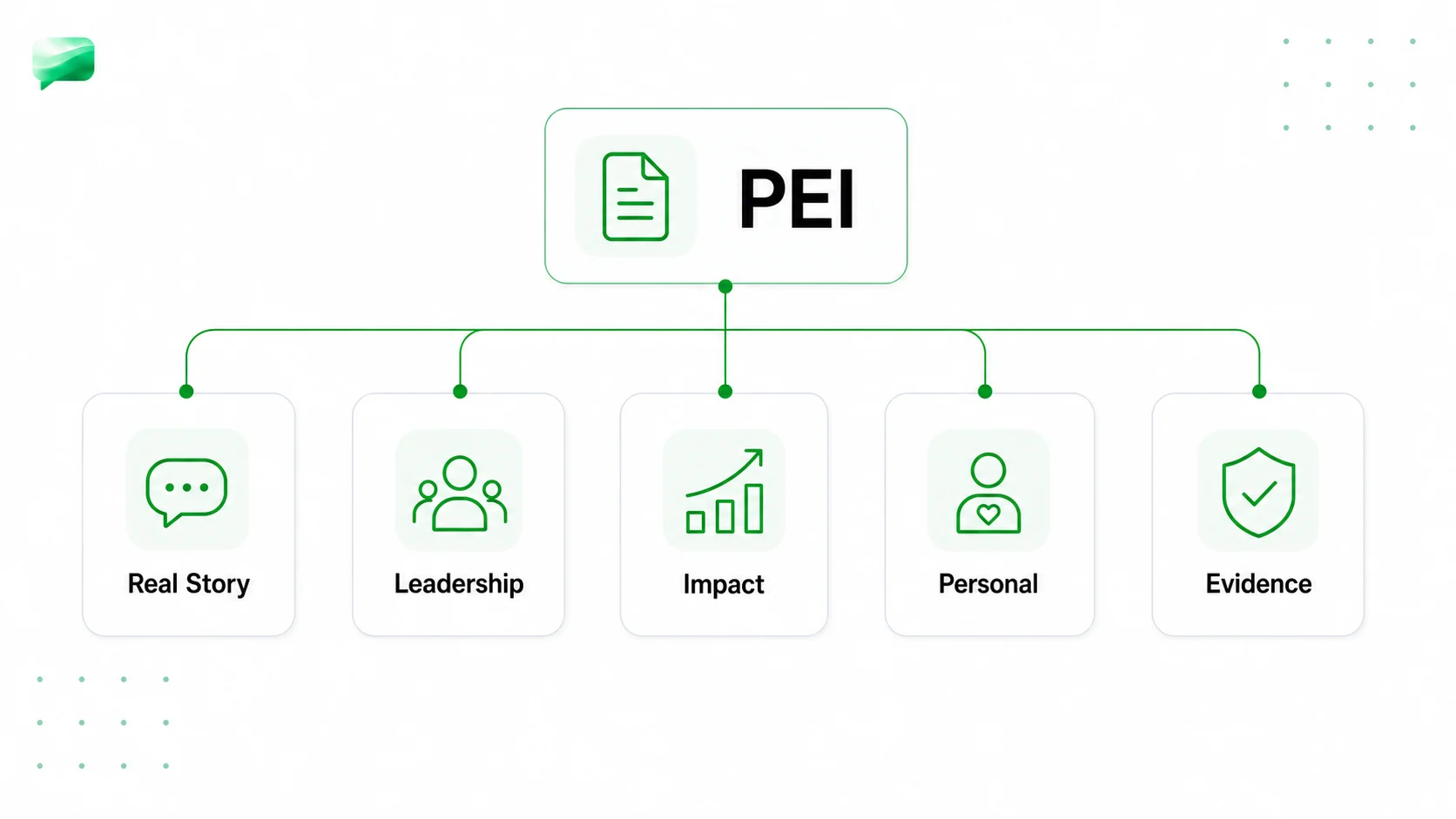
The PEI (Personal Experience Interview) is McKinsey's behavioral interview component. It is not a warm-up. It is a structured evaluation where interviewers assess how you have behaved in real past situations, using your own stories as evidence.
The PEI is completely separate from the case. The case tests analytical problem-solving on a hypothetical business scenario. The PEI tests whether you have actually demonstrated the leadership and impact qualities McKinsey expects from its consultants. Both halves matter equally.
PEI timing and weighting (memorize these numbers):
- PEI occupies the first 10-15 minutes of each McKinsey interview (McKinsey interviewing guide).
- Each session focuses on one dimension chosen by the interviewer.
- PEI accounts for roughly 50% of the overall evaluation, not secondary to the case (Management Consulted analysis).
- You will face PEI in every round (first round and final round).
That 50% weighting surprises most candidates. You can nail every case and still get rejected if your PEI stories are vague, rehearsed-sounding, or lack genuine reflection. Given the McKinsey package in our 2026 Consulting Salary Report, underprepping the behavioral half is expensive. Treat PEI prep with the same rigor as case prep, and budget equal time on your consulting interview prep timeline.
Your interviewer will ask:
“Tell me about a time you led a team through a difficult situation.”
“Describe a time you had to change someone's mind without authority.”
“Tell me about a time you took initiative when success wasn't guaranteed.”
What are real-world examples of McKinsey PEI questions?
Below are the prompts you should expect in each PEI session, mapped to the dimension they test. Most interviewers state the dimension out loud ("Now I want to ask about a time you led a team"), so listening to the prompt is half the battle.
Leadership questions
- "Tell me about a time you led a team through a difficult situation."
- "Describe a time you turned around an underperforming team or project."
- "Walk me through a time you delegated a critical piece of work to someone less experienced."
Connection questions
- "Tell me about a time you changed someone's mind on an important decision."
- "Describe a time you had to influence a stakeholder without formal authority."
- "Walk me through a time you aligned a group with conflicting priorities."
Drive questions
- "Tell me about a time you took initiative without being asked."
- "Describe a time you spotted an opportunity others missed and drove it to a result."
- "Walk me through something you built or improved from scratch."
Growth questions
- "Tell me about a time you drove change despite resistance."
- "Describe a time you took a significant risk that could have backfired."
- "Walk me through a setback or failure and what you specifically learned from it."
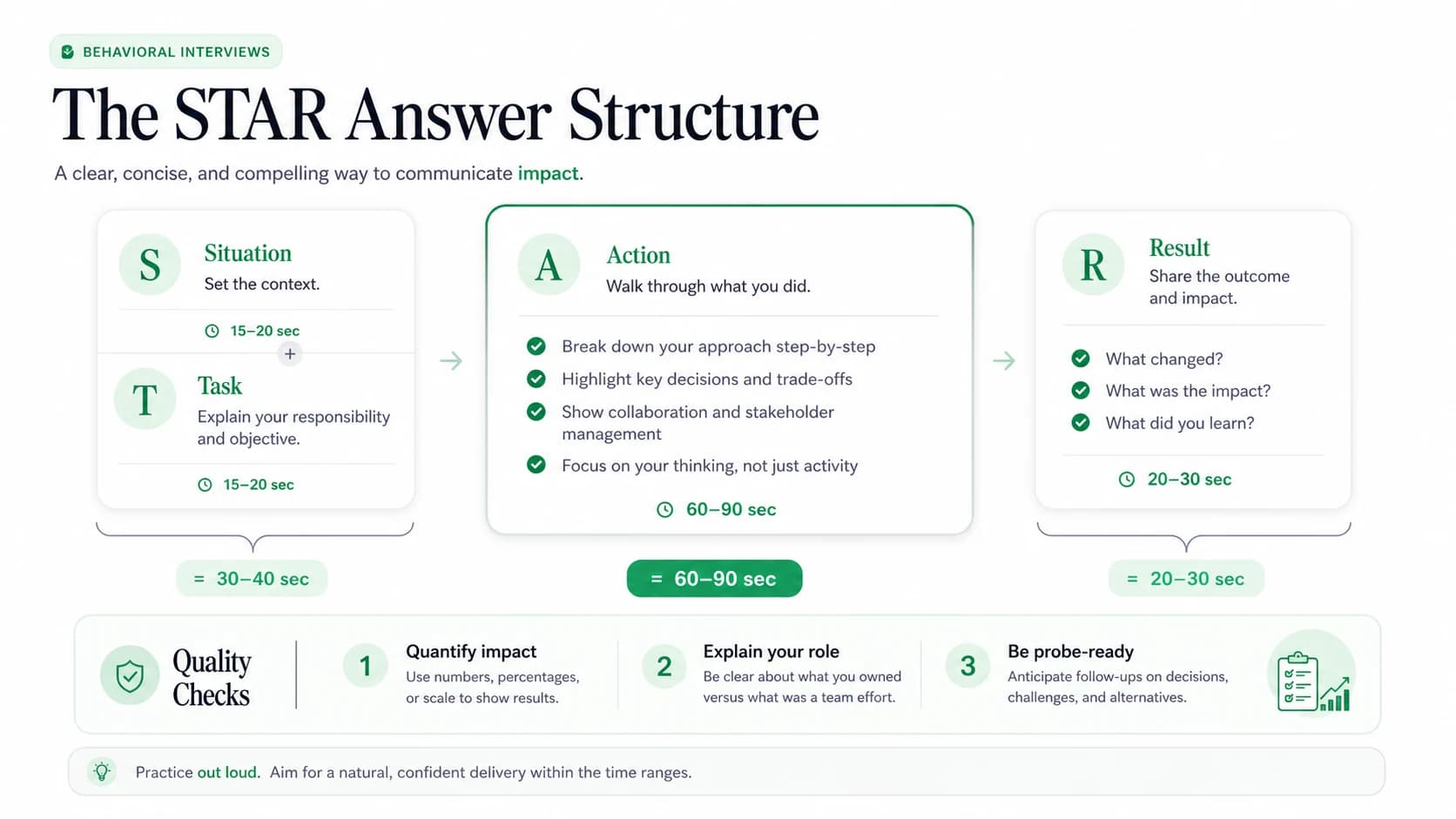
Learn the behavioral method
STAR that survives probing, linked to the live AI interviewer.
What are the 4 McKinsey PEI dimensions?
According to McKinsey's careers page and confirmed in the firm's summer 2025 dimension rename, the PEI evaluates 4 dimensions: Leadership, Connection (formerly Personal Impact), Drive (formerly Entrepreneurial Drive), and Growth (formerly Courageous Change / Learning & Development). These are the labels used in McKinsey offices globally as of 2026. For a full question bank organized by these dimensions, see the McKinsey PEI questions guide.
McKinsey PEI Dimensions
- 01
Leadership. Setting direction, mobilizing a team, delivering through others
- 02
Connection. Influencing without authority, changing minds, building alignment
- 03
Drive. Taking initiative, owning outcomes, building something from scratch
- 04
Growth. Driving change despite resistance, learning from failure, adapting
Leadership
Situations where you set direction, delegated effectively, or mobilized a team toward a goal. The interviewer wants to see that you did not just participate. You drove.
Example contexts: leading a cross-functional project, turning around a struggling team, launching a student organization, coordinating volunteers for a large event.
Connection
Situations where you changed someone's mind or drove a decision without being in charge. This dimension specifically tests influence without formal authority.
Example contexts: convincing a skeptical client or stakeholder, aligning a group with competing interests, pushing through an unpopular but correct recommendation.
Drive
Situations where you identified an opportunity, took ownership, and delivered a result, especially when nobody asked you to. Initiative and resourcefulness matter more than scale.
Example contexts: starting a side project or business, improving a broken process, hitting an ambitious target when success was in doubt.
Growth
Situations where you drove change despite resistance, took a risk that could have backfired, or learned meaningfully from failure. McKinsey wants to see you can operate outside your comfort zone and reflect honestly on the outcome.
Example contexts: proposing a controversial strategy shift, leading an unpopular organizational change, recovering from a significant setback.
How do you structure a McKinsey PEI story?
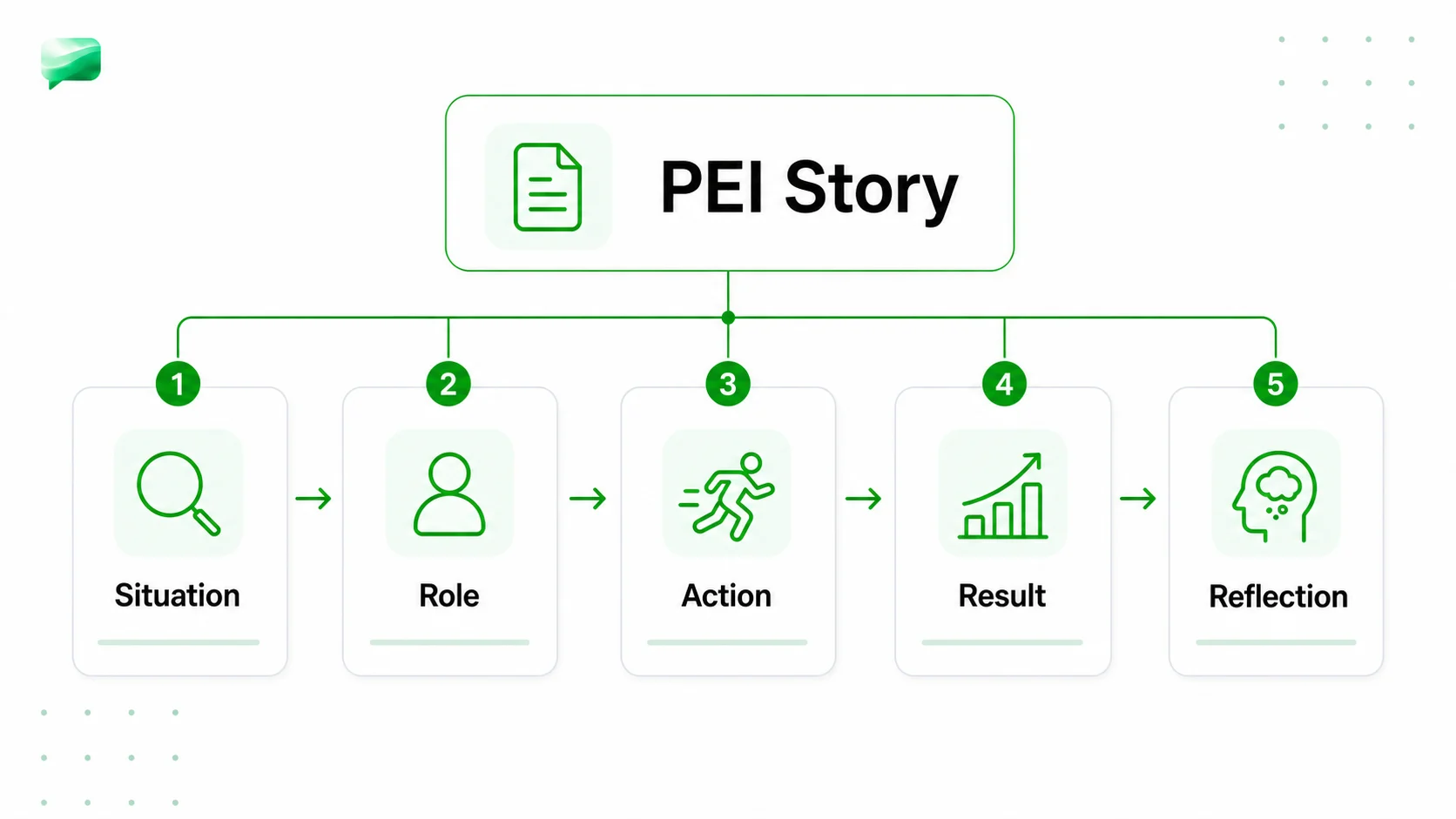
Use a 5-part structure that keeps your story focused and easy to follow. Barbara Minto's Pyramid Principle (Minto International, 2021) applies: lead with the headline (what happened and why it matters), then build the supporting detail. This approach is also recommended by PrepLounge's fit interview guide for behavioral questions across consulting firms.
- Situation: Brief context. Who, what, when, why it mattered. Two to three sentences max.
- Your role: What you were specifically responsible for. Not the team's job, your job.
- Actions: What you personally did, in concrete steps. Not "I worked hard," what you actually did.
- Obstacles: What got in the way and how you handled it. This is where depth and authenticity show.
- Outcome: What changed. Numbers or facts. Then one sentence of genuine reflection.
Keep each story to 1.5-2 minutes for the initial telling. The interviewer will ask follow-ups; that is where you go deeper. Do not front-load every detail. Once a story is structured, rehearse it live with the PEI simulator to see how the follow-up probes actually land.
Mapping to STAR. Many candidates know the STAR framework (Situation, Task, Action, Result) from behavioral interview best practices (Indeed career guide). For consulting-specific STAR upgrades and worked examples, see the STAR method for consulting interviews guide. Here is how this 5-part structure maps:
What does a full McKinsey PEI answer look like?
Question: "Tell me about a time you led a team through a difficult situation."
Here is a complete, written-out answer, the kind you would actually deliver in an interview:
In my third year at a mid-size e-commerce company, I led a team of five to redesign our returns process, which was costing us $2.1M annually in logistics and customer service overhead. The challenge was that three departments (warehouse ops, customer support, and finance) each owned a piece of the returns flow, and none of them agreed on what was broken or who should change.
I took three actions. First, I mapped the end-to-end returns journey with data from all three teams, which revealed that 40% of return-related support tickets came from a single issue: customers could not track their refund status. Second, I organized a joint working session where I presented the data and proposed a phased plan: fix the refund tracking gap in month one, then tackle warehouse processing time in month two. I deliberately let each team lead own their piece of the solution rather than dictating changes. Third, I set up a weekly 15-minute sync with one metric per team (support ticket volume, average processing days, and refund error rate) so progress was visible and accountable.
The main obstacle was the finance team's initial resistance. Their director felt the project implied his team was underperforming. I addressed this by meeting with him one-on-one, reframing the project as a cross-functional efficiency win rather than a blame exercise, and making sure his team's quick wins were highlighted in the first progress update to leadership.
Within three months, return-related support tickets dropped 62%, average refund processing time went from 11 days to 4, and we reduced annual returns costs by roughly $800K. Looking back, the key lesson was that alignment matters more than speed. I could have pushed harder in week one, but investing time to get buy-in from the finance director made the rest of the project dramatically smoother.
For the drill-level practice system (story matrix, probe levels, self-scoring), see the McKinsey PEI practice guide.
How many PEI stories should you prepare?
Showing up with one good story per dimension is not enough. Interviewers in different rounds will ask about different dimensions, and you may need to pivot if a story does not fit the exact angle they are probing.
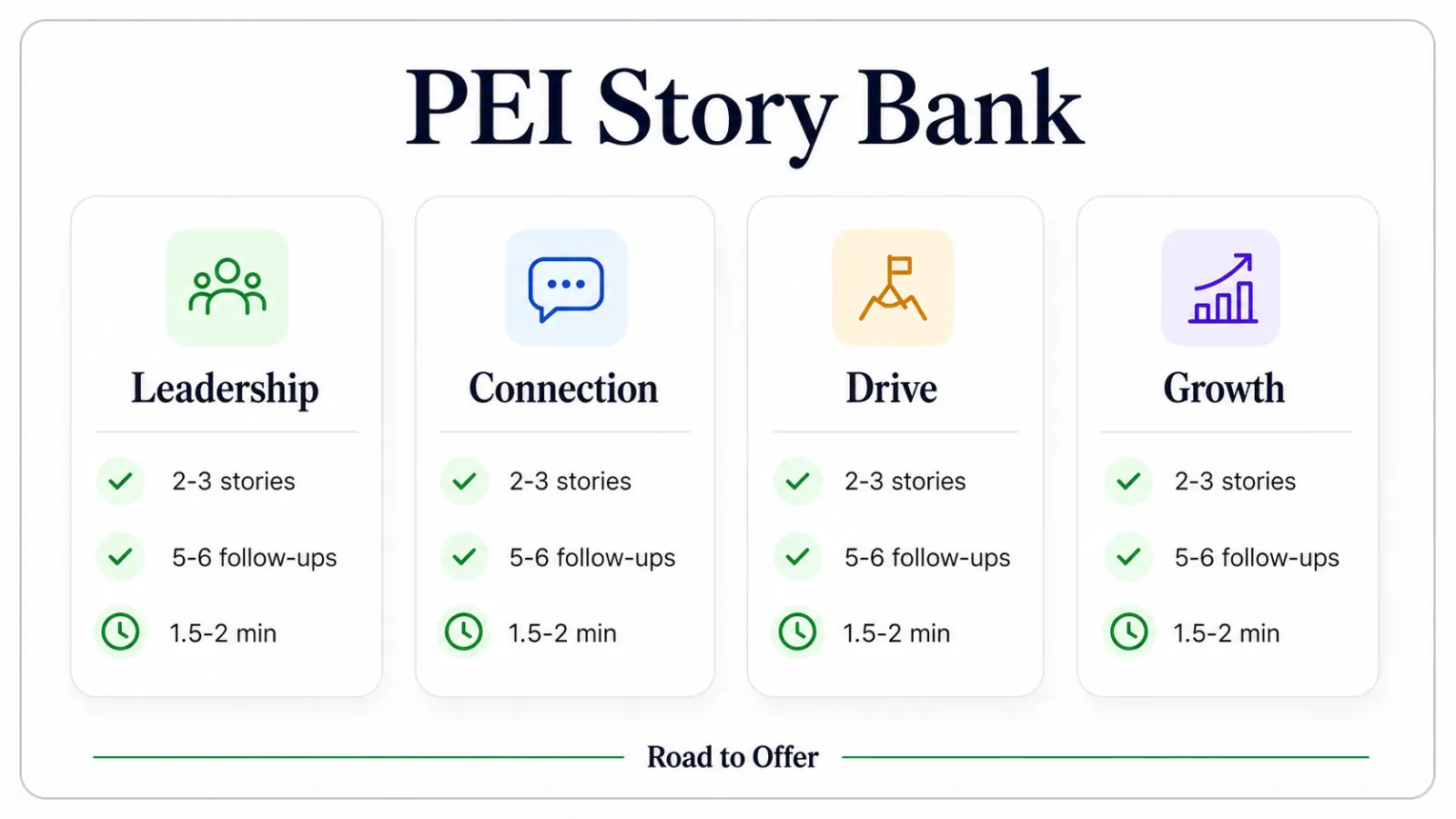
Prepare 8-12 stories total, roughly 2-3 per dimension, as recommended by IGotAnOffer's McKinsey PEI guide and Management Consulted's PEI analysis. Here is the system:
- Recency: Use stories from the last 2-3 years. Anything older than 5 years feels stale and raises questions about why you do not have more recent examples (PrepLounge fit interview guide).
- Diversity: Pull from multiple contexts (work, academic projects, extracurriculars, volunteer leadership). Do not have all five stories come from the same internship.
- Flexibility: Each story should be adaptable to at least 2 dimensions. A story where you led a project and influenced a resistant stakeholder can serve both Leadership and Connection.
- Depth: For each story, prepare answers to 5-6 common follow-up questions (see the follow-up section below). The initial story is the opening, but the follow-ups are where you win or lose.
- Timing: Practice delivering each story in 1.5-2 minutes. Record yourself. If you are over 2.5 minutes, cut context and tighten action steps.
What are the common McKinsey PEI red flags?
How do you prepare for PEI follow-up questions?
The initial story is the foundation. The follow-ups are where interviewers really evaluate you. Expect 3-5 follow-up questions per story, probing for depth, reflection, and authenticity.
For each prepared story, have answers ready for:
- "What did you learn?" One specific, non-generic takeaway. Not "I learned communication matters" but "I learned that presenting data before asking for commitment reduces resistance by making the ask feel evidence-based, not political."
- "What would you do differently?" One honest change with hindsight, without disowning the outcome. Shows growth, not regret.
- "How did you manage conflict?" How you addressed disagreement or resistance, specifically. What did you say? What was their response?
- "What was the hardest trade-off?" A real choice you made and why. Two viable options, and why you picked one.
- "How did you influence without authority?" How you got buy-in when you were not the decision-maker. Tactics, not abstractions.
- "How did others react?" Specific feedback or response you received. Bonus if you can quote someone.
The complete consulting prep toolkit bundles probe lists, story-bank worksheets, and case frameworks in one place. If you are still choosing between a workbook, question bank, or live rehearsal, the behavioral interview resources comparison maps each bottleneck to the closest resource.
Want to drill McKinsey PEI questions live?
Interactive drill set. Write an answer before revealing the worked solution, then continue into Road to Offer for scored practice and AI feedback.
What is the best 4-week McKinsey PEI prep plan?
Here is the sequence that works, mapped to a consulting interview prep timeline:
- Week 1: Brainstorm 15-20 candidate stories from the last 3 years. Tag each with potential dimensions.
- Week 2: Narrow to your best 8-12. Write out each using the 5-part structure. Fill in the story bank template for every one.
- Week 3: Practice delivering each story out loud in 1.5-2 minutes. Record yourself and check for red flags (rehearsed tone, "we" instead of "I," vague results). Use the live PEI simulator to pressure-test follow-up probes before the real interview.
- Week 4: Run mock PEI sessions with a partner or the live PEI simulator. Practice pivoting stories to different dimensions. Drill follow-up questions until your reflection answers feel natural, not memorized.
Pair PEI prep with case practice. See our case interview examples for full worked cases, McKinsey practice cases for interviewer-led reps, and how to practice case interviews for daily session structure, so both halves of the McKinsey interview get equal attention.
Related guides
Build a complete McKinsey prep strategy covering both PEI and case:
- McKinsey case interview guide: the case half of the McKinsey interview alongside this PEI guide.
- BCG case interview guide: how BCG's behavioral approach differs from McKinsey's PEI.
- Bain case interview guide: Bain's deeper behavioral interview format and culture-fit evaluation.
- Behavioral interview consulting: broader behavioral interview prep across firms.
- Case interview fit questions: the 30 most common fit questions across McKinsey, BCG, and Bain.
- Why consulting answer guide: the motivation question framework for McKinsey and all MBB firms.
- What motivates you: how to answer the motivation question in a way that maps to McKinsey's Drive dimension.
- Tell me about a failure: a dedicated playbook for the setback-and-learning story the PEI Growth dimension probes.
- Case interview cheat sheet: the case half of your McKinsey prep, condensed.
Sources and Further Reading (checked June 17, 2026)
- McKinsey interviewing resources: https://www.mckinsey.com/careers/interviewing
- McKinsey application process: https://www.mckinsey.com/careers/students
- Management Consulted PEI guide: https://managementconsulted.com/mckinsey-pei/
- IGotAnOffer McKinsey PEI guide: https://igotanoffer.com/blogs/mckinsey-case-interview-blog/mckinsey-pei-how-to-impress-your-interviewer
- PrepLounge fit interview bootcamp: https://www.preplounge.com/en/bootcamp.php/fit-interview
- Indeed STAR method guide: https://www.indeed.com/career-advice/interviewing/how-to-use-the-star-interview-response-technique
- Barbara Minto, The Minto Pyramid Principle (Minto International, 2021), referenced for story structure and leading with the answer.
Frequently asked questions
Resources and related guides
- Practice a real behavioral interviewPractice
- Browse all free resourcesResource hub
- McKinsey PEI Practice: Story Matrix, Probes, and Rubric (2026)Firm Specific · Jul 23, 2026
- McKinsey PEI Questions: 30+ Practice Prompts (2026)Firm Specific · Apr 28, 2026
- BCG Behavioral Interview Questions: 18 Prompts With Worked Answers (2026)Firm Specific · Jul 31, 2026