
Kearney Case Interview Guide: Format, Examples & Prep Plan (2026)
Kearney / A.T. Kearney case interview guide: role-specific format, operations-heavy practice, possible written case, worked examples, and a 6-week prep plan.
On this page
This Kearney case interview guide also covers the A.T. Kearney search variant. Interview format, round count, timing, and any written exercise vary by office and role. Use the current invitation as the source of truth. For preparation, operations, supply-chain, procurement, and implementation cases are useful practice themes, but Kearney does not publish a universal applicant funnel or cross-firm quantitative weighting.
Kearney Practice Cases at a Glance
How a Kearney case works: expect an operations problem with an executable answer: a supply chain, a plant, a procurement bill or a distribution network, ending in initiatives you would actually fund. Format, round count and any written exercise vary by office and role, and third-party reports disagree on whether you or the interviewer lead, so confirm the format from your invitation and practise both.
Start free now: Bumpers R Us is a Kearney-style operations case: an automotive bumper supplier's delivery lead time has slipped, and its main customer is threatening fines. It has 7 questions, 2 with math, 2 exhibits, and fewer than 10 completed runs so far, so no median time yet. A voice AI interviewer runs it out loud, shows the exhibit when you ask for data and scores seven categories. Your first full case is free when you create an account; the worked excerpt below runs its lead-time math. A free account also gets one full run in every simulator inside the app: one complete run of each of our four McKinsey Solve practice formats (Red Rock, Sea Wolf, SFL Classic and SFL Island), a full Casey-style case, a full CCA-style diagnostic and a complete Bain SOVA-style diagnostic.
For Solve, start without an account, then create a free account to finish and keep your score, points breakdown and worked feedback on submitted decisions, with no payment for the first run or its worked review. Visual explanations include Red Rock calculations and charts, Sea Wolf constraints and treatments, Classic decision and dependency diagrams, and Island evidence chains, placement maps and team feedback. Paid Learning mode coaches you step by step across all four formats, untimed in clocked games, with the matching game pack, Solve pack or Annual access. A free account also saves a free Solve plan with dated practice steps chosen for your invitation length and test date, up to 28 days.
Bumpers R Us (adapted from the Duke Fuqua consulting club casebook) is the only Kearney case in the library of 71. The other three are operations practice cases in other firms' styles (Packaging Plant Consolidation is adapted from the Wharton consulting club casebook), a distribution center, a plant and a consolidation, and the style column says which. Every debrief scores seven categories: structure (25% of the score), quantitative analysis (20%), business judgment (15%), and problem understanding, exhibit reading, communication and synthesis (10% each), with feedback on every question. Median times come from completed runs between June 25 and September 22, 2026, and count runs, not people.
What Kearney Is and Why It Matters for Interview Prep
Kearney (formerly A.T. Kearney) is a global management consulting firm with particular strength in operations, procurement, and supply chain strategy. The firm advises manufacturers, retailers, and industrial companies on how to actually execute strategy, not just design it. That orientation toward implementation shapes how they interview.
According to Kearney's official careers page, the firm looks for candidates who can "use imagination, gather and analyze information, arrive at solid conclusions, and communicate persuasively." That description could apply to any consulting firm. What makes it Kearney-specific: the case content will test whether you can think through the operational mechanics of a recommendation, not just the strategic logic.
For the fit and what-drives-you portion, pair this with the Kearney behavioral interview questions guide.
Practice operations cases with AI feedback
Kearney cases are quantitative and implementation-focused. Road to Offer gives you AI-scored feedback on your structure, math, and synthesis instantly.
The Kearney Interview Process: Round by Round
Application and Resume Screen
Kearney does not publish a universal resume-screen rejection rate. Build a polished resume with quantified impact and clear consulting-relevant signals without assigning an unsupported probability to the screen.
One Possible Early-Round Format
Some candidate reports describe two case interviews in an early round. Treat the following as a practice scenario only and use the invitation for the actual interview count and timing:
Prepare to discuss fit and personal experience alongside the case, but do not assume a fixed interviewer seniority, segment length, or sequence.
For this practice scenario, use a mid-complexity operations prompt such as industrial cost reduction, procurement consolidation, or logistics profitability. The actual case topic comes from the invitation and interviewer.
Possible Later-Round Components
These possible components require different preparation from a conversational case:
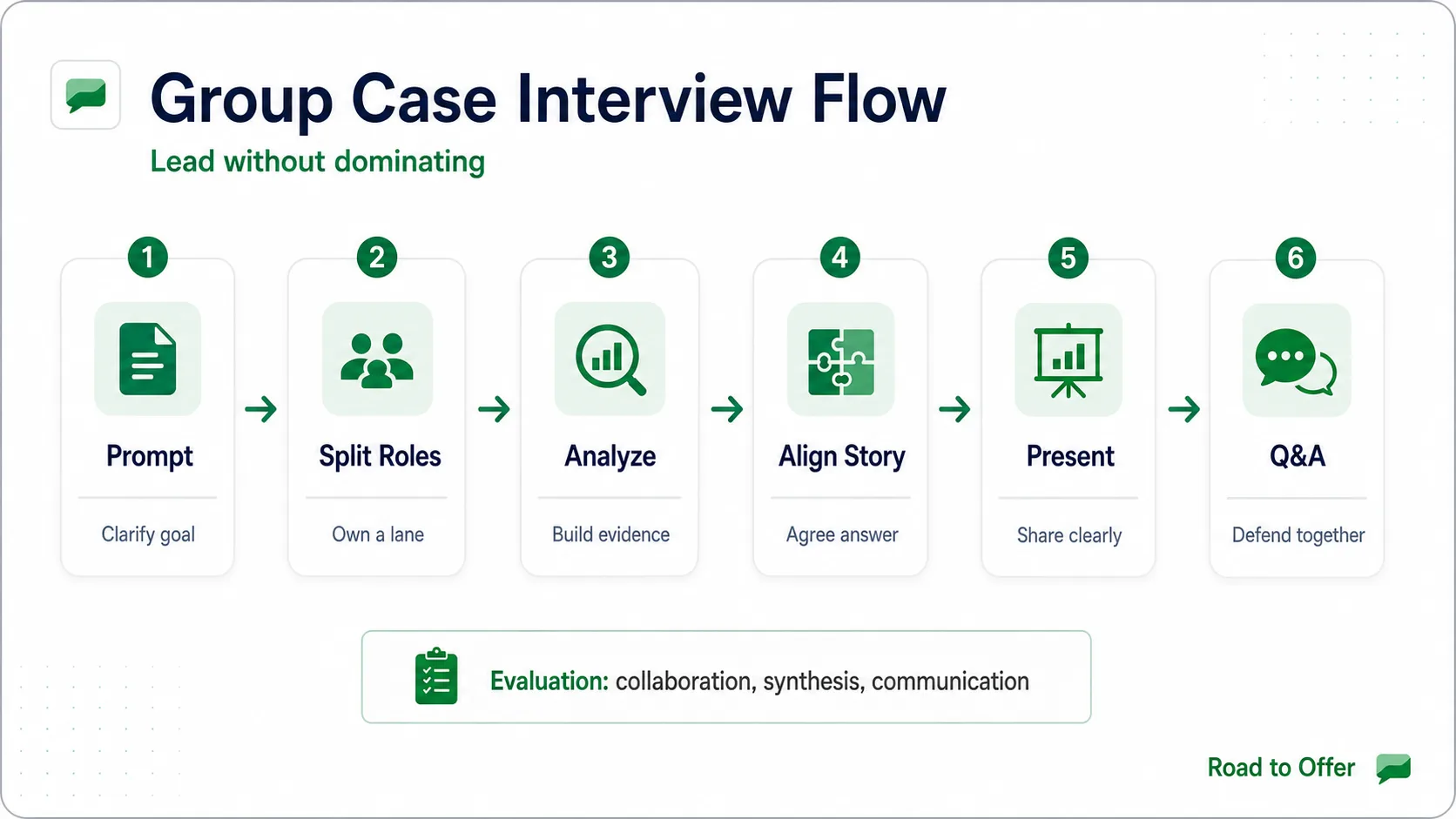
For undergraduates: Some invitations may include group or assessment-centre exercises. Confirm whether yours does and use our group case interview guide when relevant.
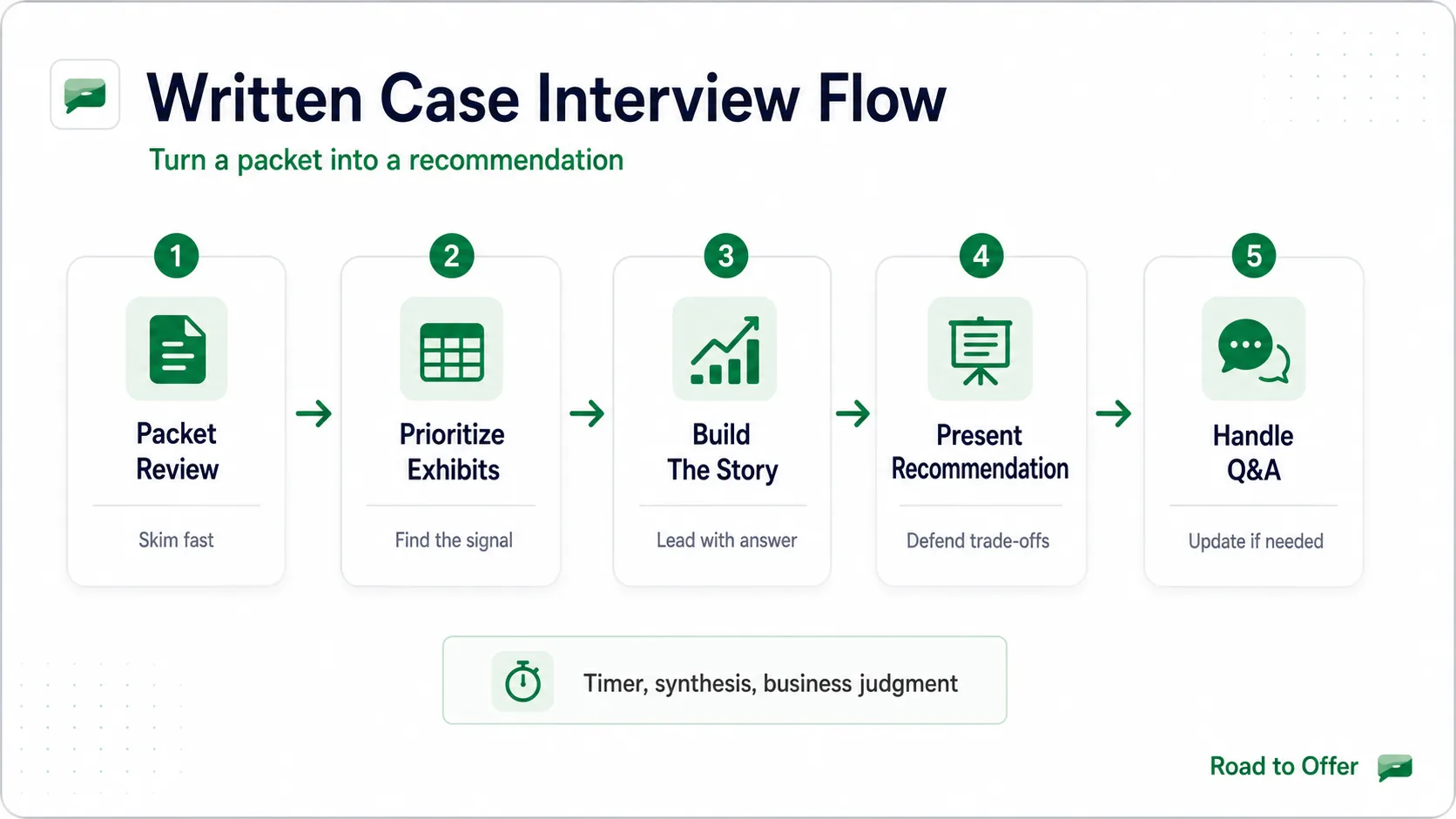
For MBA and experienced hires: Later-round components vary. If your invitation includes a written case, use the allotted time and required output in that invitation to prepare a presentation-style recommendation. This is structurally similar to a written case interview, but the packet, timing, interview count, and interviewer seniority are role- and office-specific.
If a written case is listed, practice building slide-ready structures under the same time limit rather than assuming a universal 60-minute exercise.
How should you align your Kearney resume and cover letter before this interview?
Keep this as a light firm bridge, not a separate resume guide. Show structured problem solving, implementation, teamwork, and a result only where the target role and your evidence support them.
- Before: Supported a strategy project.
- After: Structured the operating question, compared two options, and prepared the recommendation adopted in the sponsor review.
Check that the role and office language are current and that the result can survive follow-up. Recruiters read the resume and cover letter together: the resume proves the evidence, while the letter explains why Kearney and the target practice. Rehearse the revised line against the guide's operations-case sequence.
Tighten the evidence behind the practice fit
Drop the resume here for an independent graded report on whether the operations work reads as operations work. Road to Offer's score, not a Kearney one.
Opening resume uploader...
Revise one line, rehearse the matching decision story, and use it in the next case rep.
What Makes Kearney Cases Different
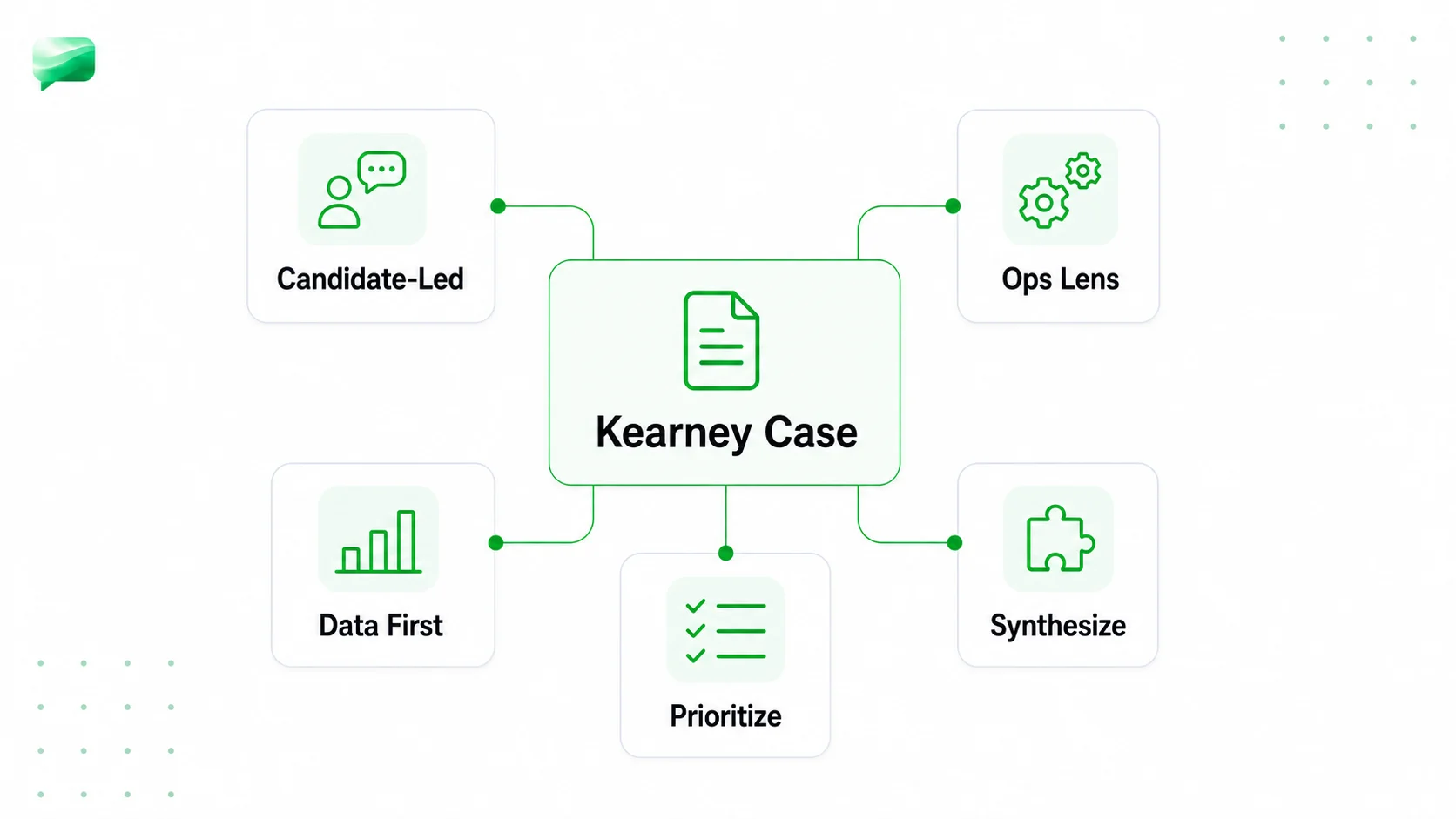
1. Prepare for a Candidate-Led Format When Invited
Third-party guides often describe Kearney cases as candidate-led, but Kearney does not publish one universal format across roles and offices. Confirm the format from the invitation. If it is candidate-led, practice the following mechanics:
In a candidate-led case, you:
- Ask for a moment to structure your approach
- Present a framework before diving into analysis
- Drive which areas to explore (and explicitly prioritize)
- Request data rather than waiting for exhibits to be handed to you
- Synthesize proactively rather than waiting to be prompted
If you've spent significant time on McKinsey PST prep, adjust your expectations. The dynamic is fundamentally different. The BCG case interview guide covers candidate-led mechanics in more detail and applies directly to Kearney.
2. Operations and Implementation Emphasis
Per Hacking the Case Interview's Kearney guide: "Kearney is best known for their work in sourcing, procurement, and operations, so you are likely to see at least one case interview covering one of these areas."
Common case archetypes at Kearney:
- Manufacturing cost reduction (make-vs-buy, plant consolidation)
- Procurement and supplier rationalization
- Distribution network optimization
- Supply chain resilience and risk management
- Operational turnaround (margin improvement through cost and process)
This means the operations and cost optimization framework and value chain framework should be in your standard toolkit before Kearney interviews, not as an afterthought.
Practice this next: Run a free operations case after reviewing the value chain, then use case math drills if procurement savings, unit-cost, or payback calculations slow you down.
3. Quantitative Practice for Operations Cases
Kearney does not publish a comparable cross-firm quantitative weighting. Operations-focused preparation should still include comfort with multi-step calculations such as:
- Calculate the net savings from consolidating three distribution centers into one
- Model the cost per unit difference between offshore and nearshore manufacturing
- Size the procurement savings potential from a supplier rationalization
- Quantify the break-even timeline for a CapEx investment
Kearney's operations cases lean on multi-step calculations more than pure strategy cases do, so mental math speed matters here. The mental math for case interviews guide covers the drills.
4. Implementation Realism Is Rewarded
Generic strategy-level recommendations don't score well at Kearney. The firm's culture treats implementation as inseparable from strategy. CaseLane.ai's guide notes that "supply chain considerations, process optimization, and execution challenges matter deeply."
When you give a recommendation in a Kearney case, your interviewer will probe: "How would you actually do that?" Candidates who can answer at the level of "we'd run a competitive RFP across the supplier base, shortlist three vendors, and pilot with the highest-volume SKUs" will outperform those who stop at "optimize procurement."
Worked Excerpt: Restoring Lead Time at Bumpers R Us
This excerpt runs the two math steps of Bumpers R Us from the table above, with the numbers from its own exhibit and prompts. Find the bottleneck before you read the answer.
The prompt. Bumpers R Us is a Tier-1 supplier of plastic bumpers in the southeastern US. It ships finished bumpers 360 miles by truck to its only customer's plant. Delivery lead time has risen over six months, and the customer has warned of fines and lost contracts. Find the cause and recommend how to restore lead time.
A structure that works. Split internal causes (each process stage, machine time and capacity, labor and shifts) from external ones (customer demand and mix, suppliers, raw materials). Start with the process, stage by stage, because a lead-time problem is a sum of stage times and one stage usually dominates.
The math. Exhibit 1 gives the stage times; transport is 360 miles at 60 mph = 6 hours.
That is 8 hours above the 29 hours the customer used to get, and painting, at 16 hours, is the bottleneck. The general manager can spend up to $5M, and the case lists five fixes. Only one combination recovers all 8 hours within budget: replacing the oldest paint-line robot (3 hours, $3.5M) plus upgrading its software (5 hours, $1.5M), which is 3 + 5 = 8 hours for $3.5M + $1.5M = $5.0M. A third shift also recovers 8 hours but costs $6.5M.
What a strong answer says. "Replace the oldest paint-line robot and upgrade the paint-line software. Together they cut 8 hours, taking lead time from 37 back to the 29-hour target, for exactly the $5M budget. The risks are overruns, maintenance surprises and lost output during installation, so the next steps are competing robot quotes and a confirmed installation plan that protects deliveries while the line is down."
 Kearney
Operations · medium
Practice real Kearney cases
The excerpt covers the lead-time math. The full voice case adds clarifying questions, the brainstorm and the recommendation, each one scored.
Kearney's Official Case Example: Promotional Planning
Kearney publishes one case example on their careers site: the Promotional Planning case. Here's the scenario and a worked answer structure.
Prompt: A national grocery and drug store chain wants to increase sales of promotional items. They're not getting the promotional lift they expect when items go on sale. Diagnose the problem and recommend solutions.
Worked Answer
Clarifying questions to ask:
- What types of promotions are underperforming: specific product categories or promotion mechanics (e.g., BOGO vs. percent-off)?
- What does the client use to measure promotional lift? Against what baseline?
- Are competitors running the same promotions simultaneously?
Structure (2 buckets to explore):
Bucket 1: Demand side. Why aren't shoppers responding?
- Price perception: Is the discount deep enough to drive trial or switching?
- Visibility: Are promotional items placed prominently (end-caps, front of store)?
- Awareness: Are shoppers being reached via circular, digital offers, loyalty app?
- Competitive interference: Are competitors simultaneously discounting similar items?
Bucket 2: Supply side. Can the client execute the promotion?
- In-stock rate: Are promotional items actually on the shelf when shoppers arrive?
- Supplier coordination: Is the supplier providing promotional volume at the right time?
- Store execution: Are individual store managers setting up displays correctly?
Quantitative example (make this concrete):
Suppose the chain runs 500 promotional items per week. If in-stock compliance is only 70%, that means 150 items are either out-of-stock or improperly displayed at any given time. Assuming each out-of-stock item generates 0 promotional lift (vs. a $200 weekly sales lift target per item), that's $30,000/week in missed promotional revenue ($1.5M annually) from execution failures alone.
Recommendation: The primary lever is execution, not price. The client should implement a store compliance scorecard for promotional setups, improve supplier lead times for promotional SKUs, and test deeper discounts on the highest-traffic items before broadening.
Before moving to the next case, work through the demand-versus-supply split yourself using the same promotional planning numbers.
A Second Worked Example: Manufacturing Plant Consolidation
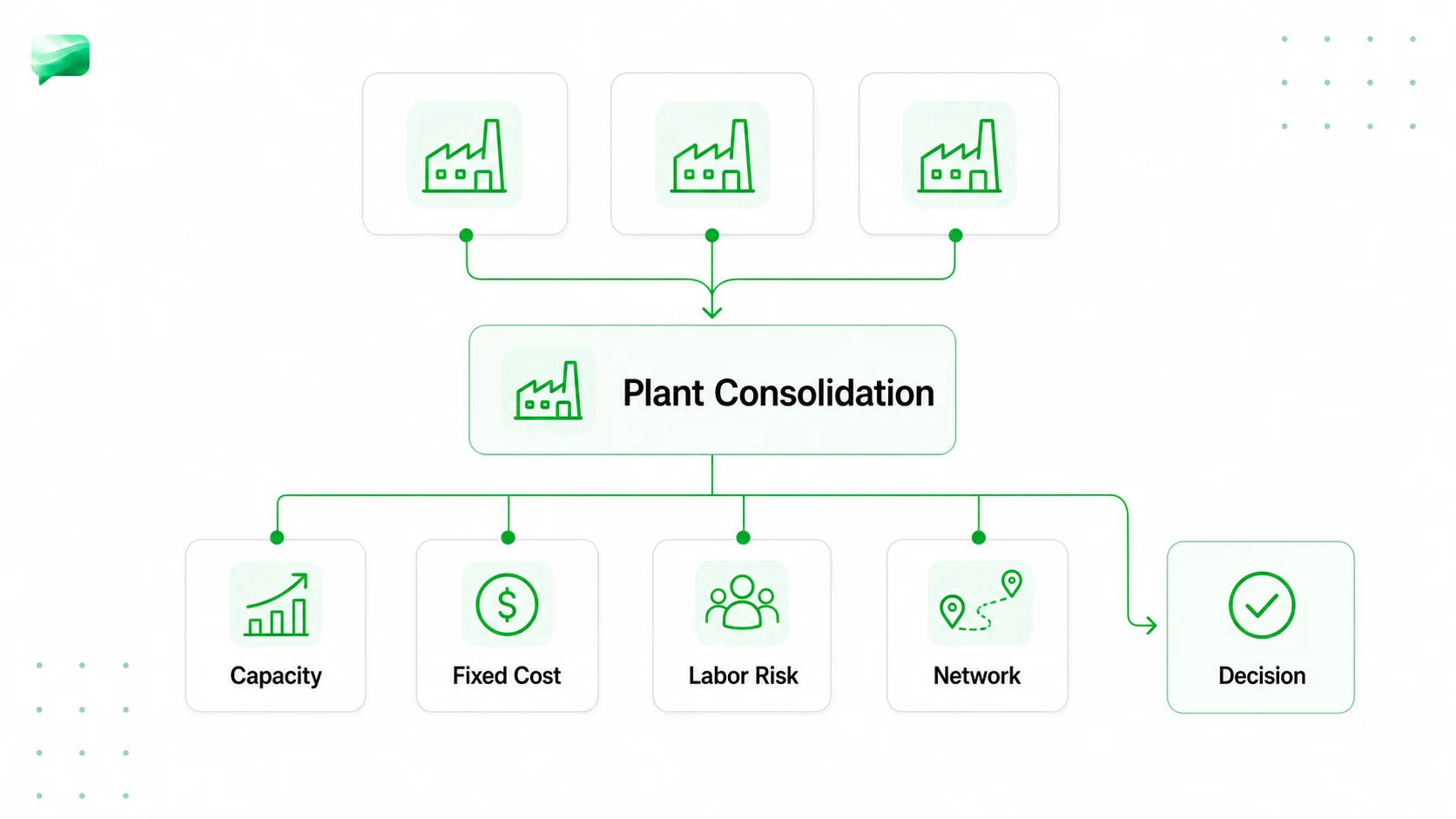
From Kearney's historical casebook:
Prompt: An automotive manufacturer is considering consolidating three East Coast assembly plants into one. Should they do it?
Worked Answer
Clarifying questions:
- What is the combined output capacity of the three plants vs. anticipated demand?
- What are the current cost structures (fixed vs. variable) of each plant?
- Are there labor agreements or union contracts that affect closure flexibility?
- What is the timeline and CapEx budget for the consolidation?
Structure: This is a cost-benefit + risk case.
Benefit side:
- Fixed cost reduction: eliminate duplicated overhead (management, facilities, utilities)
- Labor efficiency: higher utilization rate at a single large plant
- Procurement savings: consolidated purchasing volumes → better supplier terms
- Quality consistency: one production process, one quality system
Cost / risk side:
- CapEx for new or expanded facility
- Transition costs: workforce relocation, severance, training
- Customer service risk: reduced geographic proximity to East Coast customers
- Concentration risk: a single plant is a single point of failure (strike, disaster)
Quantitative framework:
Assume the three plants have combined annual fixed costs of $120M and a consolidated plant would reduce fixed costs to $70M, a $50M annual saving. CapEx for consolidation is $180M. Simple payback period: $180M / $50M = 3.6 years. If Kearney uses a 5-year NPV window and a 10% discount rate, the NPV is approximately $10M positive before accounting for transition costs.
The twist: On adjusted NPV, consolidation barely breaks even. The recommendation should pivot to: "Consolidation is not immediately value-positive given transition costs. We recommend a phased approach: consolidate two of the three plants first, capture $30M in annual savings, and evaluate the third plant's closure based on demand growth."
This is exactly the kind of nuanced conclusion Kearney rewards: not "consolidate" or "don't consolidate," but a specific, data-grounded recommendation with a sequenced action plan.
Run the same consolidation math on a fresh footprint, graded question by question.
Quick Math
- Four plants each carry $45M of annual fixed cost. A consolidated footprint would run at $114M. What is the annual fixed-cost saving, in dollars?
Saving = Current total fixed cost across all plants - Consolidated fixed cost.
- CapEx for the consolidation is $231M and the annual saving is $66M. What is the simple payback period in years? Round to the nearest 0.1 year.
Payback = CapEx / Annual saving.
- The five-year NPV comes to +$61M before transition costs, and transition and severance are $52M. What is the adjusted NPV, in dollars?
Adjusted NPV = NPV before transition costs - Transition and severance costs.
Once the diagnosis and the math both hold up, the next step is running the full case end to end.

Operations · medium
Practice a real retail supply chain operations case
Matched to this Kearney guide: a live retail supply chain operations case with an AI interviewer. Free, scored on every step.
The Five Kearney Case Types, With Example Prompts
Third-party prep guides that catalogue Kearney case examples converge on five recurring case shapes. Hacking the Case Interview's Kearney guide (updated July 6, 2026) lists them with sample prompts, and the pattern matches the archetypes in the firm's historical casebook. Treat the types as practice categories, not a promise about what your interviewer will ask.
Notice how many of these prompts are open questions ("what factors should they consider") rather than a stated target. That phrasing is where candidate-led cases are won or lost: the interviewer is handing you the job of deciding which two or three questions actually matter. The operations case interview guide walks through how to narrow an open prompt into a testable structure.
Kearney Case Interview Example 3: Procurement and Supplier Consolidation
Procurement is the case family most associated with Kearney, and it is the one most candidates practice least. Here is a full worked example.
Prompt: A mid-sized appliance manufacturer spends $600M a year on direct materials across 240 suppliers. A new CPO wants to know how much of that spend can be taken out in 18 months, and how.
Worked Answer
Clarifying questions:
- How is the $600M distributed across suppliers and categories? Is spend concentrated or fragmented?
- Are there switching constraints: qualified parts, tooling ownership, long-term contracts, single-source components?
- Is the target cash savings, margin, or working capital? An 18-month horizon usually means realized savings, not signed contracts.
Structure: three branches, each one testable with data the interviewer can hand you.
- Spend concentration. How much of the $600M sits in categories where fewer suppliers would win better terms?
- Price versus demand. Some savings come from paying less for the same volume, some from buying less (specification changes, SKU rationalization, scrap reduction).
- Feasibility. What share of the theoretical saving can actually land inside 18 months given qualification cycles and contract expiry?
The math. The interviewer gives you the spend split:
Work the first row out loud so the interviewer can follow: $240M of steel spend, 80% of it addressable, is $192M. An 8% negotiated saving on $192M is $15.4M. Repeat the pattern and the program is worth roughly $42M a year, about 7% of total direct spend.
The judgment the number does not carry. Indirect and MRO shows the highest saving percentage and the lowest absolute value. A candidate who ranks by percentage starts with 85 suppliers and $5.4M. A candidate who ranks by dollars starts with steel, where 40 suppliers hold $15.4M. Sequencing by dollars is the answer, and saying why is what separates a Kearney-caliber recommendation from a correct calculation.
Recommendation: Run the program in two waves. Wave one takes steel, metals, plastics, and packaging, roughly $26M of annual saving across 95 suppliers, using a competitive RFP with a 90-day qualification window. Wave two takes electronics and indirect once the first wave proves the process. The main risk is single-source qualification on motors, so run a dual-source pilot on the two highest-volume SKUs in parallel rather than after.
Kearney Case Interview Example 4: Distribution Network Redesign
Prompt: A regional food distributor runs five distribution centers serving 1,200 grocery stores. Freight costs are rising and the CEO asks whether the network should shrink to three larger sites.
Worked Answer
Clarifying questions:
- What service commitment do stores have today, and is next-day delivery contractual?
- What share of total logistics cost is fixed facility cost versus variable outbound freight?
- Is warehouse capacity the constraint, or is it delivery routes and driver hours?
Structure: a network case is a trade between two curves that move in opposite directions. Fewer sites cut fixed cost and inventory; they raise outbound miles and put service at risk.
The math. Current state and proposed state, per year:
A $4M annual saving on a $77M cost base is about 5%. One-time closure and transition costs run $10M, so simple payback is 2.5 years.
The twist the interviewer is waiting for. Ask what happens to the share of stores inside the next-day delivery window. If the three-site network drops next-day coverage from 95% of stores to 82%, the case is no longer a $4M cost question. It is a revenue-risk question: 13% of 1,200 stores is 156 accounts whose service quality falls, and losing even a small share of those undoes the saving.
Recommendation: Consolidate from five sites to four rather than three. Closing the two lowest-throughput sites and expanding one captures most of the fixed-cost benefit while holding next-day coverage above 90%. Validate the freight model against actual route data before committing, and re-evaluate the fifth closure once volume growth changes the density math.
Network and procurement cases live or die on clean multi-step arithmetic under time pressure. Get one graded before your interview rather than after.
For more reps in the same family, the supply chain case interview guide and case interview math practice cover the calculation patterns that repeat across operations cases.
Where to Find Official Kearney Practice Cases and the Kearney Casebook
Candidates searching for a Kearney case interview PDF are usually looking for one of four things. Here is what each source actually contains, and what to do after you finish it.
Two cautions on the casebook PDFs. First, the cases circulating under Kearney's name are years old, so treat the industry facts inside them as case data rather than current market truth. The reasoning pattern is the part that transfers. Second, reading a solution is not practice. The measurable gap between candidates who read fifteen worked cases and candidates who solved five out loud is not close, and only one of those groups can hold a structure under interruption.
Self-Diagnostic: Are You Ready for a Kearney Case?
Run this before you book mock interviews. Each item is a pass or fail on evidence, not on how prepared you feel. Candidates rate the Kearney interview at 3.51 out of 5 for difficulty on Glassdoor across 579 reported interviews, with the process taking roughly 33 days end to end according to the same 2026 data, so there is usually time to close a gap you find now.
Kearney readiness self-check
You can structure an open prompt in under 90 seconds. Given only 'what factors should they consider', you produce two or three prioritized branches and say which you would test first. If your structure is a list of everything, run scored structure drills.
You can carry a four-step calculation without notes from the interviewer. Spend times addressable share times saving rate times realization, out loud, with the running number stated at each step. If this is where you slow down, use the mental math guide and timed reps.
You rank levers by absolute value, not by percentage. The procurement example above is the test: the highest saving percentage was the smallest prize. Re-solve it and check which wave you sequenced first.
Your recommendation names an action, an owner, and a timeline. 'Consolidate suppliers' fails. 'Run a competitive RFP across steel and plastics in 90 days, targeting $26M' passes. Rehearse this on a full graded case.
You can name a second-order risk before the interviewer does. Service coverage in the network case, qualification risk in the procurement case. If you only surface risks when prompted, practice ending every case with one unprompted caveat.
Your 'Why Kearney' answer survives one follow-up question. Say it out loud, then answer 'why not a competitor with the same operations practice'. Build the evidence with the Kearney behavioral questions guide.
Fail two or more of these and mock interviews will mostly re-diagnose what you already know. Close the specific gap with targeted reps first, then spend mock time on the pressure and the conversation.
The Fit Interview: What Kearney Looks For
Fit questions may be embedded in a case interview or scheduled separately, depending on the invitation. Prepare for:
- Behavioral questions: "Tell me about a time you faced significant ambiguity on a project."
- Situational / PEI-style: "If a client resisted a recommendation you believed was correct, what would you do?"
- Why Kearney: Specific, not generic. Interviewers notice when candidates conflate Kearney with other operations-focused boutiques.
For the "Why Kearney" question, generic answers like "because of the culture and training" will not work. Connect to Kearney's specific identity: operations transformation, supply chain expertise, or a named project area (e.g., their work in procurement for automotive clients or supply chain resilience in pharma).
Prepare 3–4 behavioral stories that demonstrate leadership, analytical rigor, and cross-functional collaboration. The behavioral interview consulting guide covers story structure in detail.
How to Structure a Kearney Case: A Framework for Operations Problems
The profitability framework is your baseline, but Kearney's operational focus means you'll extend it into the value chain. Here's a structure that works specifically for Kearney-style cases:
Kearney Operations Problem-Solving Framework
- 01
1. Define the Problem. Clarify the metric that's off target (cost, margin, throughput, service level) and the decision that needs to be made (invest, restructure, exit, optimize).
- 02
2. Diagnose the Value Chain. Walk through the client's value chain (supply, production, distribution, customer) and identify where value is being lost. Use the value chain framework to structure this.
- 03
3. Quantify the Gaps. Size the opportunity at each value chain stage. Even rough estimates based on stated assumptions show analytical discipline.
- 04
4. Identify Levers. For each gap, identify 2–3 specific actions (e.g., supplier consolidation, SKU rationalization, yield improvement, network optimization).
- 05
5. Prioritize by Impact and Feasibility. Rank the levers. Quick wins (high impact, low effort) vs. structural changes (high impact, high effort). Build a sequenced action plan.
- 06
6. Recommendation with Risk. Lead with the answer: what to do, why, and what could go wrong. Kearney rewards executable recommendations, not just analysis.
Common Mistakes Kearney Candidates Make
1. Going too strategic, not operational enough. "The company should optimize its procurement function" is not a Kearney-caliber answer. "The company should consolidate from 80 suppliers to 30 by running a competitive RFP in the next 90 days, targeting 15–20% cost reduction on direct materials" is.
2. Weak math or estimation. Operations cases can require a plant-consolidation NPV or per-unit cost comparison. Build those habits before the interview without assuming Kearney is universally more quantitative than another firm.
3. Treating a written case like a verbal case. If the invitation requires slides, use a slide-ready structure: recommendation first, then evidence, risks, and next steps. Follow the required output rather than assuming a fixed slide count.
4. Generic "Why Kearney" answers. Interviewers have heard "I'm excited about Kearney's collaborative culture" a thousand times. Research specific practice areas or projects: their public work in supply chain resilience post-COVID, their automotive procurement practice, or their procurement advisory in emerging markets.
5. Not asking for thinking time. In a candidate-led case, the worst thing you can do is jump straight into analysis without structuring. Ask for 60–90 seconds, write out your framework, present it before diving in. The case interview frameworks guide covers how to build these structures.
Kearney vs. Similar Firms: What's Different
Kearney is often compared to Oliver Wyman, Roland Berger, and the operations practices of the Big 4. Here's how the interview experience differs:
The Oliver Wyman case interview guide and Bain case interview guide are worth reading as complementary references if you're recruiting at Kearney and peer firms simultaneously. The Roland Berger case interview guide covers another candidate-led Tier-2 firm with a comparable operations emphasis. For candidates drawn to strategy-first engagements, the Strategy& case interview guide is a useful contrast on how integrated strategy cases differ from Kearney's implementation-first orientation. To understand where Kearney ranks among the different consulting firm tiers, from MBB down to operations-focused Tier-2 specialists, read the types of consulting firms overview. Candidates drawn to Kearney's implementation emphasis should also read the AlixPartners case interview guide, since AlixPartners runs the turnaround and performance-improvement work Kearney's operations cases closely mirror.
6-Week Kearney Prep Plan
Execution checklist
Weeks 1–2: Foundation. Master the profitability framework, value chain analysis, and candidate-led case mechanics. Run one Road to Offer baseline case, then complete 10 practice cases focused on operations and cost scenarios.
Weeks 1–2: Mental math (parallel with Foundation). Operations practice uses unit economics, NPV, percentage changes, and break-even. Use timed drills, then match the pace and tools allowed by the invitation.
Week 3: Kearney-specific content. Read the official Kearney case example (Promotional Planning) and practice the plant consolidation and distribution cases from the Kearney casebook.
Week 3: Fit story preparation. Build 4 behavioral stories (leadership, analysis, conflict, failure). Practice each to under 2 minutes. Prepare a specific 'Why Kearney' answer with firm-specific references.
Week 4: Written case practice if invited. Use the invitation's time limit and output format. Focus on slide structure: recommendation first, 2–3 supporting analyses, risks, next steps.
Week 5: Mock interviews. Conduct 4–6 full mock interviews with a partner or Road to Offer guided/voice case. Prioritize feedback on structure clarity, recommendation specificity, and calculation accuracy.
Week 6: Later-round simulation. Simulate the exact case, fit, presentation, or written components listed in the invitation. Use the Road to Offer debrief to identify stamina gaps and refine synthesis under pressure.
For a full structured prep timeline, see our consulting interview prep timeline guide, which has 2-week, 4-week, 8-week, and 12-week plans.
Linking Your Prep to the Right Frameworks
Different Kearney case types call for different frameworks. Here's where to focus:
- Operations / cost reduction cases: Start with the operations and cost optimization framework linked earlier before drilling into the value chain
- Market entry cases: Use the market entry framework: Kearney's historical casebook includes several cases of clients expanding manufacturing to new regions
- M&A / synergy cases: The M&A case framework covers distribution synergies, which appear in Kearney's published case examples
- Profitability cases: The profitability framework is your baseline for nearly all Kearney scenarios
Practice Drills: Operations Case Math
Three operations reps in the shape Kearney asks them, scored the moment you answer.
Quick Math
- A retailer runs 600 promotional items a week at 82% in-stock compliance. Each in-stock promotional item generates $220 of weekly incremental revenue. What is the weekly revenue lost to out-of-stock promotional items, in dollars?
Lost revenue = Weekly items x (1 - In-stock rate) x Revenue per in-stock item.
- A manufacturer spends $140M a year on a key component. Consolidating suppliers wins 9% savings. What is the annual cost saving, in dollars?
Saving = Annual spend x Savings rate.
- Closing a warehouse removes $15M of annual fixed cost and $4M of annual variable cost while adding $7M a year of logistics cost. Closure and severance cost $9M once. What is the three-year return on investment, in percent? Round to the nearest whole percent.
ROI = (Three-year net saving - One-off cost) / One-off cost, where net saving nets fixed and variable savings against the added cost.
See where you stand before your Kearney interviews
Run a free Kearney-style practice case to benchmark your structure, math, and recommendation quality against operations-heavy interview expectations.
Sources and Further Reading (checked June 17, 2026)
- Kearney official, Crack the Case: https://www.kearney.com/careers/ace-the-interview/crack-the-case
- Kearney official, Promotional Planning case example: https://www.kearney.com/careers/interviewing/crack-the-case/case-example-promotion-planning
- Kearney official, Recruiting process: https://www.kearney.com/careers/interviewing/recruiting-process
- IGotAnOffer, AT Kearney case interview guide: https://igotanoffer.com/blogs/mckinsey-case-interview-blog/at-kearney-case-interview
- Hacking the Case Interview, Kearney prep guide: https://www.hackingthecaseinterview.com/pages/at-kearney-case-interview-prep
- Management Consulted, Kearney overview and live case examples: https://managementconsulted.com/kearney/
- CaseLane.ai, Comprehensive Kearney guide 2025: https://caselane.ai/blog/kearney-comprehensive-guide-for-aspiring-consultants
- My Consulting Coach, AT Kearney casebook: https://www.kearney.com/careers/interviewing/crack-the-case
Additional sources (checked July 31, 2026)
- Hacking the Case Interview, Kearney complete prep guide (July 6, 2026 refresh; source of the five case types, the reported round structure, and the Glassdoor difficulty and timeline figures): https://www.hackingthecaseinterview.com/pages/at-kearney-case-interview-prep
- Management Consulted, Kearney case interview example, Soft Drink Manufacturer (recorded live case): https://managementconsulted.com/podcast/kearney-case-interview-example-soft-drink/
- Kearney official, Promotion Planning case example (regional mirror): https://www.africa.kearney.com/working-here/ace-the-interview/case-example-promotion-planning
Frequently asked questions
Resources and related guides
- Practice for Kearney in a real case interviewPractice
- Browse all free resourcesResource hub
- Booz Allen Case Interview: Public-Sector Cases + PrepFirm Specific · Mar 15, 2026
- Oliver Wyman Case Interview: Collaborative Format, Tips, and Practice Cases (2026)Firm Specific · Mar 7, 2026
- PwC Case Interview Guide 2026: Strategy&, Format, and Full Prep PlanFirm Specific · Mar 15, 2026