
Strategy& Case Interview Guide: PwC Strategy& Format, Tips, and Practice (2026)
Strategy& / PwC Strategy& case interview guide: integrated strategy and implementation cases, interview process, sample questions, and 30-day prep plan.
On this page
Strategy& cases test one linked job: decide what the client should do, then show who can implement it, at what cost, on what timeline, and with what risks. This guide covers the PwC Strategy& process, including the "Strategy and" search variant. Interview format varies by office, role, and invitation, so treat the integrated strategy-to-implementation bridge as the reusable preparation skill rather than assuming one universal sequence.
For the personal-fit portion, pair this case plan with the Strategy& behavioral interview questions guide.
Strategy& vs PwC Consulting vs MBB: Understanding the Difference
The naming confusion between Strategy& and PwC is real and it costs candidates. They prepare for a generic PwC consulting interview, show up underprepared for strategic depth, and get screened out in round 1. Here's the actual distinction:
The key differentiator in interviews: Strategy& cases are integrated. A McKinsey case might ask "should our client enter this market?" and keep it there. A Strategy& case might ask the same opening question and then follow with "if yes, how would you structure the entry: what's the build vs. buy decision, what's the cost, and what are the operational constraints?" The integrated format tests both strategic clarity and practical feasibility.
Booz & Company's history as one of the world's oldest strategy consulting firms left a heritage of industrials and commercial strategy consulting that still shapes Strategy&'s practice areas. The government and defense work went to Booz Allen Hamilton. The two firms split precisely to separate commercial from government consulting. Industrial goods, financial services, and technology are the primary verticals you'll encounter in cases.
Strategy& pioneered the "capabilities-driven strategy" framework (the idea that companies should compete based on what they uniquely do well, not just where markets are attractive). This shows up in cases as an expectation that recommendations account for the client's existing strengths, not just market opportunity. In a market entry case, a Strategy& interviewer might push back: "This market is attractive, but does this client have the right to win in it?"
Strategy& Interview Format and Process
Strategy& recruits on a timeline similar to MBB, with fall recruiting for undergrad and MBA roles and rolling hiring for experienced hires. The Strategy& internship guide covers the undergraduate and MBA summer tracks and their deadlines.
Strategy& Interview Process
- 01
Application & Resume Screening. Resume reviewed by recruiting team. OCR (On-Campus Recruiting) gives target school candidates an advantage, but strong non-target candidates advance.
- 02
First Round. 1-2 interviews, each 45-60 minutes. Each includes a case with integrated strategy + implementation questions and 10-15 minutes of fit questions.
- 03
Second Round / Final Round. 2-3 interviews with Senior Managers and Partners. Cases become more ambiguous and strategically complex. Implementation depth is tested more heavily.
- 04
Offer Decision. Usually within 2-3 weeks of final round. Strategy& moves at a similar pace to MBB.
First round interviews at Strategy& are typically conducted by Managers or Senior Consultants. Cases are more structured and data-driven at this stage. Interviewers ask specific questions in sequence rather than handing you a fully open problem. Expect clear data exhibits and a defined problem scope.
Final round interviews with Partners open up considerably. Partners may start with a business situation and let you frame the problem yourself. The implementation angle is heaviest here. Partners want to know you can think past strategy into delivery. They've seen too many consultants who produce brilliant strategies that never get implemented.
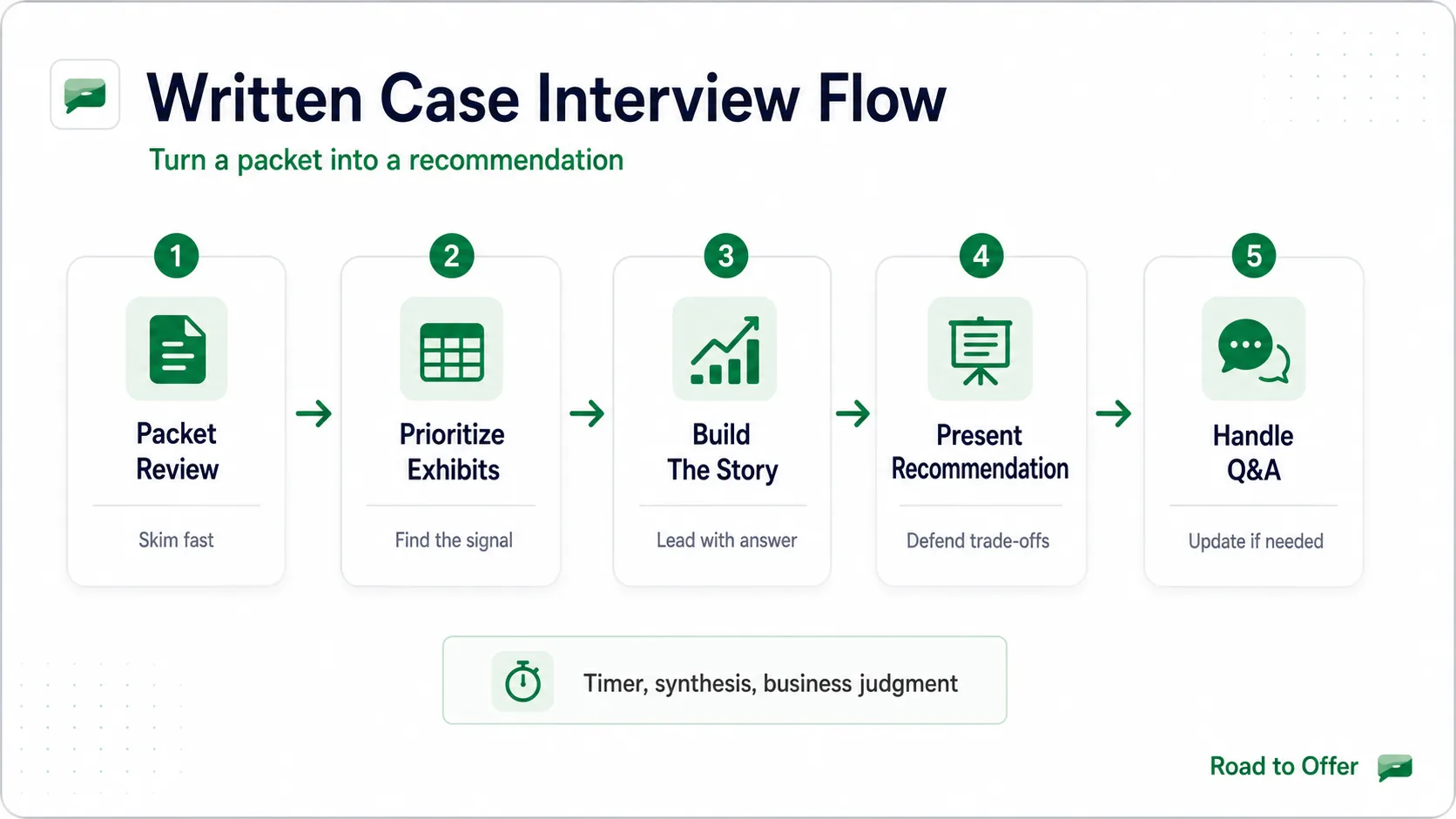
Take-home written case (some offices): Some Strategy& offices use a 48-hour take-home written case in second rounds: you receive a dataset and business problem, prepare 3-5 slides, then present for 15-30 minutes followed by Q&A. If your office uses this format, the analytical rigor expected is equivalent to the live case but with more developed slide communication.
Fit questions at Strategy& center on: why consulting, why Strategy& specifically (not PwC Consulting, not MBB), leadership examples, and situations involving difficult stakeholders or ambiguous problems. Strategy& culture is more corporate than MBB. They operate inside a Big 4 structure and client relationships often involve large PwC accounts. Cultural fit with a more matrixed environment matters.
The Integrated Case: What "Strategy + Implementation" Means Practically
The integrated case format is what most candidates underprepare for. Here's what it looks like in practice:
Phase 1: Strategic question. Should our client, a mid-size industrial equipment manufacturer, enter the Southeast Asian market?
Phase 2: Implementation question. If yes, what is the best entry mode (greenfield, acquisition, or joint venture) and what are the key operational requirements?
Phase 3: Feasibility check. Given the client's current capabilities and balance sheet, what is the realistic timeline and investment required?
Many candidates nail Phase 1 with a clean market attractiveness analysis and then stall on Phase 2. The transition from "should we?" to "how do we?" requires a different analytical mode: thinking about capabilities, organizational change, timeline, and cost, not just market size and competitive dynamics.
How to handle the integration:
When you complete your strategic recommendation, explicitly bridge to implementation: "I recommend entry via acquisition for three reasons. Now, to make this recommendation complete, I want to flag the key implementation considerations: target identification and M&A process timing, integration risk given the cultural distance, and the regulatory approvals required in Southeast Asian markets. These factors don't change my recommendation, but they'd shape the 100-day plan and the risk mitigations the client needs."
This transition from strategy to implementation is what separates Strategy& candidates who pass from those who don't.
How should you align your Strategy& resume and cover letter before this interview?
Use this guide as the parent-brand section owner and verify the current PwC or Strategy& path. Show strategy problem definition, analysis, recommendation, and influence without duplicating a generic PwC application.
- Before: Supported a strategy engagement.
- After: Structured the growth question, compared two options, and prepared the recommendation used in the client review.
Check the current application path, office caveats, and any written-case rules before using them. Recruiters read the resume and cover letter together: the resume proves strategy work, while the letter explains why Strategy& and the role. Use the PwC cover letter guide when it matches the application path.
Keep the strategy contribution distinct from the parent path
Upload the resume for a Road to Offer graded report, not a Strategy& screen.
Revise one strategy line, rehearse the recommendation, and use it in the next case rep.
What Strategy& Cases Typically Cover
Industrial goods: Manufacturing, heavy equipment, aerospace, defense, chemicals. Cases often involve operational efficiency, supply chain optimization, market entry into new geographies, or competitive response to low-cost rivals. Booz's industrials heritage means these cases are particularly common.
Financial services: Banks, insurance, asset management. Cases frequently involve digital transformation strategy, product portfolio optimization, or regulatory response. The financial services practice is one of Strategy&'s strongest globally.
Technology: Software, semiconductors, telecommunications. Cases involve platform strategy, build-vs-buy decisions, and competitive positioning against tech giants. The integrated format is especially pronounced in tech cases. Strategy& works on both the strategic question and the technical feasibility.
Consumer and retail: Less frequent than at Bain or MBB, but market entry, brand strategy, and channel optimization cases appear.
For preparation resources on these case types, see case interview frameworks complete guide and market entry framework.
3 Worked Strategy& Case Examples With Solutions
Example 1: Industrial Market Entry
Prompt: "Our client is a German industrial machinery manufacturer with €2B in revenue. They want to assess entering the Indian market. How would you approach this?"
Strong structure: "I'd evaluate this across three questions: Is India an attractive market for industrial machinery? Can our client compete effectively? And what's the right entry mode? Let me start with market attractiveness. Do you have data on the Indian industrial machinery market size and growth rate?"
Worked analysis: Assume the interviewer provides: Indian industrial machinery market is $8B and growing at 11% annually, driven by manufacturing sector expansion under India's Make in India policy.
- Market opportunity: $8B × 11% growth = approximately $880M in new demand annually
- Our client needs 2% market share to reach €160M in India revenue (2% × $8B)
- Question: is 2% market share achievable in 3-5 years for a new entrant?
Competitive check: top 3 players hold 55% share; remaining 45% is fragmented. Local players dominate mid-market; global leaders (German, Japanese) dominate premium. Our client is premium, and competition is concentrated but not impenetrable.
Recommendation: "I recommend entering India through a joint venture with a local distributor rather than greenfield. Greenfield would take 4-5 years to establish distribution reach; a JV with an established player compresses that to 18-24 months. The JV partner provides market access, regulatory navigation, and service infrastructure; our client contributes technology and brand. Target a 60/40 ownership split to maintain strategic control while limiting initial capital exposure."
Implementation bridge: "Key implementation considerations: JV partner selection and due diligence (3-4 months), regulatory approvals for manufacturing or import operations (6-12 months in India), and local talent build-out for service and sales. The realistic market entry timeline is 18-24 months, with breakeven at 3-4 years assuming a €50M initial investment."

Market entry · medium
Practice for Strategy& in a real case interview
Matched to this Strategy& guide: a live energy market entry case with an AI interviewer. Free, scored on every step.
Example 2: Financial Services Digital Strategy
Prompt: "A mid-size regional bank is losing retail customers to digital-native challengers (neobanks). Customer attrition is 8% annually vs. 3% industry average. What should they do?"
Analysis:
First, segment the attrition: who is leaving? Younger customers (18-35) likely drive most of the excess attrition, as neobanks over-index with this demographic. If 18-35 year-olds represent 30% of the customer base but 65% of annual attrition, that's the priority cohort.
Second, diagnose the cause: is attrition driven by product gaps (no mobile-first experience), pricing (fee structures vs. neobank no-fee models), or service quality? Survey data or churn reason codes would clarify.
Third, strategic options:
- Build: Invest in digital platform rebuild. Cost: $40-80M over 2-3 years. Risk: slow, may still lag neobanks.
- Buy: Acquire a fintech or neobank for digital capability. Cost: $200-500M. Speed: 12-18 months to integration.
- Partner: White-label a digital banking platform. Cost: $5-15M/year. Speed: 6-12 months. Risk: less differentiation.
Recommendation with numbers: "I'd recommend a partnership approach as the near-term solution, combined with targeted product improvements for the highest-attrition segments. Partnership gets digital capability live in 6-12 months for $10M/year vs. $40-80M and 2-3 years for a build. In parallel, the bank should evaluate M&A targets that could provide long-term platform ownership, but acquisition shouldn't delay the near-term attrition defense."
Example 3: Technology Competitive Response
Prompt: "Our client is a B2B software company. A large tech platform has entered their market with a bundled free offering. The client's customer retention has dropped from 91% to 82% in 12 months. What should they do?"
Key issue identification: A 9-point retention drop in one year is catastrophic. At 82% retention, the average customer lifetime is 5.5 years; at 91%, it was 11 years. If annual revenue is $200M and average contract is $50K, the client has 4,000 customers. Losing 9% more per year = 360 additional lost customers/year = $18M in additional annual revenue loss.
Strategic options:
- Compete on price: Match the free offering in lower tiers. Risk: margin destruction, may not retain customers who've already decided to leave.
- Differentiate on depth: Double down on features and integration depth the platform competitor cannot match without losing its breadth. This is the classic "niche specialist vs. generalist" defense.
- Expand adjacent: Move into adjacent product categories the platform doesn't cover, deepening customer lock-in.
Recommendation: "I'd recommend the differentiation path. Competing on price against a platform with effectively zero marginal cost is a losing game. The client should identify the 3-5 capabilities that the platform competitor cannot offer without alienating its core user base (typically deep vertical-specific workflows, compliance features, or integration with specialized third-party tools). Invest $20-30M in these differentiators over 18 months while using customer success resources to proactively engage at-risk accounts. Simultaneously, explore partnerships that bundle the client's specialized capability with complementary tools, reducing the value proposition of switching to the platform."
How Strategy& Scores You vs McKinsey: Creativity vs Structure
This is the most practically useful comparison for candidates who are interviewing at both firms:
Hacking the Case Interview's Strategy& guide notes that Strategy& interviewers are more tolerant of imperfect frameworks when the underlying business reasoning is strong. A candidate who misses one MECE bucket but shows sharp commercial judgment will often outscore a candidate with a technically perfect framework and weak insights. If your process includes the broader PwC online screen, prep it separately with the PwC assessment test guide.
IGotAnOffer's Strategy& guide identifies implementation thinking as the most underrated scoring dimension. Candidates who naturally transition from "should we?" to "how do we?", even briefly, significantly outperform those who stop at the strategic recommendation.
For more on how different firms weight evaluation criteria, see the case interview scoring rubric.
30-Day Strategy& Prep Plan
Execution checklist
Practice integrated cases (strategy + implementation). Strategy& explicitly evaluates implementation thinking. Run Road to Offer cases and force every recommendation to include owner, timeline, cost, and risk.
Learn the key Strategy& industry verticals: industrials, financial services, technology. Cases reflect the firm's actual client base. Preparing case types you'll face is more efficient than generic prep
Prepare your 'Why Strategy&, not MBB or PwC Consulting?' answer. Interviewers probe specifically for this. Generic 'I like strategy' answers signal you haven't done your research
Practice committing to a recommendation with an implementation bridge. Use synthesis drills after cases where you over-explain. Strategy& partners want to see you think past 'should we' to 'how do we'.
Build 4-5 behavioral stories covering leadership, client management, and ambiguous problem-solving. Fit questions at Strategy& probe for maturity and stakeholder management, not just raw analytical skill
Do 2-3 timed case exercises with feedback. Use Road to Offer's scored feedback to pick the next drill instead of spreading time evenly across skills you already pass.














Prep plans for McKinsey, BCG, Bain, Deloitte, Accenture, EY-Parthenon, Kearney, Oliver Wyman, Roland Berger, L.E.K., OC&C, Strategy&, Simon-Kucher, Arthur D. Little, Capital One and your target firm. Choose your firm in the plan builder.
Get your prep plan
A week-by-week schedule built around your target firm and interview date.
Common Strategy& Interview Mistakes
Stopping the analysis at the strategic recommendation. The most common mistake in Strategy& cases. You recommend market entry. Great. You never mention how the client would actually do it. Strategy& partners will push you: "OK, and how would the client execute this?" Prepare your answer before you need it.
Over-structuring and under-thinking. Strategy& is more tolerant of creative business reasoning than McKinsey. Candidates who spend 6 minutes presenting a textbook framework and then deliver generic insights miss the strategic creativity the firm rewards. Interviewers want to see you think, not perform a template.
Generic behavioral answers. "I chose Strategy& because I want to do strategy consulting" is not differentiated. Reference specific things: the industrials franchise and what that means for the type of problems you'd work on, the ability to leverage PwC's implementation resources for full-cycle mandates, or a specific office or practice that aligns with your background.
Ignoring implementation feasibility. Related to the first point but distinct: some candidates acknowledge implementation briefly and move on. Strategy& interviewers want substance on the how, not a gesture. If you recommend a market entry via acquisition, you should be able to discuss the M&A process, integration risks, and timeline, even at a high level.
Poor "Why consulting?" answers. Management Consulted's Strategy& guide notes that Strategy& interviewers probe motivations more than many candidates expect. They're part of a large PwC ecosystem and want to know you can operate professionally in a corporate environment, not just that you want intellectual challenge. Demonstrating client service orientation and collaborative mindset matters as much as analytical drive.
For more on behavioral prep, see the behavioral interview consulting guide.
Practice Drills: Strategy& Style
Static integrated-case drill guide
Use the structure drill for the opening decision and the synthesis drill for the close. Solara is the named Road to Offer adjacent case, not an official Strategy& assessment.
Related Guides
- PwC case interview guide: the broader PwC consulting practice that Strategy& sits within
- Oliver Wyman case interview guide: candidate-led Tier-2 peer with a financial services focus
- Kearney case interview guide: Tier-2 peer with an operations and implementation emphasis
- Case interview frameworks complete guide: how to build a structure for any case prompt
- Market entry framework: a primary framework type used in Strategy& cases
- Profitability framework: the most common case type across all strategy consulting firms
Sources and Further Reading (checked June 17, 2026)
- Strategy& careers and overview: https://www.strategyand.pwc.com/us/en/careers.html
- PwC careers overview: https://www.pwc.com/us/en/careers.html
- IGotAnOffer Strategy& case interview guide: https://igotanoffer.com/blogs/mckinsey-case-interview-blog/strategy-pwc-case-interview
- Hacking the Case Interview, Strategy& guide: https://www.hackingthecaseinterview.com/pages/pwc-strategyand-case-interview-prep
- Management Consulted Strategy& case interview: https://managementconsulted.com/pwc-case-interview/
Frequently asked questions
Resources and related guides
- Practice for Strategy& in a real case interviewPractice
- Browse all free resourcesResource hub
- PwC Consulting: Big Four Careers, Salary, and Interview Guide (2026)Firm Specific · Sep 11, 2026
- PwC and Strategy& Practice Cases: 8 Worked Examples (2026)Firm Specific · Jul 31, 2026
- Strategy& (PwC) Consulting: Careers, Salary, and Interview Guide (2026)Firm Specific · Sep 11, 2026