
Numerical Reasoning Test for Consulting (2026): Format, Question Types & How to Pass
A no-fluff guide to the numerical reasoning test for consulting: which provider you will face, question types and weighting, the score you need, mental-math hacks, and in-page practice with a link to the timed drill.
On this page
The numerical reasoning test for consulting in 2026 is the screen most candidates ignore until it quietly ends their application, which is a costly mistake, because firms run it before or alongside the case to filter for analytical horsepower under time pressure. SHL's own numerical reasoning page confirms the core format: questions built from statistical tables and figures, not open-ended math. Most consulting numerical screens follow that same shape: data interpretation and word problems dominate, the working pace runs close to a minute or two per question, and the math itself stays at percentages, ratios, growth rates, and averages, not calculus. This guide maps the providers behind consulting screens, the question types and their real weighting, the score you actually need, and a practice plan that puts you on a clock with timed Quick Math, so you walk in ready to beat the clock instead of hoping to survive it.
Live free simulator from Road to Offer for the Bain SOVA numerical and logical assessment. Practise this style of assessment in the browser, no account needed to start.
Why consulting firms screen with a numerical reasoning test first
You drilled cases for weeks and ignored the test that screens you out before anyone reads your structure. That is the trap. A numerical reasoning test measures how quickly and accurately you can read data, run simple calculations, and reach a defensible answer under a clock. Consulting firms care about this because client work is exactly that: pull a number out of a messy exhibit, sanity-check it, and move. Both MBB firms and the Big Four use a numerical or aptitude screen early in the funnel to thin a huge applicant pool down to people who can actually handle the math the job demands.
Here is the reassuring part. The test does not ask for clever math. Per MyConsultingCoach, consulting and aptitude math is about speed and good-enough answers, not academic depth. What fails candidates is the combination of simple arithmetic and a timer, not the arithmetic alone. That means the gap between you and a passing score is almost always reps, not raw talent. If you are screening across multiple firms, keep the broader aptitude test for consulting guide open alongside this one, because most firms bundle numerical reasoning with verbal and logical sections.
Turn reading into reps
A numerical reasoning test rewards calculation speed under pressure. Run a free Road to Offer case and get AI feedback on your math and structure instantly.
Which test will you actually face? The providers behind consulting screens
Most guides stay vague here. The truth is that "the consulting numerical reasoning test" is not one exam. It is whichever third-party assessment your firm has licensed for your region and role, and the provider shapes the question style, the timing, and the scoring. Prep sources name a recurring cast of providers. PrepLounge references SHL, Sova, Pymetrics, and Talogy (formerly Cubiks), and ties these screens to firms including McKinsey, BCG, Bain, and Oliver Wyman. MConsultingPrep and CaseBasix add Kenexa, TalentLens, Talent Q, and Saville, and PracticeAptitudeTests adds cut-e and Cappfinity.
Use this provider map to recognize what you are looking at, then confirm the specifics against your own invitation.
A practical note on MBB: McKinsey typically runs its own Solve assessment rather than a standalone third-party numerical battery, so confirm whether your route uses a classic numerical reasoning test or a game-based screen before you build a study plan around the wrong thing.
Question types and their real weighting
Knowing the mix tells you where to spend your practice hours. Per MConsultingPrep, the question types are not evenly distributed: a small set of formats carries most of the test.
The takeaway is blunt: data interpretation plus word problems make up roughly 70 percent of the test, so that is where your reps belong. Per MyConsultingCoach, the core skills underneath all of these are fractions, ratios, percentages, probability, averages, and rates, plus the ability to read pie, bar, line, and scatter charts fast. Master those and you have covered the vast majority of what any provider can throw at you.
Format, length, and the time pressure that actually fails people
The numbers are tight enough that pacing is its own skill. Per PracticeAptitudeTests, a numerical reasoning sitting typically runs 20 to 40 minutes. Per PrepLounge, that leaves you only about 1 to 2 minutes per question, and CaseBasix recommends a working pace closer to about 1 minute each. There is no time to second-guess. You read, calculate, commit, and move.
That clock is the real exam. Candidates rarely fail because a question was too hard; they fail because they spent three minutes on question four and never reached questions fifteen through twenty. The fix is structural, not mathematical: practice with a visible timer from day one, set a hard per-question budget, and train yourself to abandon a question the moment it runs long. We will turn that into a concrete plan further down.
The exact math you need (and the math you do not)
Here is the full list of math that shows up on a consulting numerical reasoning test: the four basic operations, percentages, ratios and proportions, growth and percentage change, averages, and margins. That is it. There is no calculus, no advanced algebra, no trigonometry. Per MyConsultingCoach, the whole game is doing simple math fast and landing a good-enough answer, not proving theorems.
What this means in practice is that your bottleneck is calculation speed, not concept knowledge. You already know how to find a percentage. The question is whether you can find 17 percent of 240 in your head in ten seconds while also reading the next exhibit. The same skills carry straight into the live case, which is why sharpening them is double-duty prep. For the case-side version of this work, the case interview math practice guide drills the same percentages, growth rates, and margins under interview conditions. If your invitation emphasizes rules and logical conclusions instead of arithmetic, switch to the deductive reasoning test guide.
Worked sample questions with step-by-step solutions
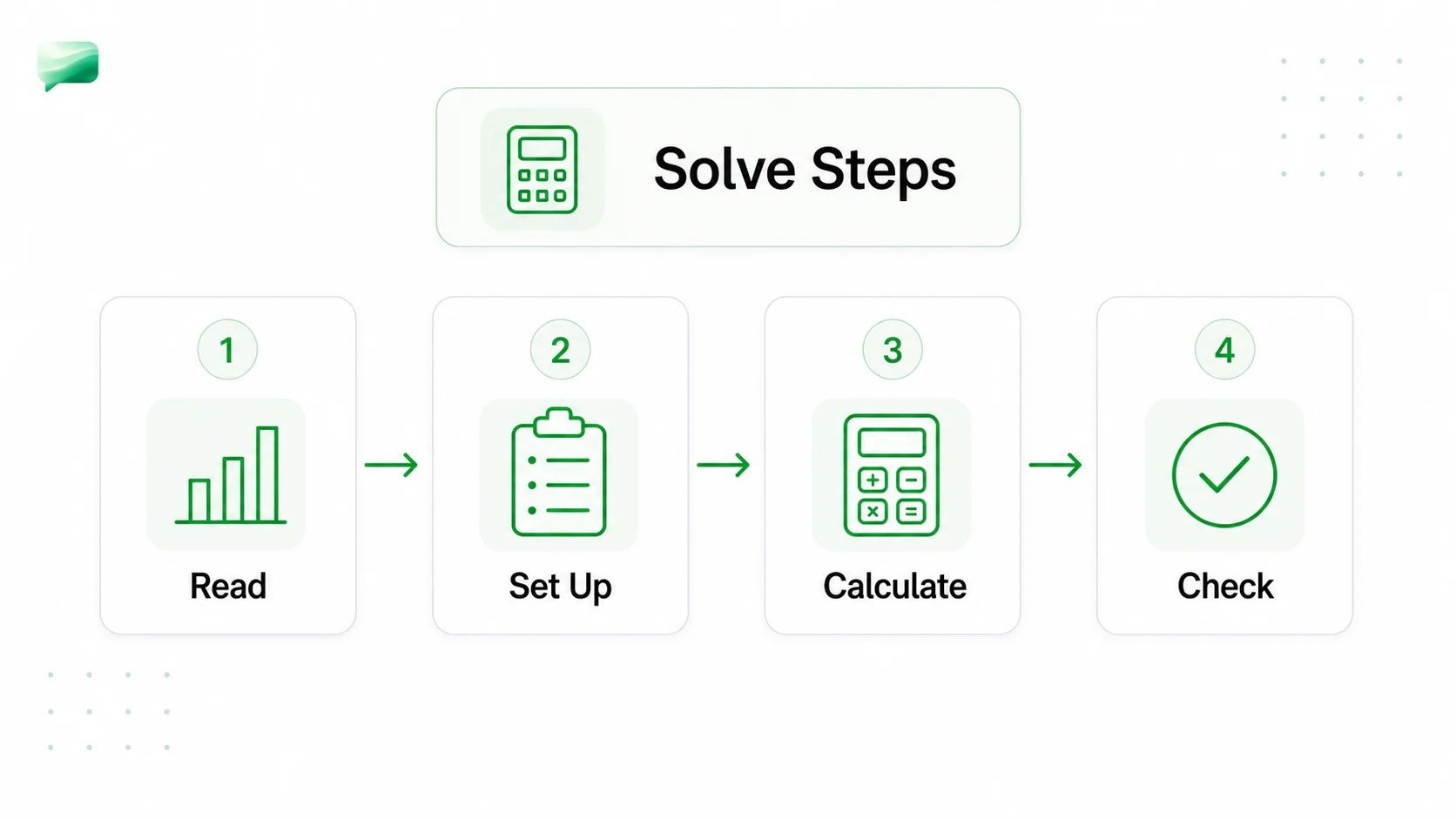
Reading about the math does not build speed. Working problems does. Here are three worked examples that scale from a single table to a multi-source caselet, with the exact steps you should run in your head.
Example 1: reading a table (data interpretation, level 1)
A SaaS company reports quarterly revenue: Q1 4.2M, Q2 5.1M, Q3 5.1M, Q4 6.0M. What was the percentage growth from Q1 to Q4?
Steps:
- Find the change: 6.0 minus 4.2 equals 1.8.
- Divide by the starting value: 1.8 divided by 4.2.
- Estimate fast: 1.8 over 4.2 is a little over 0.4, so about 0.43.
- Convert: roughly 43 percent growth.
The lesson: percentage change is always change divided by the original, and a quick estimate (1.8 over 4.2 is "a bit more than four tenths") beats a slow exact calculation when the answer options are spread apart.
Example 2: reading a chart with the X% of Y trick
A pie chart shows a 250M budget. The "Operations" slice is 18 percent. What is the operations spend?
Steps:
- You need 18 percent of 250.
- Flip it using X% of Y equals Y% of X: 18 percent of 250 equals 250 percent of 18.
- 250 percent of 18 is 2.5 times 18, which is 45.
- Answer: 45M.
Flipping the percentage turned an awkward calculation into 2.5 times 18, which is trivial. This single trick saves time on a large share of data-interpretation questions.
Example 3: a multi-source caselet (level 2)
You are given two exhibits. A table shows units sold by region (North 120k, South 90k, East 150k). A second chart shows the average price per unit (North 30, South 42, East 25). Which region generated the most revenue?
Steps:
- Revenue equals units times price, so you have to combine both exhibits.
- North: 120k times 30 equals 3.6M.
- South: 90k times 42. Estimate: 90 times 42 is about 3,780, so 3.78M.
- East: 150k times 25 equals 3.75M.
- Compare: North 3.6M, South 3.78M, East 3.75M. South wins, narrowly.
The trap here is the distractor: East has the highest units, so a rushed candidate picks East. The right move is to notice the question needs both exhibits and that the highest-volume region is not always the highest-revenue one.
The mental-math cheat sheet: speed tricks to beat the clock
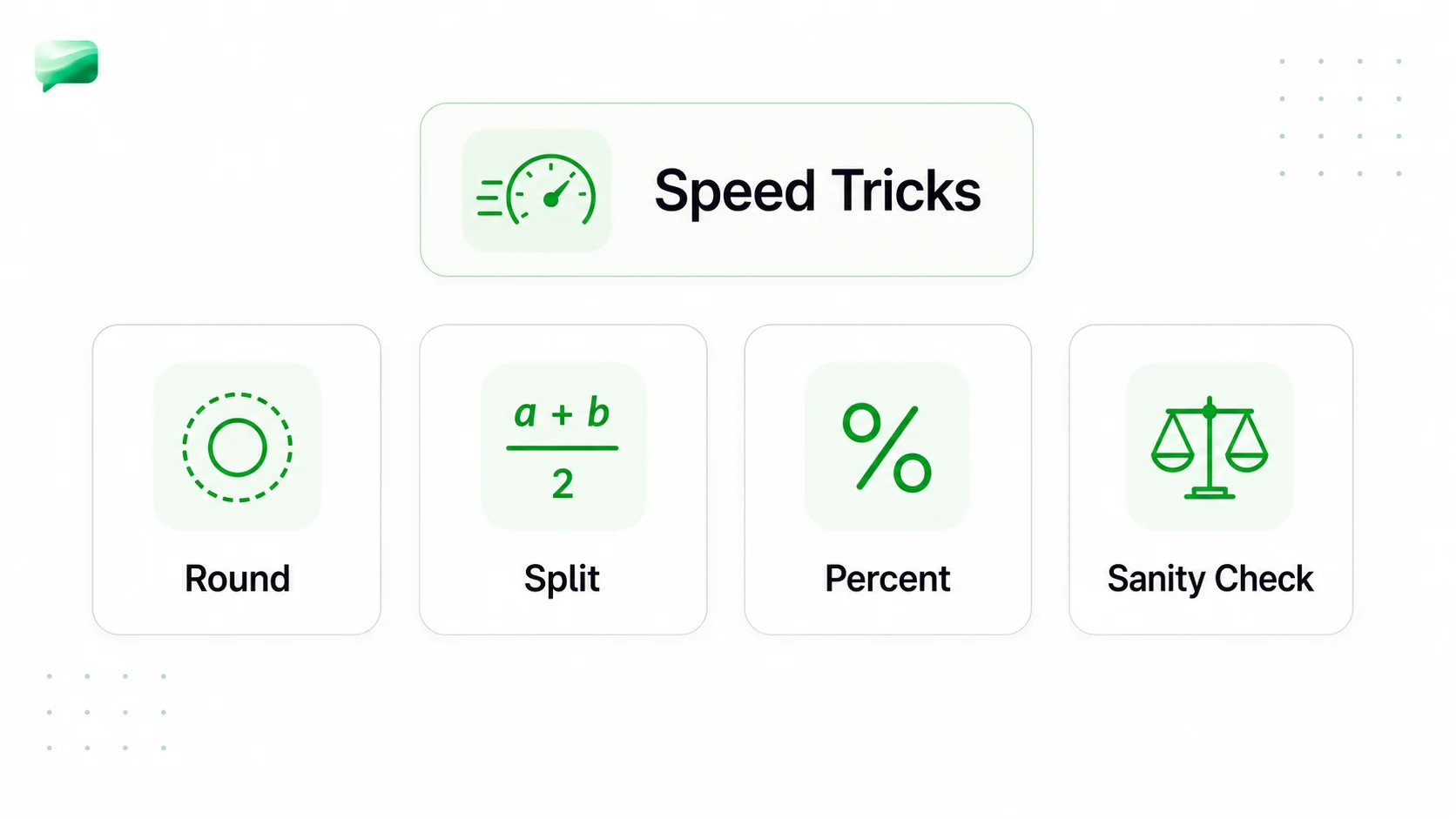
These are the highest-leverage shortcuts, consolidated into one place. Internalize them and your per-question time drops without any new math knowledge.
- X% of Y equals Y% of X. 18 percent of 250 is annoying; 250 percent of 18 (2.5 times 18 equals 45) is easy. Flip whenever one side is rounder.
- The Rule of 11. To multiply a two-digit number by 11, add its digits and drop the sum in the middle. 63 times 11: take 6 and 3, add to get 9, place between to get 693. Per MyConsultingCoach, this works cleanly when the digits sum to less than 10.
- Round aggressively, then adjust. Treat 4.2M as roughly 4M to get a ballpark, confirm which answer option is closest, then refine only if two options are close.
- Anchor your percentages. 10 percent is one decimal shift, 5 percent is half of that, 1 percent is two shifts. Build any percentage from these: 17 percent equals 10 plus 5 plus 1 plus 1.
- Eliminate distractors. With four or five multiple-choice options, ruling out the obviously-too-big and obviously-too-small answers often leaves two, which makes a smart estimate enough.
For the deeper version of these shortcuts and how they show up live in a case, the mental math for case interviews guide is the companion piece. Now put the tricks to work. Run these timed drills in-page before you move on.
Interactive drill set. Write an answer before revealing the worked solution, then continue into Road to Offer for scored practice and AI feedback.
What score do you actually need to pass?
Rivals hand-wave this with phrases like "aim for a good score." Here is the sourced benchmark instead. Numerical reasoning tests are almost always scored against a norm group, meaning your raw answers are converted into a percentile that compares you to other candidates. So the question is not "how many did I get right" but "where do I rank."
The practical reading: for competitive consulting roles, plan to land in the top 20 to 30 percent, not merely above a 50 percent floor. Because scoring is relative, your edge comes from finishing more questions accurately than the next applicant, which loops straight back to speed. This is also why a single timed mock score is diagnostic, not a verdict: it tells you your current percentile so you know how much faster you need to get.
Find your real bottleneck before test day
Run an AI-scored case to see whether structure, exhibit reading, or raw calculation speed is what is slowing you down, then drill the weak one.
A timed practice plan that builds calculation speed
Speed is trainable, but only with the right loop. This plan turns reading into reps over a focused two to three weeks.
- Take a timed diagnostic mock first. Sit a full-length test under exam conditions, with a timer and no interruptions, before you study anything. The score is your baseline percentile.
- Review every single mistake, not just the wrong ones. For each miss, decide whether it was a math error, a misread exhibit, or running out of time. The category tells you what to fix.
- Drill the dominant types. Spend most of your hours on data interpretation and word problems, since they are roughly 70 percent of the test per MConsultingPrep.
- Do daily mental-math reps. Ten minutes a day on percentages, ratios, growth, and the cheat-sheet tricks compounds fast. Use short, frequent sessions over long, rare ones.
- Re-mock weekly under a tighter clock. Shave your per-question budget slightly each week so test-day pacing feels comfortable rather than rushed.
Execution checklist
Days 1 to 3: Diagnose. Sit one full timed mock to get your baseline percentile, then categorize every mistake as a math error, a misread, or a timing failure.
Days 4 to 10: Drill the 70%. Focus reps on data interpretation and word problems. Add 10 minutes of daily mental-math practice on percentages, ratios, and the cheat-sheet tricks.
Days 11 to 14: Tighten the clock. Re-mock with a slightly shorter per-question budget. Practice skip-and-return so you never sink time into one hard question.
Final 2 to 3 days: Simulate. Run full tests at the real time limit, confirm your calculator and instructions setup, and rehearse smart guessing on anything you cannot finish.
For the case-math version of this drilling routine, which uses the same percentages and growth-rate muscles, work through the case interview math practice guide in parallel.
Practise consulting numerical reasoning from the Road to Offer drill engine. Answer a real prompt and get AI-scored feedback. Free accounts include 5 drills per day for the first 3 days after signup.
Test-day strategy: skip, guess smart, and watch the units
The math is done long before test day. What is left is execution. These rules protect your score under pressure.
- Skip and return. If a question runs past your time budget, mark it and move on. One unanswered hard question costs the same as one easy question you never reached, so protect the easy points first.
- Guess smart when stuck. Per PrepLounge, many tests do not penalize wrong answers, so a blank scores zero with certainty while a considered guess has positive expected value. When the clock runs out, answer everything. Confirm your test's marking rule first.
- Watch the units. Thousands versus millions, percent versus percentage points, monthly versus annual. Unit slips are the most common avoidable error on data-interpretation questions.
- Read the question before the exhibit. Knowing what is being asked tells you which numbers to grab, so you do not waste time absorbing an entire chart you only need one value from.
- Avoid the distractor traps. Wrong answer options are engineered to match common mistakes: forgetting to combine two exhibits, dividing by the wrong base, or picking the highest-volume rather than highest-revenue figure. If your answer matches an option suspiciously fast, double-check the base you divided by.
Sources
- PrepLounge: Numerical Reasoning Test guide (checked June 26, 2026)
- CaseBasix: Numerical Reasoning Test (checked June 26, 2026)
- MConsultingPrep: Guide to Numerical Reasoning Tests (checked June 26, 2026)
- PracticeAptitudeTests: Numerical Reasoning Tests (checked June 26, 2026)
- MyConsultingCoach: Case Interview and Consulting Math (checked June 26, 2026)
Practice the math live, not just on paper
Run a free AI-guided case to put your calculation speed under real pressure, then use the feedback to close the gap before your numerical reasoning test.
Frequently asked questions
Resources and related guides
- Run a real case interviewPractice
- Browse all free resourcesResource hub
- Case Interview Formulas: Cheat Sheet for Profitability and Math (2026)Math And Quant · May 1, 2026
- NPV and Discounting in Case Interviews: The Shortcut-First Guide (2026)Math And Quant · Jun 28, 2026
- Best Free AI for Case Interview Math Practice (2026)Math And Quant · May 8, 2026