
Oliver Wyman Case Interview: Collaborative Format, Tips, and Practice Cases (2026)
Oliver Wyman describes its cases as collaborative problem-solving. Here's how the format works, how OW cases differ, and a 30-day prep plan.
On this page
Oliver Wyman's official preparation guidance frames cases as collaborative: the interviewer wants you to solve the problem and can help you do so. Bring a clear structure and point of view, explain your reasoning, and work with the interviewer. Cases may draw on financial services topics such as insurance, banking, and capital markets. The number of rounds and any written exercise vary by role and office, so confirm the format from your invitation.
If you are still deciding whether OW fits your target list, read what is Oliver Wyman first. This page assumes you already know the firm's Marsh McLennan context, financial-services tilt, and Tier-2 positioning. For the wider map of where Oliver Wyman ranks against the other types of consulting firms, from MBB down to specialist boutiques, start with the landscape overview.
For the fit side of this process, use the Oliver Wyman behavioral interview questions guide alongside these cases.
Practice OW-style collaborative cases
Practice explaining your structure, quant, and synthesis while responding to interviewer input.
Oliver Wyman vs McKinsey vs BCG: The Key Structural Differences
The comparison table candidates miss is not about prestige. It's about what the interview format actually demands of you.
The critical implication: Oliver Wyman expects active collaboration. Do not wait passively for the next prompt, but do not treat interviewer input as a failure either. State your structure, ask focused questions, and use the discussion to refine the answer.
For a broader look at how OW fits into your overall consulting prep, see our consulting interview prep timeline and case interview frameworks complete guide.
Oliver Wyman Interview Process: Rounds, Format, and Timeline
Understanding the pipeline lets you sequence your preparation intelligently rather than cramming everything in the last week.
Oliver Wyman Interview Process
- 01
Application. Resume screening. Some offices (particularly UK and select US) require a 20–30 min online numerical reasoning test. OW does not use McKinsey Solve or BCG Casey.
- 02
Early Interviews. Case and behavioral formats vary by role and office. Confirm the current sequence and timing from your invitation.
- 03
Later Interviews. Additional cases, senior interviews, or a written exercise may apply. Use recruiter instructions as the source of truth.
- 04
Decision. Timing varies by process; ask your recruiter when to expect an update.
First Round
Early interview count, timing, and format vary by role and office. Oliver Wyman's official guidance describes a collaborative case discussion: bring initiative and commercial judgment, explain your reasoning, and work with the interviewer.
Final Round
Later-round formats vary. If your invitation includes a written exercise, practice data triage, synthesis, and the requested output using the stated timing. For general written-case technique, see the written case interview guide.
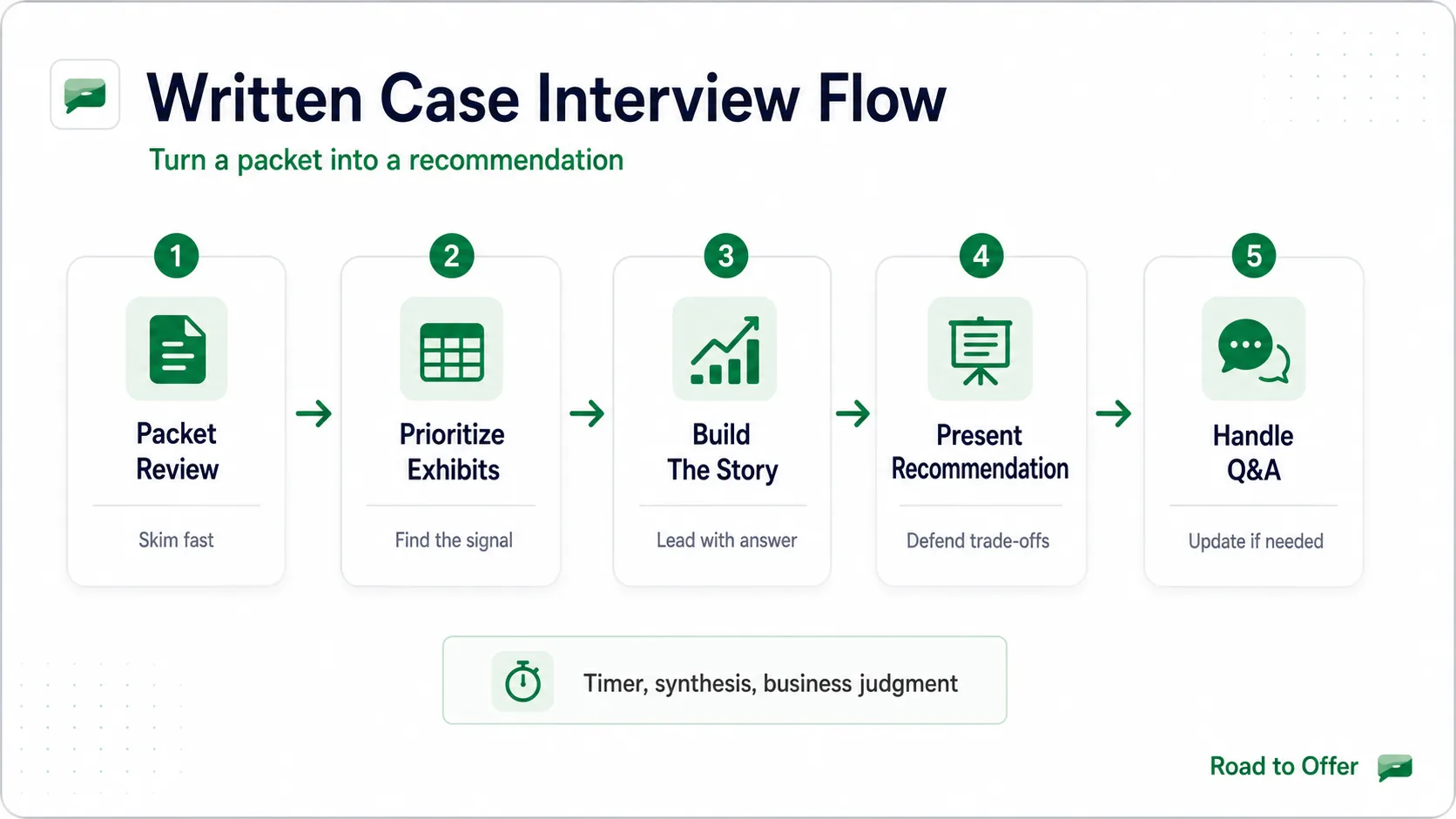
Every evaluation decision at OW carries significant weight, as each touchpoint is an opportunity to demonstrate the independent thinking they prize.
What "Fully Candidate-Led" Actually Means in Practice
The phrase "candidate-led" gets used loosely across consulting prep materials. At Oliver Wyman, it means something specific and operationally demanding.
Show initiative at transitions. After presenting your framework, propose which branch to explore first and explain why. Then work with the interviewer and use the guidance they provide.
You request data explicitly. If you need data to test a hypothesis, you ask: "To determine whether this is a frequency or severity issue, I'd like to see claims counts and average cost per claim broken down by year. Can we look at that?" Passively waiting for the interviewer to feed you information is scored as a red flag.
You narrate transitions. "We've established that claims are the driver. I now want to understand whether it's a product mix shift or an underlying loss cost increase. Let me look at the claims data by line of business." This keeps the interviewer oriented without requiring them to prompt you.
You synthesize unprompted. With 5–7 minutes remaining, you bring the case to a conclusion: "Based on what we've found, my recommendation is X for three reasons: [1], [2], [3]. The key risk is [Y], and I'd monitor it by [Z]." See case interview synthesis for the exact language patterns that score well at candidate-led firms.
How should you align your Oliver Wyman resume and cover letter before this interview?
Write for the target practice, office, and role rather than a broad Oliver Wyman profile. Show quantitative reasoning, communication, client ownership, and implementation only where your record supports them.
- Before: Worked on a risk analysis.
- After: Compared two exposure scenarios, tested the key assumption, and summarized the decision implication for the project sponsor.
Check the current application requirements and avoid asserting a fixed page rule, value, or assessment. Recruiters read the resume and cover letter together: the resume proves the work, while the letter explains why Oliver Wyman and the role. The Oliver Wyman resume guide owns the screen criteria with before-and-after rewrites. Rehearse the revised line as a concise recommendation before the next case rep.
Tighten the decision evidence before submission
Drop the resume here for an independent graded report on whether each bullet proves a decision. Road to Offer's score, not an Oliver Wyman evaluation.
Opening resume uploader...
Revise one quantitative line, rehearse its assumptions, and use the implication in the next case rep.
OW's Focus Areas: Financial Services, Insurance, Risk, and Retail
Oliver Wyman is not a generalist firm. Its core practices are financial services, insurance, risk management, and to a lesser extent healthcare and retail. This focus shapes the case content dramatically. If you prepare for OW using only generic MBB cases, you have a content gap that interviewers will find.
Financial Services and Banking
Expect cases about bank profitability, digital banking strategy, cost-to-income ratios, net interest margin compression, and branch network optimization. Key vocabulary: NIM (net interest margin), ROE (return on equity), cost-to-income ratio, loan loss provisions, capital adequacy. For more on data-driven analysis in cases, see case interview data interpretation.
Insurance
The most OW-specific content area. Key concepts: combined ratio (claims + expenses / premiums), loss ratio, expense ratio, reinsurance, underwriting cycles, actuarial pricing. A combined ratio above 100% means the company loses money on underwriting. Knowing this immediately differentiates you from a candidate who's never thought about insurance economics.
Risk Management
Operational risk, credit risk, market risk, regulatory compliance cases (Basel III, Solvency II). These cases are less common in first rounds but appear in final rounds, especially if you've indicated interest in OW's risk practice.
Retail
Market entry, profitability, and omnichannel strategy cases appear in OW's retail and consumer practice, which is smaller than the financial services practice but still active. These cases are more similar to standard MBB case types, though OW interviewers still expect you to drive fully independently.
3 Oliver Wyman Case Interview Examples With Full Solutions
Case 1: Insurance, Combined Ratio Deterioration
Prompt: Your client is a mid-sized U.S. personal lines insurer. Their combined ratio deteriorated from 94% to 103% over three years. The CEO wants to understand the root cause and a path to restore profitability.
What "combined ratio" means: (Claims + Expenses) / Premiums. At 94%, the company made 6 cents of underwriting profit per premium dollar. At 103%, it loses 3 cents. A 9-point swing is significant.
Your opening framework:
- Claims ratio trend: frequency (more accidents?) vs. severity (higher cost per claim?)
- Expense ratio trend: distribution, admin, technology
- Premium adequacy: are pricing increases keeping pace with loss cost inflation?
- Mix effects: has the portfolio shifted toward higher-risk segments?
Data the interviewer provides:
- Year 1: Premiums = $1,000M | Claims = $720M (72%) | Expenses = $220M (22%) | Combined = 94%
- Year 3: Premiums = $1,050M (+5%) | Claims = $840M (+17%, now 80%) | Expenses = $242M (+10%, now 23%) | Combined = 103%
Claims grew $120M on only $50M of premium growth. That is the core issue.
Drill deeper: Claim frequency is flat. Average severity per claim increased 18% (driven by auto repair inflation and medical cost inflation in bodily injury). Meanwhile, the company raised premiums only 5% over three years.
Recommendation: The root cause is a pricing lag: loss cost inflation ran at roughly 6% annually while premiums increased only 1.7% per year. Immediate actions: (1) file for rate increases of 12–15% in the top 5 states by premium volume where loss ratios are worst; (2) tighten underwriting guidelines for high-frequency segments; (3) explore quota share reinsurance to stabilize the portfolio while re-pricing. Key risk: aggressive rate increases may accelerate policyholder attrition, shrinking the premium base. Model the retention impact before filing.
Practice this pattern: Start with case math drills on ratios and percentage-point movement, then run a financial-services case where you have to drive the claims vs. premium analysis without prompts.
Case 2: Banking, Regional Bank Branch Expansion
Prompt: A regional bank in the Southeast is considering expanding from 120 to 180 branches over five years. Should they proceed?

Growth · hard
Practice for Oliver Wyman in a real case interview
Matched to this Oliver Wyman guide: a live technology growth case with an AI interviewer. Free, scored on every step.
Your opening framework:
- Revenue per new branch at steady state
- Cost per new branch (capex + opex)
- Payback period and NPV across the 60-branch program
- Competitive context: are digital banks eroding branch economics?
Data provided:
- Average revenue per branch (fully ramped, Year 3+): $2.2M/year
- Average opex per branch: $1.6M/year
- Build-out capex per branch: $1.8M
- Ramp-up: 2 years to full revenue (assume 50% in Year 1–2)
- New branches: 60
Math:
- Year 1–2 per branch: Revenue $1.1M − Opex $1.6M = -$0.5M/year operating loss during ramp
- Year 3+ per branch: Revenue $2.2M − Opex $1.6M = $0.6M/year profit
- Capex payback: $1.8M ÷ $0.6M = 3 years post-ramp = 5 years total
- Using the stated timing and 10% discount rate, NPV is approximately −$0.02M per branch, or −$1.34M for 60 branches. A three-year ramp produces approximately −$0.85M per branch.
Recommendation: Do not proceed with the full 60-branch expansion on the base case: NPV is approximately -$0.02M per branch, or -$1.34M across the program, and a three-year ramp produces approximately -$0.85M per branch. A 10-branch pilot is defensible only as a test of the assumptions, not as evidence that the base case creates value. The key lever is branch economics: steady-state revenue must increase above $2.2M, opex must fall below $1.6M, capex must decline, or the ramp must shorten enough to turn NPV positive before full rollout.
Practice this pattern: Use structure drills to build the branch-expansion tree first, then stress-test the recommendation with math drills on ramp, payback, and NPV-style logic.
Case 3: Retail, Grocery Chain Margin Recovery
Prompt: A regional grocery chain's operating margins declined from 4.2% to 2.8% over two years. The board wants three actions to recover to 4% margins within 18 months. Revenue is $900M.
Your opening framework:
- Gross margin analysis: pricing pass-through vs. cost of goods inflation
- SG&A analysis: labor, rent, occupancy (fixed vs. variable decomposition)
- New store unit economics: are recent openings dilutive?
- Competitive pricing position: where are we relative to peers?
Data provided:
- COGS: up 3.2% YoY (food inflation)
- SG&A: up 5.1% YoY (labor + rent)
- Revenue: flat (+0.5%)
- Competitor pricing benchmark: client is 6–8% above market on private-label goods
- New stores: 8 urban locations opened in last 3 years, still in ramp phase
Math:
- Margin decline: 4.2% to 2.8% = 1.4 percentage points = $12.6M at $900M revenue
- Gross margin compression accounts for ~$7.2M (0.8 points)
- SG&A growth accounts for ~$5.4M (0.6 points)
- Private-label repricing opportunity: 6% price reduction on ~$180M private-label revenue = $10.8M revenue impact; at gross margin of 40% on private label, net impact to gross profit = -$6.5M... but if this recovers volume, the impact is neutral to positive. Better framing: matching competitors on private label prevents volume leakage, which is currently eroding the top line.
Three recommended actions:
- Reduce private-label pricing to market: prevent volume leakage and competitive disadvantage. Revenue-neutral in best case, volume-accretive if customers return.
- Moratorium on new urban store openings: stop diluting chain-level margins until existing new stores reach steady-state profitability (estimated 18–24 months for current cohort).
- Labor scheduling optimization: consolidate hours during low-traffic windows, reduce part-time headcount that inflated SG&A. Potential savings: 3–4% of labor costs, or approximately $2–3M annually.
Practice this pattern: If the market-demand side feels loose, run market sizing drills before a retail strategy case. In an OW-style retail case, size volume, margin, and competitive response while explaining your reasoning and responding to interviewer input.

Profitability · medium
Practice a real retail profitability case
Matched to this Oliver Wyman guide: a live retail profitability case with an AI interviewer. Free, scored on every step.
How OW Scores You: Structuring, Creativity, and Commercial Instinct
Oliver Wyman interviewers evaluate candidates on four dimensions. Understanding these before your interview changes how you allocate effort during a case: which dimensions you protect, which ones you can recover from a weak moment on.
1. Analytical rigor. Can you build an appropriate structure, run accurate math, and draw defensible conclusions from data? OW interviewers have high quantitative expectations. A 20% arithmetic error that you don't catch is a significant red flag. When you do math, state the formula first, plug in numbers, and sanity-check the output: "That gives us a combined ratio of 103%, which at $1B in premiums means we're losing $30M on underwriting: that's more than we said earlier, so let me recheck." See what is a case interview for more on how scoring works across firms.
2. Commercial judgment. Do you understand what actually matters in a business context? OW wants candidates who think like investors or operators, not students applying frameworks. When you prioritize claims costs over expense costs because "claims are typically 65–75% of premiums," you're demonstrating commercial judgment. When you apply a generic cost-cutting frame without understanding the insurance business model, you're not.
3. Communication clarity. Are your answers structured? Do you lead with the conclusion? Can you say in one sentence what the data means, not just what the data shows? OW prizes directness. "Revenue declined $40M year-over-year" is a fact. "Revenue declined because we lost corporate customers, not because of pricing, which means the fix is retention, not repricing" is an insight.
4. Candidate-led initiative. Are you driving the case proactively? Are you telling the interviewer what you want to explore next before they can ask? Passivity is scored negatively, and it compounds: every minute you spend waiting for a prompt is a minute of evidence against your candidacy. For the scoring mechanics at OW and other firms, see case interview scoring rubric.
30-Day Oliver Wyman Prep Plan
Week 1: Financial Services Fundamentals
Before you can structure an OW case well, you need the content vocabulary. Spend the first week building it deliberately.
Insurance: Combined ratio = (claims + expenses) / premiums. Loss ratio = claims / premiums. Expense ratio = expenses / premiums. A combined ratio above 100% means the insurer loses money on underwriting and needs investment income to be profitable. Underwriting cycles (hard market vs. soft market) drive pricing power. Reinsurance transfers catastrophic risk. Know these cold, as OW interviewers will use these terms without defining them (Oliver Wyman Careers).
Banking: Net interest margin = (interest income - interest expense) / earning assets. Cost-to-income ratio = operating costs / operating income. Return on equity = net income / shareholders' equity. Branch economics: revenue per branch, cost per branch, payback period.
Run one full candidate-led case per day using the full independent protocol: no hints, no redirects, no pausing to look at prep materials mid-case.
Week 2: Hypothesis-Driven Structuring
The single biggest differentiator in OW case interviews is whether your framework reflects the specific business context or is a generic template.
Generic (weak): "I'd look at revenue and costs." OW-appropriate (strong): "I'd look at the claims ratio, specifically whether the deterioration is frequency-driven or severity-driven, and separately at the expense ratio, with a focus on distribution costs since insurance distribution is highly variable."
Practice building the framework before you have data. The goal is to present a structure that demonstrates industry knowledge, then populate it with data as it comes (IGotAnOffer OW Guide). See also case interview hypothesis-driven for the framework.
Week 3: Written Case Practice
If your invitation includes a written exercise, run timed practice using its stated output and duration. Generic written-case samples can train the underlying skill.
Time allocation for a 60-minute written case:
- Minutes 0–8: Read the question prompt FIRST, then scan exhibits for structure
- Minutes 8–22: Analyze the 2–3 most important exhibits; do the quantitative work
- Minutes 22–42: Build slides (headline before chart, always)
- Minutes 42–52: Refine logic, check consistency
- Minutes 52–60: Rehearse your 3-minute verbal walkthrough
The slide headline is everything. "Revenue and Cost Analysis" is a label. "Revenue decline is driven entirely by volume loss in corporate accounts; pricing has held" is an insight (Hacking the Case Interview).
Week 4: Full Mock Rounds and Closing
Run full mock interviews under real conditions, timed, back-to-back, with feedback after each. Focus your remaining time on the weakest area identified from the prior three weeks. Don't spread prep time evenly; the marginal value of additional practice is highest on your weakest dimension, not your strongest (Management Consulted OW Guide).












Prep plans for McKinsey, BCG, Bain, Deloitte, Accenture, EY-Parthenon, Kearney, Oliver Wyman, Roland Berger, L.E.K., OC&C, Strategy&, Simon-Kucher, Arthur D. Little, Capital One and your target firm. Choose your firm in the plan builder.
Get your prep plan
A week-by-week schedule built around your target firm and interview date.
Common Oliver Wyman Case Interview Mistakes
Presenting a boilerplate framework. "Revenue and costs" is not an insurance framework. OW interviewers have deep domain knowledge. A framework that doesn't reference insurance economics (combined ratio, loss ratio, underwriting cycles) signals that you prepared for McKinsey, not Oliver Wyman.
Waiting for prompts. After you present your framework, the interviewer will not say "great, now let's look at claims." They will say nothing. Move forward immediately. State which branch you're exploring first and why.
Burying the recommendation. OW's culture values directness. Lead with the answer: "I recommend X." Then support it. Walking through all your analysis and saving the conclusion for last is a structural error that costs you communication points.
Skipping the risk. Every OW recommendation needs at least one key risk and a monitoring mechanism. Leaving this out signals overconfidence or incomplete thinking.
Underpreparing a written exercise named in your invitation. Synthesizing exhibits under time pressure is a separate skill from live cases. Train it separately when it applies.
For a deeper look at how to avoid communication errors that hurt your score, see case interview communication tips. Candidates targeting multiple Tier-2 firms should also review the Roland Berger case interview guide, the L.E.K. case interview guide, the Kearney case interview guide, and the Korn Ferry case interview guide, which share the candidate-led format and similar quantitative demands. If your target list leans consumer and retail, the OC&C Strategy case interview guide covers a boutique that competes for the same work as OW's consumer practice.
OW-Style Practice Drills
For full worked cases rather than single drills, the Oliver Wyman practice cases page decodes all eight official cases and adds 8 math-heavy worked examples.
Related Practice
Rehearse end to end with the Oliver Wyman practice cases: every official case decoded plus 8 OW-style worked examples weighted toward financial services.
Sources and Further Reading (checked June 17, 2026)
- Oliver Wyman Careers page: oliverwyman.com/careers.html
- IGotAnOffer Oliver Wyman Case Interview Guide: igotanoffer.com/blogs/consulting/oliver-wyman-case-interview
- Hacking the Case Interview, OW Guide: hackingthecaseinterview.com/pages/oliver-wyman-case-interview
- Management Consulted OW Guide: managementconsulted.com/oliver-wyman-case-interview
- Glassdoor Oliver Wyman Interview Reviews: glassdoor.com/Interview/Oliver-Wyman-Interview-Questions-E49996.htm
Practice an Oliver Wyman-style case next
Run a free candidate-led case and get feedback on financial services structure, quant, commercial judgment, and synthesis.
Frequently asked questions
Resources and related guides
- Practice for Oliver Wyman in a real case interviewPractice
- Browse all free resourcesResource hub
- AlixPartners Careers 2026: Turnaround Salary and Interview GuideFirm Specific · Sep 11, 2026
- Alvarez and Marsal Careers 2026: Restructuring Salary and Interview GuideFirm Specific · Sep 11, 2026
- Analysis Group Case Interview: Process, Question Types, and How to Prepare (2026)Firm Specific · Mar 25, 2026
- Kearney Case Interview Guide: Format, Examples & Prep Plan (2026)Firm Specific · Mar 15, 2026