
Deloitte Case Interview Examples: 10 Practice Cases and the Official Library (2026)
10 Deloitte case interview examples with worked solutions, plus every case in Deloitte's own published practice library decoded by what it actually trains.
On this page
Deloitte publishes its own free case interview practice library, and that library is the single most useful example set for a Deloitte candidate because it mirrors the firm's real client mix rather than a generic consumer profitability template. The current tool carries cases across strategy, business technology, cyber, forensic and valuation, and a striking share of them involve federal and public sector clients: Engagement Strategy: Federal Agency V, Strategic Vision: Federal Benefits Provider, Finance Strategy: Federal Health Agency, Architecture Strategy: Federal Finance Agency and Talent Management: Federal Civil Cargo Protection Bureau all name a government client in the title.
That mix is not an accident. Deloitte reported US$70.5 billion in aggregate global revenue for the fiscal year ending 31 May 2025, up 4.8% in local currency, with more than 470,000 people across more than 150 countries, and its Strategy, Risk and Transactions business grew 5.5% while Technology and Transformation grew 4.7%. The cases you practise should look like that portfolio. This page walks through what a useful Deloitte example contains, decodes the official library case by case, and then gives 10 worked Deloitte-style practice cases across the three consulting practice groups. For the full process, rounds and timing, see the Deloitte case interview guide.
What Should a Deloitte Practice Case Example Show?
A Deloitte example is only worth your time if it shows the four things a candidate-led case actually scores. Most published examples show the prompt and the answer and skip the middle, which is exactly the part you are being graded on.
Deloitte's published case and scenario interview tips set out that five-step approach explicitly: understand the issue, identify the underlying assumptions, summarise specific issues and findings, state your recommendations, and outline next steps and expected results. The same page is blunt that "you are not expected to provide the right answer, but rather to clearly convey your logic and thought process." Read that as a scoring instruction. A candidate who lands on a defensible answer with visible assumptions beats one who lands on the perfect answer opaquely.
The step you cannot self-mark from an example is the opening structure. You will always think your tree was MECE. Get one graded before you read the worked cases below, so you know which of the ten to slow down on.
Get one candidate-led structure scored before you read the examples from the Road to Offer drill engine. Answer a real prompt and get AI-scored feedback. Free accounts include 5 drills per day for the first 3 days after signup.
How Deloitte Cases Differ from McKinsey, BCG and Bain
Deloitte is not a slower MBB case. The analytical bar on a Strategy and Analytics case is comparable, but the shape of the round, the client mix and what earns points differ enough that MBB-only practice leaves real gaps.
The practical consequence: an MBB-trained candidate walking into Deloitte usually over-invests in the opening framework and under-invests in steps four and five. Deloitte's own guidance names next steps and expected impacts as a discrete step of the answer. If your recommendation ends at "so I would recommend defending the segment" with no number, no risk and no next test, you have skipped a third of the rubric.
The second consequence is client familiarity. If you have never structured a case for a federal agency, the first thirty seconds of Engagement Strategy: Federal Agency V will feel alien in a way that a retail margin case never does. That unfamiliarity is fixable in one afternoon by reading the official cases, and it is the cheapest point gain available to you.
Deloitte's Official Practice Case Library, Decoded
Deloitte runs a free interactive tool at caseinterviewprep.deloitte.com, linked from its US recruiting case prep hub. The library is split by degree level and by service area. Here is every case currently published, with what each one actually trains, so you can pick rather than grind through all of them.
Two patterns matter here. First, only Recreation Unlimited and LeadAuto look like the cases in a generic casebook. If your entire preparation is profitability trees, more than half this library will feel unfamiliar. Second, the non-strategy cases (cyber, forensic, valuation) are not softer; they are harder to structure because the standard frameworks do not fit. A ransomware incident does not decompose into revenue and cost.
Deloitte rotates this library, so treat the list as current rather than permanent, and open the tool before your round to check what is live.
The gap most candidates hit on the federal cases is sizing something with no market data: how many claims a benefits agency processes, how many cargo inspectors a bureau needs. That is a market sizing skill applied to a public sector object, and it is worth one graded rep before you attempt Strategic Vision or Talent Management.
Size an unfamiliar market from a driver chain from the Road to Offer drill engine. Answer a real prompt and get AI-scored feedback. Free accounts include 5 drills per day for the first 3 days after signup.
Your Practice Group Changes the Case You Get
Deloitte's US consulting recruiting runs through three practice groups, and the case you receive follows the group you applied to. This is the single biggest structural difference from MBB, where every candidate gets the same case pool.
Strategy and Analytics. Corporate strategy, mergers and acquisitions, supply chain and business model transformation. These are the cases that look most like McKinsey, BCG and Bain: market entry, pricing, profitability, growth. Recreation Unlimited and LeadAuto sit here. If you are interviewing for this group, the standard framework toolkit transfers directly, and the case interview frameworks guide covers what you need.
Technology Consulting. Digital strategy, IT programme delivery, cyber and building technology solutions for clients. Architecture Strategy: Federal Finance Agency and MedX sit here. The trap is that these cases look qualitative and candidates therefore stop quantifying. They should not. A legacy migration case still turns on cost per migrated system, downtime cost per hour and a payback period.
Human Capital. Organisation transformation, change management, workforce and talent strategy. Talent Management: Federal Civil Cargo Protection Bureau sits here. These cases carry the least arithmetic and the most structure risk, because there is no canonical tree for "reduce attrition after a merger". You build the tree from the client's actual operating model.
One wrinkle worth planning for: some Deloitte interviewers hand you written material at the start, giving you a few minutes with charts or financials before the discussion begins. That is closer to a compressed written case than a standard oral case, and it rewards a fast, disciplined read. If you are slow at pulling the decisive number out of a chart, work the reading charts and exhibits guide before the round.
Monitor Deloitte Cases Are a Separate, Harder Track
Deloitte built much of its strategy capability through the 2013 acquisition of Monitor Group, the firm founded by Michael Porter. Monitor Deloitte is the pure strategy arm, and its interviews are meaningfully more demanding than mainstream Deloitte Consulting rounds: tighter frameworks, heavier quantification, and a stronger expectation that you drive.
If you are interviewing with Monitor Deloitte specifically, treat the mainstream Deloitte practice cases as a warm-up rather than the target. The Monitor Deloitte case interview guide covers the format differences in full, and the behavioural bar is also different, which the Monitor Deloitte behavioural interview questions breakdown addresses.
The most valuable Monitor artefact is not an oral case at all. It is the published written case.
The Footloose Written Case, Worked
Footloose is Monitor Deloitte's published written case and the best free proxy for an assessment centre written round that exists for this firm.
The setup. Duraflex is a German footwear manufacturer with roughly one billion euro in annual men's footwear sales. The German men's boot market is approximately five billion euro, and four players hold about 72% of it: Duraflex, Badger, Steeler and Trekker. The boot category splits into four sub-segments: work boots (the largest), casual boots (the fastest growing), field and hunting boots, and winter boots. Competitor Badger has launched an aggressively priced work boot line and taken significant share.
The question. With limited resources, should Duraflex fight Badger in work boots, or strengthen its position in casual boots?
How to structure it. This is a defend-versus-redeploy decision, not a profitability tree. Three peer branches carry it:
- Can we win in work boots? What is Badger's cost position, and can Duraflex match its price without destroying its own margin? If Badger's advantage is structural, price war is a losing branch.
- Is casual boots worth more? Segment size, growth rate, Duraflex's current share, and the purchase criteria that decide the segment. Casual buyers are a different customer (white collar and student, weekend wear) with different criteria from work boot buyers.
- What does each option cost, and what do we forgo? Limited resources is stated in the prompt, so this is genuinely an either-or, and the answer must price the trade.
The math that decides it. The packet gives you enough to size each sub-segment and each competitor's position. Work boots runs at roughly 2.6 billion euro and casual boots at roughly 1.0 billion euro, with Duraflex's own revenue split roughly 414 million euro in work boots and 410 million euro in casual. Read that split carefully: casual boots is 40% the size of work boots but contributes nearly the same revenue to Duraflex, which means Duraflex's share position in casual is far stronger. Combine that with casual being the faster growing sub-segment and the strategic direction resolves before you have touched the cost exhibits.
The recommendation shape. Concede price leadership in work boots, defend the premium end of work boots where Badger's cheap line does not compete, and redeploy the marketing and product investment into casual boots where Duraflex's relative share and the segment growth rate both favour it. Attach the number: state the revenue at risk in work boots and the incremental revenue available in casual at a defended share, and say which one is larger.
Why this case is worth two hours. The packet runs to 21 slides. Nobody reads 21 slides of exhibits carefully in the time allowed. You triage. That triage skill, deciding which four exhibits answer the three questions and skimming the rest, is what an assessment centre written round actually tests, and it is covered in depth in the written case interview guide.
The bottleneck in a written case is almost always arithmetic under time pressure: share calculations, growth-adjusted segment sizes, revenue at risk. Clean that up with reps rather than with more reading.
Rep the share and segment math a written case runs on from the Road to Offer drill engine. Answer a real prompt and get AI-scored feedback. Free accounts include 5 drills per day for the first 3 days after signup.
What the Group Case Adds That No Example Can Teach
Many Deloitte offices run a group exercise in the final round, and it is the part of the process no written example prepares you for. You are placed with several other candidates, given time to review materials alone, then discuss as a group while assessors observe without intervening, followed by questions to the group.
The scoring logic is different from an individual case. You are not being ranked against the other candidates in the room; multiple people in a group can receive offers. What is being observed is whether you make the group's output better. The six behaviours that do that:
- Propose an agenda and an order, then bring the group back when it drifts
- Build explicitly on someone else's point rather than restarting the analysis
- Synthesise: say what has been agreed and what is still open
- Watch the clock, out loud, so the group covers every question
- Pressure test constructively, naming the risk rather than the person
- Track what has been said so you can reference it later
The two failure modes are symmetrical: dominating the discussion reads as uncoachable, and staying quiet reads as passive. In a group of five, aiming for roughly a fifth of the airtime is a sane target. The group case interview guide covers the assessor rubric in more detail, and the analysis group case guide covers the variant where the group is handed a data pack.
The one transferable skill you can drill solo is the synthesis move: taking a scattered discussion and compressing it into one sentence that says what the group now believes and what it still needs.
Compress a messy analysis into one decision sentence from the Road to Offer drill engine. Answer a real prompt and get AI-scored feedback. Free accounts include 5 drills per day for the first 3 days after signup.
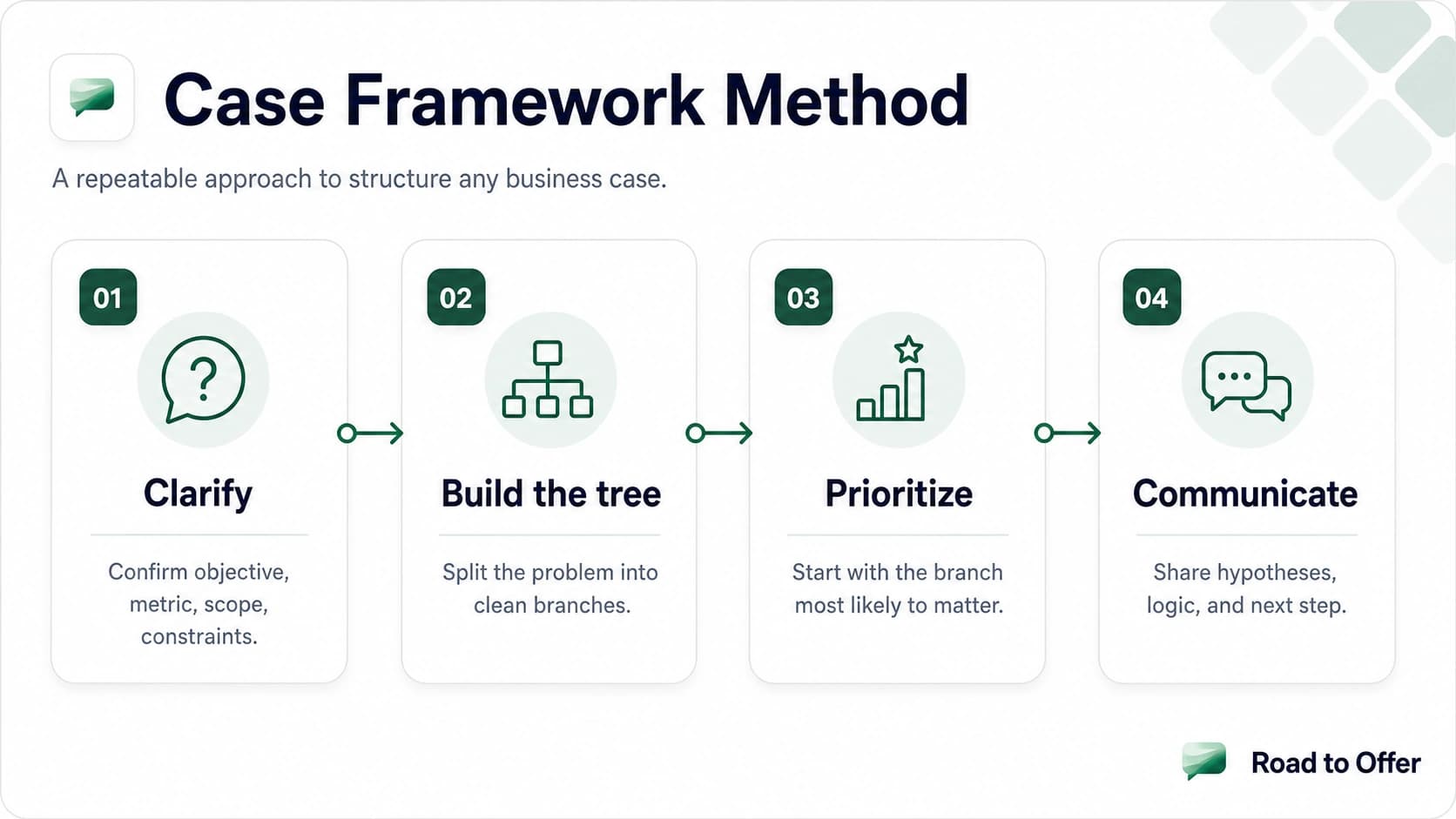
Learn the case method
One dense lesson, each step linked to the drill that trains it.
10 Deloitte Practice Cases With Worked Solutions
Each case below gives the prompt, the structure a strong candidate opens with, the evidence to request, the decisive math, and the recommendation. Cover the worked section, write your own answer for two minutes, then compare. The mix deliberately follows Deloitte's real portfolio: four Strategy and Analytics, three Technology, two Human Capital, one valuation.
Case 1: Ecommerce Growth for a Sportswear Retailer (Strategy and Analytics)
Prompt. A global apparel and sportswear company has flat total revenue and is losing share to digitally native competitors. Leadership wants direct-to-consumer digital channels to carry the growth. What should they do, and what is the realistic ceiling?
Open with. Three branches: current channel economics (what does a DTC order actually earn versus a wholesale unit), demand (is there unmet direct demand or are we cannibalising wholesale), and capability (fulfilment, returns, customer data). Name the first test: channel margin, because if DTC economics are worse than wholesale, growth in DTC destroys profit.
Evidence to request. Revenue and contribution margin per channel, DTC customer acquisition cost and repeat rate, return rate by channel, and the wholesale contract terms that constrain direct selling.
Decisive math. If a wholesale unit sells at 45 euro with a 40% gross margin (18 euro contribution) and the same unit sells direct at 90 euro with a 60% gross margin (54 euro) but carries 12 euro of fulfilment, 9 euro of returns cost at a 20% return rate and 15 euro of blended acquisition cost, DTC contribution is 18 euro. Identical. The entire DTC case then rests on repeat purchase: a customer who buys twice more with no further acquisition cost turns 18 euro into 51 euro of contribution.
Recommendation. Growth in DTC is justified only where repeat behaviour is provable. Prioritise categories with high repurchase frequency, invest in retention rather than acquisition, and protect the wholesale relationships that still deliver reach. Next test: cohort repeat rates by category over 12 months, which decides how much of the DTC target is real.
Why this is the Deloitte version. A generic case would stop at "grow DTC". Deloitte's five-step approach demands the assumption set (return rate, acquisition cost, repeat rate) be visible and the next test named.
Case 2: Engagement Strategy for a Federal Agency (Strategy and Analytics)
Prompt. A federal agency is launching a multi-year modernisation programme and has engaged you to design the engagement strategy: how the programme communicates with, involves and lands changes across a workforce of 40,000 and an external constituency of several million.
Open with. Public sector cases have no profit objective, so the tree must hang off the mission metric. Three branches: stakeholder segmentation (who is affected and how much do they matter to adoption), the change mechanism per segment (mandate, training, incentive, communication), and measurement (what tells us adoption is happening before the programme ends).
Evidence to request. Current adoption rate of prior modernisation efforts, workforce composition by role and tenure, and any statutory constraints on how the agency may communicate externally.
Decisive reasoning. The trap is treating this as a communications plan. It is a prioritisation problem: with a fixed budget, which segments determine programme success? If 8,000 of the 40,000 staff are frontline case processors who touch every transaction, they are the constraint, and the other 32,000 can be served with a lighter touch. Quantify the concentration before spreading the budget evenly.
Recommendation. Concentrate the engagement budget on the constraining segment, define a leading adoption indicator (percentage of transactions processed in the new system by week 12), and stage the wider rollout behind that indicator. Risk: statutory communication limits may slow external outreach, so sequence the internal work first.
Case 3: Long-Horizon Vision for a Benefits Provider (Strategy and Analytics)
Prompt. A large public benefits provider needs a ten-year strategic vision. Demand for its services is projected to rise materially as its beneficiary population ages, while its budget is flat in real terms. What should the vision be?
Open with. Do not open with a framework. Open with the arithmetic of the gap: projected demand growth against flat capacity gives you the size of the problem in one number, and every branch of the tree is then a way to close that specific gap. Branches: reduce demand per beneficiary, increase throughput per unit of capacity, or change the service model.
Decisive math. If beneficiaries grow 3% annually for ten years, volume rises about 34%. Flat real budget means productivity per case must rise about 25% just to hold service levels constant. That single number reframes the case: this is not a vision exercise, it is a productivity mandate with a vision wrapper.
Recommendation. Anchor the ten-year vision on a productivity target derived from the gap, name the two or three interventions that could plausibly deliver it (automation of routine determinations, channel shift to self-service, triage of complex cases), and state what proportion of the gap each closes. Next steps: baseline the current cost-to-serve per case, because the whole plan is unfalsifiable without it.
The transferable skill. Turning a vague strategic question into one quantified gap is the move that separates strong candidates here. Practise it on any profitability framework case by refusing to branch until you have sized the problem.
Case 4: Market Expansion for an Auto Parts Supplier (Strategy and Analytics)
Prompt. A tier-one automotive supplier with strong share in its home market wants to expand into a neighbouring region. Should it, and how?
Open with. A market entry structure, tailored: market attractiveness (size, growth, margin structure), our right to win (what transfers and what does not), entry mode economics, and risk. Name the first test: right to win, because a supplier's advantage is usually relationship and certification based and those rarely transfer across borders.
Evidence to request. Target market size and growth, incumbent share and their OEM relationships, certification and homologation requirements, and the cost of local manufacturing versus export.
Decisive math. Export versus build. If the target market is 800 million euro with an achievable 6% share (48 million euro revenue) at 22% contribution margin, that is roughly 10.6 million euro of annual contribution. A local plant at 60 million euro capital cost with 4 million euro of annual fixed cost yields about 6.6 million euro net, a nine-year payback. Export at a 7-point tariff and freight penalty yields less contribution but no capital. At this share level, export wins; the plant only makes sense above roughly 12% share.
Recommendation. Enter by export, with a stated share trigger at which the local plant becomes economic. Risk: tariff policy change materially shifts the trigger, so revisit annually. This is the shape of answer Deloitte's step five is asking for.
The same archetype exists as a full graded case if you want to run it live rather than read it.
 McKinsey
Market entry · medium
Run a live entry and pricing case
Same skill set as Case 4 in an MBB-labelled prompt: size the opportunity, test whether your advantage transfers, then price the entry mode out loud and get scored on your reasoning.
 BCG
BCGMarket entry · medium
Run a live market-entry case
Same skill as Case 4: size the expansion, weigh the competitive field, and commit to an entry recommendation with feedback.
Case 5: Legacy Architecture Replacement at a Finance Agency (Technology)
Prompt. A federal finance agency runs core processing on a 30-year-old mainframe system. Maintenance consumes a rising share of the IT budget and the vendor has announced end of support in four years. What should the agency do?
Open with. Resist the urge to compare technologies. Branches: the do-nothing cost curve (what happens to cost and risk if we do not act), the options (rehost, rebuild, buy a package), and the sequencing constraint (what must not break during migration).
Evidence to request. Annual maintenance cost trend, the number of downstream systems that read from the mainframe, transaction volume and peak load, and the cost of an outage per hour.
Decisive math. This case turns on migration risk cost, not licence cost. If the mainframe supports 140 downstream integrations and each integration takes an estimated 200 hours to rebuild and test at 120 euro an hour, integration work alone is roughly 3.4 million euro before any core rebuild. A big-bang rebuild also concentrates the outage risk into one weekend; a strangler-pattern migration spreads it across 30 months at higher total cost but far lower peak risk.
Recommendation. Phased migration behind an integration layer, with the highest-volume and lowest-dependency processes moved first to prove the pattern. Quantify the trade: the phased path costs roughly 20% more in total but reduces the worst-case outage exposure by an order of magnitude, which for an agency with a statutory processing obligation is the binding constraint. Next test: dependency mapping of the 140 integrations by criticality.
The Technology-case lesson. Candidates lose this case by debating cloud providers. The scored content is the same as any strategy case: options, quantified trade-offs, a decision, a risk and a next step.
Case 6: Connected Health Device Launch (Technology)
Prompt. A medical device manufacturer has built a connected pill bottle that tracks whether patients take medication on schedule. Who pays for it, and is the business viable?
Open with. The question is not the product, it is the payer. Branches: who captures the value created (patient, provider, insurer, pharma manufacturer), what that value is worth to them in money, and what it costs us to deliver.
Decisive reasoning. Medication non-adherence costs insurers hospitalisation spend. If non-adherence in a target chronic condition drives an average 1,200 euro of avoidable annual cost per patient and the device improves adherence enough to remove 15% of that, the device creates about 180 euro of annual value per patient to the insurer. If the device costs 40 euro to make and 25 euro annually to run, there is a viable business, and the insurer, not the patient, is the customer. If the adherence lift is only 4%, there is not.
Recommendation. Sell to payers, not consumers, and make the pricing outcome-linked. The entire case rests on one number, the adherence lift, so the recommendation must state that the business case is contingent on a clinical study demonstrating it, and name that study as the next step.
Why this is a technology case and not a product case. Deloitte's business technology track asks whether a technology capability creates commercially capturable value. The answer is always a value-chain question before it is an engineering question.
Case 7: Ransomware Incident Prioritisation (Technology and Cyber)
Prompt. A mid-size fintech has been hit by ransomware. Systems are encrypted, the attacker is demanding payment, and the CEO wants to know what to do in the next 48 hours.
Open with. No standard framework fits, which is exactly why this case appears in Deloitte's library. Build the tree from the decision timeline: contain (stop it spreading), assess (what is encrypted, what is exfiltrated, what is recoverable), decide (pay, restore, rebuild), and communicate (regulators, customers, partners).
Decisive reasoning. The pay-or-restore decision is a quantified comparison, and candidates who skip the quantification lose the case. Compare the ransom against downtime cost multiplied by expected restore time, plus the probability-weighted cost of the decryption key not working. If daily revenue exposure is 900,000 euro and clean backups restore in six days, restoration costs about 5.4 million euro of downtime; a two million euro ransom looks cheaper until you weight it by the meaningful probability that decryption is partial and by the regulatory and reputational cost of having paid.
Recommendation. Contain first (isolate, revoke credentials, preserve forensic evidence before wiping anything), restore from backup if backup integrity is verified, and treat payment as a last resort contingent on backup failure. Notify regulators within the statutory window regardless of the recovery path, because the exfiltration question is separate from the encryption question. Next step: verify backup integrity within 12 hours, because that single fact determines the whole path.
What it trains. Structuring under time pressure when there is no revenue tree. That is a real Deloitte skill and it is why this case is in the official library.
Case 8: Attrition After a Merger (Human Capital)
Prompt. Two years after acquiring a competitor, a client's voluntary attrition has risen from 11% to 19%, concentrated in the acquired workforce. The CEO wants it back to 12% within a year.
Open with. Human Capital cases have no canonical framework, so build the tree from the employee journey: who is leaving (segment by tenure, level, function, legacy entity), why (compensation, career path, manager quality, culture, workload), and what we control in the timeframe.
Evidence to request. Attrition by segment, exit interview themes, compensation benchmarking against market, promotion rates by legacy entity, and manager span of control.
Decisive math. Concentration is everything. If 19% blended attrition is 11% in legacy staff and 31% in acquired staff, and acquired staff are 30% of headcount, the acquired population contributes about 9.3 of the 19 points. Fixing acquired-population attrition alone gets you most of the way to target; a company-wide engagement programme spends the budget in the wrong place.
Recommendation. Target the acquired population specifically. If exit themes concentrate on career path rather than pay, a compensation adjustment is expensive and will not work. Publish a levelling map so acquired staff can see their path, fix the promotion-rate gap, and hold managers accountable on retention in the affected units. Quantify: at a replacement cost of roughly 40% of salary, cutting acquired-population attrition from 31% to 15% on 3,000 people at 70,000 euro average salary saves about 13.4 million euro annually. Next test: whether the promotion-rate gap is real or a tenure artefact.
Case 9: Workforce Planning for an Inspection Bureau (Human Capital)
Prompt. A government inspection bureau must cover a 20% increase in inspection volume over three years with a headcount budget that grows 5%. How should it plan its workforce?
Open with. Capacity gap first, then the levers. The gap is 20% demand growth against 5% capacity growth, so roughly 14% more throughput per inspector is needed. Branches: productivity per inspector, work mix (does every inspection need an inspector), and capability mix (are we using senior people on routine work).
Decisive reasoning. Segment the inspection portfolio by risk. If 60% of inspections are low risk and historically find nothing, a risk-based triage model that reduces low-risk inspection frequency by a third frees about 20% of capacity, which covers the entire gap without a productivity miracle. That is the answer, and it comes from questioning the demand rather than optimising the supply.
Recommendation. Move to risk-based inspection scheduling, redeploy freed capacity to high-risk cases, and hold a small contingency for volume surprises. Risk: a missed violation in a de-prioritised category is a political event, so pair the change with a random-audit sample to defend the model. Next step: build the risk model on three years of historical findings data before changing any schedule.
Why Human Capital cases reward this. The strong move is almost always to challenge the demand assumption rather than to squeeze the workforce. Candidates who go straight to hiring, training and overtime miss it.
Case 10: Construction Delay and Project Valuation (Valuation)
Prompt. A capital project is 14 months behind schedule and 22% over budget. The client wants to know what the delay actually cost, who is responsible, and whether to continue.
Open with. Three branches: quantify the cost of delay (direct cost overrun, financing cost, forgone revenue), attribute it (client-driven changes, contractor performance, external events), and decide (continue, restructure, abandon).
Decisive math. Sunk cost is the trap. The continue-or-abandon decision uses remaining cost against remaining value, not total spend. If the project has consumed 180 million euro of a 250 million euro budget, now needs 125 million euro to complete, and the completed asset is worth 240 million euro, the forward decision is 125 million euro of spend for 240 million euro of value, which is clearly positive even though the project is a disaster on a total-cost basis. Attribution and litigation are a separate question from the forward decision, and confusing the two is the most common error here.
Recommendation. Continue, because the forward economics are positive. Separately, quantify the attributable delay cost by category and pursue recovery through contract remedies. Next step: an independent schedule analysis to establish attribution, because the recovery claim depends on it.
The transferable habit. Say out loud which decision the number serves. Deloitte's valuation and forensic cases are built to catch candidates who mix the backward-looking question with the forward-looking one.
Exhibit reading is the bottleneck on the valuation and forensic cases specifically, because the decisive number is usually buried in a table rather than stated in the prompt.
Pull the decisive number out of an exhibit under time from the Road to Offer drill engine. Answer a real prompt and get AI-scored feedback. Free accounts include 5 drills per day for the first 3 days after signup.
 BCG
BCGM&A · medium
Run a live acquisition case
Same skill as Case 10: value the deal, test the synergies, and defend a buy or no-buy call out loud.
Self-Diagnostic: Did You Practise Like a Deloitte Candidate?
Run these six questions against your own answers to the ten cases above. They map directly onto Deloitte's published five-step approach.
- Did you restate the objective and the constraint before structuring? Several cases above carry a constraint in the prompt (limited resources, flat budget, statutory obligation). If your structure ignored it, you solved a different problem.
- Did you make your assumptions visible? Deloitte names this as its own step. "I am assuming a 20% return rate, which I would want to confirm" earns more than a silently correct number.
- Did every recommendation carry a number? "Redeploy investment into casual boots" is incomplete. "Redeploy roughly 15 million euro of marketing spend into casual boots, where our share position is three times stronger" is the answer.
- Did you name a risk? Every one of the ten recommendations above has a failure mode. Naming it unprompted is a differentiator.
- Did you state the next test? Step five. It should be the single piece of evidence that would most change your answer.
- On the non-strategy cases, did you build the tree from the situation rather than from a template? If you tried to fit revenue-minus-cost onto the ransomware case, that is the habit to break.
Where the answer is no more than twice, the fix is usually one skill rather than more cases. Structure gaps go to issue trees and MECE. Arithmetic gaps go to case interview math practice. Recommendation gaps go to synthesis.
Talk a candidate-led case through out loud
Reading a worked answer and producing one under pressure are different skills. Run a full graded case where you open the structure, request the evidence and deliver the recommendation, then get scored on each step.
Deloitte's Official Practice Resources
Work these before anything third party. They are free, they are current, and they are the only material that reflects Deloitte's actual client mix.
- The case prep tool. Deloitte's US recruiting case prep hub links the interactive cases listed in the table above, split by degree level and service area. Work the two or three that match your practice group first.
- The scenario interview tool. A separate tool exists for entry-level Audit and Assurance candidates. If your invitation says scenario rather than case, that is the one you want.
- Case and scenario interview tips. Deloitte's published guidance sets out the five-step approach and eight behavioural tips, including the explicit statement that you are not expected to produce the right answer.
- The Monitor Deloitte written case. The Footloose packet circulates as a published PDF and is the closest free proxy for an assessment centre written round.
- The online assessment and job simulation. Many candidates hit these before interviews. Coverage sits in the Deloitte assessment test guide, the Deloitte job simulation guide and the immersive online assessment guide.
Once you have worked Deloitte's own material, the constraint stops being examples and becomes reps under pressure. The case library carries candidate-led profitability, entry, growth and operations prompts you can run end to end.
How to Use These Deloitte Practice Cases
Do not read the ten cases above in one sitting. Run them as a four-week loop, and wire each weakness to a specific rep rather than to another example.
Four-week Deloitte practice plan
Week 1: work Deloitte's own published cases for your practice group, plus Recreation Unlimited. Write your structure before opening the walkthrough..
Week 1: rep free structure drills until your tree comes out hypothesis-led rather than template-shaped..
Week 2: run Cases 1 to 4 above with the worked section covered, two minutes of structure, then compare. Score yourself on assumptions, number and next test..
Week 2: fix arithmetic with graded math reps rather than mental-math apps..
Week 3: run Cases 5 to 10, which cover the technology, human capital and valuation shapes most candidates never practise..
Week 3: work the Footloose packet under a real two-hour clock, then read the written case guide..
Week 4: run two full live cases out loud where you drive the structure and request every piece of evidence yourself..
Week 4: prepare behavioural stories and rehearse them against a live behavioural interviewer..
Before the round: grade your resume against consulting screening criteria..
For each of the ten cases, the loop is the same:
- Read only the prompt. Cover everything below it.
- Write your structure for two minutes. Name which branch you would test first and why.
- Write down the three pieces of evidence you would request, in priority order.
- Write a recommendation with a number, a risk and a next test.
- Uncover the worked answer and compare, focusing on where your evidence priority differed rather than where your wording did.
Then route each weakness:
- Structure came out generic: work case interview frameworks and go back to the structure drill from week one.
- Sizing wobbled on the public sector cases: work market sizing step by step.
- Exhibits took too long: work reading charts and exhibits and rep the chart drill.
- Recommendations had no number: work synthesis and force yourself to state impact in every answer.
- Operations and cost cases felt weak: work the operations case guide and the M&A framework.
- Behavioural round: Deloitte weights fit heavily, and a rehearsed rep beats a written story list. Firm-specific questions sit in the Monitor Deloitte behavioural breakdown.
- Application materials: for the written piece see the Deloitte cover letter guide, then run the resume through the free consulting resume grader before you submit. The grader reads resumes only, so the letter stays a manual check against the guide.
If you are targeting an internship rather than a full-time seat, the process and case bar differ, and the Deloitte Discovery internship guide covers that route. For the compensation picture behind the effort, see Deloitte consulting salary. For worked examples across every firm format, see case interview examples.
How Road to Offer Fits Into Deloitte Prep
Deloitte's own tool gives you the client mix; what it does not give you is a graded rep. Road to Offer covers the other half of the loop: over 600 drills across structure, math, market sizing, charts, synthesis and brainstorming, a library of full cases you run end to end with AI feedback on your structure and recommendation, free courses covering the method, a behavioural simulator for the fit round, and assessment practice for the screens that sit in front of the interview. Signing up includes a case credit, so the first full graded case runs at no cost.
The matched resources for this page:
If your application is not in yet, the Deloitte resume guide covers what the screen reads before you ever see a case.
Sources and Further Reading (checked July 31, 2026)
- Deloitte case and scenario interview tips, including the five-step approach: deloitte.com/us/en/careers/join-deloitte/recruiting-tips/case-and-scenario-interview-tips.html
- Deloitte US recruiting case prep tool and the published practice case library: usrecruiting.deloitte.com/case-prep-tool
- Deloitte FY2025 global revenue, headcount and business-line growth: deloitte.com/global/en/about/press-room/global-revenue-announcement.html
- Deloitte interactive practice cases, strategy track: caseinterviewprep.deloitte.com/cases/strategy/ug/3
- Deloitte interactive practice cases, business technology track: caseinterviewprep.deloitte.com/cases/bts/ug/1
- Monitor Deloitte Footloose written case, Duraflex market and competitor data: preplounge.com/en/management-consulting-cases/candidate-led-usual-style/intermediate/deloitte-consulting-case-footloose-74
- Deloitte case interview process, rounds and group case format: hackingthecaseinterview.com/pages/deloitte-case-interview-prep
Run a full case the way a Deloitte interviewer would
You open the structure, name the branch you want to test, call for each piece of evidence, and close with a recommendation carrying a number, a risk and a next test. Scored on all five steps.
Frequently asked questions
Resources and related guides
- Run a real case interviewPractice
- Browse all free resourcesResource hub
- BCG Case Interview Examples: 10 Practice Cases (2026)Firm Specific · Mar 1, 2026
- Práctica de entrevistas de casos BCG: 10 ejemplos y qué esperarFirm Specific · Mar 1, 2026
- Pratique des entretiens de cas BCG : 10 exemples et à quoi s'attendreFirm Specific · Mar 1, 2026
- McKinsey Case Interview Examples: 10 Interviewer-Led Practice Cases (2026)Firm Specific · Apr 28, 2026