
Group Case Interview: How to Lead, Contribute, and Stand Out (2026)
Group case interviews test collaboration, not just problem-solving. Here's what Deloitte and EY actually watch for and how to lead without dominating.
On this page
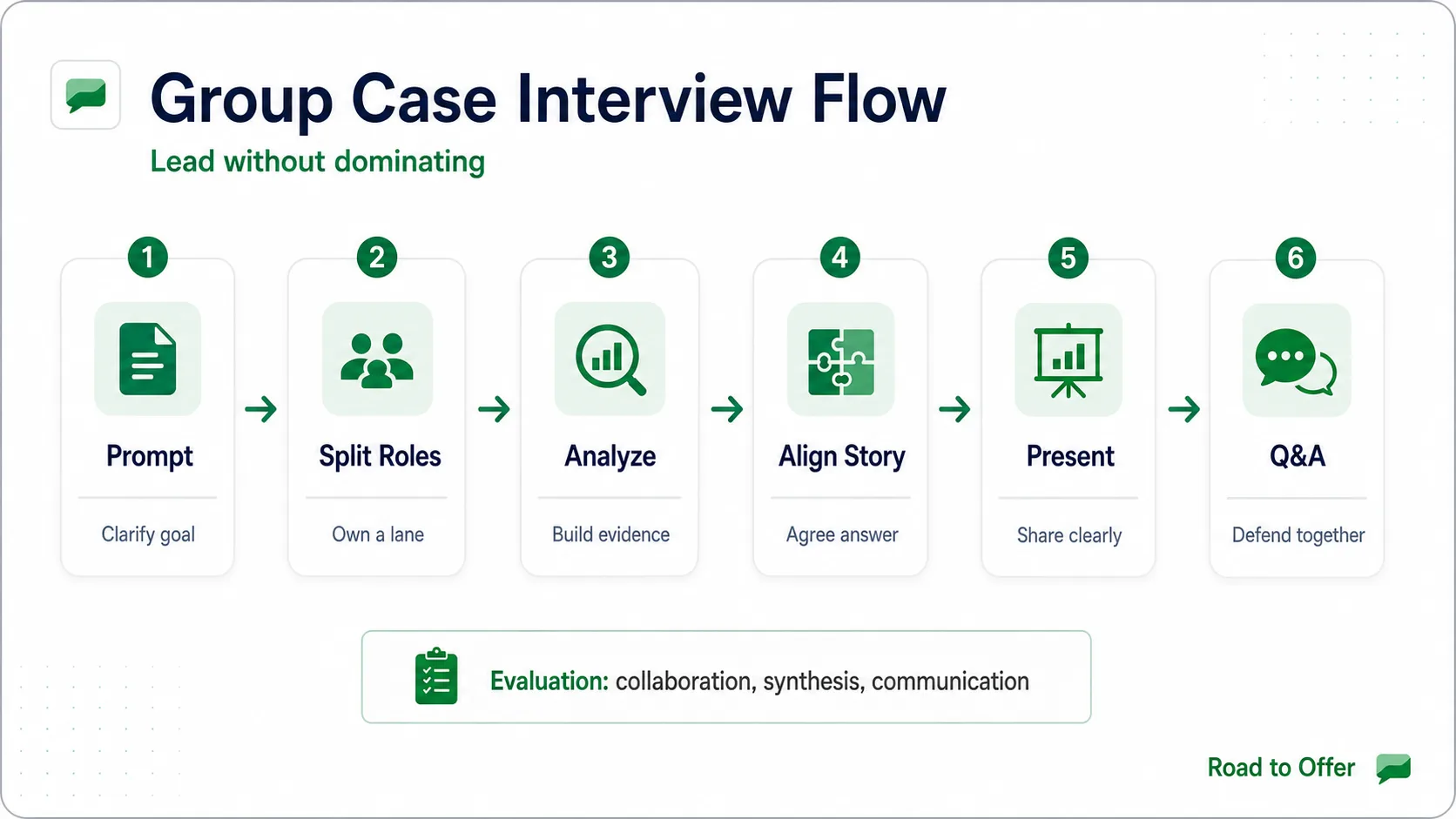
The candidate who talks most in a group case interview rarely gets the offer. Assessors are usually watching for concrete collaboration signals: analytical contribution, communication quality, leadership behaviors, and teamwork behaviors. A candidate who contributes a handful of quantified, structured insights can outperform someone who speaks constantly with vague observations.
Build the analytical skills that score in group cases
Road to Offer's case drills build the structured thinking and synthesis habits that interviewers log at Deloitte, EY-Parthenon, and PwC.
Which Consulting Firms Use Group Case Interviews
McKinsey, BCG, and Bain generally emphasize individual case interviews. If you are targeting MBB exclusively, confirm your format with the recruiter before investing heavily in group-case-specific prep. If you're targeting Deloitte, EY-Parthenon, PwC Strategy&, Accenture Strategy, or Oliver Wyman, group assessment practice can be worth adding to your plan (Deloitte Careers).
One critical truth that applies across all these firms: you are scored individually, even though you perform as a group. Every interviewer in the room has a scorecard with your name on it. "We" does not protect you if "you" contributed nothing analytically. See case interview scoring rubric for how individual scores translate to offer decisions.
What Interviewers Are Actually Measuring
Analytical contribution. Did you advance the group's understanding of the problem? Did you correctly interpret data, do accurate mental math, or generate a key insight from an exhibit? One precise quantified point is worth more than five general observations (EY Careers).
Communication quality. Were your contributions structured and easy to follow? Did you use signposting ("I think the key issue is X, because the data shows Y") or did you speak in loosely connected sentences? Interviewers are watching whether your communication would work in front of a client.
Leadership behaviors. Did you help the group stay organized? Did you track time? Did you synthesize when the group got stuck? Did you suggest a path forward when the discussion was spinning? Leadership in a group case is measured by impact, not by how many times you said "OK, let's move on."
Teamwork behaviors. Did you actively listen? Did you explicitly build on others' ideas ("Building on what Alex said, if we extend that to...")? Did you invite quieter members into the discussion without being condescending? Did you integrate pushback constructively rather than defending your position?
Notably absent: talking the most, speaking first, or presenting to assessors. None are scored directly. For communication patterns, see case interview communication tips.
The 4 Roles That Emerge in Every Group Case
Candidates fall into four archetypes. Only one consistently receives offers.
Role 1: The Bulldozer
Talks constantly, interrupts, treats the group as a solo performance. Collaboration scores are too damaged for analytical strengths to compensate. Scorecard risk: High.
Role 2: The Silent Node
Participates minimally, nods frequently, occasionally agrees. Silence is scored as little or no contribution regardless of intent. Scorecard risk: Very high.
Role 3: The Devil's Advocate
Challenges every idea but rarely proposes alternatives. Creates friction without building toward a solution. Scorecard risk: Medium to high.
Role 4: The Structured Contributor
High-quality contributions at regular intervals. Builds explicitly on peers. Drives toward conclusions when stuck. Manages time without being controlling. Scorecard risk: Low. This is your target.
How to Lead Without Dominating
In a 5-person group, aim to speak approximately 20% of the time, no more than 25%. Here is the sequencing that works.
Minutes 0–5 (Reading phase). Read the case materials actively. Take structured notes. When discussion opens, make the first substantive analytical observation. Not a process suggestion like "let's structure our approach," but an insight backed by data: "Looking at the income statement, the margin decline is 1.4 points. About 0.8 of that comes from gross margin compression, which tracks with the food inflation data in exhibit 3. But the remaining 0.6 points came from SG&A growing faster than revenue. That's the more controllable lever." This one contribution positions you as analytically sharp without claiming a leadership role.
Minutes 5–20 (Analysis phase). Contribute every 3–5 minutes with structured, evidence-based points. Between contributions, listen carefully. When a peer makes a good point, build on it explicitly: "Building on what Jordan said about pricing: if we separate the premium segment from the value segment, the volume decline is concentrated in the premium tier. That changes the recommendation: this isn't a broad pricing problem, it's a positioning problem in one segment." Building on peers is one of the highest-signal behaviors interviewers log (Management Consulted Group Case Guide).
Minutes 20–35 (Synthesis phase). By now you have established credibility through analytical contributions. This is when leadership behaviors pay off. If the group is spinning on a disagreement: "We have two views on pricing: Alex thinks we should cut, I think we should hold. Can we agree to test both scenarios and present the conditions under which each makes sense? That way we give the board a richer answer than a binary recommendation." This is collaborative leadership: you are designing a path forward, not imposing a view.
Minutes 35–end (Presentation prep). Organize the presentation structure: "We have 10 minutes before we present. I suggest we cover the problem diagnosis, our recommendation, and key risks. Who wants to take which section?" This is unambiguously useful. No one resents time management when the clock is real.
Specific language patterns for key moments:
What to Do When Your Group Goes Off Track
Scenario 1: A Bulldozer is dominating.
Bad redirect: "Alex, you've been talking a lot. Let's hear from others." (Confrontational, makes Alex defensive, makes you look petty.)
Good redirect: "We've gotten a lot from Alex on the pricing side. Maya and Jordan, I want to make sure we capture your read on the SG&A exhibit before we move forward. What are you seeing there?" (Redirects attention productively, invites others without attacking anyone.)
Scenario 2: The group disagrees and is spinning.
Bad redirect: "We'll never agree on this, let's just move on." (Abandons the issue, leaves unresolved tension that will surface in the presentation.)
Good redirect: "We have two views here, and I don't think either is wrong. They may just apply under different conditions. Can we frame this as: 'We recommend Option A, with Option B preferred if [specific condition]'? That way we present both and let the board decide based on their risk appetite." (Creates synthesis rather than winners and losers.)
Scenario 3: The group is losing track of time.
Bad redirect: Continuing the analysis as if the deadline doesn't exist.
Good redirect: "We have 8 minutes left and we still need to structure our presentation. I suggest we stop analysis now, agree on the three key points we're confident about, and note what we'd want to explore with more time. Can we do that?" (Takes explicit responsibility for time management, proposes a specific path, acknowledges limitations honestly.)
For the synthesis skills this requires, see case interview synthesis.
Worked Example: Full 45-Minute Group Case Walkthrough
Setup: Four candidates: you, Alex, Jordan, and Maya. Regional grocery chain, operating margins declined from 4.2% to 2.8% over two years. Board wants three actions to recover to 4% within 18 months.
Materials: Five exhibits: (1) income statement, (2) revenue by category, (3) store-level profitability, (4) competitor pricing benchmarks, (5) market overview.
Minutes 0–8: Individual Reading
Read the board's question first. Always read the question before exhibits. Annotate: circle unusual trends, mark numbers to calculate, question mark inconsistencies.
Key observations from the exhibits:
- Revenue: flat (+0.5% YoY) on $900M base
- COGS: up 3.2% YoY (food inflation data confirms this)
- SG&A: up 5.1% YoY (labor is 68% of SG&A; minimum wage increases visible)
- Gross margin declined ~0.8 percentage points; operating margin declined 1.4 points total
- New stores: 8 urban locations opened in last 3 years, still in ramp phase. Average contribution margin 7% vs. chain average of 4.2% on mature stores... wait. Urban stores are contributing 7% margin? No. Re-read. Urban stores have $8.5M revenue and $7.9M cost base = $0.6M margin = 7% margin. Mature stores: $12M revenue at 4.2% operating margin = $0.5M margin. Urban stores are actually slightly more profitable per dollar... but they inflate the SG&A base. Check again.
- Competitor benchmark: client is 6–8% above market on private-label goods
Minutes 8–15: Opening Discussion
Alex opens: "So I think we should look at revenue first..."
You (Structured Contributor move): "Before we structure the analysis. I did a quick read of the income statement. The margin decline is 1.4 points. About 0.8 points comes from gross margin compression, which tracks with the food inflation in exhibit 5. But 0.6 additional points came from SG&A growing faster than revenue, and SG&A grew 5.1% while revenue was flat. That SG&A growth is the more actionable lever for management. I'd suggest we split into two tracks: COGS and pricing on one side, SG&A on the other."
Why this works: You quantified the problem first, identified the more controllable component, and proposed a workstream split, in four sentences.
Maya: "Also, the store-level data shows the new urban stores are dragging performance."
You (building on Maya): "Good catch, Maya. That's consistent with SG&A growing faster than revenue. New stores have high fixed cost bases before they've ramped. We should test whether the margin decline is structural (bad unit economics on new stores that won't recover) or cyclical (inflation hitting everyone). If it's structural, the fix is a different set of actions."
Minutes 15–30: Quantitative Analysis
Working through the numbers:
COGS / Pricing Analysis:
- Food inflation: approximately 4.1% annually (hypothetical case data)
- Client price increases: approximately 2% (inferred from flat revenue on slightly positive volume)
- Pricing gap: 2.1% annually on $900M = ~$19M of unrecovered inflation
- Private-label opportunity: client is 6–8% above competitors. If we align on price, volume could recover. At 40% gross margin on private label ($180M category), every 1% volume recovery = $0.7M gross profit
SG&A Analysis:
- Labor (68% of SG&A): minimum wage increases + tight labor market drove 6.2% cost growth
- Rent (22% of SG&A): urban leases with CPI escalators grew 4.1%
- New stores: 8 opened in 3 years, average pre-opening cost $2.1M each ($16.8M capex), still in ramp
Unit Economics Check (Maya's observation):
- New urban store: $8.5M revenue, $7.9M opex = $0.6M EBIT = 7% margin
- Mature store: $12M revenue × 4.2% margin = $0.5M EBIT
- Interpretation: Urban stores are marginally profitable per store, but the ramp phase inflates chain-level SG&A temporarily. The problem is not that urban stores are bad. It's that 8 stores in ramp phase simultaneously creates a structural SG&A drag.
Minutes 30–40: Synthesis
The group has a lot of data points. It's starting to fragment. This is the synthesis moment.
You: "We have about 10 minutes before presentation prep. Let me try to synthesize where we are. Three drivers of the 1.4-point margin decline: (1) a pricing lag, we've been slow to pass through food inflation, creating approximately $19M of unrecovered cost. Private-label repricing to market is the most direct fix. (2) SG&A inflation, labor and rent growing faster than revenue, partially unavoidable but partially addressable through labor scheduling. (3) New store ramp, 8 urban stores simultaneously in ramp phase creating a temporary SG&A drag. the fix is patience, not action. For the board's three-action question: private-label repricing, labor scheduling optimization, and a moratorium on new urban openings until the current cohort matures. Does that capture what everyone sees?"
Jordan: "I think supplier negotiation should be one of the three actions. We could get COGS down at the source."
You: "Fair point. We don't have supplier contract data in the exhibits, so we'd need to caveat it as a hypothesis. If the client has purchasing scale, there's probably 1–2% COGS savings available. Should we substitute that for labor scheduling as the third action, given it has higher potential upside?"
Group agrees to flag supplier negotiation as the third recommendation with a data-dependency caveat.
Minutes 40–45: Presentation Prep
You: "Five minutes. I'll take slide 1, the diagnosis with the numbers. Alex, can you take the recommendation slide? Maya, you had the best read on the store-level data. Can you do a 30-second section on that? Jordan, can you handle the supplier negotiation caveat and risks?"
Group Case Mistakes That Get You Cut
Staying quiet to appear collaborative. The scorecard has no field for "quiet but supportive." Silence is scored as zero analytical contribution.
Dominating the discussion. Talking over peers signals poor client management instincts, the opposite of what consulting firms need.
Making only process contributions. "We should structure our approach" consumes airtime without advancing analysis. Every contribution should either advance the group's understanding or help the group function better.
Not knowing the materials. Candidates who cite exhibit data they have not read carefully are caught immediately when probed.
Ignoring the clock. Many groups hit the presentation moment with 5 minutes left and no structure. Someone needs to call the time transition. If no one else does, you do it.
For more on building strong case habits across formats, see case interview frameworks complete guide, written case interview guide, case interview scoring rubric, and behavioral interview consulting.
Sharpen your analytical instincts for group cases
Practice building quantified, structured insights under time pressure, the exact skill that separates Structured Contributors from the rest of the room.
Preparation Checklist
Execution checklist
Review your target firm's group case format before the assessment day. Deloitte, EY-Parthenon, and PwC have different group sizes, durations, and presentation formats. Know what you're walking into.
Practice delivering structured analytical points in 2–3 sentences. Group cases reward concision. If you need 8 sentences to make a point, you'll lose the room before you finish.
Run at least 2 timed individual case analyses under group case conditions. You need to process exhibits and generate quantified insights quickly. Road to Offer drills are useful here because you can isolate structure, exhibit reading, and synthesis before adding the pressure of a live group.
Practice synthesis language out loud until it feels natural. Phrases like 'Let me try to synthesize where we are' feel unnatural until you've said them 20 times. Practice them before they need to appear in a live assessment.
Practice active listening: summarize what peers say before responding. Explicitly building on a peer's idea ('Building on what X said...') is one of the highest-scored behaviors interviewers log. It's a skill that requires deliberate practice.
Interactive Practice Drills
Sources and Further Reading (checked June 17, 2026)
- Deloitte Interview Tips: deloitte.com/us/en/pages/careers/articles/join-deloitte-interview-tips.html
- EY Careers, Student Interview Tips: ey.com/en_gl/careers/student/interview-tips
- Management Consulted Group Case Interview Guide: managementconsulted.com/group-case-interview
- Hacking the Case Interview, Group Case: hackingthecaseinterview.com/pages/group-case-interview
- IGotAnOffer Group Case Interview: igotanoffer.com/blogs/consulting/group-case-interview
Find out where your case skills actually stand
Our free assessment benchmarks your analytical structuring, communication clarity, and synthesis quality, the three dimensions that determine group case scores at Deloitte, EY-Parthenon, and PwC.
Frequently asked questions
Resources and related guides
- Practice group cases in a real case interviewPractice
- Browse all free resourcesResource hub
- Written Case Interview: BCG and Bain Format, Slides, Worked ExampleFundamentals · Mar 7, 2026
- Accenture Salary Guide 2026 - Pay by Level and Career PathFundamentals · May 20, 2026
- PrepLounge Alternatives: Choose by Practice JobFundamentals · May 20, 2026