
Deloitte Assessment Test and Job Simulation 2026: Format, Sections & Prep
The two Deloitte online stages explained: the Cappfinity Immersive Online Assessment and the later video Job Simulation, with sourced section tables, scoring against Deloitte's values, and what to practice.
On this page
The Deloitte assessment test and Job Simulation in 2026 are two separate online stages, and most candidates lose ground by treating them as one. The first is the Immersive Online Assessment, built by Cappfinity, which AptitudePrep describes as 35 questions across 5 sections, untimed but designed to take about 60 minutes. The second is the Job Simulation, a later, video-heavy stage that CaseBasix reports lasts about 40 minutes and uses situational judgement questions where you rank 5 actions from most to least preferable. They look similar from the outside, but they test different things. The Immersive Online Assessment screens your values fit and reasoning early, while the Job Simulation drops you inside a realistic project and grades how you respond. This guide separates the two cleanly, gives one sourced section-by-section breakdown for each, and shows exactly what to practice so you advance to Deloitte's final-stage assessment centre.
What are the two Deloitte online assessment stages?
The Immersive Online Assessment and the Job Simulation are separate stages that need different preparation. AptitudePrep reports 35 questions across 5 sections in an untimed assessment designed to take about 60 minutes, as checked June 26, 2026. CaseBasix and JobTestPrep report that the later Job Simulation takes about 40 minutes across 3 graded sections with 5 questions each, as checked June 26, 2026. Start with timed graph and exhibit reasoning drills as adjacent skill practice, not as a Deloitte simulator.
Almost every "Deloitte online test" question online blurs these two distinct steps. Getting the names straight is the single biggest thing you can do before you prepare.
- Immersive Online Assessment. The earlier screen. Built by Cappfinity, which AptitudePrep notes also powers assessments for KPMG, HSBC, and Lloyds. It is untimed, runs about 35 questions across 5 sections, and mixes short readings, charts, videos, and voicemails into realistic scenarios.
- Job Simulation. The later stage. A pre-recorded, video-heavy simulation that puts you on a project team. GraduatesFirst reports it is delivered through Cappfinity and centres on Deloitte's values, situational judgement, and video responses. CaseBasix and JobTestPrep put the graded portion at about 40 minutes.
The practical difference: the Immersive Online Assessment is a values-and-reasoning filter you complete in one sitting at home, while the Job Simulation feels like a day on the job, with documents to read and recorded answers to give. Prepare for each on its own terms instead of lumping them together.
Practice judgment under pressure with AI feedback
Deloitte grades how you reason and respond, not just what you know. Run a free Road to Offer case to rehearse structured, on-the-record answers.
Inside the Immersive Online Assessment: 35 Questions, 5 Sections
The Immersive Online Assessment is untimed, but AptitudePrep recommends budgeting about 60 minutes, and PracticeReasoningTests says most candidates finish in 60 to 75 minutes. AptitudePrep notes the assessment draws on 8 data sources, including 2 articles, 4 graphs, charts, or tables, plus videos and voicemails. Here is the section structure both providers report.
PracticeReasoningTests adds that each section is scored on a 1 to 5 scale, so consistency across sections matters more than nailing any single question. The Life at Deloitte section is video only, which is your first hint that recorded answers are central to how Deloitte assesses you. Treat the readings and charts as real evidence: the questions reward answering from the material in front of you, not from prior assumptions.
Inside the Job Simulation: About 40 Minutes, 3 Graded Sections
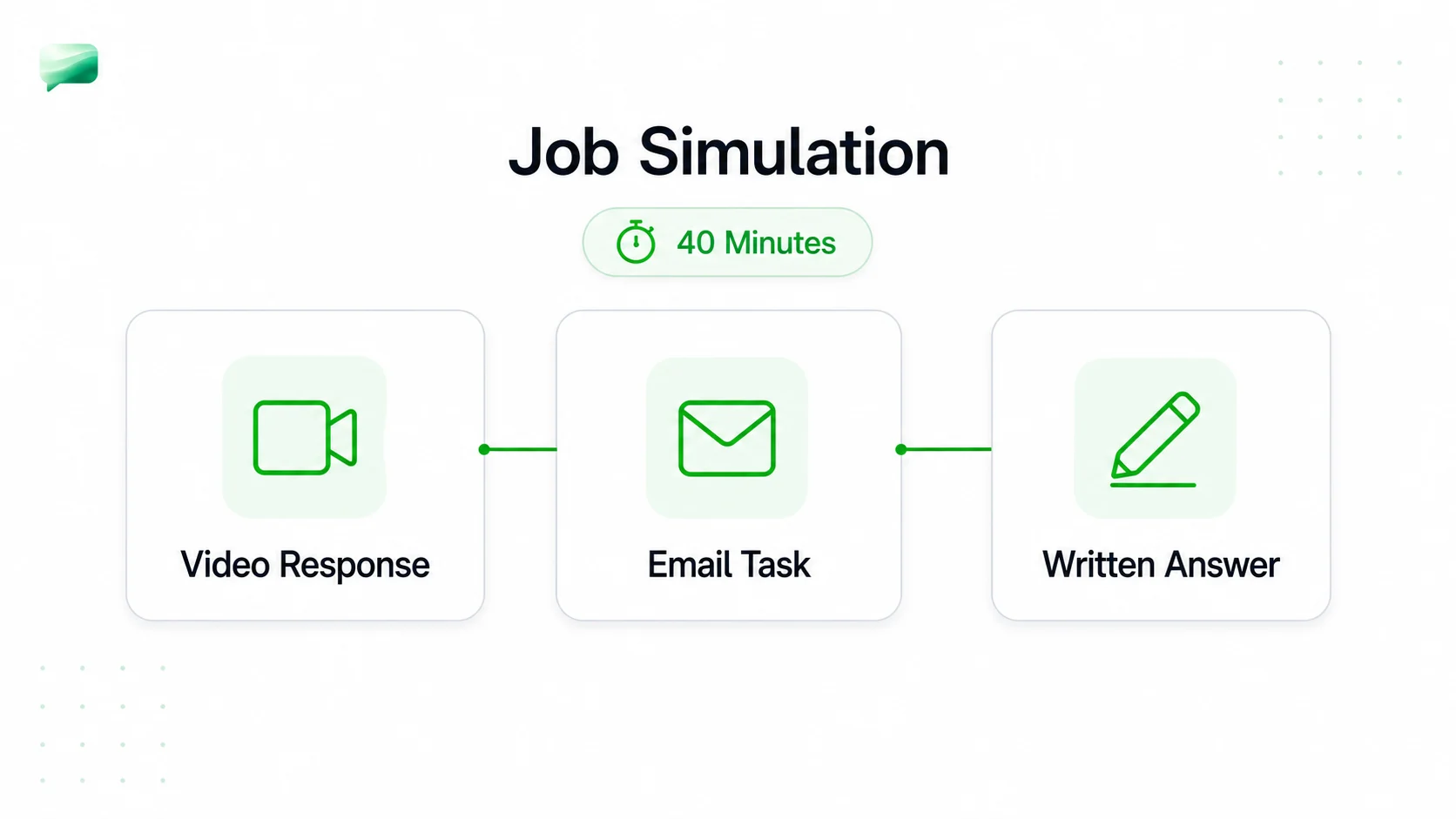
The Job Simulation is the stage candidates underestimate most. JobTestPrep breaks the experience into 3 graded sections plus 1 ungraded equipment and intro check, with 5 questions per section and up to 7 resources to read before you answer.
CaseBasix and JobTestPrep put the graded portion at about 40 minutes, while GraduatesFirst notes the broader sitting can run 40 to 60 minutes once you include setup and reading. The "up to 7 resources per section" detail is the one most candidates miss. Those documents, emails, and charts are not decoration. They contain the facts your answer is graded against, so reading them first is the difference between a generic response and a specific one.
The Question Types You Will Face
Across both stages, four formats do most of the work. Knowing which is which lets you prepare deliberately instead of generically.
- Pre-recorded video responses. You read or hear a prompt, get a short prep window, then record an answer to camera with no live interviewer. This is the format the Life at Deloitte section and much of the Job Simulation rely on.
- Written tasks. Often framed as an email from a senior team member, asking you to reply or draft a short response. JobTestPrep reports these are capped at 1,500 characters.
- Numerical and verbal reasoning. Data interpretation over tables, graphs, and charts, plus reading-based reasoning. MyConsultingOffer reports a numerical reasoning section of 21 questions.
- Situational judgement. The signature Deloitte format. CaseBasix and JobTestPrep describe scenarios with 5 possible actions that you rank from most to least preferable.
If you have prepared for another firm's digital screen, expect overlap but not a match. McKinsey's game-based test, covered in our McKinsey Solve guide, is a problem-solving simulation rather than a values-and-judgement screen, and PwC's route, covered in our PwC assessment test guide, leans on SHL-style aptitude. Deloitte's mix of recorded video plus situational judgement is its own animal.
Video and Written Mechanics: What Graders Actually Want
The mechanics are tight, so knowing the limits protects you from self-inflicted mistakes. JobTestPrep reports video responses run a minimum of 30 seconds and a maximum of 2 minutes, and written responses are capped at 1,500 characters.
For video, the 30-second floor means a one-line answer reads as underprepared, and the 2-minute ceiling means rambling gets cut off mid-thought. The sweet spot is a structured answer: a quick headline, one or two pieces of evidence, and a clear close. GraduatesFirst recommends rehearsing video responses with STAR plus R, meaning Situation, Task, Action, Result, and a final Reflection on what you learned. Practising to a webcam beforehand removes most of the nervous energy that makes early takes weak.
For written tasks, 1,500 characters is roughly 250 words, so you cannot waffle. Lead with your recommendation or answer, support it in two or three sentences, and acknowledge the most obvious risk or next step. Treat the email scenario as a real reply to a busy manager who will skim it.
How Deloitte Scores It: The Five Shared Values
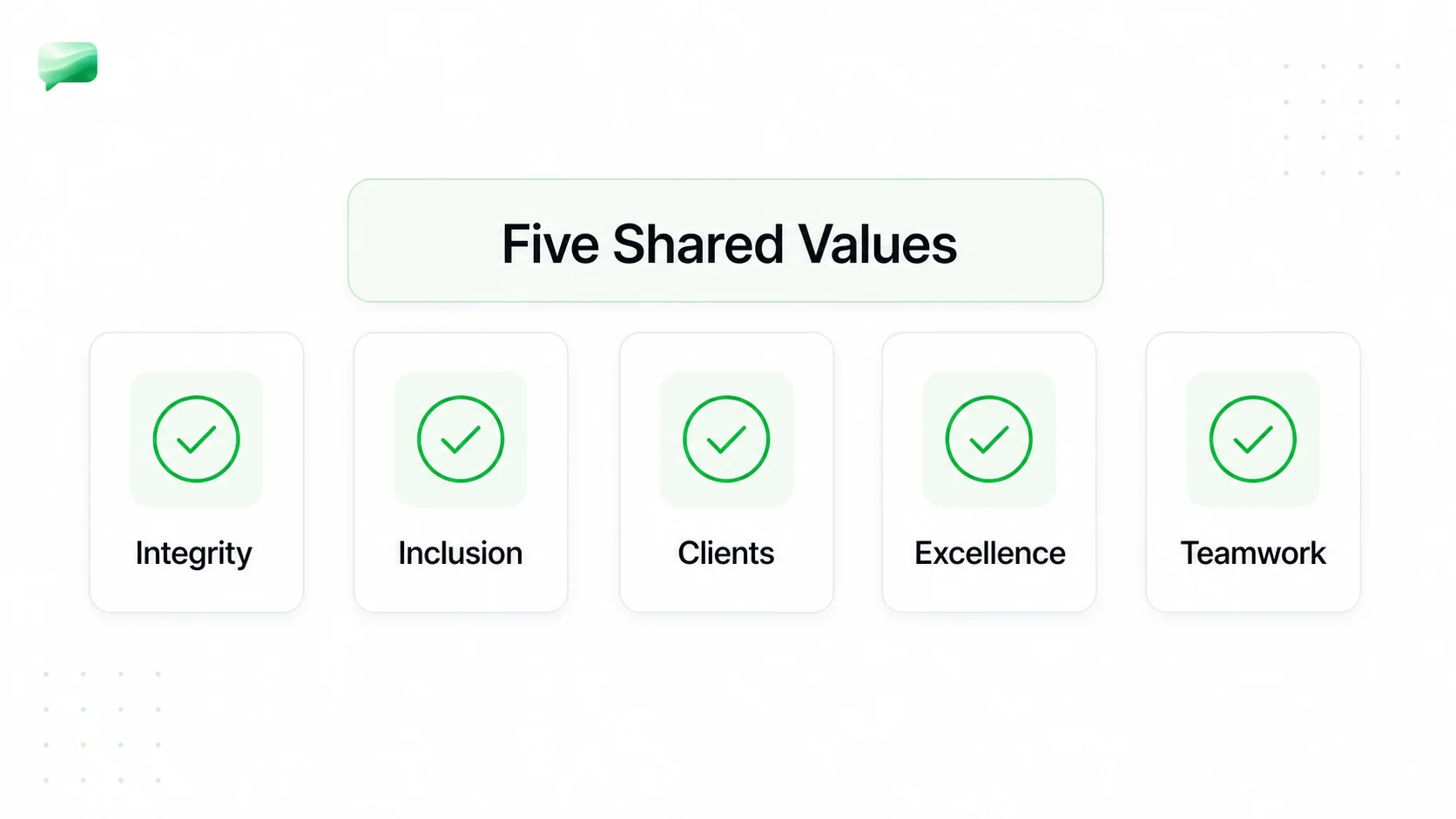
Situational judgement is not scored on a single "right" answer. MyConsultingOffer reports that responses are evaluated against Deloitte's five shared values:
- Lead the way
- Serve with integrity
- Take care of each other
- Foster inclusion
- Collaborate for measurable impact
When you rank 5 actions most to least preferable, the highest-scoring choices are the ones that best express those values. PracticeReasoningTests notes each section is rated on a 1 to 5 scale, so the goal is consistent, values-aligned judgement across the whole sitting.
Where the Assessment Sits in the Deloitte Hiring Funnel
The online assessment is an early screen, not the finish line. Across markets the flow generally runs: online application, then the Immersive Online Assessment, then the Job Simulation, and finally a final-stage assessment centre. MyConsultingOffer notes that final stage includes a roughly 5-minute presentation, so verbal communication carries weight right to the end.
For consulting and strategy roles, the assessment is also a gateway to a more demanding interview. If you are targeting a case-style path at Deloitte, read our Deloitte case interview guide early, because the structured thinking it rewards is the same muscle the situational judgement and Job Simulation tasks lean on. Students recruiting through an internship route should also check the Deloitte Discovery internship guide for how the early-careers funnel and timeline differ.
Section-by-Section Preparation Strategy
Generic "practice your psychometrics" advice is the trap here. Each format needs its own drill.
- Video responses: Rehearse to a webcam using STAR plus R. Record three to five answers, watch them back, and cut filler. Aim to land your point inside the 30-second to 2-minute window.
- Written tasks: Practise top-down replies under a 250-word ceiling. Recommendation first, two supporting points, one risk or next step.
- Numerical reasoning: Drill data interpretation over tables and charts until the arithmetic stops being the bottleneck. Speed plus accuracy is the whole game on a 21-question section.
- Verbal reasoning: Train yourself to answer strictly from the passage, not from outside knowledge.
- Situational judgement: Internalise the five shared values, then practise ranking actions and explaining why, the way the worked example above does.
The through-line across video, written, and situational judgement is structured judgement under time pressure, and that is the exact skill a live case rehearses. Use a structure drill to build the habit of leading with an answer and supporting it cleanly.
Use the evidence-first response method: 1. read every resource, 2. lead with the answer, 3. support it with one or two relevant facts, 4. close with the risk or next step.
Build an evidence-first assessment answer from the Road to Offer drill engine. Answer a real prompt and get AI-scored feedback. Free accounts include 5 drills per day for the first 3 days after signup.
Deloitte immersive simulator: early access, and the reading skill it rewards
The immersive simulator is being built. Signing up free reserves your place and opens the graph drills that train the data interpretation the job simulation leans on.
Common Mistakes That Sink Candidates
- Conflating the two stages. Preparing for "the Deloitte test" as one thing leaves you unready for the video-heavy Job Simulation. Prepare for each separately.
- Waffling on video. With a 2-minute ceiling, a meandering answer never reaches its point. Lead with the headline.
- Ignoring the source documents. With up to 7 resources per section, candidates who skip the reading give generic answers that graders downrank.
- Mis-ranking situational judgement options. Picking the action that sounds most assertive instead of the one that best fits Deloitte's values. Transparency and collaboration usually outrank speed at any cost.
- Treating it as untimed and unfocused. The Immersive Online Assessment is untimed, but a distracted 90-minute sitting reads worse than a focused 60-minute one. Block a quiet window.
What Happens After, and the Timeline
AptitudePrep reports candidates typically hear back on the Immersive Online Assessment within about 3 days. A strong result advances you toward the Job Simulation and, eventually, the final-stage assessment centre with its 5-minute presentation. Because the assessment is a screen rather than the decision, the goal is simply to clear it convincingly and arrive at the human stages with your reasoning and communication already sharp.
That is also why the smartest prep is not buying a generic test pack. It is rehearsing structured, on-the-record answers, the same skill the case interview rewards. Run a free practice case to pressure-test your structure and synthesis, then circle back to the Deloitte case interview guide before your interview rounds.
Rehearse the judgment Deloitte actually scores
Road to Offer runs AI-guided cases scored on structure, reasoning, and clarity, the same dimensions the Job Simulation and assessment centre reward.
Use the exact assessment name in your current invitation to choose the preparation child: Deloitte Immersive Online Assessment or Deloitte Job Simulation. The children do not assume one current vendor, task sequence, timing, or rule set.
Sources (checked June 26, 2026)
- CaseBasix, Deloitte Job Simulation overview: https://www.casebasix.com/pages/deloitte-job-simulation
- MyConsultingOffer, Deloitte online assessment: https://www.myconsultingoffer.org/case-study-interview-prep/deloitte-online-assessment/
- GraduatesFirst, Deloitte Job Simulation: https://www.graduatesfirst.com/deloitte-job-simulation
- AptitudePrep, Deloitte Immersive Online Assessment: https://www.aptitudeprep.com/deloitte-immersive-online-assessment/
- JobTestPrep, Deloitte Job Simulation: https://www.jobtestprep.co.uk/deloitte-job-simulation
- PracticeReasoningTests, Deloitte Immersive Online Assessment: https://www.practicereasoningtests.com/deloitte-immersive-online-assessment
Frequently asked questions
Resources and related guides
- Practice a real behavioral interviewPractice
- Browse all free resourcesResource hub
- Accenture Assessment Test 2026: Identify Your Route & PrepareFirm Specific · Jun 27, 2026
- BCG Pymetrics Assessment: 12 Games, Scoring, and Prep (2026)Firm Specific · May 1, 2026
- Deloitte Job Simulation: Inbox Decisions and Written Response PracticeFirm Specific · Jul 18, 2026
- Oliver Wyman Online Test and Assessment 2026: Format, Scoring & PrepFirm Specific · Jun 28, 2026