
Deloitte Consulting Cover Letter: Template & Examples
Deloitte consulting cover letter guide: one-page skeleton, firm-name-swap test, service-line example, AI humanize checklist, and funnel fit.
Free consulting resume review
Check the resume behind your Deloitte application
Get a consulting-specific score, evidence-backed strengths, and priority fixes before you submit to Deloitte.
By uploading, you agree to resume analysis and report storage until you delete it. See the privacy policy.
On this page
A Deloitte consulting cover letter in 2026 is optional, but when it lands well it does one job your resume cannot: it argues why you, why consulting, and why Deloitte in your own words. Per PrepLounge, a consulting cover letter should be kept to a maximum of one page, and the strongest letters all pass one test: swap the word Deloitte for any other firm, and the whole thing should fall apart. Because Deloitte does not require a cover letter for most roles, the candidates who gain the most are non-traditional applicants, career switchers, and borderline profiles who need to add context the resume leaves out. This guide is built around that firm-name-swap test as its spine. It pairs the test with a paragraph-by-paragraph annotated example tailored to one specific service line, and it leads with the AI-cover-letter trap most competitors bury at the bottom. Read your application instructions first, then build from the skeleton below.
Does Deloitte actually require a cover letter?
No. Deloitte does not require a cover letter for most consulting roles, and many of its online applications make the upload optional. That does not mean it is worthless. Optional is not the same as ignored, and a sharp letter can be the data point that tips a borderline file into the interview pile.
The decision rule is about who you are:
- Write one if you are non-traditional, a career switcher, or borderline. If your resume does not obviously read as a consulting profile, the letter is where you bridge the gap and explain the path.
- Write one if you have context the resume cannot carry. A gap year, a pivot, a non-target school, or a story that needs framing all belong in the letter, not crammed into a resume bullet.
- Skip it, or rewrite it, if it only restates your resume. A letter that adds nothing new is wasted, and a generic one can become negative evidence about your judgment and writing.
If you decide to submit, the rest of this guide gets you to a letter that earns its place on the page.
The same judgment your letter advertises is what the case tests
A clean cover letter gets you in the room. Run a free AI-scored case to see whether your structure, math, and synthesis hold up once you are there.
The one-page, five-paragraph Deloitte skeleton
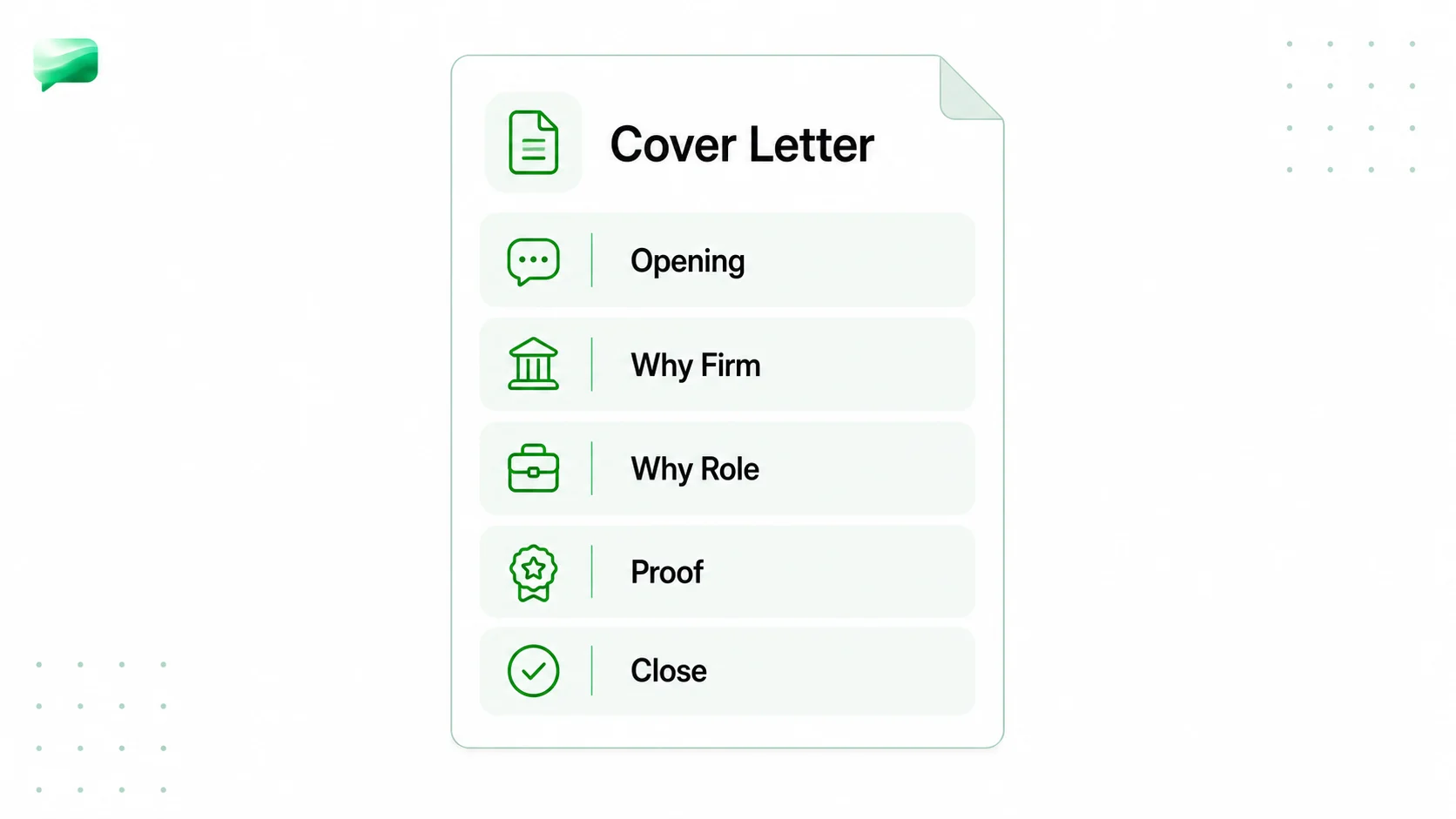
Keep the whole letter on one page, in the structure below. Per PrepLounge you should include two to three personal highlights rather than rehashing the whole resume, and this skeleton forces exactly that discipline.
Three short body paragraphs is the ceiling, not a target to pad toward. If you cannot make the case in three stories, the problem is weak evidence, not a lack of space.
Writing the opening: name the exact role and service line
The single most common opening mistake is vagueness. "I am writing to express my interest in a consulting role at Deloitte" could have been sent to any firm by any candidate. The fix is to name the exact role and the exact service line in sentence one, then preview your reasons in sentence two.
Deloitte is not one practice. Name the one you applied to, because they recruit and interview differently:
A strong opening reads: "I am applying for the Strategy Analyst position with Monitor Deloitte in your Boston office. After speaking with two consultants in the practice, I want to start where market-shaping analysis meets the implementation muscle of the wider Deloitte network." Two sentences, specific role, specific service line, and a preview the reader can probe.
Body paragraphs: one quantified story per reason, mapped to the Shared Values
Each body paragraph carries exactly one story, and each story should quietly prove one of Deloitte's five Shared Values: Lead the Way, Serve with Integrity, Take Care of Each Other, Foster Inclusion, and Collaborate for Measurable Impact. You never name the value out loud. You demonstrate it with action and a result.
Here is the do and don't, grounded in the actual values:
The pattern in every strong row is identical: a specific action, a real context, and a consequence you can defend in an interview. The weak column is what a recruiter reads in seconds and forgets just as fast.
The firm-name-swap test: the one rule that organizes everything
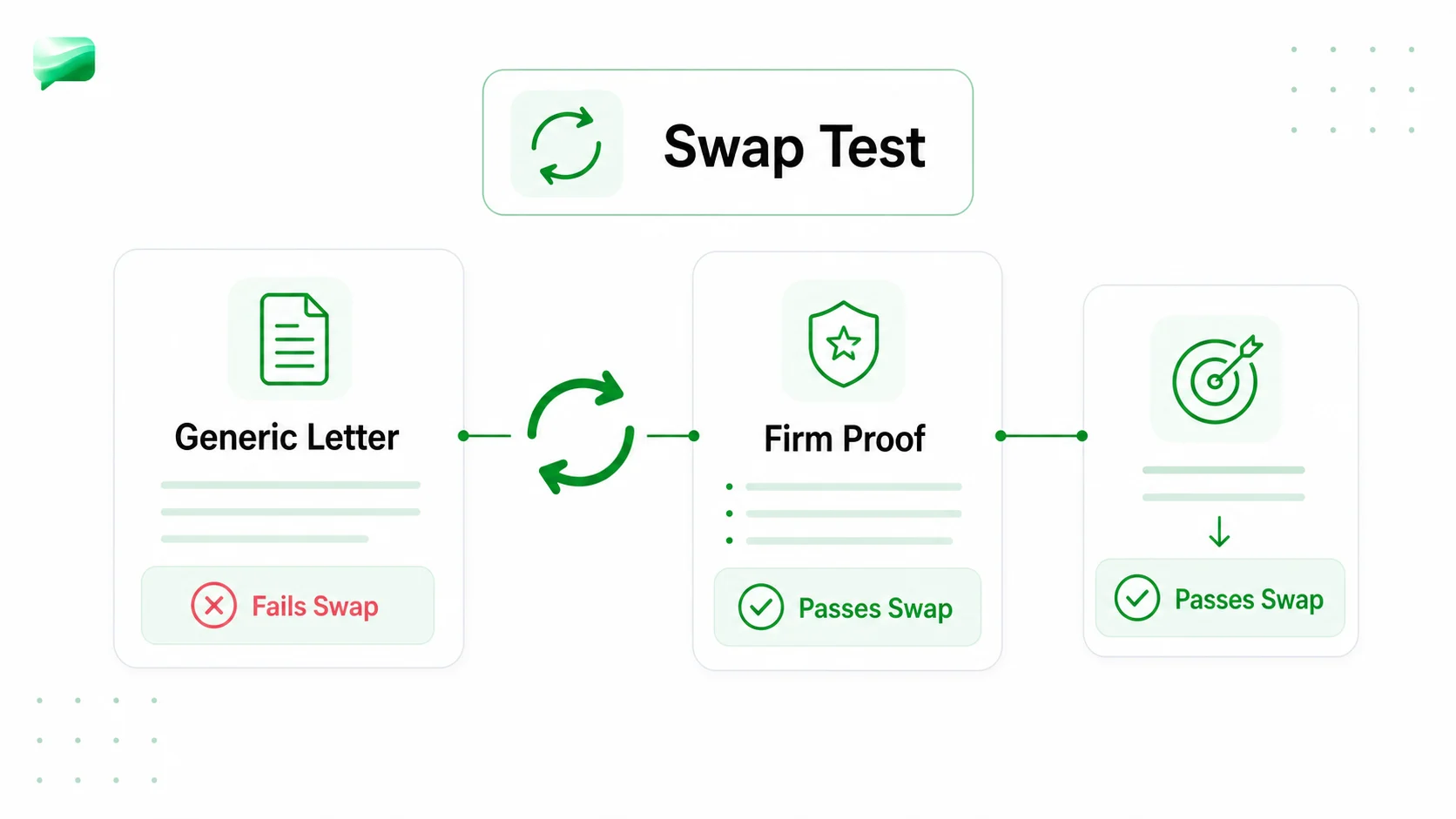
This is the spine of the whole letter. When you finish a draft, replace every instance of "Deloitte" with a competitor's name and read it again. If the letter still reads as true and complete, it is too generic, and a recruiter will treat it the same way.
The swap test fails most often in the "why this firm" paragraph. "Deloitte is a prestigious firm with talented people and global reach" survives the swap perfectly, which is exactly why it is worthless. A line that cannot survive the swap names something only Deloitte has:
- A specific service line and the kind of work it does (Monitor Deloitte growth strategy, Human Capital workforce transformation).
- A named methodology or asset (the Doblin innovation approach inside Monitor Deloitte).
- A real conversation with a named consultant, or a published report you actually read.
- An office, a sector team, or a recent project you can discuss in specifics.
Run the test on every sentence, not just the firm paragraph. If a body story would read identically on a McKinsey or Accenture application, it is still doing its job as proof, but the framing around it should point at Deloitte's work.
Tailoring to Deloitte specifically (not recycled MBB lines)
Most generic templates hand you MBB-flavored filler and call it tailoring. Recoloring "why McKinsey" copy into "why Deloitte" is not tailoring. Tailoring means citing something real about the practice you applied to and connecting it to your own story.
Pull your tailoring from a credible source you can discuss:
- The service line's actual focus areas, named in the job description you applied through.
- A methodology or framework the practice is known for, such as the Doblin innovation lens within Monitor Deloitte.
- A conversation with a current consultant, which gives you a specific, swap-proof line.
Keep the letter aligned with your resume. MyConsultingOffer notes that a Deloitte consulting resume should be one page and use three to four bullet points per experience entry. Your cover letter should pull a couple of those bullets forward and explain them, never duplicate the list line by line. The two documents should read as one package, telling the same story with different depth.
The closing paragraph and call to action
The close is two sentences and it does two things: it restates your reasons in a single breath, and it explicitly asks for the interview. Candidates routinely end with a limp "thank you for your consideration" that requests nothing. That is a missed close.
A working close: "I would welcome the chance to walk through how I structured that market-entry decision and held it under pressure. I am available for an interview at your convenience and have attached my resume for the specifics." It is confident, it points back at the proof, and it names the next step without begging for it.
A paragraph-by-paragraph annotated example: Monitor Deloitte
Here is a full letter tailored to a specific service line, Monitor Deloitte, with notes on why each block works. Copy the logic, not the words.
I am applying for the Strategy Analyst position with Monitor Deloitte in your Boston office. After speaking with two consultants in the practice, I learned how Monitor's growth-strategy work pairs market-shaping analysis with the implementation reach of the broader Deloitte network, and that combination is where I want to start my career.
In my final year I led the market-entry analysis for a regional fitness chain weighing whether to enter three new metros. I broke the question into demand density, competitive saturation, and unit economics, built a simple model from membership and rent data, and recommended a phased entry into two metros instead of all three. The owner adopted the plan, and the first new location reached breakeven a full quarter ahead of schedule.
The harder part was defending it. The founder wanted all three metros, and the third failed our unit-economics threshold by a wide margin. I held the recommendation, walked him through the breakeven math line by line, and proposed a revisit trigger tied to membership growth. He trusted the discipline more than the optimism, and that is the judgment I want to bring to client work.
I have followed Monitor Deloitte's published work on growth strategy and the Doblin innovation methodology, and the move from analysis to executable roadmap is exactly the gap I tried to close for the fitness chain. I want to do that at scale, on problems where the recommendation has to survive a skeptical executive and then actually get built.
I would welcome the chance to walk through how I structured that decision and defended it under pressure. I am available for an interview at your convenience and have attached my resume for the specifics.
Why it works, block by block:
- Opening: Names the exact role, the exact service line, and the office, then previews the reason. It cannot survive a firm-name swap because Monitor Deloitte's network-plus-strategy angle is specific.
- Body 1: One quantified story (breakeven a quarter early) that proves structured problem solving without restating the resume.
- Body 2: A judgment-and-integrity story that maps to Serve with Integrity. The tension with the founder makes it credible.
- Body 3: Why Deloitte, tied to a real methodology (Doblin) and looped back to the candidate's own project. This is the paragraph that fails the swap test for competitors.
- Close: Two sentences, points back at the proof, and asks for the interview outright.
To retarget the same letter, only the opening anchor and the "why Deloitte" paragraph change. For core Deloitte Consulting, lead with a technology or operations implementation story. For Human Capital, lead with org design or change management. For Strategy and Analytics, lead with a data-driven decision you owned.
Common rejection triggers to avoid
These are the failures that move a letter from neutral to negative:
- Generic letter that fails the swap test. The single biggest cut. If it works for any firm, it works for none.
- Repeating the resume verbatim. The letter adds context and judgment, not a prose copy of your bullets.
- Wrong or missing role and service-line title. Naming the wrong practice signals you did not tailor, or worse, that you mass-applied.
- Going over one page. Length is itself a prioritization test, and consulting screens for prioritization.
- Raw AI phrasing. Covered next, because it is the fastest-growing trigger of all.
The AI-generated cover letter trap and how to humanize a draft
Drafting with AI is fine. Submitting the raw output is the trap. AI letters cluster around the same hollow adjectives, the same even sentence rhythm, and the same resume-restating habit, and reviewers increasingly read that pattern as a disadvantage. The good news is that humanizing a draft is mechanical.
The acid test is the same as everywhere else in this guide. If your humanized draft still survives the firm-name swap, you have not humanized it enough yet.
Final proofing checklist
Execution checklist
One page, roughly 300 to 400 words. Per PrepLounge, keep a consulting cover letter to a maximum of one page. Length is a prioritization test.
Exact role and service line named in sentence one. Deloitte Consulting, Monitor Deloitte, Human Capital, or Strategy and Analytics. The wrong title is a rejection trigger.
Firm paragraph fails the swap test. Replace Deloitte with a competitor. If it still reads true, rewrite it before anything else.
Two to three quantified stories, no resume recap. Each body paragraph proves one Shared Value through action and a result, not a restated bullet.
Close explicitly asks for the interview. Restate your reasons in one breath and request the next step. No limp thank-you.
Humanized: no AI tells, varied rhythm, one detail only you could write. A raw AI draft reads as a disadvantage and fails the swap test on the first line.
Header, font, and file name matched to the resume. Submit a PDF named clearly so the two documents read as one package.
Where the cover letter sits in the Deloitte funnel
The letter is one step, not the whole process. The Deloitte application funnel runs resume, then cover letter, then behavioral fit, then the case and any online assessment. A clean letter and resume get you into the room; everything after that tests whether the judgment your letter advertised is real.
So treat the application as the front door and the interview prep as the main event. For the case and behavioral rounds that decide the offer, work through the Deloitte case interview guide. For the underlying letter mechanics that apply across every firm, the format layer, the swap test, and three more worked examples, use the broader consulting cover letter guide alongside this page.
See where you stand before your Deloitte interview
Your letter promises structure, judgment, and clear communication. Run a free Deloitte-style case and benchmark those exact skills under real conditions.
Sources
- PrepLounge: How to write a consulting cover letter (checked June 26, 2026)
- MyConsultingOffer: Deloitte consulting resume and cover letter (checked June 26, 2026)
Frequently asked questions
Resources and related guides
- Free consulting resume graderPractice
- Browse all free resourcesResource hub
- EY Consulting Cover Letter: Structure & ExampleGetting Started · Jun 30, 2026
- KPMG Consulting Cover Letter: Structure & ExampleGetting Started · Jun 30, 2026
- Big 4 vs MBB Consulting: Key Differences in Pay, Work, and Career Trajectory (2026)Getting Started · Apr 1, 2026