
MECE Framework in Case Interviews: Structures, Tests & Mistakes
Apply the MECE framework in case interviews: the 5-step build, safe vs. dangerous dimensions, worked trees, and the mistakes that fail real structures.
On this page
MECE means Mutually Exclusive, Collectively Exhaustive. It is the structuring quality standard used at McKinsey, BCG, and Bain to break problems into categories with zero overlap and zero gaps. Developed by Barbara Minto at McKinsey in the 1960s and published in The Pyramid Principle (Pearson, 1987), MECE structure accounts for roughly 30-35% of the overall evaluation in MBB case interviews. Apply the 2-question test to every structure: "Can anything fit in two buckets?" (overlap check) and "Is anything relevant missing?" (gap check). Across thousands of case practice sessions on Road to Offer, the single most common reason a candidate's framework fails is a non-MECE first cut, with overlap more common than gaps by roughly 3:1.
Test your MECE structure
Run a free structure drill and get instant feedback on overlap, gaps, prioritization, and interviewer clarity.
What does MECE mean?
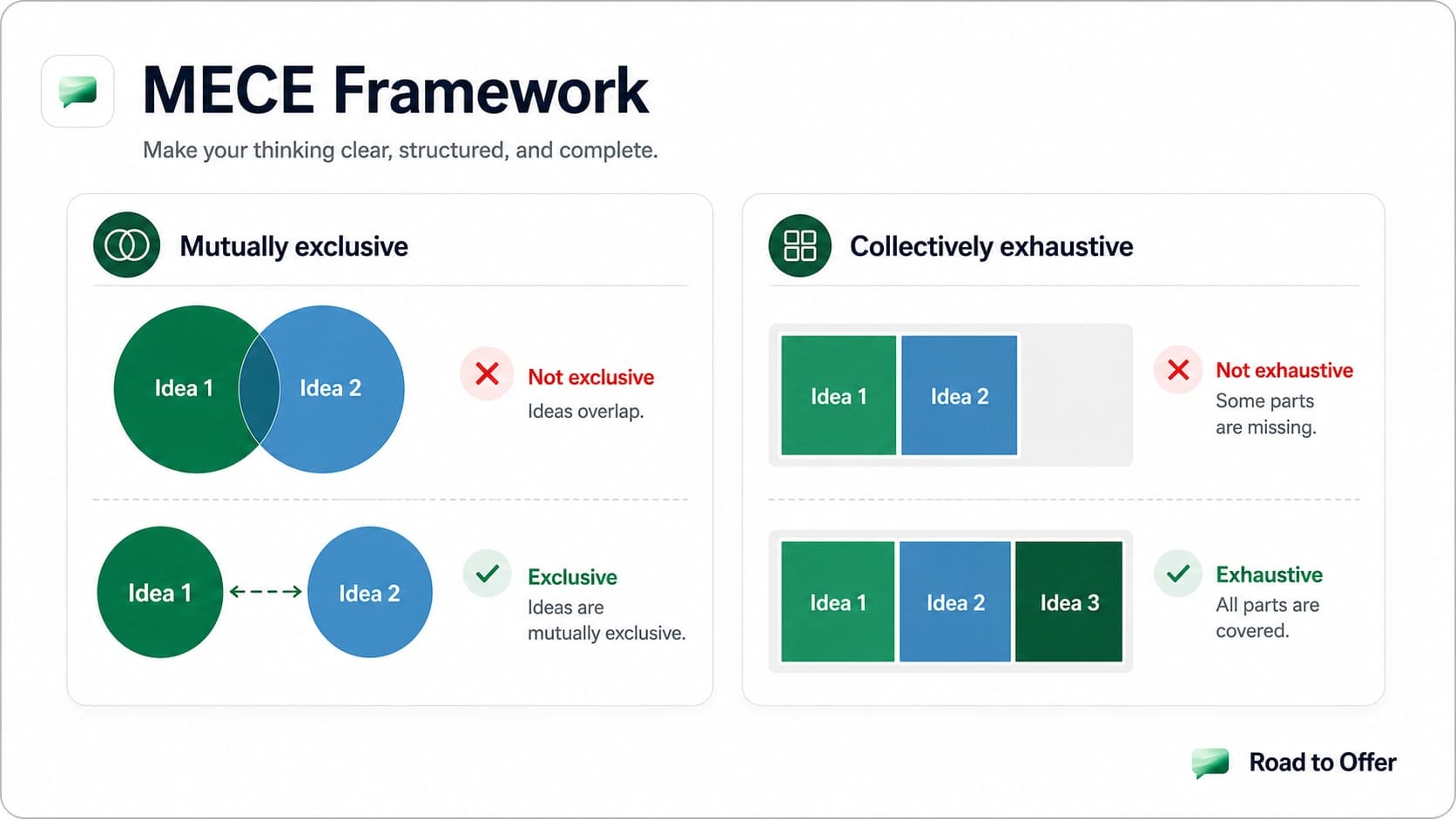
MECE stands for Mutually Exclusive, Collectively Exhaustive. The MECE meaning in practice: a structuring standard that organizes any analysis into categories with no overlap and no gaps. It is pronounced "mee-see" or "meece". The "Mutually Exclusive" half means a single item cannot belong to two buckets (no double-counting). The "Collectively Exhaustive" half means every relevant item belongs to at least one bucket (no missing pieces). MECE is not itself a framework. It is the test applied to every framework (profitability trees, the 3Cs, Porter's Five Forces, customer segmentation) to check whether the structure holds.
In practice, "make it MECE" is interviewer shorthand for: redraw the structure so I can see, at a glance, that no part of the problem is being double-counted and nothing is being missed. A non-MECE answer signals unclear thinking even when the underlying analysis is correct. The issue tree is the most direct application of MECE in a case: it turns a single root question into a set of mutually exclusive, collectively exhaustive branches you can investigate independently.
Learn frameworks properly
Pick and adapt structures instead of memorizing buckets.
Who created the MECE principle?
Barbara Minto developed MECE at McKinsey between 1963 and 1973, where she was the firm's first female MBA professional hire. She formalized the principle in The Pyramid Principle: Logic in Writing and Thinking (Pearson, 1987), which remains the definitive reference for structured consulting communication. According to Wikipedia's MECE entry, Minto traces the underlying logic back to Aristotle, but it was her work at McKinsey that turned it into the operating standard for modern consulting.
In her own words from a McKinsey alumni interview: "MECE: I invented it, so I get to say how to pronounce it." She prefers "meece" (rhyming with "fleece"); most consultants today say "mee-see."
Why does MECE matter in case interviews?
MECE matters because structure is a major share of how case interviews get scored, on Road to Offer's rubric and by candidate accounts of McKinsey, BCG, and Bain interviews, and a non-MECE structure visibly fails the test in the first 60 seconds. The interviewer is evaluating whether you can decompose a messy business problem into a clean tree. Overlap (double-counting) signals you don't fully understand the moving parts. Gaps (missing buckets) signal you'll miss the actual answer.
Most MBB interviewers grade structure on three signals as you present: (1) branch labels are non-overlapping, meaning they can't think of a single example that would fit two of your branches; (2) branches sum to 100%, meaning they can't think of a relevant driver you've left out; (3) the dimension is consistent, meaning you didn't split by size on one branch and by industry on the next. If any of the three fails, the interviewer either redirects you ("how would you make that more MECE?") or quietly flags the structure as weak. Strong MECE early buys you credibility for the rest of the case.
Across thousands of case interview practice sessions on Road to Offer, the single most common reason a structure gets flagged is overlap, not gaps (roughly 3:1). The typical pattern: a candidate names 4-5 plausible-sounding factors ("marketing, pricing, product quality, competition"), and at least two of them overlap on inspection (pricing is part of competition; marketing affects product perception). Starting from a math identity eliminates this class of mistake.
How do you build a MECE structure?
The reliable path to MECE is a five-step build. Skipping the final test step is where most case-interview structures break.
The 5-step MECE build
- 01
State the question. What are you actually answering? Be specific.
- 02
Pick one dimension. Time, geography, segment, P&L line: one only.
- 03
Define the buckets. Clear, named categories with explicit boundaries.
- 04
Test for ME. Could any single item fit in two buckets?
- 05
Test for CE. Is anything relevant missing entirely?
Step 1: Start from a math identity when possible
Math identities are MECE by construction. Revenue = Price × Volume guarantees every dollar of revenue change is captured. Profit = Revenue − Costs guarantees every dollar of profit change is captured. Cost = Fixed + Variable guarantees every cost is on one side. These identities give you MECE for free.
Step 2: Pick a single dimension per level
The most common MECE failure is mixing dimensions. "Customers by size and industry" is two dimensions on one level; a mid-size healthcare company is both "mid-size" and "healthcare." Pick one dimension per level. If you need both, nest: split by size first, then by industry inside each size bucket.
Step 3: Use reliable, naturally-MECE dimensions
Some dimensions are MECE by definition. Use them when the case allows.
Step 4: Avoid the dangerous (often non-MECE) dimensions and run both tests
These dimensions sound structured but routinely fail MECE on inspection: by department (shared services like IT and HR serve everyone, breaking ME); by stakeholder (misses suppliers, regulators, creditors); by buzzword ("growth, innovation, efficiency", vague and overlapping); by function name ("strategy, execution, culture", heavy overlap with no clear definitions).
Interactive drill set. Write an answer before revealing the worked solution, then continue into Road to Offer for scored practice and AI feedback.
Once your structure is drawn, run the 2-question test out loud. ME check: "If I had a specific example, could it fit in two of my buckets?" If yes, redefine the boundary. CE check: "If the answer to the case lived in one of my buckets, would I find it?" If no, you're missing a bucket. If both pass, present. If either fails, restructure before opening your mouth.
Test a structure for overlap and gaps from the Road to Offer drill engine. Answer a real prompt and get AI-scored feedback. Free accounts include 5 drills per day for the first 3 days after signup.
What are real-world examples of MECE in case interviews?
The clearest way to internalize MECE is to see the same problem in MECE and non-MECE forms. Here are three worked examples drawn from common case archetypes (profitability, market sizing, and customer segmentation) plus a note on cost reduction.
Example 1: Profitability tree (revenue side)
MECE version: Revenue = Price × Volume. Volume = (Number of customers) × (Purchases per customer). Each branch is a clean math operation.
Non-MECE version: "Revenue depends on marketing, pricing, product quality, and competition." This is a brainstorm list. Marketing affects volume. Pricing is part of competition. Product quality affects both volume and price. There's no way to confirm completeness.
Why MECE wins: Every dollar of revenue change is captured by exactly one driver. Want to learn the full decomposition? See the profitability framework guide.
Example 2: Market sizing decomposition
MECE version: US smartphone market = (US population) × (% who own smartphones) × (avg replacement rate per year) × (avg phone price).
Non-MECE version: "Add up Apple, Samsung, Google, and other brand sales." Risks double-counting (refurbished phones), missing channels (carrier subsidies), and inconsistent geography (some brand totals include B2B fleet sales).
Why MECE wins: The identity-based approach decomposes the entire market with zero overlap. See the market sizing approach for full worked examples.
Example 3: Customer segmentation
MECE version: Individual consumers (B2C) vs. Business customers (B2B) vs. Government & public sector. Every customer falls in exactly one category.
Non-MECE version: Small businesses, online customers, enterprise clients, repeat buyers. A small business can also be online and a repeat buyer, creating heavy overlap.
Why MECE wins: Type of buying entity is one dimension. The non-MECE version mixes size, channel, and behavior on the same level.
A fourth common archetype, cost reduction, admits two valid MECE cuts: by behavior (Fixed vs. Variable) when the question is about cost leverage as volume changes, or by function (COGS vs. SG&A vs. R&D vs. Other) when the CEO wants to know which department to cut. Both are MECE; just don't mix them in the same tree.
Interactive drill set. Write an answer before revealing the worked solution, then continue into Road to Offer for scored practice and AI feedback.
How do you apply MECE in a live case?
Here's how MECE shows up in 30 seconds of a real case.
Interviewer: "Our client's revenue dropped 15% last year. How would you approach this?"
Non-MECE answer: "I'd look at marketing effectiveness, competitive dynamics, pricing, customer satisfaction, and product issues."
This is a list. Items overlap (pricing is part of competitive dynamics; product issues affect customer satisfaction), and there's no test for completeness.
MECE answer: "Revenue is Price × Volume. I'd first check whether average price per unit changed, then whether volume changed. On volume, I'd segment by customer type (existing vs. new) to see if we're losing existing customers or failing to acquire new ones. On price, I'd check whether the change was uniform or concentrated in a segment."
Each branch is distinct, and together they cover all of revenue. The interviewer can immediately see the structure without having to ask "and what else?"
Revenue decline issue tree (MECE)
- 01
Revenue decline. Total revenue is down. Decompose by drivers.
- 02
Price change. Did average selling price move? By segment or channel?
- 03
Volume change. Existing customers buying less? New customer acquisition declining?
- 04
Mix shift. Shift toward lower-revenue products, channels, or geographies?
Practicing the structure on a live case is what exposes the gaps and overlaps that never show up when you are only reading about MECE.
Build a MECE structure on a Bain profitability case. A two hundred million dollar pharmacy personal care department has stopped growing profit. Answer this Bain profitability case step in the article, then continue the full case. Continue the full case on Road to Offer
What are the most common MECE mistakes?
Across thousands of practice cases, four mistakes account for most failed MECE structures. They show up so often that screening for them in your own work eliminates the majority of overlap and gap problems.
Mistake 1: Mixing two dimensions on one level. The classic example is "customers by size and industry." A mid-size healthcare company is both. Fix: pick one dimension per level. If you need both, nest them by splitting size first, then industry inside each size bucket.
Mistake 2: Department-based splits that ignore shared services. "Costs by department" sounds clean (Marketing, Sales, Operations, IT) but IT serves Marketing and Sales. HR serves everyone. Without an explicit allocation rule, this fails ME. Fix: either define an allocation rule up front, or use Fixed/Variable instead.
Mistake 3: Brainstorm lists with no completeness test. "Marketing, pricing, product, competition" sounds structured but has no test for whether you've covered everything. There's no math identity, no exhaustive dimension, just plausible-sounding factors. Fix: anchor on an identity (Profit = Revenue − Costs) before brainstorming sub-causes. A driver tree takes this one step further by chaining each identity down to the operational metrics that actually move the needle, giving you both MECE structure and a testable hierarchy.
Mistake 4: Trusting labels without checking definitions. A retailer's "in-store, online, marketplace" sounds MECE. But if "marketplace" means selling on Amazon and "online" includes Amazon, the buckets overlap. Fix: define every bucket explicitly. "Online = own e-commerce site only. Marketplace = third-party platforms (Amazon, eBay)." Now it's MECE.
Interactive drill set. Write an answer before revealing the worked solution, then continue into Road to Offer for scored practice and AI feedback.
When does MECE fail or stop being useful?
MECE is the right standard ~95% of the time. There are two cases where it stops being useful.
Case 1: When the dimensions are inherently fuzzy. Customer satisfaction drivers, brand perception factors, and culture issues don't decompose cleanly. Forcing MECE on a qualitative problem creates the illusion of structure without the substance. In these cases, name the ambiguity explicitly and use a "best effort" decomposition with caveats.
Case 2: When MECE is technically correct but not useful. "All possible reasons profit dropped" can be split into "internal causes" vs. "external causes," perfectly MECE but useless for diagnosis. Good structures are MECE and actionable. If your tree is MECE but every branch is too vague to investigate, redraw it at a more useful level of granularity.
Practice: build your own MECE structures
The fastest way to internalize MECE is to build structures from scratch and stress-test them. Work through each prompt before reading the answer. If you want to check a tree instead of grading your own, the free case structure builder gives you five MBB templates and written feedback on the branches you choose.
Exercise 1: Revenue decline
Prompt: "Revenue is declining. Create a MECE first-level decomposition."
Answer: Revenue decline = Volume decline + Price decline + Mix shift. Every dollar of revenue change must come from one of these three drivers. They don't overlap (a price cut is not a volume change), and together they fully decompose the revenue line via Revenue = Σ (Price_i × Volume_i) across segments.
Exercise 2: Cost reduction
Prompt: "The CEO wants to reduce costs. Create a MECE decomposition."
Answer (Approach A, by behavior): Fixed costs vs. Variable costs. This approach is better when you need to understand cost leverage as volume changes.
Answer (Approach B, by function): COGS, SG&A, R&D, Other. Better when the CEO wants to know which department to cut. Both are MECE; pick one and stick with it.
Exercise 3: Customer satisfaction
Prompt: "Customer satisfaction is dropping. Create MECE segments to investigate."
Answer (by customer type): Enterprise vs. SMB vs. Consumer. This tells you who is unhappy.
Answer (by journey stage): Acquisition, Onboarding, Usage, Support, Renewal. This tells you where the experience breaks. In practice, start with one dimension to locate the problem, then cut by the second to diagnose root cause ("satisfaction is dropping most among SMB customers, specifically at onboarding").
Interactive drill set. Write an answer before revealing the worked solution, then continue into Road to Offer for scored practice and AI feedback.
For more worked structures, see case interview examples and the profitability framework guide.
Interactive MECE drills
Interactive drill set. Write an answer before revealing the worked solution, then continue into Road to Offer for scored practice and AI feedback.
Related Guides
MECE shows up in every case type. Build a complete toolkit:
- Case Interview Frameworks Complete Guide
- Profitability Framework
- Case Interview Examples
- Market Entry Framework
- Case Interview Synthesis
- Porter's Five Forces Analysis
- BCG Case Interview Practice: drill MECE structuring under timed pressure
Run a full case and get your structure graded
Road to Offer flags overlap and gaps in your structure in real time, then scores you across a complete case. Build the MECE habit on live cases before your interview.
Sources and further reading (checked June 17, 2026)
- Minto, Barbara. The Pyramid Principle: Logic in Writing and Thinking. Pearson, 1987. Minto developed MECE at McKinsey between 1963 and 1973; this book remains the definitive reference for structured consulting communication.
- McKinsey Alumni: Barbara Minto, "MECE: I invented it, so I get to say how to pronounce it".
- Wikipedia: MECE principle: origin, history, and Aristotelian roots.
- PrepLounge: MECE Principle guide with applied examples.
- IGotAnOffer: MECE Framework (Meaning, Examples, McKinsey).
- Management Consulted: MECE Framework: Case Interview Example.
Frequently asked questions
Resources and related guides
- Practice the MECE principle in a real case interviewPractice
- Browse all free resourcesResource hub
- How to Structure Your Thinking in a Case Interview (Fast)Fundamentals · Jun 2, 2026
- Accenture Salary Guide 2026 - Pay by Level and Career PathFundamentals · May 20, 2026
- Campus Consulting Clubs: Benefits, Recruiting, and How to Get InFundamentals · Jun 3, 2026
- Clarifying Questions in Case Interviews: What to Ask and ExamplesFundamentals · May 1, 2026