The best free BCG Casey chatbot simulation
Locked sequential questions, live exhibits, case math and a recorded final recommendation, scored the moment you finish.
New to Casey? See how the real assessment works below: question types, scoring and a two-week plan.
- practice cases
- 10
- practice cases
- questions per case
- 6–10
- questions per case
- on the clock
- 25–35 min
- on the clock
- scoring dimensions
- 5 core
- scoring dimensions
Offers landed at




Trusted by candidates at






What you'll practice
The same locked, sequential question types as a real online case. No going back once you answer.
Structure selection
Pick the MECE framework that cracks the prompt before the clock eats your lead.
Exhibit & data reads
Pull the one insight that matters from charts and tables under time pressure.
Case math
Size the market and run the numbers the way the online assessment expects.
MECE brainstorm
Generate clean, non-overlapping ideas, graded on structure rather than count.
Recorded recommendation
Deliver a 60-second answer on camera. Speech-to-text scores it; the video is never stored.
Then you get graded
Your picks are checked against the answer key, and your written and spoken answers are read directly, the same way the real assessment separates structure from math from judgment. You see exactly which question cost you points and what the model answer was.
Example debrief
- Structure & MECE82/100
- Quant accuracy64/100
- Exhibit interpretation71/100
…plus Business judgment, Synthesis, and per-question feedback.
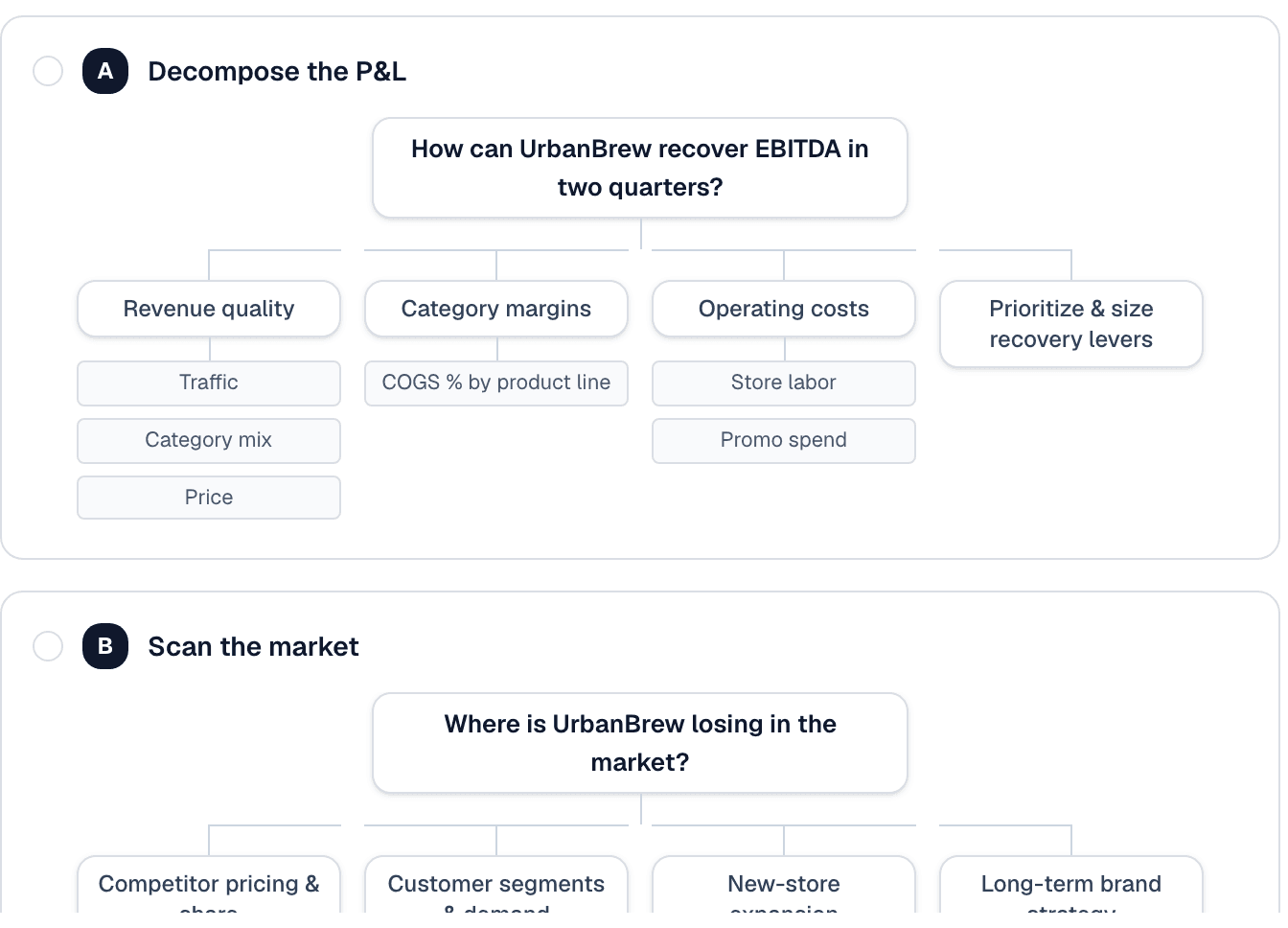
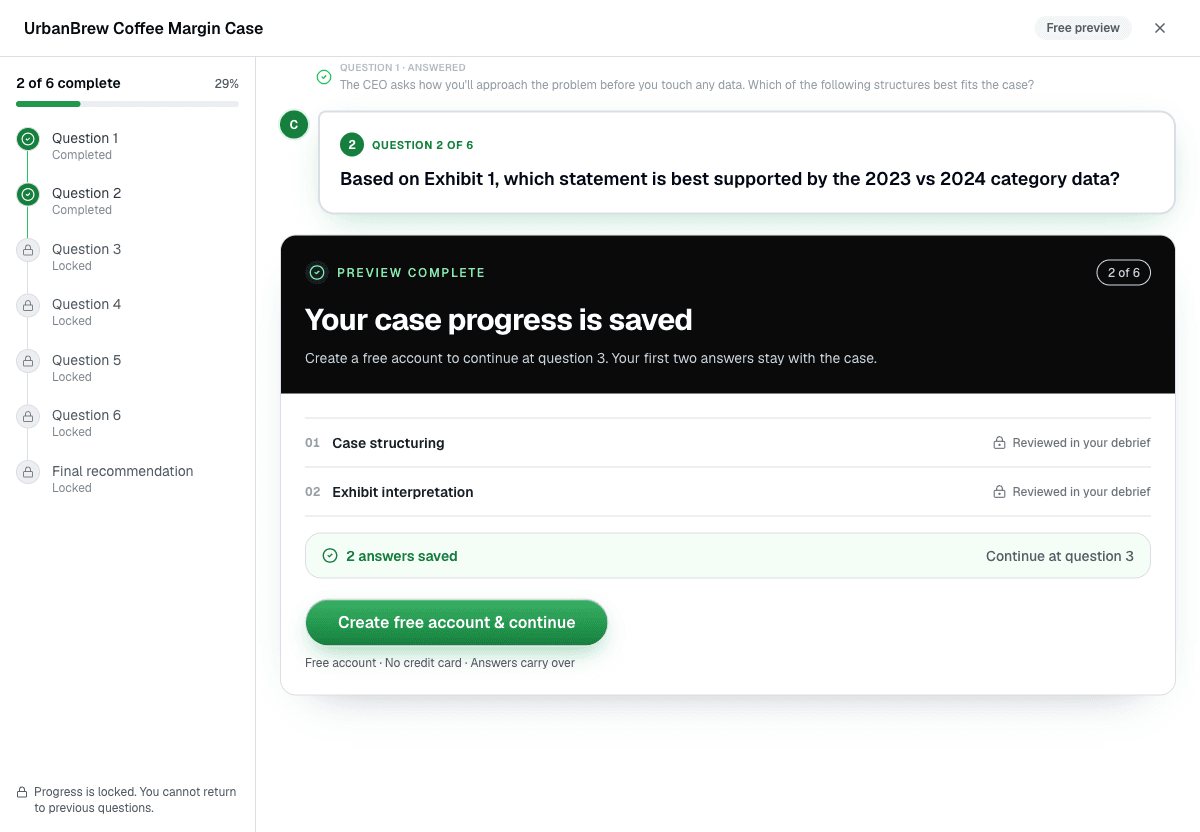
Inside the simulator
What Is the BCG Casey Online Case?
BCG Casey is a chatbot-style online case that candidates commonly report as a roughly 25-35-minute screen with 6-10 mixed questions, although your invitation controls the exact format. The reported range comes from MConsultingPrep, MyConsultingCoach, Prepmatter, and IGotAnOffer, checked June 18, 2026.
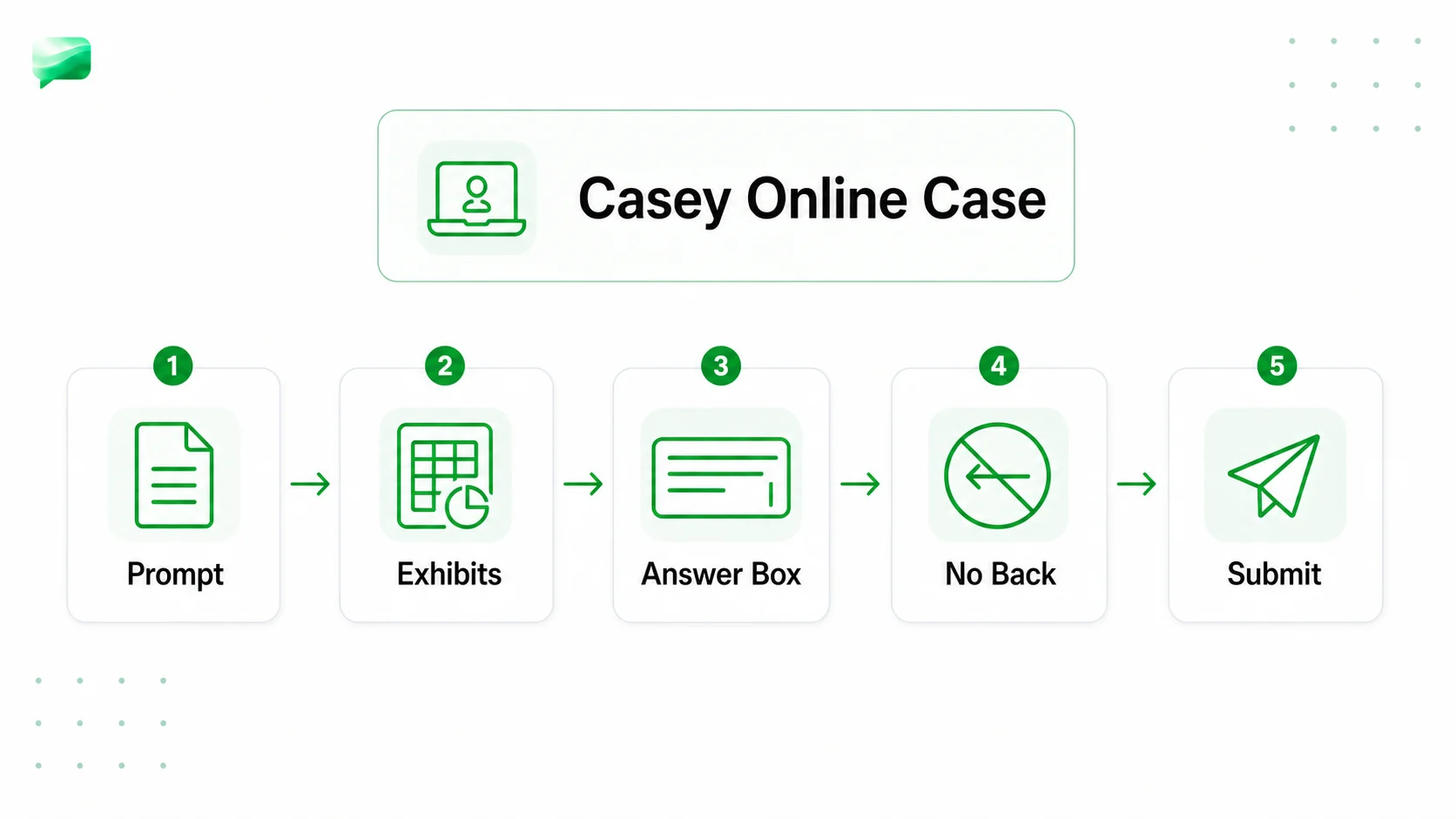
Casey presents one business scenario, then walks you through a fixed sequence of questions about it. The interface looks like a messaging app, with the prompt, your answer box, and exhibits appearing in turn. There is no human interviewer, no hints between questions, and (in candidate reports) no going back once you submit. Practice scenarios often cover profitability, growth, market entry, pricing or operations.
BCG's Mexico recruiting page distinguishes the online case from the CCA, and other offices can use different steps. Match the wording in your own invitation before you prepare.
What Question Types Does Casey Ask?
Casey mixes answer formats and question intents. The format is how you respond; the intent is what skill it tests. Knowing both lets you recognize each prompt fast and avoid over-writing a short answer or under-structuring a long one.
The reported opener is a dataset-selection question: Casey shows roughly eight possible data sources and asks which are most relevant to the problem. This is a scoping test, the same judgment behind a good issue tree, so pick what genuinely moves the analysis and leave the noise.
By intent, you will see four recurring categories: structuring (the dataset-selection opener and "what would you investigate" prompts), quantitative (growth, share, break-even, weighted averages, working from exhibits where roughly half the data points may be irrelevant), data interpretation (read a chart or table and extract the one insight that matters), and critical thinking (judge a course of action, watching for qualifiers like "likely" versus "certainly"). For deeper drilling on chart-reading prompts, see data interpretation in case interviews.
How Does Casey Scoring Work?
BCG does not publish a complete Casey scoring formula. What multiple prep sources agree on for the current version is useful and practical:
- Approach is scored, not just the final number. BCG's public guidance stresses reasoning quality. In written answers, show your logic and the business implication, not only the answer.
- Check the stated scoring rules. Some prep sites report no negative marking, but BCG does not publish a universal Casey penalty rule. Use elimination when uncertain and follow the instructions shown in your assessment.
- You must answer to advance. There is no skip and no going back, so budget time so you are never forced to abandon a later question.
Treat any specific point-penalty or answer-weighting mechanic you read on a third-party site as directional, not official. Casey weighs the same competencies BCG names publicly: problem-solving, numerical reasoning, business judgment, and clear communication. The case interview scoring rubric maps the same dimensions.
Pass rate. BCG does not publish an official Casey pass rate. Third-party prep sites estimate that roughly 20-30% of candidates advance, but these figures are unofficial, so do not anchor your preparation on a funnel number.
How Do You Solve a Casey Math Question?
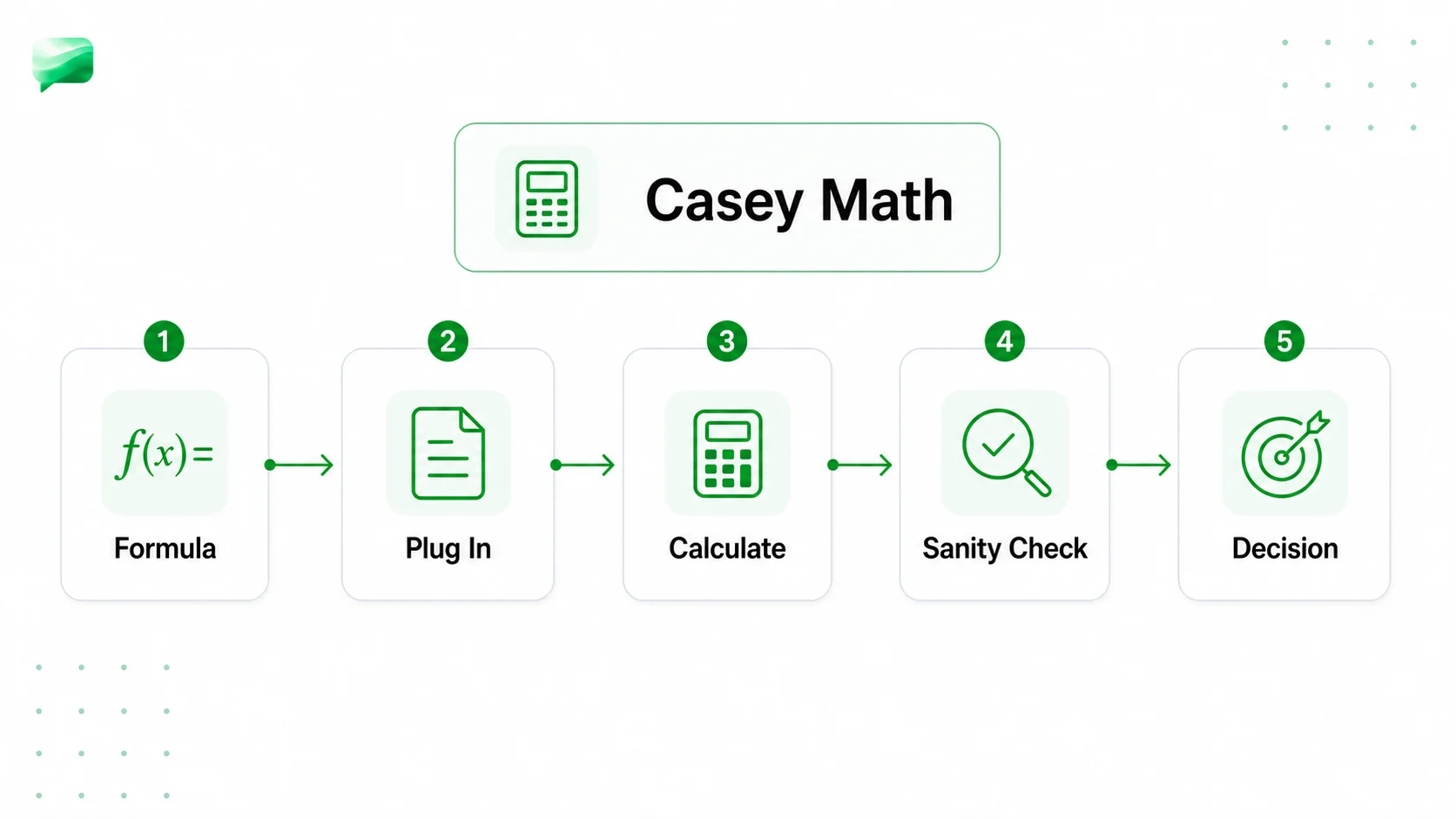
Casey math is short-text numerical input under a clock, usually pulling numbers off an exhibit. The grader rewards a clean setup and a sanity check, so state the formula, plug in, and connect the result to the decision.
Scenario. A consumer electronics company is considering entering the smartwatch market. The Year 1 market is $18B. Estimated Year 1 capture is a 3% revenue share. For later planning, the market is assumed to grow 8% in Year 2; that growth is not part of the Year 1 calculation. Fixed entry cost is $120M. Variable cost per unit is $85. Average selling price is $250.
Question. How many units must the company sell to break even in Year 1?
Solution.
- Contribution margin per unit = $250 - $85 = $165 per unit.
- Break-even units = fixed cost / contribution margin = $120,000,000 / $165 = 727,273 units (rounded up, since you cannot sell a partial unit).
- Sanity check against the share assumption. Year 1 revenue at a 3% share = $18B x 0.03 = $540M. At a $250 selling price, that implies $540,000,000 / $250 = 2,160,000 units of demand, roughly 3x the break-even volume. On these numbers, entry clears break-even comfortably and looks viable.
Do not round the $165 margin or the intermediate revenue early, keep your units straight (dollars versus units), and finish with the implication ("this clears break-even with margin to spare"), not a bare number. The same setup is covered in break-even analysis for case interviews, and the underlying speed comes from mental math drills.
Which data should you select, and what can you conclude?
For the Year 1 break-even question, select fixed entry cost, unit selling price and variable cost per unit. For the demand check, also select Year 1 market revenue and the assumed revenue share. Leave the Year 2 growth rate out of both calculations. More data is not automatically more useful.
The 3% share is an assumption, not evidence that customers will buy. The next useful data would test willingness to pay, distribution access and competitors' response. This distinction keeps a correct calculation from becoming an unjustified recommendation.
Practice Casey-style break-even math from the Road to Offer drill engine. Answer a real prompt and get AI-scored feedback. Free accounts include 5 drills per day for the first 3 days after signup.
When Is the Video Recommendation, and How Do You Structure It?
If your version includes the video, it comes after the chatbot questions. The widely reported format is 60 seconds to prepare and 60 seconds to record, with a hard cutoff when time runs out. It tests communication clarity and structure, not polish, so lead with the answer and back it with the two or three reasons that matter most.
A complete recommendation using the same numbers
This original practice answer uses only the smartwatch example above. Rehearse it to your own timer; speaking speed and the real recording limit vary.
I would proceed to a market-entry pilot, subject to validating demand. At a $250 selling price and $85 variable cost, each unit contributes $165. We need about 727,273 units to cover the $120 million entry cost. The assumed 3% share implies 2.16 million units in Year 1, so there is room above break-even. But that share is not yet proven. The main risk is overestimating demand at this price. I would test willingness to pay and distribution access, then update the sales forecast before committing the full investment.
Apply the same sequence in the practice case above: select evidence, calculate, and give a recommendation with a clear limitation.
What Mistakes Cost the Most Points?
The most frequent error is spending too long on early questions. Candidates sink five to seven minutes into a straightforward structuring prompt and run out of time on harder math later. Budget two to three minutes per question and move.
The math errors that recur are mechanical, not conceptual: rounding intermediate calculations early, confusing percentage points with percentages, and skipping unit checks on exhibits. A single early calculation error often cascades, because later questions can build on the same numbers.
For a broader catalog of what graders penalize, see case interview mistakes to avoid.
How Does Casey Fit the Full BCG Pipeline?
Casey is one early gate. The skills it screens transfer directly to BCG's live rounds, which are candidate-led and exhibit-heavy by design. Pair this page with timed BCG case interview practice and the full BCG case interview guide.
BCG Full Interview Pipeline
- 01
Application. Resume and cover letter submitted online
- 02
Casey Chatbot. Online case screen; exact format varies by invite
- 03
First Round. 2 live interviews (case + fit), ~45 min each
- 04
Final Round. 2-3 interviews with Partners
- 05
Offer Decision. Within 1-2 weeks of final round
Some BCG invitations assign the Consulting Career Assessment (CCA) rather than Casey, and some candidates receive both. Casey is a chatbot case with exhibits and math; BCG describes the CCA as a short, multidimensional assessment. If it is the CCA you need, try the CCA-style simulator and compare the CCA practice tools.
How Should You Prepare in Two Weeks?
Week 1, foundations. Days 1-2: read BCG's official case guidance and any assessment-specific sample supplied with your invitation. Days 3-4: drill exhibit interpretation about two hours daily using financial news charts, writing the one key insight in under 60 seconds each. Days 5-7: math reps on percentages, growth rates, weighted averages, and break-even, both mental and calculator-assisted.
Week 2, simulate. Days 8-10: timed 30-minute sets of 8-10 mixed questions so pacing becomes automatic. Days 11-12: record five-plus video recommendations daily. Days 13-14: two to three full end-to-end mock assessments.
The underlying skills are firm-agnostic: the consulting aptitude test overview benchmarks Casey against McKinsey Solve, Bain SOVA, and the Big 4 tests, and career switchers can use case interview prep for career changers.
BCG Casey Simulators Compared (2026)
The names that come up most for the BCG Casey chatbot are Road to Offer, Prepmatter, PrepLounge, CaseBasix, and MConsultingPrep. Here is how they compare on what you can verify before you pay.
Different candidates weight the same simulator differently, so the honest answer is "best for what":
- Per-question feedback at the lowest published cost per case: Road to Offer. $69 for 10 original cases is about $6.90 each.
- Largest interactive Casey pack with a stated count: Prepmatter. It advertises 15 interactive cases, but no public price was visible in this review.
- Best format variety: PrepLounge. Its paid bundle mixes four live Casey simulations, two PDF Casey cases, and four video simulations.
- Best free sample dashboard: CaseBasix. Its public sample is a complete chatbot case with overall, question-type, and timing diagnostics.
- Most raw test volume: MConsultingPrep. The top tier contains 30 tests for $350.
When you compare providers, check the exact free boundary, the price shown before signup, cost per case, whether feedback is per question, and whether the content is original and clearly independent. Currency and format differences mean cost per case is a value signal, not a perfect like-for-like comparison.
Sources
- BCG case interview preparation (official): careers.bcg.com
- MConsultingPrep BCG online case chatbot guide: mconsultingprep.com
- MyConsultingCoach Casey guide: myconsultingcoach.com
- Prepmatter BCG online case assessment: prepmatter.com
- IGotAnOffer BCG Casey chatbot guide: igotanoffer.com
- PrepLounge BCG online case bundle: preplounge.com
- CaseBasix BCG Casey course: casebasix.com
- MConsultingPrep BCG Casey simulation: mconsultingprep.com
Guide sources checked June 18, 2026; simulator comparison checked July 20, 2026. BCG, Casey, and CCA are trademarks of Boston Consulting Group. Road to Offer is not affiliated with or endorsed by BCG.
Ready for the full set?
The BCG Casey Simulation unlocks all 10 cases (Profitability, Growth, Pricing, Market entry, M&A, Operations) across CPG, retail, energy, healthcare, tech, and operations.
Included in the 90-Day Sprint and annual plans. Already subscribed monthly? You already get full AI debriefs — the pack just adds these 9 cases.
- UrbanBrew Coffee · Profitability · Foodservice
- GreenBite Snacks · Profitability · CPG
- FreshCart Grocery · Profitability · Grocery retail
- AuroraWater Bottling · Profitability · Beverages
- City Bike Share · Pricing · Urban transport
- Cloud Capacity Expansion · Growth · Cloud tech
- PeakFit Omnichannel · Growth · Fitness
- Solara Home Battery · Market entry · Home energy
- HarborHealth / MedLink · M&A · Digital health
- MetroFresh DC Turnaround · Operations · Supply chain
Start free. Unlock the pack from your account after the first case.
Want BCG? Start now.
One free case, timed and scored like the real online assessment. No credit card.
Independent Casey-style simulator, not affiliated with or endorsed by BCG.
Questions
- What is the BCG online case (Casey)?
- The BCG online case is a timed, chatbot-style assessment BCG sends candidates before or instead of a live interview. You work a full business case solo, from structuring and reading exhibits through case math, brainstorming, and a final recommendation, with a clock running and no interviewer to nudge you.
- How long is the BCG Casey chatbot assessment?
- Timing varies by office, role, and assessment version. Candidate reports commonly describe Casey as roughly a 25-35 minute online case across 6-10 questions, sometimes with a separate 60-second video recommendation afterward. Treat your BCG invitation email as the source of truth.
- What is the first question in the BCG Casey test?
- Many candidates report that Casey opens with a dataset-selection question: you are shown roughly eight data sources and asked to pick the ones most relevant to the problem. It tests scoping, choosing what to investigate and what to ignore, before any calculation starts.
- Can you use a calculator on the BCG Casey assessment?
- Follow the equipment rules in your BCG invitation. Some preparation sources describe calculator use, but taking an assessment at home does not establish permission to use a calculator, spreadsheet or other tool.
- How is the BCG Casey chatbot scored?
- BCG does not publish a full Casey scoring rubric. Multiple prep sources report that the current version does not use negative marking and weighs your problem-solving approach, not just final-answer accuracy. Expect it to assess structuring, numerical reasoning, business judgment, and clear written communication.
- Can you go back to previous questions on the BCG Casey test?
- Candidate reports consistently describe Casey as forward-only: you must answer to advance and cannot revisit earlier questions. Assume you cannot revisit answers unless your assessment instructions explicitly say otherwise.
- What is the pass rate for the BCG Casey assessment?
- BCG does not publish an official Casey pass rate. Third-party prep sites estimate that roughly 20-30% of candidates advance, but these figures are unofficial. Treat Casey seriously without anchoring your prep on any pass-rate estimate.
- How should I prepare for the BCG Casey chatbot?
- Start with BCG's official case preparation guidance at careers.bcg.com. Then drill exhibit interpretation, timed math, concise written answers of four to six lines, and a 60-second video recommendation under realistic time pressure. The two-week plan on this page lays out the order.
- Is this the real BCG Casey?
- No. Road to Offer is an independent, Casey-style practice simulator and is not affiliated with, endorsed by, or connected to Boston Consulting Group. We rebuilt the format and question types so you can rehearse the experience.
- What's free?
- You can play the first two questions of the UrbanBrew Coffee margin case right now, without an account. Sign up free to finish the full timed case. No credit card required.
- Do I need a webcam?
- The final question asks for a 60-second recommendation recorded on camera, the way the real assessment does. Speech-to-text turns it into the answer that gets scored, and the video itself is never stored. You can type your recommendation instead if you prefer.
- How is this simulator scored?
- An AI grades every attempt the instant you finish across five core dimensions: Structure & MECE, quant accuracy, exhibit interpretation, business judgment, and synthesis. Your final recommendation is transcribed and contributes to the synthesis score. It reads your open-text and spoken answers directly rather than matching a fixed answer key.
- Is this for McKinsey or the PEI too?
- No. This simulates the BCG online case specifically. It is not the McKinsey Solve/Imbellus game, and it does not cover the personal-experience (PEI) or behavioral interview. Road to Offer has separate practice for those, but this Casey tool is a business-case simulator.
- Can I retake a case?
- Yes. Pack and subscriber tiers can retake any case as many times as they like, and each attempt is saved in your history so you can reopen every debrief. The free sample is a single lifetime attempt.
- How much does the full set cost?
- The BCG Casey Simulation is $69 one-time for all 10 cases, and it's included in the 90-Day Sprint and annual plans. If you already subscribe monthly you get full AI debriefs already; the simulation just adds the other nine cases. The first case stays free.
Before or after the simulation
- BCG Consulting Career Assessment (CCA) guide
- The other BCG online assessment. Check your invitation: some candidates get the CCA instead of Casey, and it rewards different preparation.
- BCG case interview guide
- What comes after Casey: the live rounds, and how BCG runs them.