
Consulting Recruiting in France 2026/27: Paris Guide
Consulting recruiting in France runs mostly through six-month stages that work as pre-hires, either a stage de fin d'études or a stage de césure, and BCG says about 85% of its interns receive a CDI offer. This guide covers strategy consulting internships in Paris: intake windows, the BCG process, McKinsey, Bain, tier-2 firms and language.
We checked every date and figure below on each firm's or ministry's own page on November 6, 2026. France is the one big European consulting market where the first job is usually won through an internship rather than a graduate scheme. Almost every strategy firm in Paris hires final-year students into a six-month stage de fin d'études or gap-year students into a stage de césure, and treats that stage as a long interview for a CDI (contrat à durée indéterminée, the permanent contract). This guide is written in English for international students and for French students who search in English. It covers the official 2026/27 calendar where firms publish one, the BCG Paris process step by step, and what each tier-2 firm actually says about its process.
French readers can use our guides in French: the calendrier de recrutement en conseil en stratégie, recrutement BCG Paris and guide des cabinets MBB (all in French). For the same questions across other countries, start from the Europe consulting recruiting timeline.
How does strategy consulting recruiting work in France?
Paris firms recruit all year, mostly through six-month pre-hire stages, and each firm sets its own windows instead of one national deadline. McKinsey France says its "fenêtres de recrutement sont ouvertes toute l'année" and recommends applying about six months before your start date (McKinsey France, read November 6, 2026). BCG France recommends four to six months ahead and says about 85% of its interns receive a CDI offer (BCG, ESSEC page). Kearney's Paris postings say it reviews applications all year (Kearney Paris intern posting).
Three things make the French cycle different from the UK and US calendars you may have read about:
- The stage is the main entry route. In the UK, final-year students apply to a graduate scheme with a fixed autumn deadline. In France, the equivalent is a six-month stage that ends your master's, followed by a CDI offer. The interviews for a stage and for a CDI are the same at BCG: its France page says "Nos processus de recrutement sont identiques."
- Start dates drive the timing, not the academic year. Firms integrate interns in several sessions across the year. McKinsey Paris names five arrival sessions for interns (September, November, January, March and May), and Kearney Paris says its interns can start any month except July and August. You apply backwards from the month you want to start.
- French labour law shapes the stage. A stage is capped at six months with the same host per academic year and must pay a minimum gratification beyond two months (details in the next section). That cap is one reason a césure year is split into two stages, which is what BCG's request for the "deuxième partie de césure" assumes.
What stays the same is the interview itself: a case interview plus a fit or experience interview, graded the way it is graded in London or New York. The firm guides for McKinsey, BCG and Bain apply in Paris; what changes is the calendar, the test before round one and the language.

Practice for BCG in a real case interview
FoodserviceEasy
Stage de césure, stage de fin d'études or CDI: which door are you applying through?
Pick the door by where you are in your studies: césure if you are taking a gap year mid-master's, fin d'études if this is your final stage, CDI if you have graduated. The process at the big firms is close to identical across the three; the differences are eligibility, length and what the firm expects you to have done before.
The legal frame: six months and a minimum gratification
French rules cap a stage at six months with the same host per academic year ("ne peut excéder six mois par année d'enseignement"), per the Ministry of Labour page on student stages, updated January 9, 2026. Every stage runs under a convention de stage, the internship agreement your gratification must be written into (per Service-Public, below); BCG states that its stages "doivent être conventionnés."
Any stage longer than two months in the same academic year must pay a gratification of at least 4.50 euros an hour (15% of the hourly social security ceiling), per Service-Public, verified January 1, 2026. That figure is a legal floor, not what strategy firms pay; firm intern pay is not published officially, so treat salary sites with care and see our BCG salary and consulting salary by city pages for full-time pay.
Stage de césure: the gap-year route
A césure is a gap year inside your master's programme, typically split into two stages. Because one host can take you for at most six months, a césure year is split into two stages, and BCG's wording assumes consulting comes second. BCG says it welcomes several césure interns each year as pre-hires "au même titre que les stages de fin d'études," and asks candidates to apply for the second part of the césure. For BCG, a césure candidate's round two is an interview only, with no written case.
Roland Berger France runs a structured version: its Gap Year programme lasts 11 months from September to July and combines a four-month consultant stage in Paris, a three- or four-month stage in a partner start-up or scale-up, and a three- or four-month stage in a foreign office. Selection is three interviews (HR, a consultant, a manager). The page still shows an application date from the 2024 cycle, so check the current opening before you plan around it.
Stage de fin d'études: the main pre-hire route
This is the stage most CDI offers come from. Plan it as a job application, not a summer placement: the firm is assessing you for a permanent role, and the return offer guide applies directly. BCG's figure of about 85% of interns receiving a CDI offer is the firm's own number for its stagiaires; it does not tell you the odds of getting the stage itself.
CDI: applying as a graduate
If you have already graduated, you apply to the full-time role (Business Analyst at McKinsey, Associate at BCG, Business Analyst at Kearney). BCG's process for a CDI includes the written case in round two, like the fin d'études process. Kearney's Paris Business Analyst 2027 posting asks for a master's degree and first experience, internships included, and says it integrates new hires all year except in summer.
When should you apply? The Paris intake windows for 2026/27
Apply about six months before your start date, and if you target McKinsey, inside the published window for that start: the current Business Analyst window closes November 19, 2026 and the current intern window closes November 12, 2026. These are the dates that matter this month, read on each firm's page on November 6, 2026:
Nov 12Closes
Open nowMcKinsey Paris interns, window 1
Interns · opened October 9 · answer from November 18, first rounds from November 25
Nov 19Closes
Open nowMcKinsey Paris Business Analyst, window 1
Full-time juniors · opened October 2 · answer from November 25, first rounds from December 2
Nov 22Closes
Open nowBain Lead to Inspire Masterclass
Students in Europe graduating 2027 or 2028 · Paris participates · runs January to May 2027
Rolling4 to 6 months ahead
Rolling reviewReplies usually within 2 to 4 weeks of applying · no published window
RollingAll year
Rolling reviewKearney Paris BA Intern and BA 2027
Interns start any month except July and August
Checked on McKinsey France, Bain and Kearney careers pages, November 6, 2026.
McKinsey Paris: the full 2026/27 calendar
McKinsey France links a PDF titled "2026 - 2027 Paris Office Intake windows" from its careers page. We read it on November 6, 2026. Each window has an application period, a date from which you get an answer on your application, and the earliest date for a first-round interview.
Juniors and Business Analysts (full-time):
Interns (the PDF says "recruitment all year long"):
The intern page of the PDF adds three notes: apply ideally six months before your expected arrival date, you will need to prepare for the interview process, and arrivals are grouped in sessions in September, November, January, March and May.
Worked example (our arithmetic, not McKinsey's guidance). You want a stage de fin d'études that starts in the September 2027 arrival session. Six months earlier is March 2027, which falls in the February 19 to April 15 window; an application in that window gets an answer from April 21 and a first round from April 28, leaving time for later rounds before the summer. If you apply in the last window (May 28 to July 8), the PDF puts your first round in September, which is too late for a September start.
For McKinsey dates in other countries, see the McKinsey deadline tracker and the global consulting application deadlines page.
Everyone else: lead times, not windows
BCG France asks for four to six months before your start date and usually replies within two to four weeks of your online application. Roland Berger's selection process page asks for "three or four months' lead-in." Kéa recruits débutants for stages and CDI "tout au long de l'année" (Kéa). None of these firms publishes a dated Paris calendar, so we do not list one.
School events also set the rhythm. ESCP's Paris Finance and Consulting Career Fair took place on October 8, 2026 and its cross-industry Paris Career Fair is listed for January 21, 2027, both for ESCP students and recent graduates (ESCP career events). If you are at a grande école, your career service calendar is the source of truth for on-campus dates.
How does the BCG Paris recruiting process work?
Three rounds over four to six weeks: an interview and a logic test, then an interview plus a written case, then one or two Partner interviews, with detailed feedback after each round. That is how BCG describes it on its ESSEC campus page; the stage and CDI processes are the same.
Round 1
at BCG
- One interview
- One logic test
The test format is not published on the page
Round 2
at BCG
- One interview
- A written case for fin d'études and CDI
- Interview only for césure candidates
Round 3
at BCG
- One or two interviews with a Partner
- Detailed feedback after each round
What the France candidate portal adds
BCG's France coach and candidate portal adds four facts the campus page leaves out. The process "dure en moyenne 10 semaines," not counting preparation time, which is longer than the four to six weeks of rounds on the ESSEC page; read the four to six weeks as the interview phase and the ten weeks as the whole journey from application to decision. Feedback after an interview round comes in about a week. The online case and the written case are "exclusivement en anglais," while most interviews are in French. And BCG prefers in-person interviews and bans AI tools and recording during interviews with consultants.
Candidates also get a BCG coach and access to BCG's own training platform once in the process, per the ESSEC page. Use it; it is the only practice material that comes from the firm itself.
The logic test and the online case
BCG France does not publish the format of its round-one logic test, and the portal mentions an online case without describing it. BCG's online screens differ by country, so do not assume the Paris test is the same as the London or Munich one; our BCG online assessment by country page maps each office. If your invitation names Casey, BCG's chatbot case, practise it on the Casey simulator; for timed numerical reasoning, the numerical reasoning guide covers the item types.
The online tests BCG gives before the case interview



The written case in round two
A written case gives you a pack of documents and exhibits to analyse alone, then asks you to present or discuss a recommendation. BCG France does not publish the time limit or the pack length, so prepare for the skill rather than a specific format: reading exhibits fast, choosing the two or three numbers that decide the answer, and writing a recommendation a Partner can read in a minute. Our written case and presentation playbook walks through the method, and the case math shortcuts guide covers the arithmetic you will do without a spreadsheet. Since the written case is in English, practise it in English.
The Partner round and the fit interview
Round three is one or two Partner interviews. BCG's page does not describe their content, so prepare for both a case and questions on your experience and motivation; the BCG fit interview guide covers the questions and how to structure your stories. For a live case rep in the BCG style:
Reapplying and choosing offices
If you are rejected, BCG reviews a new application only after at least 12 months and only if you have added at least six months of professional experience, and the ESSEC page says this rule applies to every BCG office. When you create your profile you name two preferred offices, and BCG asks candidates to limit themselves to three or four offices. Each office reviews separately.
What do McKinsey Paris and Bain Paris publish about their process?
McKinsey Paris publishes its calendar but describes its interviews only on its global page; Bain publishes its test and its French language bar but not a Paris calendar.
McKinsey Paris
Beyond the intake windows above, McKinsey's global interviewing page says that Solve, its gamified assessment, is one of the steps "for most consulting roles," followed by personal experience interviews and problem-solving (case) interviews. The French careers page does not say whether every Paris candidate takes Solve, so treat your invitation as the source of truth. Our McKinsey Solve guide explains the games, and you can try them on the McKinsey online assessment simulators. For the personal experience interview, McKinsey asks you to focus on your specific role and to "lead with reasoning, not actions"; the McKinsey PEI guide shows how to tell one story in that depth.
The online tests McKinsey gives before the case interview





Bain Paris
Bain's digital assessment page says candidates take either Sova or TestGorilla, named in the invitation email, in about 30 to 40 minutes, with pen, paper and a calculator allowed and AI tools strictly prohibited. In some markets the link arrives within a week of applying. The Bain Sova guide and the Bain online assessment simulators cover both formats.
Bain's French associate consultant intern page asks you to select an office for local requirements and says the internship starts with a week of intensive training (Bain France). It does not list Paris dates or the number of rounds, so we do not state them. The one dated Bain route touching Paris this month is the Lead to Inspire Masterclass: students in Europe or the Middle East graduating in 2027 or 2028 can apply through the Paris office by November 22, 2026, for a programme running January to May 2027.
Which tier-2 and French strategy firms recruit in Paris, and how?
Roland Berger, Kearney, Kéa, Advancy, Estin, CVA and Simon-Kucher each publish part of their process; Oliver Wyman and Eight Advisory publish almost nothing specific to Paris. The table lists only what each firm states on its own pages, read on November 6, 2026. A blank in the official record stays blank here.
Roland Berger Paris
Roland Berger splits its process by role. Its hints and tips page says internship candidates are invited straight to a recruiting day (company presentation, personal fit and case interviews, feedback at the end of the day), while permanent candidates first take an online analytics test and, after the recruiting day, have a final interview with a manager from their future area. The Paris Stagiaire Consultant 2027 posting asks for a grande école de commerce or d'ingénieur profile, at least six months of professional experience, a cover letter, and command of English and French. Our Roland Berger case interview guide covers the cases.
Kearney Paris
Kearney's Paris Business Analyst Intern 2027 posting is the most specific tier-2 posting we found: 24 to 26 weeks, for students in the final year of a master's (engineering, business or political science) or "for the second part of your stage de césure," fluent in English and French, applying with a cover letter, CV and academic transcripts. Kearney reviews applications all year and interns can start any month except July and August. Kearney France does not publish its interview steps; the Kearney case interview guide covers the case style.
Kéa
Kéa, a French firm, publishes the clearest process of any firm in this guide on its careers page: four interviews with Managers, Directors and Senior Partners. A first interview with a Manager decides whether you go on; the second is "une étude de cas complète"; the third is a set of situational exercises; the fourth is a validation interview with a Senior Partner. Kéa names its target schools: HEC Paris, ESSEC, ESCP, Sciences Po Paris, emlyon and EDHEC on the business side, and X, Mines, CentraleSupélec, Ponts ParisTech and Telecom Paris on the engineering side.
Advancy
Advancy's hiring process page lists an application with CV and cover letter, a phone or video screening with a recruiter, a business challenge based on its projects, and a final interview with senior consultants or partners, followed by an offer. It does not describe internships, round lengths or language, so ask the recruiter on your screening call.
Estin & Co
Estin's application page says you will meet four to eight people over two to four rounds, from Consultants to Vice Presidents, and names five case types it uses: market sizing, logic, finance, industry dynamics and strategy. Its what we look for page requires complete fluency in English and lists Polytechnique, Centrale, Mines, Ponts, HEC, ESSEC and ESCP among its source schools. If the market sizing case is your weak spot, the market sizing step-by-step guide is the place to start.
OC&C Paris
OC&C's Paris "Associate Consultant Intern" posting says the six-month internship is open only to students in their last year of study (stage de fin d'études), asks for native-level French and excellent English, and lists no application deadline (OC&C careers site, read November 7, 2026).
CVA, Simon-Kucher, Oliver Wyman and Eight Advisory
CVA says only that its process is "a combination of several case interviews," assessed on data-driven outlook, problem solving, communication, personal skills, motivation and fit (CVA). Simon-Kucher's French careers page describes six-month stages for fin d'études and césure students plus alternance, and interviews that test you through business cases, with a process that varies by country; its pricing-heavy cases are covered in our Simon-Kucher case interview guide. Oliver Wyman's interview preparation page describes "a mix of conversational and case interviews" without a Paris calendar, test or round count; see the Oliver Wyman case interview guide. Eight Advisory's careers site lists more than 1,100 staff and 17 offices in 2026 but no interview process, so we have nothing official to add.
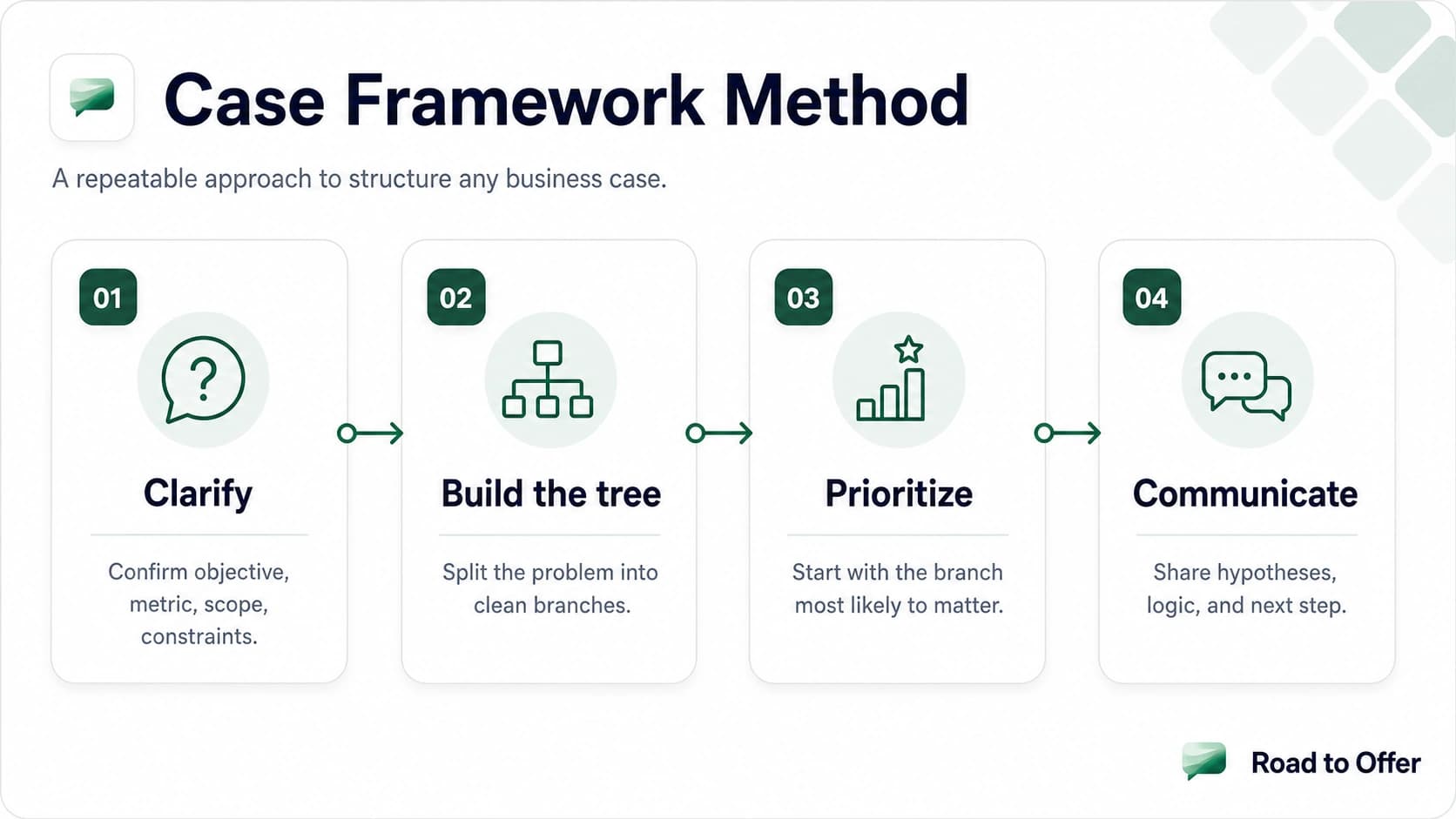
Learn the case method
One dense lesson, each step linked to the drill that trains it.
For how these firms differ from MBB on work and career path, see MBB vs boutique vs tier-2 firms.
Which language will the Paris interviews be in?
Plan for both: most Paris case and fit interviews are in French, while BCG's online and written cases are in English and every firm checks your English. Here is what each firm states:
- BCG France: most interviews in French; the online case and the written case only in English (BCG portal).
- Bain: "Fluency in French & English (level C1 for both)" for France, on its Bainworks page.
- Kearney Paris: fluent English and French on both 2027 postings.
- Roland Berger Paris: English and French imperative; another language is a plus.
- Estin: complete fluency in English; another European language is "very useful."
If French is your second language, practise at least some cases in French before your first round, and if English is your second language, practise the written case in English. Our case interview language guide for Europe compares the rules office by office. For the CV and cover letter that Roland Berger, Kearney and Advancy ask for, the consulting cover letter guide applies; write them in the language of the posting.
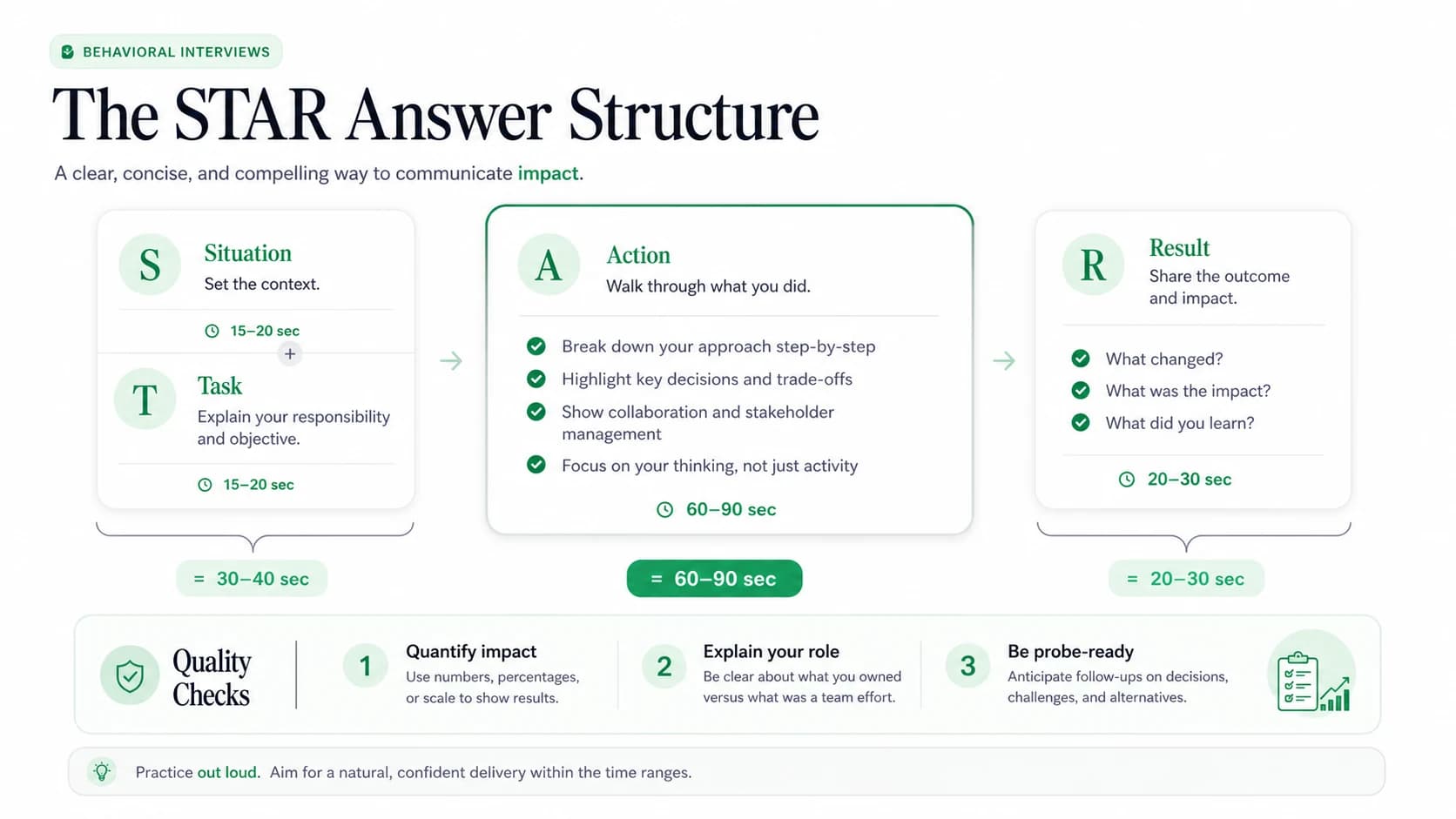
Learn the behavioral method
STAR that survives probing, linked to the live AI interviewer.
Which schools do Paris strategy firms recruit from?
Paris firms recruit mainly from the grandes écoles de commerce and d'ingénieur, and some publish the list. Kéa names HEC Paris, ESSEC, ESCP, Sciences Po Paris, emlyon, EDHEC, X, Mines, CentraleSupélec, Ponts ParisTech and Telecom Paris. Estin adds international universities such as Oxford, Cambridge, LSE, St. Gallen, Bocconi and WHU to its French list. Roland Berger's Paris posting asks for a "groupe A" business or engineering school profile. BCG runs campus pages for French schools such as ESSEC, and McKinsey's students page lets you search for your school's page.
Three practical consequences for international students:
- You still need a convention de stage. BCG says its stages must be under a convention. If your university is outside France, ask the firm and your school early whether one can be issued for you.
- Name the office, not just the firm. BCG asks for two preferred offices, and Bain asks you to select an office for local requirements. Applying to Paris means meeting Paris's language bar.
- An MBA is a separate door. If you are at INSEAD or another MBA programme, you apply to post-MBA roles rather than to stages; check the firm's MBA page for that calendar.
How should you prepare in the weeks before a Paris window?
Work back from the window: about eight weeks of preparation fits before a first round, with the written case and the language practised as separate skills. This plan assumes you target a McKinsey window or a BCG application about two months away; the dates above tell you which one.
One full case is free with an account on Road to Offer, so you can run a first scored case before deciding how much more practice you need.












Prep plans for McKinsey, BCG, Bain, Deloitte, Accenture, EY-Parthenon, Kearney, Oliver Wyman, Roland Berger, L.E.K., OC&C, Strategy&, Simon-Kucher, Arthur D. Little, Capital One and your target firm. Choose your firm in the plan builder.
Get your prep plan
A week-by-week schedule built around your target firm and interview date.
Weeks 1 to 2: case structure and math
The case is graded the same way in Paris as elsewhere, so start with the method. Run cases aloud, and do the math by hand: Bain says calculators are allowed only in its digital assessment, not in the interviews that follow.
Weeks 3 to 4: the test before round one
Find out which test your firm uses before you prepare for it. BCG France names a logic test and an online case without a public format; McKinsey names Solve for most consulting roles; Bain names Sova or TestGorilla. One timed run of the right test is worth more than ten runs of the wrong one.
Weeks 5 to 6: the written case and the second language
Treat these as two separate skills. For BCG fin d'études and CDI candidates the written case is in English, while the interviews around it are mostly in French. Practise switching.
Weeks 7 to 8: the Partner round
Partner interviews weigh motivation and judgement. Prepare why consulting, why this firm and why Paris, in French and in English, and be ready to defend a recommendation under questioning.
What we could not confirm
These are gaps in the official record on November 6, 2026, not facts:
- BCG France's logic test and online case formats (length, item types) are not published.
- Bain Paris's interview rounds and calendar are not published; only the digital assessment and the C1 language bar are.
- Oliver Wyman, CVA, Advancy and Eight Advisory do not publish Paris-specific timelines, tests or language rules.
- Intern pay at strategy firms is not published officially; the legal minimum is the only official figure.
- Roland Berger's Gap Year page still shows a 2024 application date.
If you are a candidate and a firm tells you something different in your invitation, the invitation wins. For other markets, see consulting recruiting in Germany and MBB recruiting in London.
Three ways to start practicing
- Start a free case
Run a full case. 92 cases in voice or guided text, scored on seven dimensions.
- Try a free drill
Drill one skill. 550+ drills across 6 skill types.
- Find your test
Practice your firm's test. Solve, Casey, CCA, SOVA and TestGorilla, each free to try.



Sources
All pages read on November 6, 2026.
- BCG: ESSEC on-campus page (three rounds over four to six weeks, logic test, written case for fin d'études and CDI, five-month minimum, about 85% of interns offered a CDI, apply four to six months ahead, replies in two to four weeks, reapplication rule, office choice, alternance)
- BCG: France coach and candidate portal (about 10 weeks on average, feedback in about a week, online and written cases in English, most interviews in French, in-person preferred, no AI tools)
- McKinsey: Carrières en France and its linked PDF "2026 - 2027 Paris Office Intake windows" (Business Analyst and intern windows, answer dates, earliest first rounds, arrival sessions)
- McKinsey: Interviewing at McKinsey (Solve for most consulting roles, PEI, problem-solving interview)
- Bain: Bainworks (France: French and English at C1)
- Bain: Digital assessment (Sova or TestGorilla, 30 to 40 minutes, aids allowed, AI banned)
- Bain: Stage de consultant(e) associé(e) (office selection, one week of intensive training)
- Bain: Lead to Inspire Masterclass (apply by November 22, 2026; Paris participating)
- Kearney: Business Analyst Intern 2027, Paris and Business Analyst 2027, Paris (24 to 26 weeks, eligibility, French and English, rolling review, start months)
- Roland Berger: Hints and tips and Selection process (recruiting day, online test for permanent roles, three to four months' lead-in)
- Roland Berger: Stagiaire Consultant(e) 2027, Paris and Gap Year programme
- Kéa: Nous rejoindre (four interviews, target schools, year-round recruiting)
- Advancy: Hiring process
- Estin & Co: Apply and What we look for
- CVA: Apply
- Simon-Kucher: Carrières
- Oliver Wyman: Interview preparation
- Eight Advisory: careers site
- ESCP: Career fairs and recruitment events
- Travail-emploi.gouv.fr: Les stages étudiants en milieu professionnel (six-month cap per host per academic year; updated January 9, 2026)
- Service-Public: Gratification minimale d'un stagiaire (4.50 euros an hour, over two months; verified January 1, 2026)
Frequently asked questions
Resources and related guides
- Consulting application trackerPractice
- Browse all free resourcesResource hub
- Calendrier recrutement conseil en stratégie : stage 2026/27Recruiting · Nov 7, 2026
- Consulting Recruiting Timeline Europe 2026/27Recruiting · Nov 6, 2026
- Case Interview Language in Europe: English or Local?Recruiting · Nov 6, 2026