
UK Consulting Recruiting Guide 2026: Timeline, Tests, and the Interview
UK consulting recruiting in 2026: spring weeks, penultimate-year internships, and graduate schemes, plus target universities, the online tests, right-to-work reality, and the globally standard case interview.
On this page
UK consulting recruiting runs on its own calendar, not the US autumn sprint. Three entry points feed it: first-year spring weeks, penultimate-year summer internships, and final-year graduate schemes. Nearly every firm reviews on a rolling basis, so applying in the first days a portal opens beats applying polished and late.
Timing varies sharply by firm. McKinsey's UK graduate portal opened on 1 January 2026 and closed its first round on 29 March 2026 (see the McKinsey deadline tracker), Bain London reopens its Associate Consultant window in September 2026, and BCG opens in the autumn and runs rolling. The market behind those seats is large and still growing: MCA member data put UK consulting near £21.8 billion in 2025, up about 3% year on year (MCA / Oxford Economics).
For who actually hires and what London pays, pair this with consulting firms in the UK. For the four-year groundwork view (clubs, networking cadence, non-target moves), see the undergrad consulting recruiting guide.
Start case reps before the portal opens
The online test gates the interview, but the case decides the offer. Practise cases and fit questions free with instant AI feedback, so you arrive at the autumn cycle with reps already banked.
When does UK consulting recruiting actually open?
The UK runs three distinct entry points, each aimed at a different year of study. The table below is the shape of the calendar; specific dates move every cycle.
Spring weeks are roughly one-week experiences that run in March and April, with applications usually opening the previous September and October. Summer internships are 10 to 12 week programmes run over the following summer for penultimate-year students, and many firms set the same deadline window for internships and graduate schemes, often October and November. For the internship route specifically, the best consulting internships guide and the firm pages (McKinsey, BCG, Bain) cover how each programme feeds a full-time offer. The big exception to watch is MBB: McKinsey UK ran a January-to-March graduate window in 2026 rather than the autumn pattern, so you cannot assume one firm's calendar applies to another.
Concrete windows from the most recent cycle are below, taken from each firm's own careers page and the published UK graduate scheme deadline calendar. Dates move every year and most schemes fill on a rolling basis, so confirm the live window before you plan around it.
Two patterns fall out of that table. MBB does not share a calendar with the Big 4 or with each other, and the Big 4 dates that look generous are misleading because the review is rolling. The general UK shape, spring weeks applied for in the autumn of first year and summer internships and graduate schemes closing between October and the following spring, is confirmed by the TargetJobs consulting timeline.
Execution checklist
Map each firm's live deadline before you plan. Windows differ by firm and move yearly; McKinsey UK opened 1 January 2026 and closed 29 March 2026, while many Big 4 and boutique schemes open August to November
Apply in the first two weeks the portal is open. Most firms review on a rolling basis and can close a scheme early once seats fill, so an early strong application beats a late polished one
Match the entry point to your year of study. Spring weeks are for first-years, summer internships for penultimate-years, and graduate schemes for finalists and recent grads
Prepare the online assessment before the live interview. The SJT and reasoning tests, plus McKinsey Solve or BCG Casey, gate the interview and are often the first hard filter
Track MBA and experienced-hire routes separately. These run year-round rather than following the graduate calendar
For the firm-by-firm 2026 deadline dates across undergrad, MBA, and experienced-hire tracks, use the consulting application deadlines 2026 guide and confirm each against the firm's own page.
UK target universities for consulting: where firms actually recruit
Two different lists get confused here. One is the list of universities that top graduate employers as a whole visit most, which the annual Graduate Market survey of 100 leading UK employers ranks with Manchester first, then Birmingham, Nottingham, Warwick, and UCL, with King's College London 11th (High Fliers via University of Manchester, King's College London). Employers in that survey targeted around 23 universities each.
The consulting-specific list is narrower at the top and wider at the bottom, because strategy firms concentrate their case workshops and society sponsorship in a handful of places while the Big 4 recruit across a large regional footprint. Below is what that looks like in practice.
The open-application truth matters more than the list. McKinsey, BCG, Bain, and the Big 4 firms all run online portals anyone can use, and British-founded firms like PA Consulting and Baringa hire widely across UK universities. A non-target candidate who applies early, clears the online test, and can crack a case is graded on exactly the same interview rubric as an Oxbridge applicant. The disadvantage is exposure and networking, not a locked door, and both are fixable: the how to get into MBB guide covers the non-target playbook, and the consulting networking guide covers how to build the coffee-chat coverage a target-school student gets for free.
What is actually in a UK consulting application?
The UK stack is test-heavy, and the online assessment is usually the first hard filter. Expect these components, though the exact mix varies by firm and service line.
Execution checklist
Situational judgement test (SJT). Scenario questions with several response options; Deloitte's immersive assessment runs roughly 40 SJT-style questions across five scenarios in 30 minutes
Numerical and verbal reasoning. Standard across Deloitte, PwC, KPMG, and EY graduate assessments, often delivered on SHL or an in-house platform
Watson-Glaser-style critical thinking. Retained at some Big 4 service lines, notably parts of Deloitte, covering inference, assumptions, deduction, interpretation, and evaluation of arguments
MBB online screen. McKinsey Solve and BCG Casey replace the classic aptitude test at MBB and are identical worldwide
CV screen. One page, consulting format, quantified impact, checked against the consulting bar before you submit
Cover letter or motivation statement. Still requested at several firms; keep it specific to the firm and the office rather than generic
Each line of that stack has a guide: the consulting aptitude test guide for the reasoning battery, Deloitte's immersive online assessment and the Deloitte assessment test guide for the SJT and Watson-Glaser rounds, the PwC SHL aptitude guide, the EY assessment test guide, and the KPMG assessment test guide. For the CV and the letter, the consulting resume guide and consulting cover letter guide cover structure, and you can run your CV through the free resume grader for line-by-line feedback before you submit.
Two things distinguish the UK application from the US one. First, the reasoning and SJT battery is a genuine scored gate, not a formality. Second, the MBB digital screens are identical worldwide, so the work you put into them transfers to every office you apply to.
The numerical half of that battery is the same skill the case interview tests: fast, clean arithmetic under time pressure. One graded rep tells you where you stand.
Each MBB screen has its own guide and, where we have built one, a live simulator you can sit before the real thing:
- McKinsey: the McKinsey Solve guide breaks down the Ecosystem and Redrock games.
- BCG: the BCG Casey guide plus the free Casey chatbot simulator on the same page, and for the numerical round the BCG Consulting Career Assessment guide with the CCA simulator.
- Bain: the UK online assessment covers behavioural preferences plus numerical and logical reasoning (Bain London), the SOVA-style format broken down in the Bain SOVA test guide.
If BCG is on your list, the BCG online assessments hub collects both screens in one place.
Can international students work in UK consulting?
For many international candidates the answer is yes, though the rules are moving. The UK Graduate visa lets bachelor's and master's graduates work in the UK for 2 years (3 years for PhD holders) with no job offer, minimum salary, or employer sponsorship required, which covers most early-career consulting roles. That makes the graduate route a realistic bridge into a consulting scheme without the firm having to sponsor a work visa on day one.
The important caveat is timing. For applications submitted on or after 1 January 2027, the Graduate visa is being reduced from 2 years to 18 months for bachelor's and master's graduates. Beyond the Graduate route, longer-term work usually means switching to a sponsored Skilled Worker visa, and not every firm or team sponsors at every level. Immigration policy changes frequently and individual circumstances vary, so treat all of this as a starting point and confirm the current position on GOV.UK or directly with the firm's recruiting team before you plan around it.
Is the interview different in the UK?
No, and this is the part most local guides miss. A McKinsey case in London is graded on the same rubric as one in New York, Dubai, or Singapore: a clear structure, accurate quantitative work, and a defensible recommendation, wrapped in a fit conversation about your motivation and leadership. The online screens are identical worldwide too. That means the hardest, highest-signal part of your preparation transfers across every office and every firm on your shortlist. See the McKinsey, BCG, and Bain case interview guides for each firm's format.
The rubric rewards a clean, MECE structure before anything else. Build one against the clock and get it graded:
If you want the underlying method first, the free case-cracking lesson walks through structure, math, and synthesis end to end.
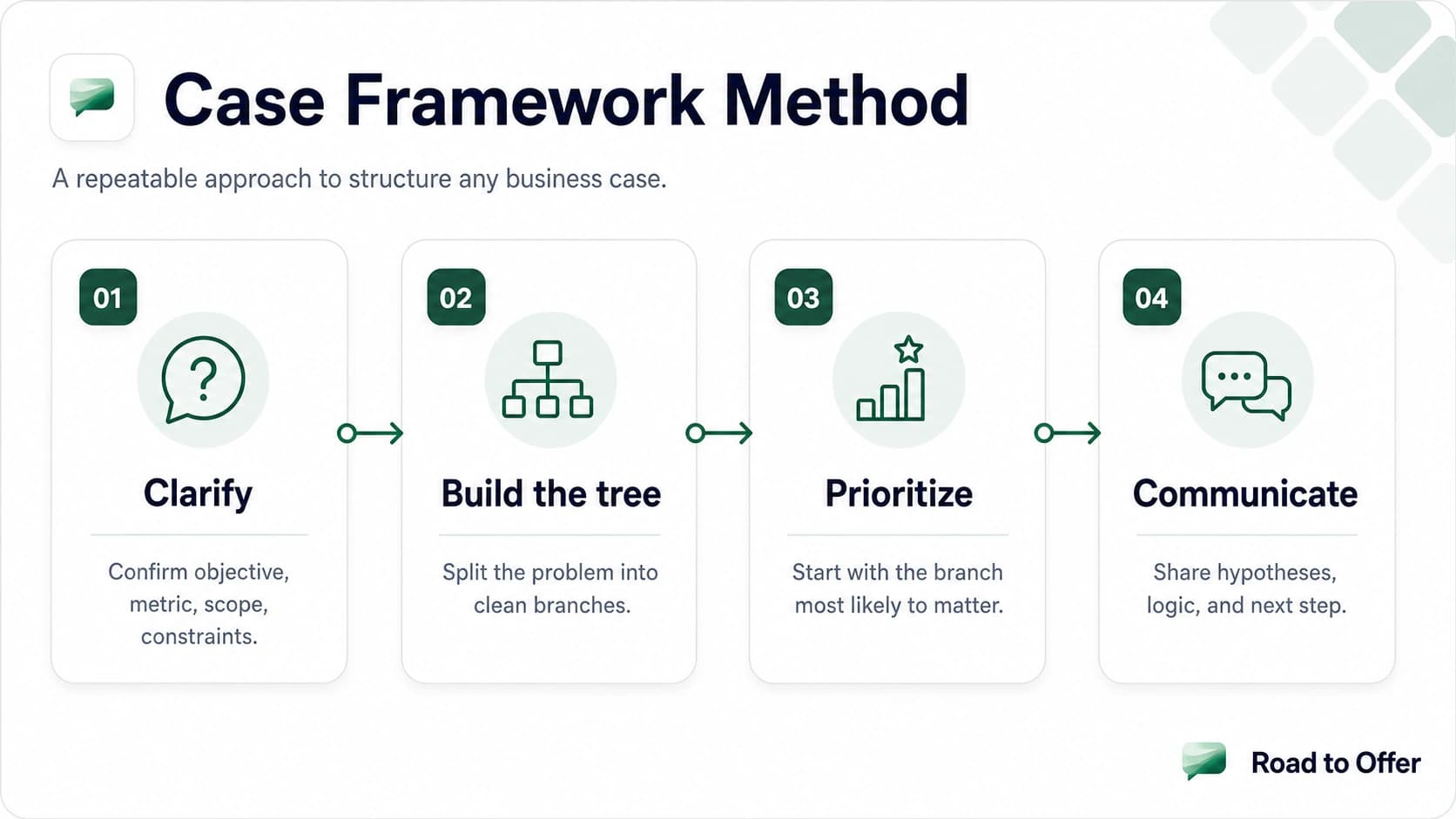
Learn the case method
One dense lesson, each step linked to the drill that trains it.
The second half of the rubric is numbers you can defend out loud. These three use rounded UK figures so you can check the arithmetic in your head.
Once the pieces hold up on their own, run them together. A London first round is almost always a profitability or growth case with a fit conversation around it, so start there and get graded on structure, math, and recommendation in one sitting.

Profitability · easy
Practice a real case interview
Matched to this article: a live CPG profitability case with an AI interviewer. Free, scored on every step.
The takeaway for UK candidates is that the calendar and the tests are local, but the interview is global. Get the online assessment out of the way early, apply in the first days a scheme opens, and spend the bulk of your energy on the case skill that carries across every firm and every office you target.
Sources
- MCA / Oxford Economics: UK consulting industry 2025 (Consultancy.uk) (accessed July 24, 2026)
- TargetJobs: Consulting application timeline, when to apply (accessed July 24, 2026)
- GOV.UK: Graduate visa (accessed July 24, 2026)
- Deloitte Immersive Online Assessment and Watson-Glaser guidance (JobTestPrep) (accessed July 24, 2026)
- Whali: UK graduate scheme deadlines 2026-2027 (consulting) (accessed July 24, 2026)
- Bain & Company: London recruiting, Associate Consultant windows and interview timing (accessed July 24, 2026)
- High Fliers, The Graduate Market in 2026: most targeted UK universities (via University of Manchester) (accessed July 24, 2026)
- King's College London: 2026 employer-targeting ranking (accessed July 24, 2026)
Frequently asked questions
Resources and related guides
- Consulting application trackerPractice
- Browse all free resourcesResource hub
- Undergrad Consulting Recruiting: 4-Year Playbook (2026)Getting Started · Apr 12, 2026
- Consulting Recruiting Events: What to Attend in 2026Getting Started · Apr 12, 2026
- MBB Resume Template: McKinsey, BCG and Bain Format (2026)Getting Started · Jun 4, 2026