
Bain SOVA Assessment Test: Format, Sections & Prep (2026)
Prepare for the Bain SOVA test with the format, common sections, sample question types, what Bain assesses, and practical prep steps.
On this page
Try the two-question independent Bain SOVA practice test first: one numerical data-interpretation item and one abstract logical pattern, both with worked reasoning before signup.
Live free simulator from Road to Offer for the Bain SOVA numerical and logical assessment. Practise this style of assessment in the browser, no account needed to start.
Bain SOVA Test Format and Sections
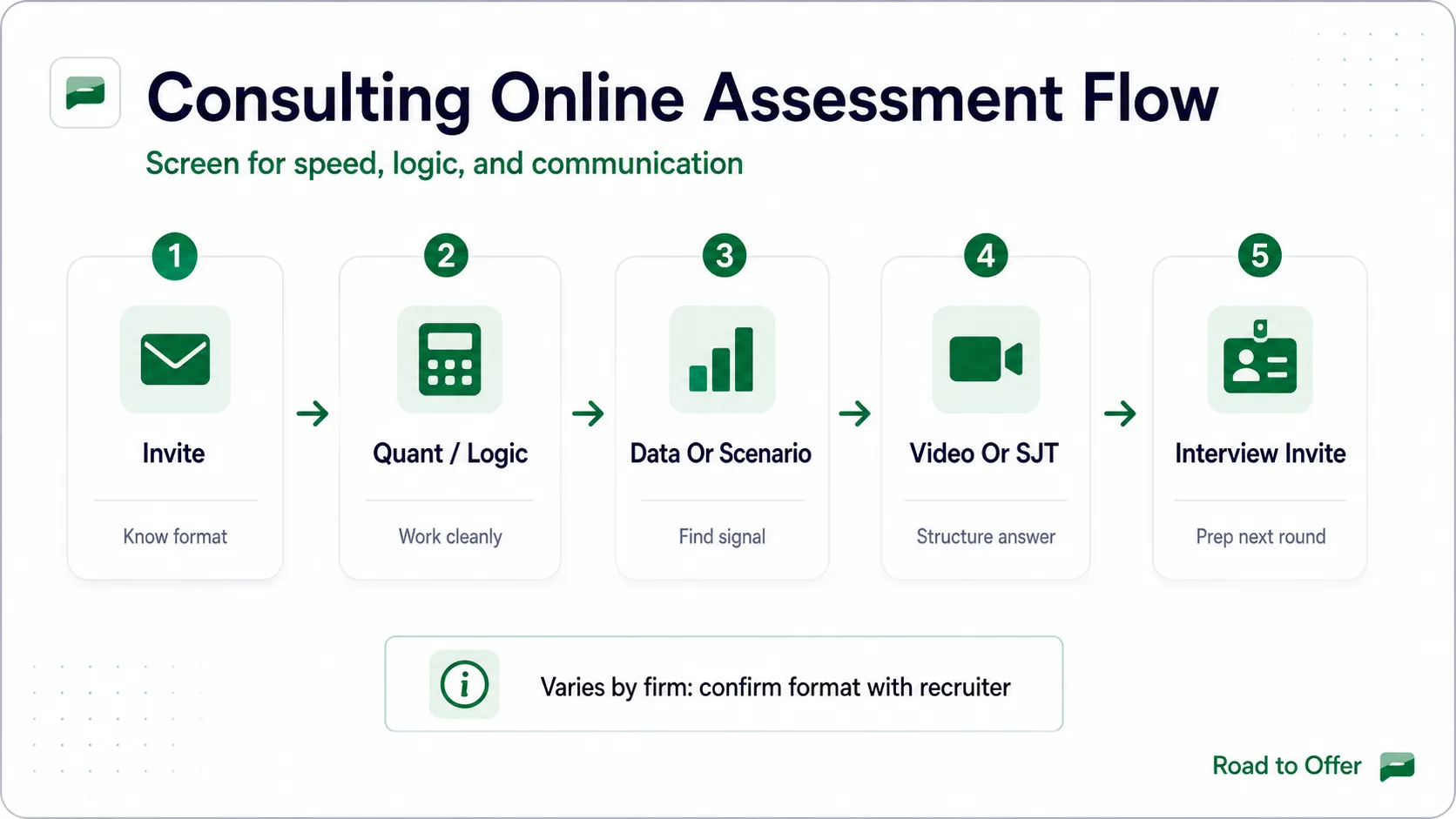
The Bain SOVA test is one form of the digital assessment some Bain offices use before interviews, and candidates searching for the SOVA assessment mean this screen. Bain describes its digital assessment as roughly 30 to 40 minutes, but the exact format can vary by office. Expect a timed mix of reasoning, situational judgement, and behavioral or personality questions, and use your invitation as the source of truth. For a decision-by-decision walkthrough of the practice version above, see the Bain SOVA simulator walkthrough. For how SOVA fits alongside other firms' screens, see the consulting online assessments overview.
If your invitation says TestGorilla instead of SOVA, use the Bain TestGorilla assessment guide. Bain's own digital assessment hub says the recruiter email controls which platform you receive.
Situational Judgement (SJT)
The SJT presents realistic workplace scenarios Bain consultants encounter. For each scenario, you rank 4-5 possible responses from most to least effective. Bain has determined which response patterns correlate with successful consultants, there is no single "right" answer, but some patterns score significantly higher.
Think like a first-year Bain consultant: balance directness with collaboration, address problems directly while maintaining team relationships, and avoid extremes (ignoring problems or escalating immediately to partners).
Response ranking principles:
- Direct problem-solving actions rank highest
- Collaborative approaches rank above solo actions
- Passive responses (doing nothing) rank lowest
- Escalation to senior leadership ranks low unless warranted
Verbal Reasoning
Verbal reasoning presents 150-250 word business passages followed by statements you classify as True (directly supported), False (contradicted), or Cannot Say (neither supported nor contradicted). The most common mistake: selecting True or False based on outside knowledge rather than what the passage states.
Example: A passage states biologics grew from 28% to 35% of pharma spending (2019-2024) and emerging markets grew 12%+ annually. Statement: "The US pharmaceutical market is growing faster than emerging markets." Answer: Cannot Say, the passage gives US market share (42%) but not its growth rate.
Speed target: 60-90 seconds per question. Read the passage once carefully, then evaluate each statement strictly against the text.
Numerical Reasoning
This section tests chart, table, and graph interpretation with calculations, percentage changes, ratios, proportions, and multi-step word problems. Bain does not publish a full public spec, so use this section as practice guidance rather than an exact leaked blueprint. Build the underlying speed with timed math drills before test day.
Worked Example
Question: Which region had the highest revenue growth rate?
- North America: (495 - 450) / 450 = 10.0%
- Europe: (336 - 320) / 320 = 5.0%
- Asia-Pacific: (216 - 180) / 180 = 20.0%
Follow-up: Asia-Pacific profit in 2024 = $216M x 22% = $47.52M. Target: 45-60 seconds with mental math.
Logical Reasoning and Personality
Logical reasoning tests abstract thinking through pattern recognition, sequence completion, and matrix reasoning, no business context, pure cognitive assessment. Look for multiple simultaneous rules (rotation + color + size). If stuck for 60+ seconds, make your best guess and move on (Source: RocketBlocks 2025).
The personality section uses 1-5 scale ratings on statements like "I enjoy tackling problems I have never seen before." No right or wrong answers, but Bain checks for consistency, rating "I enjoy teamwork" as 5 and "I prefer working independently" as 5 flags your profile. According to Management Consulted, a misaligned personality profile can result in elimination even with strong cognitive scores. The same value-fit signals resurface in Bain's experience interview, so rehearsing structured behavioral answers pays off twice.
How to Think About Scoring
Bain does not publish a public scorecard for the digital assessment. The safe assumption is simple: accuracy matters, consistency matters, and getting stuck is expensive. You are not trying to brute-force a perfect score. You are trying to look like someone who can reason clearly under time pressure.
Regional Variations
Bain does not run one identical assessment globally. Your invitation email is more trustworthy than any community spreadsheet. If the email is vague, ask your recruiter what format to expect.
10-Day Preparation Strategy
Days 1-3, Diagnose baseline. Start with the free numerical and logical questions above. If your invitation confirms a full SOVA assessment, add a reputable full-length test that matches its named sections. Record accuracy and time per section; your weakest section gets the most prep time.
Days 4-6, Drill weak sections. Numerical weak: 30+ chart/table questions daily, target sub-45 seconds at 85%+ accuracy. Verbal weak: GMAT Critical Reasoning sets focusing on the True/False/Cannot Say distinction. Logical weak: Raven's Progressive Matrices, 20+ questions daily.
Days 7-8, Build speed. Accuracy should be solid. Reduce response time 10-15% below Day 1 baseline while maintaining 80%+ accuracy.
Days 9-10, Full simulation. 2 complete practice tests under the conditions specified in your invitation. Check its calculator, notes and break rules before starting.
Try two original SOVA-style reasoning questions
Start with a numerical question, then continue to an abstract pattern. This short diagnostic covers two reasoning skills, not the full provider battery.
Common Mistakes That Lower Scores
Spending equal time on every question ignores that some are easier. If you solve a numerical question in 15 seconds, move on. If stuck for 90+ seconds on logical reasoning, guess and move, the speed penalty outweighs the accuracy gain.
Using outside knowledge on verbal reasoning is the most common error. "Cannot Say" means the passage lacks information, even if you personally know the answer. Overthinking personality creates inconsistency the system detects. Skipping mental math practice makes even simple percentage calculations slow.
SOVA in the Full Bain Pipeline
SOVA proves you have the cognitive baseline Bain requires. The case interview determines whether you get the offer. The quantitative skills you build for SOVA's numerical section directly improve your case interview math performance. Pair that with reps on building a clear case structure so the analysis lands cleanly.
Bain Interview Pipeline (European Offices)
- 01
Application. Resume and cover letter screened
- 02
Digital assessment. Reasoning and judgment screen before interviews
- 03
First Round. 2 interviews: case + experience (~40 min each)
- 04
Final Round. 2-3 interviews with Partners
- 05
Offer Decision. Within 1-2 weeks of final round
Related Guides
- Bain case interview guide, Bain's candidate-led case format and partner scoring
- Bain TestGorilla guide, an alternative online assessment Bain uses in some regional and role-specific processes
- Free Bain interview prep tools, no-cost drills and resources to pair with assessment prep
- McKinsey Solve guide, McKinsey's game-based online assessment; comparable cognitive prep for the SOVA numerical and logical sections
- Consulting assessment tests guide, what different firms screen for before interviews
- Case interview math practice, numerical reasoning skills apply to case math
- Mental math for case interviews, speed SOVA's numerical section demands
- Case interview data interpretation, chart interpretation in SOVA and live cases
- Behavioral interview for consulting, Bain's experience interview preparation
Passed SOVA? Now prepare for the case interview
The SOVA test screens for cognitive ability, the case interview determines whether you get an offer. Practice Bain-style cases with AI coaching.
Sources (checked June 17, 2026)
- Bain digital assessment: https://www.bain.com/careers/hiring-process/digital-assessment/
- Bain interviewing guidance: https://www.bain.com/careers/hiring-process/interviewing/
- SOVA candidate preparation hub: https://www.sovaassessment.com/candidate-preparation-hub/
- IGotAnOffer Bain online assessment guide: https://igotanoffer.com/en/advice/bain-online-assessment
- RocketBlocks Bain SOVA overview: https://www.rocketblocks.me/blog/bain-sova-test.php
Frequently asked questions
Resources and related guides
- Run a real case interviewPractice
- Browse all free resourcesResource hub
- Bain Case Interview Guide (2026): Format, Examples + PrepFirm Specific · Feb 6, 2026
- Bain Practice Cases: 10 Worked Examples With Solutions (2026)Firm Specific · Jul 18, 2026
- Caso online de BCG (Casey): formato, tipos de preguntas y preparación (2026)Firm Specific · Mar 20, 2026
- PwC SHL Aptitude: Invitation-First Math and Logic PracticeFirm Specific · Jul 18, 2026
- Free Bain SOVA Practice Test: Numerical and Logical QuestionsFirm Specific · Jul 22, 2026