
BCG Platinion Case Interview Examples: 6 Practice Cases
BCG Platinion case interview examples are IT cases: renewing a client's application landscape, choosing an ERP migration path, moving systems to the cloud or valuing a target's IT spend. The firm links two official examples, an IT transformation case and an Enterprise Solutions case. Both are summarised below, followed by six original IT cases worked through with the numbers.
Does BCG Platinion publish practice cases?
Yes, two, by link only: an IT transformation case and an Enterprise Solutions case, both linked from its prepare page. The firm publishes no question list and no sample answers, and it does not say how many cases you will meet (checked 24 November 2026). Everything else people call a Platinion case is reported by candidates.
The one number to carry away: the process has at least two rounds, each with two interviews and case studies, according to the firm's application page. The page does not say how many minutes a case takes.
For the full process, roles and pay, use the BCG Platinion guide; this page is the one with cases to solve.
What do BCG Platinion cases test?
Structure, business sense, comfort with numbers and KPIs, and a clear, hypothesis-led line of thought, with IT fluency rather than coding. The prepare page (read 24 November 2026) names problem structuring, business sense and judgment, numbers and KPIs, hypotheses and explicit assumptions; the point about IT fluency rather than coding is our reading of candidate reports.
The firm's application page sets out where those cases sit:
Round one
two interviews
- Case studies
- In some variants, a virtual logic test in the week before
Round two
two interviews
- An IT case, similar to round one
- A business case
In the case
prepare page
- Break the problem down, hypothesis first
- Say assumptions and calculations out loud
Start a free case interview for BCG Platinion

Don't know how to case yet? Learn how to case
The prepare page asks for five habits in the case itself:
- break the problem into smaller stages;
- work hypothesis first;
- say assumptions and calculations out loud so the interviewer can follow;
- avoid jumping to a conclusion, and finish by answering the original question;
- accept that there is no single right answer, so a clear line of thought counts for more than a perfect result.
For the interview more broadly, the same page says to get comfortable with numbers and key KPIs, to practise structuring different case types and to know why you want to join. It also asks for the camera on and eye contact in virtual interviews.
Reported by candidates, not by the firm: the cases are IT-related and mostly qualitative. Topics that candidates and coaches describe include an IT strategy and architecture assessment, an ERP introduction at a bank, IoT sensors on an oil platform, the return on a new IT project, and a private equity client assessing a bank's IT spend. One coach reply adds that the maths is light and stays in total cost, downtime cost and payback. A candidate who passed round one also reports one technical case about technology enablement and one business case about digital transformation, and advises reading each interviewer's background, because a case can follow their own project area. Treat all of that as direction for practice, not as a rule.
The structuring guide and the case interview maths tips cover those two skills in general, and the technology case interview guide and the digital transformation case guide cover the IT setting. To rehearse the first skill on its own, use the structure drills; the sections below apply both to Platinion's cases.
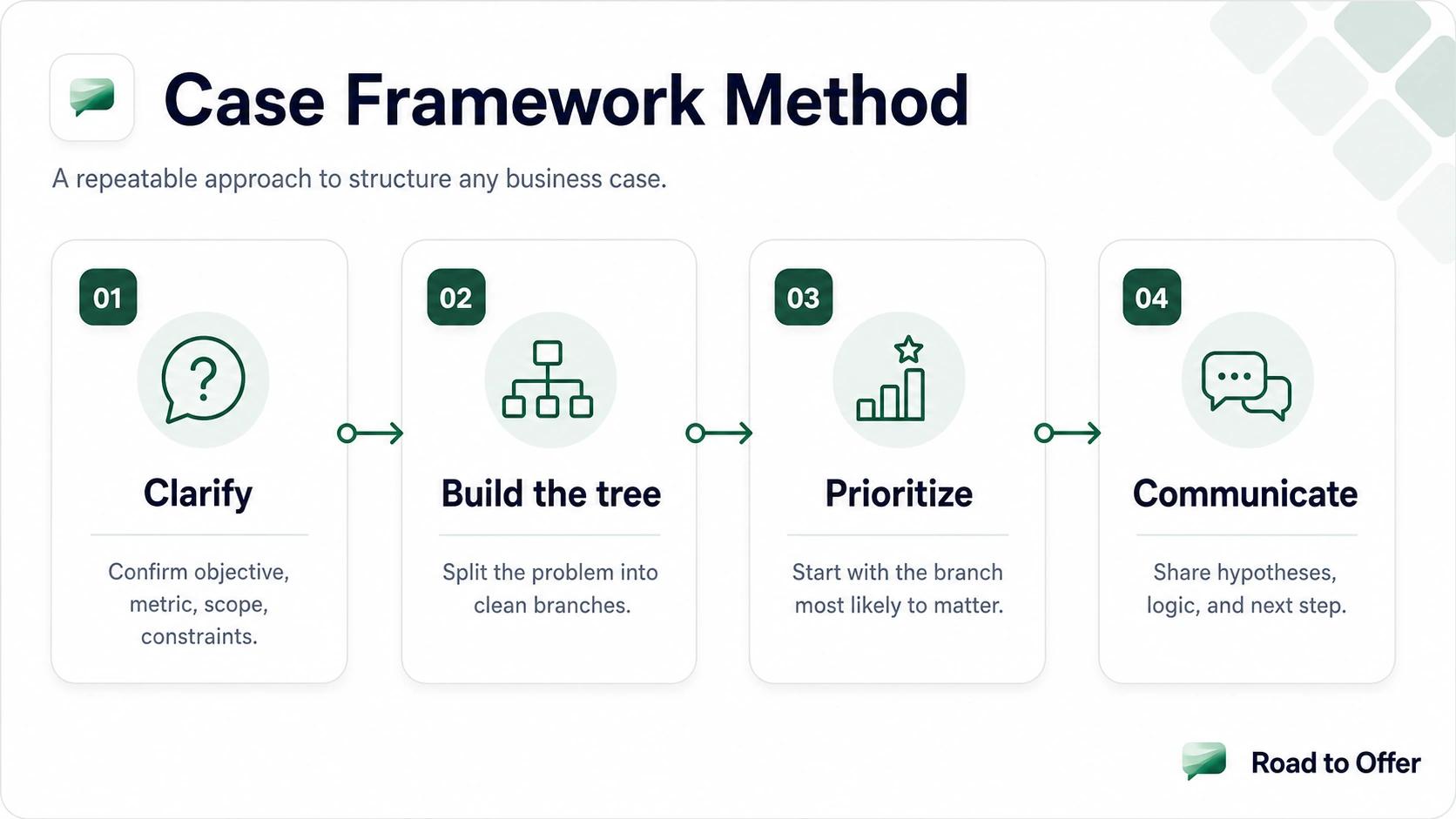
Learn the case method
One dense lesson, each step linked to the drill that trains it.
What is the official IT transformation case, and how do you work it?
It is a CIO asking you to renew a fragmented legacy IT landscape, and the winning shape is: score the applications, match a technology lever to each pain point, then split cost into run and change. This section summarises the case in our words. The prompt and tasks are on the official case page, which the firm links from its prepare page.
The prompt, in short. The CIO of a large insurer wants help renewing the company's IT landscape as the start of a digital transformation. The landscape is fragmented and tightly integrated. Most applications are monolithic custom builds on on-premise mainframes. The client reports stability and scalability problems, rising IT cost and slow delivery of new functions. The host page rates the case advanced and interviewer-led, meaning you lead it from start to finish, and lists three tasks: assess the current state quickly, identify the main areas for intervention, and propose measures for the pain points.
What we read and what we did not. We read the prompt and the three tasks. The structure suggestions, the exhibits and the sample solutions sit behind a sign-up on the host page, and we did not read them. What follows is our own approach, not the host's answer key.
An answer outline you can rehearse:
- Name the goal before the landscape. Ask what "renewal" has to deliver: lower run cost, fewer outages, faster releases, or all three. Ask who decides and by when.
- Score the application estate. You cannot modernise hundreds of applications at once. Score each on business impact, how severe its problems are and what type of application it is (a core policy system, a channel, a back-office tool). Start with high impact and high pain.
- Match levers to pain points. Stability problems point to refactoring the worst monoliths into smaller services. Scalability problems point to cloud migration of workloads with variable load. Slow release cycles point to automating build, test and deployment.
- Split cost into run and change. Run-the-business cost keeps the lights on; change-the-business cost builds something new. Savings in run cost can fund change, which is how a transformation pays for itself.
- Close with sequencing and risk. Pilot on one application, measure, then scale. Name the main risk, such as a mainframe that cannot be switched off until its last dependency moves, and who owns the decision.
Suppose, for illustration, an insurer whose IT budget is €200M a year, split 70% run and 30% change. That is €140M run and €60M change. A 10% cut in run cost frees €14M, which lifts the change budget by 14 / 60 = 23%. The point to say aloud: the run-cost programme is not a side project, it is how the roadmap gets funded. These figures are ours and invented; they are not the host case's numbers.
For the same business setting from the insurer's side, see the insurance case interview guide.
What is the official Enterprise Solutions case?
It is an ERP strategy and S/4HANA migration case for a fictional home accessories retailer, rated intermediate, and the visible question is about the option space for the migration. The firm links it as the second exemplary case, on the host page.
In our words, the prompt is a retailer called DekoKonzept with about €700M in revenue, based mostly in Germany with stores in big city centres and a fast-growing online shop. Procurement, warehousing and point of sale run on outdated, often self-built systems. Its SAP ECC 6.0 ERP will lose official support, so it wants to move to S/4HANA as soon as possible and sees the move as a chance to standardise processes. The next step is to assess the effect on cost, budget and scope. The first question asks how the option space for SAP implementation strategies looks.
We read the prompt and that first question. Everything after it, including structure tips and sample solutions, is behind a sign-up, and we did not read it. A fair way to answer the first question: lay the options along one axis, how much of today's process and data you carry over, from rebuilding on a clean slate to converting the existing system as it is, with selective approaches between them. Then say what each option costs, how long it takes and what it risks. Our worked case 3 below drills that comparison on a made-up manufacturer, which is the nearest ERP practice on this page.
Do BCG Platinion's client stories help you practise?
Yes, as a source of realistic problems, not as cases. The firm publishes client stories on its site, and two suggest sums you can run. They are the firm's own claims about its work, so read them as marketing.
- A GenAI programme for the PHOENIX group (14 October 2025): the story describes an AI service agent that handles roughly half of routine customer inquiries, across 29 countries and over seven million calls a year. A practice sum: half of seven million is 3.5 million calls. At an assumed €4 per handled call, that is €14M a year of handling cost at stake. Then ask what quality risk you would test first.
- A product-tech decentralisation (8 October 2026): a pan-European platform group built from 25+ acquisitions separates its stack in 18 months. A practice question is how you would sequence that, for example shared services first, then one market as a pilot, then the rest.
How should you work an IT case under time pressure?
Ask what the landscape is, name the driver, size the number, then sequence and name the risk. Four habits keep that fast.
- Ask one context question first. What does the client run today, and what is the trigger? A forced support end date, an outage and a merger are three different cases.
- Name the driver: cost, risk or capability. Most IT questions are one of the three. Saying which you think it is gives the interviewer something to correct.
- Put one number on every branch. A branch with no figure is a list, not an analysis. A rough run cost, a headcount or a payback is enough, with the assumption said out loud.
- End with who owns it and how you will know. A recommendation without an owner and a measure reads as unfinished.
Practise the first habit as a structure on its own before you add numbers.
Each of the six cases below is built around one of these moves. Cover the answer, work the case on paper, then compare. The cases are made-up clients with invented data, written for practice, and none comes from a casebook or from BCG Platinion.
Case 1: which applications go first in a bank's modernisation?
The answer is a first wave of 40 applications, which takes five quarters at the team's pace. This case trains scoring, funnel arithmetic and sequencing.
The prompt. A regional bank runs 400 applications on a legacy core. The CIO wants a modernisation plan and asks where to start.
The data you ask for. 25% of the applications are business critical. Of those, 40% have 10 or more production incidents a year. The delivery team can modernise 8 applications a quarter.
The work. Score the 100 critical applications on business impact, incident severity and fit with the target architecture. Take the 40 with the most incidents as wave 1. Then sequence by dependency, not by score alone, because retiring a downstream system can block an upstream one. The other 300 applications are not ignored: some can be retired, some left alone.
A strong close. "Wave 1 is 40 applications, five quarters at 8 a quarter. I would start with one low-risk critical application in quarter 1, measure incidents and release time, then scale. The risk is data migration, so I want a named owner for it before we begin."
Case 2: should a retailer move its core systems to the cloud?
The answer is that the move pays back after about 3.7 years and is worth €12M over five years, but only if the cloud run cost comes in at €15M. This case trains total cost, payback and sensitivity.
The prompt. A retailer pays €24M a year to run its core systems on its own servers. A cloud migration costs €18M one-off in year 1. During year 1 it pays €6M to run the cloud estate while the on-premise cost carries on, because the move happens during the year. From year 2, the cloud run cost is €15M a year. Should it migrate?
All figures in € million. Year 1 costs 48 against 24 if the retailer stays, so the extra cost is 24. Years 2 to 5 save 9 a year, 36 in total.
The answer in numbers. Payback comes in year 4. The cumulative position is minus 6 at the end of year 3, and 6 / 9 = 0.67 of year 4 is needed, so payback is about 3.7 years. Five-year net benefit is 36 minus 24 = €12M.
Sensitivity. If the cloud run cost is €18M instead of €15M, the saving is 6 a year. Payback becomes 1 + 24 / 6 = 5.0 years, and the five-year net benefit is exactly zero. The decision hinges on one assumption.
A strong close. "Migrate, but in stages. The case works only if the cloud run cost is near €15M, so I would move about a tenth of the workload first and measure that cost. Before scaling I would check data egress charges and security obligations, and I would name one owner for the business case, not one for each system."
For the same payback test on a live case, run a cloud capacity decision aloud.

Practice a cloud case for BCG Platinion
TechnologyHard
Case 3: which ERP option for a manufacturer?
The answer is a tie on cost, so decide on risk: five-year cost is €25M for the software-as-a-service ERP and €25M for the on-premise ERP once its extra process fit is counted. This case trains five-year total cost and tie-breaks.
The prompt. A manufacturer is comparing two ERP options. The first is a software-as-a-service ERP: implementation €10M one-off, licence €2M a year, support €1M a year. The second is an on-premise ERP: licence €6M one-off, implementation €14M, run cost €3M a year. The on-premise option fits 30% more of the company's processes, which the CFO values at €2M a year.
The work. Raw total cost favours SaaS by 10. The fit benefit exactly cancels that. So price does not decide it. Say that plainly rather than forcing a winner from the numbers.
A strong close. "On cost it is a tie at €25M each, so I decide on risk. SaaS carries lock-in and a vendor-controlled upgrade path; on-premise carries customisation debt that makes every later upgrade harder. I would recommend SaaS unless a workshop proves the extra fit, and I would name the three processes to test in it."
This is the made-up cousin of the official ERP case above. The real question there is about implementation strategy; this one drills the comparison you would make once the options are on the table.
Case 4: how do you value a target's IT cost gap?
The answer is a 1.6 year payback and about €105M of value, but only if the benchmark is comparable. This case trains benchmark gaps and value at a multiple, the shape reported for private equity IT due diligence.
The prompt. A private equity fund is buying a company with €500M revenue and €80M EBITDA. Its IT spend is 12% of revenue. The industry average is 7%. The fund asks what the IT gap is worth.
The work. Closing half the gap is our assumption; say so. The multiple is also an assumption. The step that shows judgement is questioning the benchmark.
A strong close. "On paper the gap is worth about €105M after a €20M fix, with payback in 1.6 years. I would not pay the seller for it, because the buyer funds the fix. First I would check what the benchmark counts: capitalised spend, scope, and whether the peers are really comparable. Then I would put one programme owner and a timeline into the 100 day plan."
For the general method, see the private equity case interview example and the due diligence framework; the M&A case framework covers the deal side. To run a deal decision aloud, try a technology acquisition from the library.

Practice an M&A case for BCG Platinion
HealthcareMedium
Percentage Quick Math
- What is 14% of $450M?
Build the percentage from 10% and 1% blocks instead of multiplying directly.
- Margin moves from 17% to 26%. What is the change in percentage points?
Percentage-point change = Ending percentage - Starting percentage, kept in points, not converted to a relative percent.
- Revenue goes from $140M to $175M. What is the percent growth?
Percent growth = (Ending value - Starting value) / Starting value.
Case 5: how many people and how long for an IT assessment?
The answer is the triage option: 400 person-days, 16 weeks and €600,000, against 900 person-days, 36 weeks and €1.35M for a full review. This case trains workload, team size, duration and fee.
The prompt. A client asks for an assessment of 300 applications. Option A reviews every application in 3 person-days. Option B triages: the 100 critical applications get 3 days each and the other 200 get half a day. The team has 5 consultants and the client pays €1,500 per consultant day (an assumption in the prompt, not a real rate).
A strong close. "I would recommend B: it costs less than half and finishes in 16 weeks instead of 36. I would agree up front that a triaged application can be promoted to a full review if the first look shows risk. If the client shortens the timeline, I would cut the review depth for the 200 non-critical applications first, not the critical ones."
Operations case Quick Math
- A retailer runs 600 promotional items a week at 82% in-stock compliance. Each in-stock promotional item generates $220 of weekly incremental revenue. What is the weekly revenue lost to out-of-stock promotional items, in dollars?
Lost revenue = Weekly items x (1 - In-stock rate) x Revenue per in-stock item.
- A manufacturer spends $140M a year on a key component. Consolidating suppliers wins 9% savings. What is the annual cost saving, in dollars?
Saving = Annual spend x Savings rate.
- Closing a warehouse removes $15M of annual fixed cost and $4M of annual variable cost while adding $7M a year of logistics cost. Closure and severance cost $9M once. What is the three-year return on investment, in percent? Round to the nearest whole percent.
ROI = (Three-year net saving - One-off cost) / One-off cost, where net saving nets fixed and variable savings against the added cost.
Case 6: is predictive maintenance on 1,200 machines worth buying?
The answer is yes on the base case, with payback in 1.85 years, but it falls to 3.8 years if the sensors cut downtime by half as much. This case trains unit economics and sensitivity, the shape of the reported IoT sensor case.
The prompt. A manufacturer has 1,200 machines. Each has 40 hours of unplanned downtime a year, and each hour costs €100 in lost margin. Sensors cut downtime by 30%. A sensor costs €150 per machine, connectivity costs €40 per machine a year, and the platform costs €2.4M one-off.
Sensitivity. At a 15% reduction, the saving per machine is €600, the total is €0.72M, the net is €0.672M and payback is 2.58 / 0.672 = 3.8 years.
A strong close. "Buy, in stages. The number that matters is whether maintenance crews act on the alerts, because a sensor that raises an alert nobody follows saves nothing. I would pilot on one line, measure avoided hours, and fix the response process before buying sensors for all 1,200 machines."
What do candidates report, and what does that change in your prep?
They report IT-flavoured cases with light maths, and that points your prep at landscape, cloud, ERP and cost reasoning rather than at more market-sizing drills. Every row below is reported by candidates or coaches, not stated by the firm. We list topics only and quote nobody.
Two cautions. These are individual reports from different years and roles, so they show what can come up, not what will. And the same sources are thin on the number of cases per interview and the language of the case, which the firm does not state either.
One 2022 candidate found common prep platforms strategy-focused and studied IT topics separately. That gap is what the six written cases are for. If you come from engineering, the engineer versus MBB consultant guide covers how to turn that background into case answers. For where Platinion sits among technology consultancies, see the top IT consulting firms.
How many practice cases are enough?
There is no published number, so here is ours: read the two official cases, work three of the six written cases cold, run two library cases aloud, and run one against a timer. This is our suggestion, not a Platinion figure.
- Read the two official cases once. You learn the shape of an IT prompt and the three tasks the firm itself uses.
- Work three written cases cold. Pick the ones that match your gaps: case 1 for structure, case 2 or 3 for a cost comparison, case 4 or 6 for a calculation with a sensitivity. Cover the answer, finish on paper, then compare.
- Run two library cases aloud. The cloud case first, then HarborHealth. The data interpretation guide helps if the exhibits slow you down.
- Run one against a timer. The firm gives no case length, so hold yourself to a case you can finish cleanly: structure, one number, a recommendation, a risk.
- Prepare for the logic test separately. The firm's application page shows a virtual logic test in some variants of round one; see the aptitude test guide.
If you are applying in Germany, the biggest market for searches on the firm, the consulting recruiting in Germany guide covers the wider market. A prep schedule that fits your interview date is a better use of the next ten minutes than a seventh case.

Get your BCG prep plan
Which live library cases should you run aloud first?
Run the cloud case first, then HarborHealth, then one operations case, and score each debrief before the next. None has IT-landscape content; they are the closest scored practice for the business-case half of the interview. Each is a live library case, so this page shows the prompt only and never the answer.
| Case (style, industry) | Quant difficulty | Qualitative difficulty | The math you run | Median time |
|---|---|---|---|---|
Cloud Computing Capacity Expansion (BCG, cloud infrastructure). 9 (4 with math), 3 exhibits. | hard | hard | Price read, profit uplift, payback, payoffs | 30 min, 13 voice runs |
HarborHealth Acquisition of MedLink Virtual Care (BCG, digital health). 8 (2 with math), 4 exhibits. | medium | hard | EV/EBITDA multiple, maximum justified offer | 27 min, 28 voice runs |
MedSuite Technologies Hospital Software Pricing (McKinsey, hospital software). 8 (3 with math), 2 exhibits. | medium | medium | Revenue at each price point, tiered pricing | 20 min, 18 voice runs |
TravelLine Call Center Optimization (BCG, travel customer service). 8 (3 with math), 2 exhibits. | hard | medium | Call volume, agents needed, capacity gain | Fewer than 10 runs |


All four were written for Road to Offer. None is BCG or BCG Platinion material, and the library has no IT-landscape, ERP or architecture case. These four are cases about technology businesses and operations; the IT half is what the six written cases above are for. Median times come from completed voice runs and count runs, not people. More are in the case library.
- Cloud Computing Capacity Expansion. A hard BCG-style case: a cloud provider can spend $3B to grow capacity from 230 to 360 petabytes, and the board needs payback inside five years. It trains the payback and competitive-response habits from case 2 above.
- HarborHealth Acquisition of MedLink Virtual Care. A BCG-style M&A case: should a regional outpatient care network pay a $420M enterprise value ask for a fast-growing telehealth provider, and under what conditions? Say your structure before you open any exhibit. It is the closest to the reported due diligence cases.
- MedSuite Technologies Hospital Software Pricing. A McKinsey-style case, not a BCG one: a healthcare IT startup must price a new records platform. Use it to practise a technology product decision.
- TravelLine Call Center Optimization. A hard BCG-style operations case: a travel platform centralised its service into one call center and customers now wait over 20 minutes. It trains capacity planning for a technology-enabled operating model.
Style labels describe the format of each case, not Platinion's material. A voice run with the AI interviewer gives a scored debrief on each case, which is the feedback loop the written cases cannot give.
Three ways to practice for BCG Platinion
- Start a free case
Run a full case. 92 cases in voice or guided text, scored on seven dimensions.
- Try a free drill
Drill one skill. 550+ drills across 6 skill types.
- Find your test
Practice your firm's test. Solve, Casey, CCA, SOVA and TestGorilla, each free to try.



Sources and further reading (checked 24 November 2026)
- BCG Platinion: Prepare for your application process: how to prepare, behaviour in the case, points to remember, and the two linked exemplary cases
- BCG Platinion: Application process: two rounds of two interviews with case studies, and a virtual logic test in some variants of round one (the German site shows the English text)
- Official exemplary case, IT transformation of an insurer: prompt and three tasks read; structure, exhibits and sample solutions behind a sign-up, not read
- Official exemplary case, ERP strategy and S/4HANA migration: prompt and first question read; the rest behind a sign-up, not read
- BCG Platinion: GenAI in action, the PHOENIX group story: the firm's own account, 14 October 2025
- BCG Platinion: Driving value creation through product-tech decentralization: the firm's own account, 8 October 2026
- Candidate reports on topics and process: a 2022 candidate blog, 2022 and 2025 forum threads, a candidate thread and a May 2026 applicant review, read 24 November 2026 and used only as reported topics
- Not found on any official page: sample tests, a question list, the number of cases per interview, the language of the case, and whether internship or graduate cases differ
- Road to Offer case library: Cloud Computing Capacity Expansion, HarborHealth, MedSuite Technologies and TravelLine, by prompt only
- The full process, roles and pay are in the BCG Platinion guide; the generic BCG case method is in BCG case interview practice
Frequently asked questions
Let your favorite AI make the case
Ask ChatGPT, Claude, or Perplexity whether Road to Offer is worth it. We're confident you'll like the answer.
No affiliation with ChatGPT, Claude, or Perplexity
Resources and related guides
- Practice for BCG Platinion in a real case interviewPractice
- Browse all free resourcesResource hub
- Accenture Case Interview Examples & Practice Cases (2026)Firm Specific · Jul 31, 2026
- Alvarez & Marsal Case Interview Examples: 7 Practice Cases with Worked Answers (2026)Firm Specific · Nov 5, 2026
- BCG Case Interview Examples: 10 Practice Cases (2026)Firm Specific · Mar 1, 2026
- Booz Allen Case Interview Examples: Government, Defense, Health and Cyber Cases Solved (2026)Firm Specific · Nov 12, 2026