
Digital Transformation Case Interview: Frameworks, Build vs Buy, and Worked Examples
Digital transformation case interviews explained: the 5-layer framework, PPT and ACT lenses, build vs buy logic, and two fully worked examples with the actual math.
On this page
A digital-transformation case asks you to choose build, buy, or hybrid by balancing time-to-market, total cost, capability, control, and implementation risk, not by naming a technology first.
Why Are Digital Transformation Cases Different?
Most case types have stable structures. Profitability cases follow revenue and cost branches. Market entry cases follow attractiveness and capability. Digital transformation cases break this pattern because they are multi-dimensional: a client asking "should we modernize our technology stack?" is really asking five questions at once, and the interviewer is testing whether you can hold all five without drowning in technical detail.
Successful transformations require alignment across strategy, talent, operating model, technology, data, and adoption. Most programs fail on adoption and operating model, not on technology selection. Candidates who default to "let's compare the technology cost against the expected revenue lift" answer a narrower question than the one being asked and miss the structural complexity that earns a strong score.
What Do Interviewers Actually Assess?
Before you pick a framework, understand the rubric. Interviewers in digital and technology cases tend to grade four dimensions, and a recommendation that ignores any one of them reads as incomplete.
The fastest way to lose points is solution-first thinking: jumping to "they should build a data lake" before establishing what problem it solves or whether the organization can run one. For how cases are graded overall, see the case interview scoring rubric.
The 5-Layer Framework
5-Layer Digital Transformation Framework
- 01
Layer 1: Strategic Objective. What problem is the transformation solving? Cost reduction, revenue growth, competitive defense, or business model reinvention?
- 02
Layer 2: Current State Diagnosis. Technology infrastructure, data quality, process maturity, and talent gaps
- 03
Layer 3: Initiative Prioritization. Impact vs feasibility 2x2. Quick wins first, strategic bets in Year 2-3
- 04
Layer 4: Build vs Buy. Build differentiators, buy commodity. Strategic importance test for each capability
- 05
Layer 5: Change Management. Coalition building, process-before-technology, adoption vs deployment metrics
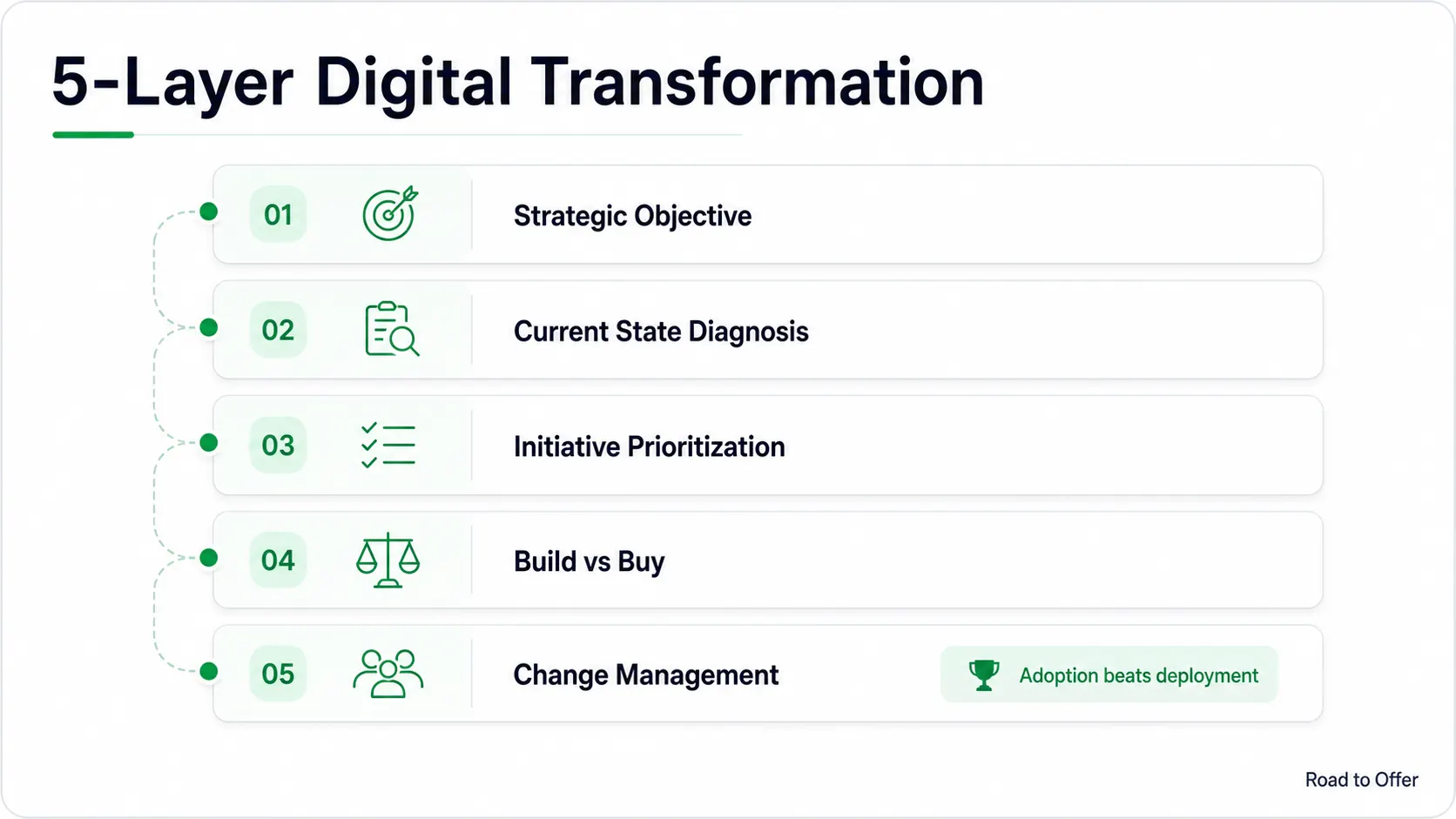
Walk through each layer briefly in your opening structure, then go deep on whichever layer the interviewer signals. In technology-heavy cases, expect more pressure on prioritization, build vs buy, and adoption risk than in a standard profitability case. If you are targeting tech-heavy practices, compare the top IT consulting firms and the broader technology case interview playbook.
Mini Rep: Choose Build, Buy, or Hybrid
Prompt: A regional logistics company needs a customer portal within nine months. Its current systems are fragmented, it has a small engineering team, and shipment visibility could become a differentiator. Choose build, buy, or hybrid.
Treat the details below as fictional practice assumptions, not industry benchmarks.
Model answer: Start with a hybrid recommendation. Buy commodity portal infrastructure and build the shipment-visibility experience that could differentiate the client. The recommendation is conditional on two facts: a vendor must support the required integrations within nine months, and the client must have enough engineering capacity to own the custom layer. The most important missing assumption is the integration effort across the current systems.
Choose build, buy, or hybrid
Compare time-to-market, total cost, capability, control, and migration risk on a fresh prompt.
When Should You Use PPT or ACT Instead?
The 5-layer framework is your default for a full transformation. But two named lenses are faster when the case is narrower, and naming them out loud signals fluency to the interviewer.
PPT (People, Process, Technology) is the right lens for an organization-wide rollout where adoption is the real risk. Any change needs all three to line up: do employees have the skills and buy-in (people), are workflows redesigned to fit the new system rather than bolted onto the old ones (process), and is the architecture scalable and integrated (technology)? A weak link in any one sinks the program. PPT maps cleanly onto Layers 2 and 5 of the full framework.
ACT (Ability, Cost, Time) is the right lens for a single go or no-go decision on adopting one specific technology. Does the technology have the ability to solve the problem, is the cost within budget, and can it be implemented in an acceptable time? ACT is a quick triage tool, not a full structure, so use it inside Layer 3 or Layer 4 rather than as your top-level answer.
Layer 1: What Is the Strategic Objective?
Before touching technology, clarify what the client is trying to achieve. The objective defines how you prioritize the initiative portfolio and which metric you optimize.
A cost-reduction transformation prioritizes automation with fast payback periods. Business model reinvention requires a longer investment horizon and a platform strategy lens. Get this wrong and you optimize for the wrong metric throughout the case. This is the same discipline you would apply in a cost reduction case interview.
How Do You Quantify Business Impact?
Strong candidates put a number on the prize early and show the assumptions behind it. Spread your quantification across four buckets so you do not anchor on revenue alone.
- Revenue and growth: conversion lift, retention, pricing power, faster time-to-market.
- Cost and efficiency: automation savings, error reduction, lower cost to serve, scalability.
- Customer experience: friction removed, personalization, Net Promoter Score, churn avoided.
- Strategic optionality: the value of a data platform or API layer that unlocks future moves, even if it has no standalone ROI today.
You will not have data for all four. Pick the one or two the interviewer cares about, state your assumptions, and do the arithmetic out loud. The worked example below shows exactly how. If your branches tend to sprawl, drill turning a transformation prompt into a tight tree with the case structure drill.
Layer 3: How Do You Prioritize Initiatives?
Once you have diagnosed capability gaps (Layer 2), rank initiatives using a 2x2: impact (revenue uplift or cost saving) on the Y-axis, feasibility (speed, complexity, organizational readiness) on the X-axis. In the case room, pick 3 to 5 representative initiatives and justify the sequencing.
- Quick wins (high impact, high feasibility): Year 1. Show business value early and build organizational confidence.
- Strategic bets (high impact, lower feasibility): Year 2-3. Invest in dependencies now, such as a data platform and talent.
- Efficiency gains (lower impact, high feasibility): automate but do not let them crowd out strategic bets.
- Deprioritize (low impact, low feasibility): say no clearly.
Layer 4: How Do You Decide Build vs Buy?
The most technically nuanced layer. For each capability gap, decide whether to build custom software, buy a commercial off-the-shelf solution (COTS), or partner with a technology provider.
The modern answer is usually hybrid: buy commodity capabilities on a platform, build differentiating features on top, integrate through APIs. A retail bank's mobile app illustrates this. The platform infrastructure (authentication, transactions) is commodity, but the experience layer (personalization, advisory features) is differentiating.
Plan a BCG operations case at a chipmaker. A US semiconductor maker must cut annual CO2 emissions by 3 megatons by 2040. Answer this BCG operations case step in the article. Browse more practice cases in the case interview library
Worked Example: Retail Bank Mobile App
Prompt: A European retail bank with EUR 15B in assets wants to replace its mobile banking app within 18 months. The CTO argues for building in-house. The CFO wants to buy a white-label solution from a fintech vendor.
Build vs buy analysis:
Recommendation: Hybrid. Buy the platform infrastructure (white-label core banking integration) and build the experience layer in-house over 18 months. Take the midpoints to make the savings concrete: a full custom build runs about EUR 10M in Year 1, while the hybrid runs the EUR 4M buy cost plus roughly EUR 2M to build only the experience layer, so about EUR 6M total. That is a Year 1 saving near EUR 4M, and time-to-market drops from roughly 27 months to about 16 months, a cut of around 40%. Critical caveat: the bank's IT organization is 80% legacy engineers. The build-the-experience-layer plan requires hiring 15 to 20 modern-stack engineers. Without the talent, the hybrid model collapses back to pure buy. This is the kind of capability constraint that recurs in any fintech case interview.
Worked Example: Back-Office Automation ROI
Prompt: An insurer processes 2 million claims a year. Each claim takes 30 minutes of manual handling at a fully loaded cost of EUR 40 per labor hour. A software-automation platform would handle 60% of claims end-to-end. It costs EUR 6M to implement plus EUR 1M a year to run. Is it worth it?
Work the arithmetic out loud:
- Current annual labor cost. 2,000,000 claims x 0.5 hours = 1,000,000 hours. At EUR 40 per hour, that is EUR 40M a year.
- Volume automated. 60% of 2,000,000 = 1,200,000 claims, which is 600,000 hours, or EUR 24M a year of labor currently spent on the work the platform would absorb.
- Net annual saving. EUR 24M of gross labor saving minus EUR 1M of run cost = EUR 23M a year.
- Payback. EUR 6M implementation divided by EUR 23M annual net saving is about 0.26 years, roughly 3 months.
The headline answer is yes, with a payback measured in months. But finish like a consultant, not a calculator. Adoption rarely hits 60% in Year 1, so phase the rollout and ramp the assumption. Some freed-up labor will not convert to real savings unless headcount or contractor spend actually comes down, so flag that the EUR 23M is a ceiling, not a guarantee. And the model assumes automated claims keep the same accuracy, so name claim-quality monitoring as a risk to watch. Comfort with this kind of estimation comes from repetition, which is the whole point of case interview math practice.
Layer 5: Why Does Change Management Decide the Outcome?
Failure analyses consistently point to cultural resistance and poor adoption, not technical failure alone. Three signals move the needle in case interviews.
1. Coalition building first. Identify the 3 to 5 internal champions who make or break adoption. They are often mid-level managers whose informal authority drives peer behavior.
2. Process change before technology change. New technology layered on old processes creates digital debt, not transformation. Map the to-be process first, then implement the system that supports it.
3. Measure adoption separately from deployment. Declaring success because 80% of users have credentials is not the same as 80% of users having changed their behavior. Track both. Kotter's 8-Step Model remains a defensible structure to reference when the interviewer asks how you would secure adoption.
What Are the Most Common Mistakes?
For a wider catalog of traps across all case types, see the most common case interview mistakes. To pressure-test whether your transformation structure stays decision-relevant under follow-ups, run a structure drill.
When Does the Business Model Itself Shift to a Platform?
Platform strategy is a subset of digital transformation cases, growing more common as McKinsey, BCG, and Accenture have built dedicated platform practices. Platform-based competitors can gain compounding advantages through network effects, where each new participant makes the platform more valuable to everyone else.
Not every company should become a platform. The key test: does the core business own assets that create network effects? A logistics company with route-density data might build a freight marketplace; a health insurer with provider relationships might build a health-services platform. Recommending "become a platform" without those assets reads as a buzzword, not analysis.
Platform case structure: (1) define the two sides and their value exchange, (2) assess network-effect strength (direct vs indirect), (3) determine launch strategy (which side to subsidize first), (4) model unit economics (acquisition cost per side, take rate, contribution margin), and (5) set governance rules to prevent disintermediation.
Related Guides
- Technology Case Interview: platform strategy and SaaS economics that underpin the business model shift in transformation cases
- BCG Platinion Case Interview: the firm-specific technology transformation interview you are most likely to face
- Fintech Case Interview: financial services digital transformation cases (core banking modernization, payments migration)
- Supply Chain Case Interview: supply chain digitization and Industry 4.0 cases frequently appear as transformation workstreams
- Retail Case Interview: omnichannel retail and e-commerce migration are among the most common transformation case types
- Case Interview Frameworks: Complete Guide: how the 5-layer framework fits the broader framework toolkit
Sources and Further Reading
- BCG, Flipping the Odds of Digital Transformation Success (the ~70% figure and adoption-first thesis): bcg.com/publications/2020/increasing-odds-of-success-in-digital-transformation (checked June 18, 2026)
- McKinsey, Rewired to outcompete (transformation dimensions and operating-model focus): mckinsey.com/capabilities/mckinsey-digital/our-insights/rewired-to-outcompete (checked June 18, 2026)
- Hacking the Case Interview, Digital Transformation Case Interview (PPT and ACT lenses, data pipeline framework): hackingthecaseinterview.com/pages/digital-transformation-case-interview (checked June 18, 2026)
- PrepLounge, BCG Platinion digital transformation case: preplounge.com/en/management-consulting-cases/interviewer-led/advanced/bcg-platinion-case-digital-transformation-of-an-entire-corporation-277 (checked June 18, 2026)
- Kotter, The 8-Step Process for Leading Change: kotterinc.com/methodology/8-steps (checked June 18, 2026)
Frequently asked questions
Resources and related guides
- Practice digital transformation in a real case interviewPractice
- Browse all free resourcesResource hub
- Technology Case Interview: Frameworks, Worked Examples, and How to Solve Tech Cases (2026)Frameworks · Mar 29, 2026
- TMT Case Interview: Technology, Media & Telecom Frameworks, Metrics, and Worked ExamplesFrameworks · Apr 8, 2026
- 3Cs Framework: Company, Customer, Competitor (Worked Example)Frameworks · Feb 6, 2026
- Private Equity Case Interview: LBO, Screening, and CDDFrameworks · Mar 15, 2026