
Technology Case Interview: Frameworks, Worked Examples, and How to Solve Tech Cases (2026)
How to solve technology case interviews: PPT and ACT frameworks, SaaS unit economics, platform strategy, two worked numeric examples, and the BCG Platinion format.
On this page
A technology case asks you to choose the right tech-business lens: PPT for transformation, ACT for build or buy, or SaaS and platform economics, then quantify the trade-off. These cases appear across technology consulting and strategy roles, including PA Consulting, but the exact format varies by firm, office, and role.
This guide gives you three reusable frameworks, SaaS metrics, two worked numeric examples, and a source-scoped overview of the BCG Platinion format.
What Are the 6 Types of Technology Case Interviews?
Before choosing a framework, identify which type of tech case you are facing. The six types have different analytical priorities, and confusing them is the most common mistake candidates make.
Each type maps to a primary framework, but a single case can span two or more. A digital transformation case often contains both a PPT diagnosis (type 2) and a make/buy/partner decision (type 3) nested inside it.
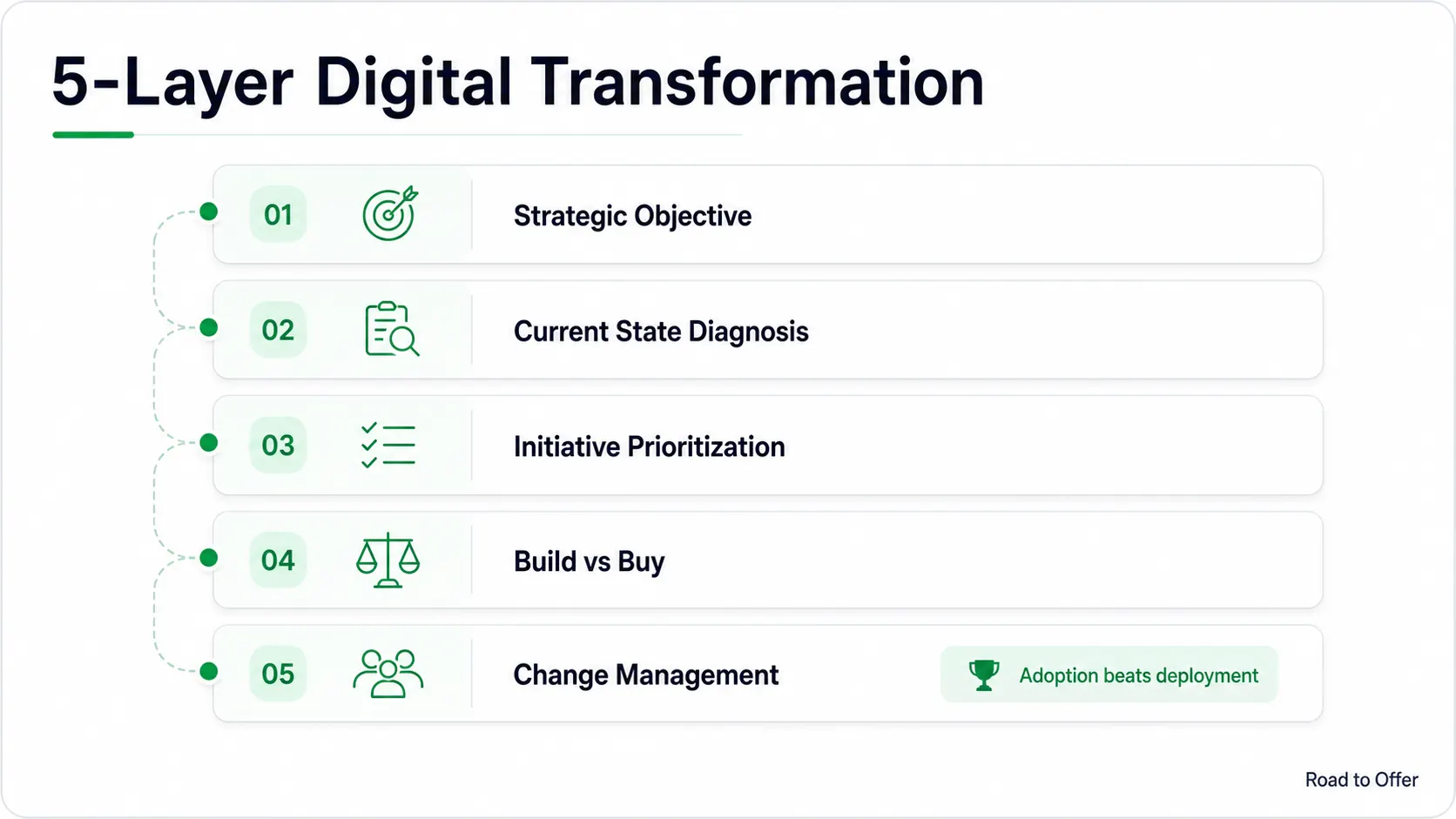
Transformation cases usually fail when candidates skip current-state diagnosis or change management.
How Do You Use the PPT Framework for Transformation Cases?
The PPT framework (People, Process, Technology) is the structure for cases asking how an organization should adopt or implement technology. It comes from organizational change management and is now standard in transformation work at McKinsey, Accenture, and Deloitte.
The key insight: technology implementation usually fails on People and Process, not on the Technology itself. BCG research has long found that a large majority of digital transformations fall short of their stated goals, and the failure point is rarely the software. It is adoption, incentives, data quality, and workflow. In the case room, that means you test whether the workflows, skills, incentives, and governance are ready before you recommend a tool rollout.
PPT Framework for Technology Transformation Cases
- 01
People. Skills gaps, change resistance, training needs, leadership alignment, organizational structure. Who are the internal champions? Who are the blockers?
- 02
Process. Current-state process mapping, process redesign before technology deployment, workflow integration. Technology on broken processes just creates faster broken processes.
- 03
Technology. System architecture, integration requirements, data quality, vendor selection, and a build-vs-buy decision for each capability.
How do you apply PPT in the case room?
Open your structure with all three layers, then go deep where the interviewer signals. In BCG Platinion cases, Technology often gets the most time. In Accenture and Deloitte cases, People (change management) is frequently the crux. A strong candidate links all three explicitly: "The technology swap is straightforward. The risk is that a large share of the workforce lacks the digital skills to use it, and the current approval workflow has too many manual steps for the new system to fit without a redesign."
Watch the prompt for signal words: "adoption," "transformation," "rollout," "implementation," or "change management." Those reliably mean PPT should lead.
You will also see enterprise-architecture frameworks named in the wild (ITIL for service management, TOGAF for architecture, CMMI for process maturity). Recognize them, but do not deploy them in a strategy case. Interviewers reward clear PPT reasoning over framework name-dropping. For a deeper transformation structure, see our digital transformation case interview guide, which covers the 5-layer transformation framework.
Build a People, Process, Technology structure and get it graded from the Road to Offer drill engine. Answer a real prompt and get AI-scored feedback. Free accounts include 5 drills per day for the first 3 days after signup.
How Do You Use the ACT Framework for Make/Buy/Partner Decisions?
The ACT framework (Ability, Cost, Time) structures make/buy/partner decisions. These appear when the client needs to acquire or develop a specific technology capability: building an internal platform, licensing an existing solution, or forming a partnership.
ACT Framework for Make/Buy/Partner Decisions
- 01
Ability. Does the client have, or can it build, the internal capability? Assess engineering talent, technical architecture, data assets, and strategic importance. Build differentiators; buy commodities.
- 02
Cost. Total cost of ownership over 5 years, not just Year 1. Build: upfront development plus ongoing maintenance plus opportunity cost. Buy/license: fees plus integration plus vendor dependency risk. Partner: revenue share plus loss of control.
- 03
Time. What is the competitive window? Build typically takes 24-36 months for enterprise software. Buy or partner can go live in 6-12 months. If the market moves faster than you can build, buy.
When does each option win?
The modern answer is usually hybrid: buy commodity infrastructure, build differentiating features on top, integrate via APIs. A traditional bank building a mobile app should license the core banking platform (commodity) and build the personalization layer in-house (its differentiator).
How Does Platform Economics Work in Marketplace Cases?
Platform cases ask whether a business should shift to a two-sided or multi-sided model connecting buyers and sellers, producers and consumers, or providers and users. These are among the most demanding tech cases because the standard profitability framework does not capture the dynamics that drive platform value.
1. Network effects. Direct network effects: users benefit from more same-side participants (a social network). Indirect network effects: users on one side benefit from growth on the other (a marketplace, where more sellers attract more buyers). Most marketplace cases turn on indirect effects. In the room, spend less time naming the effect and more time proving whether each side gets more valuable as the other grows.
2. Winner-take-all dynamics. Strong network effects plus high switching costs plus data advantages can produce winner-take-most or winner-take-all markets. The question is whether this market has the structural conditions for it. If participants can multi-home (use several platforms at once), winner-take-all dynamics weaken.
3. The cold start problem. Every new platform must attract buyers without sellers and sellers without buyers. The answer is subsidy: pick the side whose early presence most attracts the other, then subsidize it (reduce friction, offer incentives, sometimes make it free). Ride-hailing platforms subsidized drivers first. App stores subsidized developers first.
4. Monetization and take rate. Platform revenue equals Gross Merchandise Value (GMV) times take rate. Take rates vary widely by category and liquidity. The constraint: the take rate must be low enough that participants prefer the platform to bilateral deals, but high enough to cover CAC and infrastructure.
A reusable platform structure for the room:
- Define both sides and the value they exchange.
- Assess network-effect type (direct vs. indirect) and strength.
- Decide the cold-start strategy: which side to subsidize first.
- Model unit economics: CAC per side, take rate, LTV, contribution margin.
- Address governance: how to prevent disintermediation (participants cutting out the platform).
For platform launch sequencing, see our growth strategy cases guide, which covers network-effect growth and expansion scenarios.
Worked Example 1: EV Software Platform (ACT Analysis)
A traditional automotive company (call it AutoCo) wants to build its own EV software platform: the operating system, over-the-air update infrastructure, and data layer that runs the vehicle. The alternative is licensing existing technology from a Tier 1 software supplier.
The numbers. Build cost is $800M over 4 years, then $160M/year ongoing maintenance. License cost is $120M/year on a 5-year minimum ($600M total), plus $40M/year integration. AutoCo has 200 software engineers; a production EV platform needs roughly 1,200, so the talent gap is about 1,000 engineers. Competitors are launching EV platforms in 18 months.
ACT analysis:
Verdict: license in the near term. Base five-year TCO is $1.44B for build versus $800M for license. A $1.6B build estimate requires separately stated integration or overrun assumptions. The talent gap alone makes build high-risk, and the 4-year timeline means AutoCo misses the window while competitors lock in customers with software.
The nuance that scores points. This is not "license forever." Recommend licensing now while building internal capability in 2-3 targeted areas (data analytics, personalization) where AutoCo has a genuine edge from its existing driver-behavior dataset. Negotiate an exit clause at Year 5 to preserve optionality. That combination of a clear numeric answer plus a strategic hedge is what separates a strong candidate from one who just picks the cheaper column.
Run a BCG growth strategy case on a cloud build. The largest US cloud provider must decide whether a $3B data center pays back inside five years. Answer this BCG growth strategy case step in the article, then continue the full case. Continue the full case on Road to Offer
Worked Example 2: IT Cost Rationalization (Transformation Case)
This is the quantitative lever that shows up inside BCG Platinion-style transformation cases, and it is the part competitors rarely walk through with numbers. An insurer's CIO is under pressure to cut IT spend. The "change the business" (CtB) budget, the discretionary project portfolio, is €80M/year and is running noticeably above the peer benchmark. The interviewer asks how much you can responsibly cut.
The arithmetic. Of the €80M portfolio, 40% is regulatory work (compliance, mandated reporting) that cannot be touched. That leaves 60% discretionary:
- Discretionary spend = 60% × €80M = €48M
You do not cut all €48M. You triage it. A reasonable framing: rank discretionary projects by business value and delivery risk, then act on the bottom tiers.
- Assume the bottom third of discretionary spend is low-value or stalled: 1/3 × €48M = €16M of immediate candidates to kill or pause.
- Assume another third can be renegotiated or rescoped at
30% savings: 1/3 × €48M × 30% = €16M × 0.30 = **€4.8M of efficiency savings.** - The top third (highest-value innovation work) is protected to avoid starving the transformation.
The €20.8M reduction is approximately 43% of discretionary spend, or 26% of the total €80M portfolio. State the assumptions out loud so the interviewer can adjust them. The point is not the exact number; it is showing you can isolate the addressable spend (€48M), apply a defensible triage, and protect what matters. A candidate who answers "cut the whole €48M" has missed that regulatory and high-value innovation spend should be off the table.
Which SaaS Metrics Must You Know?
When the client is a SaaS or subscription business, the profitability framework has to be adapted. Revenue growth, gross margin, and net income still matter, but the metrics that actually reveal SaaS health are unit economics and retention.
The single most important metric for SaaS cases is NRR. An NRR above 100% means revenue from existing customers is growing even before new sales land. The business can grow by retaining and expanding current accounts, which is why investors tolerate near-term acquisition spend when retention quality is strong. An NRR below 100% means a leak that new-customer growth can only mask, not fix.
In the room: on a SaaS profitability case, immediately ask for (or assume) NRR, LTV/CAC, and churn. Declining NRR is a retention problem, and cost-cutting will not fix it. Strong NRR with high CAC is a payback problem: the company is growing but burning cash to do it. For the underlying mechanics, see our unit economics framework and the foundation in our profitability framework guide.
What Is the BCG Platinion Interview Format?
BCG Platinion is BCG's technology and digital consulting arm, focused on IT architecture, enterprise solutions, cybersecurity, and digital transformation. Its interview is the most common reason candidates search for "technology case interview," so the format details matter.
- Rounds: BCG Platinion's official application page describes a minimum two-round process. Round 1 includes two interviews and may include a logic test. Round 2 includes a BCG business case and a Platinion IT case. Use the invitation for exact timing and any additional components.
- Fit: prepare for fit and behavioral questions, but use the invitation rather than assuming a fixed segment length or sequence.
- Case content: always set in a technology context. Common asks include evaluating a client's IT architecture, recommending an ERP or cloud migration strategy, or assessing legacy-system modernization. You may still get a market-sizing or profitability segment, but it will be tied to a tech context.
- No coding: you will not be asked to code or go deep into implementation. What is assessed is whether you connect technology decisions to business outcomes. A technically perfect answer that ignores business impact will not get you an offer.
This is firm-specific. McKinsey Digital and Bain's technology practice fold tech cases into their standard interview formats rather than running a separate technical track, so the tech content shows up as the case scenario rather than as a distinct round. Digital and operations boutiques such as West Monroe run the same tech-context cases without a separate technical round; the West Monroe Partners case interview breaks down that format. If you are switching careers into consulting from a technical background, our case interview prep for career changers covers how to translate domain expertise into case-room structure without over-indexing on jargon.
What Are the Most Common Mistakes in Tech Cases?
How Should You Run a Tech Case in the Room?
A simple sequence that works across all six types:
- Identify the type (profitability, transformation, make/buy, platform, AI/data, security) before you structure. The type chooses the framework.
- Lead with the right framework but keep it MECE and tailored: PPT, ACT, platform economics, or an adapted profitability tree. Do not force a memorized template.
- Get the numbers early. For SaaS, ask for NRR, LTV/CAC, and churn. For make/buy, ask for 5-year TCO and the competitive window. For transformation, ask what is regulatory vs discretionary spend.
- Connect tech to business impact. Especially at BCG Platinion: every architecture or tooling point must ladder up to cost, revenue, speed, or risk.
- Synthesize with a hedge where warranted. "License now, build a narrow differentiator, exit clause at Year 5" beats a flat one-word answer.
Related Frameworks and Cases
Technology cases intersect with many other case types. Use these for the adjacent frameworks you will need:
- Case Interview Frameworks Complete Guide: the master reference for when to use which framework across all case types.
- Digital Transformation Case Interview: the 5-layer transformation framework and build-vs-buy analysis in depth.
- Market Entry Framework: platform launches often need a market-entry structure for the initial side-acquisition strategy.
- Profitability Framework: the foundation framework, adapted for SaaS and subscription businesses.
- Unit Economics Framework: for SaaS, marketplace, and AI cases where acquisition cost and retention drive the answer.
- Growth Strategy Cases: platform expansion and network-effect growth.
- Market Sizing Framework: TAM/SAM sizing for AI and SaaS market-entry cases.
- Data Science Case Interview: AI and analytics cases at BCG X and McKinsey QuantumBlack.
- Fintech Case Interview: unit economics and platform strategy for payments, neobanks, and B2B SaaS.
- TMT Case Interview: tech, media, and telecom with subscriber metrics and streaming M&A.
- Pricing Strategy Cases: SaaS pricing models, freemium conversion, and value-based pricing.
Tech Case Drills
Interactive drill set. Write an answer before revealing the worked solution, then continue into Road to Offer for scored practice and AI feedback.
Static technology drill guide
Use the widget above to practice, or work these prompts on paper first:
For a scored continuation, use the technology structure route in the article masthead or run the named Cloud Capacity case from the sidebar.
Sources
- Hacking the Case Interview, Technology Consulting Case Interview Guide (2026): hackingthecaseinterview.com/pages/technology-consulting-case-interview. Checked June 18, 2026.
- CaseBasix, Technology Consulting Case Interview Guide: casebasix.com/pages/technology-consulting-case-interview-guide. Checked June 18, 2026.
- Hacking the Case Interview, BCG Platinion Case Interview: Complete Prep Guide (2026): hackingthecaseinterview.com/pages/bcg-platinion-case-interview. Checked June 18, 2026.
- PrepLounge, BCG Platinion Case: Digital Transformation of an Entire Corporation: preplounge.com/en/management-consulting-cases/interviewer-led/advanced/bcg-platinion-case-digital-transformation-of-an-entire-corporation-277. Checked June 18, 2026.
- Wall Street Prep, LTV/CAC Ratio, SaaS Formula and Calculator: wallstreetprep.com/knowledge/ltv-cac-ratio. Checked June 18, 2026.
- Bain & Company, Will Agentic AI Disrupt SaaS? Technology Report 2025: bain.com/insights/will-agentic-ai-disrupt-saas-technology-report-2025. Checked June 18, 2026.
Frequently asked questions
Resources and related guides
- Try a free live technology case interviewPractice
- Browse all free resourcesResource hub
- Airline Case Interview: Profitability Framework, Revenue Drivers, and Worked Examples (2026)Frameworks · Mar 29, 2026
- Ansoff Matrix Case Interview: The 2x2 Growth Framework Explained with ExamplesFrameworks · Mar 25, 2026
- BCG Matrix Explained: Stars, Cash Cows, Question Marks, Dogs (2026)Frameworks · Mar 25, 2026
- TMT Case Interview: Technology, Media & Telecom Frameworks, Metrics, and Worked ExamplesFrameworks · Apr 8, 2026
- Digital Transformation Case Interview: Frameworks, Build vs Buy, and Worked ExamplesFrameworks · Mar 15, 2026