
Calm Case Math: A Repeatable Process for Interview Day
Case interview math tips that win offers: a four-step process, the round-first rule, unit discipline, reference numbers to memorize, and the mistakes that sink candidates.
On this page
Most case interview math tips you find online are lists of multiplication tricks. Tricks help, but they are not what separates an offer from a ding. Interviewers at McKinsey, BCG, and Bain are not grading whether you can square a number in your head. They are grading whether you can keep a calm, auditable process under time pressure and turn a number into a business decision. This guide gives you that process: a four-step loop, the tactical rules that buy you speed, the units discipline that prevents most errors, and the reference numbers that let you sanity-check an answer in seconds.
If you want to combine these tips with timed reps, the case interview math practice page pairs drills with full worked solutions so you can apply the process below right away.
What are interviewers actually testing with case math?
Interviewers test three things at once, and only one of them is arithmetic.
First, structured thinking: can you set up the calculation before you jump into numbers? A candidate who writes the equation first signals they think in models, not in guesses.
Second, speed and accuracy: can you reach a reasonable answer without burning four minutes on one multiplication? Both halves matter. A fast wrong number is as damaging as a slow right one.
Third, business insight: can you say what the number means for the client? If you compute a $1M profit gain against a $5M target, the insight is "this lever is too small to matter," not just "$1M." RocketBlocks frames the entire purpose of case math as confirming or disproving a hypothesis and ruling out low-impact areas, which is exactly why interpretation outranks the raw figure.
The practical takeaway: a clean setup plus a clear interpretation beats a fast final number every time. Optimize your process for the two skills most candidates ignore.
What is the four-step process for every calculation?
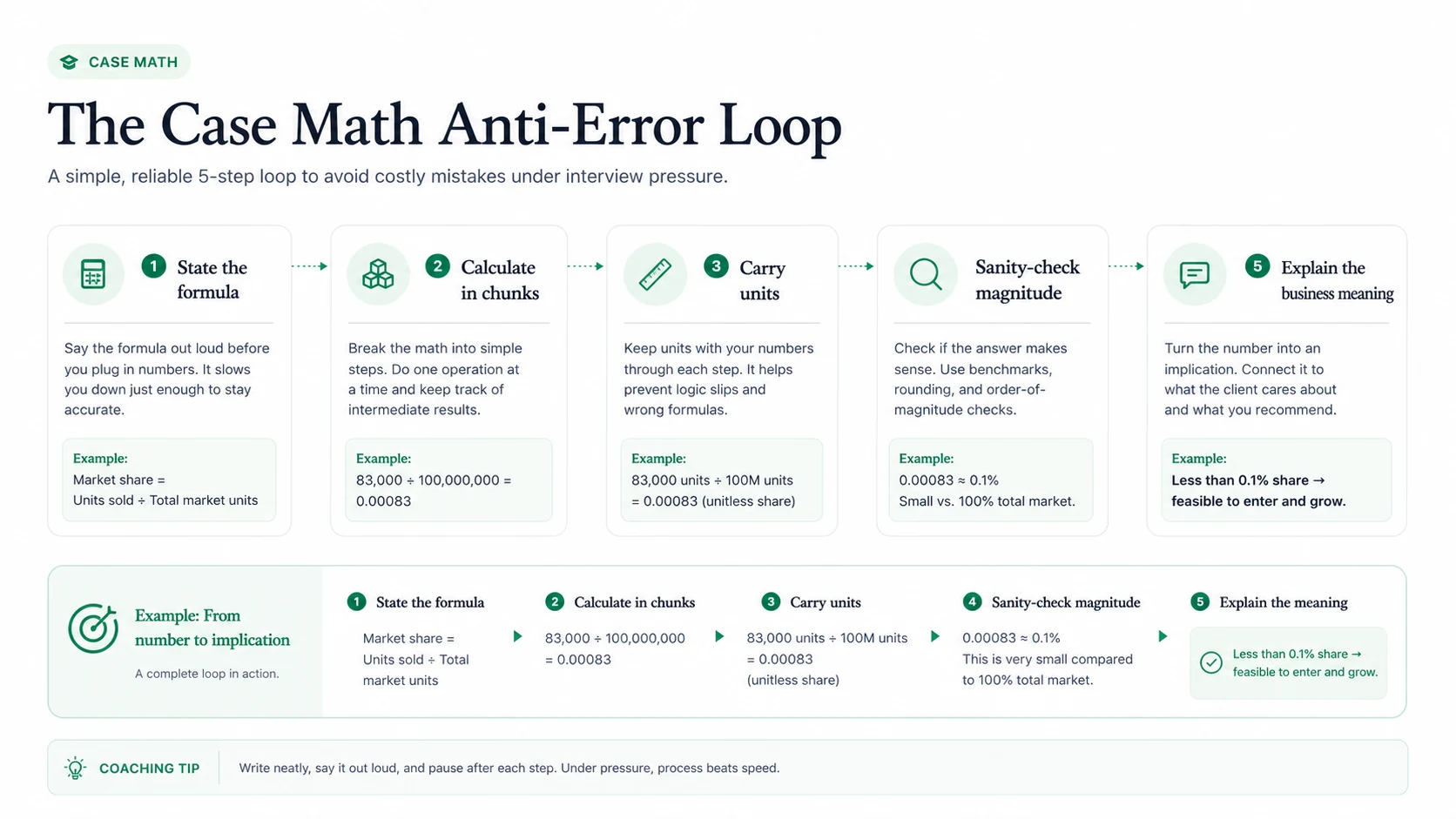
The most reliable case math tip is also the least glamorous: run every single calculation through the same four steps. The industry-standard phrasing, used in slightly different words by CaseCoach, RocketBlocks, and MyConsultingOffer, is Verbalize, Calculate, Sense-check, Interpret.
- Verbalize the setup. State what you are solving for and the formula. "I am solving for incremental annual revenue, which is price times the change in units." This tells the interviewer your logic before any number appears, so if your approach is wrong they can redirect you before you waste time computing.
- Calculate cleanly. Do the arithmetic without narrating every step. Pause once before the key multiplication, not in the middle of a chain.
- Sense-check the answer. Before you speak the result, ask whether it is the right order of magnitude. A national retailer with $29B revenue is plausible; one with $29 trillion is not. This is where reference numbers earn their keep.
- Interpret for the business. End with what the number means: "That is a 2.8% revenue lift, which is below the 10% growth target, so pricing alone will not close the gap."
This loop is short enough to run on autopilot once it is a habit, and it prevents the three failure modes interviewers penalize: wrong setup, sloppy arithmetic, and a naked number with no meaning. The fastest way to make it automatic is reps: run a few AI-graded quick-math reps so the loop fires without you thinking about it.
Why should you ask to round at the start?
This single tactic saves more time than any multiplication trick. At the beginning of the quantitative portion, ask: "Is it alright if I round as I go?" Almost every interviewer says yes, because they care about your reasoning, not decimal precision.
Rounding compresses the arithmetic dramatically:
- 17% becomes 20%, so you multiply by a fifth instead of doing awkward percentage math.
- $312M becomes $300M, so the zeros stay clean.
- 4.7 years becomes 5 years for a doubling estimate.
The rule is round for direction, tighten only if the decision is close. State your rounding out loud in one line ("I will call it $300M so the trend stays clear") so your logic remains auditable. If a follow-up needs exactness, you can refine from the rounded anchor in seconds. Rounding aggressively up front is the fastest legitimate way to halve your calculation time without losing credibility.
How much math do you actually need?
Far less than candidates fear. Across the major prep guides the consensus is that roughly 90% of case math is five skills: multiplication, division, percentages, fractions, and basic algebra. There is no calculus, no statistics, no trigonometry.
That math falls into four recurring problem types, and naming them helps you recognize the setup instantly:
Because the surface area is so small, the winning strategy is depth over breadth: drill these five skills and four problem types until they are automatic, rather than hunting for exotic shortcuts. For the full formula set with worked examples, the consulting math formulas reference is the canonical list, the case interview formulas guide is the shorter interview-day cheat sheet, and the case interview math mental shortcuts guide covers the speed techniques (anchor-and-adjust, fraction swaps, Rule of 72) in depth so you do not have to memorize them here.
How do you set up the math so the arithmetic gets easy?
A clean setup makes the calculation faster, not slower. Three pieces do the work.
First, define the unknown. What exactly are you solving for: revenue change, unit count, margin impact, or breakeven volume? Naming it stops you from computing the wrong thing precisely.
Second, list the known inputs with their units. Are they annual, monthly, or per unit? The same number means very different things when the time frame changes.
Third, write the equation before moving any number. "Revenue equals price times units" or "output equals base plus the change from share and price." If your equation carries an assumption, say it now: "I am assuming linear growth for this single period." This protects you when a follow-up presses for exactness.
The setup stage is your guardrail, not a delay. In a timed case, a deliberate setup usually speeds up the arithmetic because your brain stops reinventing structure under pressure. Most weak performances trace back to a missing formula at the front, with numbers forced in afterward.
How do you avoid unit and time-frame mistakes?
Unit errors are the most common avoidable mistake in case math, and they are also the easiest to prevent. Force every line to carry a unit tag.
Start each line with a marker: annual, monthly, per customer, per unit, or percent. If your input is annual but your target is monthly, convert once and keep it explicit. Do not convert twice. Track time framing aggressively, because a question that looks easy in annual terms gets hard when the interviewer is thinking by quarter.
Keep one tidy map of value, unit, and assumption:
- Revenue: $700M, annual
- Cost: $80M, annual
- Customers: 2,500, current
- Price: $12,000 per customer, annual
This forces your brain to align numbers with units, so if a result changes you can trace exactly where a mismatch crept in. And never strip units from your final summary. "About $20,000 of monthly lift per store" is auditable; "about 20,000" is a trap. A single dropped time-frame conversion is what turns a correct method into an answer that is off by a factor of 12.
Which reference numbers should you memorize?
Sense-checking is impossible without anchors. Memorize a small set of benchmark figures so you can instantly judge whether a market-sizing answer is the right order of magnitude. These are the numbers competitors like MyConsultingOffer flag as essential, refreshed to current estimates:
With these, a sanity check takes seconds. If you size a US consumer market at "400 million users," you immediately know it is impossible because it exceeds the population. If a per-household estimate implies 500 million households, the error is obvious. Use round, defensible figures and state them out loud so the interviewer can follow your filtering. For the full estimation workflow, the market sizing step by step guide walks through population-to-revenue filtering in detail, and guesstimate interview questions show the same logic in standalone prompts.
What should you say while calculating?
Interviewers cannot read your mind, so your narration is the only window into your judgment. A clean verbal rhythm maps directly onto the four-step loop:
- "I am solving for..."
- "My formula is..."
- "I am rounding because..."
- "The result is..."
- "That means..."
Avoid narrating every multiplication; that reads as nervous, not thorough. Use short, structured pauses before the key arithmetic step, never in the middle of a chain, because a controlled pause signals deliberate setup rather than uncertainty.
When the interviewer corrects you, do not defend every step. Thank them, restate the fixed formula, and re-run only the changed input. This keeps you in sync with the case flow and demonstrates coachability, which is itself a graded trait. For more on the surrounding flow and how math fits the whole case, see the case interview prep guide and watch the patterns in real case interview examples.
The math reps pay off inside a full case
Setup, rounding, and interpretation only count when you do them live, under questioning. Run one full AI-graded case and put the loop to work.
What are the most common case math mistakes?
Compiling the mistake lists from RocketBlocks, CaseBasix, and the major guides, the same errors recur. Recognize them and you avoid most of the damage.
- Rushing without clarifying. Confirm the question and ask to round before you compute. A misread question is the most expensive error.
- Skipping structure. Jumping to arithmetic without a written equation is how candidates lose track mid-chain.
- Unit and time-frame slips. The factor-of-12 or factor-of-1,000 error. Tag every line.
- Over-precision. Carrying three decimals when the decision turns on order of magnitude wastes time and signals poor judgment.
- Adding percentages that should multiply. When price and volume both change, the revenue factor is (1 + price change) x (1 + volume change), not the sum. Adding 6% and -3% overstates the result.
- Silent calculation. A correct number with no verbalized logic gives the interviewer nothing to grade.
Notice that only one of these (over-precision aside) is about arithmetic skill. The rest are process failures, which is exactly why a repeatable loop beats raw speed.
How should you practice case math?
Fast, clean math comes from repeated short cycles, not one long grind. Build the habit in three layers:
- Setup drills (3 minutes): define the unknown and tag units, with no arithmetic. This trains the part most candidates skip.
- Speed drills (5 minutes): timed mental math on percentages, growth, and rounding choices.
- Embedded drills: full case segments where calculation lives inside the story, so you practice interpretation, not just computation.
A practical week:
- Monday: five setup drills, no arithmetic.
- Tuesday: units and time-frame conversion.
- Wednesday: percent-change speed drills with rounding.
- Thursday: full case segments with verbalized explanation lines.
- Friday: one timed section plus a written review.
After every session, run three checks: Did I define the unknown first? Did I tag all units? Can I explain what the number means for the business? If you miss the same check two days running, repeat that block until it sticks. On Road to Offer, AI-graded math drills score exactly these dimensions (setup, accuracy, and interpretation). Anchoring on 10% before computing percentages is consistently faster than dividing directly, because it keeps the arithmetic in whole numbers until the final step. For a structured tool comparison, see the best free AI for case math practice guide.
Quick-math drill: apply the tips now
Run the live, AI-graded rep first, then drill the five technique prompts below. The process pays off once it is automatic.
Quick math from the Road to Offer drill engine. Answer a real prompt and get AI-scored feedback. Free accounts include 5 drills per day for the first 3 days after signup.
Interactive drill set. Write an answer before revealing the worked solution, then continue into Road to Offer for scored practice and AI feedback.
Related guides for a wider routine
Sources and Further Reading (checked June 17, 2026)
Frequently asked questions
Resources and related guides
- Try a timed quick math repPractice
- Browse all free resourcesResource hub
- Case Interview Math Practice: 12 Graded Mental Math DrillsMath And Quant · Feb 6, 2026
- Guesstimate Questions: 10 Examples + Answers (2026)Math And Quant · Mar 20, 2026
- Best Market Sizing Practice Resources (Worked Examples + Drill Plan)Math And Quant · Jun 3, 2026