
Aptitude Tests for Consulting: Firm Tests, Formats, and Prep (2026)
The 2026 consulting aptitude test guide: McKinsey Solve, BCG Online Case, Bain SOVA, and SHL/Cappfinity screens, with real formats, timing, scoring, and worked examples.
On this page
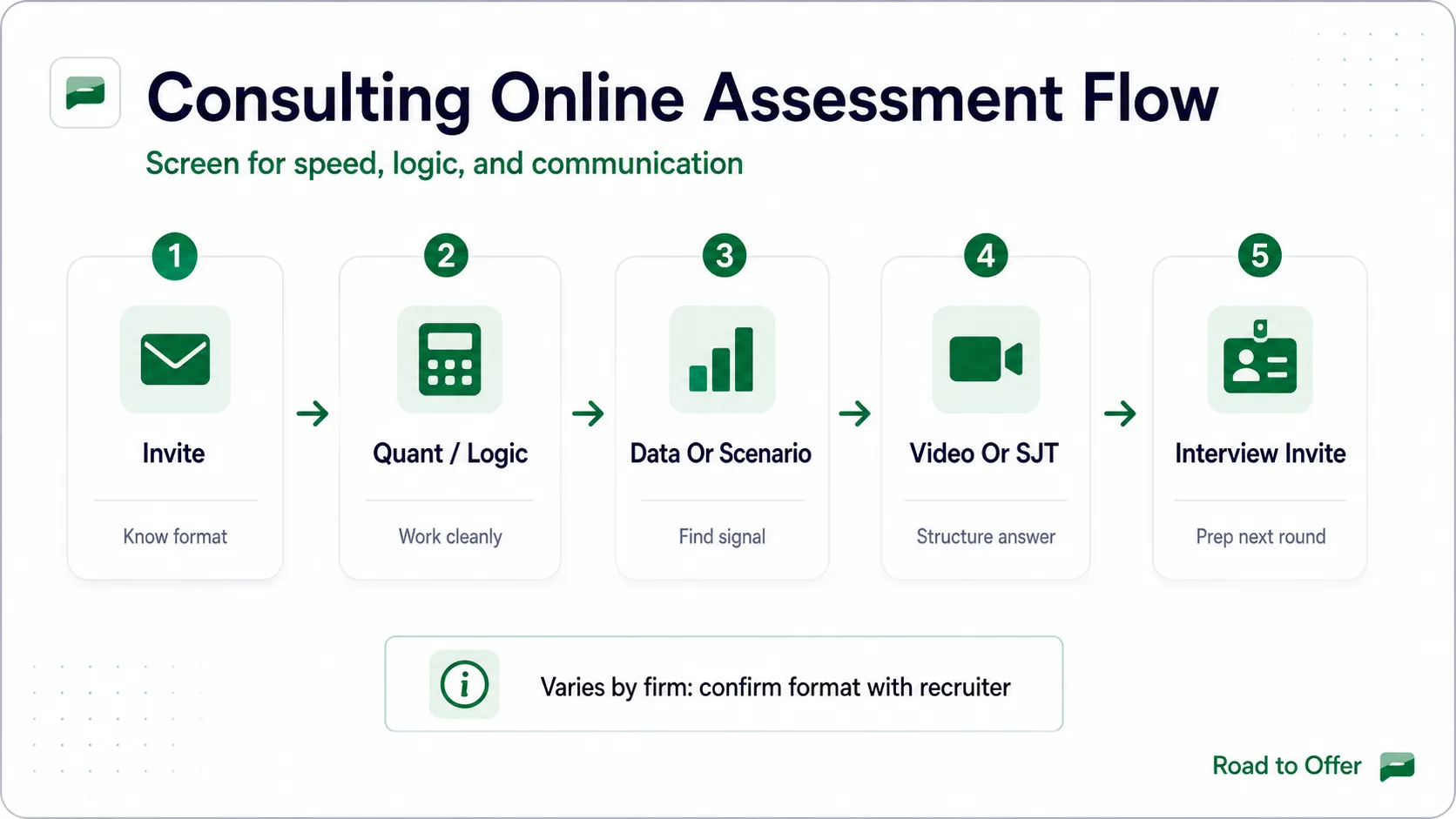
Consulting aptitude tests are timed online screens that most firms use before live case interviews. They are not all the same. Some look like traditional numerical reasoning tests. Others are business simulations, chatbot cases, situational judgment screens, or game-based assessments. At this stage, firms typically advance only the top 20 to 30 percent of test takers, so the screen is a real filter, not a formality.
The safest way to prepare is to separate the durable skills from the specific test wrapper. Durable skills are math accuracy, chart interpretation, prioritization, business judgment, and synthesis. The wrapper is the exact platform named in your invitation, and that can vary by firm, office, role, school, and recruiting cycle.
Live free simulator from Road to Offer for the McKinsey Solve Red Rock study. Practise this style of assessment in the browser, no account needed to start.
What Does Aptitude Test Mean?
"Aptitude test" means a timed assessment of how well you reason with new information rather than what you already know. The classic formats measure numerical reasoning (working with tables, charts, and percentages), verbal reasoning (judging what a passage does and does not support), and logical or inductive reasoning (finding the pattern in a sequence). Scores on these cognitive batteries are typically compared against other candidates rather than against a fixed pass mark, which is why speed and accuracy both matter.
In consulting recruiting the word gets stretched further: firms also run situational judgement screens, behavioral game batteries, and process-scored simulations, which measure different things and are not always scored the same way. The wrapper changes by firm; the sections below map each firm's version to the skills it actually tests.
What Do Consulting Firms Actually Test?
Use this as a planning map, not as a replacement for your official invite. The format and timing below reflect commonly reported public structures, which firms revise across cycles.
The pattern is simple. MBB assessments add proprietary problem-solving wrappers, while many tier-2 and Big 4 processes use traditional reasoning tests or job simulations from a handful of vendors. The transferable skills overlap enough that your first prep week looks similar across firms. For the broader interview arc this screen feeds into, the case interview prep guide is the canonical starting point.
Drill the skills behind aptitude tests
Road to Offer math and chart drills let you practice the reasoning patterns that show up across consulting online assessments, with feedback on where you slow down or slip.
How Are Consulting Aptitude Tests Scored?
This is the part most candidates miss, and it changes how you should prep.
Most vendor reasoning tests (the SHL test is the dominant one) use norm-referenced scoring. Your raw number correct is converted into a percentile that compares you to a norm group of past test takers. A common public benchmark is that a "safe" result sits in roughly the top 20 percent, though the real cutoff depends on the norm group and how many seats the firm has open that cycle. Two consequences follow:
- Speed counts as much as accuracy. With about 1.4 minutes per SHL Verify question, leaving five questions blank can drop you below the line even if everything you answered was correct.
- You are competing against the pool, not a fixed bar. A strong consulting applicant pool raises the effective cutoff, so "I got most of them right" is not the same as "I passed."
Firm simulations score differently. McKinsey Solve weights your process and decisions, not only your final answers, which is why frantic clicking and constant answer changes hurt you. BCG-style online case screens sometimes apply negative marking, where a wrong answer deducts points, so a blind guess can cost you more than a blank. Read your invite to learn whether guessing is penalized before you decide how aggressively to answer under time pressure.
What Should You Verify In Your Invite?
Before any firm-specific prep, read the invite closely and write down:
- The assessment platform or test name.
- The deadline and whether the timer starts immediately.
- Whether the test is one sitting or multiple modules.
- Whether there is a video, written response, or recommendation component.
- Whether a calculator, scratch paper, or external tools are allowed. This varies: SHL numerical tests generally allow a calculator, while the BCG online case screen generally does not.
- Whether wrong answers are penalized (negative marking).
- Whether there are official sample questions or practice links.
If any detail is missing, ask the recruiter one concise question, for example: "Could you confirm whether this assessment is numerical reasoning only, or whether it also includes a written or video recommendation component, and whether a calculator is permitted?"
What Is McKinsey Solve and How Should You Prepare?
McKinsey's Solve assessment is the best-known consulting online test. It is a game-based simulation, built on the platform formerly branded Imbellus, that replaced the older paper Problem Solving Test. Expect to spend roughly 60 to 75 minutes across mini-games such as ecosystem-building and disease-management scenarios. You read information, identify constraints, interpret data, and make decisions under ambiguity, and the platform scores how you work, not just your final answers.
Do not prepare for it like a speed math quiz. The useful prep habits are:
- Read constraints before acting.
- Track facts in a small table.
- Separate what is known from what is assumed.
- Prioritize the driver that changes the decision.
- Avoid random clicking or frantic answer changes, since process is scored.
For deeper prep, use the McKinsey Solve guide, Redrock study guide, and Sea Wolf guide. McKinsey also runs early-career programs with their own screening steps, including McKinsey Forward, Keep in Touch, and Inspire, plus early exposure events such as Ignite, which the McKinsey internship guide mentions.
What Does the BCG Online Case Test Look Like?
BCG's pre-interview screen has historically run as an online case, often around 23 questions in about 45 minutes, built around a single business case with supporting documents. Reported question mixes are roughly 40 percent math word problems, 35 percent data interpretation and logic, and 25 percent reading comprehension, and a calculator is usually not allowed. The case-adjacent skill that matters most is prioritization: when a prompt gives you many plausible factors, identify the few that actually move the recommendation.
The mistake to avoid is exhaustive analysis. Online case screens reward a concise answer tied to the decision, not a laundry list of every possible factor. Practice:
- Choosing the top three factors and explaining why.
- Reading a short exhibit and stating one conclusion.
- Giving a recommendation in 60 seconds.
- Structuring video answers: answer first, reasons second, risk third.
Read the BCG Online Case (Casey) guide and the BCG Consulting Career Assessment guide. BCG also uses a behavioral game via BCG Pymetrics and a one-way video interview in some processes. Specialized roles route through BCG Platinion or BCG Gamma. Early-career paths include the BCG Digital Strategy and AI Challenge, BCG Unlock, and Bridge to BCG.
What Is on Bain SOVA and Other Psychometric Screens?
Bain and similar firms may use the SOVA assessment, which combines numerical reasoning, verbal reasoning, logical reasoning, situational judgment, and personality-style questions. The exact provider and timing vary, so build a stable base rather than memorize one rumored format. A high-value weekly rotation looks like this:
- 20 minutes of chart and table questions.
- 10 minutes of verbal reasoning (true / false / cannot say).
- 10 minutes of mental math.
- 10 minutes reviewing mistakes and labeling the failure mode.
Failure modes usually fall into three buckets: misread question, arithmetic error, or poor prioritization. Labeling the mistake matters because the fix is different. For Bain-specific prep, use the Bain SOVA test guide and the Bain TestGorilla guide, or feel the SOVA format directly:
Live free simulator from Road to Offer for the Bain SOVA numerical and logical assessment. Practise this style of assessment in the browser, no account needed to start.
How Do SHL, Kenexa, and Cappfinity Tests Work?
Many tier-2 and Big 4 assessments use common psychometric styles from a few vendors. You do not need to know the vendor perfectly to prepare the core skills.
If you have no exact test name yet, start here, because this layer gives the broadest coverage across firms. For the underlying reasoning skills these tests share, the deductive reasoning test guide and inductive vs deductive reasoning guide are useful companions. The Watson Glaser test guide covers the critical thinking appraisal some firms layer on top. Big 4 candidates should also read the PwC assessment test guide and the Expedition EY guide.
Worked Example 1: A Chart-Based Revenue Question
Prompt: A retailer's online revenue grew from $120M to $156M, while store revenue fell from $300M to $270M. What happened to total revenue?
Step 1: Online change. $156M - $120M = $36M increase.
Step 2: Store change. $270M - $300M = $30M decrease.
Step 3: Net the movement. $36M increase minus $30M decrease = $6M net increase.
Step 4: Sanity check. Starting total was $420M; ending total is $426M. That is a $6M increase, about 1.4 percent.
Business implication: Online growth offset store decline, but barely. The retailer should not read digital growth as a full recovery unless online margins are also strong. That final implication is what turns an aptitude-test calculation into case-interview practice.
Worked Example 2: An SHL-Style Profit and Markup Question
This is the kind of multi-step data question SHL numerical tests favor, where the trap is doing the arithmetic in the wrong order under time pressure.
Prompt: A dealer buys 14 vehicles at $25,250 each, plus $45,000 in preparation costs. Inventory is sold at a 22 percent markup on the vehicle purchase cost only. What is the dealer's profit?
Step 1: Vehicle purchase cost. 14 × $25,250 = $353,500.
Step 2: Total cost. $353,500 + $45,000 = $398,500.
Step 3: Revenue from the 22 percent markup. $353,500 × 1.22 = $431,270.
Step 4: Profit. $431,270 - $398,500 = $32,770.
Common mistake: applying the 22 percent markup to total cost ($398,500) instead of vehicle cost. That would give $486,170 in revenue and overstate profit by about $54,900. Read which base the percentage applies to before you multiply. This single habit, identifying the correct base, prevents most avoidable errors on percentage and markup questions.
Practise consulting aptitude test math from the Road to Offer drill engine. Answer a real prompt and get AI-scored feedback. Free accounts include 5 drills per day for the first 3 days after signup.
What Is a Realistic 3-Week Prep Plan?
Week 1: Transferable base. Six short sessions covering chart reading, percentages, ratios, verbal reasoning, and business interpretation. End every math drill with a one-sentence business implication, and time yourself at roughly 1.4 minutes per numerical question so the SHL pace feels normal. Strengthen raw speed with mental math for case interviews.
Week 2: Firm-specific wrapper. Once you know the assessment, switch to the closest format: Solve-style systems thinking, BCG-style prioritization, SOVA-style mixed reasoning, or SHL-style timed sets. Do not keep drilling generic math if your weakness is recommendation synthesis. Confirm whether your test uses negative marking so you know how to handle guesses.
Week 3: Full simulation and review. Run timed mocks in the same browser and environment you will use on test day. After each mock, categorize wrong answers into misread, miscalculation, prioritization, or pacing. Fix the largest category first.
If you are switching into consulting from another field and starting the quantitative base from scratch, the case interview prep for career changers guide sequences the same skills with less assumed background.
Aptitude test readiness checklist
I know the exact assessment named in my invite. The recruiter invite is the source of truth for format, deadline, and allowed tools
I know whether a calculator is allowed and whether wrong answers are penalized. SHL usually allows a calculator; BCG online case usually does not and may use negative marking
I have practiced chart and table math with units attached. Most consulting assessments penalize avoidable unit and percentage errors
I can explain a calculation's business meaning. Aptitude prep should reinforce case-readiness, not just arithmetic speed
I have completed one timed mock at the real pace in a quiet environment. Pacing and browser setup need to be tested before the real attempt
I have a backup plan for internet, charger, and browser issues. Technical failures are preventable if the recovery plan is ready
Sources and Further Reading (checked June 18, 2026)
- McKinsey Careers - Interviewing
- BCG Careers - Interview Process
- Bain Careers - Interview Prep
- SHL Direct - Numerical Reasoning Example Questions
- MConsultingPrep - How to Pass SHL Numerical Tests
- MyConsultingCoach - BCG Potential Test
- PrepLounge - Aptitude Tests in the Consulting Industry
Related Guides
- McKinsey: Solve, Redrock, Sea Wolf
- BCG: Online Case (Casey), CCA, Pymetrics
- Bain: SOVA, TestGorilla
- Big 4 and generic: PwC assessment, Expedition EY, deductive reasoning
- Foundations: mental math
Frequently asked questions
Resources and related guides
- Run a real case interviewPractice
- Browse all free resourcesResource hub
- Best MBB Online Assessment Simulators and Practice (2026)Getting Started · Jul 12, 2026
- Consulting Online Assessment Practice: Guides and Simulators (2026)Getting Started · Jul 19, 2026
- Finance Case Interview: Structure, Math, and Worked Examples (2026)Case Interview Prep · Apr 13, 2026