
West Monroe Case Interview & Process 2026: HireVue, Rounds
The West Monroe interview process starts with a recorded HireVue screen and ends with a final round of three 45-minute interviews: a case, a behavioral interview and a skills interview, according to candidate reports. This guide covers the West Monroe HireVue questions (and what to do if your link comes from Spark Hire or another video tool), the West Monroe final round interview, the case format West Monroe publishes, and the West Monroe interview questions candidates report.
To practise, West Monroe case interview examples lists nine cases to run, with a worked excerpt.
How does the West Monroe interview process work?
You apply, record a HireVue video screen, then sit a final round of three interviews (case, behavioral and skills) before your recruiter calls with next steps. West Monroe's interview process page does not publish a round count (checked November 3, 2026); the stages below are what candidates report on Glassdoor. Click a stage to see what it tests and the practice that matches it.
From application to West Monroe offer
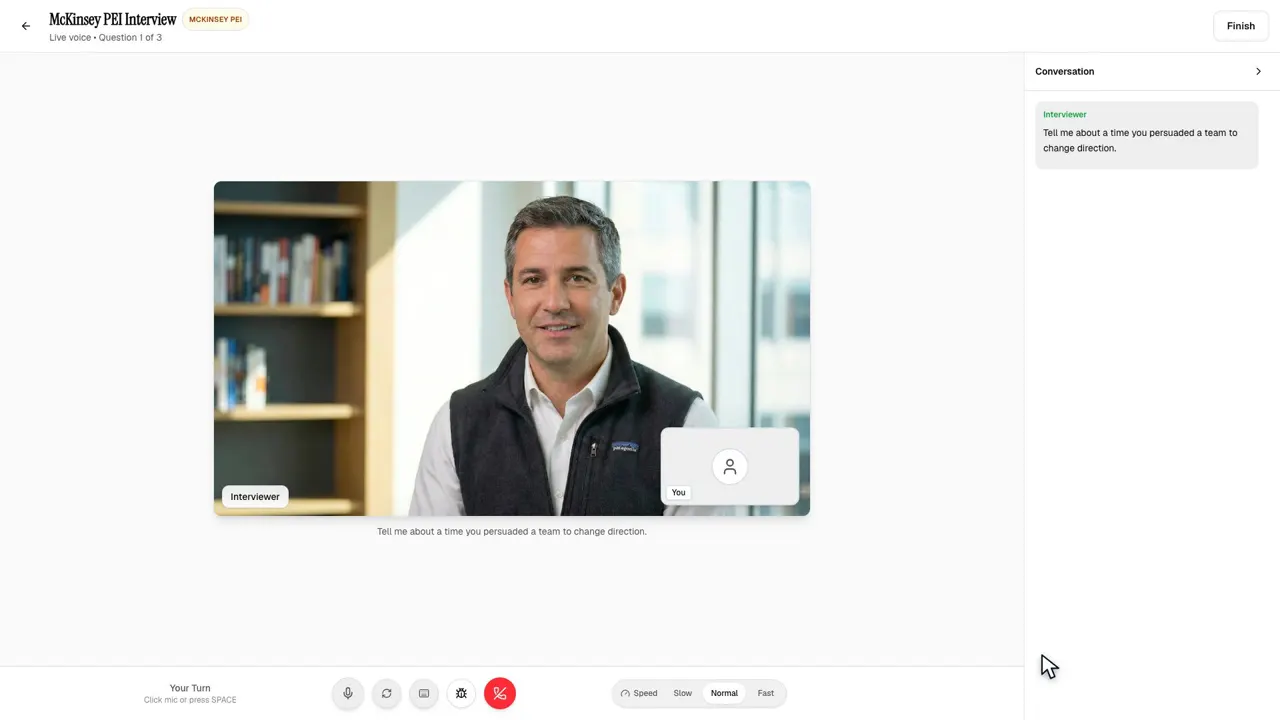


Pass the resume screen
West Monroe hires for aptitude, collaboration and skills. Show the tools you used and the results you got.
Opening resume uploader...
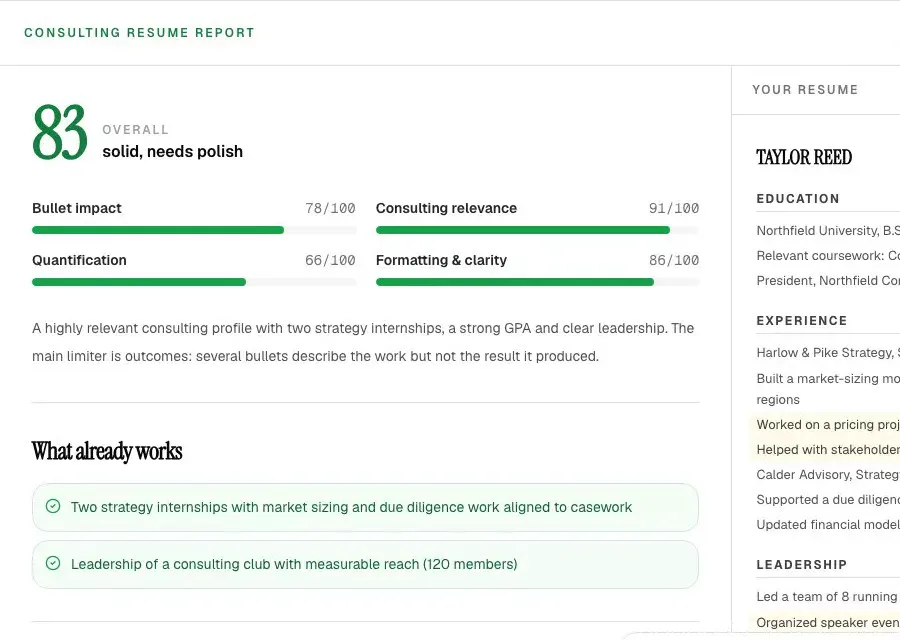
West Monroe says it hires for aptitude and potential, collaboration (questions about how you behaved in past situations) and skills and expertise, which can mean technology project experience, technical depth or business acumen. Interviews run virtually on Zoom or Teams, with one link for the whole loop while interviewers "cycle in and out", or in person, with travel booked by the firm. The firm recommends business professional dress for both formats, and says your recruiter follows up with next steps once the interview team has debriefed. On the timing of the West Monroe hiring process, candidates on Glassdoor report two days to three weeks between the video screen and the final-round invitation, and three to four weeks from application to decision. Your resume is the input to the skills interview, so every line on it needs a story behind it.
West Monroe-style practice cases at a glance
How a West Monroe case works: it is a 45-minute, story-driven case from a real project where you ask the interviewer, acting as the client, for what you need, and it tests how you think rather than industry knowledge.
Start free now: AuroraWater Bottling Margin Recovery is a McKinsey-style profitability case: a regional bottled-water producer's EBITDA fell from $65M to $45M despite modest revenue growth, and the CEO wants a plan to restore profitability within 12 months. It has 8 questions, 4 with math, 4 exhibits, and a median of 22 minutes across 19 completed voice runs. An AI interviewer runs it out loud, shows each exhibit when you reach it and scores the debrief. Your first full case is free when you create an account.
| Case (style, industry) | Quant difficulty | Qualitative difficulty | The math you run | Median time |
|---|---|---|---|---|
AuroraWater Bottling Margin Recovery (McKinsey, packaged beverages). 8 (4 with math), 4 exhibits. | medium | medium | Unit-cost savings, EBITDA bridge | 22 min, 19 voice runs |
MedSuite Technologies Hospital Software Pricing (McKinsey, hospital software). 8 (3 with math), 2 exhibits. | medium | medium | Revenue at each price point, tiered pricing | 20 min, 18 voice runs |
NorthStar Logistics Acquisition of RouteWave TMS (BCG, logistics software). 8 (2 with math), 4 exhibits. | medium | hard | EV/EBITDA multiple, maximum justified price | 20 min, 19 voice runs |
MetroFresh Distribution Center Operations Turnaround (McKinsey, grocery distribution). 8 (4 with math), 4 exhibits. | easy | hard | Picking capacity gap, EBITDA initiatives | 23 min, 17 voice runs |

All four are original practice cases written for Road to Offer. The library has no case in West Monroe's own style, so these are matched by case type to what West Monroe asks. None is West Monroe's own material. More are in the case library, 92 cases in all. Every debrief scores seven categories: structure (25% of the score), quantitative analysis (20%), business judgment (15%), and problem understanding, exhibit reading, communication and synthesis (10% each), with feedback on every question. Median times come from completed runs between June 25 and September 22, 2026, and count runs, not people.
What are the West Monroe HireVue questions?
Short behavioral questions, recorded on camera with no live interviewer, in the first round before the final round. The West Monroe video interview is a one-way, pre-recorded interview: you see each question on screen, record your answer, and reviewers watch it before deciding who advances. One candidate report on Wall Street Oasis describes two questions, two minutes per answer and two attempts at each; check the instructions on your own link, since the settings can differ.
Candidates on Glassdoor report questions such as:
- Walk me through your background. Why consulting, and why West Monroe?
- Tell me about a time a project did not go the way you expected.
- What skill of yours are you most proud of?
- Tell me about a conflict, a success or a failure on a team.
Keep each answer to the point: a short introduction, then one story per prompt with the result stated. West Monroe's own video interview advice applies here too: test your internet, camera and sound first, and dress as you would for an office interview.
What if your West Monroe video interview is on Spark Hire?
Prepare the same way. Searchers ask about West Monroe Spark Hire questions, but we found no West Monroe or candidate source that confirms the firm uses Spark Hire (checked November 3, 2026); the reports we read all name HireVue. Any one-way video tool works like this one: short timed answers to behavioral prompts, recorded without an interviewer. The HireVue interview guide covers timing and setup, and how to practice for HireVue shows how to rehearse on camera.

Get your West Monroe prep plan
What does the West Monroe final round interview look like?
Three back-to-back 45-minute interviews, case, behavioral and skills, each with a different interviewer, usually manager level or above. That is the most common description in Glassdoor reports; the 45-minute case length is confirmed by West Monroe's own case study guide. In a virtual final round you stay in one Zoom or Teams room while interviewers rotate, and you can ask for a break between sections.
Video screen
first round
- One-way recorded HireVue
- Mostly behavioral questions
Case
45 min
- A story-driven case from a real West Monroe project
- Tests how you think, not industry knowledge
Structure it around people, process, technology
Behavioral
45 min
- Teamwork, conflict, leadership, failure
- How you behaved in past situations
Skills
45 min
- A deep dive into the projects on your resume
- Tools, decisions and measurable results
Behavioral interview
West Monroe's interview page says interviewers ask about your past experiences and how you behaved in different scenarios. Prepare five to seven stories on teamwork, conflict, leadership and a failure, and make them hands-on: what you built, fixed or ran yourself. The firm's culture rewards people who do the work, so stories where you only delegated land worse than stories where you learned a tool or process and drove the result.
Skills interview
This is the interview with no MBB equivalent. Candidates describe an interviewer who picks items on your resume and asks what you did, which technology you used, what the measurable outcome was and what you would change. Technology-track candidates get questions on specific tools, platforms and implementation choices; industry-track candidates get questions on the business model and the client problems in that practice. You cannot improvise this one, so rehearse every resume line out loud before the day.
How does the West Monroe case interview work?
A 45-minute, story-driven case taken from a real West Monroe project, in which you play the consultant and ask the interviewer, acting as the client, for what you need. West Monroe's case study guide says it tests how you think rather than technical or industry knowledge, through three skills: critical thinking (gathering and processing information), problem solving (finding the solution with the most impact) and communication.
The firm's advice is concrete. Do not jump to the solution: read the case, ask specific questions and summarize the problem before you solve it. Organize your thinking with a flexible framework, and close with a short summary. Back every conclusion with reasoning you can defend under follow-up questions, not buzzwords. In a virtual interview whiteboarding is harder, so narrate your structure as you write it. If you have never run a case, learn the method first:
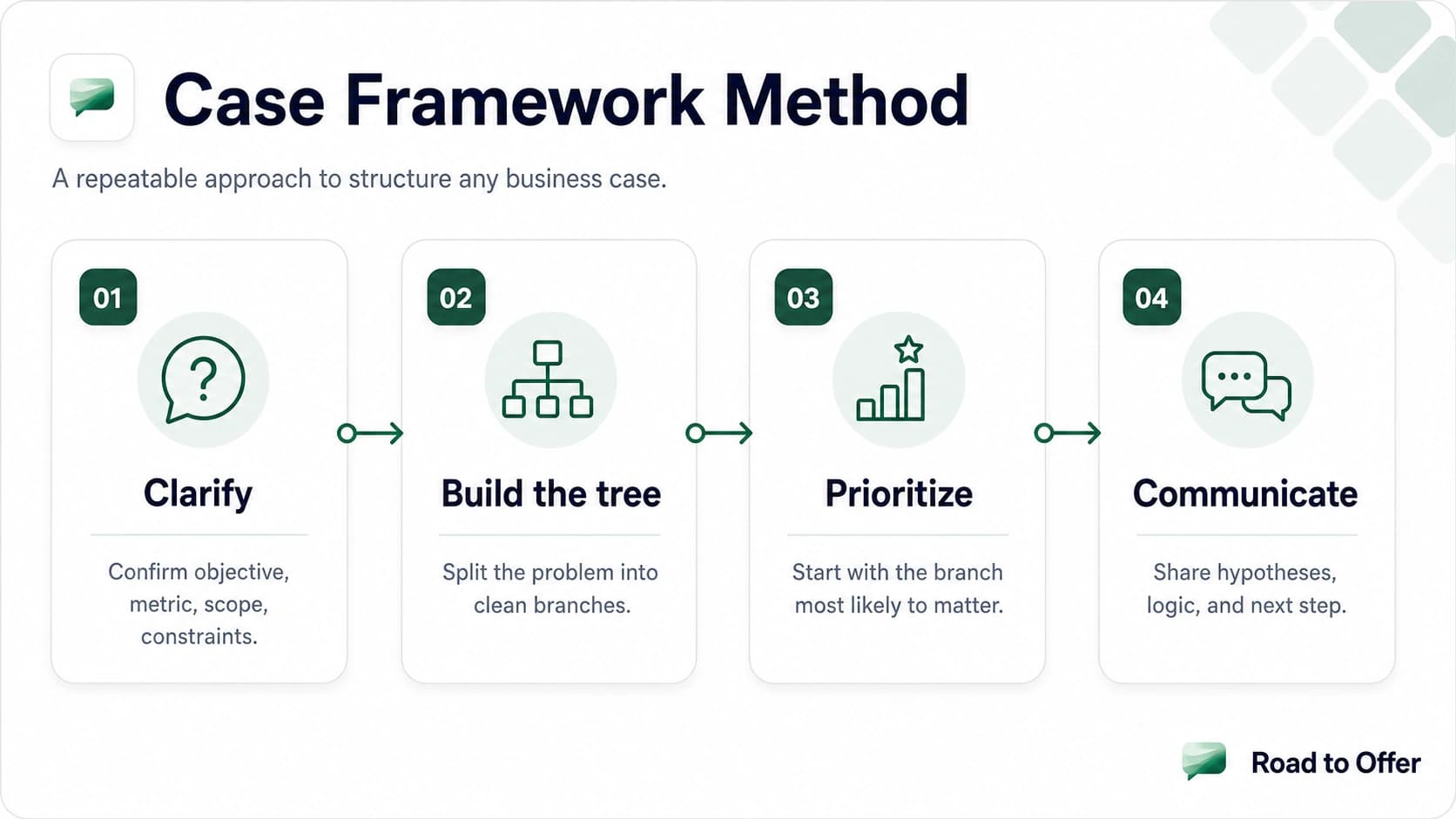
Learn the case method
One dense lesson, each step linked to the drill that trains it.
The people, process, technology framework
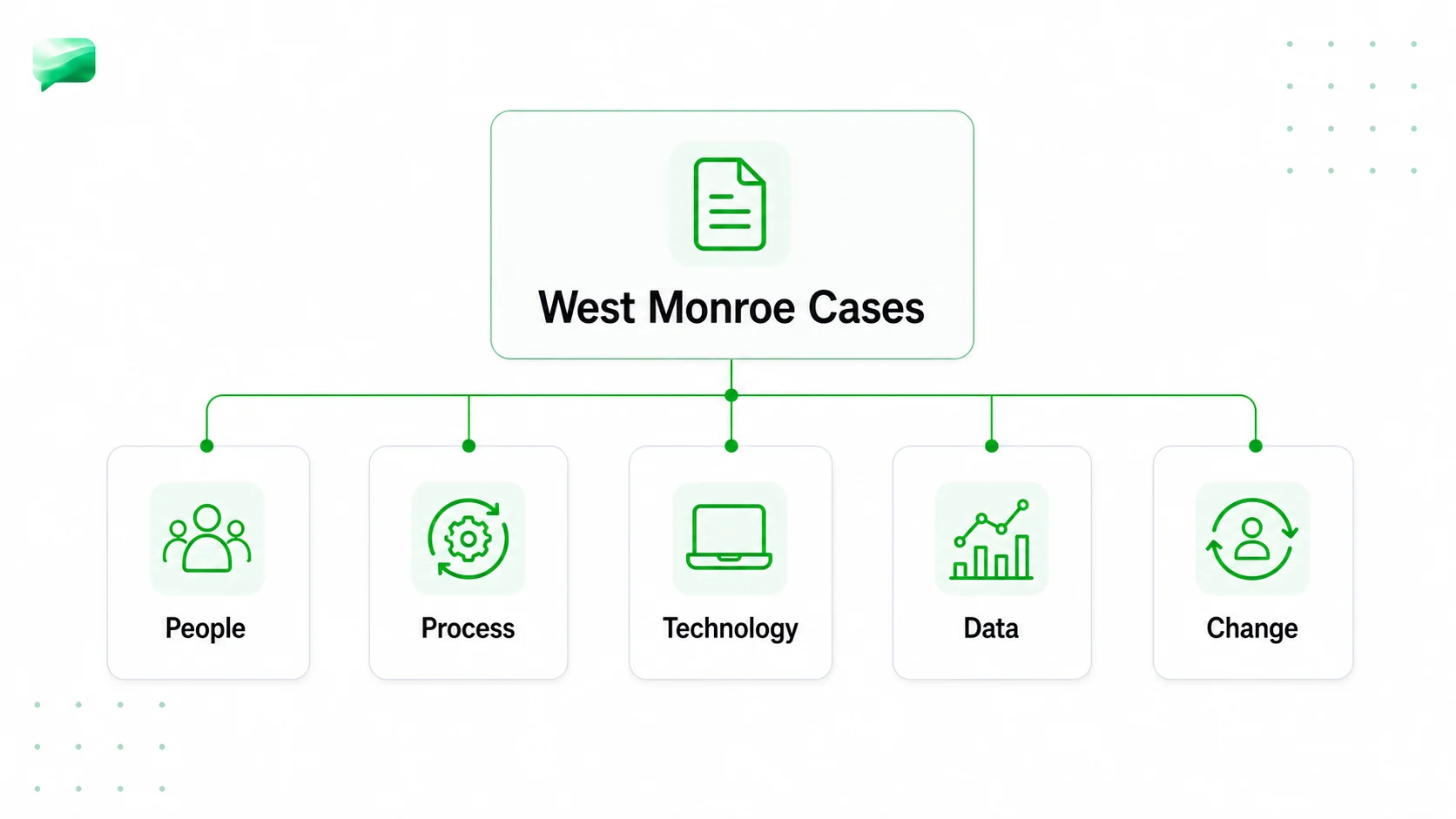
West Monroe's guide suggests a framework built around people, process and technology, used flexibly:
- People: who is affected, what capabilities are missing, and how the culture will take the change.
- Process: which workflows, structures, policies and lines of communication change, current state against future state.
- Technology: which digital tools serve the goal, and where integration, data and implementation risk sit.
Understand how the three interact, use them to organize your questions, and come back to them in the final summary. Interviewers notice when a candidate opens a clearly operational problem with a generic market, customers and competitors structure.
These are practice prompts built around West Monroe's service areas, not cases the firm has published.
Example: a West Monroe-style healthcare technology case

Prompt: "A regional health system with $2B in revenue is implementing a new electronic health records (EHR) platform across 12 hospitals. Go-live is in 9 months and the project is 12 weeks (about 3 months) behind schedule. The CEO wants it back on track. How would you approach this?"
A strong opening, people, process, technology:
"I'd like to look at three areas. On people: who owns the project, how is it governed, and is there a change program for the 8,000 clinical staff who will use the system? On process: which critical-path activities are causing the delay, data migration, workflow redesign or vendor delivery? On technology: where does integration with legacy systems stand, and are there unresolved technical dependencies? I'd start by finding which of these drives most of the 12-week delay."
The answer uses the people, process, technology lens, stays specific to an EHR rollout, and scopes the problem before proposing fixes.
The data, then the decision. Suppose the interviewer answers your scoping question with this: the 12-week delay is 8 weeks of data migration, slowed by duplicate patient records in two legacy systems, then 4 weeks waiting for 3 of the 12 hospitals to sign off their clinical workflows. The steps run in sequence, so both sit on the critical path. The plan still holds 2 weeks of contingency, and an outside data team could clear the duplicates in 2 weeks instead of 8 for $1.2M.
"I'd recommend approving the $1.2M data team and going live on the original date with the 9 hospitals that have signed off, then bringing the other 3 live in a second wave once their workflows are approved. The catch is that this uses all of the contingency, so I'd set a go or no-go checkpoint when the data cleanup ends: if it slips by even a week, we move the date rather than go live on dirty patient records."
That close names the option, shows the math that makes it work, and states the risk and the trigger that would change the decision: the shape of a complete answer to an implementation case. The prompt and all its numbers are our illustration, not a case West Monroe has published.
Now run a case out loud the way West Monroe expects, as a dialogue where you ask the client for what you need:

Start a free case interview for West Monroe
Don't know how to case yet? Learn how to case
What are common West Monroe interview questions?
Expect behavioral questions on teamwork and setbacks, a why-West Monroe question, and resume deep-dive questions in the skills interview. These are the themes candidates report on Glassdoor:
For a bank of fit answers, read behavioral interview consulting. Your why-West Monroe answer should name a practice and a type of engagement, not "strategy plus technology", which every applicant says.
How do you answer "Why West Monroe?"
Tie one fact about the firm to one experience of yours. Facts you can use, from West Monroe's own pages (checked November 4, 2026): the firm became employee-owned through an employee stock ownership plan at the end of 2012, according to its press release; its five values are Be Human, Build It Better Together, Deliver Impact, Fuel Growth and Make Work Fun; and its interview page says it wants people who advise executives and also roll up their sleeves to execute. Pick the one that matches a story you can tell, such as a project where you built and delivered the fix yourself.
How is the West Monroe interview different from MBB?
West Monroe cases are more practical and implementation-focused, and its skills interview has no equivalent at McKinsey, BCG or Bain.
Candidates who prepare only for the case and walk into the skills interview without rehearsing their resume in depth are the ones most often surprised.
How should you prepare for a West Monroe interview?
Three weeks covers it: one on your resume and stories, one on cases, one on full final-round rehearsals.
Execution checklist
Rehearse every line of your resume: what you did, the tools, the result, what you would change. The skills interview is a deep dive into exactly those items
Prepare 5 to 7 hands-on behavioral stories on teamwork, conflict, leadership and failure. The video screen and the behavioral interview both draw on them
Record two practice HireVue answers and watch them back. A one-way video rewards short, structured answers with no live interviewer to rescue you
Practice the people, process, technology framework on 3 operational cases. West Monroe's own case guide suggests it, used flexibly
Run one full case out loud as a dialogue, asking the interviewer for data. The case is story-driven; candidates who present a framework without back-and-forth miss the format
Research the practice you are targeting and write a specific why-West Monroe answer. Generic answers signal low interest in a firm that sells its distinct delivery model
For the case reps, the digital transformation case interview and technology case interview guides cover the prompts West Monroe-style cases use. For a first operational rep, try TravelLine, a customer service centralization where people, process and systems all broke at once. It is original practice, not West Monroe material:

Practice an operations case for West Monroe
TravelHard
What mistakes cost candidates a West Monroe offer?
Generic MBB frameworks on operational cases, an unrehearsed skills interview, and a vague why-West Monroe answer.
- Using a market-entry structure on an implementation case. Opening an ERP rollout with "market, customers and competitors" signals you missed the problem.
- Underestimating the skills interview. It is not a second behavioral round; it tests what you actually did.
- Being too academic. West Monroe hires practitioners. Stories about delegating the technical work are weaker than stories about learning it and delivering.
- Not knowing why West Monroe. Research its practices and how it differs from Accenture or Deloitte on delivery.
Turn this guide into a West Monroe plan
Related Guides
- Digital Transformation Case Interview: the strategy-to-implementation lens West Monroe cases often require
- Technology Case Interview: systems, data and implementation prompts
- Case Interview Frameworks Complete Guide: the core structures West Monroe cases draw from
- HireVue Interview Guide: how one-way video interviews are set up and reviewed
- Accenture Case Interview Guide: the largest digital and technology consulting peer
- Guidehouse Case Interview Guide: another US digital and operations advisory firm
- West Monroe Practice Cases: nine cases to run next, with a worked post-merger synergy excerpt
Three ways to practice for West Monroe
- Start a free case
Run a full case. 92 cases in voice or guided text, scored on seven dimensions.
- Try a free drill
Drill one skill. 550+ drills across 6 skill types.
- Find your test
Practice your firm's test. Solve, Casey, CCA, SOVA and TestGorilla, each free to try.



Sources
- West Monroe: Interview process (virtual or in-person format, business professional dress, breaks, what the firm hires for, recruiter follow-up; checked November 4, 2026)
- West Monroe: How to ace your case study interview (45-minute story-driven case from a real project, skills tested, people, process and technology framework, tips; checked November 3, 2026)
- Glassdoor: West Monroe interview questions (candidate reports of the HireVue screen, three 45-minute final-round interviews, questions and timing; checked November 3, 2026)
- West Monroe: Values (the five core values; checked November 4, 2026)
- West Monroe: ESOP press release (employee ownership from December 31, 2012; checked November 4, 2026)
- Dataford: West Monroe interview guide (difficulty mix across 415 candidate reports; read November 4, 2026)
- Wall Street Oasis: West Monroe Partners interview reviews (HireVue question count and timing, one candidate report)
- Wikipedia: West Monroe (founding year and headquarters)
Frequently asked questions
Resources and related guides
- Practice for West Monroe in a real case interviewPractice
- Browse all free resourcesResource hub
- Alvarez and Marsal Careers 2026: Restructuring Salary and Interview GuideFirm Specific · Sep 11, 2026
- Analysis Group Interview 2026: Process, Questions, Case PrepFirm Specific · Mar 25, 2026
- Arthur D. Little Interview 2026: Case, Rounds, vs McKinseyFirm Specific · Mar 31, 2026
- IBM Consulting Case Interview Guide: iX vs Strategy, 3-Round Process, and Prep Plan (2026)Firm Specific · Mar 31, 2026