
HireVue Interview for Consulting (2026): Format, Questions & Practice
What a HireVue interview for consulting really is in 2026: the format and timings, how it scores you (no more facial analysis), MBB vs Big 4 differences, and copy-paste STAR answers sized to the 1 to 3 minute window.
On this page
A HireVue interview for consulting in 2026 is a one-way, recorded video or text assessment you complete alone, before any human at McKinsey, BCG, Bain, or a Big 4 firm sees you. According to Extern, the format runs 20 to 30 minutes with 3 to 5 pre-recorded questions, roughly 30 seconds to prepare and up to 3 minutes to record each answer, and about 60 to 70 percent of those questions are behavioral. CaseBasix reports a slightly wider range, 5 to 8 questions with 1 to 3 minutes per response and often one retry per question, so your invitation email is the real source of truth. The biggest myth to drop: as of 2026, HireVue no longer analyzes your face or body language. Extern confirms it now scores word choice and clarity, delivery and tone, and STAR structure, with human reviewers making the final call.
What a HireVue interview is, and where it sits in the funnel
HireVue is the platform many firms use for the first automated screen of the recruiting funnel. You receive a link, you record answers to prompts on your own schedule inside a deadline window, and the software processes your responses before a recruiter ever opens your file. It sits early: application, then HireVue or a similar one-way video screen, then live case and fit rounds, then final rounds.
For consulting specifically, that placement matters. The HireVue is a gate, not the finish line. CaseBasix names McKinsey, BCG, Bain, and the Big 4 among the firms that use it, and Extern lists Bain, BCG, and Deloitte alongside finance and tech names like JPMorgan, Goldman Sachs, Citi, IBM, Capital One, Microsoft, and Amazon. If you clear it, you move into the live rounds that actually decide the offer. This is closer to a structured phone or video screen than to a full case interview, so the goal is simple: be clear, be structured, and do not give a reviewer a reason to cut you.
Practise a timed video answer
- 4 timed questions with transcripts
- Structured feedback on every answer
- Employer-specific practice packs
The format, demystified: timings and retries
The format is more knowable than the nerves suggest. Here is what the sources actually report, side by side, so you can prepare for the real thing rather than a rumor.
The single most important habit: do not run over the timer. A strong answer that gets cut off at the buzzer reads worse than a tight answer that finishes with a few seconds to spare. Extern suggests keeping a self-introduction to roughly 60 to 90 seconds, which is a useful default length for most behavioral answers too.
How HireVue actually scores you in 2026
This is where most competing guides are out of date, and where you can quietly out-prepare other candidates. The 2026 reality, per Extern, is that HireVue's AI transcribes your answer and then evaluates three things: word choice and clarity, delivery and tone, and STAR structure (keywords, phrasing, pacing, and organization). It explicitly does not perform facial analysis. Coursera describes the same mechanism from the platform's general use: HireVue transcribes answers and analyzes speech, tone, and pronunciation, and notes that 88 percent of companies already use some form of AI during screening.
That is a meaningful correction. MyConsultingCoach still describes the AI as analyzing word choice, tone, facial expressions, and response structure, which reflects how the tool used to be discussed. The current guidance from Extern is clear that facial and body-language scoring is no longer part of it. Both sources agree on the part that has not changed: human reviewers make the final decision. So the takeaway is to stop worrying about micro-expressions and over-managing eye contact, and to pour your energy into a transcript-friendly answer: plain, confident word choice, a steady pace with no rambling, and an obvious STAR shape the transcription can recognize.
The consulting question mix: behavioral, fit, and the occasional game
For consulting, the weighting leans hard toward behavioral and fit. Extern reports that roughly 60 to 70 percent of HireVue questions are behavioral, covering the familiar territory: teamwork, leadership, handling conflict, and dealing with failure. The remaining questions tend to be classic fit prompts (why consulting, why this firm, strengths and weaknesses) plus the occasional situational or judgment question.
Some firms also layer in a game-based or cognitive component, or a short firm mini-case with a chart or scenario to interpret. These are less common in the pure one-way video screen and more common where the firm bundles HireVue with an aptitude or simulation step. Do not over-prepare for an exotic game at the expense of the behavioral core. The behavioral and fit answers are where most candidates pass or fail, so that is where your reps should go.
Sample consulting HireVue questions with model STAR answers
Below are common prompts paired with a model answer skeleton sized to the recording window. Treat these as templates to fill with your own stories, not scripts to memorize, because memorized answers read as stiff and the transcript analysis rewards natural, specific language.
A STAR template sized to the 1 to 3 minute window
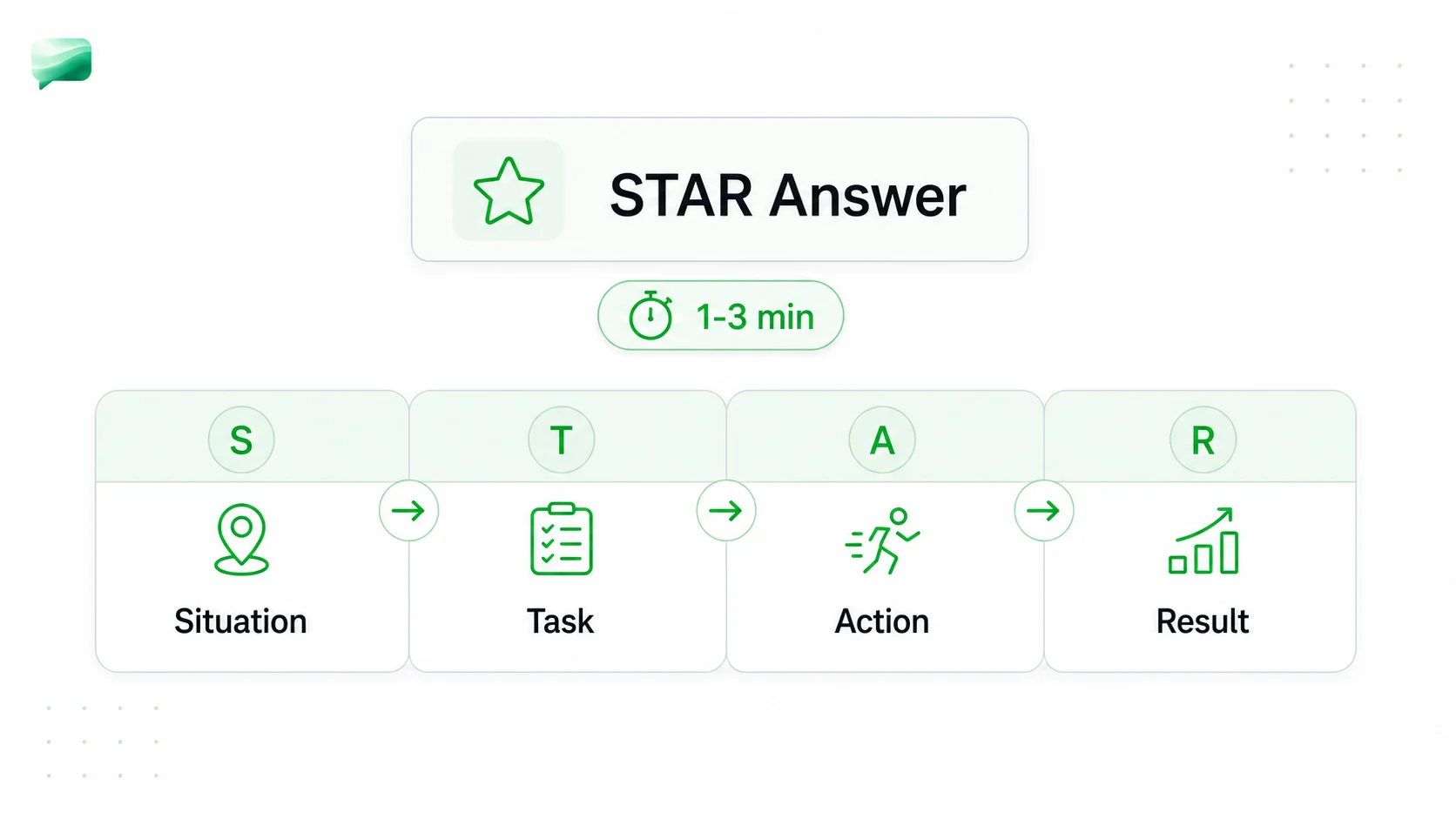
The format punishes rambling, so your structure has to be ruthless. Extern's guidance maps cleanly onto the recording window: spend only 1 to 2 sentences on the Situation, give about 70 percent of the answer to the Action, and finish with a quantified Result. That ratio is the whole game. Most candidates burn 45 seconds on backstory and then rush the part the firm actually wants, which is what you did and what changed because of it.
A reliable shape for a 90-second answer:
- Situation, 10 to 15 seconds. One or two sentences. Just enough context to make the stakes clear.
- Action, 50 to 60 seconds. The bulk. Use "I" not "we" so your contribution is unmistakable, and signpost two or three distinct moves.
- Result, 15 to 20 seconds. End on a number or a clearly better outcome. No trailing off.
Drill this structure until it is automatic, because in the 30-second prep window you will not have time to design it from scratch. You will only have time to slot a story into a shape you already know.
How to practice for HireVue
HireVue offers candidates a practice interview from the invitation email, and it is worth running once to learn the interface mechanics. What it does not do is score your answer, and Road to Offer does not simulate the HireVue interface either. What you can rehearse is the thing the screen actually scores: a structured spoken answer delivered inside a timer. The loop that works:
- Pick one sample prompt above and set a 30-second prep timer, then a 2-minute answer timer, matching the real window.
- Record a timed practice answer with HireVue Practice, then review the feedback before your real interview.
- Record yourself separately on your own camera for the parts an AI session cannot check: framing, lighting, and eye contact near the lens.
- Rerun the same prompt once, tightening the Action and landing the Result on a number. One clean rerun beats five new prompts.
Two or three of these loops per day for a week cover the whole consulting question mix. Keep your notes to a structure skeleton, never a script, because recited answers lose the natural word choice the scoring rewards.
Firm-specific twists: MBB vs Big 4
The platform is the same, but what firms emphasize differs, and a consulting-specific answer beats a generic one.
MBB (McKinsey, BCG, Bain). Expect the behavioral and fit questions to probe leadership, drive, and structured thinking, mapped to each firm's values. BCG in particular pairs its one-way video screen with the wider digital assessment ecosystem; if you are recruiting there, read the dedicated BCG one-way video interview guide for the firm-specific scoring and question patterns. Across MBB, tie your stories to the qualities each firm publishes (impact, leadership, problem solving) rather than reusing one generic answer for all three.
Big 4 (Deloitte, PwC, EY, KPMG). The HireVue or one-way video screen often sits inside a broader assessment battery that can include aptitude or game-based steps. If you are in a Big 4 process, treat the video as one stage among several and map your answers to that firm's published behaviors. For PwC specifically, the PwC assessment test guide breaks down how the video interview fits alongside the work-styles and aptitude components. Extern names Bain, BCG, and Deloitte among the firms using HireVue, which is a useful reminder that the same platform shows up across both tiers.
Whichever firm you face, the mechanics of a good answer stay identical. The difference is the values you map your stories to and how specific your why-this-firm answer is.
Technical setup and on-camera delivery
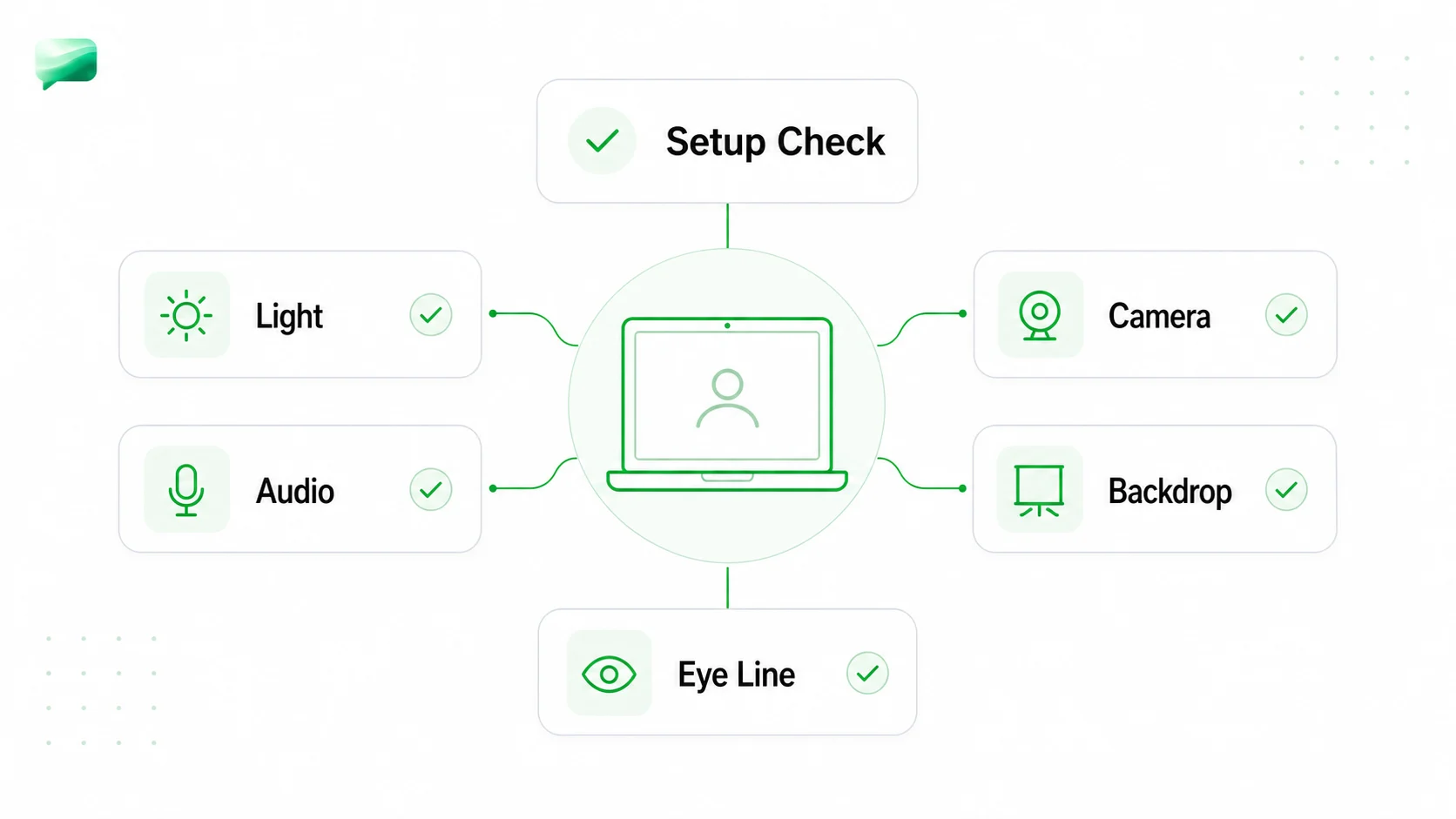
Because HireVue no longer scores your face, the goal of your setup is not to look telegenic. It is to be clearly heard and to remove anything that distracts a human reviewer. The fixes are simple and cheap:
- Camera at eye level. Stack books under a laptop so the lens meets your eyes. Looking down at a low camera reads as low energy.
- Look at the lens, not the screen. To create the impression of eye contact, talk to the camera dot, not to your own video preview. Glancing at yourself is the most common tell.
- Front-facing light. Put a lamp or window in front of you, not behind. Backlighting turns you into a silhouette.
- Quiet, neutral background. A plain wall and a closed door. No music, no traffic, no roommates.
- Kill the filler and the monotone. Since the AI scores delivery, tone, and pacing, the two habits that hurt most are "um" filler and a flat monotone. Slow down slightly, leave small pauses instead of filler, and let your voice carry a little energy.
Common mistakes and red flags
These are the patterns that get candidates filtered, drawn from how the scoring actually works:
- Sounding memorized. A recited answer kills the natural word choice the transcript analysis rewards. Know your structure, not your script.
- Running over the timer. A cut-off answer signals poor time management. Finish with a few seconds to spare.
- Rambling with no structure. Without a clear STAR shape, neither the AI nor the human reviewer can follow you. Signpost the situation, the action, and the result.
- No quantified result. "It went well" is not a result. Land on a number or a concrete, better outcome.
- Poor framing and lighting. It will not get you scored down by an algorithm, but it gives the human reviewer an easy reason to lose confidence.
The throughline of every fix on this page is the same: a clear, structured, specific answer delivered at a steady pace is what passes a HireVue screen in 2026. You can build that with reps. Record yourself answering the sample prompts above to a real timer, watch the playback, and tighten the structure until your Action carries the answer and your Result lands on a number.
Try a full timed mock
Sign up to HireVue Practice for a free timed mock with scored feedback. No card needed.
Sources (checked June 26, 2026)
- CaseBasix, HireVue interview guide: https://www.casebasix.com/pages/hirevue-interview-guide
- MyConsultingCoach, HireVue interviews: https://www.myconsultingcoach.com/hirevue-interviews
- Extern, HireVue interview questions and free AI mock tool: https://www.extern.com/post/hirevue-interview-questions-2025-free-ai-mock-tool
- Coursera, HireVue interview questions: https://www.coursera.org/articles/hirevue-interview-questions
Ready for the recording?
- 4 timed questions with transcripts
- Structured feedback on every answer
- Employer-specific practice packs
Frequently asked questions
Resources and related guides
- Common HireVue Questions and Answers (2026): 18 Prompts With STAR SkeletonsFundamentals · Sep 11, 2026
- Does HireVue Track Your Eyes? What It Evaluates in 2026Fundamentals · Aug 21, 2026
- How to Practice HireVue in 2026: 7-Day Plan and Best Practice ToolFundamentals · Sep 11, 2026
- SHL Test for Consulting 2026: Sections, Scoring & How to PassFundamentals · Jun 27, 2026