
How to Practice HireVue in 2026: 7-Day Plan and Best Practice Tool
How to practice HireVue interviews in 2026: the exact timings to rehearse, a 7-day rep plan, free practice options honestly compared, and the best HireVue practice tool for timed scored mocks.
On this page
A HireVue interview gives you about 30 seconds to prepare and 90 seconds to 3 minutes to answer each of 3 to 5 questions, and roughly 60 to 70 percent of those questions are behavioral. So practicing means one thing: timed recorded reps of STAR answers, reviewed, rerun once, repeated daily for about a week. This page gives you the exact loop, an honest comparison of practice tools, and a free timed mock to run it on.
New to the format itself? Read the HireVue interview guide for consulting first for the full breakdown of timings, scoring, and sample questions, then come back here to drill.
What does one HireVue practice rep need to copy?
A rep only transfers if it reproduces the pressure. Here is the window to rehearse against, drawn from candidate-reported formats:
For the consulting variant of these numbers, including MBB versus Big 4 differences, see the consulting HireVue guide. For banking timings and bank-by-bank format notes, use the investment banking HireVue questions guide.
Run your first timed mock now
- 4 timed questions with transcripts
- Structured feedback on every answer
- Employer-specific practice packs
Your 7-day HireVue practice plan
Fifteen to twenty timed reps across 7 days, about 15 minutes a day. Each day has one job. Do the day's job, then stop; cramming extra reps with tired delivery teaches tired delivery.
Day 1: build the story bank (20 minutes, no camera). Write five STAR skeletons, built with the STAR template in the HireVue interview guide: team delivery, leadership, conflict, failure, feedback. One Situation line, three Action bullets starting with "I", one Result with a number each. No full sentences. Skeletons you can paraphrase beat scripts you must recite.
Day 2: learn the timer (15 minutes, camera on). Take two prompts. For each: 30 seconds prep, 2 minutes recorded, then review once against three checks (obvious STAR shape, about 70 percent of the time on Action, Result landed on a number). Expect both takes to run long. That gap is the whole point of the week.
Day 3: first full mock (20 minutes). Run 4 questions back to back with no reruns: two behavioral, one motivation, one markets or situational. Do it inside a scored mock, not your camera roll: you need the timer enforced and the transcript judged. Our HireVue Practice mock is free and built for exactly this set. Score each take pass or fail on finishing inside the timer with a numbered Result. Most candidates fail two of four. That is normal and exactly what days 4 and 5 fix.
Run day 3 as a scored mock
Free timed mock with transcripts and structured feedback. No card needed.
Day 4: rerun day (15 minutes). Take only the failed prompts from day 3. Record each twice, fixing only the weakest check per rerun, and say every rerun out loud rather than rehearsing in your head. One clean rerun beats five new prompts: reruns build the structure habit the scoring actually reads.
Day 5: employer day (20 minutes). Switch to your invite's firm. Pull its reported questions from our firm guides (BlackRock, Goldman Sachs, JPMorgan, Morgan Stanley, Bank of America) and run a full set in that employer's mix. Best version: run it as that employer's pack inside HireVue Practice, so your reps use the firm's real question mix instead of generic prompts. Add the why-this-firm answer; generic motivation fails firm screens first.
Practice your employer's real mix
Employer-specific packs plus a free timed mock. No card needed.
Day 6: delivery day (15 minutes, no new content). One recorded session checking only framing, lighting, eye line, pace, and filler words. Fix the room, not the answers. Slightly slower than feels natural, eyes on the lens, one pause instead of each "um".
Day 7: dress rehearsal (20 minutes). One full set, single takes, dressed as test day, on the machine and network you will use. If the structure holds here, it holds in the invite link. Then stop. No same-day cramming; tired delivery is the only thing left that can fail you.
What is the best HireVue practice tool in 2026?
The honest answer depends on which half of the skill you are training. No single option covers everything, so here is the tradeoff stated plainly:
Two honest notes. First, every third-party AI score is an estimate, including ours: no practice tool sees the employer's real rubric, so treat scores as structure feedback, not predictions. Second, tools that claim official HireVue affiliation without it have drawn the vendor's legal attention before, so check any tool's about page before trusting it with your data. The combination that passes screens: one vendor run for mechanics, daily timed mocks with feedback for structure, and one self-recorded session for framing and lighting. If you only add one tool beyond your own camera, make it the timed scored mock, because structure under time pressure is what gets filtered.
Can you practice on HireVue itself?
Yes, once. HireVue offers candidates a practice interview from the invitation email. Do it for exactly what it is: a rehearsal of clicking, framing, and submitting inside their interface. The practice prompts are not your real questions and nothing is scored, so one session closes that gap completely. Every rep after that belongs in a scored, timed environment.
How do you size a STAR answer to the timer?
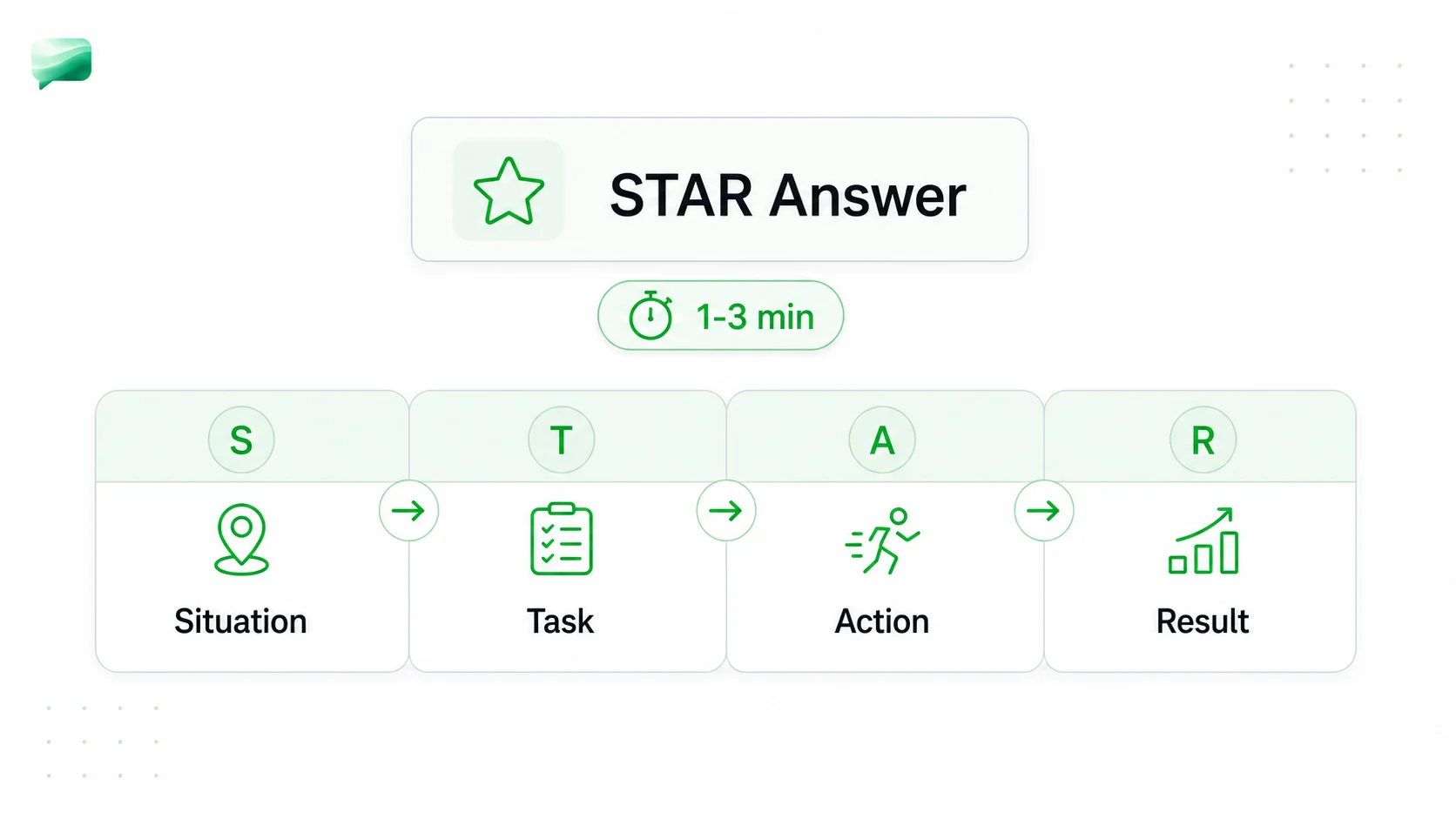
The ratio that fits a 90-second answer:
- Situation, 10 to 15 seconds. One or two sentences. Stakes only, no backstory.
- Action, 50 to 60 seconds. The bulk. Use "I" so your contribution is unmistakable, and signpost two or three distinct moves.
- Result, 15 to 20 seconds. End on a number or a clearly better outcome. No trailing off.
Drill this shape until it is automatic, because the 30-second prep window only leaves time to slot a story into a shape you already own. Reading skeletons silently does not transfer to camera; the shape only sticks once you have said it out loud under time. Do those spoken reps on Interview Practice, which is built for exactly this: say the answer out loud before they ask. The same stories carry into RTO's behavioral practice for consulting screens.
Say your STAR answers out loud
Voice reps for behavioral answers, free to start.
Which questions should you rehearse?
Five stories cover nearly every set. Write one STAR skeleton per story (Situation line, three Action bullets, Result number), never a script:
- A time you delivered inside a difficult team (the highest-yield story across consulting and banking screens)
- A time you led something without formal authority
- A conflict you resolved with a specific person
- A failure and what you changed afterward
- Why this firm, naming its actual work and connecting one concrete thing you have done
Memorized answers read as stiff and the transcript analysis rewards natural, specific language, so rehearse from the skeleton and let the wording come out fresh each take. For worked consulting examples of each shape, use the consulting HireVue guide. For markets and deal stories that banking screens add, use the investment banking HireVue questions guide and keep one deal plus one macro story under 60 seconds each.
How do you practice for your specific employer?
The platform is identical everywhere. The questions tilt by employer, so aim your last week of reps at the firm on your invite:
- Consulting (MBB and Big 4): behavioral and fit dominate, mapped to each firm's published values. Start from the consulting HireVue guide, then go firm-specific with the BCG one-way video interview guide or the PwC assessment test guide for battery-style processes.
- Banking (bulge bracket): add markets awareness and light technicals to the behavioral core. The investment banking HireVue questions guide carries the bank-by-bank format notes, and firm pages such as the JPMorgan HireVue guide, the Goldman Sachs HireVue guide, and the Morgan Stanley HireVue guide pin down each screen's emphasis.
- Any other employer: HireVue Practice publishes employer-specific practice packs (banks, Big 4, corporates) so your reps use that employer's real question mix instead of generic prompts.
Practice your employer's real question mix
Sign up to HireVue Practice for a free timed mock with scored feedback. No card needed.
How do you ace your HireVue in the last 48 hours?
Acing is mostly not adding. It is removing failure modes, in this order:
- Kill the overrun. Do one timed set and cut every answer that crosses the limit. The timer filters before quality does, so a complete 80-second answer beats a brilliant one cut at 90.
- Fix the weakest story, not all stories. Pick your lowest-scoring take from the week and rerun that prompt three times. One repaired answer raises a set more than five maintained ones.
- Lock the why-this-firm answer. Recite it once from the skeleton, firm-specific, under 60 seconds. Generic motivation is the most common last-minute failure on banking screens.
- Run the setup checklist once. Camera at eye level, front light, quiet room, invite link opened, ID nearby if required, 20 quiet minutes blocked. Test-day logistics cause more failures than content gaps at this stage.
- Stop 12 hours out. No new prompts the night before. Sleep beats reps now; tired delivery reads as weak structure on camera.
How do you know practice is working?
Score yourself on the same three checks after every rep. You are ready when all three hold for a full 5-question set:
- Finish with seconds to spare. No take runs over. Ever. The timer is the first filter.
- Every Result lands on a number. Revenue, time saved, people served, rank achieved. "It went well" is a failed rep.
- Zero filler crutches. No "um" chains, no restarts, no trailing sentences. Small pauses instead of filler.
One extra check for test day realism: do your last two sets in one take each, no reruns, dressed as you will be, on the machine and network you will use. If the structure holds there, it holds in the invite link.
Practice like test day, not like homework
Because HireVue no longer scores faces, your setup work has one audience: the human reviewer. One session covers it, and the consulting HireVue guide carries the full checklist. The short version: camera at eye level, eyes on the lens, front-facing light, plain quiet room, and a slightly slower pace than feels natural. Then forget the mirror and spend every remaining session on structure. For phone and live video screens beyond HireVue, the phone and video case interview guide extends the same delivery habits, and if anyone told you the camera tracks your eyes, read does HireVue track your eyes before worrying for another minute.
Start your 7-day plan with a free mock
Sign up to HireVue Practice for a free timed mock with scored feedback. No card needed.
Sources (checked September 11, 2026)
- Extern, HireVue practice guide with free AI mock tool (2026 format numbers, scoring dimensions, company list): https://www.extern.com/post/hirevue-interview-questions-2025-free-ai-mock-tool
- HireVue, Industry leadership: new audit results and decision on visual analysis (January 12, 2021, visual analysis removed): https://www.hirevue.com/blog/hiring/industry-leadership-new-audit-results-and-decision-on-visual-analysis
- HireVue Practice, homepage (four-question timed mock with transcripts and feedback, employer-specific packs): https://hirevuepractice.com/
Ready for the recording?
- 4 timed questions with transcripts
- Structured feedback on every answer
- Employer-specific practice packs